engine TOYOTA SEQUOIA 2009 2.G Workshop Manual
[x] Cancel search | Manufacturer: TOYOTA, Model Year: 2009, Model line: SEQUOIA, Model: TOYOTA SEQUOIA 2009 2.GPages: 612
Page 180 of 612
180
2-3. Operating the lights and wipers
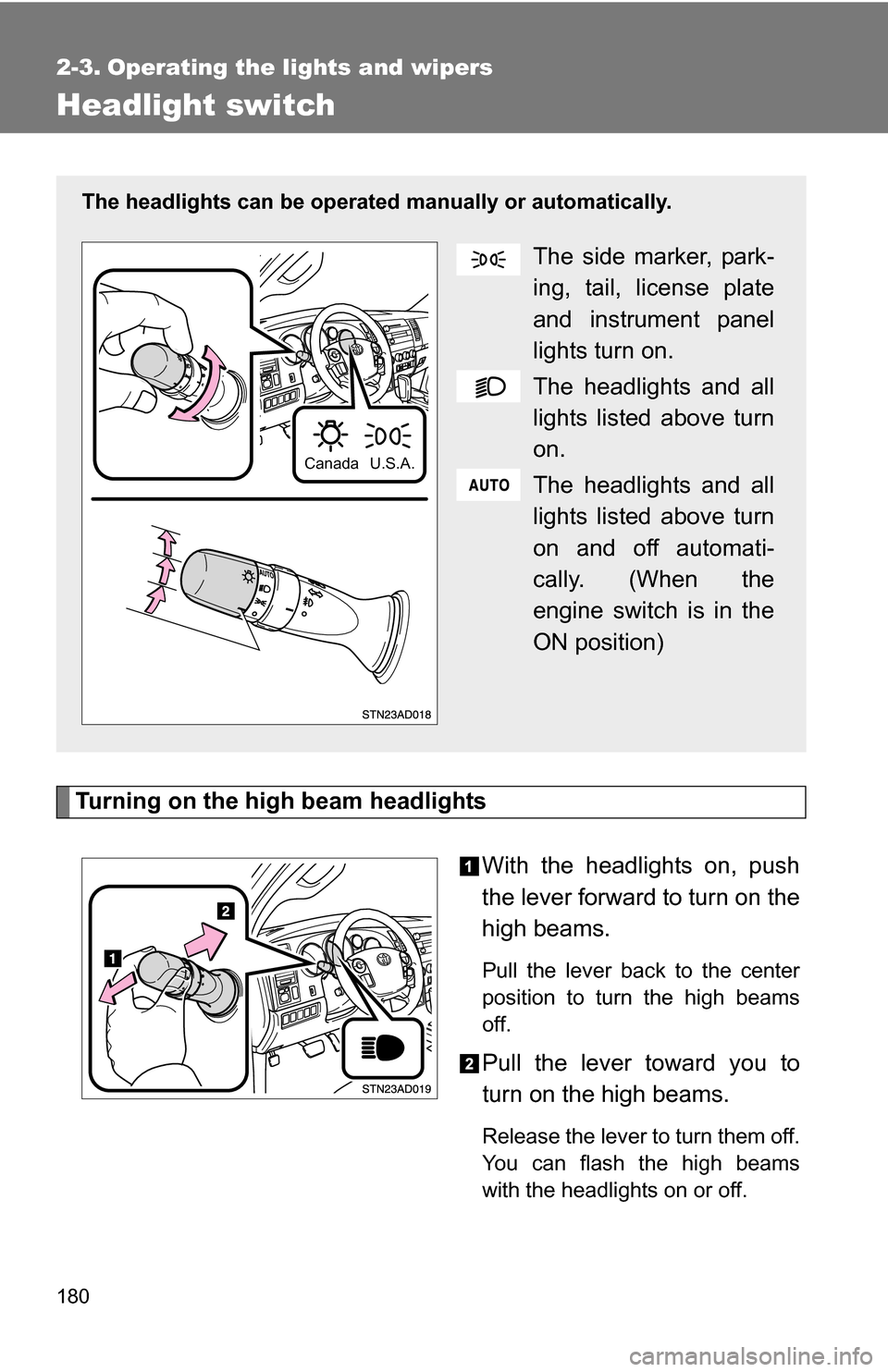
Headlight switch
Turning on the high beam headlightsWith the headlights on, push
the lever forward to turn on the
high beams.
Pull the lever back to the center
position to turn the high beams
off.
Pull the lever toward you to
turn on the high beams.
Release the lever to turn them off.
You can flash the high beams
with the headlights on or off.
The headlights can be operated manually or automatically.
The side marker, park-
ing, tail, license plate
and instrument panel
lights turn on.
The headlights and all
lights listed above turn
on.
The headlights and all
lights listed above turn
on and off automati-
cally. (When the
engine switch is in the
ON position)
Canada U.S.A.
Page 181 of 612
181
2-3. Operating the lights and wipers
2
When driving
■
Daytime running light system (if equipped)
To make your vehicle more visible to other drivers, the front turn signal lights
turn on automatically whenever the engine is started and the parking brake
is released. Daytime running lights are not designed for use at night.
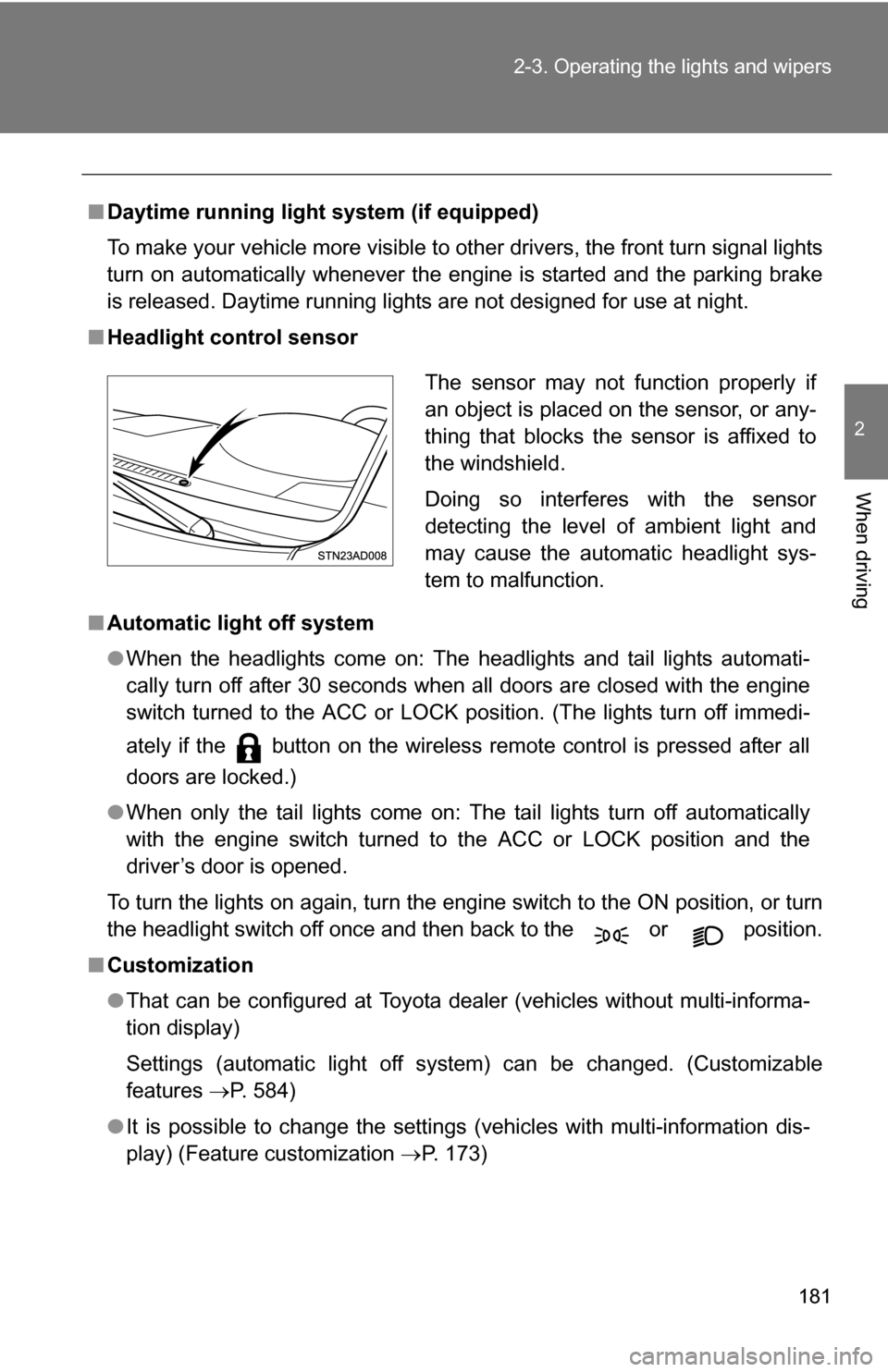
■ Headlight control sensor
■ Automatic light off system
●When the headlights come on: The headlights and tail lights automati-
cally turn off after 30 seconds when all doors are closed with the engine
switch turned to the ACC or LOCK position. (The lights turn off immedi-
ately if the button on the wireless remote control is pressed after all
doors are locked.)
● When only the tail lights come on: The tail lights turn off automatically
with the engine switch turned to the ACC or LOCK position and the
driver’s door is opened.
To turn the lights on again, turn the engine switch to the ON position, or turn
the headlight switch off once and then back to the or position.
■ Customization
●That can be configured at Toyota dealer (vehicles without multi-informa-
tion display)
Settings (automatic light off system) can be changed. (Customizable
features P. 584)
● It is possible to change the settings (vehicles with multi-information dis-
play) (Feature customization P. 173)
The sensor may not function properly if
an object is placed on the sensor, or any-
thing that blocks the sensor is affixed to
the windshield.
Doing so interferes with the sensor
detecting the level of ambient light and
may cause the automatic headlight sys-
tem to malfunction.
Page 182 of 612
182 2-3. Operating the lights and wipers
NOTICE
■To prevent battery discharge
Do not leave the lights on longer than necessary when the engine is not run-
ning.
Page 185 of 612
185
2-3. Operating the lights and wipers
2
When driving
■
The windshield wiper and washer can be operated when
The engine switch must be in the ON position.
■ If no windshield washer fluid sprays
Check that the washer nozzles are not blocked and if there is washer fluid in
the windshield washer fluid reservoir.
NOTICE
■When the windshield is dry
Do not use the wipers, as they may damage the windshield.
■ When there is no washer fluid spray from the nozzle
Damage to the washer fluid pump may be caused if the lever is pulled
toward you and held continually.
■ When a nozzle becomes block
Do not try to clear it with a pin or other object. The nozzle will be damaged.
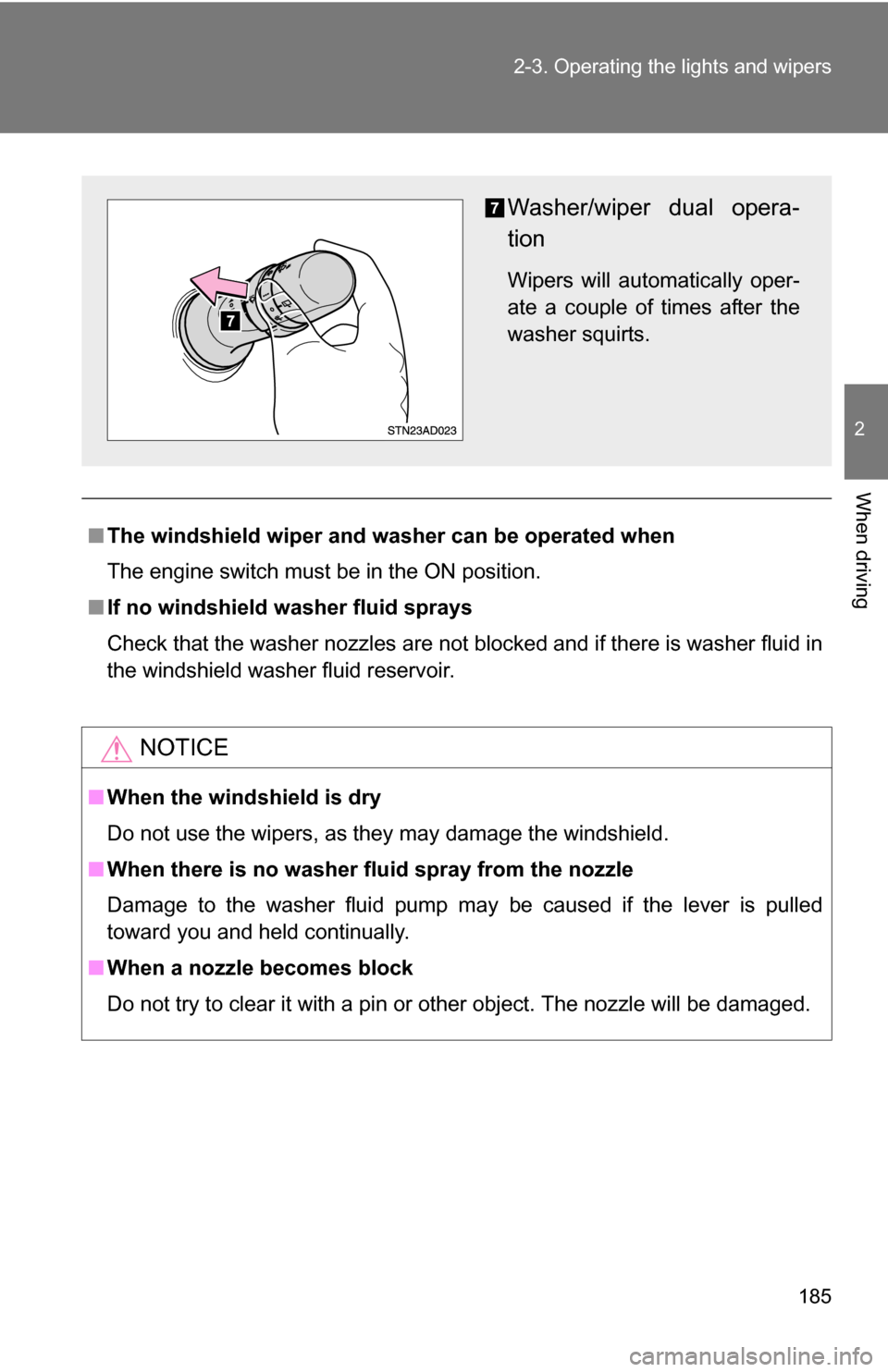
Washer/wiper dual opera-
tion
Wipers will automatically oper-
ate a couple of times after the
washer squirts.
Page 186 of 612
186
2-3. Operating the lights and wipers
Rear window wiper and washer
■The rear window wiper and w asher can be operated when
● The engine switch must be in the ON position.
● The back window is fully closed.
■ Customization that can be co nfigured at Toyota dealer
Settings (e.g. washer linkage wiper control) can be changed.
(Customizable features P. 584)
NOTICE
■When the rear window is dry
Do not use the wipers, as they may damage the rear window.
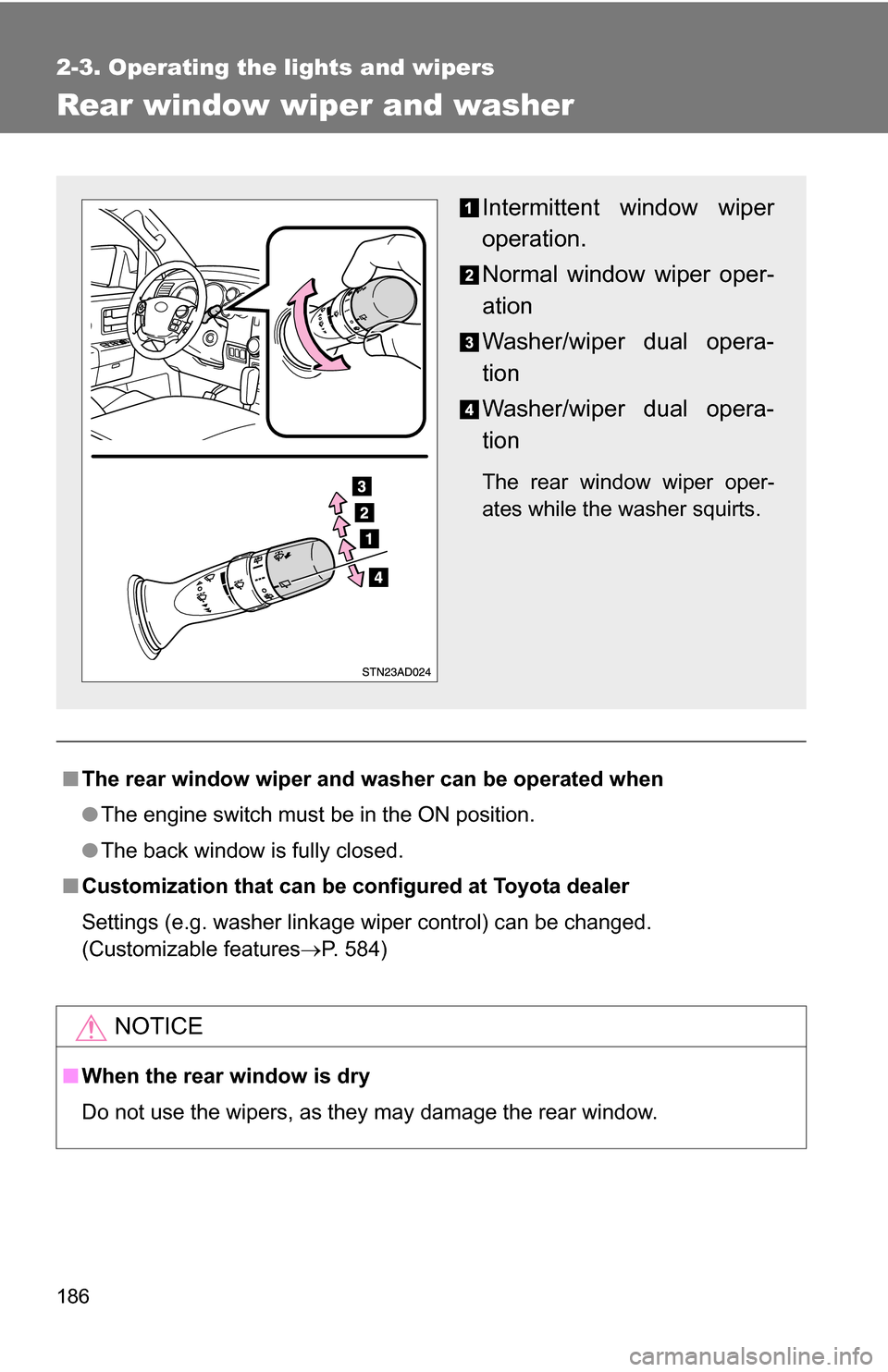
Intermittent window wiper
operation.
Normal window wiper oper-
ation
Washer/wiper dual opera-
tion
Washer/wiper dual opera-
tion
The rear window wiper oper-
ates while the washer squirts.
Page 187 of 612
187
2-3. Operating the lights and wipers
2
When driving
Headlight cleaner switch (if equipped)
■The headlight cleaner can be operated when
The engine switch is in the ON position and the headlights are turned on.
NOTICE
■When the washer fluid tank is empty
Do not use this function when the washer fluid tank is empty. This may
cause the washer fluid pump to overheat.
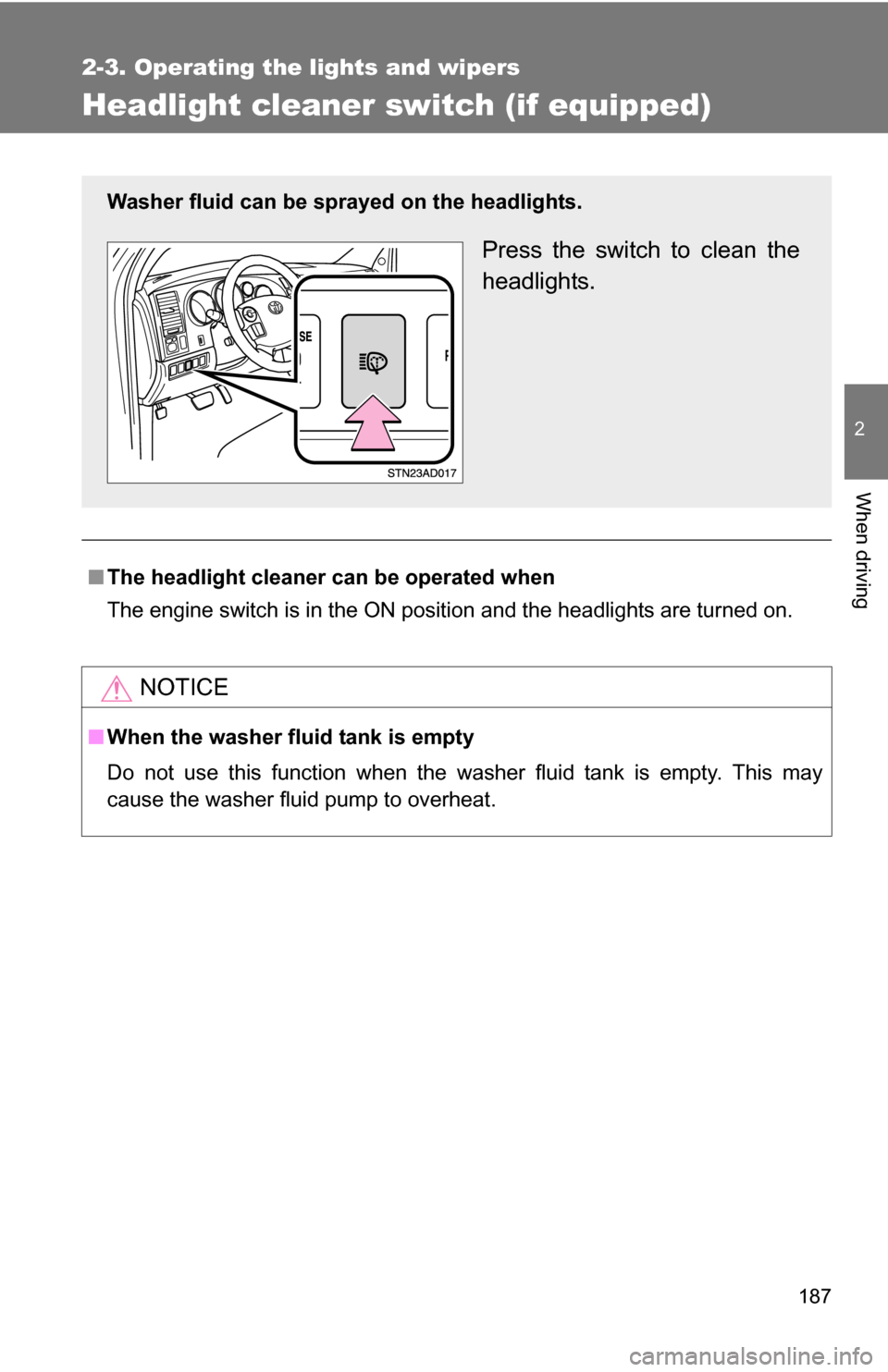
Washer fluid can be sprayed on the headlights.
Press the switch to clean the
headlights.
Page 192 of 612
192 2-4. Using other driving systems
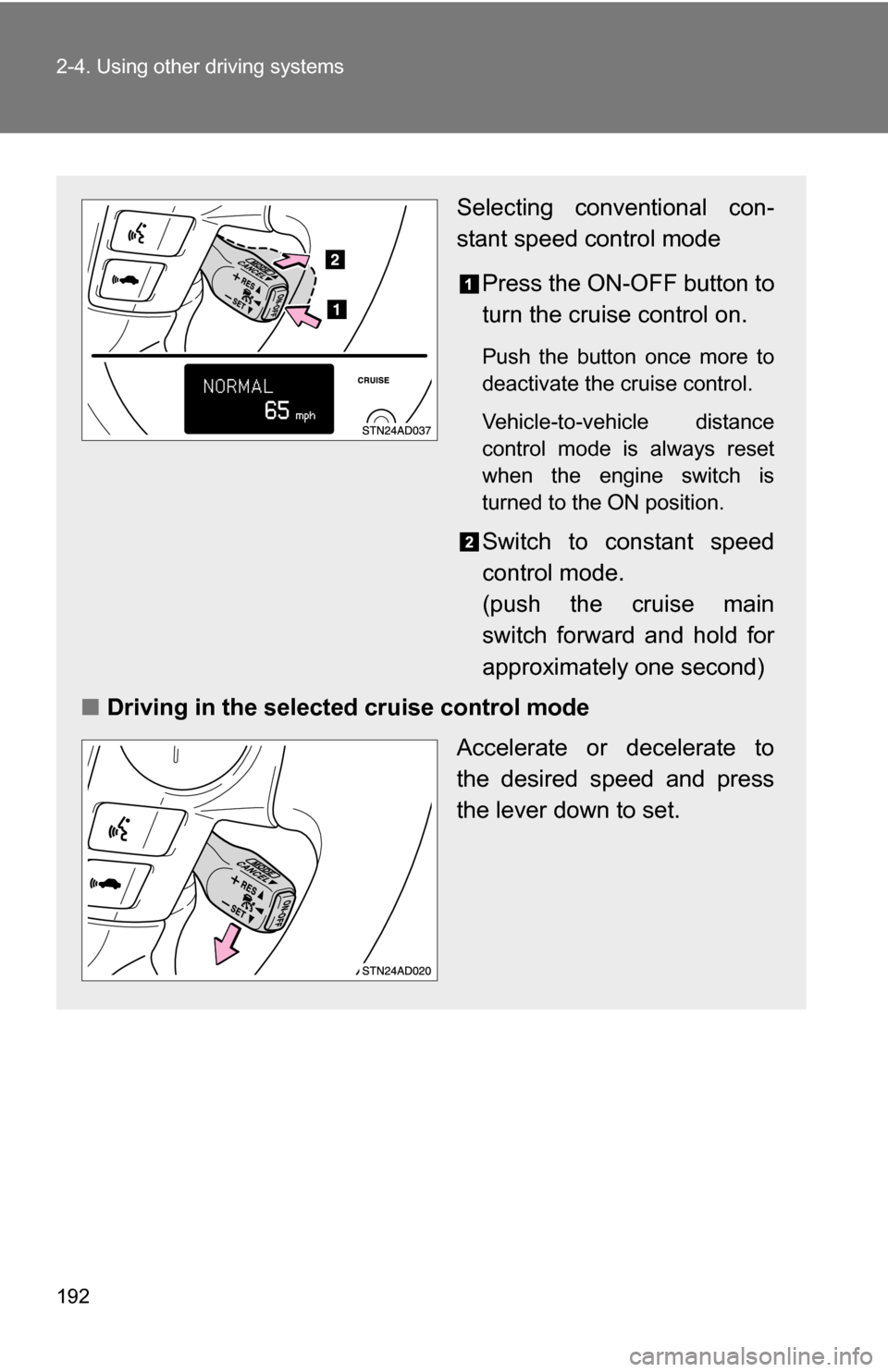
Selecting conventional con-
stant speed control modePress the ON-OFF button to
turn the cruise control on.
Push the button once more to
deactivate the cruise control.
Vehicle-to-vehicle distance
control mode is always reset
when the engine switch is
turned to the ON position.
Switch to constant speed
control mode.
(push the cruise main
switch forward and hold for
approximately one second)
■ Driving in the selected cruise control mode
Accelerate or decelerate to
the desired speed and press
the lever down to set.
Page 194 of 612
194 2-4. Using other driving systems
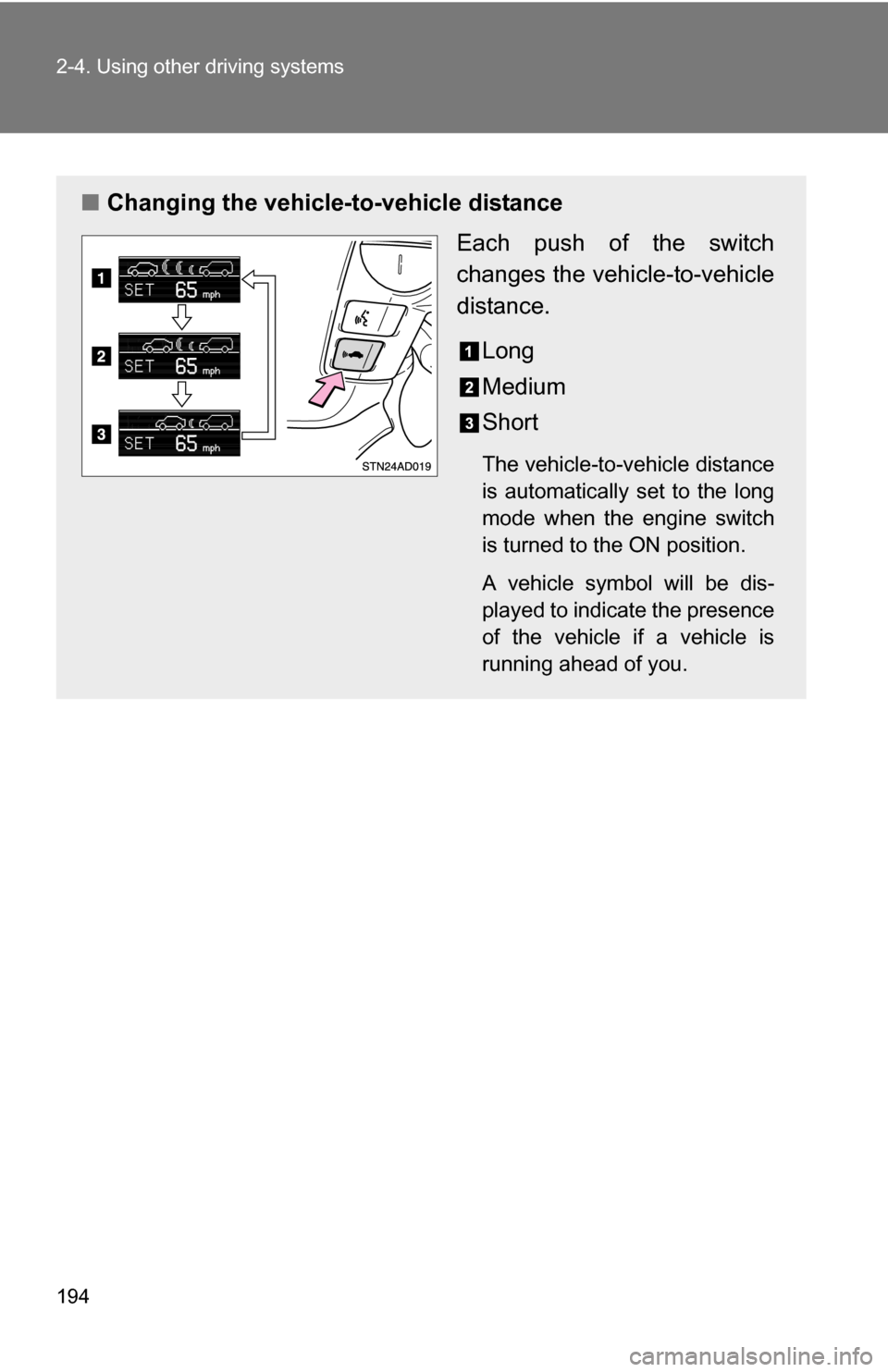
■Changing the vehicle -to-vehicle distance
Each push of the switch
changes the vehi cle-to-vehicle
distance.
Long
Medium
Short
The vehicle-to-vehicle distance
is automatically set to the long
mode when the engine switch
is turned to the ON position.
A vehicle symbol will be dis-
played to indicate the presence
of the vehicle if a vehicle is
running ahead of you.
Page 202 of 612
202
2-4. Using other driving systems
Intuitive parking assist (if equipped)
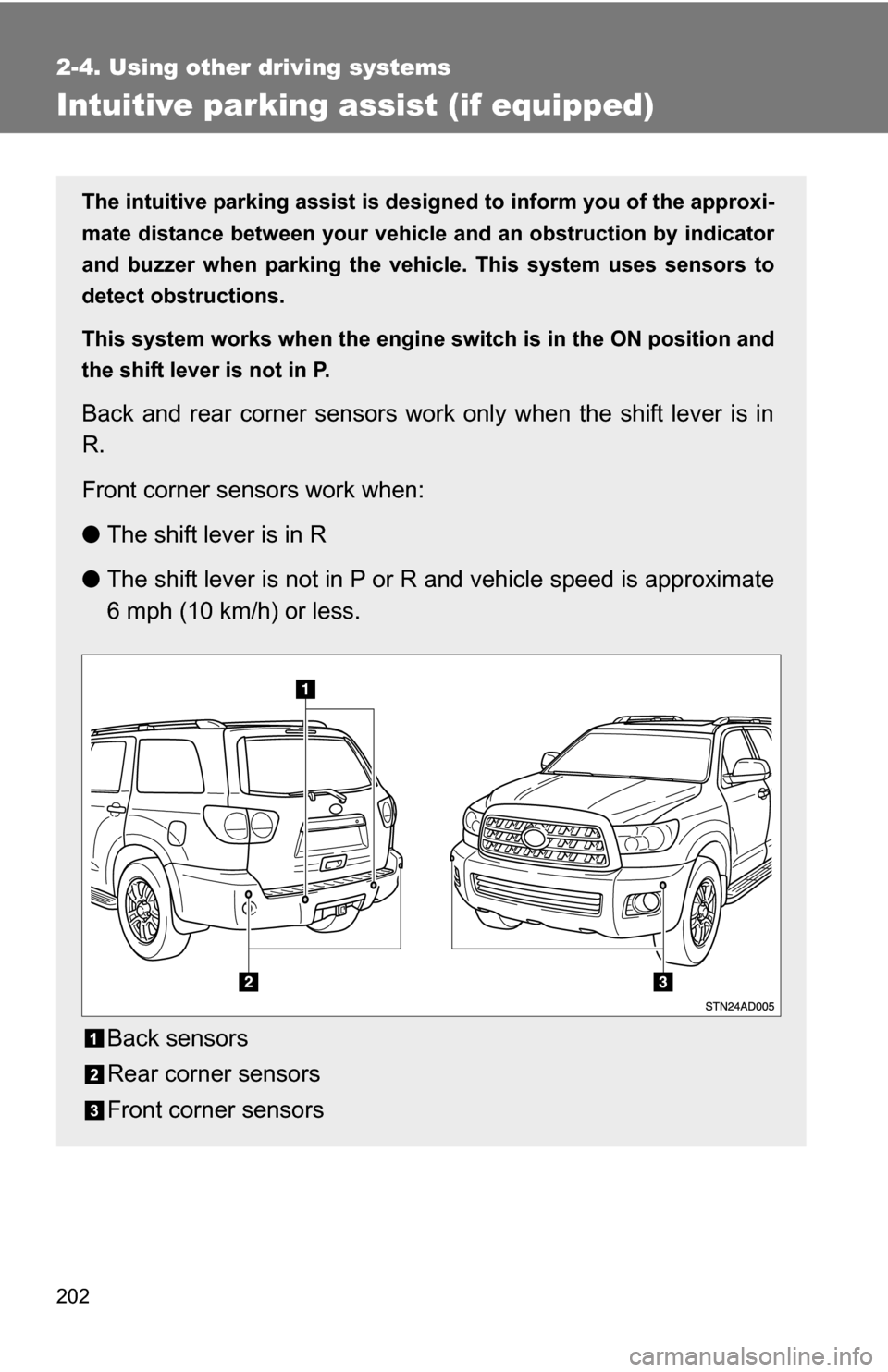
The intuitive parking assist is designed to inform you of the approxi-
mate distance between your vehicle and an obstruction by indicator
and buzzer when parking the veh icle. This system uses sensors to
detect obstructions.
This system works when the engine switch is in the ON position and
the shift lever is not in P.
Back and rear corner sensors work only when the shift lever is in
R.
Front corner sensors work when:
● The shift lever is in R
● The shift lever is not in P or R and vehicle speed is approximate
6 mph (10 km/h) or less.
Back sensors
Rear corner sensors
Front corner sensors
Page 206 of 612
206 2-4. Using other driving systems
■Sensor detection information
●Certain vehicle conditions and the surrounding environment may affect
the ability of a sensor to correctly detect an obstacle. Particular instances
where this may occur are listed below.
• There is dirt, snow or ice on a sensor.
• A sensor is frozen.
• A sensor is covered in any way.
• The vehicle is leaning considerably to one side.
• On an extremely bumpy road, on an incline, on gravel, or on grass.
• The vicinity of the vehicle is noisy due to vehicle horns, motorcycle
engines, air brakes of large vehicles, or other loud noises producing
ultrasonic waves.
• There is another vehicle equipped with parking assist sensors in the vicinity.
• A sensor is coated with a sheet of spray or heavy rain.
• The vehicle is equipped with a fender pole or radio antenna.
• A bumper or sensor receives a strong impact.
• The vehicle is approaching a tall or right-angled curb.
• In harsh sunlight or intense cold weather.
• The area directly under the bumpers is not detected. Objects lower than the sensors or thin stakes etc. may be detected ini-
tially, but as they draw closer, they may cease to be detected.
• A towing hitch is mounted to the vehicle.
• A non-genuine Toyota suspension (lowered suspension etc.) is installed.
• When attaching a two-way radio antenna.
• When a towing eyelet is mounted on your vehicle.
• When the bumper is damaged.
In addition to the examples above, there are instances in which, because of
their shapes, signs and other objects may be judged by a sensor to be closer
than they are.
● The shape of the obstacle may prevent a sensor from detecting it. Pay
particular attention to the following obstacles:
• Wires, fences, ropes, etc.
• Cotton, snow and other materials that absorb radio waves
• Sharply-angled objects