engine TOYOTA SEQUOIA 2009 2.G Repair Manual
[x] Cancel search | Manufacturer: TOYOTA, Model Year: 2009, Model line: SEQUOIA, Model: TOYOTA SEQUOIA 2009 2.GPages: 612
Page 208 of 612
208
2-4. Using other driving systems
Electronically modulated air suspension (if equipped)
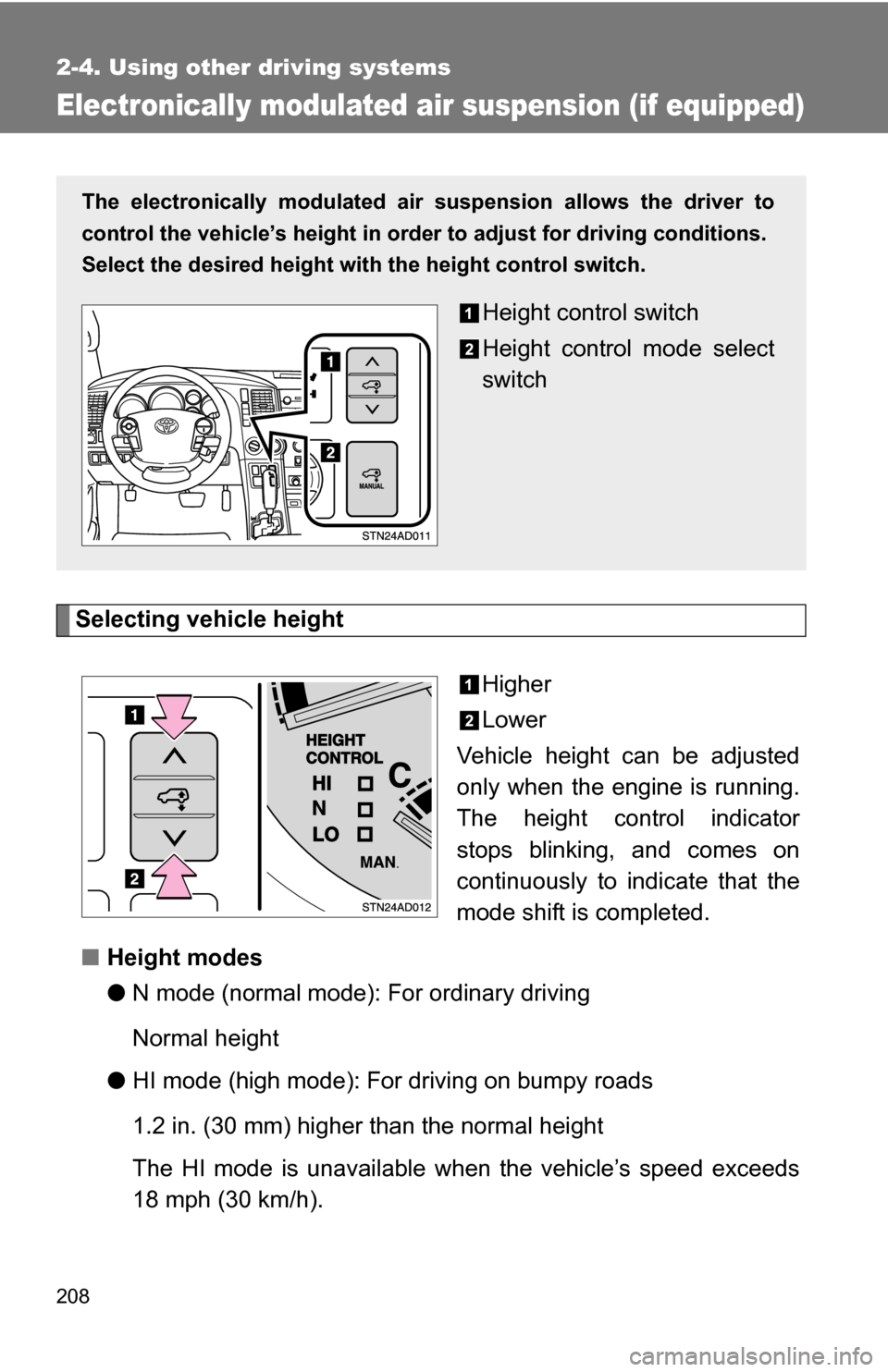
Selecting vehicle heightHigher
Lower
Vehicle height can be adjusted
only when the engine is running.
The height control indicator
stops blinking, and comes on
continuously to indicate that the
mode shift is completed.
■ Height modes
●N mode (normal mode): For ordinary driving
Normal height
● HI mode (high mode): For driving on bumpy roads
1.2 in. (30 mm) higher than the normal height
The HI mode is unavailable w hen the vehicle’s speed exceeds
18 mph (30 km/h).
The electronically modulated air suspension allows the driver to
control the vehicle’s height in orde r to adjust for driving conditions.
Select the desired height with the height control switch.
Height control switch
Height control mode select
switch
Page 210 of 612
210 2-4. Using other driving systems
■Automatic leveling function
Regardless of the number of occupants or the luggage load, vehicle height
in any mode is always adjusted to a fixed height by the automatic leveling
function.
■ When HI mode is selected
The vehicle height will change to N mode when driving at the speeds of 1\
8
mph (30 km/h).
■ When LO mode is selected
●The vehicle height will change to N mode when vehicle speed exceeds 7
mph (12 km/h).
● This mode allows for easy access to the vehicle (getting in and out) and
easy loading and unloading.
■ The electronically modulated air susp ension will not operate in the fol-
lowing cases:
● The underbody of the vehicle is touching the surface of the road.
● The area around the suspension is covered with ice.
The height control indicators will blink, turn off and then turn on continuously
to indicate that the electronically modulated air suspension is not opera-
tional.
To re-enable operation, turn off the engine and then restart it.
■ Even if you hear an operating noise
This does not indicate a problem in the electronically modulated air suspen-
sion.
■ If there is a problem somewhere in the electronically modulated air
suspension
The height control MAN. indicator will behave as follows:
●The indicator will not come on when the engine switch is turned on.
● The indicator will blink.
Although the vehicle may be driven, have the vehicle inspected by your Toy-
ota dealer.
Page 211 of 612
211
2-4. Using other
driving systems
2
When driving
CAUTION
■The electronically modulated air susp ension must be turned off in the
following circumstances:
Otherwise, the automatic leveling function may cause the vehicle’s height to
change, resulting in an unexpected accident.
● When driving through water such as shallow streams (Put the vehicle
height in HI mode and turn off the electronically modulated air suspension.
Drive at 18 mph [30 km/h] or slower.)
● When jacking up the vehicle, installing tire chains or tying the vehicle with
chains/wires for transportation via flat bed truck (Turn the system to the
manual mode and stop the engine.)
● When the vehicle must be towed (Put the vehicle height in N mode and
turn the system to the manual mode.)
● When the vehicle gets stuck (Turn the system to the manual mode.)
● When disconnecting a trailer (Put the vehicle height in LO mode and turn
the system to the manual mode.)
■ Selecting the correct height mode
Observe the following precautions to prevent accidents.
Failure to do so may cause damage to parts of the vehicle, as well as dan-
gerous handling characteristics, which may lead to fatal or injury accidents.
●Before you lower the vehicle’s height, check under the vehicle to make
sure that no one is there.
● The HI mode should be used for off-road driving conditions.
As the vehicle’s center of gravity is higher in this setting, the vehicle may
become unstable when turning abruptly.
● Do not select HI mode when you load cargo on the roof luggage carrier.
This may result in a loss of control or vehicle rollover.
Page 217 of 612
217
2-4. Using other
driving systems
2
When driving
Therefore, the vehicle is free to roll even if the automatic transmission is in
P. You or someone else could be seriously injured. You must complete the
shifting of the transfer mode.
To complete the shifting, stop the vehicle completely, return the shift lever
to N, and confirm that the shift was completed (The indicator turns on/off).
● If the engine coolant temperature is too low, transfer mode may not be
able to shift. When the engine is warmer, turn the switch again.
If the 4LO indicator, 4HI indicator or the center differential lock indicator con-
tinues to blink even after attempting the above, there may be a malfunction
in the engine, the brake system or the four-wheel drive system. In this case,
you may not be able to shift between 2WD and 4H, 4H and 4L, and the cen-
ter differential lock may not be operable. Have the vehicle inspected by your
Toyota dealer immediately.
■ Shifting to 4L
The VSC OFF indicator will come on.
However, the VSC remains activated.
CAUTION
■Shifting from 2WD to 4H while driving
Never operate the front wheel drive cont rol switch if the wheels are slipping.
Stop the slipping or spinning before shifting.
■ When the vehicle is parked
●If the shift lever is moved before the 4LO indicator turns on/off, the transfer
mode may not be shifted completely. The transfer mode disengages both
the front and rear driveshafts from the powertrain and allows the vehicle to
move regardless of the shift position. (At this time, the indicator blinks and
the buzzer sounds.)
Therefore, the vehicle is free to roll even if the automatic transmission is in
P. You or someone else could be seriously injured. You must complete the
shifting of the transfer mode. ( P. 214)
Page 219 of 612
219
2-4. Using other driving systems
2
When driving
AUTO LSD system
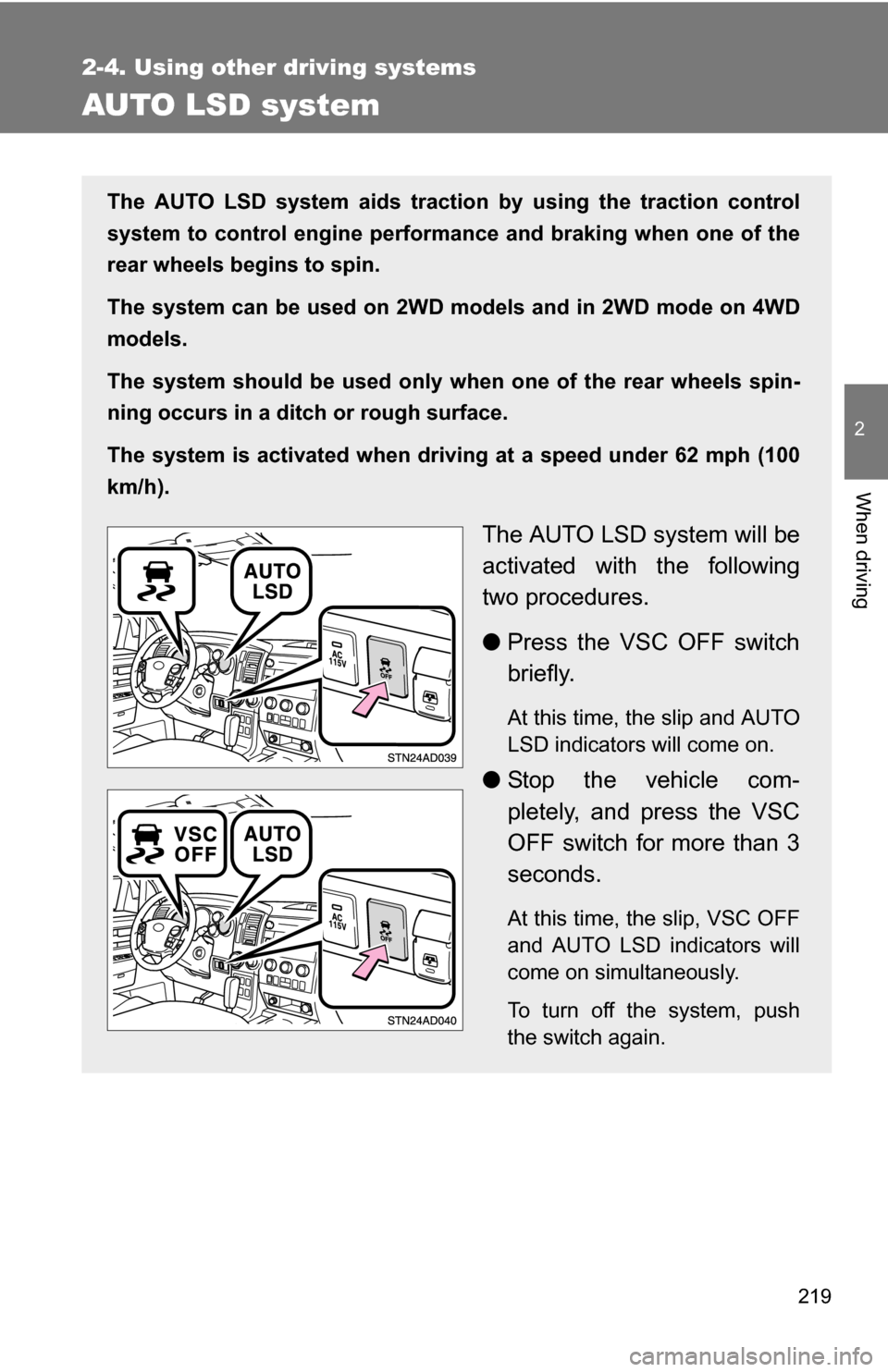
The AUTO LSD system aids traction by using the traction control
system to control engine performance and braking when one of the
rear wheels begins to spin.
The system can be used on 2WD models and in 2WD mode on 4WD
models.
The system should be used only wh en one of the rear wheels spin-
ning occurs in a ditch or rough surface.
The system is activated when driving at a speed under 62 mph (100
km/h).
The AUTO LSD system will be
activated with the following
two procedures.
● Press the VSC OFF switch
briefly.
At this time, the slip and AUTO
LSD indicators will come on.
●Stop the vehicle com-
pletely, and press the VSC
OFF switch for more than 3
seconds.
At this time, the slip, VSC OFF
and AUTO LSD indicators will
come on simultaneously.
To turn off the system, push
the switch again.
Page 220 of 612
220 2-4. Using other driving systems
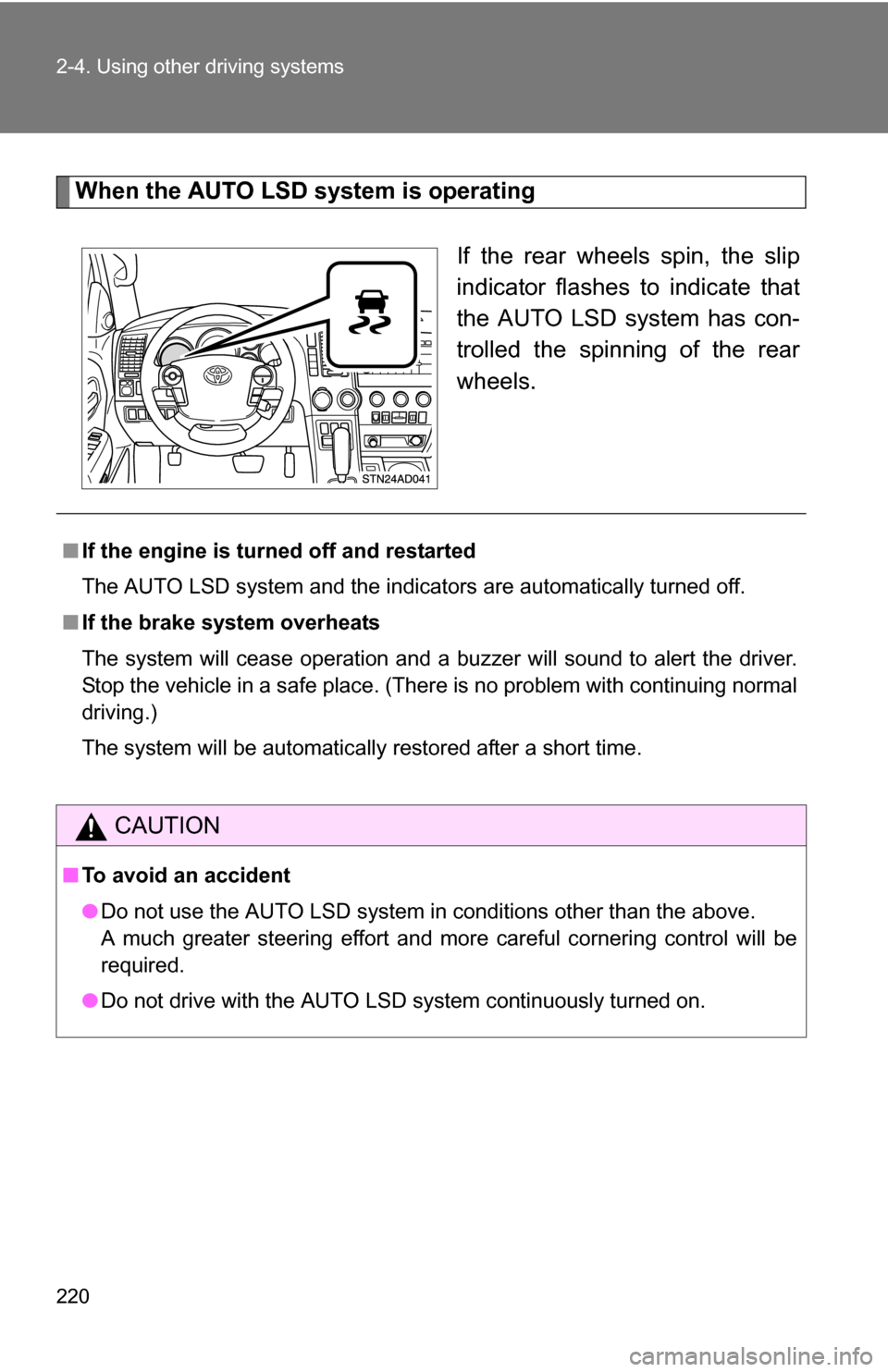
When the AUTO LSD system is operatingIf the rear wheels spin, the slip
indicator flashes to indicate that
the AUTO LSD system has con-
trolled the spinning of the rear
wheels.
■If the engine is turned off and restarted
The AUTO LSD system and the indicators are automatically turned off.
■ If the brake system overheats
The system will cease operation and a buzzer will sound to alert the driver.
Stop the vehicle in a safe place. (There is no problem with continuing normal
driving.)
The system will be automatically restored after a short time.
CAUTION
■To avoid an accident
●Do not use the AUTO LSD system in conditions other than the above.
A much greater steering effort and more careful cornering control will be
required.
● Do not drive with the AUTO LSD system continuously turned on.
Page 222 of 612
222 2-4. Using other driving systems
To disable VSC or TRAC (2WD models and 2WD mode on 4WD models)
If the vehicle gets stuck in fresh snow or mud, VSC or TRAC may
reduce power from the engine to the wheels. You may need to turn
the system off to enable you to rock the vehicle in order to free it.
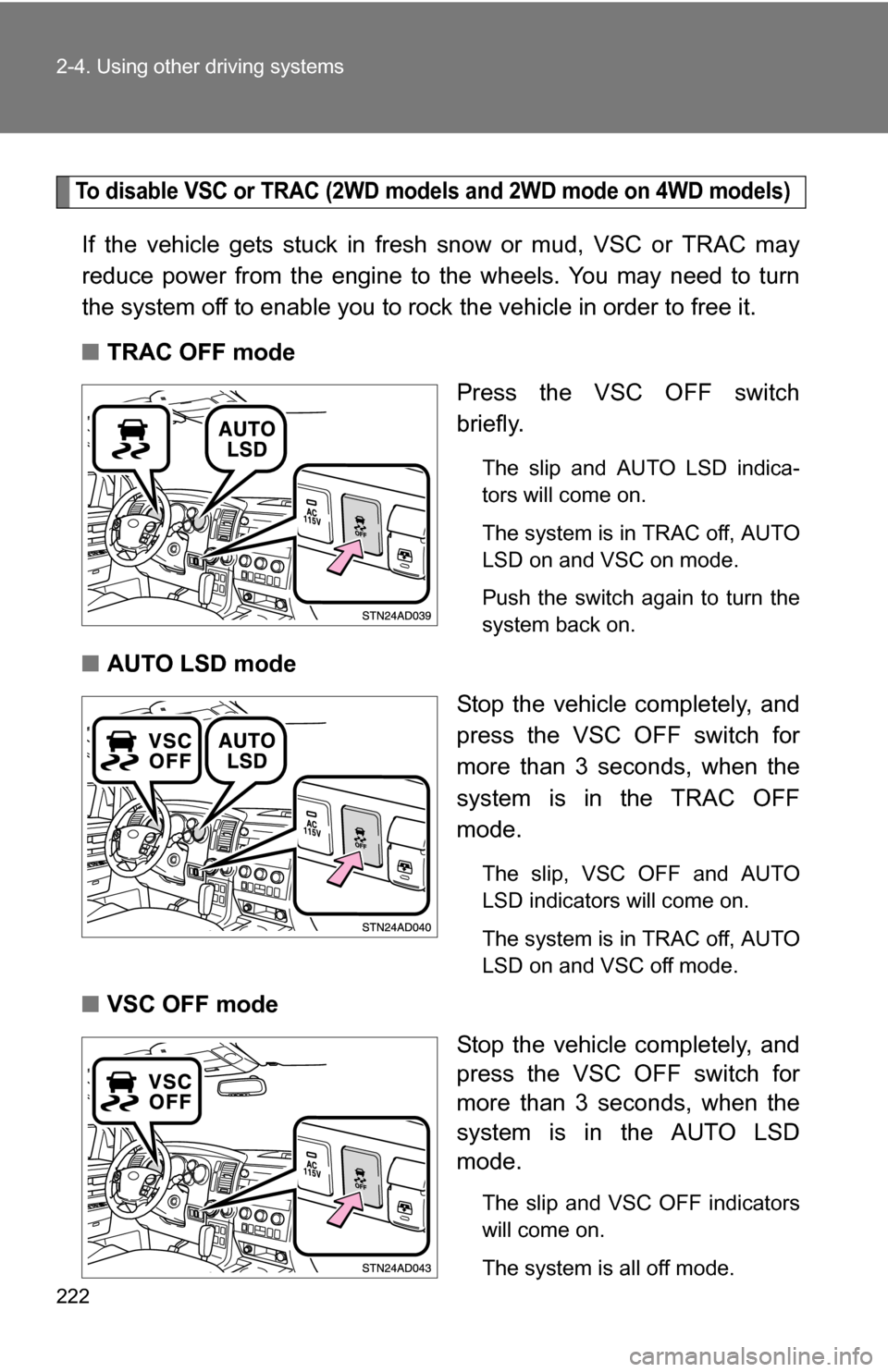
■ TRAC OFF mode
Press the VSC OFF switch
briefly.
The slip and AUTO LSD indica-
tors will come on.
The system is in TRAC off, AUTO
LSD on and VSC on mode.
Push the switch again to turn the
system back on.
■AUTO LSD mode
Stop the vehicle completely, and
press the VSC OFF switch for
more than 3 seconds, when the
system is in the TRAC OFF
mode.
The slip, VSC OFF and AUTO
LSD indicators will come on.
The system is in TRAC off, AUTO
LSD on and VSC off mode.
■VSC OFF mode
Stop the vehicle completely, and
press the VSC OFF switch for
more than 3 seconds, when the
system is in the AUTO LSD
mode.
The slip and VSC OFF indicators
will come on.
The system is all off mode.
Page 223 of 612
223
2-4. Using other
driving systems
2
When driving
To disable VSC or A-TRAC (4H mode on 4WD models)
If the vehicle gets stuck in fresh snow or mud, VSC or A-TRAC may
reduce power from the engine to the wheels. You may need to turn
the system off to enable you to rock the vehicle in order to free it.
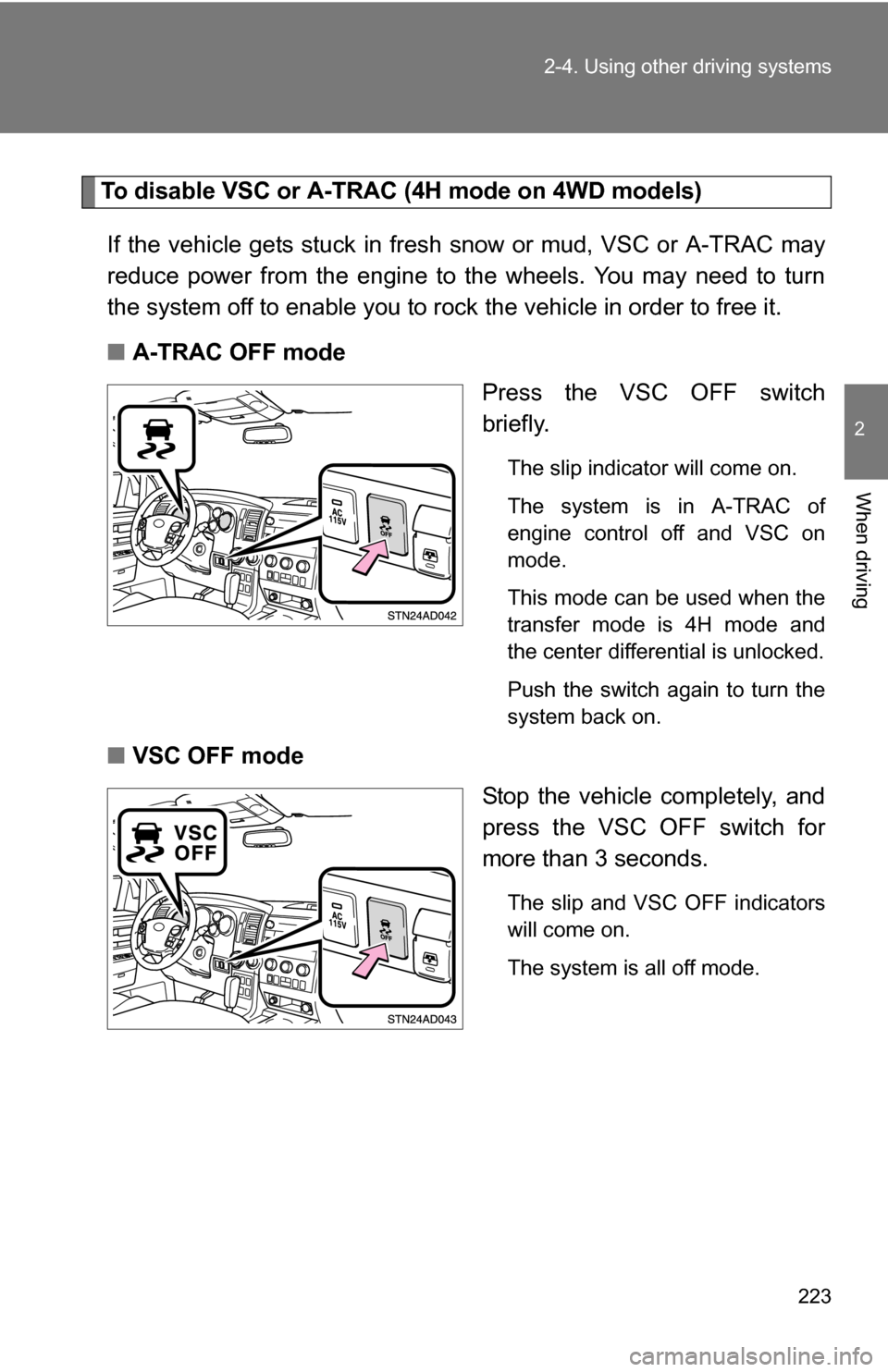
■ A-TRAC OFF mode
Press the VSC OFF switch
briefly.
The slip indicator will come on.
The system is in A-TRAC of
engine control off and VSC on
mode.
This mode can be used when the
transfer mode is 4H mode and
the center differential is unlocked.
Push the switch again to turn the
system back on.
■VSC OFF mode
Stop the vehicle completely, and
press the VSC OFF switch for
more than 3 seconds.
The slip and VSC OFF indicators
will come on.
The system is all off mode.
Page 224 of 612
224 2-4. Using other driving systems
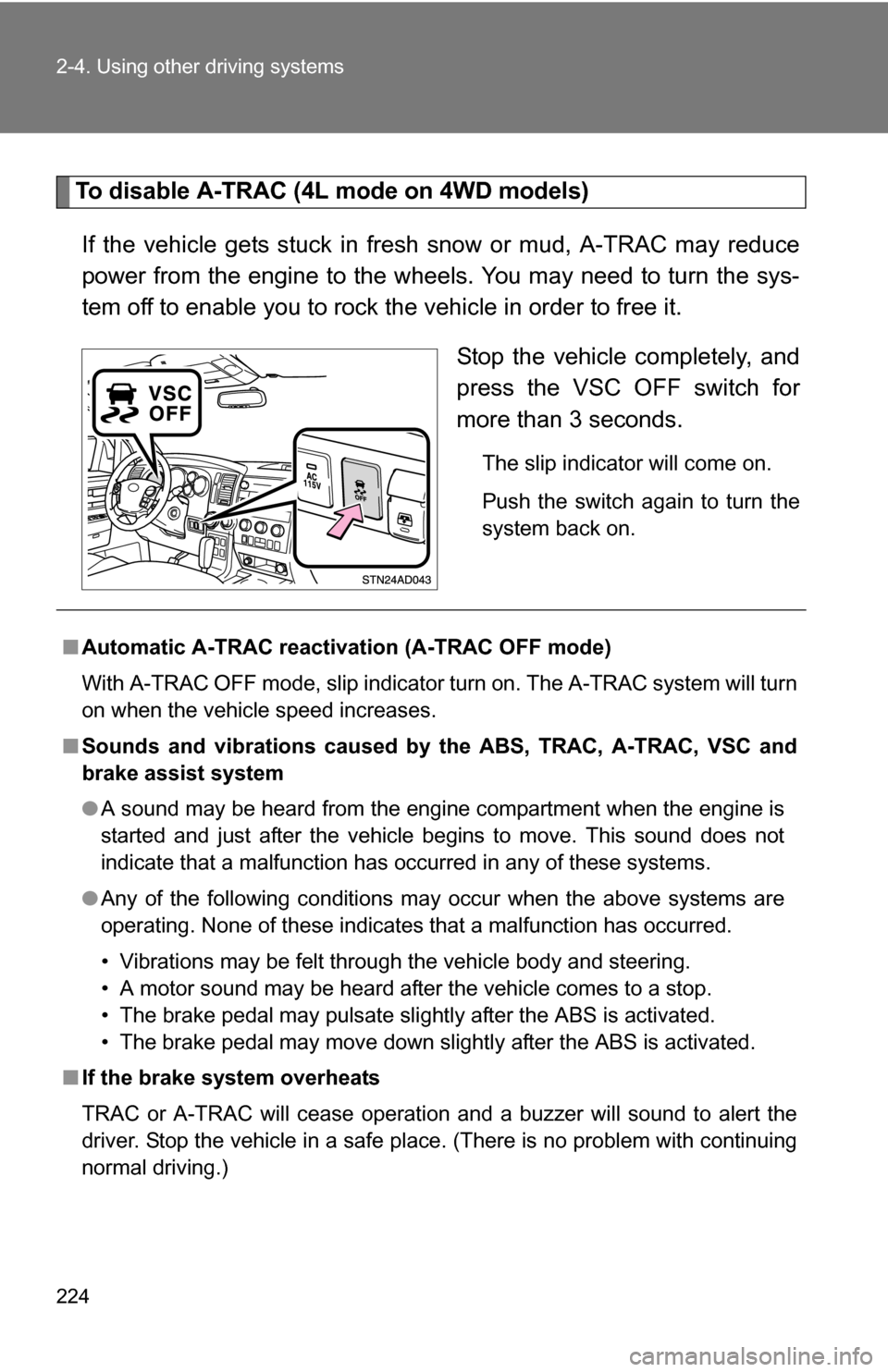
To disable A-TRAC (4L mode on 4WD models)If the vehicle gets stuck in fresh snow or mud, A-TRAC may reduce
power from the engine to the wheels. You may need to turn the sys-
tem off to enable you to rock the vehicle in order to free it. Stop the vehicle completely, and
press the VSC OFF switch for
more than 3 seconds.
The slip indicator will come on.
Push the switch again to turn the
system back on.
■Automatic A-TRAC reactivat ion (A-TRAC OFF mode)
With A-TRAC OFF mode, slip indicator turn on. The A-TRAC system will turn
on when the vehicle speed increases.
■ Sounds and vibrations caused by the ABS, TRAC, A-TRAC, VSC and
brake assist system
● A sound may be heard from the engine compartment when the engine is
started and just after the vehicle begins to move. This sound does not
indicate that a malfunction has occurred in any of these systems.
● Any of the following conditions may occur when the above systems are
operating. None of these indicates that a malfunction has occurred.
• Vibrations may be felt through the vehicle body and steering.
• A motor sound may be heard after the vehicle comes to a stop.
• The brake pedal may pulsate slightly after the ABS is activated.
• The brake pedal may move down slightly after the ABS is activated.
■ If the brake system overheats
TRAC or A-TRAC will cease operation and a buzzer will sound to alert the
driver. Stop the vehicle in a safe place. (There is no problem with continuing
normal driving.)
Page 225 of 612
225
2-4. Using other
driving systems
2
When driving
■Power steering system operation sound
When you turn the engine switch to ON after the battery has been discon-
nected and reconnected, a sound may be heard from the engine compart-
ment.
This does not indicate a malfunction.
CAUTION
Any of the following conditions may result in an accident which could cause
death or serious injury.
■ The ABS does not opera te effectively when
● The limits of the gripping performance have been exceeded.
● The vehicle hydroplanes while driving at high speed on the wet or slick
road.
■ Stopping distance when the ABS is operating will exceed that of nor-
mal conditions
The ABS is not designed to shorten the vehicle’s stopping distance. Always
maintain a safe distance from the vehicle in front of you in the following situ-
ations.
● When driving on dirt, gravel or snow-covered roads
● When driving with tire chains
● When driving over bumps in the road
● When driving over roads with pothol es or roads with uneven roads
■ When VSC is activated
The slip indicator flashes and a warning buzzer sounds. Always drive care-
fully. Reckless driving may cause an accident. Exercise particular care when
the indicator flashes and a buzzer sounds.
■ TRAC or A-TRAC may not operate effectively when
Directional control and power may not be achievable while driving on slip-
pery road surfaces, even if TRAC or A-TRAC is operating.
Do not drive the vehicle in conditions where stability and power may be lost.