air condition TOYOTA SEQUOIA HYBRID 2023 Owners Manual
[x] Cancel search | Manufacturer: TOYOTA, Model Year: 2023, Model line: SEQUOIA HYBRID, Model: TOYOTA SEQUOIA HYBRID 2023Pages: 628, PDF Size: 14.27 MB
Page 1 of 628
1
2
3
4
5
6
8 7
9
10
Owners Manual_USA_M0C043_en
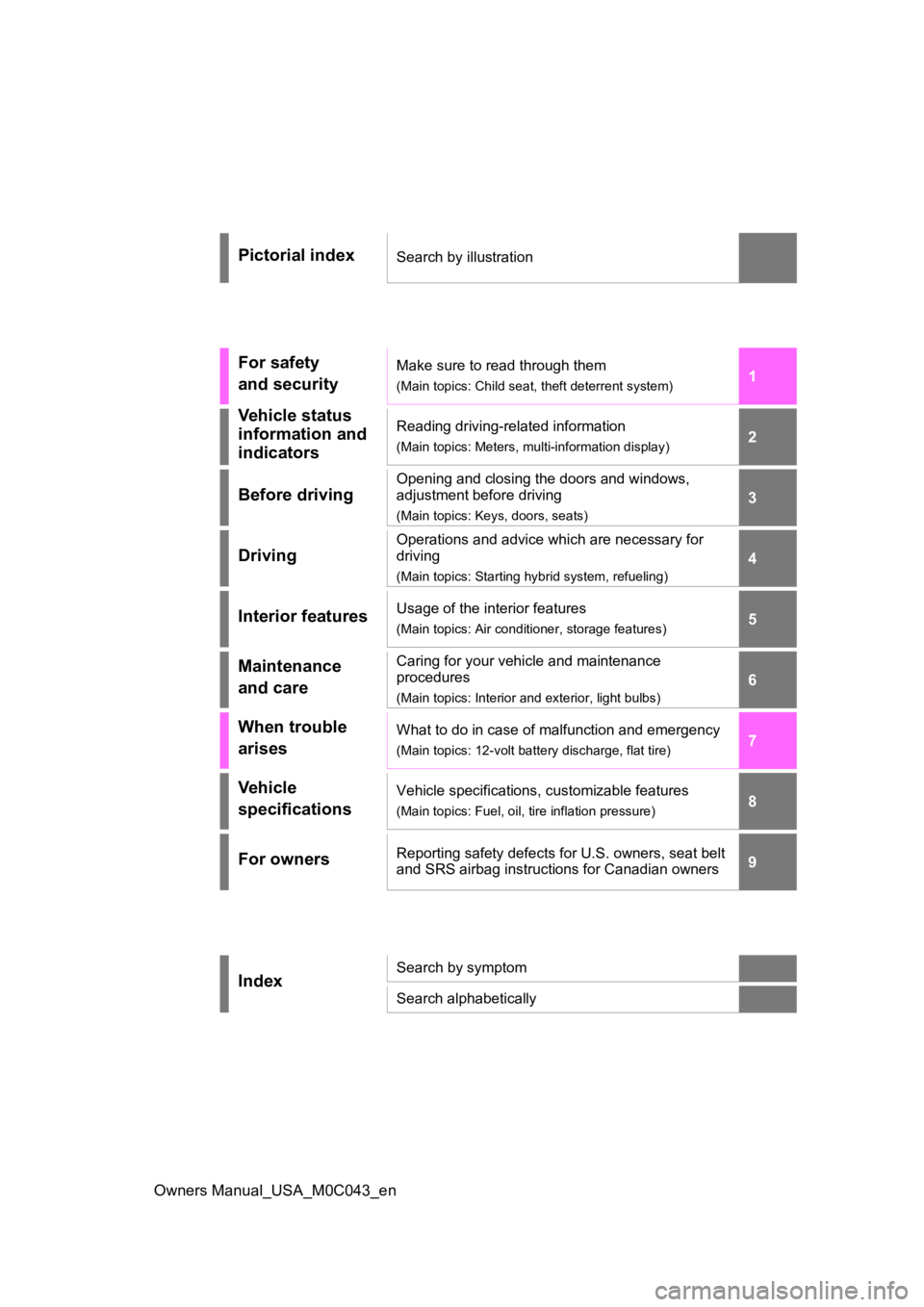
Pictorial indexSearch by illustration
For safety
and securityMake sure to read through them
(Main topics: Child seat, theft deterrent system)
Vehicle status
information and
indicatorsReading driving-related information
(Main topics: Meters, multi-information display)
Before driving
Opening and closing the doors and windows,
adjustment before driving
(Main topics: Keys, doors, seats)
Driving
Operations and advice which are necessary for
driving
(Main topics: Starting hybrid system, refueling)
Interior featuresUsage of the interior features
(Main topics: Air conditioner, storage features)
Maintenance
and careCaring for your vehicle and maintenance
procedures
(Main topics: Interior and exterior, light bulbs)
When trouble
arisesWhat to do in case of malfunction and emergency
(Main topics: 12-volt battery discharge, flat tire)
Vehicle
specificationsVehicle specifications, customizable features
(Main topics: Fuel, oil, tire inflation pressure)
For ownersReporting safety defects for U.S. owners, seat belt
and SRS airbag instructions for Canadian owners
IndexSearch by symptom
Search alphabetically
Page 4 of 628
4TABLE OF CONTENTS
Owners Manual_USA_M0C043_en
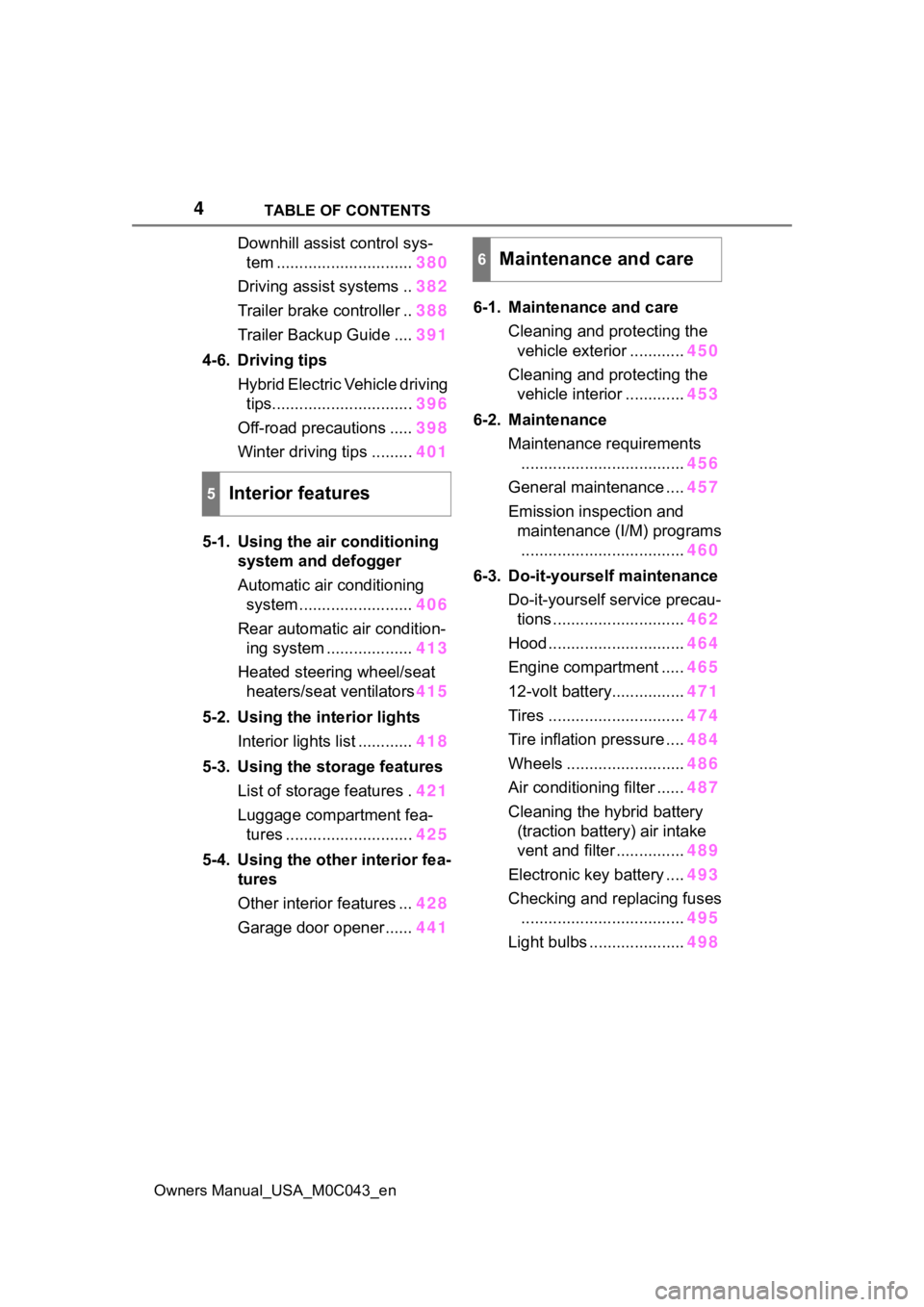
Downhill assist control sys-tem .............................. 380
Driving assist systems .. 382
Trailer brake controller .. 388
Trailer Backup Guide .... 391
4-6. Driving tips Hybrid Electric Vehicle driving tips............................... 396
Off-road precautions ..... 398
Winter driving tips ......... 401
5-1. Using the air conditioning
system and defogger
Automatic air conditioning system ......................... 406
Rear automatic air condition- ing system ................... 413
Heated steering wheel/seat heaters/seat ventilators 415
5-2. Using the interior lights Interior lights list ............ 418
5-3. Using the storage features List of storage features . 421
Luggage compartment fea- tures ............................ 425
5-4. Using the other interior fea- tures
Other interior features ... 428
Garage door opener...... 4416-1. Maintenance and care
Cleaning and protecting the vehicle exterior ............ 450
Cleaning and protecting the vehicle interior ............. 453
6-2. Maintenance Maintenance requirements.................................... 456
General maintenance .... 457
Emission inspection and maintenance (I/M) programs.................................... 460
6-3. Do-it-yourself maintenance Do-it-yourself service precau-tions ............................. 462
Hood .............................. 464
Engine compartment ..... 465
12-volt battery................ 471
Tires .............................. 474
Tire inflation pressure .... 484
Wheels .......................... 486
Air conditioning filter ...... 487
Cleaning the hybrid battery (traction battery) air intake
vent and filter ............... 489
Electronic key battery .... 493
Checking and replacing fuses .................................... 495
Light bulbs ..................... 498
5Interior features
6Maintenance and care
Page 8 of 628
8
Owners Manual_USA_M0C043_ention is disabled, data from when the
system operates will not be avail-
able.
To learn more about the vehi-
cle data collected, used and
shared by Toyota, please visit
www.toyota.com/privacyvts/
.
If your Toyota has Safety Con-
nect and if you have subscribed
to those services, please refer to
the Safety Connect Telematics
Subscription Service Agreement
for information on data collected
and its usage.
To learn more about the vehi-
cle data collected, used and
shared by Toyota, please visit
www.toyota.com/privacyvts/
.
This vehicle is equipped with an
event data recorder (EDR). The
main purpose of an EDR is to
record, in certain crash or near
crash-like situations, such as an
air bag deployment or hitting a
road obstacle, data that will
assist in understanding how a
vehicle’s systems performed.
The EDR is designed to record
data related to vehicle dynamics
and safety systems for a short
period of time, typically 30 sec-
onds or less. The EDR in this vehicle is
designed to record such data
as:
• How various systems in your
vehicle were operating;
• Whether or not the driver and passenger safety belts were
buckled/fastened;
• How far (if at all) the driver was depressing the accelera-
tor and/or brake pedal; and,
• How fast the vehicle was trav- eling.
These data can help provide a
better understanding of the cir-
cumstances in which crashes
and injuries occur.
NOTE: EDR data are recorded
by your vehicle only if a non-triv-
ial crash situation occurs; no
data are recorded by the EDR
under normal driving conditions
and no personal data (e.g.,
name, gender, age, and crash
location) are recorded. How-
ever, other parties, such as law
enforcement, could combine the
EDR data with the type of per-
sonally identifying data rou-
tinely acquired during a crash
investigation.
To read data recorded by an
EDR, special equipment is
required, and access to the
vehicle or the EDR is needed. In
addition to the vehicle manufac-
turer, other parties, such as law
enforcement, that have the spe-
cial equipment, can read the
Usage of data collected
through Safety Connect
(U.S.mainland only)
Event data recorder
Page 18 of 628

18Pictorial index
Owners Manual_USA_M0C043_en
Power switch ................................................... ................... P.212
Starting the hybrid system/changing the modes .................. P. 2 1 2
Emergency stop of the hybrid system ............................ ...... P.502
When the hybrid system will not start .......................... ........ P.532
Warning messages ............................................... ............... P.519
Multimedia system
*1
Air conditioning system ............................. ....................... P.406
Usage................................................................................... P.406
Rear window defogger ........................................... .............. P.408
Shift lever.................................................... ........................ P.217
Changing the shift position.................................... ............... P.218
Precautions for towing .. ....................................... ................ P.505
When the shift lever does not move............................. ........ P.218
Tilt and telescopic st eering control switch
*2/tilt and telescopic
steering lock release lever
*2P.158
Adjustment ..................................................... ...................... P.158
Driving position memory
*2.................................................... P.152
Hood lock release lever ........................................ ............. P.464
*1: Refer to “MULTIMEDIA OWNER’S MANUAL”.
*2: If equipped
Page 40 of 628
401-1. For safe use
Owners Manual_USA_M0C043_ensuch as a parked vehicle or sign
pole, which can
move or deform
on impact
• If the vehicle is involved in an underride collision, such as a colli-
sion in which the front of the vehi-
cle underrides, or goes under, the
bed of a truck
●Depending on the type of collision,
it is possible that only the seat belt
pretensioners and knee airbags
will activate.
●The SRS front airbags for the front
passenger will not activate if there
is no passenger sitting in the front
passenger seat. However, the
SRS front airbags for the front
passenger may de ploy if luggage
is put in the seat, even if the seat
is unoccupied.
■SRS airbag deployment condi-
tions (SRS side and curtain
shield airbags)
●The SRS side and curtain shield
airbags will deploy i n the event of
an impact that exceeds the set
threshold level (the level of force
corresponding to the impact force
produced by an approximately
3300 lb. [1500 kg] vehicle colliding
with the vehicle cabin from a
direction perpendicular to the
vehicle orientation at an approxi-
mate speed of 12 - 18 mph [20 -
30 km/h]).
●Both SRS curtain shield airbags
may deploy in the event of a
severe side collision.
●Both SRS curtain shield airbags
will deploy in the event of vehicle
rollover.
●Both SRS curtain shield airbags
may also deploy in the event of a
severe frontal collision.
■Conditions under which the
SRS airbags may deploy
(inflate), other t han a collision
The SRS front airbags and SRS
side and curtain shield airbags may
also deploy if a serious impact occurs to the underside of your vehi-
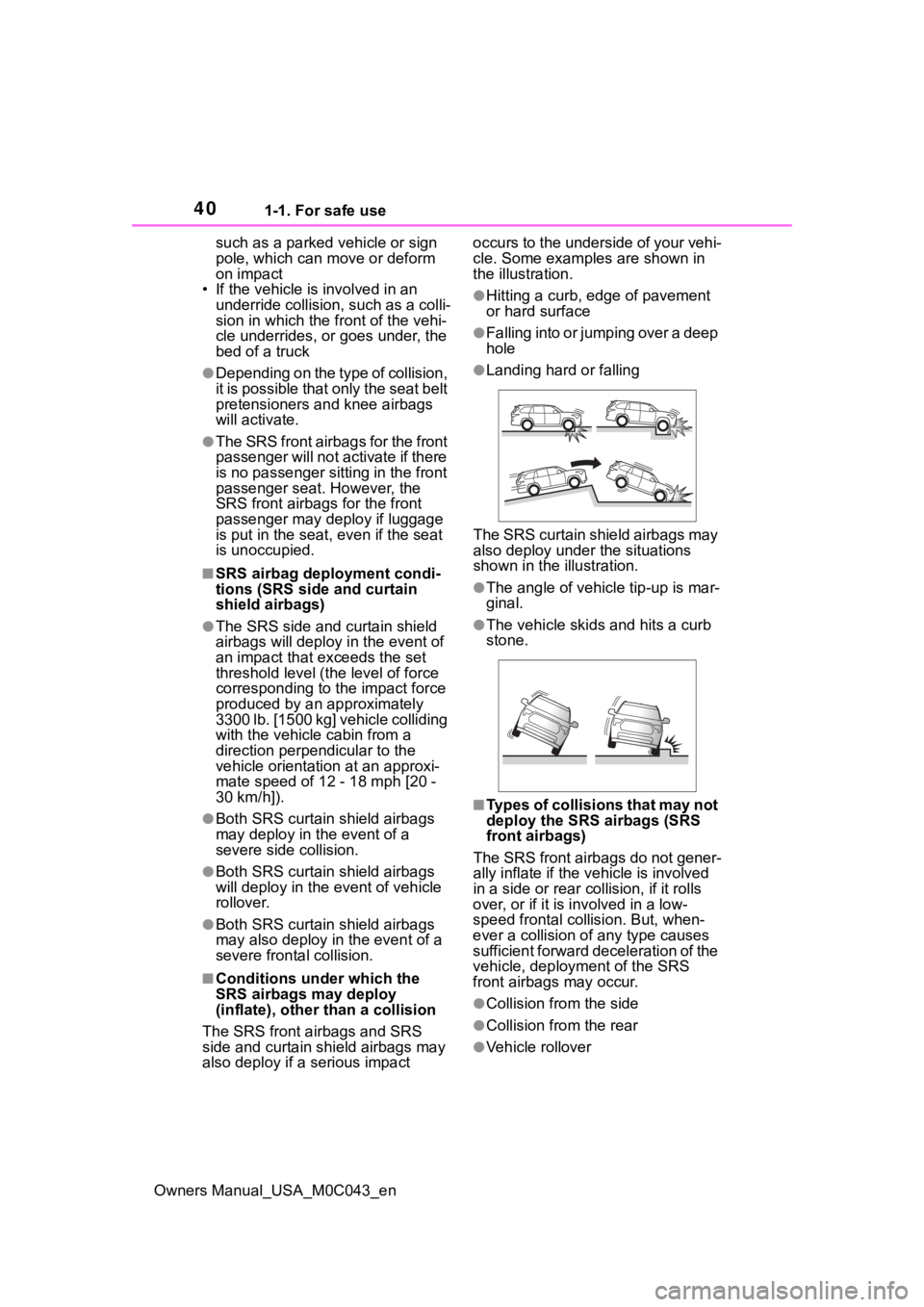
cle. Some examples are shown in
the illustration.
●Hitting a curb, edge of pavement
or hard surface
●Falling into or jumping over a deep
hole
●Landing hard or falling
The SRS curtain shield airbags may
also deploy under the situations
shown in the illustration.
●The angle of vehicle tip-up is mar-
ginal.
●The vehicle skids and hits a curb
stone.
■Types of collisions that may not
deploy the SRS airbags (SRS
front airbags)
The SRS front airbags do not gener-
ally inflate if the vehicle is involved
in a side or r ear collision, if it rolls
over, or if it is involved in a low-
speed frontal collision. But, when-
ever a collision o f any type causes
sufficient forward deceleration of the
vehicle, deploym ent of the SRS
front airbags may occur.
●Collision from the side
●Collision from the rear
●Vehicle rollover
Page 47 of 628
471-1. For safe use
Owners Manual_USA_M0C043_en
1
For safety and security
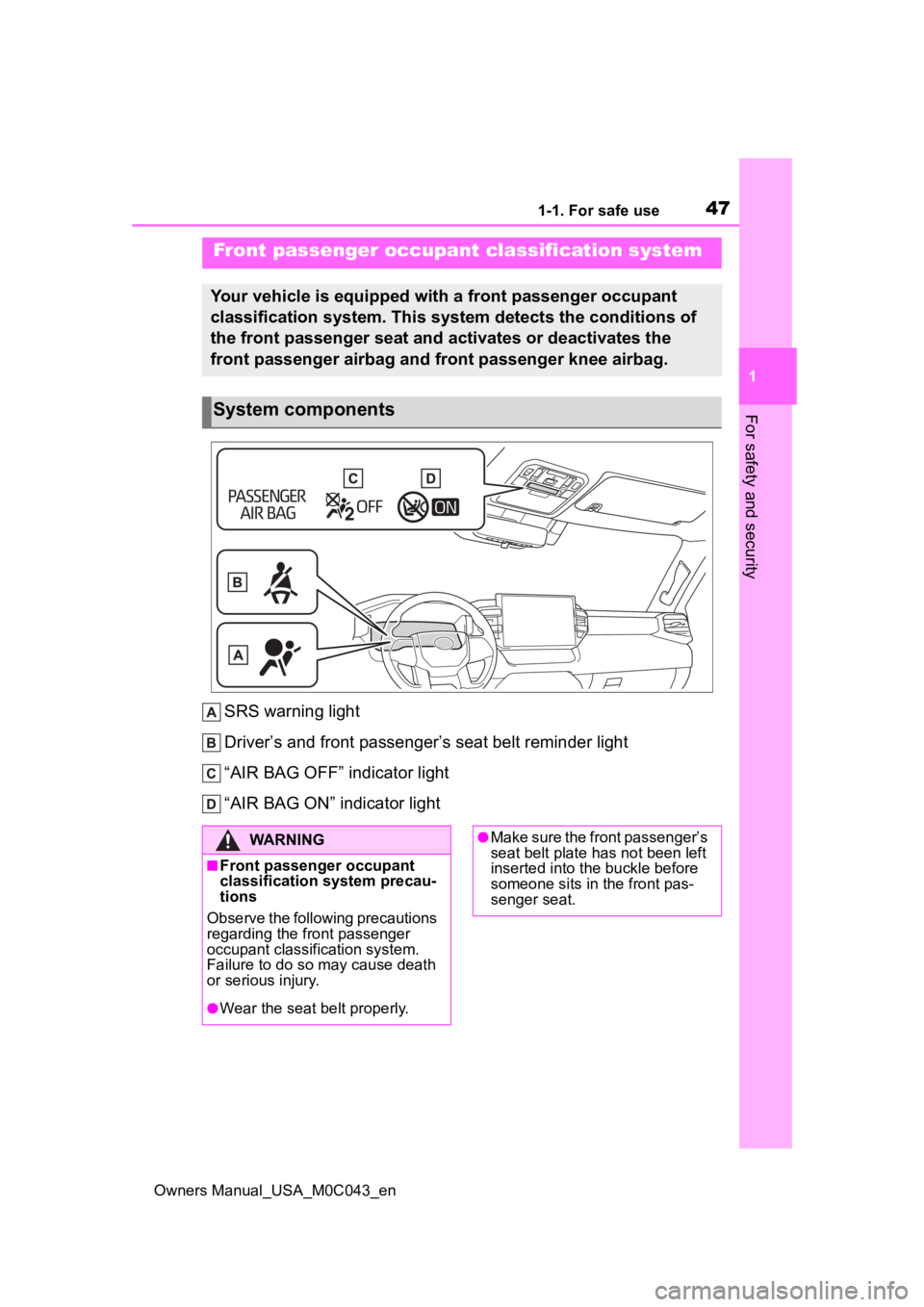
SRS warning light
Driver’s and front passenger ’s seat belt reminder light
“AIR BAG OFF” indicator light
“AIR BAG ON” indicator light
Front passenger occupant classification system
Your vehicle is equipped with a front passenger occupant
classification system. This system detects the conditions of
the front passenger seat and activates or deactivates the
front passenger airbag and front passenger knee airbag.
System components
WARNING
■Front passenger occupant
classification system precau-
tions
Observe the following precautions
regarding the front passenger
occupant classification system.
Failure to do so may cause death
or serious injury.
●Wear the seat belt properly.
●Make sure the front passenger’s
seat belt plate has not been left
inserted into the buckle before
someone sits in the front pas-
senger seat.
Page 49 of 628
491-1. For safe use
Owners Manual_USA_M0C043_en
1
For safety and security
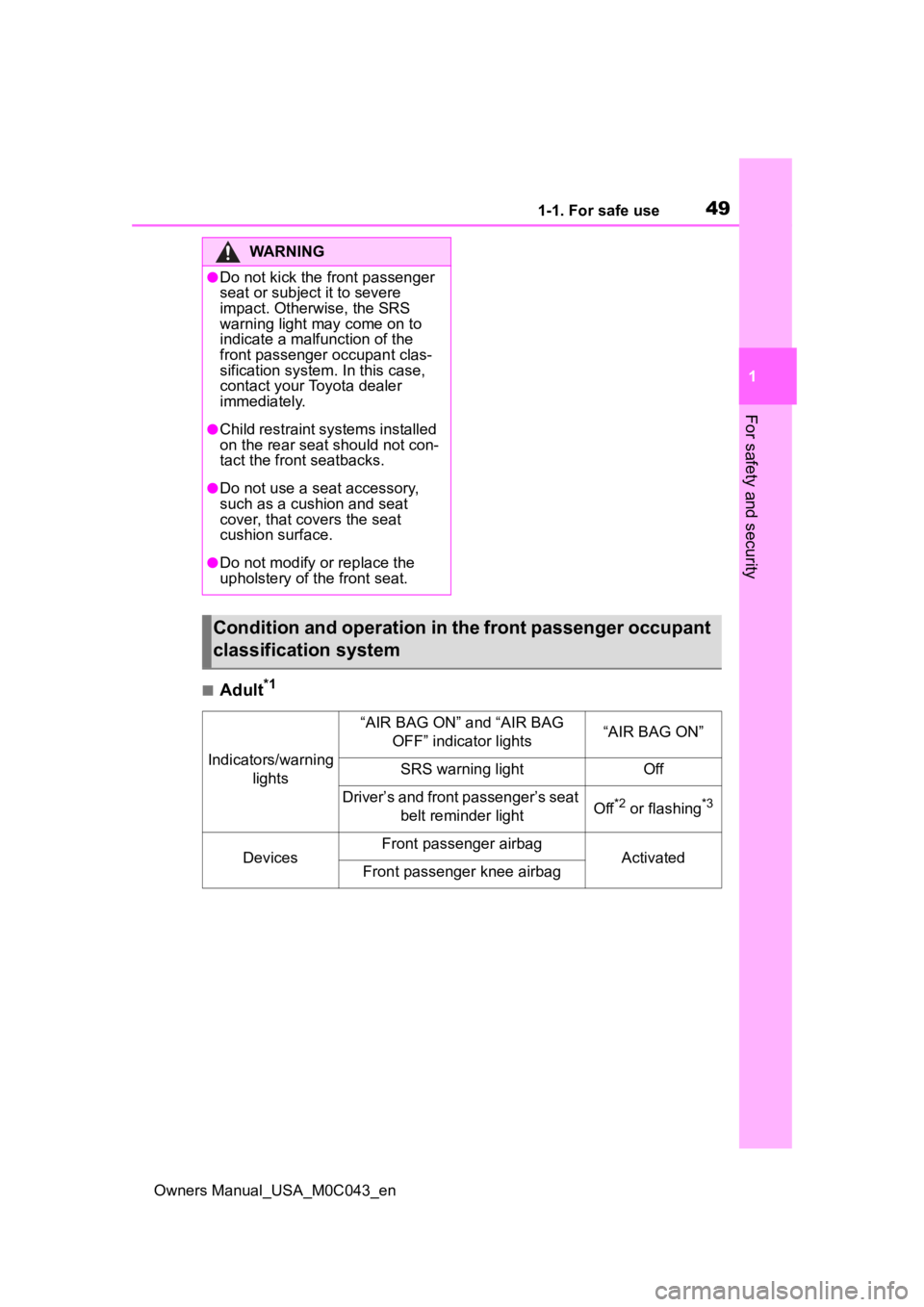
■Adult*1
WARNING
●Do not kick the front passenger
seat or subject it to severe
impact. Otherwise, the SRS
warning light may come on to
indicate a malfunction of the
front passenger occupant clas-
sification system. In this case,
contact your Toyota dealer
immediately.
●Child restraint systems installed
on the rear seat should not con-
tact the front seatbacks.
●Do not use a seat accessory,
such as a cushion and seat
cover, that covers the seat
cushion surface.
●Do not modify or replace the
upholstery of the front seat.
Condition and operation in the front passenger occupant
classification system
Indicators/warning lights
“AIR BAG ON” and “AIR BAG OFF” indicator lights“AIR BAG ON”
SRS warning lightOff
Driver’s and front passenger’s seat belt reminder lightOff*2 or flashing*3
DevicesFront passenger airbagActivatedFront passenger knee airbag
Page 72 of 628
721-3. Emergency assistance
Owners Manual_USA_M0C043_en
When the power switch is turned
to ON, the red indicator light
comes on for 2 seconds then
turns off. Afterward, the green
indicator light comes on, indicat-
ing that the service is active.
The following indicator light pat-
terns indicate specific system
usage conditions:
Green indicator light on =
Active service
Green indicator light flashing
= Safety Connect call in pro-
cess
Red indicator light (except at
vehicle start-up) = System
malfunction (contact your Toy-
ota dealer)
No indicator light (off) =
Safety Connect service not
active
■Automatic Collision Notifi-
cation
In case of either airbag deploy-
ment or severe rear-end colli-
sion, the system is designed to
automatically call the response
center. The responding agent
receives the vehicle’s location
and attempts to speak with the
vehicle occupants to assess the
level of emergency. If the occu- pants are unable to communi-
cate, the agent automatically
treats the call as an emergency,
contacts the nearest emer-
gency services provider to
describe the situation, and
requests that assistance be sent
to the location.
■Stolen Vehicle Location
If your vehicle is stolen, Safety
Connect can work with local
authorities to assist them in
locating and recovering the
vehicle. After filing a police
report, call the Safety Connect
response center at 1-800-331-
4331 in the United States, 1-
877-855-8377 in Puerto Rico or
1-888-869-6828 in Canada, and
follow the prompts for Safety
Connect to initiate this service.
In addition to assisting law
enforcement with recovery of a
stolen vehicle, Safety-Connect-
equipped vehicle location data
may, under certain circum-
stances, be shared with third
parties to locate your vehicle.
Further information is available
at Toyota.com.
■Emergency Assistance But-
ton (“SOS”)
In the event of an emergency on
the road, push the “SOS” button
to reach the Safety Connect
response center. The answer-
ing agent will determine your
vehicle’s location, assess the
emergency, and dispatch the
Safety Connect LED light
Indicators
Safety Connect services
Page 78 of 628
781-4. Hybrid system
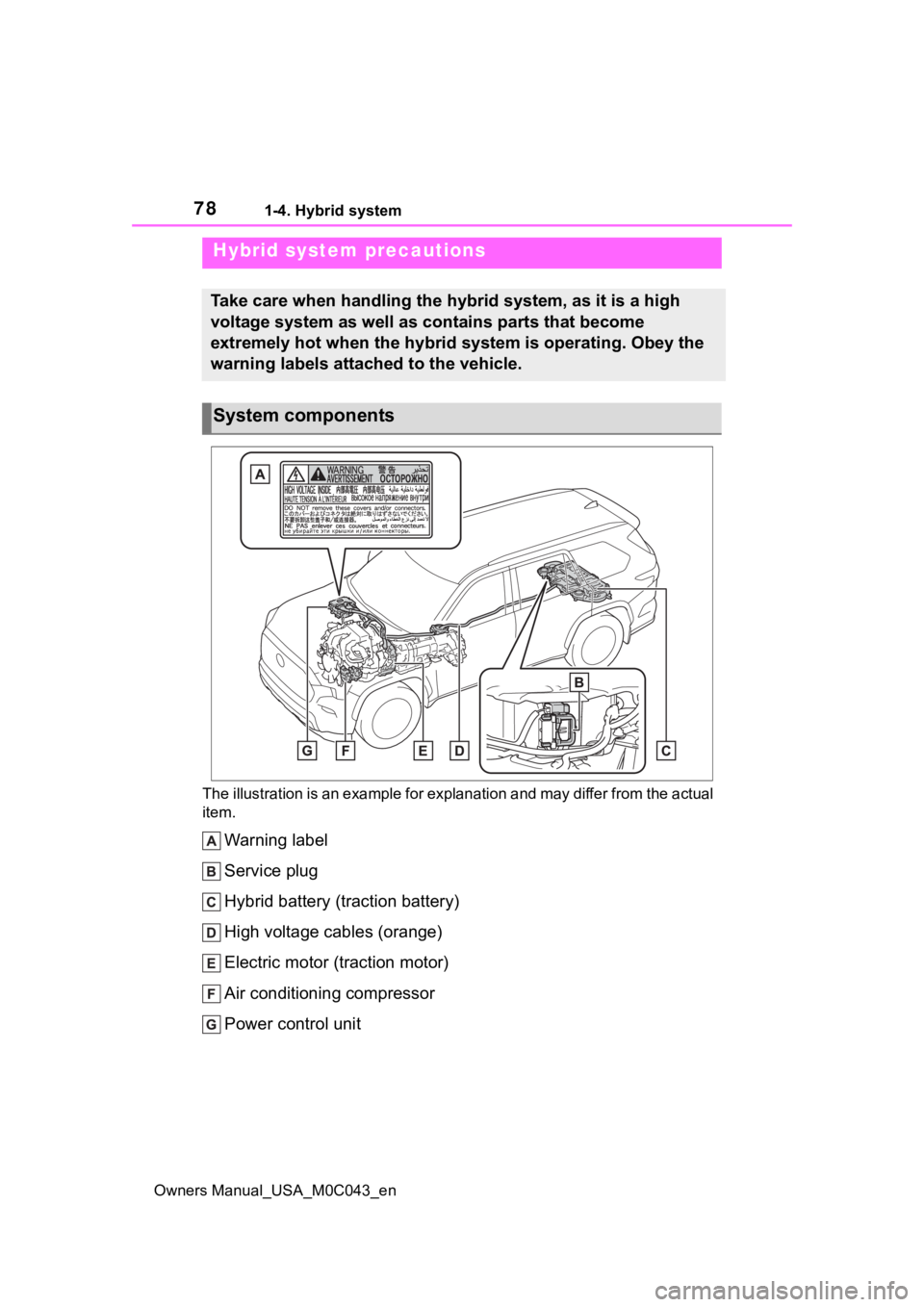
Owners Manual_USA_M0C043_enThe illustration is an example fo
r explanation and may differ from the actual
item.
Warning label
Service plug
Hybrid battery (traction battery)
High voltage cables (orange)
Electric motor (traction motor)
Air conditioning compressor
Power control unit
Hybrid system precautions
Take care when handling the hybrid system, as it is a high
voltage system as well as contains parts that become
extremely hot when the hybrid system is operating. Obey the
warning labels attached to the vehicle.
System components
Page 141 of 628
1413-2. Opening, closing and locking the doors
Owners Manual_USA_M0C043_en
3
Before driving
while the vehicle is not in operation
for a long time.
●In the following situations, the
smart key system may take some
time to unlock the doors.
• The electronic key has been left in an area of approximately 6 ft. (2
m) of the outside of the vehicle for
10 minutes or longer.
• The smart key system has not been used for 5 days or longer.
●If the smart key system has not
been used for 14 days or longer,
the doors canno t be unlocked at
any doors except the driver’s door.
In this case, take hold of the
driver’s door handle, or use the
wireless remote control or the
mechanical key, to unlock the
doors.
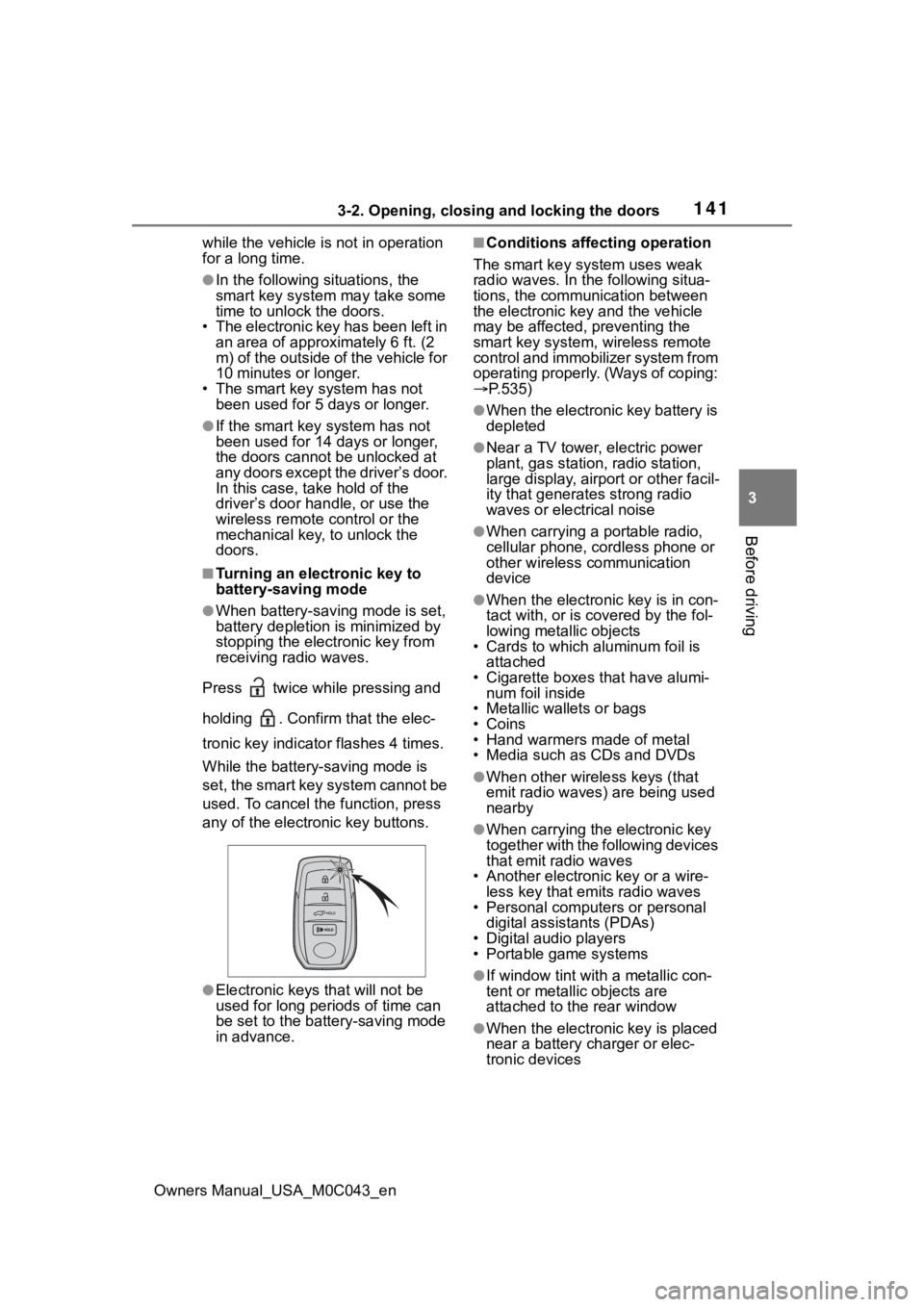
■Turning an electronic key to
battery-saving mode
●When battery-saving mode is set,
battery depletion is minimized by
stopping the electronic key from
receiving radio waves.
Press twice while pressing and
holding . Confirm that the elec-
tronic key indicator flashes 4 times.
While the battery-saving mode is
set, the smart key system cannot be
used. To cancel the function, press
any of the electronic key buttons.
●Electronic keys that will not be
used for long periods of time can
be set to the battery-saving mode
in advance.
■Conditions affecting operation
The smart key system uses weak
radio waves. In the following situa-
tions, the communication between
the electronic key and the vehicle
may be affected, preventing the
smart key system, wireless remote
control and immobilizer system from
operating properly. (Ways of coping:
P.535)
●When the electronic key battery is
depleted
●Near a TV tower, electric power
plant, gas station, radio station,
large display, airpo rt or other facil-
ity that generates strong radio
waves or electrical noise
●When carrying a portable radio,
cellular phone, cordless phone or
other wireless communication
device
●When the electronic key is in con-
tact with, or is c overed by the fol-
lowing metallic objects
• Cards to which aluminum foil is
attached
• Cigarette boxes that have alumi- num foil inside
• Metallic wallets or bags
•Coins
• Hand warmers made of metal
• Media such as CDs and DVDs
●When other wirel ess keys (that
emit radio waves) are being used
nearby
●When carrying the electronic key
together with the following devices
that emit radio waves
• Another electronic key or a wire- less key that emits radio waves
• Personal computers or personal
digital assistants (PDAs)
• Digital audio players
• Portable game systems
●If window tint wit h a metallic con-
tent or metallic objects are
attached to the rear window
●When the electronic key is placed
near a battery charger or elec-
tronic devices