engine TOYOTA SIENNA 2007 Service Repair Manual
[x] Cancel search | Manufacturer: TOYOTA, Model Year: 2007, Model line: SIENNA, Model: TOYOTA SIENNA 2007Pages: 3000, PDF Size: 52.26 MB
Page 333 of 3000
2GR-FE ENGINE CONTROL SYSTEM – SFI SYSTEMES–405
ES
DESCRIPTION
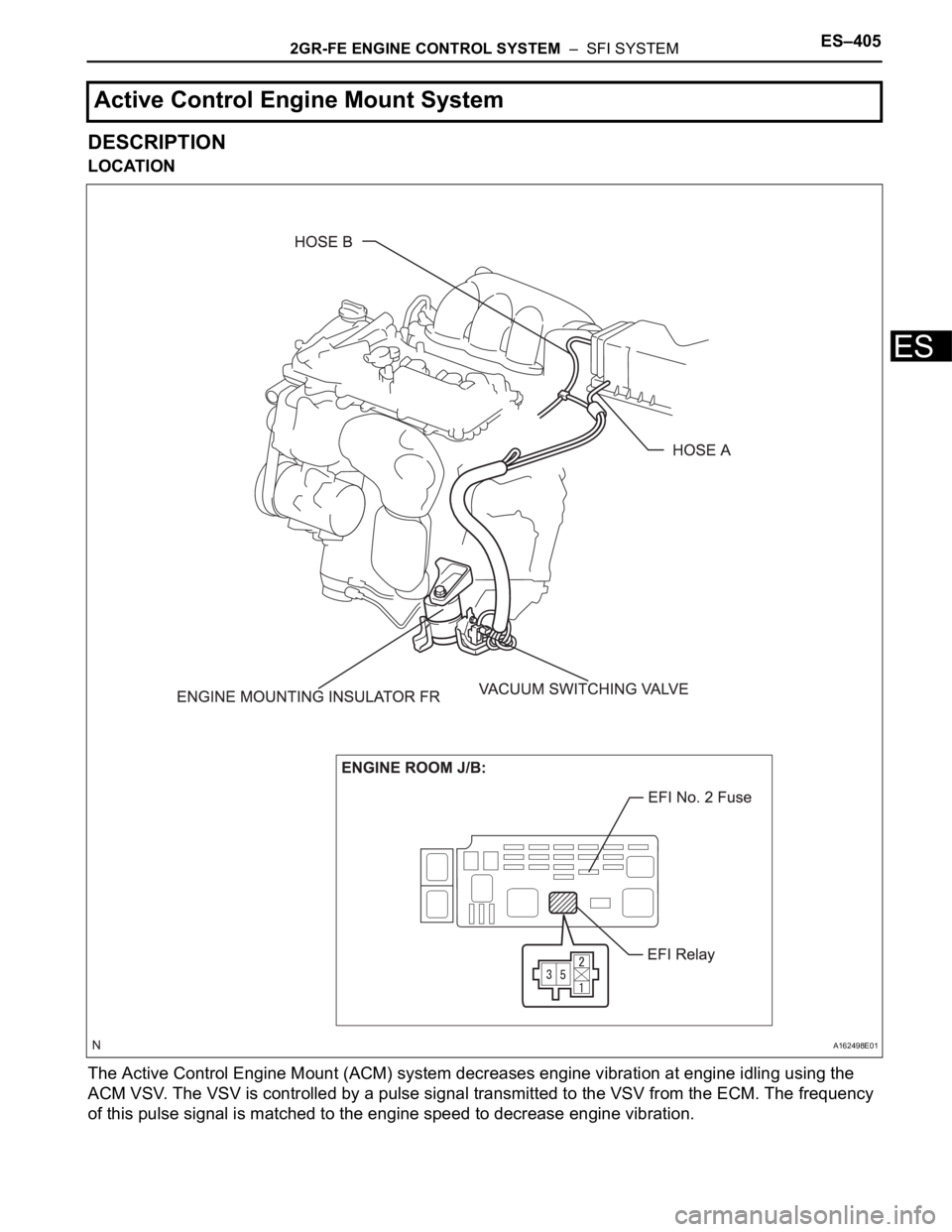
LOCATION
The Active Control Engine Mount (ACM) system decreases engine vibration at engine idling using the
ACM VSV. The VSV is controlled by a pulse signal transmitted to the VSV from the ECM. The frequency
of this pulse signal is matched to the engine speed to decrease engine vibration.
Active Control Engine Mount System
A162498E01
Page 334 of 3000
ES–4062GR-FE ENGINE CONTROL SYSTEM – SFI SYSTEM
ES
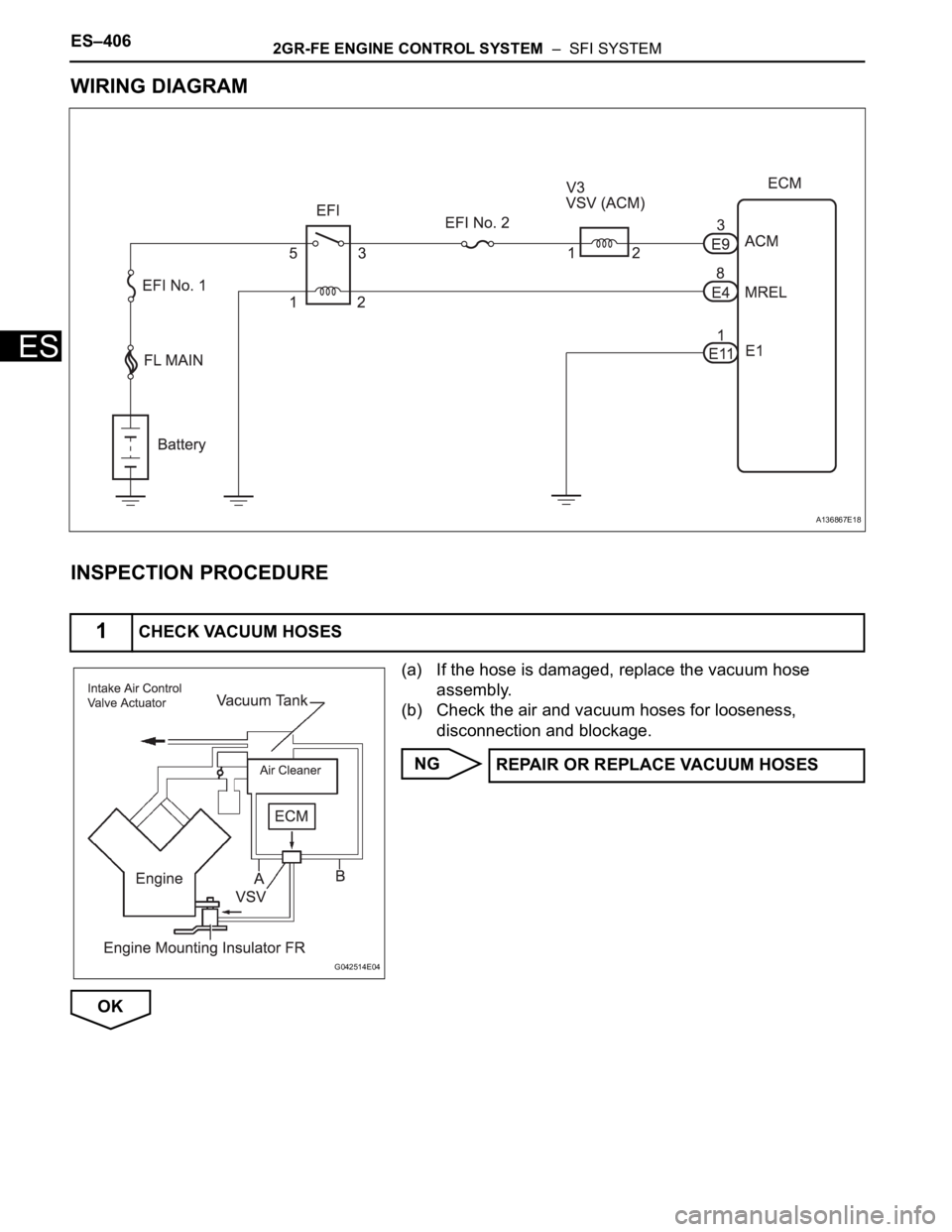
WIRING DIAGRAM
INSPECTION PROCEDURE
(a) If the hose is damaged, replace the vacuum hose
assembly.
(b) Check the air and vacuum hoses for looseness,
disconnection and blockage.
NG
OK
1CHECK VACUUM HOSES
A136867E18
G042514E04
REPAIR OR REPLACE VACUUM HOSES
Page 335 of 3000
2GR-FE ENGINE CONTROL SYSTEM – SFI SYSTEMES–407
ES
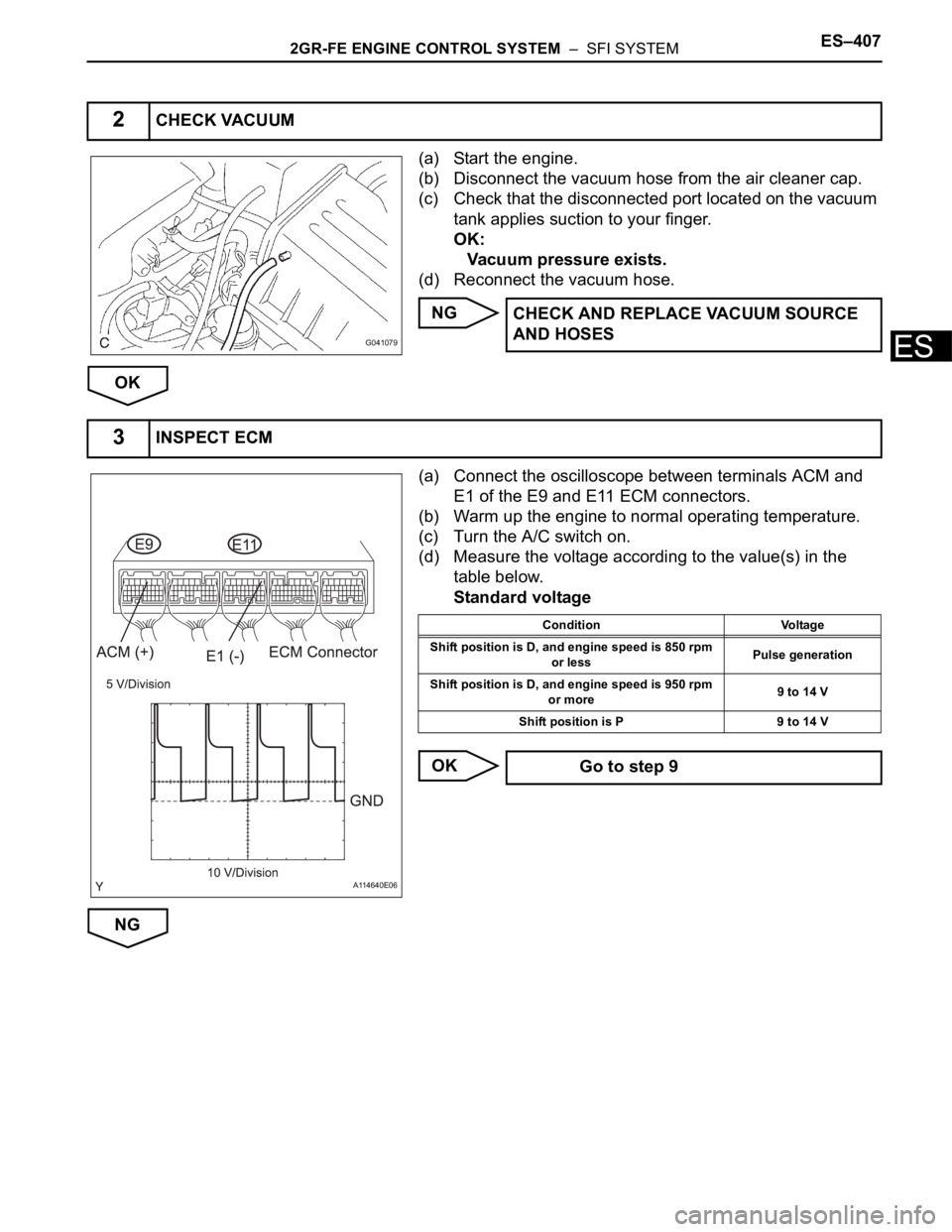
(a) Start the engine.
(b) Disconnect the vacuum hose from the air cleaner cap.
(c) Check that the disconnected port located on the vacuum
tank applies suction to your finger.
OK:
Vacuum pressure exists.
(d) Reconnect the vacuum hose.
NG
OK
(a) Connect the oscilloscope between terminals ACM and
E1 of the E9 and E11 ECM connectors.
(b) Warm up the engine to normal operating temperature.
(c) Turn the A/C switch on.
(d) Measure the voltage according to the value(s) in the
table below.
Standard voltage
OK
NG
2CHECK VACUUM
G041079
CHECK AND REPLACE VACUUM SOURCE
AND HOSES
3INSPECT ECM
A114640E06
Condition Voltage
Shift position is D, and engine speed is 850 rpm
or lessPulse generation
Shift position is D, and engine speed is 950 rpm
or more9 to 14 V
Shift position is P 9 to 14 V
Go to step 9
Page 336 of 3000
ES–4082GR-FE ENGINE CONTROL SYSTEM – SFI SYSTEM
ES
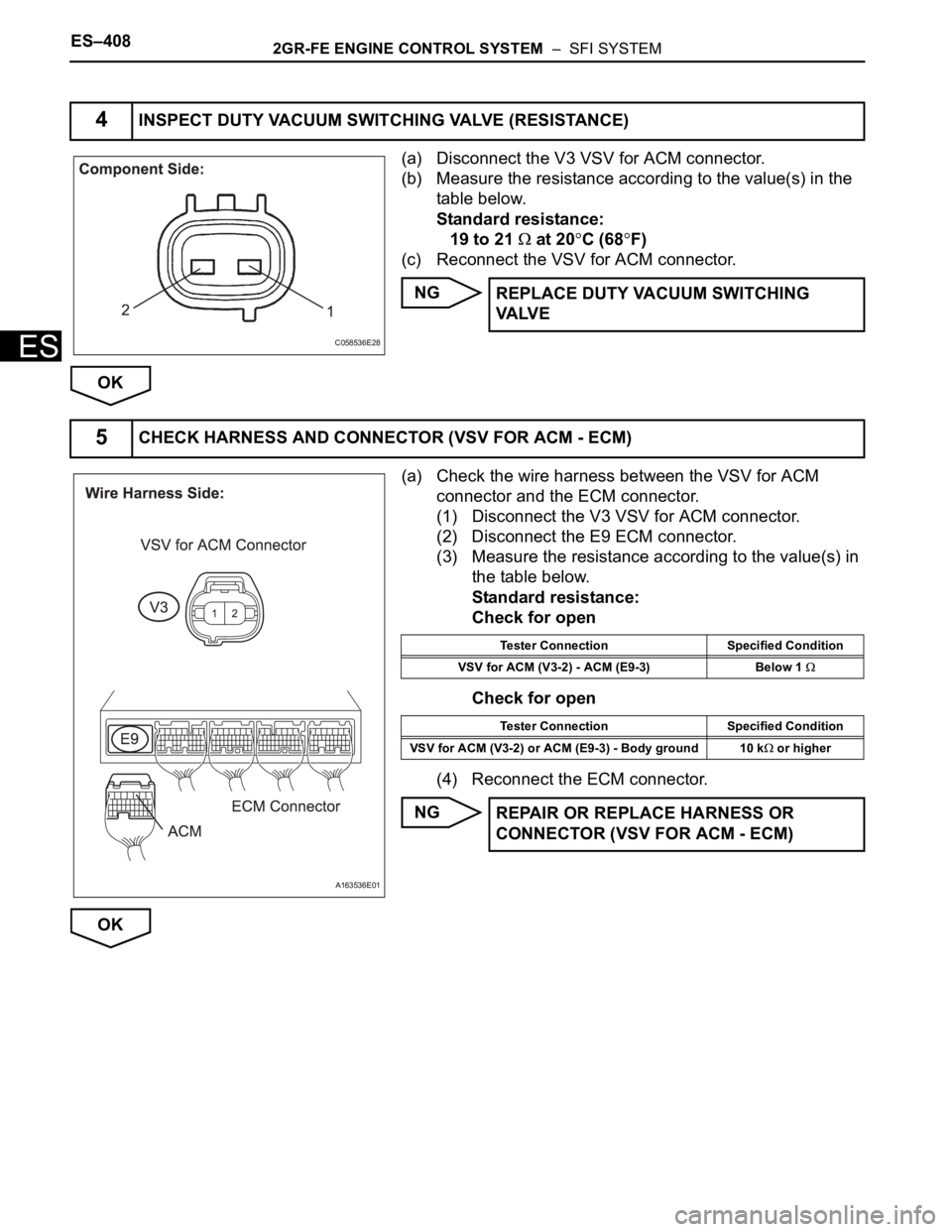
(a) Disconnect the V3 VSV for ACM connector.
(b) Measure the resistance according to the value(s) in the
table below.
Standard resistance:
19 to 21
at 20C (68F)
(c) Reconnect the VSV for ACM connector.
NG
OK
(a) Check the wire harness between the VSV for ACM
connector and the ECM connector.
(1) Disconnect the V3 VSV for ACM connector.
(2) Disconnect the E9 ECM connector.
(3) Measure the resistance according to the value(s) in
the table below.
Standard resistance:
Check for open
Check for open
(4) Reconnect the ECM connector.
NG
OK
4INSPECT DUTY VACUUM SWITCHING VALVE (RESISTANCE)
C058536E28
REPLACE DUTY VACUUM SWITCHING
VA LV E
5CHECK HARNESS AND CONNECTOR (VSV FOR ACM - ECM)
A163536E01
Tester Connection Specified Condition
VSV for ACM (V3-2) - ACM (E9-3) Below 1
Tester Connection Specified Condition
VSV for ACM (V3-2) or ACM (E9-3) - Body ground 10 k
or higher
REPAIR OR REPLACE HARNESS OR
CONNECTOR (VSV FOR ACM - ECM)
Page 337 of 3000
2GR-FE ENGINE CONTROL SYSTEM – SFI SYSTEMES–409
ES
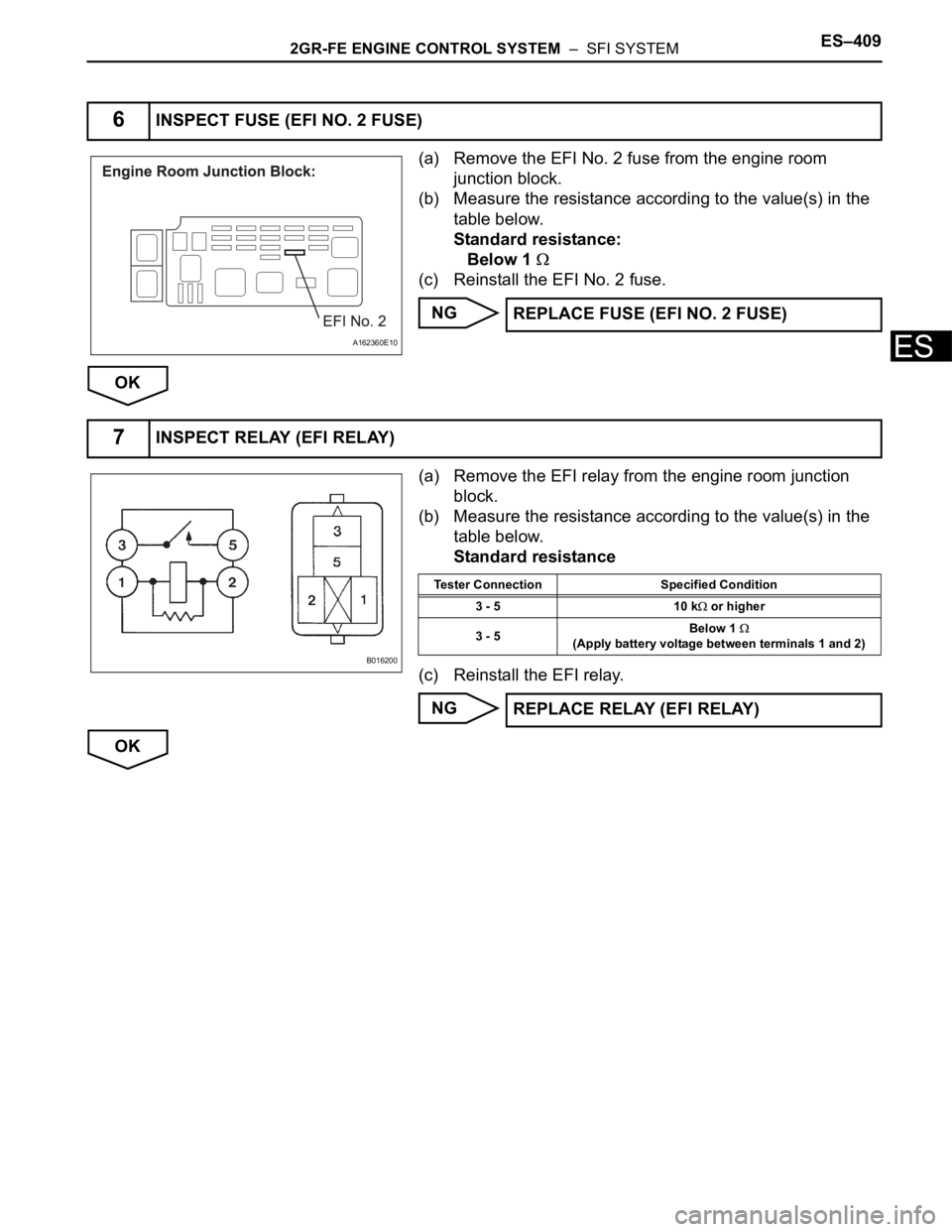
(a) Remove the EFI No. 2 fuse from the engine room
junction block.
(b) Measure the resistance according to the value(s) in the
table below.
Standard resistance:
Below 1
(c) Reinstall the EFI No. 2 fuse.
NG
OK
(a) Remove the EFI relay from the engine room junction
block.
(b) Measure the resistance according to the value(s) in the
table below.
Standard resistance
(c) Reinstall the EFI relay.
NG
OK
6INSPECT FUSE (EFI NO. 2 FUSE)
A162360E10
REPLACE FUSE (EFI NO. 2 FUSE)
7INSPECT RELAY (EFI RELAY)
B016200
Tester Connection Specified Condition
3 - 5 10 k
or higher
3 - 5Below 1
(Apply battery voltage between terminals 1 and 2)
REPLACE RELAY (EFI RELAY)
Page 338 of 3000
ES–4102GR-FE ENGINE CONTROL SYSTEM – SFI SYSTEM
ES
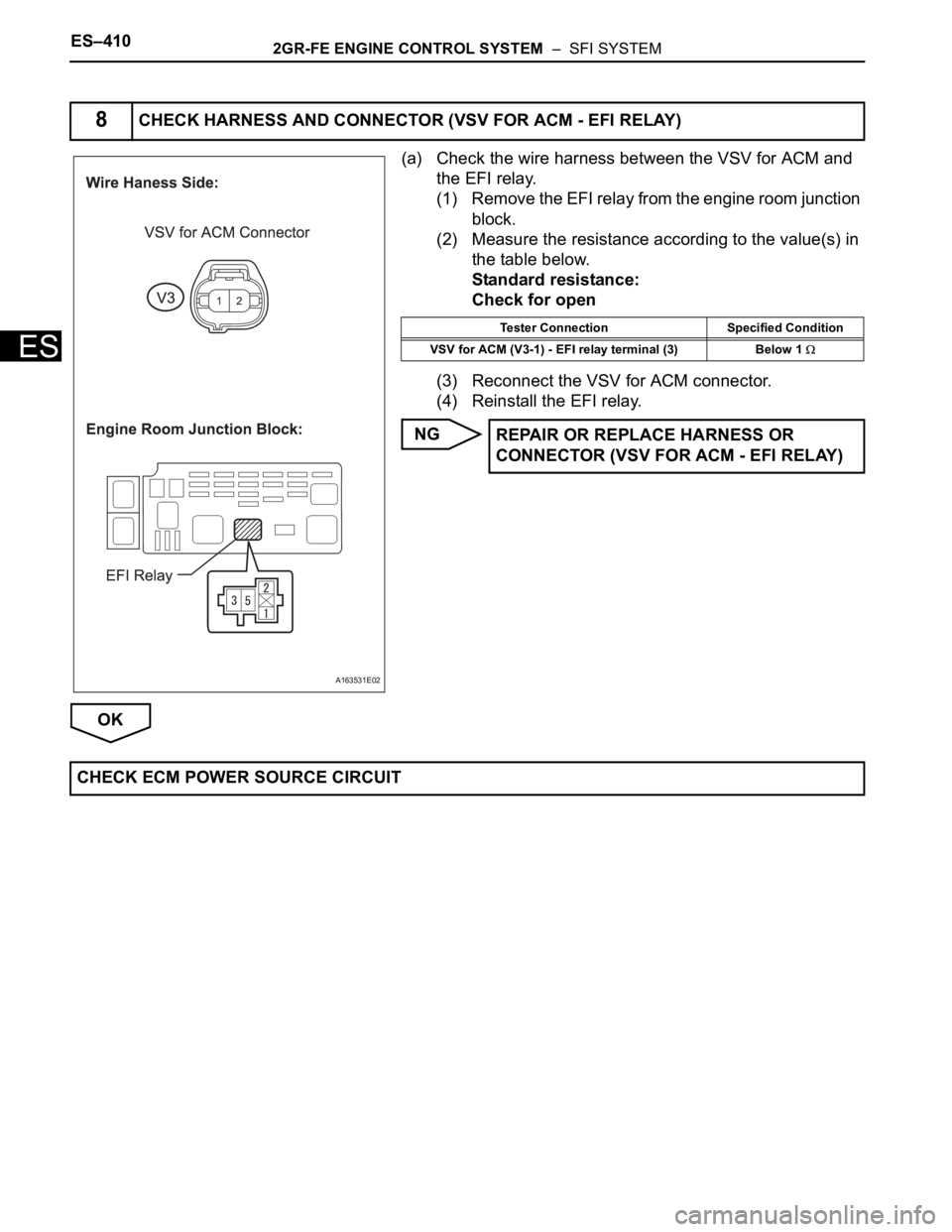
(a) Check the wire harness between the VSV for ACM and
the EFI relay.
(1) Remove the EFI relay from the engine room junction
block.
(2) Measure the resistance according to the value(s) in
the table below.
Standard resistance:
Check for open
(3) Reconnect the VSV for ACM connector.
(4) Reinstall the EFI relay.
NG
OK
8CHECK HARNESS AND CONNECTOR (VSV FOR ACM - EFI RELAY)
A163531E02
Tester Connection Specified Condition
VSV for ACM (V3-1) - EFI relay terminal (3) Below 1
REPAIR OR REPLACE HARNESS OR
CONNECTOR (VSV FOR ACM - EFI RELAY)
CHECK ECM POWER SOURCE CIRCUIT
Page 339 of 3000
2GR-FE ENGINE CONTROL SYSTEM – SFI SYSTEMES–411
ES
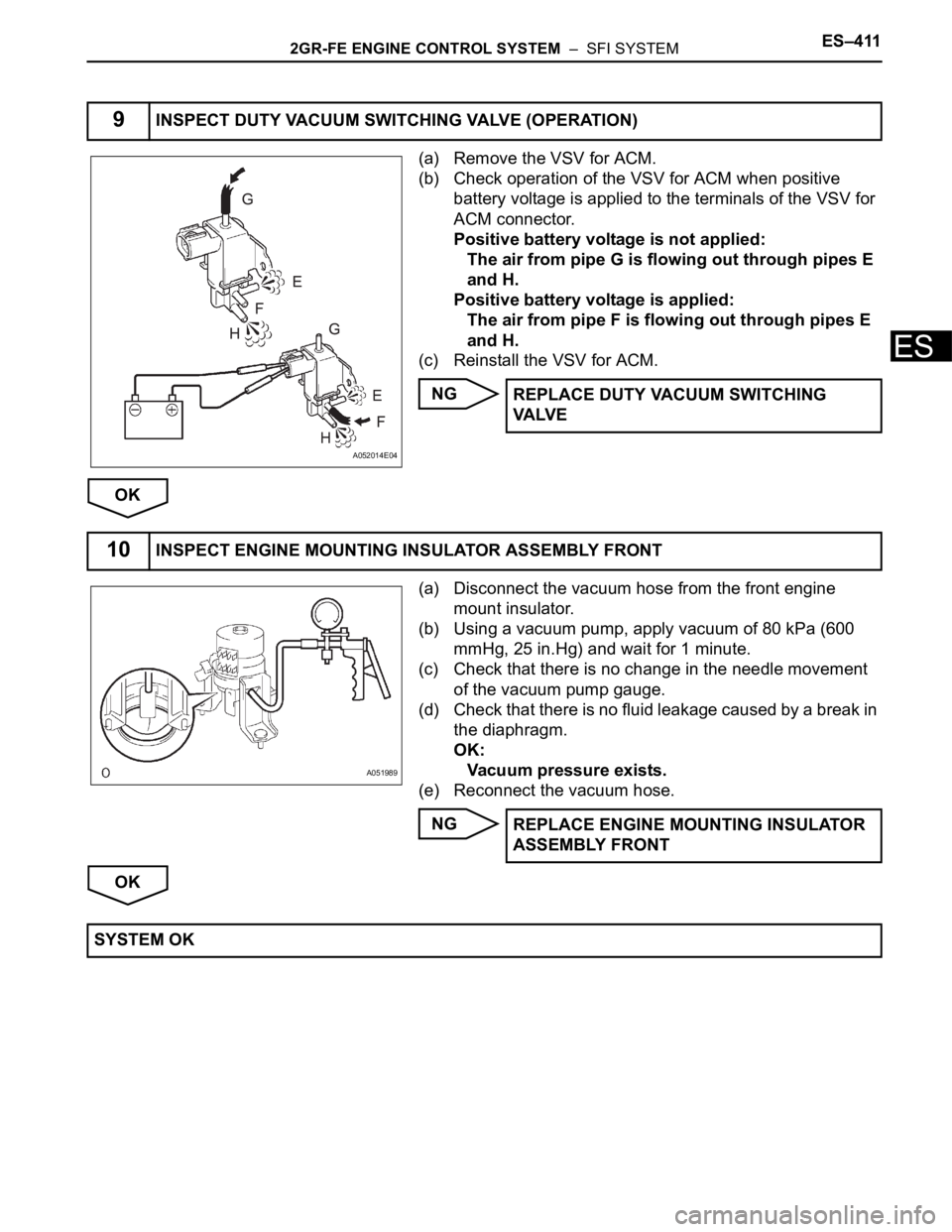
(a) Remove the VSV for ACM.
(b) Check operation of the VSV for ACM when positive
battery voltage is applied to the terminals of the VSV for
ACM connector.
Positive battery voltage is not applied:
The air from pipe G is flowing out through pipes E
and H.
Positive battery voltage is applied:
The air from pipe F is flowing out through pipes E
and H.
(c) Reinstall the VSV for ACM.
NG
OK
(a) Disconnect the vacuum hose from the front engine
mount insulator.
(b) Using a vacuum pump, apply vacuum of 80 kPa (600
mmHg, 25 in.Hg) and wait for 1 minute.
(c) Check that there is no change in the needle movement
of the vacuum pump gauge.
(d) Check that there is no fluid leakage caused by a break in
the diaphragm.
OK:
Vacuum pressure exists.
(e) Reconnect the vacuum hose.
NG
OK
9INSPECT DUTY VACUUM SWITCHING VALVE (OPERATION)
A052014E04
REPLACE DUTY VACUUM SWITCHING
VA LV E
10INSPECT ENGINE MOUNTING INSULATOR ASSEMBLY FRONT
A051989
REPLACE ENGINE MOUNTING INSULATOR
ASSEMBLY FRONT
SYSTEM OK
Page 340 of 3000
ES–142GR-FE ENGINE CONTROL SYSTEM – SFI SYSTEM
ES
CHECK FOR INTERMITTENT
PROBLEMS
1. CHECK FOR INTERMITTENT PROBLEMS
HINT:
For use of the intelligent tester only:
Inspect the vehicle's ECM using check mode.
Intermittent problems are easier to detect with an
intelligent tester when the ECM is in check mode. In
check mode, the ECM uses 1 trip detection logic, which
is more sensitive to malfunctions than normal mode
(default), which uses 2 trip detection logic.
(a) Clear the DTCs (See page ES-39).
(b) Switch the ECM from normal mode to check mode
using an intelligent tester (See page ES-43).
(c) Perform a simulation test (See page IN-35).
(d) Check and wiggle the harness(es), connector(s)
and terminal(s) (See page IN-30).
Page 341 of 3000
2GR-FE ENGINE CONTROL SYSTEM – SFI SYSTEMES–15
ES
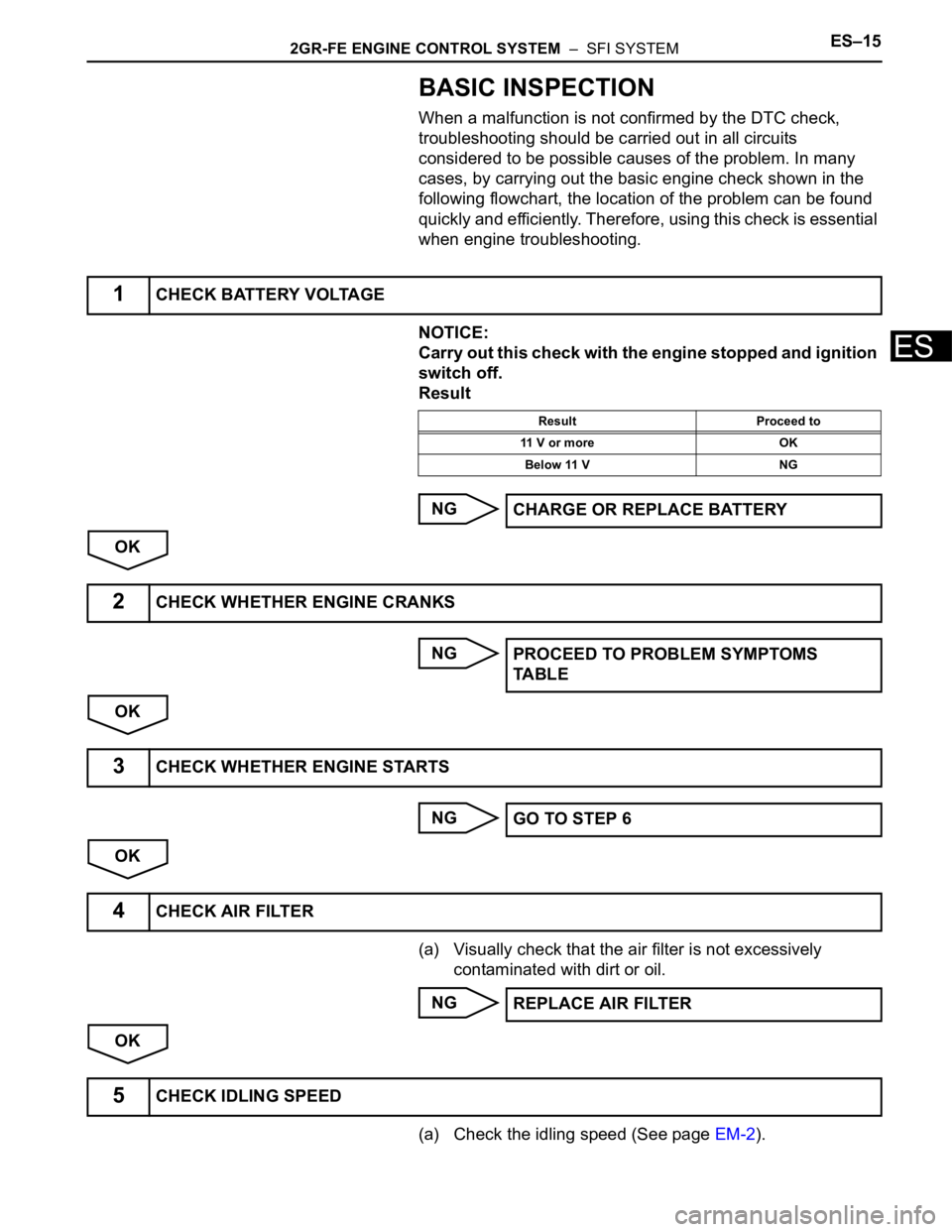
BASIC INSPECTION
When a malfunction is not confirmed by the DTC check,
troubleshooting should be carried out in all circuits
considered to be possible causes of the problem. In many
cases, by carrying out the basic engine check shown in the
following flowchart, the location of the problem can be found
quickly and efficiently. Therefore, using this check is essential
when engine troubleshooting.
NOTICE:
Carry out this check with the engine stopped and ignition
switch off.
Result
NG
OK
NG
OK
NG
OK
(a) Visually check that the air filter is not excessively
contaminated with dirt or oil.
NG
OK
(a) Check the idling speed (See page EM-2).
1CHECK BATTERY VOLTAGE
Result Proceed to
11 V or more OK
Below 11 V NG
CHARGE OR REPLACE BATTERY
2CHECK WHETHER ENGINE CRANKS
PROCEED TO PROBLEM SYMPTOMS
TA B L E
3CHECK WHETHER ENGINE STARTS
GO TO STEP 6
4CHECK AIR FILTER
REPLACE AIR FILTER
5CHECK IDLING SPEED
Page 342 of 3000
ES–162GR-FE ENGINE CONTROL SYSTEM – SFI SYSTEM
ES
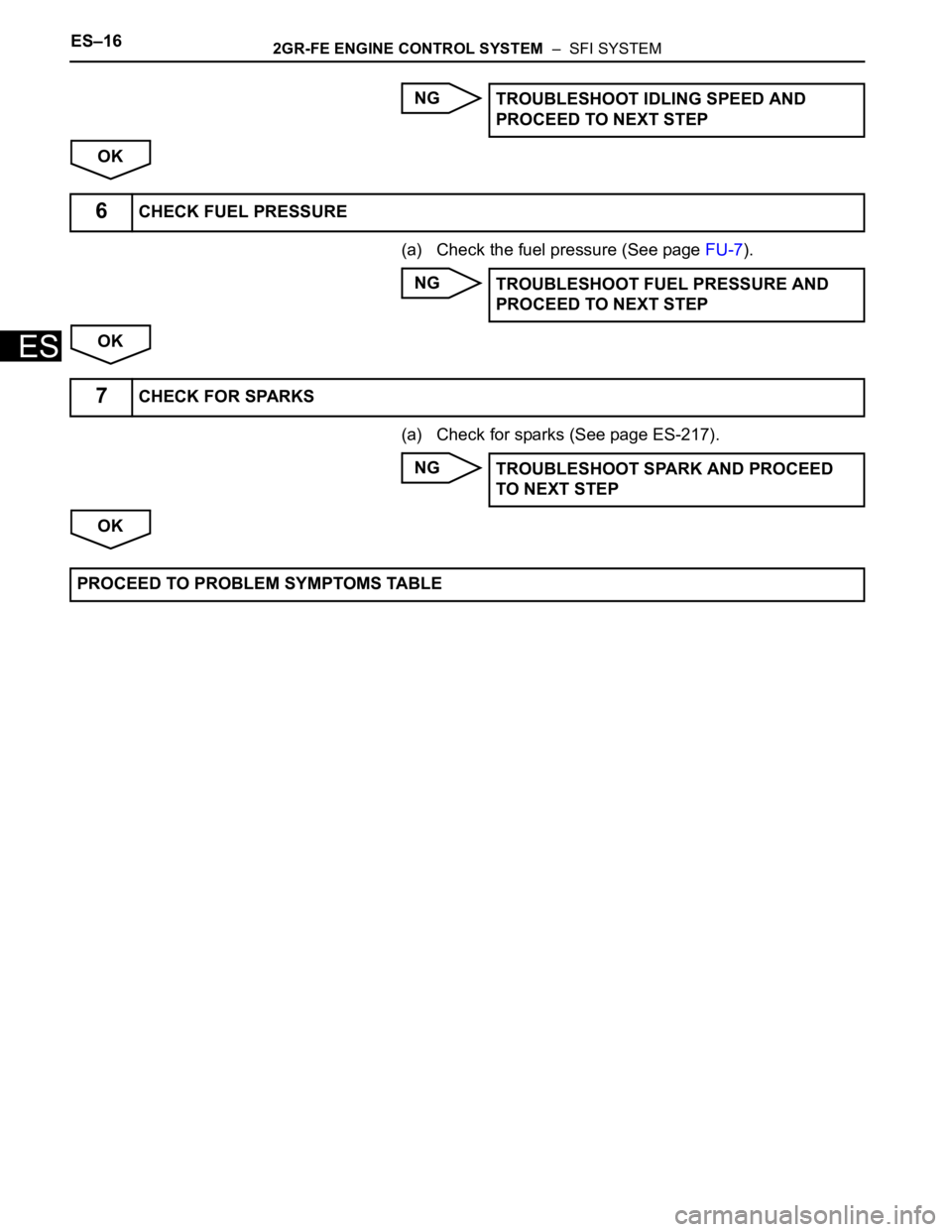
NG
OK
(a) Check the fuel pressure (See page FU-7).
NG
OK
(a) Check for sparks (See page ES-217).
NG
OKTROUBLESHOOT IDLING SPEED AND
PROCEED TO NEXT STEP
6CHECK FUEL PRESSURE
TROUBLESHOOT FUEL PRESSURE AND
PROCEED TO NEXT STEP
7CHECK FOR SPARKS
TROUBLESHOOT SPARK AND PROCEED
TO NEXT STEP
PROCEED TO PROBLEM SYMPTOMS TABLE