sensor TOYOTA SIENNA 2007 Service Repair Manual
[x] Cancel search | Manufacturer: TOYOTA, Model Year: 2007, Model line: SIENNA, Model: TOYOTA SIENNA 2007Pages: 3000, PDF Size: 52.26 MB
Page 561 of 3000

ES–2682GR-FE ENGINE CONTROL SYSTEM – SFI SYSTEM
ESKey-off monitor sequence 1 to 8
1. Atmospheric pressure measurement
2. First reference pressure measurement
3. EVAP canister vent valve close stuck check
4. Vacuum introduction
5. EVAP canister purge valve close stuck check
6. Second reference pressure measurement
7. Leak check
8. Atmospheric pressure measurement
Time after key-off 5 or 7 or 9.5 hours
EVAP pressure sensor malfunction (P0450, P0451,
P0452, P0453)Not detected
EVAP canister purge valve Not operated by scan tool
EVAP canister vent valve Not operated by scan tool
EVAP leak detection pump Not operated by scan tool
Both of the following conditions 1 and 2 are met before
key-off-
1. Duration that vehicle driven 5 minutes or more
2. EVAP purge operation Performed
ECT 4.4 to 35
C (40 to 95F)
IAT 4.4 to 35
C (40 to 95F)
Next sequence is run if the following condition is met: -
Atmospheric pressure change Less than 0.3 kPa (2.25 mmHg) in 1 second
Next sequence is run if all of the following conditions
are met:Conditions 1, 2 and 3
1. EVAP pressure just after reference pressure
measurement-1 kPa (-7.5 mmHg) or less
2. Reference pressure -4.85 to -1.057 kPa (-36.384 to -7.929 mmHg)
3. Reference pressure Saturated within 1 minute
Next sequence is run if the following condition is met: -
EVAP pressure change after vent valve is ON 0.3 kPa (2.25 mmHg) or more
Next sequence is run if the following condition is met: -
EVAP pressure Saturated within 15 minutes
Next sequence is run if the following condition is met: -
EVAP pressure change after purge valve is open 0.3 kPa (2.25 mmHg) or more
Next sequence is run if all of the following conditions
are met:Conditions 1, 2, 3 and 4
1. EVAP pressure just after reference pressure
measurement-1 kPa (-7.5 mmHg) or less
2. Reference pressure -4.85 to -1.057 kPa (-36.384 to -7.929 mmHg)
3. Reference pressure Saturated
4. Difference between first reference pressure and
second reference pressureLess than 0.7 kPa (5.25 mmHg)
Next sequence is run if the following condition is met -
EVAP pressure when vacuum introduction was
completeLower than second reference pressure
EVAP monitor is complete if the following condition is
met:-
Page 566 of 3000
2GR-FE ENGINE CONTROL SYSTEM – SFI SYSTEMES–273
ES
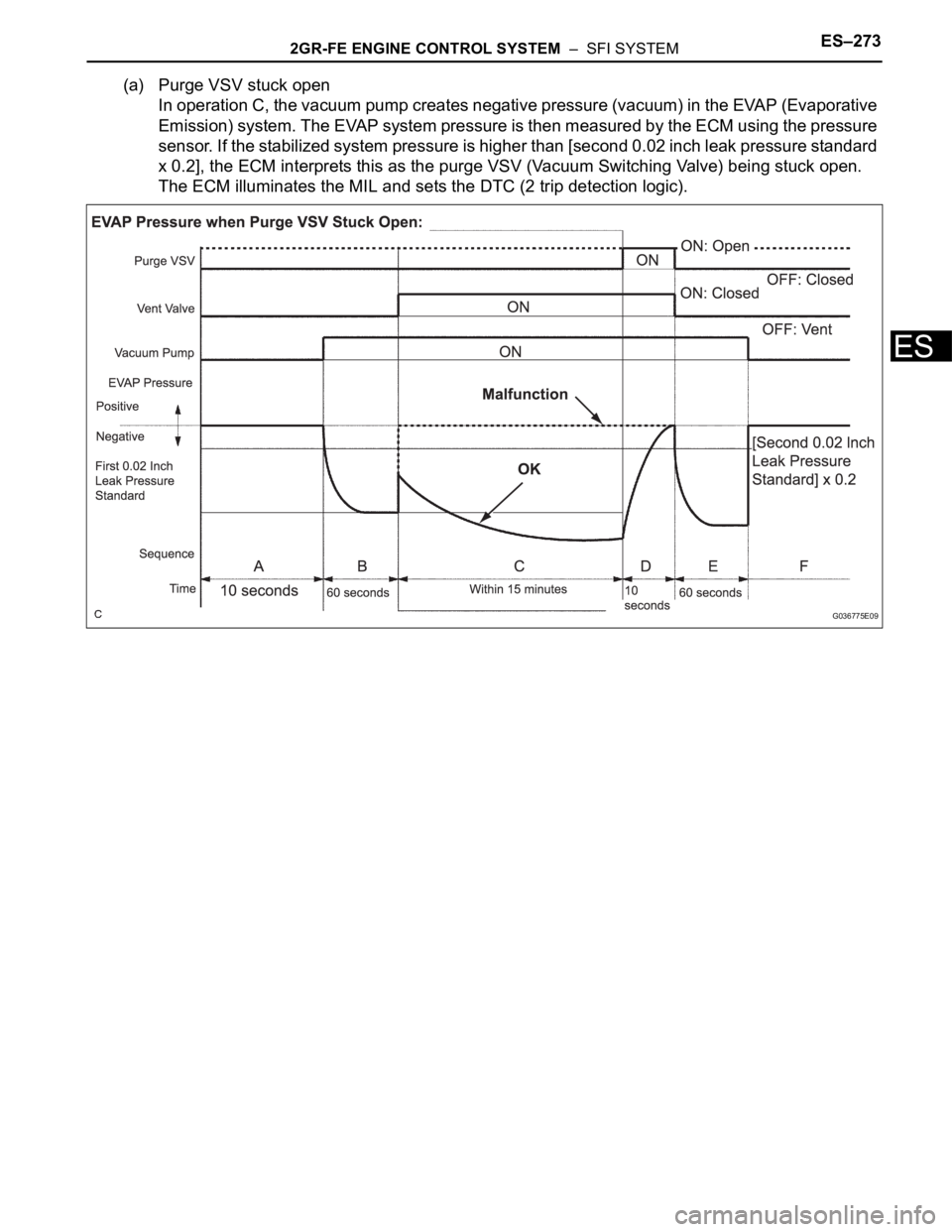
(a) Purge VSV stuck open
In operation C, the vacuum pump creates negative pressure (vacuum) in the EVAP (Evaporative
Emission) system. The EVAP system pressure is then measured by the ECM using the pressure
sensor. If the stabilized system pressure is higher than [second 0.02 inch leak pressure standard
x 0.2], the ECM interprets this as the purge VSV (Vacuum Switching Valve) being stuck open.
The ECM illuminates the MIL and sets the DTC (2 trip detection logic).
G036775E09
Page 567 of 3000
ES–2742GR-FE ENGINE CONTROL SYSTEM – SFI SYSTEM
ES
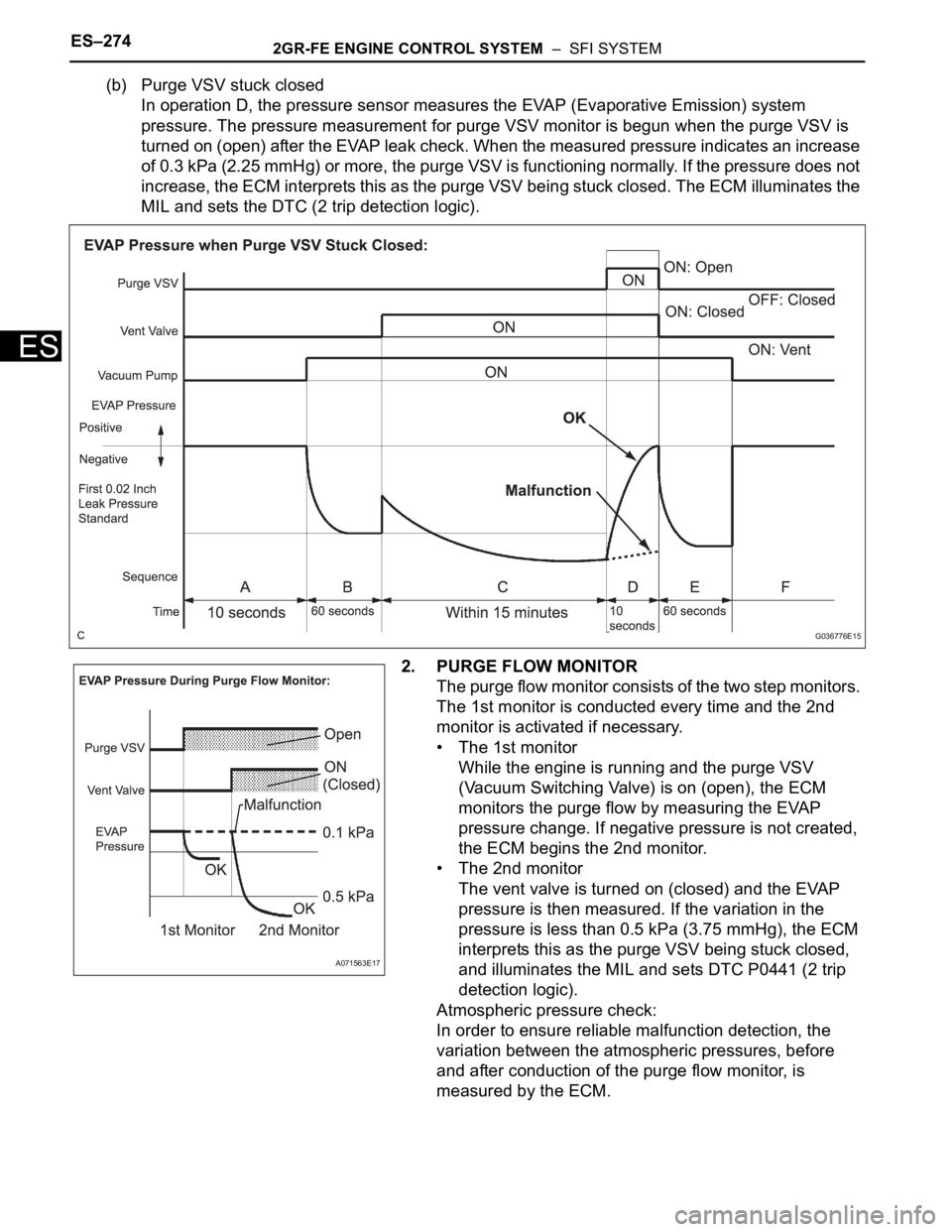
(b) Purge VSV stuck closed
In operation D, the pressure sensor measures the EVAP (Evaporative Emission) system
pressure. The pressure measurement for purge VSV monitor is begun when the purge VSV is
turned on (open) after the EVAP leak check. When the measured pressure indicates an increase
of 0.3 kPa (2.25 mmHg) or more, the purge VSV is functioning normally. If the pressure does not
increase, the ECM interprets this as the purge VSV being stuck closed. The ECM illuminates the
MIL and sets the DTC (2 trip detection logic).
2. PURGE FLOW MONITOR
The purge flow monitor consists of the two step monitors.
The 1st monitor is conducted every time and the 2nd
monitor is activated if necessary.
• The 1st monitor
While the engine is running and the purge VSV
(Vacuum Switching Valve) is on (open), the ECM
monitors the purge flow by measuring the EVAP
pressure change. If negative pressure is not created,
the ECM begins the 2nd monitor.
• The 2nd monitor
The vent valve is turned on (closed) and the EVAP
pressure is then measured. If the variation in the
pressure is less than 0.5 kPa (3.75 mmHg), the ECM
interprets this as the purge VSV being stuck closed,
and illuminates the MIL and sets DTC P0441 (2 trip
detection logic).
Atmospheric pressure check:
In order to ensure reliable malfunction detection, the
variation between the atmospheric pressures, before
and after conduction of the purge flow monitor, is
measured by the ECM.
G036776E15
A071563E17
Page 568 of 3000

2GR-FE ENGINE CONTROL SYSTEM – SFI SYSTEMES–275
ES
MONITOR STRATEGY
TYPICAL ENABLING CONDITIONS
All:
Purge flow:
Purge VSV stuck open and closed:
Key-off monitor sequence 1 to 8
1. Atmospheric pressure measurement
Related DTCsP0441: Purge VSV stuck open
P0441: Purge VSV stuck closed
P0441: Purge flow
Required Sensors / Components Purge VSV and pump module
Frequency of Operation Once per driving cycle
Duration Within 15 minutes
MIL Operation 2 driving cycles
Sequence of Operation None
The monitor is run whenever this DTC is not presentP0011, P0012 (VVT System 1-Advance, Retard), P0021, P0022 (VVT System 2-
Adavance, Retard), P0100, P0101, P0102, P0103 (MAF Sensor), P0110, P0112,
P0113 (IAT Sensor), P0115, P0116, P0117, P0118 (ECT Sensor), P0120, P0121,
P0122, P0123, P0220, P0222, P0223 , P2135 (TP Sensor), P0125 (Insufficient ECT
for Closed Loop), P0171,P0172 (Fuel System), P0300, P0301, P0302, P0303,
P0304, P0305, P0306 (Misfire), P0335 (CKP Sensor), P0340 (CMP Sensor), P0351,
P0352, P0353, P0354, P0355, P0356 (Ignitor), P0450, P0451, P0452, P0453 (EVAP
pressure Sensor), P0500 (VSS)
Engine Running
ECT 4.4
C (40F) or more
IAT 4.4
C (40F) or more
EVAP pressure sensor Not detected
EVAP canister purge valve Not operated by scan tool
EVAP system check Not operated by scan tool
Battery voltage 10 V or more
Purge duty cycle 8% or more
Atmospheric pressure 70 to 110 kPa (525 to 825 mmHg)
Battery voltage 10.5 V or more
Vehicle speed Less than 2.5 mph (4 km/h)
Ignition switch OFF
Time after key-off 5 or 7 or 9.5 hours
EVAP pressure sensor malfunction (P0450, P0452,
P0453)Not detected
EVAP canister purge valve Not operated by scan tool
EVAP canister vent valve Not operated by scan tool
EVAP leak detection pump Not operated by scan tool
Both of the following conditions 1 and 2 are met before
key-off-
1. Duration that vehicle driven 5 minutes or more
2. EVAP purge operation Performed
ECT 4.4 to 35
C (40 to 95F)
IAT 4.4 to 35
C (40 to 95F)
Next sequence is run if the following condition is met -
Atmospheric pressure change Less than 0.3 kPa (2.25 mmHg) in 1 second
Page 570 of 3000

2GR-FE ENGINE CONTROL SYSTEM – SFI SYSTEMES–277
ES
DTC SUMMARY
HINT:
The canister pressure sensor is built into the canister pump module.
DESCRIPTION
The description can be found in the EVAP (Evaporative Emission) System (See page ES-409).
DTC P0450Evaporative Emission Control System Pressure
Sensor / Switch
DTC P0451Evaporative Emission Control System Pressure
Sensor Range / Performance
DTC P0452Evaporative Emission Control System Pressure
Sensor / Switch Low Input
DTC P0453Evaporative Emission Control System Pressure
Sensor / Switch High Input
DTCs Monitoring ItemMalfunction Detection
ConditionTrouble Area Detection TimingDetection
Logic
P0450Pressure sensor abnormal
voltage fluctuationSensor output voltage rapidly
fluctuates beyond upper and
lower malfunction thresholds for
0.5 seconds.• Pump module
•ECM• EVAP
monitoring
(ignition switch
OFF)
• Ignition switch
ON1 trip
P0451Pressure sensor abnormal
voltage fluctuationSensor output voltage fluctuates
frequently in a certain time period.
• Pump module
• Connector/wire
harness (Pump
module - ECM)
•ECM• EVAP
monitoring
(ignition switch
OFF)
• Engine running2 trip
P0451Pressure sensor constant
voltageSensor output voltage does not
vary in a certain time period.EVAP monitoring
(ignition switch
OFF)2 trip
P0452Pressure sensor voltage
lowSensor output voltage is less than
0.45 V for 0.5 seconds.• Ignition switch
ON
• EVAP
monitoring
(ignition switch
OFF)1 trip
P0453Pressure sensor voltage
highSensor output voltage is more
than 4.9 V for 0.5 seconds.• Ignition switch
ON
• EVAP
monitoring
(ignition switch
OFF)1 trip
Page 571 of 3000
ES–2782GR-FE ENGINE CONTROL SYSTEM – SFI SYSTEM
ES
MONITOR DESCRIPTION
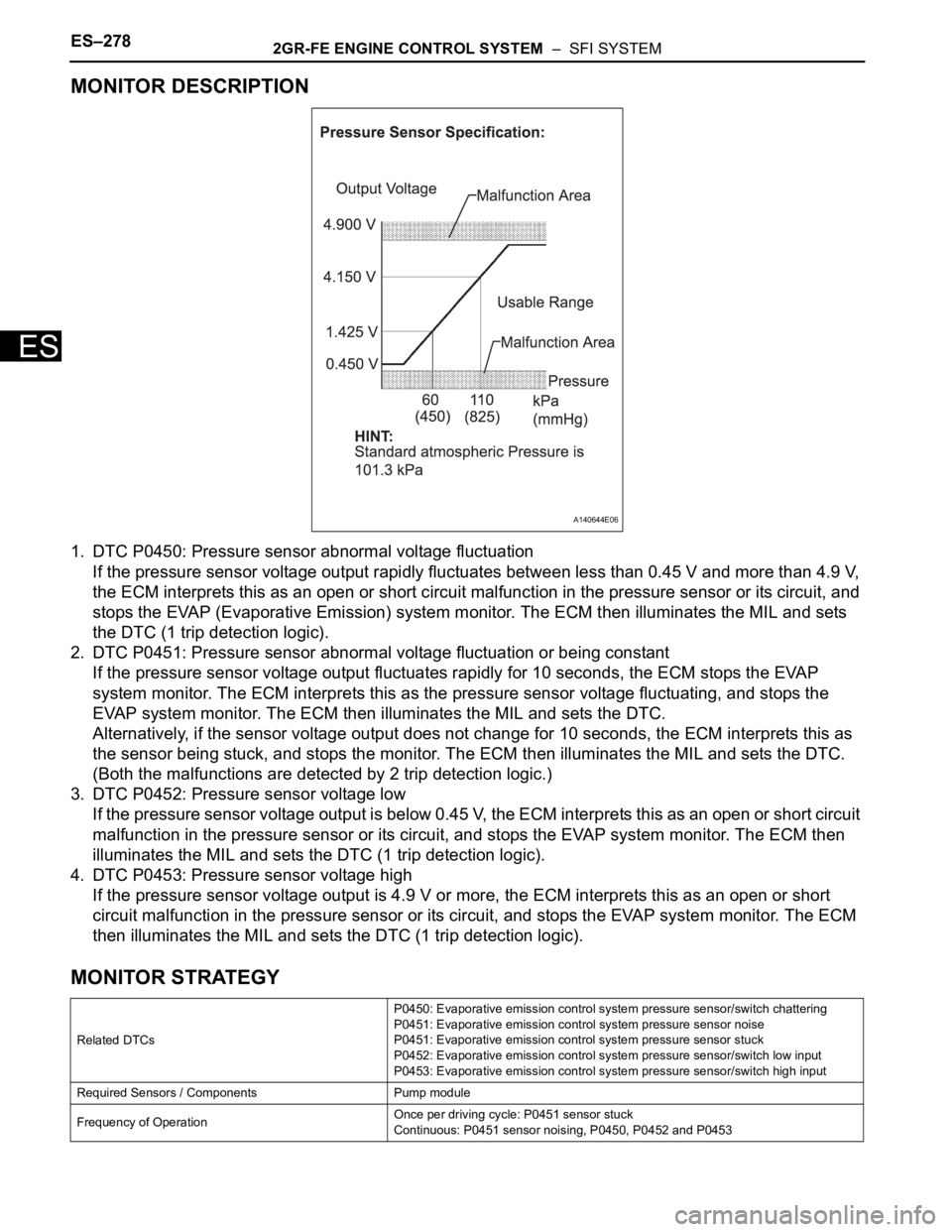
1. DTC P0450: Pressure sensor abnormal voltage fluctuation
If the pressure sensor voltage output rapidly fluctuates between less than 0.45 V and more than 4.9 V,
the ECM interprets this as an open or short circuit malfunction in the pressure sensor or its circuit, and
stops the EVAP (Evaporative Emission) system monitor. The ECM then illuminates the MIL and sets
the DTC (1 trip detection logic).
2. DTC P0451: Pressure sensor abnormal voltage fluctuation or being constant
If the pressure sensor voltage output fluctuates rapidly for 10 seconds, the ECM stops the EVAP
system monitor. The ECM interprets this as the pressure sensor voltage fluctuating, and stops the
EVAP system monitor. The ECM then illuminates the MIL and sets the DTC.
Alternatively, if the sensor voltage output does not change for 10 seconds, the ECM interprets this as
the sensor being stuck, and stops the monitor. The ECM then illuminates the MIL and sets the DTC.
(Both the malfunctions are detected by 2 trip detection logic.)
3. DTC P0452: Pressure sensor voltage low
If the pressure sensor voltage output is below 0.45 V, the ECM interprets this as an open or short circuit
malfunction in the pressure sensor or its circuit, and stops the EVAP system monitor. The ECM then
illuminates the MIL and sets the DTC (1 trip detection logic).
4. DTC P0453: Pressure sensor voltage high
If the pressure sensor voltage output is 4.9 V or more, the ECM interprets this as an open or short
circuit malfunction in the pressure sensor or its circuit, and stops the EVAP system monitor. The ECM
then illuminates the MIL and sets the DTC (1 trip detection logic).
MONITOR STRATEGY
Related DTCsP0450: Evaporative emission control system pressure sensor/switch chattering
P0451: Evaporative emission control system pressure sensor noise
P0451: Evaporative emission control system pressure sensor stuck
P0452: Evaporative emission control system pressure sensor/switch low input
P0453: Evaporative emission control system pressure sensor/switch high input
Required Sensors / Components Pump module
Frequency of OperationOnce per driving cycle: P0451 sensor stuck
Continuous: P0451 sensor noising, P0450, P0452 and P0453
A140644E06
Page 572 of 3000

2GR-FE ENGINE CONTROL SYSTEM – SFI SYSTEMES–279
ES
TYPICAL ENABLING CONDITIONS
All:
P0451 (Noise monitor):
P0451 (Stuck monitor):
P0450, P0452 and P0453:
TYPICAL MALFUNCTION THRESHOLDS
(a) P0450: Pressure sensor chattering
(b) P0451: Pressure sensor noise
(c) P0451: Pressure sensor stuck
(d) P0452: Pressure sensor low voltage
(e) P0453: Pressure sensor high voltage
DurationLess than 15 seconds: P0451 (Pressure sensor noise)
Within 2 minutes: P0451 (Pressure sensor stuck)
0.5 seconds: P0450, P0452, P0453
MIL OperationImmediate: P0450, P0452, P0453
2 driving cycles: P0451
Sequence of Operation None
The monitor will run whenever these DTCs are not
presentNone
Atmospheric pressure 70 to 110 kPa (525 to 825 mmHg)
Battery voltage 10.5 V or more
IAT 4.4 to 35
C (40 to 95F)
EVAP pressure sensor malfunction (P0450, P0452,
P0453)Not detected
Either of the following conditions 1 or 2 is met -
1. Engine condition Running
2. Time after key-off 5 or 7 or 9.5 hours
Battery voltage 10.5 V or more
IAT 4.4 to 35
C (40 to 95F)
EVAP pressure sensor malfunction (P0450, P0452,
P0453)Not detected
Atmospheric pressure 70 to 110 kPa (525 to 825 mmHg)
Time after key-off 5 or 7 or 9.5 hours
Ignition switch ON
Battery voltage 8 V or more
Sta r t e r OF F
EVAP pressure Less than 42.11 kPa (316 mmHg), or more than 123.761 kPa (928 mmHg)
Frequency that EVAP pressure change is 0.3 kPa (2.25
mmHg) or more10 times or more in 10 seconds
EVAP pressure change during reference pressure
measurementLess than 0.65 kPa (4.876 mmHg)
EVAP pressure Less than 42.11 kPa (316 mmHg)
EVAP pressure More than 123.761 kPa (928 mmHg)
Page 574 of 3000
2GR-FE ENGINE CONTROL SYSTEM – SFI SYSTEMES–281
ES
INSPECTION PROCEDURE
NOTICE:
• When a vehicle is brought into the workshop, leave it as it is. Do not change the vehicle
condition. For example, do not tighten the fuel cap.
• Do not disassemble the canister pump module.
• The intelligent tester is required to conduct the following diagnostic troubleshooting
procedure.
(a) Connect the intelligent tester to the DLC3.
(b) Turn the ignition switch to the ON position (do not start
the engine).
(c) Turn the tester on.
(d) Select the following menu items: DIAGNOSIS /
ENHANCED OBD II / DTC INFO / CURRENT CODES.
(e) Read DTCs.
(f) Select the following menu items: DIAGNOSIS /
ENHANCED OBD II / DATA LIST / EVAP / EVAP VAPOR
PRESS.
(g) Read the EVAP (Evaporative Emission) pressure
displayed on the tester.
Result
B
C
A
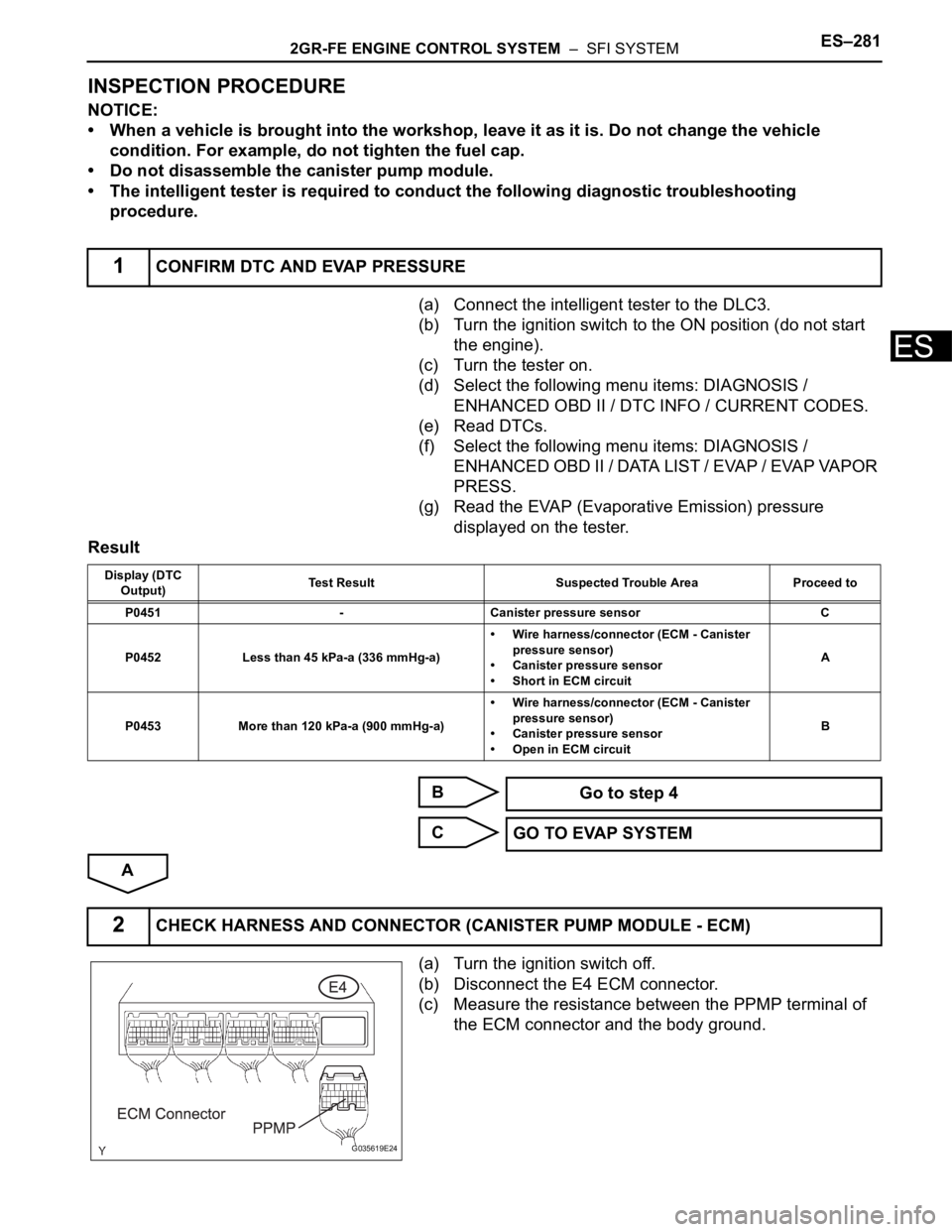
(a) Turn the ignition switch off.
(b) Disconnect the E4 ECM connector.
(c) Measure the resistance between the PPMP terminal of
the ECM connector and the body ground.
1CONFIRM DTC AND EVAP PRESSURE
Display (DTC
Output)Test Result Suspected Trouble Area Proceed to
P0451 - Canister pressure sensor C
P0452 Less than 45 kPa-a (336 mmHg-a)• Wire harness/connector (ECM - Canister
pressure sensor)
• Canister pressure sensor
• Short in ECM circuitA
P0453 More than 120 kPa-a (900 mmHg-a)• Wire harness/connector (ECM - Canister
pressure sensor)
• Canister pressure sensor
• Open in ECM circuitB
Go to step 4
GO TO EVAP SYSTEM
2CHECK HARNESS AND CONNECTOR (CANISTER PUMP MODULE - ECM)
G035619E24
Page 575 of 3000
ES–2822GR-FE ENGINE CONTROL SYSTEM – SFI SYSTEM
ES
Result
(d) Reconnect the ECM connector.
B
A
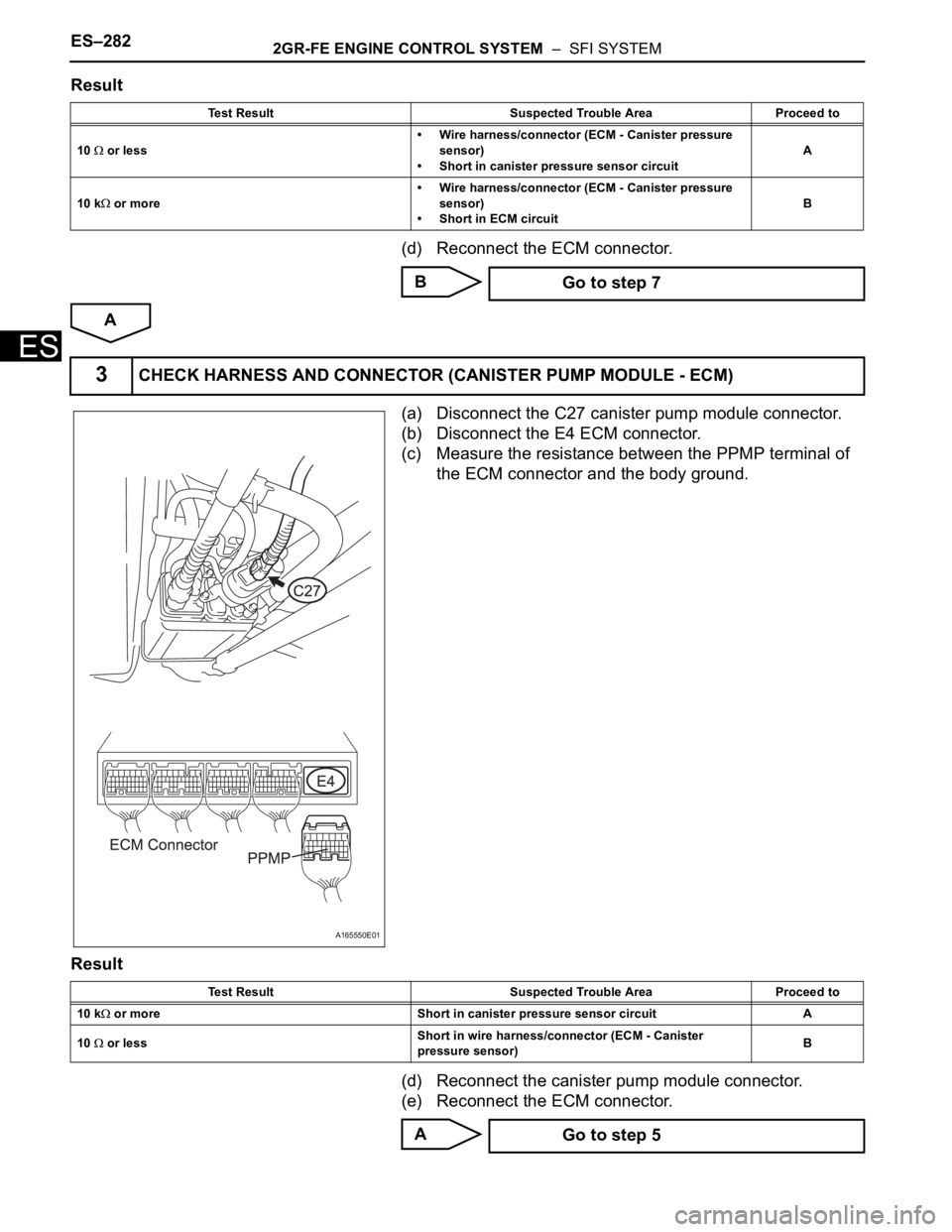
(a) Disconnect the C27 canister pump module connector.
(b) Disconnect the E4 ECM connector.
(c) Measure the resistance between the PPMP terminal of
the ECM connector and the body ground.
Result
(d) Reconnect the canister pump module connector.
(e) Reconnect the ECM connector.
A
Test Result Suspected Trouble Area Proceed to
10
or less• Wire harness/connector (ECM - Canister pressure
sensor)
• Short in canister pressure sensor circuitA
10 k
or more• Wire harness/connector (ECM - Canister pressure
sensor)
• Short in ECM circuitB
Go to step 7
3CHECK HARNESS AND CONNECTOR (CANISTER PUMP MODULE - ECM)
A165550E01
Test Result Suspected Trouble Area Proceed to
10 k
or more Short in canister pressure sensor circuit A
10
or lessShort in wire harness/connector (ECM - Canister
pressure sensor)B
Go to step 5
Page 576 of 3000
2GR-FE ENGINE CONTROL SYSTEM – SFI SYSTEMES–283
ES
B
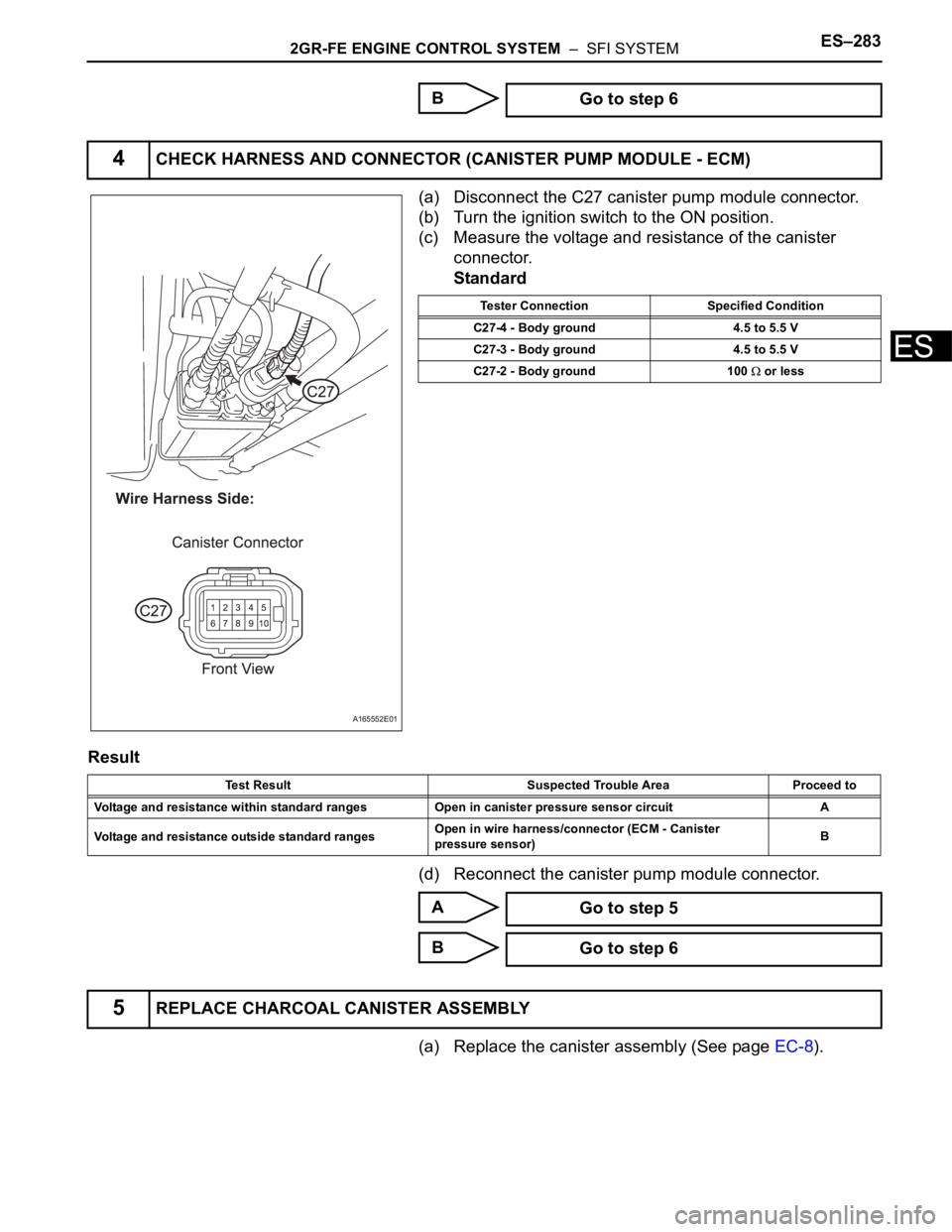
(a) Disconnect the C27 canister pump module connector.
(b) Turn the ignition switch to the ON position.
(c) Measure the voltage and resistance of the canister
connector.
Standard
Result
(d) Reconnect the canister pump module connector.
A
B
(a) Replace the canister assembly (See page EC-8). Go to step 6
4CHECK HARNESS AND CONNECTOR (CANISTER PUMP MODULE - ECM)
A165552E01
Tester Connection Specified Condition
C27-4 - Body ground 4.5 to 5.5 V
C27-3 - Body ground 4.5 to 5.5 V
C27-2 - Body ground 100
or less
Test Result Suspected Trouble Area Proceed to
Voltage and resistance within standard ranges Open in canister pressure sensor circuit A
Voltage and resistance outside standard rangesOpen in wire harness/connector (ECM - Canister
pressure sensor)B
Go to step 5
Go to step 6
5REPLACE CHARCOAL CANISTER ASSEMBLY