sensor TOYOTA SIENNA 2007 Service Repair Manual
[x] Cancel search | Manufacturer: TOYOTA, Model Year: 2007, Model line: SIENNA, Model: TOYOTA SIENNA 2007Pages: 3000, PDF Size: 52.26 MB
Page 581 of 3000
ES–2882GR-FE ENGINE CONTROL SYSTEM – SFI SYSTEM
ES
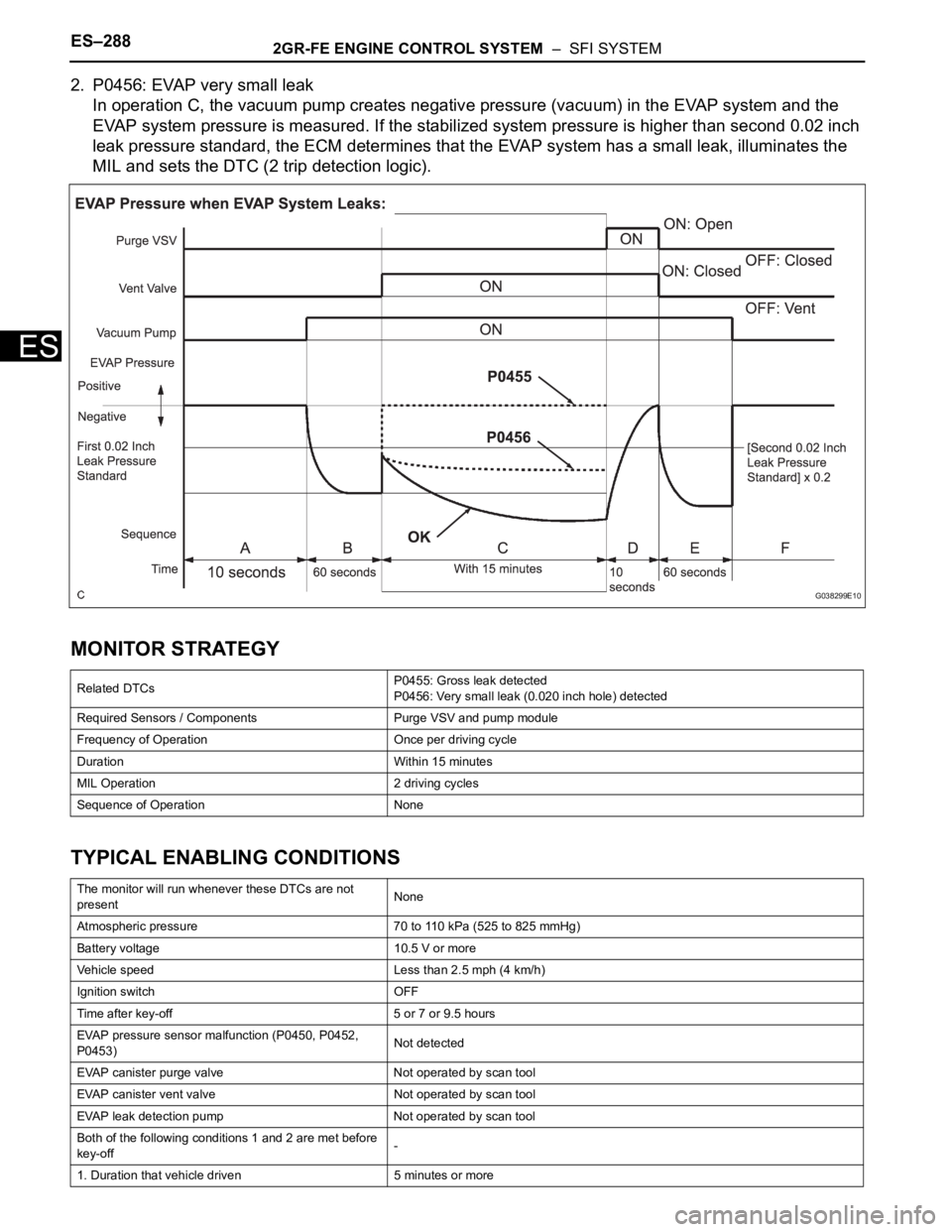
2. P0456: EVAP very small leak
In operation C, the vacuum pump creates negative pressure (vacuum) in the EVAP system and the
EVAP system pressure is measured. If the stabilized system pressure is higher than second 0.02 inch
leak pressure standard, the ECM determines that the EVAP system has a small leak, illuminates the
MIL and sets the DTC (2 trip detection logic).
MONITOR STRATEGY
TYPICAL ENABLING CONDITIONS
Related DTCsP0455: Gross leak detected
P0456: Very small leak (0.020 inch hole) detected
Required Sensors / Components Purge VSV and pump module
Frequency of Operation Once per driving cycle
Duration Within 15 minutes
MIL Operation 2 driving cycles
Sequence of Operation None
The monitor will run whenever these DTCs are not
presentNone
Atmospheric pressure 70 to 110 kPa (525 to 825 mmHg)
Battery voltage 10.5 V or more
Vehicle speed Less than 2.5 mph (4 km/h)
Ignition switch OFF
Time after key-off 5 or 7 or 9.5 hours
EVAP pressure sensor malfunction (P0450, P0452,
P0453)Not detected
EVAP canister purge valve Not operated by scan tool
EVAP canister vent valve Not operated by scan tool
EVAP leak detection pump Not operated by scan tool
Both of the following conditions 1 and 2 are met before
key-off-
1. Duration that vehicle driven 5 minutes or more
G038299E10
Page 584 of 3000
2GR-FE ENGINE CONTROL SYSTEM – SFI SYSTEMES–291
ES
DESCRIPTION
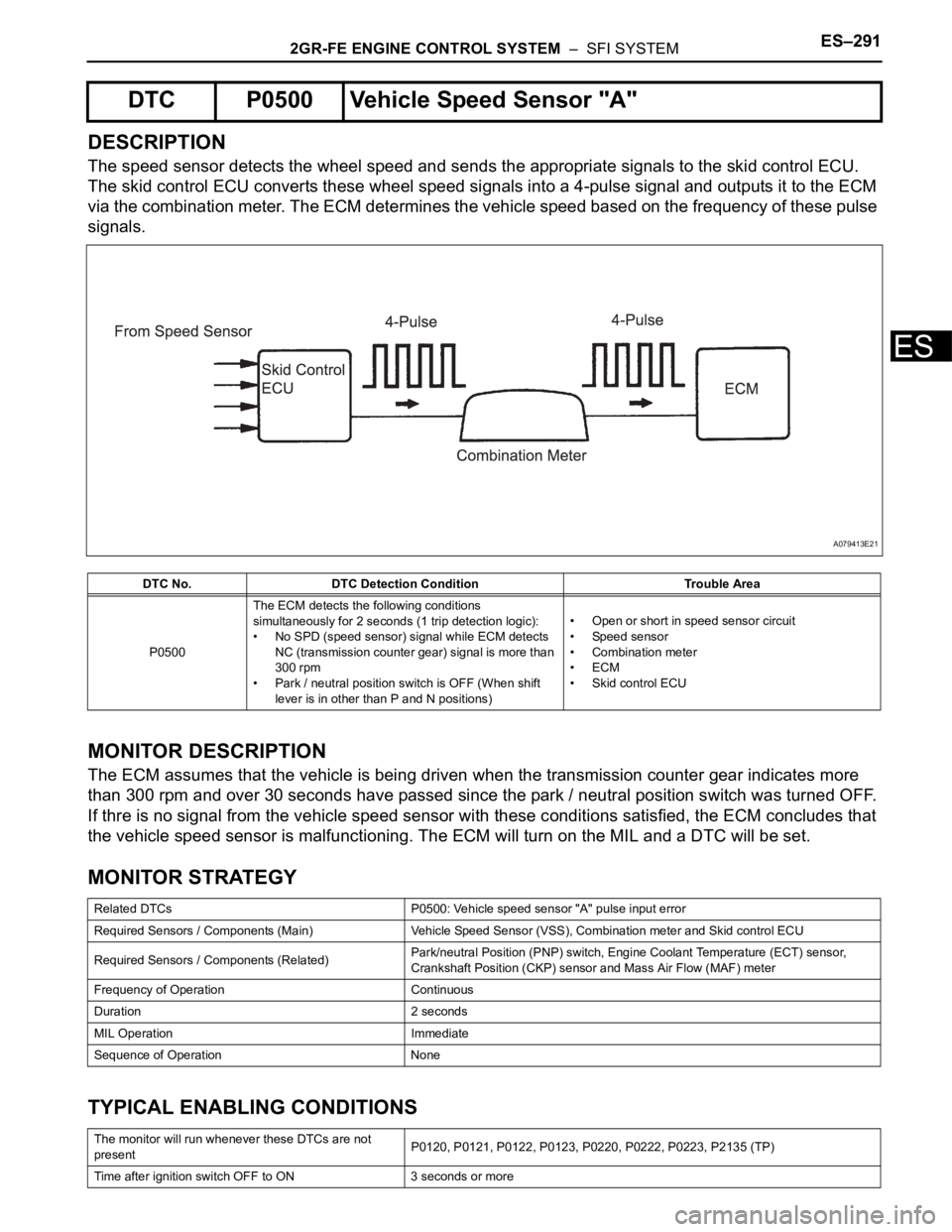
The speed sensor detects the wheel speed and sends the appropriate signals to the skid control ECU.
The skid control ECU converts these wheel speed signals into a 4-pulse signal and outputs it to the ECM
via the combination meter. The ECM determines the vehicle speed based on the frequency of these pulse
signals.
MONITOR DESCRIPTION
The ECM assumes that the vehicle is being driven when the transmission counter gear indicates more
than 300 rpm and over 30 seconds have passed since the park / neutral position switch was turned OFF.
If thre is no signal from the vehicle speed sensor with these conditions satisfied, the ECM concludes that
the vehicle speed sensor is malfunctioning. The ECM will turn on the MIL and a DTC will be set.
MONITOR STRATEGY
TYPICAL ENABLING CONDITIONS
DTC P0500 Vehicle Speed Sensor "A"
DTC No. DTC Detection Condition Trouble Area
P0500The ECM detects the following conditions
simultaneously for 2 seconds (1 trip detection logic):
• No SPD (speed sensor) signal while ECM detects
NC (transmission counter gear) signal is more than
300 rpm
• Park / neutral position switch is OFF (When shift
lever is in other than P and N positions)• Open or short in speed sensor circuit
• Speed sensor
• Combination meter
•ECM
• Skid control ECU
Related DTCs P0500: Vehicle speed sensor "A" pulse input error
Required Sensors / Components (Main) Vehicle Speed Sensor (VSS), Combination meter and Skid control ECU
Required Sensors / Components (Related)Park/neutral Position (PNP) switch, Engine Coolant Temperature (ECT) sensor,
Crankshaft Position (CKP) sensor and Mass Air Flow (MAF) meter
Frequency of Operation Continuous
Duration 2 seconds
MIL Operation Immediate
Sequence of Operation None
The monitor will run whenever these DTCs are not
presentP0120, P0121, P0122, P0123, P0220, P0222, P0223, P2135 (TP)
Time after ignition switch OFF to ON 3 seconds or more
A079413E21
Page 585 of 3000
ES–2922GR-FE ENGINE CONTROL SYSTEM – SFI SYSTEM
ES
TYPICAL MALFUNCTION THRESHOLDS
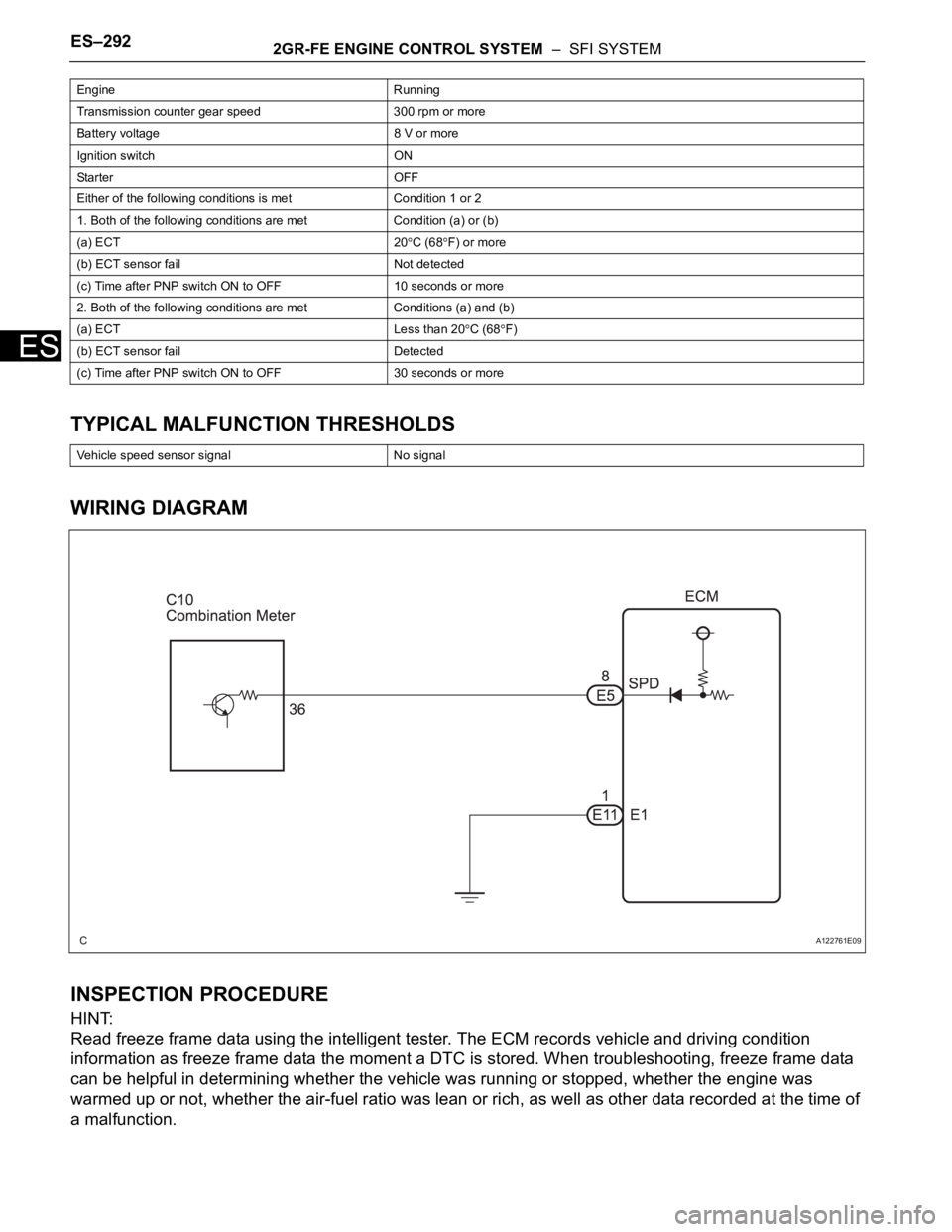
WIRING DIAGRAM
INSPECTION PROCEDURE
HINT:
Read freeze frame data using the intelligent tester. The ECM records vehicle and driving condition
information as freeze frame data the moment a DTC is stored. When troubleshooting, freeze frame data
can be helpful in determining whether the vehicle was running or stopped, whether the engine was
warmed up or not, whether the air-fuel ratio was lean or rich, as well as other data recorded at the time of
a malfunction.
Engine Running
Transmission counter gear speed 300 rpm or more
Battery voltage 8 V or more
Ignition switch ON
Starter OFF
Either of the following conditions is met Condition 1 or 2
1. Both of the following conditions are met Condition (a) or (b)
(a) ECT 20
C (68F) or more
(b) ECT sensor fail Not detected
(c) Time after PNP switch ON to OFF 10 seconds or more
2. Both of the following conditions are met Conditions (a) and (b)
(a) ECT Less than 20
C (68F)
(b) ECT sensor fail Detected
(c) Time after PNP switch ON to OFF 30 seconds or more
Vehicle speed sensor signal No signal
A122761E09
Page 586 of 3000
2GR-FE ENGINE CONTROL SYSTEM – SFI SYSTEMES–293
ES
(a) Drive the vehicle and check whether the operation of the
speedometer in the combination meter is normal.
HINT:
• The vehicle speed sensor is operating normally if the
speedometer reading is normal.
• If the speedometer does not operate, check it by
following the procedure described in speedometer
malfunction.
NG
OK
(a) Connect the intelligent tester to the DLC3.
(b) Turn the ignition switch to the ON position.
(c) Turn the tester on.
(d) Select the following menu items: DIAGNOSIS /
ENHANCED OBD II / DATA LIST / PRIMARY / VEHICLE
SPD.
(e) Drive the vehicle.
(f) Read the value displayed on the tester.
OK:
Vehicle speeds displayed on tester and
speedometer display are equal.
NG
OK
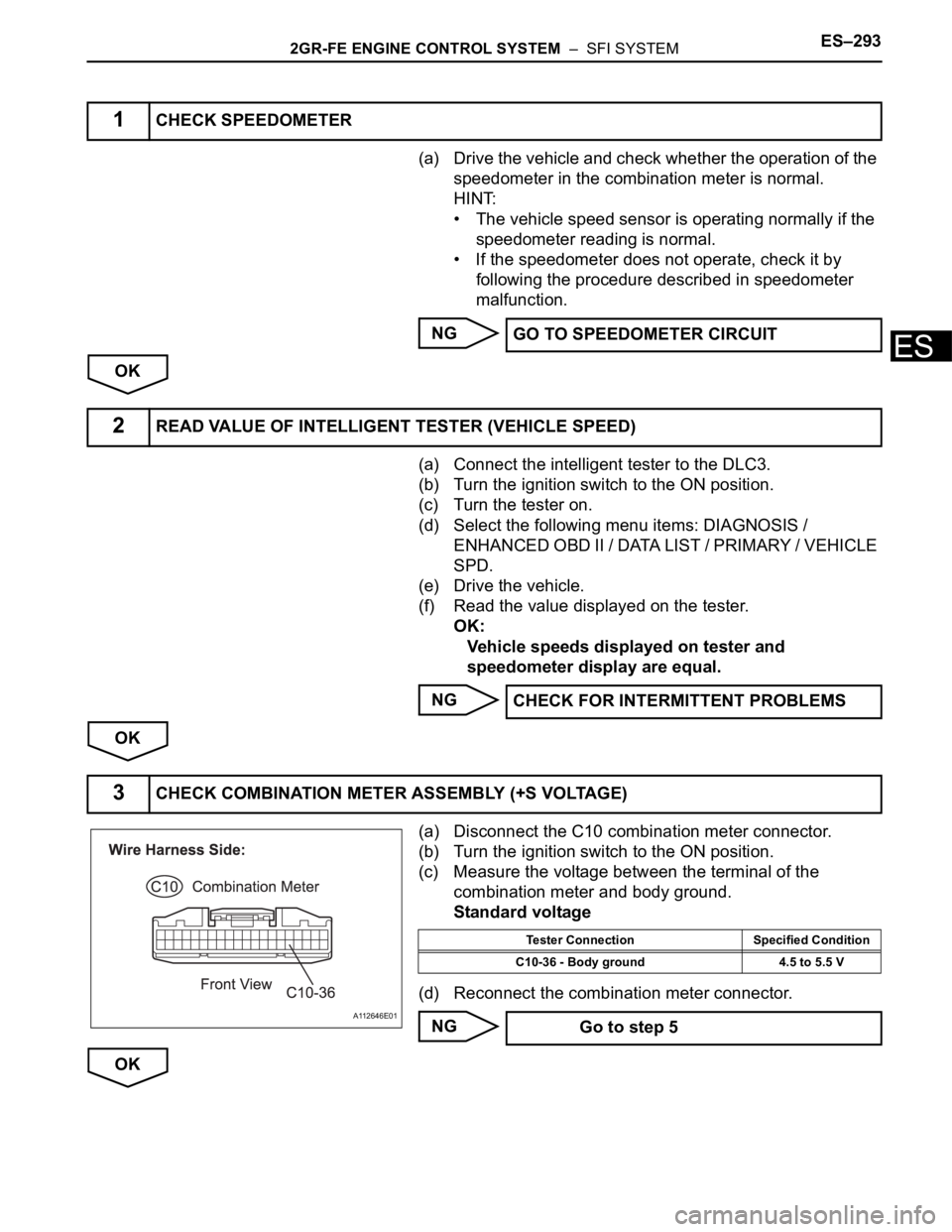
(a) Disconnect the C10 combination meter connector.
(b) Turn the ignition switch to the ON position.
(c) Measure the voltage between the terminal of the
combination meter and body ground.
Standard voltage
(d) Reconnect the combination meter connector.
NG
OK
1CHECK SPEEDOMETER
GO TO SPEEDOMETER CIRCUIT
2READ VALUE OF INTELLIGENT TESTER (VEHICLE SPEED)
CHECK FOR INTERMITTENT PROBLEMS
3CHECK COMBINATION METER ASSEMBLY (+S VOLTAGE)
A112646E01
Tester Connection Specified Condition
C10-36 - Body ground 4.5 to 5.5 V
Go to step 5
Page 589 of 3000

ES–2962GR-FE ENGINE CONTROL SYSTEM – SFI SYSTEM
ES
DESCRIPTION
The stop light switch is a duplex system that transmits two signals: STP and ST1-. These two signals are
used by the ECM to monitor whether or not the brake system is working properly. If the signals, which
indicate the brake pedal is being depressed or released, are detected simultaneously, the ECM interprets
this as a malfunction in the stop light switch and sets the DTC.
HINT:
The normal conditions are as shown in the table below. The signals can be read using the intelligent
tester.
MONITOR DESCRIPTION
This DTC indicates that the stop light switch remains on. When the stop light switch remains ON during
"stop and go" driving, the ECM interprets this as a fault in the stop light switch and the MIL comes on and
the ECM stores the DTC. The vehicle must stop (less than 2 mph (3 km/h)) and go (19 mph (30 km/h) or
more) 5 times for two driving cycles in order to detect a malfunction.
MONITOR STRATEGY
TYPICAL ENABLING CONDITIONS
DTC P0504 Brake Switch "A" / "B" Correlation
DTC P0724 Brake Switch "B" Circuit High
Signals Brake Pedal Released In Transition Brake Pedal Depressed
STP OFF ON ON
ST1- ON ON OFF
DTC No. DTC Detection Condition Trouble Area
P0504Conditions (a), (b) and (c) continue for 0.5 seconds or
more (1 trip detection logic):
(a) Ignition switch in the ON position
(b) Brake pedal released
(c) STP signal OFF when ST1- signal OFF• Short in stop light switch signal circuit
• STOP fuse
• Stop light switch
•ECM
P0724The stop light switch remains ON even when the
vehicle is driven in a STOP (less than 2 mph (3 km/h))
and GO (19 mph (30 km/h) or more) fashion 5 times. (2
trip detection logic)• Short in stop light switch signal circuit
• Stop light switch
•ECM
Related DTCs P0724: Stop light switch/Rationality
Required sensors/Components Stop light switch, Vehicle speed sensor
Frequency of operation Continuous
Duration GO and STOP 5 times
MIL operation 2 driving cycles
Sequence of operation None
The monitor will run whenever this DTC is not present None
Ignition switch ON
Starter OFF
Battery voltage 8 V or more
GO (Vehicle speed is 18.65 mph (30 km/h) or more) Once
STOP (Vehicle speed is less than 1.86 mph (3 km/h)) Once
Page 593 of 3000

ES–3002GR-FE ENGINE CONTROL SYSTEM – SFI SYSTEM
ES
DESCRIPTION
The idling speed is controlled by the ETCS (Electronic Throttle Control System). The ETCS is comprised
of: 1) the one valve type throttle body; 2) the throttle actuator, which operates the throttle valve; 3) the
Throttle Position (TP) sensor, which detects the opening angle of the throttle valve; 4) the Accelerator
Pedal Position (APP) sensor, which detects the accelerator pedal position; and 5) the ECM, which
controls the ETCS.
Based on the target idling speed, the ECM controls the throttle actuator to provide the proper throttle valve
opening angle.
MONITOR DESCRIPTION
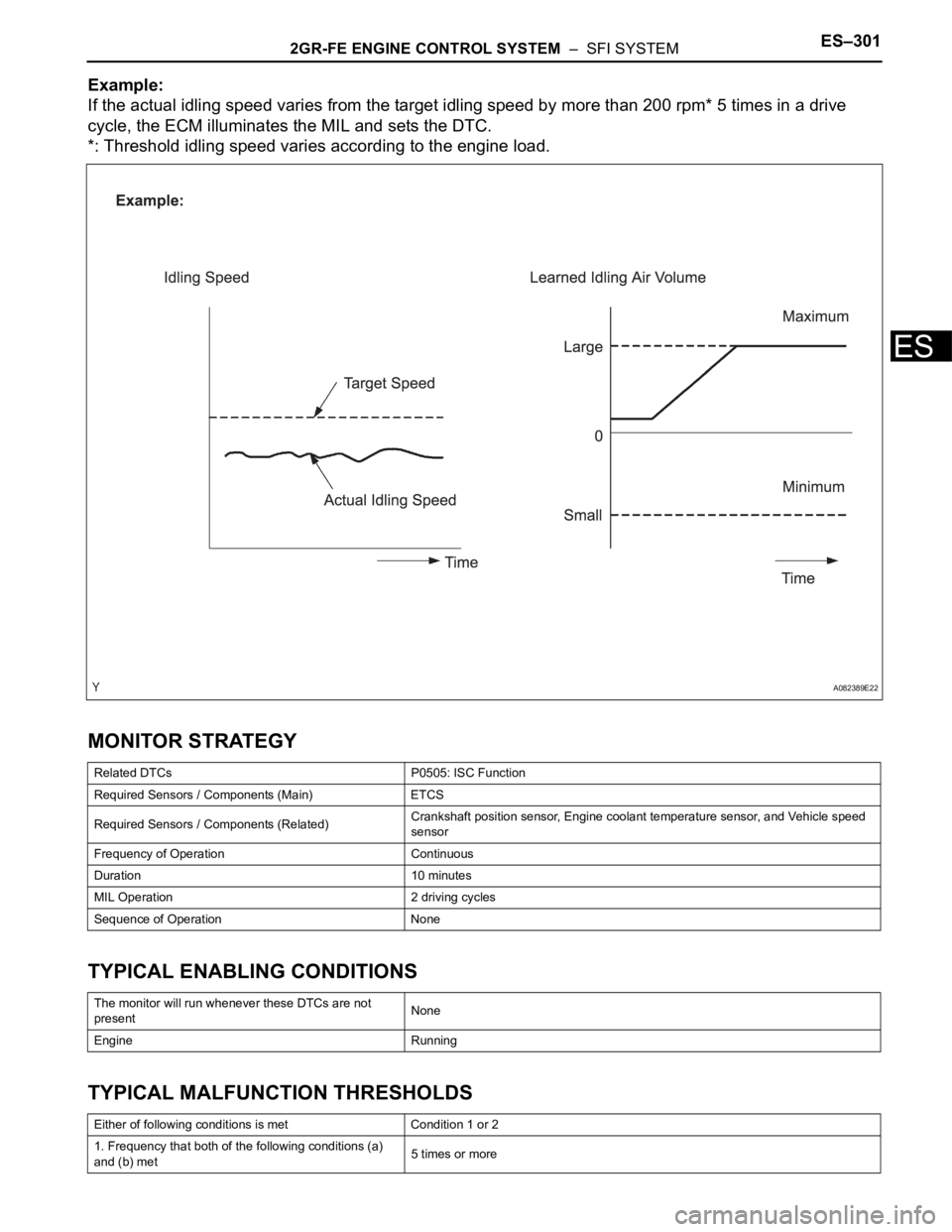
The ECM monitors the idling speed and idling air flow volume to conduct Idle Speed Control (ISC). The
ECM determines that the ISC system is malfunctioning if the following conditions are met:
• The learned idling air flow volume remains at the maximum or minimum volume 5 times or more in a
drive cycle.
• While driving at 6 mph (10 km/h) or more, the actual engine idling speed varies from the target idling
speed by between 100 rpm and 200 rpm, 5 times or more in a drive cycle.
DTC P0505 Idle Control System Malfunction
DTC No. DTC Detection Condition Trouble Area
P0505Idling speed continues to vary greatly from target idling
speed (2 trip detection logic)•ETCS
• Intake system
• PCV hose connection
•ECM
Page 594 of 3000
2GR-FE ENGINE CONTROL SYSTEM – SFI SYSTEMES–301
ES
Example:
If the actual idling speed varies from the target idling speed by more than 200 rpm* 5 times in a drive
cycle, the ECM illuminates the MIL and sets the DTC.
*: Threshold idling speed varies according to the engine load.
MONITOR STRATEGY
TYPICAL ENABLING CONDITIONS
TYPICAL MALFUNCTION THRESHOLDS
Related DTCs P0505: ISC Function
Required Sensors / Components (Main) ETCS
Required Sensors / Components (Related)Crankshaft position sensor, Engine coolant temperature sensor, and Vehicle speed
sensor
Frequency of Operation Continuous
Duration 10 minutes
MIL Operation 2 driving cycles
Sequence of Operation None
The monitor will run whenever these DTCs are not
presentNone
Engine Running
Either of following conditions is met Condition 1 or 2
1. Frequency that both of the following conditions (a)
and (b) met5 times or more
A082389E22
Page 598 of 3000
2GR-FE ENGINE CONTROL SYSTEM – SFI SYSTEMES–305
ES
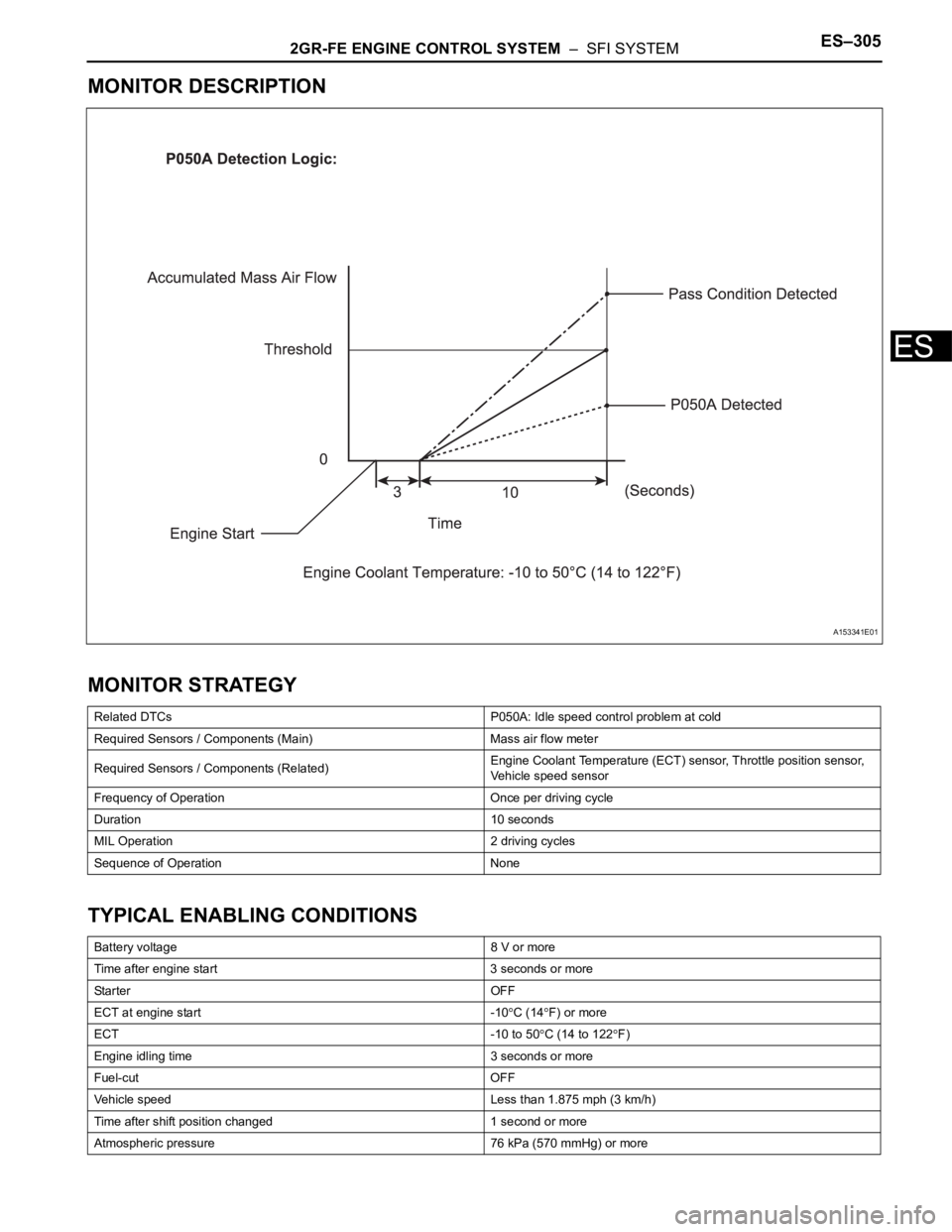
MONITOR DESCRIPTION
MONITOR STRATEGY
TYPICAL ENABLING CONDITIONS
Related DTCs P050A: Idle speed control problem at cold
Required Sensors / Components (Main) Mass air flow meter
Required Sensors / Components (Related)Engine Coolant Temperature (ECT) sensor, Throttle position sensor,
Vehicle speed sensor
Frequency of Operation Once per driving cycle
Duration 10 seconds
MIL Operation 2 driving cycles
Sequence of Operation None
Battery voltage 8 V or more
Time after engine start 3 seconds or more
Sta r t e r OF F
ECT at engine start -10
C (14F) or more
ECT -10 to 50
C (14 to 122F)
Engine idling time 3 seconds or more
Fuel-cut OFF
Vehicle speed Less than 1.875 mph (3 km/h)
Time after shift position changed 1 second or more
Atmospheric pressure 76 kPa (570 mmHg) or more
A153341E01
Page 604 of 3000
2GR-FE ENGINE CONTROL SYSTEM – SFI SYSTEMES–311
ES
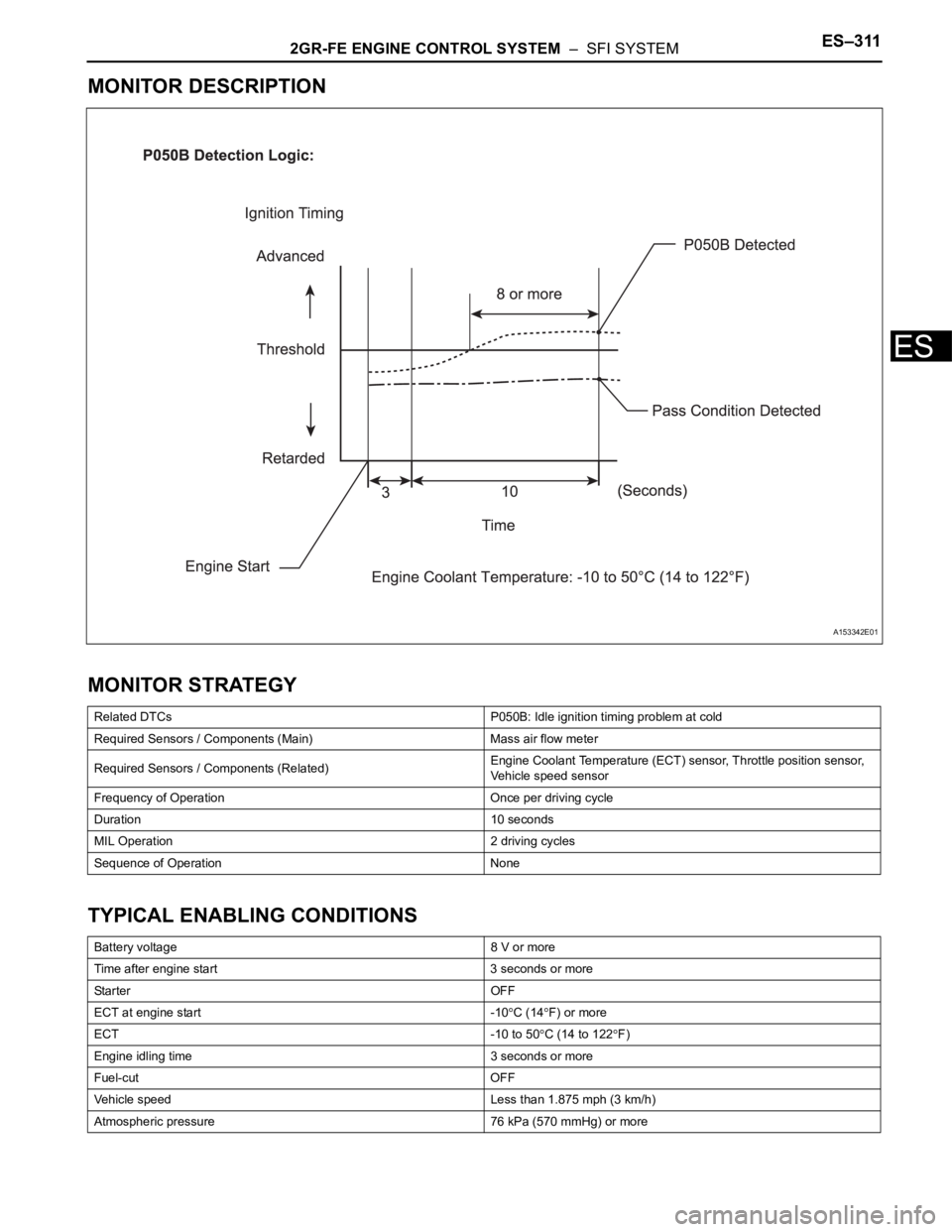
MONITOR DESCRIPTION
MONITOR STRATEGY
TYPICAL ENABLING CONDITIONS
Related DTCs P050B: Idle ignition timing problem at cold
Required Sensors / Components (Main) Mass air flow meter
Required Sensors / Components (Related)Engine Coolant Temperature (ECT) sensor, Throttle position sensor,
Vehicle speed sensor
Frequency of Operation Once per driving cycle
Duration 10 seconds
MIL Operation 2 driving cycles
Sequence of Operation None
Battery voltage 8 V or more
Time after engine start 3 seconds or more
Sta r t e r OF F
ECT at engine start -10
C (14F) or more
ECT -10 to 50
C (14 to 122F)
Engine idling time 3 seconds or more
Fuel-cut OFF
Vehicle speed Less than 1.875 mph (3 km/h)
Atmospheric pressure 76 kPa (570 mmHg) or more
A153342E01
Page 607 of 3000
ES–3142GR-FE ENGINE CONTROL SYSTEM – SFI SYSTEM
ES
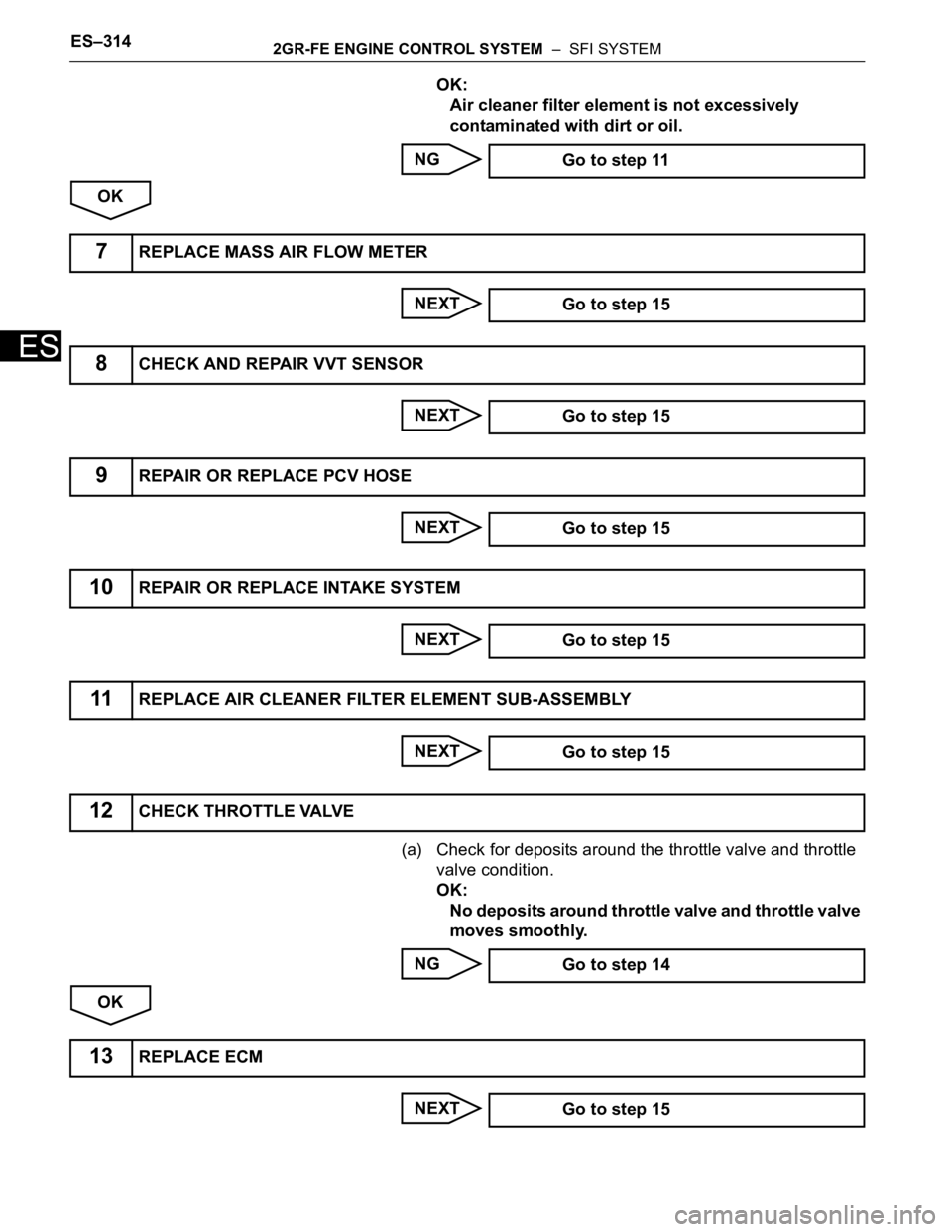
OK:
Air cleaner filter element is not excessively
contaminated with dirt or oil.
NG
OK
NEXT
NEXT
NEXT
NEXT
NEXT
(a) Check for deposits around the throttle valve and throttle
valve condition.
OK:
No deposits around throttle valve and throttle valve
moves smoothly.
NG
OK
NEXT Go to step 11
7REPLACE MASS AIR FLOW METER
Go to step 15
8CHECK AND REPAIR VVT SENSOR
Go to step 15
9REPAIR OR REPLACE PCV HOSE
Go to step 15
10REPAIR OR REPLACE INTAKE SYSTEM
Go to step 15
11REPLACE AIR CLEANER FILTER ELEMENT SUB-ASSEMBLY
Go to step 15
12CHECK THROTTLE VALVE
Go to step 14
13REPLACE ECM
Go to step 15