engine TOYOTA SIENNA 2007 Service Repair Manual
[x] Cancel search | Manufacturer: TOYOTA, Model Year: 2007, Model line: SIENNA, Model: TOYOTA SIENNA 2007Pages: 3000, PDF Size: 52.26 MB
Page 643 of 3000
ES–3502GR-FE ENGINE CONTROL SYSTEM – SFI SYSTEM
ES
(f) Securely apply the parking brake and move the gear
selector lever to the D position (Procedure "A").
(g) While depressing the brake pedal securely, fully depress
the accelerator pedal for 5 seconds (Procedure "B").
(h) Select the following menu items on the tester:
DIAGNOSIS / ENHANCED OBD II / DTC INFO /
CURRENT CODES.
(i) Read the DTCs.
HINT:
The voltage output of the throttle position sensor can be
checked during procedure "B" using the intelligent tester.
Variations in the voltage output indicate that the throttle
actuator is in operation. To check the voltage output
using the intelligent tester, select the following menu
items: DIAGNOSIS / ENHANCED OBD II / DATA LIST /
PRIMARY / THROTTLE POS #1.
OK:
No DTC output.
NG
OKREPLACE THROTTLE BODY (See page ES-
493)
CHECK FOR INTERMITTENT PROBLEMS
Page 644 of 3000

2GR-FE ENGINE CONTROL SYSTEM – SFI SYSTEMES–351
ES
HINT:
These DTCs relate to the Accelerator Pedal Position (APP) sensor.
DESCRIPTION
HINT:
This ETCS (Electronic Throttle Control System) does not use a throttle cable.
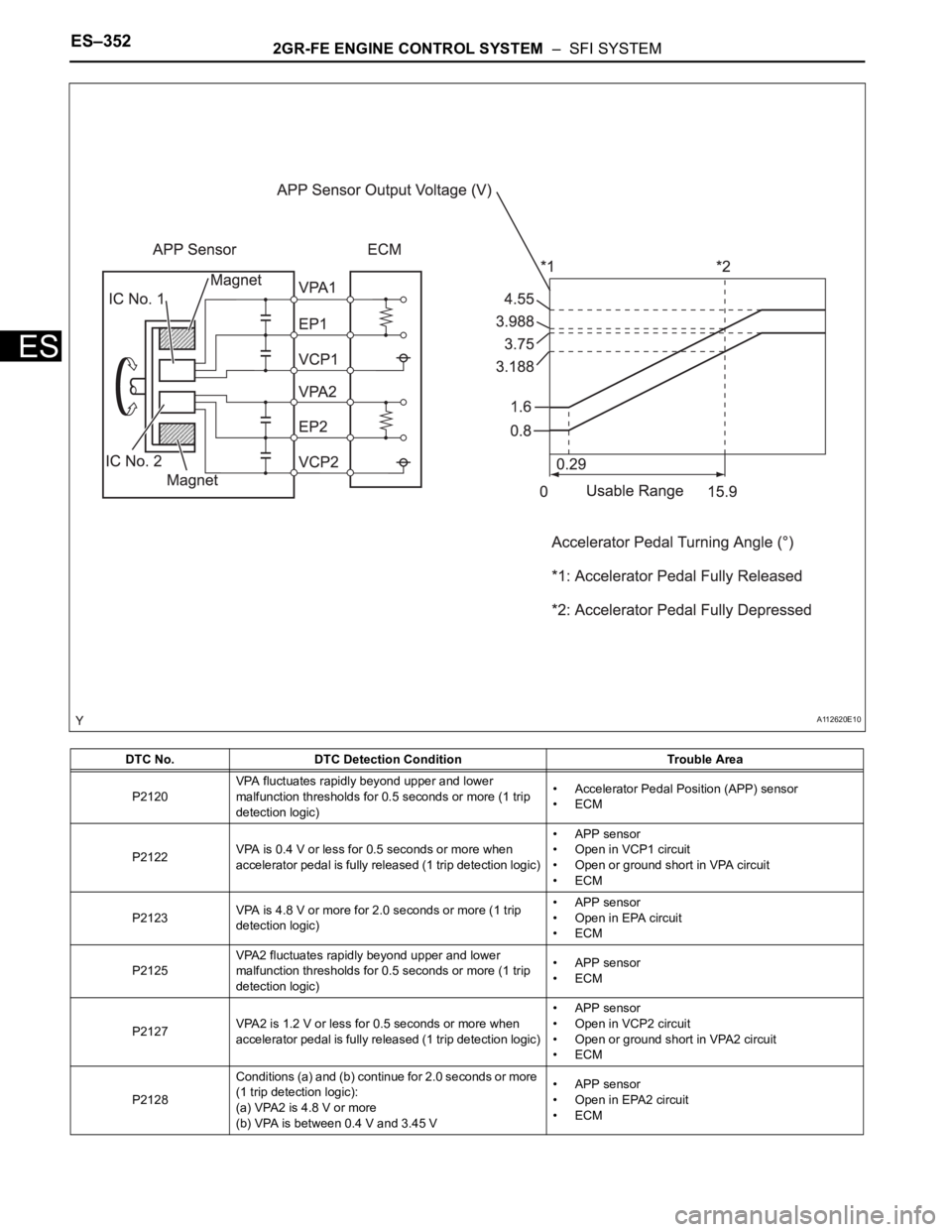
The Accelerator Pedal Position (APP) sensor is integrated with the accelerator pedal bracket and has 2
sensor circuits: VPA (main) and VPA2 (sub). This sensor is a non-contact type, and uses Hall-effect
elements, in order to yield accurate signals, even in extreme driving conditions, such as at high speeds as
well as very low speeds. The voltage, which is applied to terminals VPA and VPA2 of the ECM, varies
between 0 V and 5 V in proportion to the operating angle of the accelerator pedal (throttle valve). A signal
from VPA indicates the actual accelerator pedal opening angle (throttle valve opening angle) and is used
for engine control. A signal from VPA2 conveys the status of the VPA circuit and is used to check the APP
sensor itself.
The ECM monitors the actual accelerator pedal opening angle (throttle valve opening angle) through the
signals from VPA and VPA2, and controls the throttle actuator according to these signals.
DTC P2120Throttle / Pedal Position Sensor / Switch "D"
Circuit
DTC P2122Throttle / Pedal Position Sensor / Switch "D"
Circuit Low Input
DTC P2123Throttle / Pedal Position Sensor / Switch "D"
Circuit High Input
DTC P2125Throttle / Pedal Position Sensor / Switch "E"
Circuit
DTC P2127Throttle / Pedal Position Sensor / Switch "E"
Circuit Low Input
DTC P2128Throttle / Pedal Position Sensor / Switch "E"
Circuit High Input
DTC P2138Throttle / Pedal Position Sensor / Switch "D" /
"E" Voltage Correlation
Page 645 of 3000
ES–3522GR-FE ENGINE CONTROL SYSTEM – SFI SYSTEM
ES
DTC No. DTC Detection Condition Trouble Area
P2120VPA fluctuates rapidly beyond upper and lower
malfunction thresholds for 0.5 seconds or more (1 trip
detection logic)• Accelerator Pedal Position (APP) sensor
•ECM
P2122VPA is 0.4 V or less for 0.5 seconds or more when
accelerator pedal is fully released (1 trip detection logic)• APP sensor
• Open in VCP1 circuit
• Open or ground short in VPA circuit
•ECM
P2123VPA is 4.8 V or more for 2.0 seconds or more (1 trip
detection logic)• APP sensor
• Open in EPA circuit
•ECM
P2125VPA2 fluctuates rapidly beyond upper and lower
malfunction thresholds for 0.5 seconds or more (1 trip
detection logic)• APP sensor
•ECM
P2127VPA2 is 1.2 V or less for 0.5 seconds or more when
accelerator pedal is fully released (1 trip detection logic)• APP sensor
• Open in VCP2 circuit
• Open or ground short in VPA2 circuit
•ECM
P2128Conditions (a) and (b) continue for 2.0 seconds or more
(1 trip detection logic):
(a) VPA2 is 4.8 V or more
(b) VPA is between 0.4 V and 3.45 V• APP sensor
• Open in EPA2 circuit
•ECM
A112620E10
Page 646 of 3000

2GR-FE ENGINE CONTROL SYSTEM – SFI SYSTEMES–353
ES
HINT:
When any of these DTCs are set, check the APP sensor voltage by selecting the following menu items on
the intelligent tester: DIAGNOSIS / ENHANCED OBD II / DATA LIST / PRIMARY / ACCEL POS #1 and
ACCEL POS #2.
HINT:
• Accelerator pedal positions are expressed as voltages.
• AP denotes Accelerator Pedal.
MONITOR DESCRIPTION
When either of the voltage outputs of VPA or VPA2 deviates from the standard range, or the difference
between the voltage outputs of the 2 sensor circuits is less than the threshold, the ECM determines that
there is a malfunction in the APP sensor. The ECM then illuminates the MIL and sets a DTC.
Example:
When the voltage output of VPA drops below 0.4 V for more than 0.5 seconds when the accelerator pedal
is fully depressed, DTC P2122 is set.
If the malfunction is not repaired successfully, a DTC is set 2 seconds after the engine is next started.
MONITOR STRATEGY
TYPICAL ENABLING CONDITIONS
P2138Condition (a) or (b) continues for 2.0 seconds or more
(1 trip detection logic):
(a) Difference between VPA and VPA2 is 0.02 V or less
(b) VPA is 0.4 V or less and VPA2 is 1.2 V or less• Short between VPA and VPA2 circuits
• APP sensor
•ECM
Trouble AreasACCEL POS #1 When
AP ReleasedACCEL POS #2 When
AP ReleasedACCEL POS #1 When
AP DepressedACCEL POS #2 When
AP Depressed
VCP circuit open 0 to 0.2 V 0 to 0.2 V 0 to 0.2 V 0 to 0.2 V
Open or ground short in VPA circuit 0 to 0.2 V 1.2 to 2.0 V 0 to 0.2 V 3.4 to 5.0 V
Open or ground short in VPA2 circuit 0.5 to 1.1 V 0 to 0.2 V 2.6 to 4.5 V 0 to 0.2 V
EPA circuit open 4.5 to 5.0 V 4.5 to 5.0 V 4.5 to 5.0 V 4.5 to 5.0 V
Normal condition 0.5 to 1.1 V 1.2 to 2.0 V 2.6 to 4.5 V 3.4 to 5.0 V
Related DTCsP2120: Accelerator Pedal Position (APP) sensor 1 range check (fluctuating)
P2122: APP sensor 1 range check (low voltage)
P2123: APP sensor 1 range check (high voltage)
P2125: APP sensor 2 range check (fluctuating)
P2127: APP sensor 2 range check (low voltage)
P2128: APP sensor 2 range check (high voltage)
P2138: APP sensor range check (correlation)
Required Sensors / Components (Main) APP sensor
Required Sensors / Components (Related) -
Frequency of Operation Continuous
Duration0.5 seconds: P2120, P2122, P2125 and P2127
2.0 seconds: P2123, P2128 and P2138
MIL Operation Immediate
Sequence of Operation None
The monitor will run whenever these DTCs are not
presentNone
Throttle actuator power ONDTC No. DTC Detection Condition Trouble Area
Page 647 of 3000

ES–3542GR-FE ENGINE CONTROL SYSTEM – SFI SYSTEM
ES
TYPICAL MALFUNCTION THRESHOLDS
P2120:
P2122:
P2123:
P2125:
P2127:
P2128:
P2138:
COMPONENT OPERATING RANGE
FA I L - S A F E
When any of DTCs P2120, P2121, P2122, P2123, P2125, P2127, P2128 and P2138 are set, the ECM
enters fail-safe mode. If either of the 2 sensor circuits malfunctions, the ECM uses the remaining circuit to
calculate the accelerator pedal position to allow the vehicle to continue driving. If both of the circuits
malfunction, the ECM regards the accelerator pedal as being released. As a result, the throttle valve is
closed and the engine idles.
Fail-safe mode continues until a pass condition is detected, and the ignition switch is turned off.
Either of the following conditions is met Condition A or B
A. VPA voltage when VPA2 is 0.04 V or more 0.4 V or less
B. VPA voltage 4.8 V or more
VPA voltage when VPA2 is 0.04 V or more 0.4 V or less
VPA voltage 4.8 V or more
Either of the following conditions is met Condition A or B
A. VPA2 voltage when VPA is 0.04 V or more 1.2 V or less
B. VPA2 voltage when VPA is 0.4 to 3.45 V 4.8 V or more
VPA2 voltage when VPA is 0.04 V or more 1.2 V or less
VPA2 voltage when VPA is 0.4 to 3.45 V 4.8 V or more
Either of following conditions is met: Condition A or B
Condition A -
Difference between VPA and VPA 2 voltages 0.02 V or less
Condition B -
VPA voltage 0.4 V or less
VPA2 voltage 1.2 V or less
Parameter Standard Value
VPA voltage 0.4 V to 4.8 V
VPA2 voltage 1.2 V to 4.8 V
Difference between VPA and VPA2 voltages More than 0.02 V
Page 648 of 3000
2GR-FE ENGINE CONTROL SYSTEM – SFI SYSTEMES–355
ES
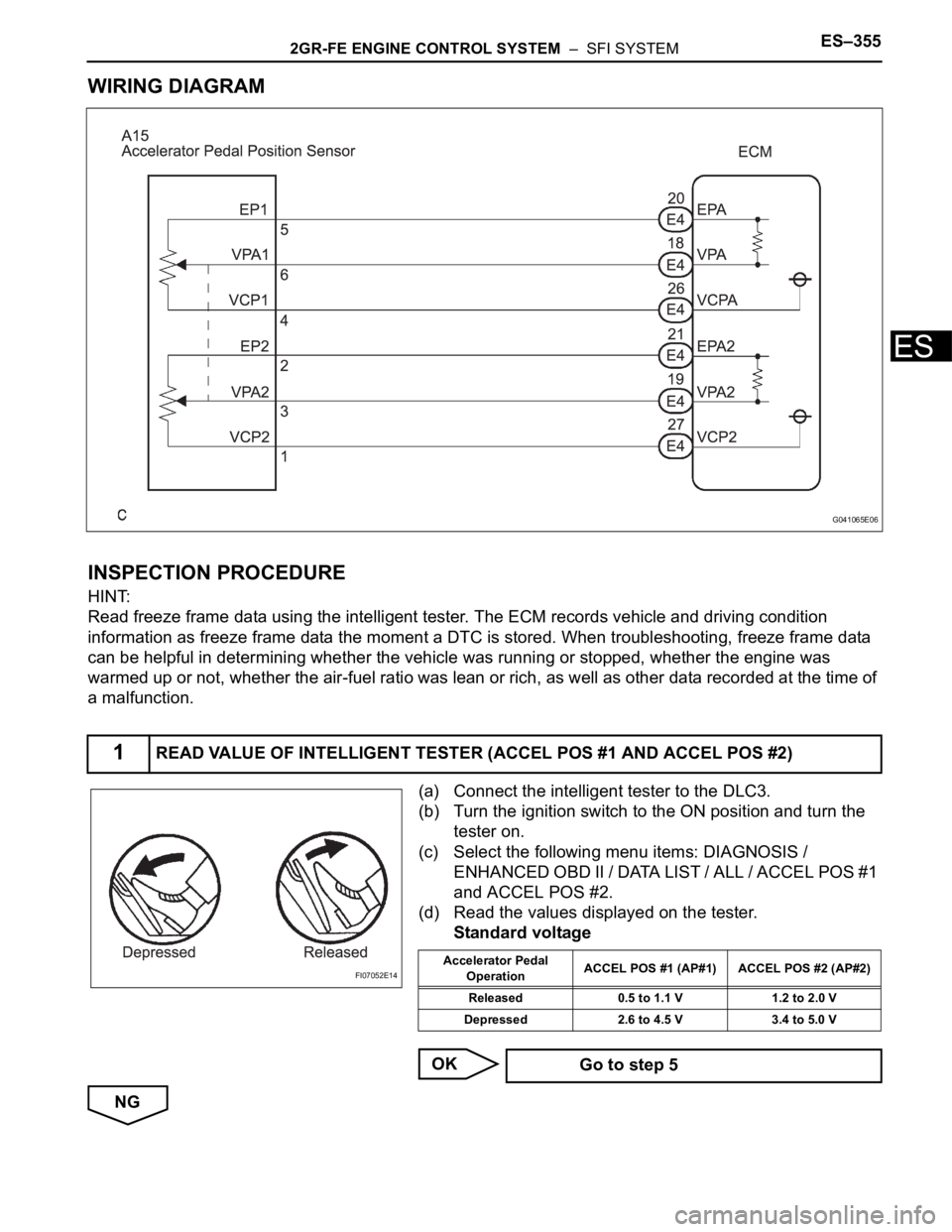
WIRING DIAGRAM
INSPECTION PROCEDURE
HINT:
Read freeze frame data using the intelligent tester. The ECM records vehicle and driving condition
information as freeze frame data the moment a DTC is stored. When troubleshooting, freeze frame data
can be helpful in determining whether the vehicle was running or stopped, whether the engine was
warmed up or not, whether the air-fuel ratio was lean or rich, as well as other data recorded at the time of
a malfunction.
(a) Connect the intelligent tester to the DLC3.
(b) Turn the ignition switch to the ON position and turn the
tester on.
(c) Select the following menu items: DIAGNOSIS /
ENHANCED OBD II / DATA LIST / ALL / ACCEL POS #1
and ACCEL POS #2.
(d) Read the values displayed on the tester.
Standard voltage
OK
NG
1READ VALUE OF INTELLIGENT TESTER (ACCEL POS #1 AND ACCEL POS #2)
G041065E06
FI07052E14Accelerator Pedal
OperationACCEL POS #1 (AP#1) ACCEL POS #2 (AP#2)
Released 0.5 to 1.1 V 1.2 to 2.0 V
Depressed 2.6 to 4.5 V 3.4 to 5.0 V
Go to step 5
Page 649 of 3000
ES–3562GR-FE ENGINE CONTROL SYSTEM – SFI SYSTEM
ES
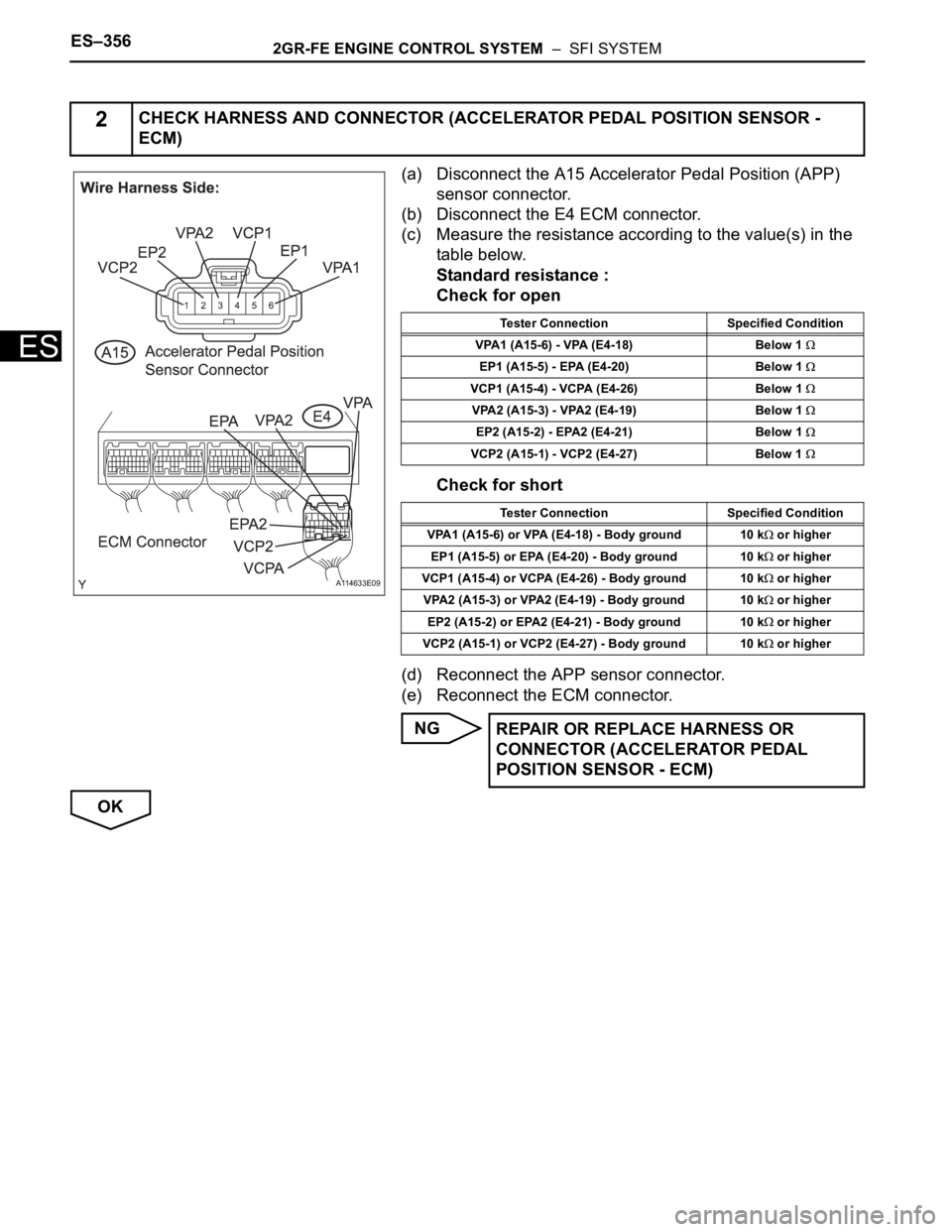
(a) Disconnect the A15 Accelerator Pedal Position (APP)
sensor connector.
(b) Disconnect the E4 ECM connector.
(c) Measure the resistance according to the value(s) in the
table below.
Standard resistance :
Check for open
Check for short
(d) Reconnect the APP sensor connector.
(e) Reconnect the ECM connector.
NG
OK
2CHECK HARNESS AND CONNECTOR (ACCELERATOR PEDAL POSITION SENSOR -
ECM)
A114633E09
Tester Connection Specified Condition
VPA1 (A15-6) - VPA (E4-18) Below 1
EP1 (A15-5) - EPA (E4-20) Below 1
VCP1 (A15-4) - VCPA (E4-26) Below 1
VPA2 (A15-3) - VPA2 (E4-19) Below 1
EP2 (A15-2) - EPA2 (E4-21) Below 1
VCP2 (A15-1) - VCP2 (E4-27) Below 1
Tester Connection Specified Condition
VPA1 (A15-6) or VPA (E4-18) - Body ground 10 k
or higher
EP1 (A15-5) or EPA (E4-20) - Body ground 10 k
or higher
VCP1 (A15-4) or VCPA (E4-26) - Body ground 10 k
or higher
VPA2 (A15-3) or VPA2 (E4-19) - Body ground 10 k
or higher
EP2 (A15-2) or EPA2 (E4-21) - Body ground 10 k
or higher
VCP2 (A15-1) or VCP2 (E4-27) - Body ground 10 k
or higher
REPAIR OR REPLACE HARNESS OR
CONNECTOR (ACCELERATOR PEDAL
POSITION SENSOR - ECM)
Page 650 of 3000
2GR-FE ENGINE CONTROL SYSTEM – SFI SYSTEMES–357
ES
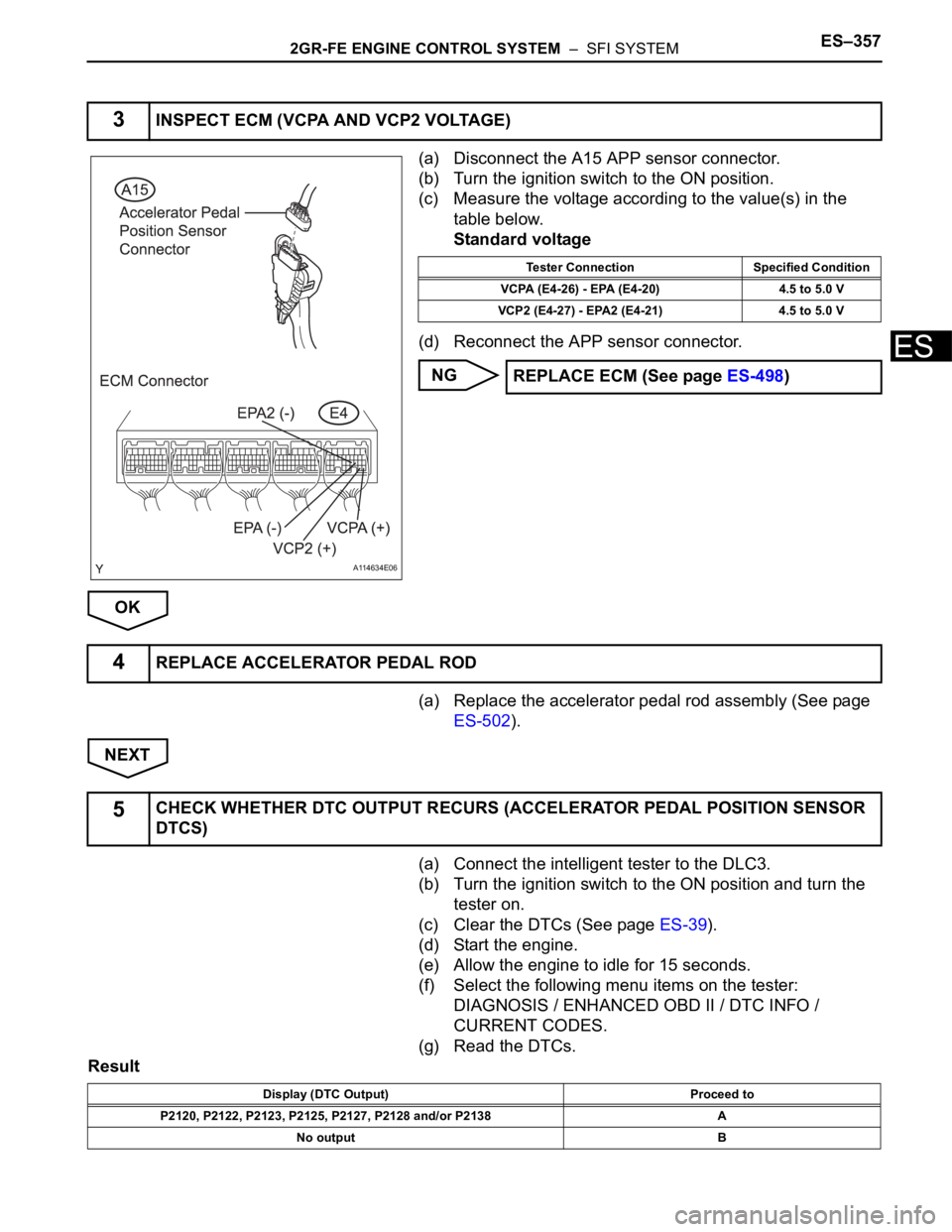
(a) Disconnect the A15 APP sensor connector.
(b) Turn the ignition switch to the ON position.
(c) Measure the voltage according to the value(s) in the
table below.
Standard voltage
(d) Reconnect the APP sensor connector.
NG
OK
(a) Replace the accelerator pedal rod assembly (See page
ES-502).
NEXT
(a) Connect the intelligent tester to the DLC3.
(b) Turn the ignition switch to the ON position and turn the
tester on.
(c) Clear the DTCs (See page ES-39).
(d) Start the engine.
(e) Allow the engine to idle for 15 seconds.
(f) Select the following menu items on the tester:
DIAGNOSIS / ENHANCED OBD II / DTC INFO /
CURRENT CODES.
(g) Read the DTCs.
Result
3INSPECT ECM (VCPA AND VCP2 VOLTAGE)
A114634E06
Tester Connection Specified Condition
VCPA (E4-26) - EPA (E4-20) 4.5 to 5.0 V
VCP2 (E4-27) - EPA2 (E4-21) 4.5 to 5.0 V
REPLACE ECM (See page ES-498)
4REPLACE ACCELERATOR PEDAL ROD
5CHECK WHETHER DTC OUTPUT RECURS (ACCELERATOR PEDAL POSITION SENSOR
DTCS)
Display (DTC Output) Proceed to
P2120, P2122, P2123, P2125, P2127, P2128 and/or P2138 A
No output B
Page 651 of 3000

ES–3582GR-FE ENGINE CONTROL SYSTEM – SFI SYSTEM
ES
B
ASYSTEM OK
REPLACE ECM (See page ES-498)
Page 652 of 3000

2GR-FE ENGINE CONTROL SYSTEM – SFI SYSTEMES–359
ES
HINT:
This DTC relates to the Accelerator Pedal Position (APP) sensor.
DESCRIPTION
Refer to DTC P2120 (See page ES-343).
MONITOR DESCRIPTION
The accelerator pedal position sensor is mounted on the accelerator pedal bracket. The accelerator pedal
position sensor has 2 sensor elements and 2 signal outputs: VPA and VPA2. VPA is used to detect the
actual accelerator pedal angle (used for engine control) and VPA2 is used to detect malfunctions in VPA.
When the difference between the voltage outputs of VPA and VPA2 deviates from the standard, the ECM
determines that the accelerator pedal position sensor is malfunctioning. The ECM turns on the MIL and
the DTC is set.
MONITOR STRATEGY
TYPICAL ENABLING CONDITIONS
TYPICAL MALFUNCTION THRESHOLDS
FAIL-SAFE
The accelerator pedal position sensor has 2 (main and sub) sensor circuits. If a malfunction occurs in
either of the sensor circuits, the ECM detects the abnormal signal voltage difference between the 2 sensor
circuits and switches to limp mode. In limp mode, the functioning circuit is used to calculate the
accelerator pedal opening angle to allow the vehicle to continue driving. If both circuits malfunction, the
ECM regards the opening angle of the accelerator pedal as being fully closed. In this case, the throttle
valve remains closed as if the engine is idling.
DTC P2121Throttle / Pedal Position Sensor / Switch "D"
Circuit Range / Performance
DTC No. DTC Detection Condition Trouble Area
P2121Difference between VPA and VPA2 is less than 0.4 V, or
more than 1.2 V for 0.5 seconds (1 trip detection logic)• Accelerator position (APP) sensor
•ECM
Related DTCs P2121: Accelerator pedal position (APP) sensor rationality
Required Sensors / Components (Main) APP sensor
Required Sensors / Components (Related) -
Frequency of Operation Continuous
Duration 0.5 seconds
MIL Operation Immediate
Sequence of Operation None
The monitor will run whenever these DTCs are not
presentNone
Either of the following conditions is met. Condition 1 or 2
1. Ignition switch ON
2. Electronic throttle actuator power ON
Difference between VPA1 voltage (learned value) and
VPA2 voltage (learned value)Less than 0.4 V, or more than 1.2 V