check engine TOYOTA SIENNA 2007 Service Repair Manual
[x] Cancel search | Manufacturer: TOYOTA, Model Year: 2007, Model line: SIENNA, Model: TOYOTA SIENNA 2007Pages: 3000, PDF Size: 52.26 MB
Page 2577 of 3000
BRAKE CONTROL – ANTI-LOCK BRAKE SYSTEMBC–37
BC
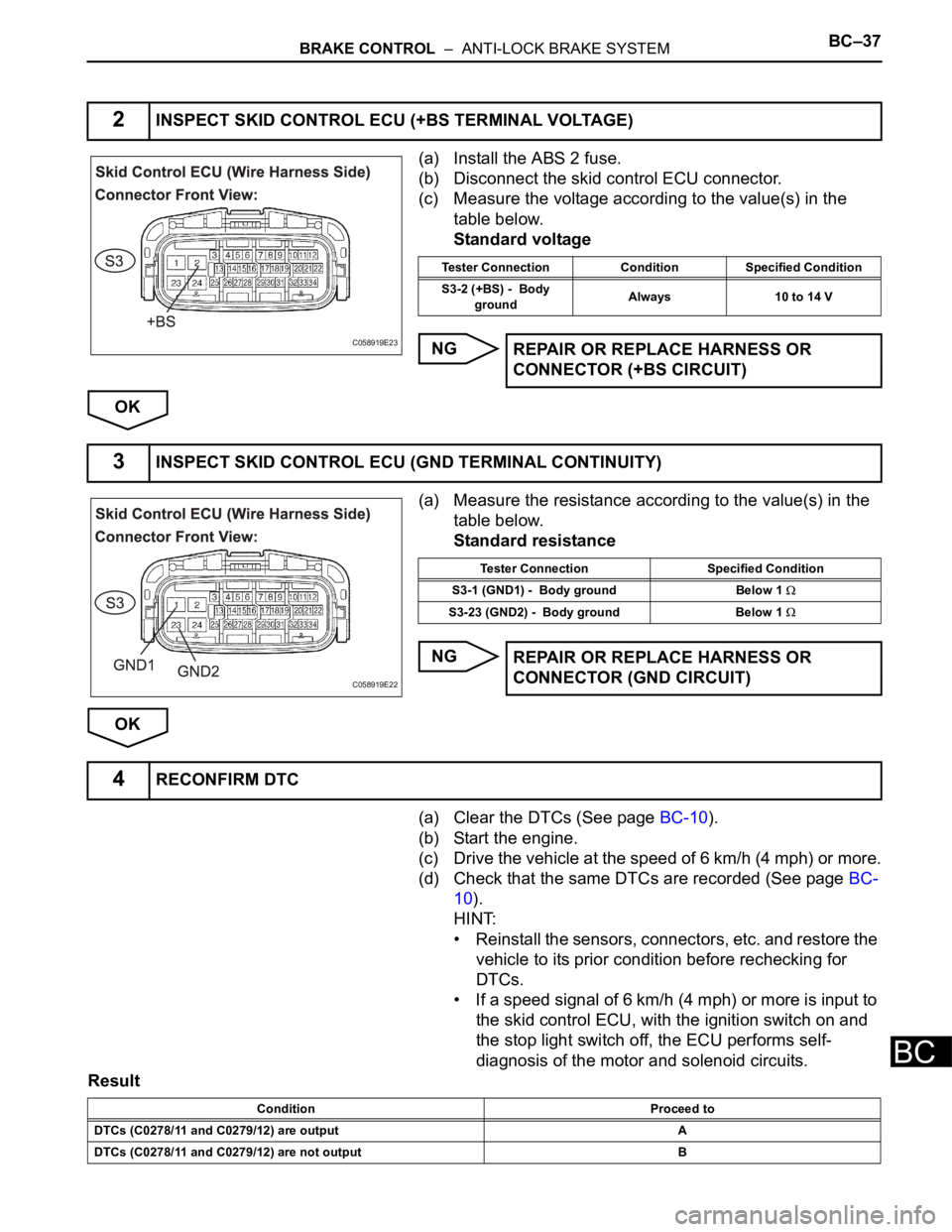
(a) Install the ABS 2 fuse.
(b) Disconnect the skid control ECU connector.
(c) Measure the voltage according to the value(s) in the
table below.
Standard voltage
NG
OK
(a) Measure the resistance according to the value(s) in the
table below.
Standard resistance
NG
OK
(a) Clear the DTCs (See page BC-10).
(b) Start the engine.
(c) Drive the vehicle at the speed of 6 km/h (4 mph) or more.
(d) Check that the same DTCs are recorded (See page BC-
10).
HINT:
• Reinstall the sensors, connectors, etc. and restore the
vehicle to its prior condition before rechecking for
DTCs.
• If a speed signal of 6 km/h (4 mph) or more is input to
the skid control ECU, with the ignition switch on and
the stop light switch off, the ECU performs self-
diagnosis of the motor and solenoid circuits.
Result
2INSPECT SKID CONTROL ECU (+BS TERMINAL VOLTAGE)
C058919E23
Tester Connection Condition Specified Condition
S3-2 (+BS) - Body
groundAlways 10 to 14 V
REPAIR OR REPLACE HARNESS OR
CONNECTOR (+BS CIRCUIT)
3INSPECT SKID CONTROL ECU (GND TERMINAL CONTINUITY)
C058919E22
Tester Connection Specified Condition
S3-1 (GND1) - Body ground Below 1
S3-23 (GND2) - Body ground Below 1
REPAIR OR REPLACE HARNESS OR
CONNECTOR (GND CIRCUIT)
4RECONFIRM DTC
Condition Proceed to
DTCs (C0278/11 and C0279/12) are output A
DTCs (C0278/11 and C0279/12) are not output B
Page 2583 of 3000
BC–40BRAKE CONTROL – ANTI-LOCK BRAKE SYSTEM
BC
(a) Check the battery voltage.
Standard voltage:
11 to 14 V
NG
OK
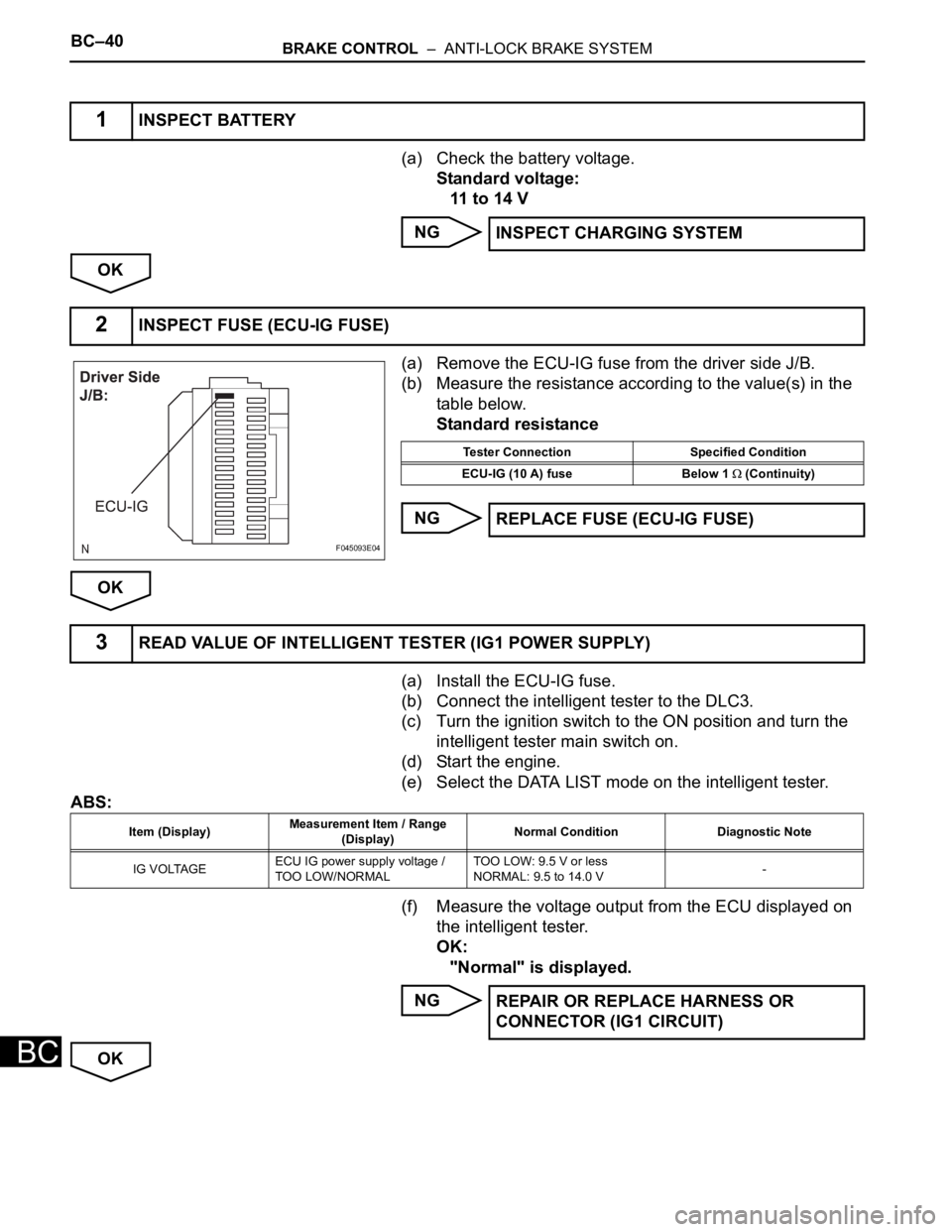
(a) Remove the ECU-IG fuse from the driver side J/B.
(b) Measure the resistance according to the value(s) in the
table below.
Standard resistance
NG
OK
(a) Install the ECU-IG fuse.
(b) Connect the intelligent tester to the DLC3.
(c) Turn the ignition switch to the ON position and turn the
intelligent tester main switch on.
(d) Start the engine.
(e) Select the DATA LIST mode on the intelligent tester.
ABS:
(f) Measure the voltage output from the ECU displayed on
the intelligent tester.
OK:
"Normal" is displayed.
NG
OK
1INSPECT BATTERY
INSPECT CHARGING SYSTEM
2INSPECT FUSE (ECU-IG FUSE)
F045093E04
Tester Connection Specified Condition
ECU-IG (10 A) fuse Below 1
(Continuity)
REPLACE FUSE (ECU-IG FUSE)
3READ VALUE OF INTELLIGENT TESTER (IG1 POWER SUPPLY)
Item (Display)Measurement Item / Range
(Display)Normal Condition Diagnostic Note
IG VOLTAGEECU IG power supply voltage /
TOO LOW/NORMALTOO LOW: 9.5 V or less
NORMAL: 9.5 to 14.0 V-
REPAIR OR REPLACE HARNESS OR
CONNECTOR (IG1 CIRCUIT)
Page 2600 of 3000
BR–22BRAKE – BRAKE BOOSTER
BR
INSPECTION
1. INSPECT BRAKE VACUUM CHECK VALVE
ASSEMBLY
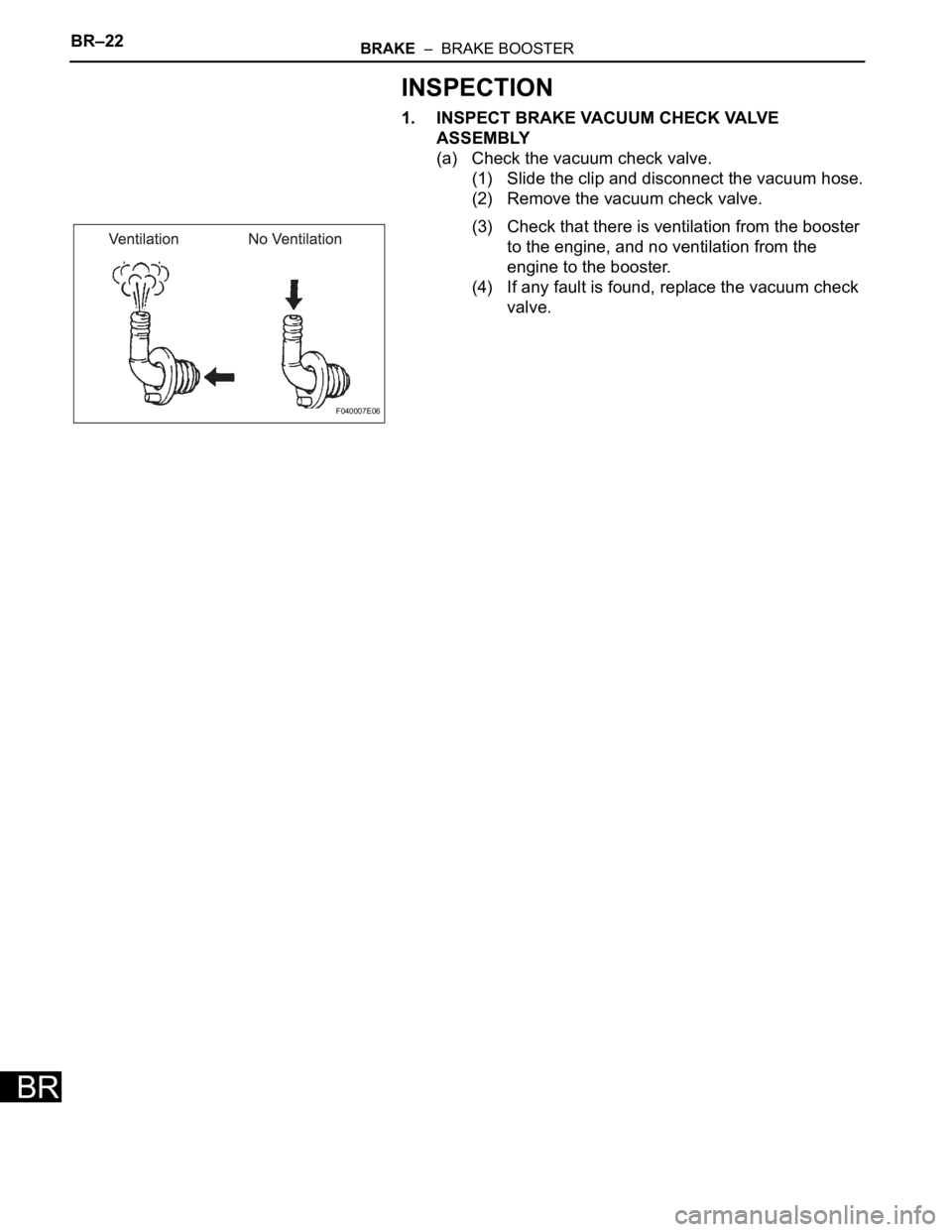
(a) Check the vacuum check valve.
(1) Slide the clip and disconnect the vacuum hose.
(2) Remove the vacuum check valve.
(3) Check that there is ventilation from the booster
to the engine, and no ventilation from the
engine to the booster.
(4) If any fault is found, replace the vacuum check
valve.
F040007E06
Page 2605 of 3000
BR–10BRAKE – BRAKE PEDAL
BR
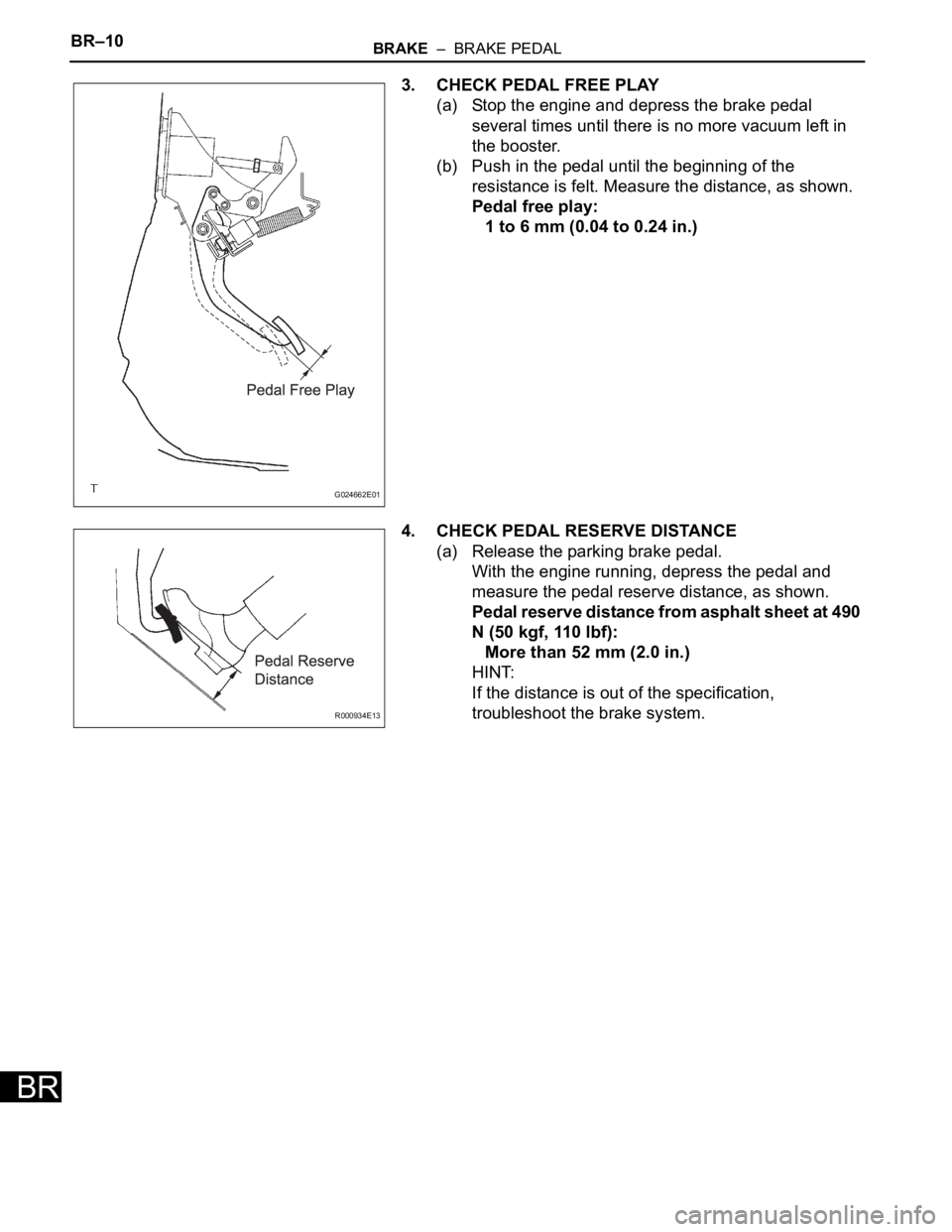
3. CHECK PEDAL FREE PLAY
(a) Stop the engine and depress the brake pedal
several times until there is no more vacuum left in
the booster.
(b) Push in the pedal until the beginning of the
resistance is felt. Measure the distance, as shown.
Pedal free play:
1 to 6 mm (0.04 to 0.24 in.)
4. CHECK PEDAL RESERVE DISTANCE
(a) Release the parking brake pedal.
With the engine running, depress the pedal and
measure the pedal reserve distance, as shown.
Pedal reserve distance from asphalt sheet at 490
N (50 kgf, 110 lbf):
More than 52 mm (2.0 in.)
HINT:
If the distance is out of the specification,
troubleshoot the brake system.
G024662E01
R000934E13
Page 2615 of 3000
BRAKE – BRAKE BOOSTERBR–19
BR
ON-VEHICLE INSPECTION
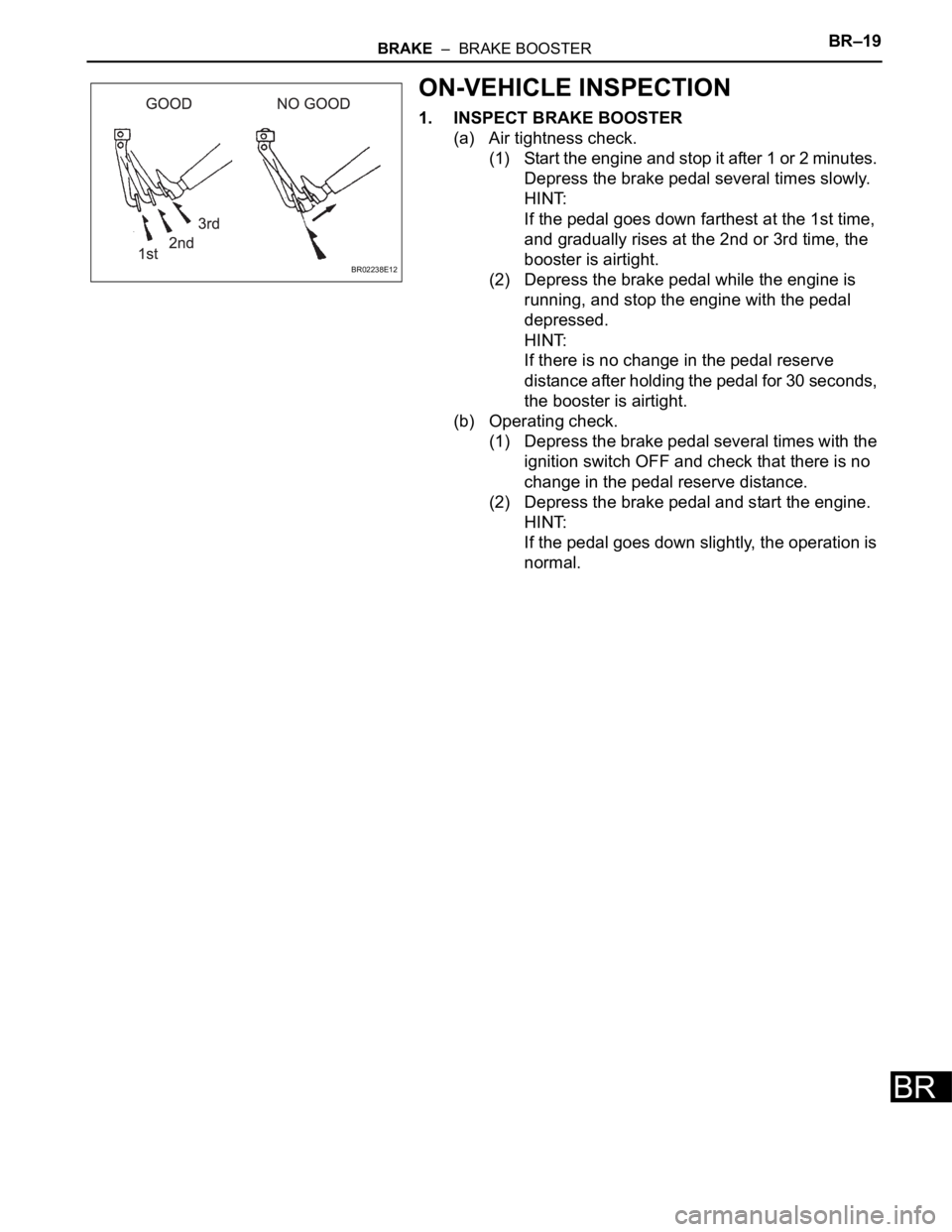
1. INSPECT BRAKE BOOSTER
(a) Air tightness check.
(1) Start the engine and stop it after 1 or 2 minutes.
Depress the brake pedal several times slowly.
HINT:
If the pedal goes down farthest at the 1st time,
and gradually rises at the 2nd or 3rd time, the
booster is airtight.
(2) Depress the brake pedal while the engine is
running, and stop the engine with the pedal
depressed.
HINT:
If there is no change in the pedal reserve
distance after holding the pedal for 30 seconds,
the booster is airtight.
(b) Operating check.
(1) Depress the brake pedal several times with the
ignition switch OFF and check that there is no
change in the pedal reserve distance.
(2) Depress the brake pedal and start the engine.
HINT:
If the pedal goes down slightly, the operation is
normal.
BR02238E12
Page 2674 of 3000
SR–10STEERING COLUMN – STEERING COLUMN ASSEMBLY
SR
REASSEMBLY
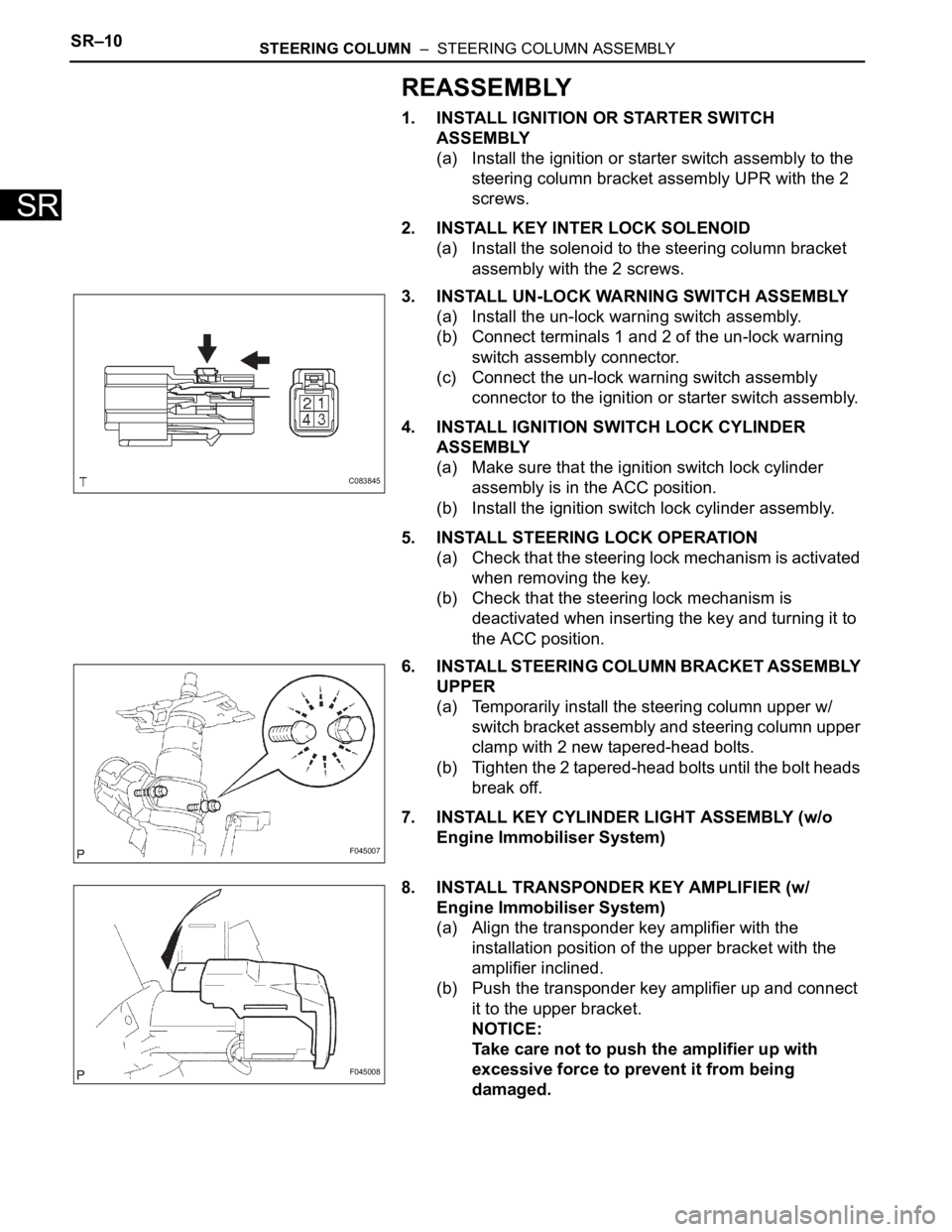
1. INSTALL IGNITION OR STARTER SWITCH
ASSEMBLY
(a) Install the ignition or starter switch assembly to the
steering column bracket assembly UPR with the 2
screws.
2. INSTALL KEY INTER LOCK SOLENOID
(a) Install the solenoid to the steering column bracket
assembly with the 2 screws.
3. INSTALL UN-LOCK WARNING SWITCH ASSEMBLY
(a) Install the un-lock warning switch assembly.
(b) Connect terminals 1 and 2 of the un-lock warning
switch assembly connector.
(c) Connect the un-lock warning switch assembly
connector to the ignition or starter switch assembly.
4. INSTALL IGNITION SWITCH LOCK CYLINDER
ASSEMBLY
(a) Make sure that the ignition switch lock cylinder
assembly is in the ACC position.
(b) Install the ignition switch lock cylinder assembly.
5. INSTALL STEERING LOCK OPERATION
(a) Check that the steering lock mechanism is activated
when removing the key.
(b) Check that the steering lock mechanism is
deactivated when inserting the key and turning it to
the ACC position.
6. INSTALL STEERING COLUMN BRACKET ASSEMBLY
UPPER
(a) Temporarily install the steering column upper w/
switch bracket assembly and steering column upper
clamp with 2 new tapered-head bolts.
(b) Tighten the 2 tapered-head bolts until the bolt heads
break off.
7. INSTALL KEY CYLINDER LIGHT ASSEMBLY (w/o
Engine Immobiliser System)
8. INSTALL TRANSPONDER KEY AMPLIFIER (w/
Engine Immobiliser System)
(a) Align the transponder key amplifier with the
installation position of the upper bracket with the
amplifier inclined.
(b) Push the transponder key amplifier up and connect
it to the upper bracket.
NOTICE:
Take care not to push the amplifier up with
excessive force to prevent it from being
damaged.
C083845
F045007
F045008
Page 2683 of 3000
SR–10STEERING COLUMN – STEERING COLUMN ASSEMBLY
SR
REASSEMBLY
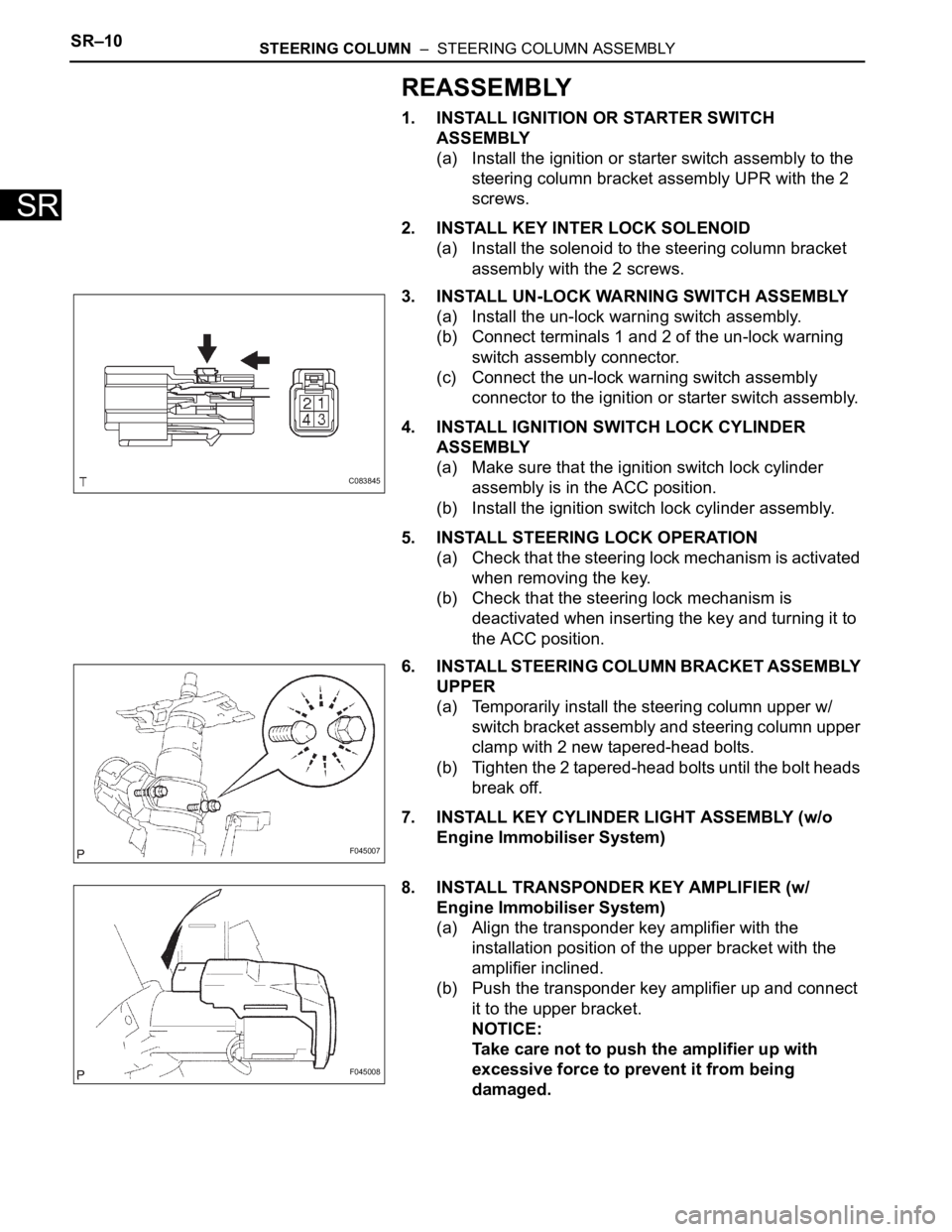
1. INSTALL IGNITION OR STARTER SWITCH
ASSEMBLY
(a) Install the ignition or starter switch assembly to the
steering column bracket assembly UPR with the 2
screws.
2. INSTALL KEY INTER LOCK SOLENOID
(a) Install the solenoid to the steering column bracket
assembly with the 2 screws.
3. INSTALL UN-LOCK WARNING SWITCH ASSEMBLY
(a) Install the un-lock warning switch assembly.
(b) Connect terminals 1 and 2 of the un-lock warning
switch assembly connector.
(c) Connect the un-lock warning switch assembly
connector to the ignition or starter switch assembly.
4. INSTALL IGNITION SWITCH LOCK CYLINDER
ASSEMBLY
(a) Make sure that the ignition switch lock cylinder
assembly is in the ACC position.
(b) Install the ignition switch lock cylinder assembly.
5. INSTALL STEERING LOCK OPERATION
(a) Check that the steering lock mechanism is activated
when removing the key.
(b) Check that the steering lock mechanism is
deactivated when inserting the key and turning it to
the ACC position.
6. INSTALL STEERING COLUMN BRACKET ASSEMBLY
UPPER
(a) Temporarily install the steering column upper w/
switch bracket assembly and steering column upper
clamp with 2 new tapered-head bolts.
(b) Tighten the 2 tapered-head bolts until the bolt heads
break off.
7. INSTALL KEY CYLINDER LIGHT ASSEMBLY (w/o
Engine Immobiliser System)
8. INSTALL TRANSPONDER KEY AMPLIFIER (w/
Engine Immobiliser System)
(a) Align the transponder key amplifier with the
installation position of the upper bracket with the
amplifier inclined.
(b) Push the transponder key amplifier up and connect
it to the upper bracket.
NOTICE:
Take care not to push the amplifier up with
excessive force to prevent it from being
damaged.
C083845
F045007
F045008
Page 2713 of 3000
POWER STEERING – POWER STEERING SYSTEMPS–3
PS
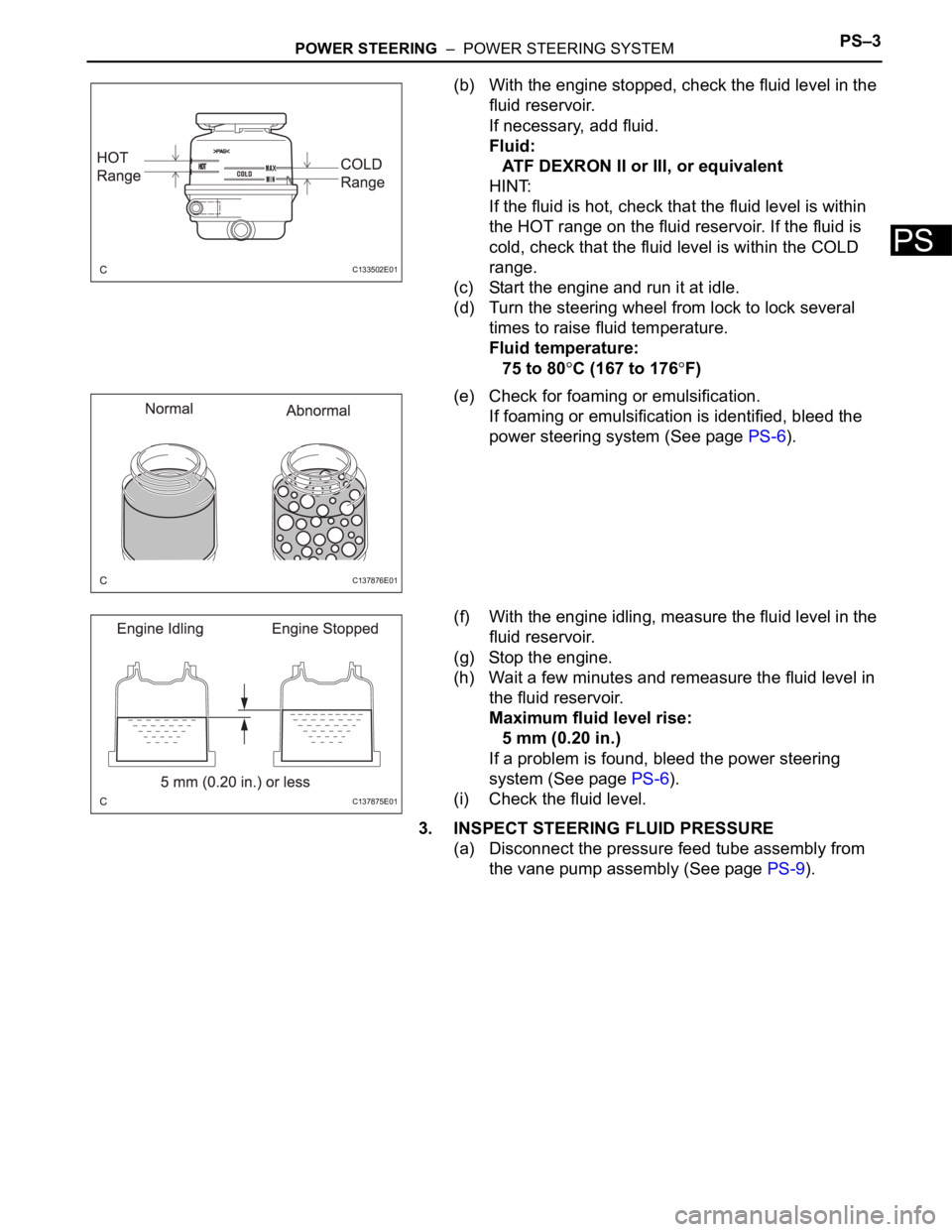
(b) With the engine stopped, check the fluid level in the
fluid reservoir.
If necessary, add fluid.
Fluid:
ATF DEXRON II or III, or equivalent
HINT:
If the fluid is hot, check that the fluid level is within
the HOT range on the fluid reservoir. If the fluid is
cold, check that the fluid level is within the COLD
range.
(c) Start the engine and run it at idle.
(d) Turn the steering wheel from lock to lock several
times to raise fluid temperature.
Fluid temperature:
75 to 80
C (167 to 176F)
(e) Check for foaming or emulsification.
If foaming or emulsification is identified, bleed the
power steering system (See page PS-6).
(f) With the engine idling, measure the fluid level in the
fluid reservoir.
(g) Stop the engine.
(h) Wait a few minutes and remeasure the fluid level in
the fluid reservoir.
Maximum fluid level rise:
5 mm (0.20 in.)
If a problem is found, bleed the power steering
system (See page PS-6).
(i) Check the fluid level.
3. INSPECT STEERING FLUID PRESSURE
(a) Disconnect the pressure feed tube assembly from
the vane pump assembly (See page PS-9).
C133502E01
C137876E01
C137875E01
Page 2714 of 3000
PS–4POWER STEERING – POWER STEERING SYSTEM
PS
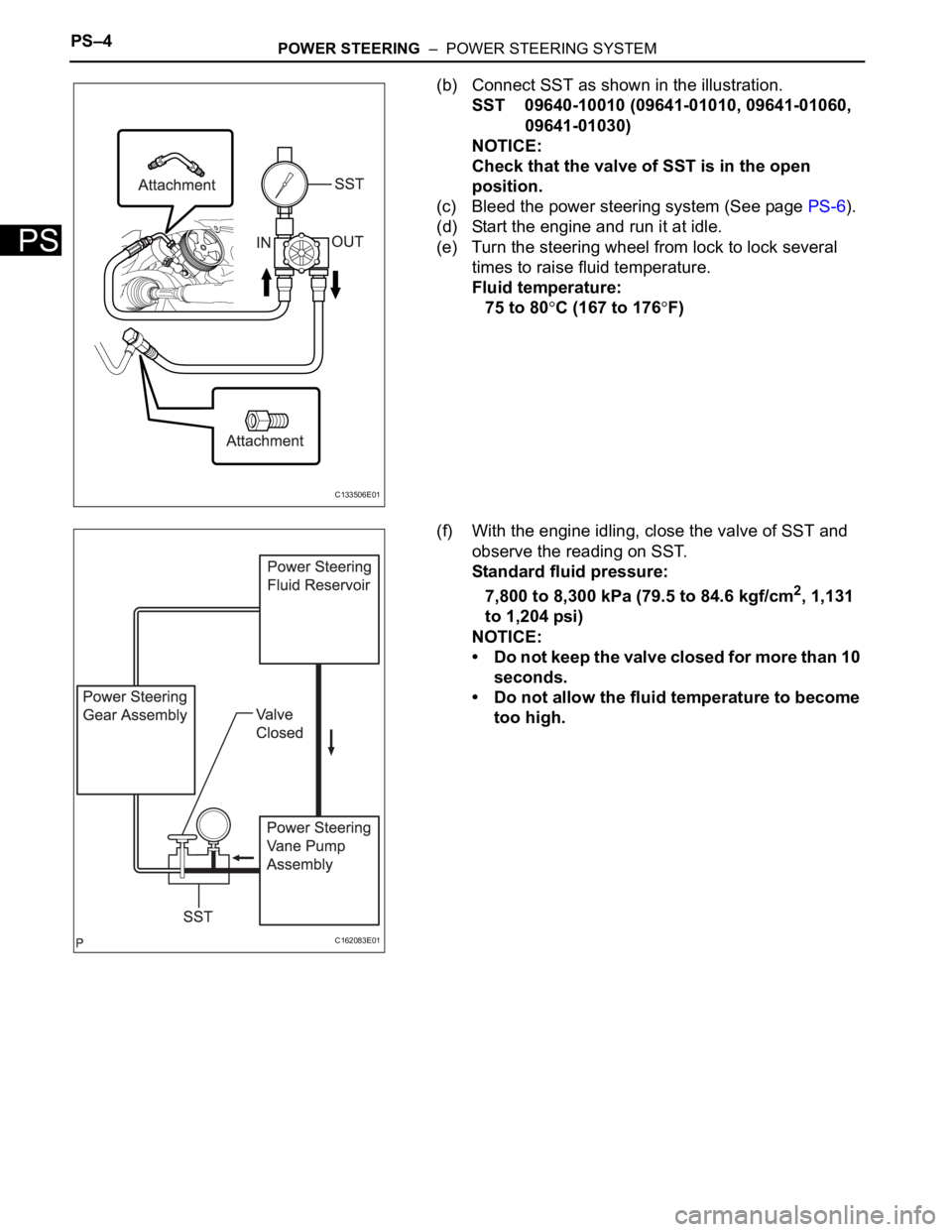
(b) Connect SST as shown in the illustration.
SST 09640-10010 (09641-01010, 09641-01060,
09641-01030)
NOTICE:
Check that the valve of SST is in the open
position.
(c) Bleed the power steering system (See page PS-6).
(d) Start the engine and run it at idle.
(e) Turn the steering wheel from lock to lock several
times to raise fluid temperature.
Fluid temperature:
75 to 80
C (167 to 176F)
(f) With the engine idling, close the valve of SST and
observe the reading on SST.
Standard fluid pressure:
7,800 to 8,300 kPa (79.5 to 84.6 kgf/cm
2, 1,131
to 1,204 psi)
NOTICE:
• Do not keep the valve closed for more than 10
seconds.
• Do not allow the fluid temperature to become
too high.
C133506E01
C162083E01
Page 2715 of 3000
POWER STEERING – POWER STEERING SYSTEMPS–5
PS
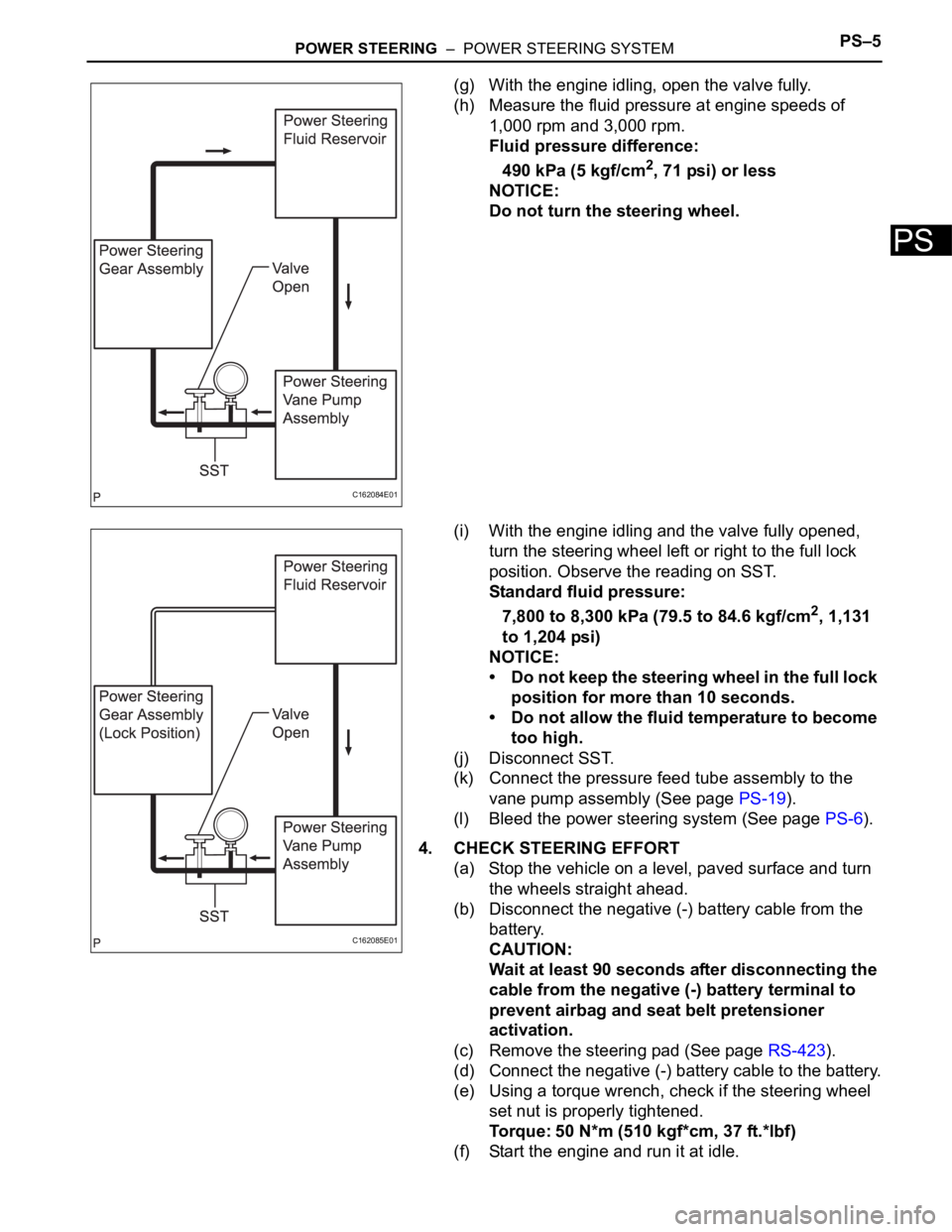
(g) With the engine idling, open the valve fully.
(h) Measure the fluid pressure at engine speeds of
1,000 rpm and 3,000 rpm.
Fluid pressure difference:
490 kPa (5 kgf/cm
2, 71 psi) or less
NOTICE:
Do not turn the steering wheel.
(i) With the engine idling and the valve fully opened,
turn the steering wheel left or right to the full lock
position. Observe the reading on SST.
Standard fluid pressure:
7,800 to 8,300 kPa (79.5 to 84.6 kgf/cm
2, 1,131
to 1,204 psi)
NOTICE:
• Do not keep the steering wheel in the full lock
position for more than 10 seconds.
• Do not allow the fluid temperature to become
too high.
(j) Disconnect SST.
(k) Connect the pressure feed tube assembly to the
vane pump assembly (See page PS-19).
(l) Bleed the power steering system (See page PS-6).
4. CHECK STEERING EFFORT
(a) Stop the vehicle on a level, paved surface and turn
the wheels straight ahead.
(b) Disconnect the negative (-) battery cable from the
battery.
CAUTION:
Wait at least 90 seconds after disconnecting the
cable from the negative (-) battery terminal to
prevent airbag and seat belt pretensioner
activation.
(c) Remove the steering pad (See page RS-423).
(d) Connect the negative (-) battery cable to the battery.
(e) Using a torque wrench, check if the steering wheel
set nut is properly tightened.
Torque: 50 N*m (510 kgf*cm, 37 ft.*lbf)
(f) Start the engine and run it at idle.
C162084E01
C162085E01