brake TOYOTA SIENNA 2019 (in English) Owner's Guide
[x] Cancel search | Manufacturer: TOYOTA, Model Year: 2019, Model line: SIENNA, Model: TOYOTA SIENNA 2019Pages: 584, PDF Size: 14.5 MB
Page 228 of 584
228
SIENNA_OM_OM08025U_(U)
4-2. Driving procedures
Engine (ignition) switch (vehicles with a
smart key system)
Check that the parking brake is set.
Check that the shift lever is set in P.
Firmly depress the brake pedal.
The engine switch indicator will turn green. If the indicator d oes not turn
green, the engine cannot be started.
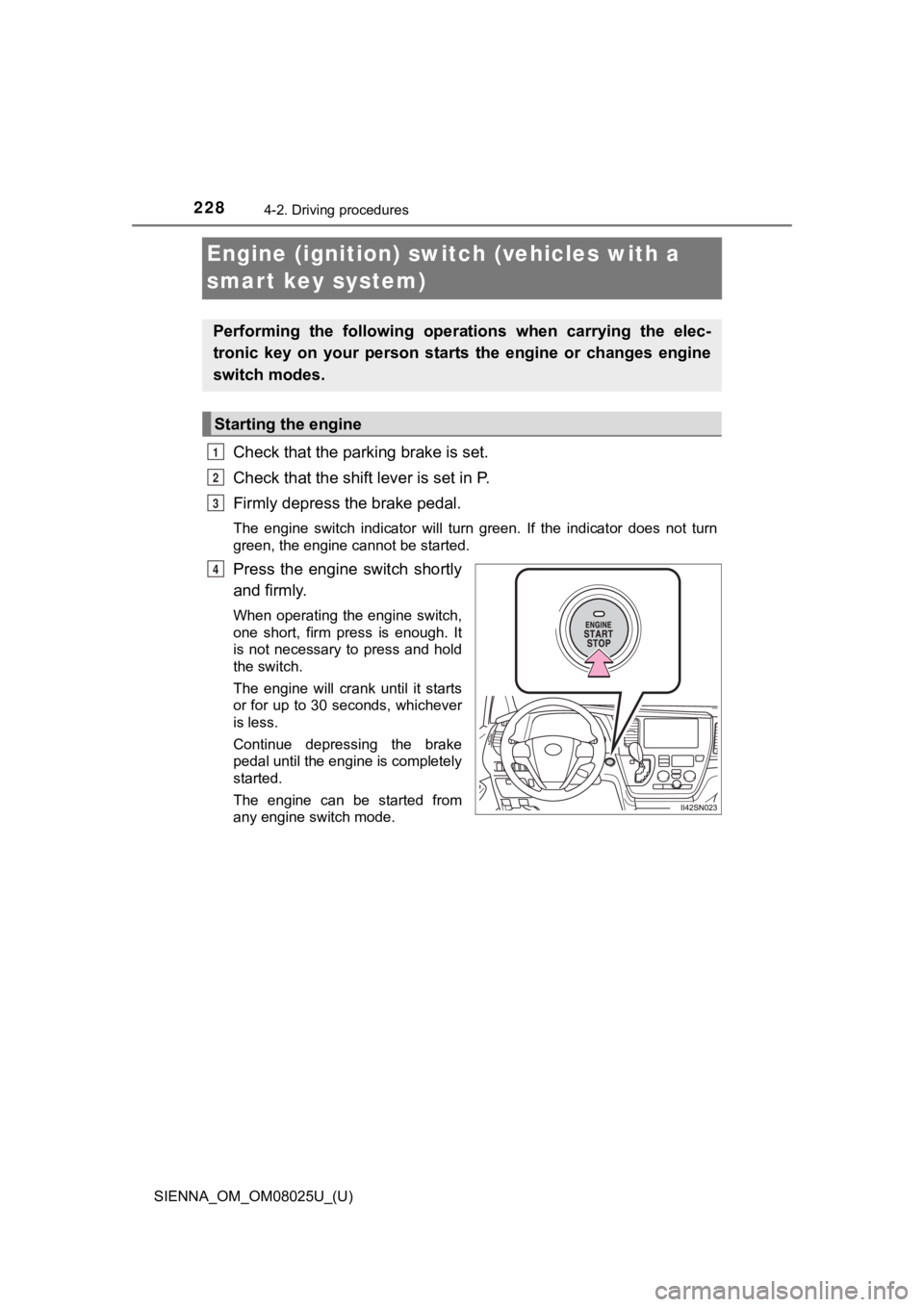
Press the engine switch shortly
and firmly.
When operating the engine switch,
one short, firm press is enough. It
is not necessary to press and hold
the switch.
The engine will crank until it starts
or for up to 30 seconds, whichever
is less.
Continue depressing the brake
pedal until the engine is completely
started.
The engine can be started from
any engine switch mode.
Performing the following opera tions when carrying the elec-
tronic key on your person starts the engine or changes engine
switch modes.
Starting the engine
1
2
3
4
Page 229 of 584
SIENNA_OM_OM08025U_(U)
2294-2. Driving procedures
4
Driving
Stop the vehicle.
Set the parking brake. (P. 240), and shift the shift lever to P.
Press the engine switch.
Release the brake peda l and check that the indicator on the engine
switch is off.
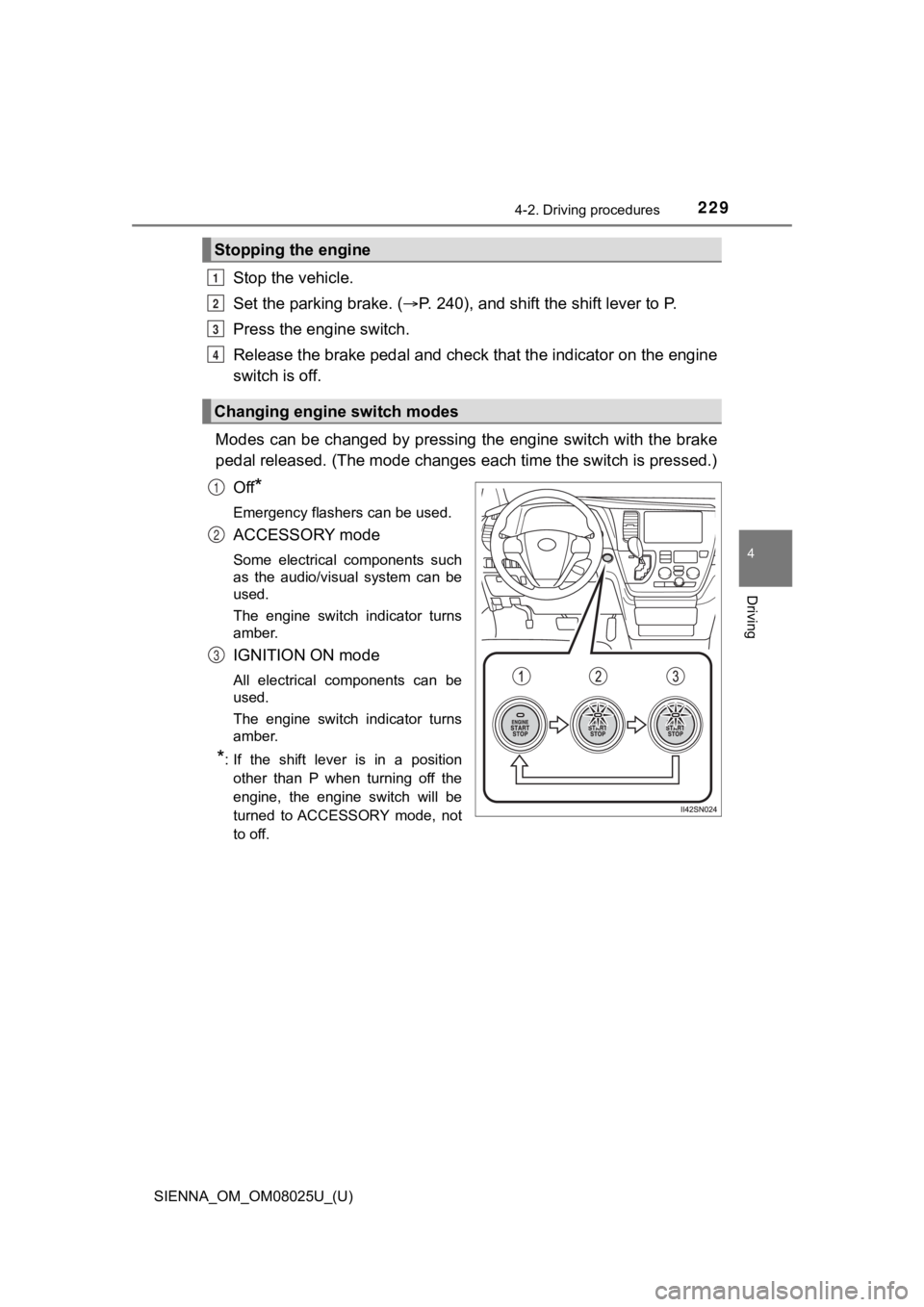
Modes can be changed by pressing the engine switch with the bra ke
pedal released. (The mode changes each time the switch is pressed.)
Off
*
Emergency flashers can be used.
ACCESSORY mode
Some electrical components such
as the audio/visual system can be
used.
The engine switch indicator turns
amber.
IGNITION ON mode
All electrical components can be
used.
The engine switch indicator turns
amber.
*: If the shift lever is in a position other than P when turning off the
engine, the engine switch will be
turned to ACCESSORY mode, not
to off.
Stopping the engine
Changing engine switch modes
1
2
3
4
1
2
3
Page 230 of 584

230
SIENNA_OM_OM08025U_(U)
4-2. Driving procedures
If the engine is stopped with the shift lever in a position other than P,
the engine switch will not be turned off but instead be turned to
ACCESSORY mode. Perform the following procedure to turn the
switch off:
Check that the park ing brake is set.
Shift the shift lever to P.
Check that the indicator on the engine switch is illuminated in
amber and then press the engine switch once.
Check that the indi cator on the engine switch is off.
■Auto power off function
If the vehicle is left in ACCESSORY mode for more than 20 minut es or
IGNITION ON mode (the engine is not running) for more than an hour with
the shift lever in P, the engine switch will automatically turn off. However, this
function cannot entirely prevent battery discharge. Do not leav e the vehicle
with the engine switch in ACCESSORY or IGNITION ON mode for lon g peri-
ods of time when the engine is not running.
■ Electronic key battery depletion
P. 107
■ Conditions affecting operation
P. 119
■ Note for the entry function
P. 145
■ If the engine does not start
The engine immobilizer system may not have been deactivated. ( P. 77)
Contact your Toyota dealer.
When stopping the engine with the shift lever in a position other
than P
1
2
3
4
Page 232 of 584

232
SIENNA_OM_OM08025U_(U)
4-2. Driving procedures
WARNING
■When starting the engine
Always start the engine while sitting in the driver’s seat. Do not depress the
accelerator pedal while starting the engine under any circumsta nces.
Doing so may cause an accident resulting in death or serious in jury.
■ Caution while driving
If the vehicle begins to slide due to engine failure or other c ircumstances, do
not lock or open the doors until the vehicle reaches a safe and complete
stop. Activation of the steering lock in this circumstance may lead to an
accident, resulting in death or serious injury.
■ Stopping the engine in an emergency
If you want to stop the engine in an emergency while driving th e vehicle,
press and hold the engine switch for more than 2 seconds, or pr ess it briefly
3 times or more in succession. ( P. 463)
However, do not touch the engine switch while driving except in an emer-
gency. Turning the engine off while driving will not cause loss of steering or
braking control, but the power assist to these systems will be lost. This will
make it more difficult to steer and brake, so you should pull o ver and stop
the vehicle as soon as it is safe to do so.
NOTICE
■ To prevent battery discharge
● Do not leave the engine switch in ACCESSORY or IGNITION ON mode
for long periods of time without the engine running.
● If the indicator on the engine switch is illuminated, the engin e switch is not
off. When exiting the vehicle, always check that the engine swi tch is off.
● Do not stop the engine when the shift lever is in a position ot her than P. If
the engine is stopped in another shift lever position, the engi ne switch will
not be turned off but instead be turned to ACCESSORY mode. If t he vehi-
cle is left in ACCESSORY mode, battery discharge may occur.
■ When starting the engine
● Do not race a cold engine.
● If the engine becomes difficult to start or stalls frequently, have the engine
checked immediately.
■ Symptoms indicating a malf unction with the engine switch
If the engine switch seems to be operating somewhat differently than usual,
such as the switch sticking slightly, there may be a malfunctio n.
Contact your Toyota dealer immediately.
Page 233 of 584
233
SIENNA_OM_OM08025U_(U)
4-2. Driving procedures
4
Driving
Automatic transaxle
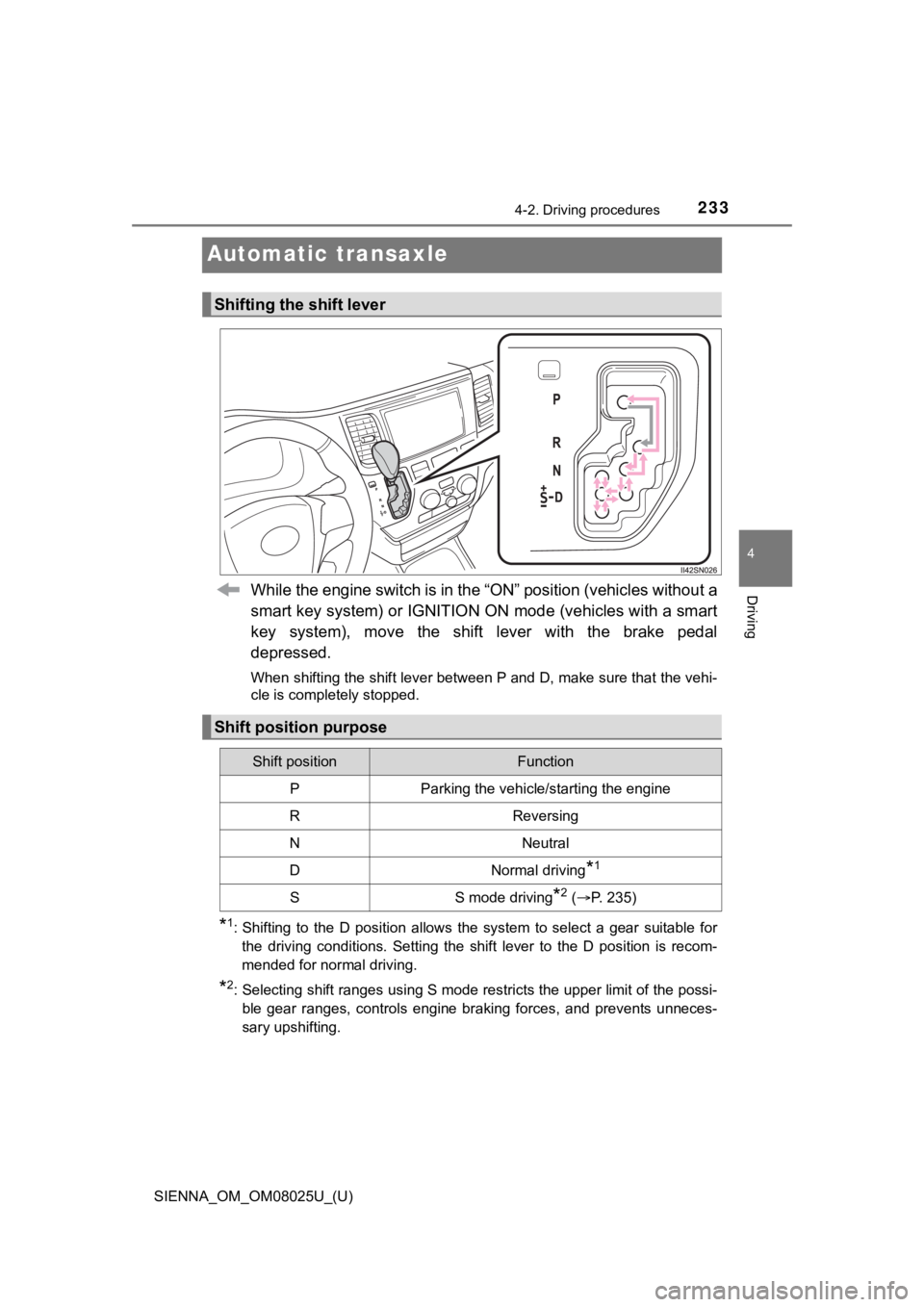
While the engine switch is in the “ON” position (vehicles without a
smart key system) or IGNITION ON mode (vehicles with a smart
key system), move the shift lever with the brake pedal
depressed.
When shifting the shift lever between P and D, make sure that t he vehi-
cle is completely stopped.
*1: Shifting to the D position allows the system to select a gear suitable for
the driving conditions. Setting the shift lever to the D position is recom-
mended for normal driving.
*2: Selecting shift ranges using S mode restricts the upper limit of the possi-
ble gear ranges, controls engine braking forces, and prevents u nneces-
sary upshifting.
Shifting the shift lever
Shift position purpose
Shift positionFunction
PParking the vehicle/starting the engine
RReversing
NNeutral
DNormal driving*1
SS mode driving*2 ( P. 235)
Page 236 of 584

236
SIENNA_OM_OM08025U_(U)
4-2. Driving procedures
■S mode
●When the shift range is 7 or lower, holding the shift lever toward “+” sets the
shift range to 8.
● To prevent excessive engine speed, a function was adopted that automati-
cally selects a higher shift range before the engine speed beco mes too high.
● To protect the automatic transaxle, a function is adopted that automatically
selects a higher shift range when the fluid temperature is high .
■ Downshift restriction warning buzzer (S mode)
To help ensure safety and driving performance, downshifting ope ration may
sometimes be restricted. In some circumstances, downshifting ma y not be
possible even when the shift lever is operated. (A buzzer will sound twice.)
■ Deactivation of power mode
Power mode will be canceled if the engine is turned off after d riving in power
mode.
■ When driving with the dynamic r adar cruise control activated
Even when performing the following actions with the intent of e nabling engine
braking, engine braking will not activate because dynamic radar cruise con-
trol will not be canceled.
● While driving in S mode, downshifting to 7, 6, 5 or 4. ( P. 2 3 5 )
● When switching the driving mode to power mode while driving in D.
(P. 234)
■ Shift lock system
The shift lock system is a system to prevent accidental operation of the shift
lever in starting.
The shift lever can be shifted from P only when the engine switch is in the
“ON” position (vehicles without a smart key system) or IGNITION ON mode
(vehicles with a smart key system) and the brake pedal is being depressed.
Page 237 of 584
SIENNA_OM_OM08025U_(U)
2374-2. Driving procedures
4
Driving
■If the shift lever cannot be shifted from P
●First, check whether the brake pedal is being depressed.
If the shift lever cannot be shifted with your foot on the brak e pedal, there
may be a problem with the shift lock system. Have the vehicle i nspected by
your Toyota dealer immediately.
The following steps may be used as an emergency measure to ensu re that
the shift lever can be shifted.
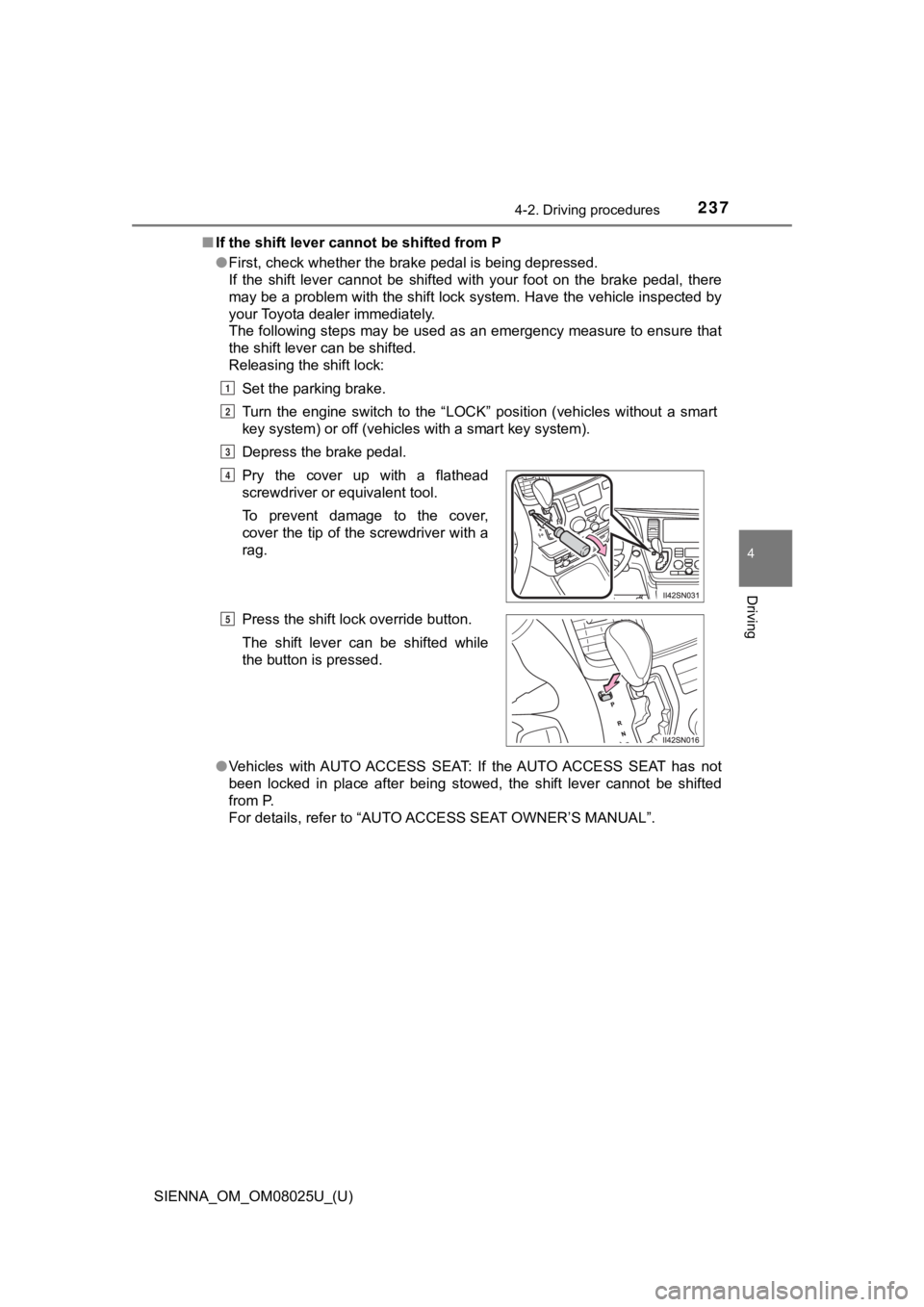
Releasing the shift lock:
Set the parking brake.
Turn the engine switch to the “LOCK” position (vehicles without a smart
key system) or off (vehicles with a smart key system).
Depress the brake pedal.
● Vehicles with AUTO ACCESS SEAT : If the AUTO ACCESS SEAT has not
been locked in place after being stowed, the shift lever cannot be shifted
from P.
For details, refer to “AUTO ACCESS SEAT OWNER’S MANUAL”. Pry the cover up with a flathead
screwdriver or equivalent tool.
To prevent damage to the cover,
cover the tip of the screwdriver with a
rag.
Press the shift lock override button.
The shift lever can be shifted while
the button is pressed.
1
2
3
4
5
Page 238 of 584

238
SIENNA_OM_OM08025U_(U)
4-2. Driving procedures
■If the beep sounds continuously w hen the shift lever is shifted from P
(vehicles with an AUTO ACCESS SEAT)
The AUTO ACCESS SEAT may not be locked in place.
For details, refer to “AUTO ACCESS SEAT OWNER’S MANUAL”.
■ If “S” does not come on even aft er shifting the shift lever to S
This may indicate a malfunction in the automatic transaxle syst em. Have the
vehicle inspected by your Toyota dealer immediately. (In this s ituation, the
transaxle will operate in the same manner as when the shift lev er is in D.)
■ AI-SHIFT
AI-SHIFT automatically selects the suitable gear according to d river perfor-
mance and driving conditions.
AI-SHIFT automatically operates when the shift lever is in the D position.
(Shifting the shift lever to the S position cancels the functio n.)
WARNING
■When driving on slippery road surfaces
Do not accelerate or shift gears suddenly.
Sudden changes in engine braking may cause the vehicle to spin or skid,
resulting in an accident.
■ To prevent an accident when releasing the shift lock
Before pressing the shift lock override button, make sure to se t the parking
brake and depress the brake pedal.
If the accelerator pedal is accidentally depressed instead of t he brake pedal
when the shift lock override button is pressed and the shift le ver is shifted
out of P, the vehicle may suddenly start, possibly leading to a n accident
resulting in death or serious injury.
Page 240 of 584
240
SIENNA_OM_OM08025U_(U)
4-2. Driving procedures
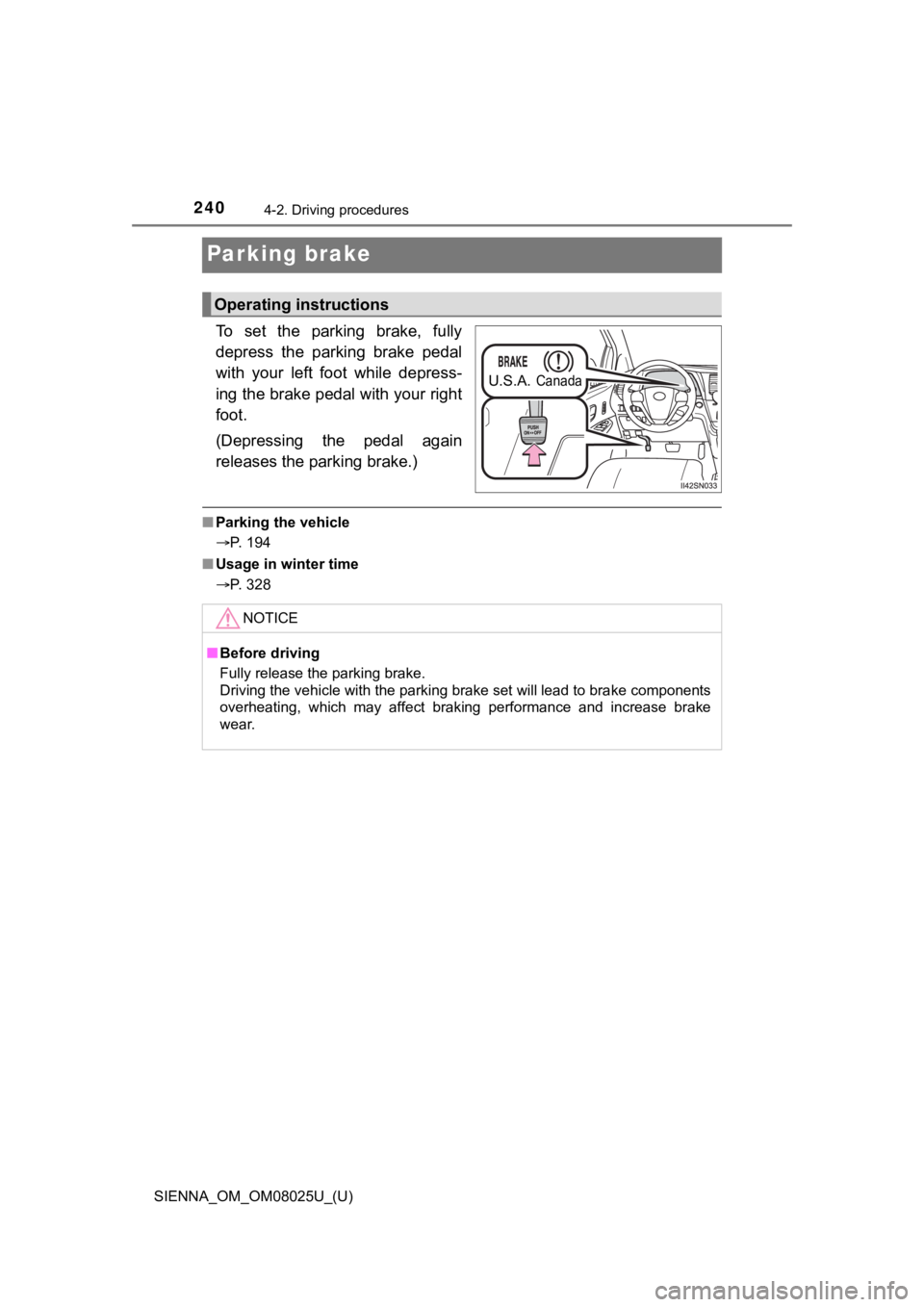
Parking brake
To set the parking brake, fully
depress the parking brake pedal
with your left foot while depress-
ing the brake pedal with your right
foot.
(Depressing the pedal again
releases the parking brake.)
■Parking the vehicle
P. 194
■ Usage in winter time
P. 328
Operating instructions
U.S.A.Canada
NOTICE
■Before driving
Fully release the parking brake.
Driving the vehicle with the parking brake set will lead to bra ke components
overheating, which may affect braking performance and increase brake
wear.
Page 244 of 584
244
SIENNA_OM_OM08025U_(U)
4-3. Operating the lights and wipers
■Daytime running light system (if equipped)
●Bulb type: The daytime running lights illuminate using the same lights as the
headlights and illuminate dimmer than the headlights.
● LED type: The daytime running lights illuminate using the same lights as the
parking lights and illuminate brighter than the parking lights.
● To make your vehicle more visible to other drivers during dayti me driving,
the daytime running lights turn on automatically when all of the following
conditions are met. (The daytime running lights are not designe d for use at
night.)
• The engine is running
• The parking brake is released
• The headlight switch is in the (Canada only), or “AUTO”
*
position
*: When the surroundings are bright
The daytime running lights remain on after they illuminate, even if the parking
brake is set again.
● For the U.S.A.: Daytime running lights can be turned off by ope rating the
headlight switch.
● Compared to turning on the headlights, the daytime running ligh t system
offers greater durability and consumes less electricity, so it can help improve
fuel economy.
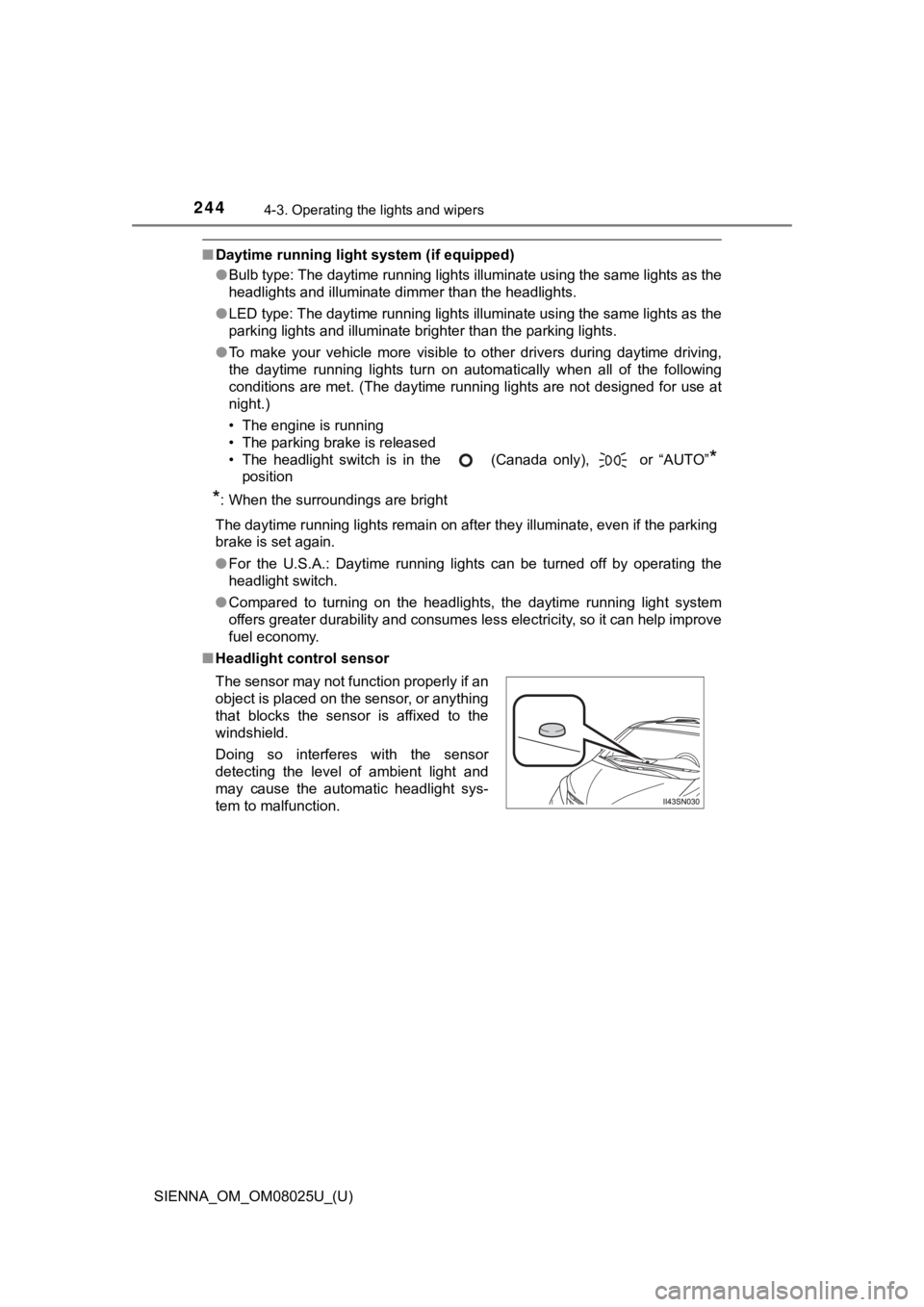
■ Headlight control sensor
The sensor may not function properly if an
object is placed on the sensor, or anything
that blocks the sensor is affixed to the
windshield.
Doing so interferes with the sensor
detecting the level of ambient light and
may cause the automatic headlight sys-
tem to malfunction.