ESP TOYOTA SUPRA 2023 Repair Manual
[x] Cancel search | Manufacturer: TOYOTA, Model Year: 2023, Model line: SUPRA, Model: TOYOTA SUPRA 2023Pages: 372, PDF Size: 6.32 MB
Page 295 of 372

2955-1. MOBILITY
5
MOBILITY
Perform a system reset again.
• Tire Pressure Monitor mal- function: have the system
checked by your Toyota
dealer.
• Each tire, including the spare (if provided) should be
checked monthly when cold
and inflated to the inflation
pressure recommended by
the vehicle manufacturer on
the vehicle placard or tire
inflation pressure label. (If
your vehicle has tires of a dif-
ferent size than the size indi-
cated on the vehicle placard
or tire inflation pressure label,
you should determine the
proper tire inflation pressure
for those tires.) As an added
safety feature, your vehicle
has been equipped with a tire
pressure monitoring system
(TPMS) that illuminates a low
tire pressure telltale when one
or more of your tires is signifi-
cantly under-inflated. Accord-
ingly, when the low tire
pressure telltale illuminates,
you should stop and check
your tires as soon as possi-
ble, and inflate them to the
proper pressure. Driving on a
significantly under-inflated tire
causes the tire to overheat and can lead to tire failure.
Under-inflation also reduces
fuel efficiency and tire tread
life, and may affect the vehi-
cle's handling and stopping
ability. Please note that the
TPMS is not a substitute for
proper tire maintenance, and
it is the driver's responsibility
to maintain correct tire pres-
sure, even if under-inflation
has not reached the level to
trigger illumination of the
TPMS low tire pressure tell-
tale. Your vehicle has also
been equipped with a TPMS
malfunction indicator to indi-
cate when the system is not
operating properly. The TPMS
malfunction indicator is com-
bined with the low tire pres-
sure telltale. When the system
detects a malfunction, the tell-
tale will flash for approxi-
mately one minute and then
remain continuously illumi-
nated. This sequence will
continue upon subsequent
vehicle start-ups as long as
the malfunction exists. When
the malfunction indicator is
illuminated, the system may
not be able to detect or signal
low tire pressure as intended.
TPMS malfunctions may
occur for a variety of reasons,
including the installation of
replacement or alternate tires
or wheels on the vehicle that
prevent the TPMS from func-
Declaration according to
NHTSA/FMVSS 138 Tire
Pressure Monitoring System
Page 300 of 372
3005-1. MOBILITY
This chapter describes all stan-
dard, country-specific and
optional features offered with
the series. It also describes fea-
tures that are not necessarily
available in your vehicle, for
instance, due to the selected
options or country versions. This
also applies to safety-related
functions and systems. When
using these functions and sys-
tems, the applicable laws and
regulations must be observed.
Depending on the region, many
gas stations sell fuel that has
been customized to winter or
summer conditions. Fuel that is
available in winter,for instance
helps make a cold start easier.
For the best fuel consumption,
the gasoline should be sul-
fur-free or very low in sulfur con-
tent.
Fuels that are marked on the gas pump as containing metal
must not be used.
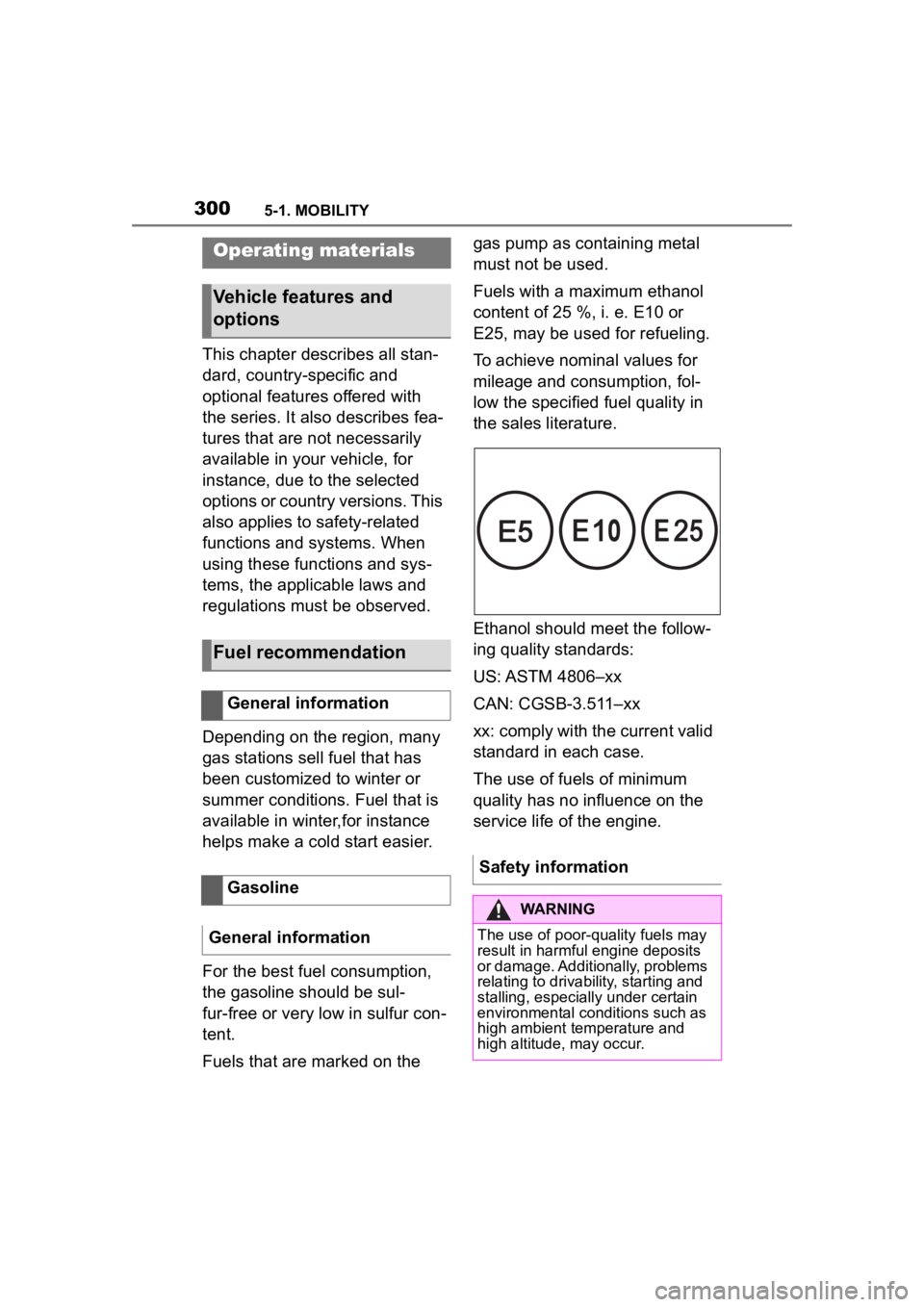
Fuels with a maximum ethanol
content of 25 %, i. e. E10 or
E25, may be used for refueling.
To achieve nominal values for
mileage and consumption, fol-
low the specified fuel quality in
the sales literature.
Ethanol should meet the follow-
ing quality standards:
US: ASTM 4806–xx
CAN: CGSB-3.511–xx
xx: comply with the current valid
standard in each case.
The use of fuels of minimum
quality has no influence on the
service life of the engine.
Operating materials
Vehicle features and
options
Fuel recommendation
General information
Gasoline
General information
Safety information
WARNING
The use of poor-quality fuels may
result in harmful engine deposits
or damage. Additionally, problems
relating to drivability, starting and
stalling, especially under certain
environmental conditions such as
high ambient temperature and
high altitude, may occur.
Page 309 of 372
3095-1. MOBILITY
5
MOBILITY
Condition Based Service CBS
determines the maintenance
recommendation using sensors
and special algorithms that take
into account the driving condi-
tions of the vehicle.
The system makes it possible to
adapt the amount of mainte-
nance corresponding to your
user profile.
Information on service notifica-
tions, refer to page 147, can be
displayed on the Control Dis-
play.
Storage periods during which
the vehicle battery was discon-
nected are not taken into
account.
If this occurs, have a Toyota
dealer update the time-depen-
dent maintenance procedures,
such as checking brake fluid
and, if necessary, changing the
engine oil and the microfil-
ter/activated-charcoal filter.Please consult “Owner's War-
ranty Information Booklet” or
“Owner's Manual Supplement”
for additional information on ser-
vice and maintenance work.
The manufacturer of your vehi-
cle recommends that mainte-
nance and repair be performed
by a Toyota dealer. Records of
regular maintenance and repair
work should be retained.
Scheduled maintenance should
be performed at specified inter-
vals according to the mainte-
nance schedule.
For details about maintenance
items and schedules, refer to
the "Scheduled Maintenance
Guide" or "Owner's Manual Sup-
plement".
Devices connected to the OBD
socket trigger the alarm system
when the vehicle is locked.
Remove any devices con-
nected at the OBD socket
Condition Based Service
CBS
Concept
General information
Storage periods
"Owner's Warranty Infor-
mation Booklet" or
"Owner's Manual Supple-
ment"
Scheduled maintenance
Socket for OBD Onboard
Diagnosis
General information
Page 312 of 372
3125-1. MOBILITY
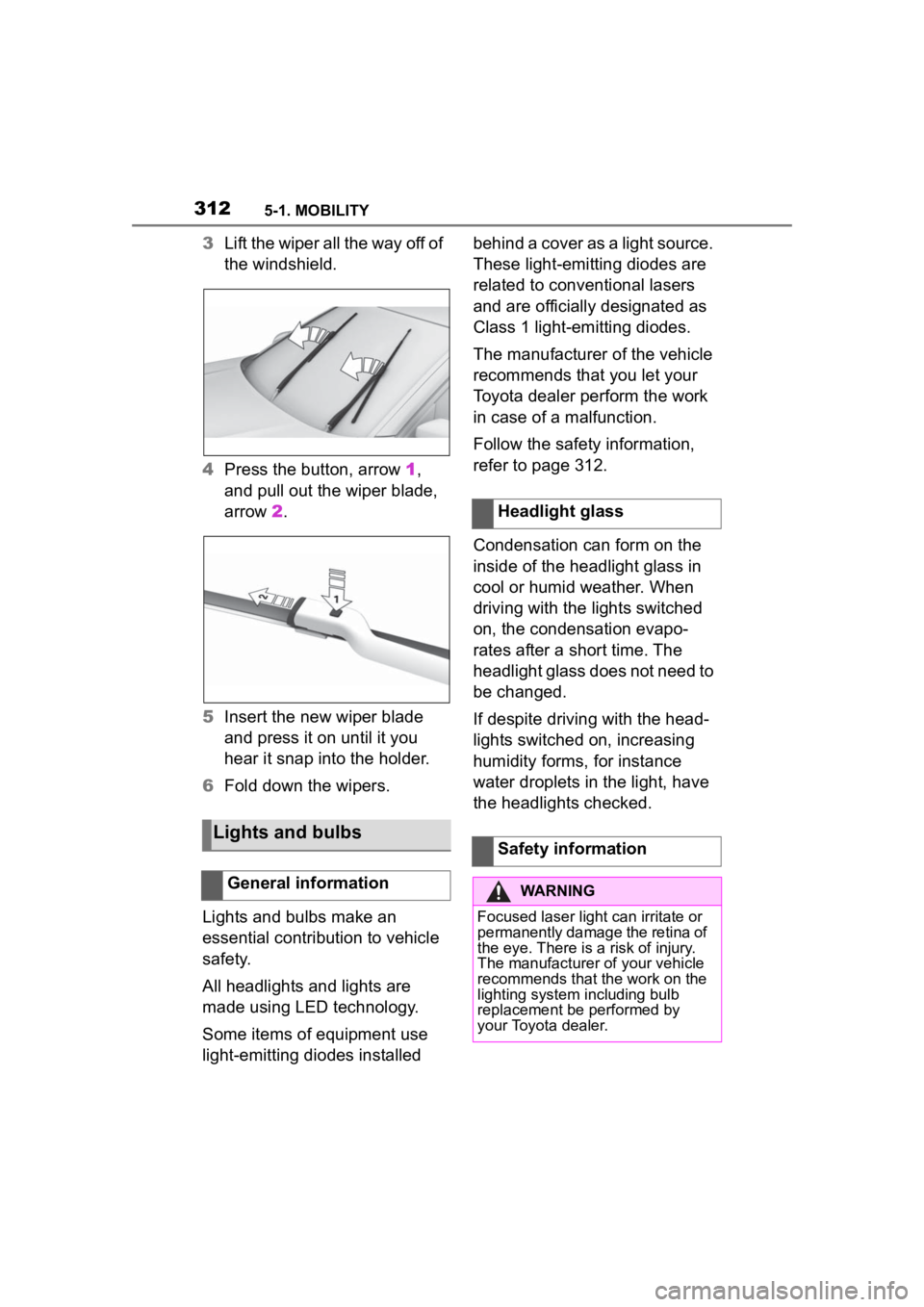
3Lift the wiper all the way off of
the windshield.
4 Press the button, arrow 1,
and pull out the wiper blade,
arrow 2.
5 Insert the new wiper blade
and press it on until it you
hear it snap into the holder.
6 Fold down the wipers.
Lights and bulbs make an
essential contribution to vehicle
safety.
All headlights and lights are
made using LED technology.
Some items of equipment use
light-emitting diodes installed behind a cover as a light source.
These light-emitting diodes are
related to conventional lasers
and are officially designated as
Class 1 light-emitting diodes.
The manufacturer of the vehicle
recommends that you let your
Toyota dealer perform the work
in case of a malfunction.
Follow the safety information,
refer to page 312.
Condensation can form on the
inside of the headlight glass in
cool or humid weather. When
driving with the lights switched
on, the condensation evapo-
rates after a short time. The
headlight glass does not need to
be changed.
If despite driving with the head-
lights switched on, increasing
humidity forms, for instance
water droplets in the light, have
the headlights checked.
Lights and bulbs
General information
Headlight glass
Safety information
WARNING
Focused laser light can irritate or
permanently damage the retina of
the eye. There is a risk of injury.
The manufacturer of your vehicle
recommends that the work on the
lighting system including bulb
replacement be performed by
your Toyota dealer.
Page 324 of 372
3245-1. MOBILITY
For technical reasons, the emer-
gency call cannot be guaran-
teed under unfavorable
conditions.
Active Toyota Supra Connect
contract.
Standby state is switched on.
The automatic emergency call
is functional.
The SIM card integrated in
the vehicle has been acti-
vated.
Under certain conditions, for
instance if the airbags trigger, an
emergency call is automatically
initiated immediately after an
accident of corresponding
severity. Automatic emergency
call is not affected by pressing the SOS button.
1
Tap the cover.
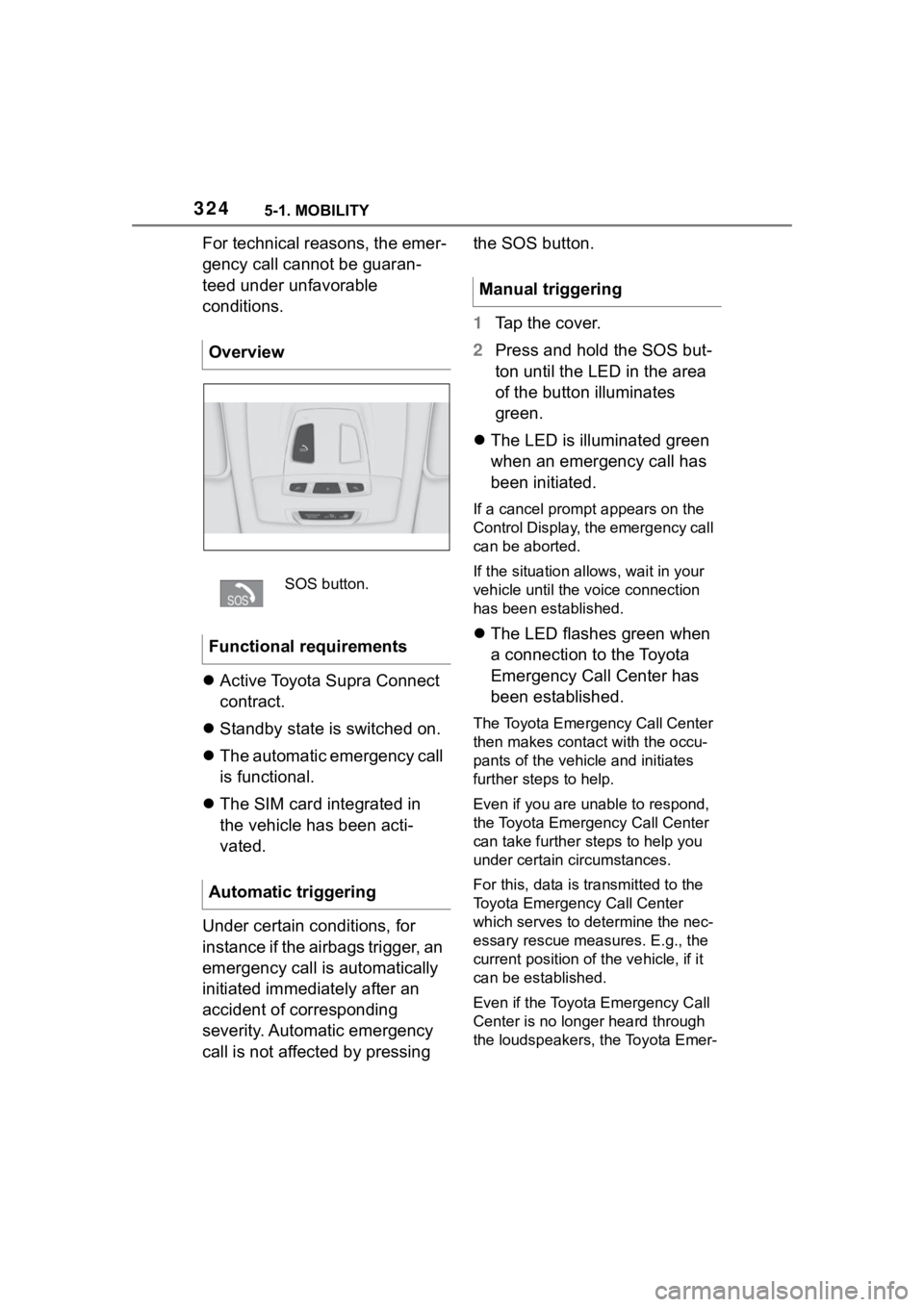
2 Press and hold the SOS but-
ton until the LED in the area
of the button illuminates
green.
The LED is illuminated green
when an emergency call has
been initiated.
If a cancel prompt appears on the
Control Display, the emergency call
can be aborted.
If the situation allo ws, wait in your
vehicle until the voice connection
has been established.
The LED flashes green when
a connection to the Toyota
Emergency Call Center has
been established.
The Toyota Emergency Call Center
then makes contact with the occu-
pants of the vehicle and initiates
further steps to help.
Even if you are unable to respond,
the Toyota Emerg ency Call Center
can take further steps to help you
under certain circumstances.
For this, data is transmitted to the
Toyota Emergency Call Center
which serves to determine the nec-
essary rescue measures. E.g., the
current position of the vehicle, if it
can be established.
Even if the Toyota Emergency Call
Center is no longer heard through
the loudspeakers, the Toyota Emer-
Overview
SOS button.
Functional requirements
Automatic triggering
Manual triggering
Page 326 of 372
3265-1. MOBILITY
2Attach one terminal clamp of
the positive jumper cable to
the positive terminal of the
battery, or to the correspond-
ing starting aid terminal of the
vehicle providing assistance.
3 Attach the terminal clamp on
the other end of the cable to
the positive terminal of the
battery, or to the correspond-
ing starting aid terminal of the
vehicle to be started.
4 Attach one terminal clamp of
the negative jumper cable to
the negative terminal of the
battery, or to the correspond-
ing engine or body ground of
assisting vehicle.
5 Attach the second terminal
clamp to the negative termi-
nal of the battery, or to the
corresponding engine or
body ground of the vehicle to
be started.
Never use spray fluids to start
the engine.
1 Start the engine of the assist-
ing vehicle and let it run for
several minutes at an
increased idle speed.
2 Start the engine of the vehicle
that is to be started in the
usual way.
If the first starting attempt is not
successful, wait a few minutes
before making another attempt in order to allow the discharged bat-
tery to recharge.
3
Let both engines run for sev-
eral minutes.
4 Disconnect the jumper
cables in the reverse order.
Check the battery and recharge,
if needed.
Starting the engine
Tow-starting and towing
Safety information
WARNING
Due to system limits, individual
functions can malfunction during
tow-starting/towing with the Toy-
ota Supra Safety systems acti-
vated. There is a risk of an
accident. Switch all Toyota Supra
Safety systems off prior to
tow-starting/towing.
Manual transmission
Safety information
NOTICE
The vehicle can become dam-
aged when lifting and securing it.
There is a risk of damage to prop-
erty.
●Lift the vehicle using suitable
means.
●Do not lift or secure the vehicle
by its tow fitting, body parts, or
suspension parts.
Page 328 of 372
3285-1. MOBILITY
To remove a broken-down vehi-
cle from the hazardous area,
push it for a short distance at a
speed of no more than 6 mph/10
km/h.
For rolling or pushing the vehi-
cle, refer to page 133.
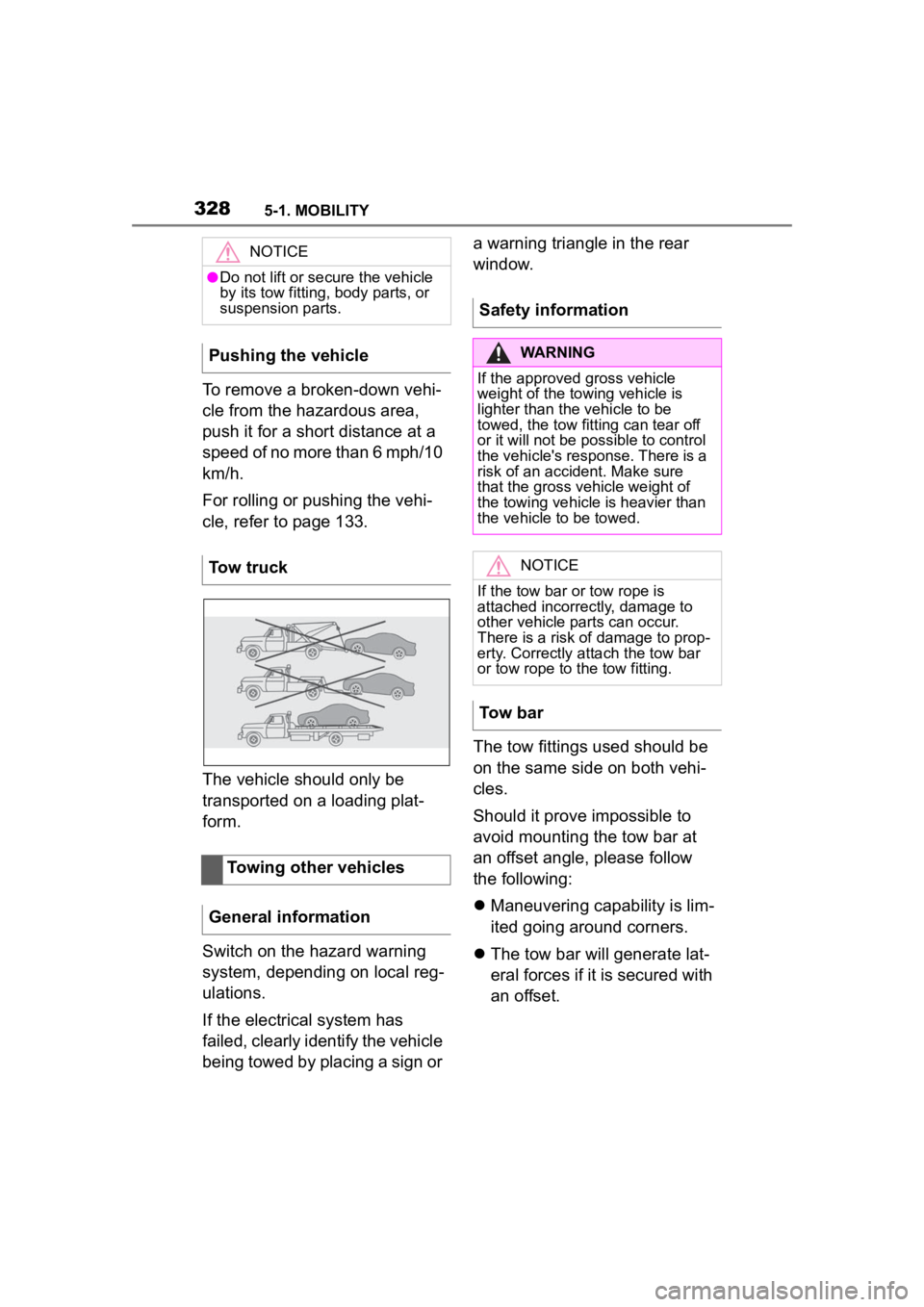
The vehicle should only be
transported on a loading plat-
form.
Switch on the hazard warning
system, depending on local reg-
ulations.
If the electrical system has
failed, clearly identify the vehicle
being towed by placing a sign or a warning triangle in the rear
window.
The tow fittings used should be
on the same side on both vehi-
cles.
Should it prove impossible to
avoid mounting the tow bar at
an offset angle, please follow
the following:
Maneuvering capability is lim-
ited going around corners.
The tow bar will generate lat-
eral forces if it is secured with
an offset.
NOTICE
●Do not lift or se cure the vehicle
by its tow fitting, body parts, or
suspension parts.
Pushing the vehicle
Tow truck
Towing other vehicles
General information
Safety information
WARNING
If the approved gross vehicle
weight of the towing vehicle is
lighter than the vehicle to be
towed, the tow fitting can tear off
or it will not be possible to control
the vehicle's response. There is a
risk of an accident. Make sure
that the gross v ehicle weight of
the towing vehicle is heavier than
the vehicle to be towed.
NOTICE
If the tow bar or tow rope is
attached incorrectly, damage to
other vehicle pa rts can occur.
There is a risk of damage to prop-
erty. Correctly a ttach the tow bar
or tow rope to the tow fitting.
Tow bar
Page 335 of 372
3355-1. MOBILITY
5
MOBILITY
When cleaning the vehicle, use
only neutral wheel cleaners hav-
ing a pH value from 5 to 9. Do
not use abrasive cleaning
agents or steam jets above 140
°F/60 °C. Follow the manufac-
turer's instructions.
Aggressive, acidic or alkaline
cleaning agents can destroy the
protective layer of adjacent
components, such as the brake
disc.
After cleaning, apply the brakes
briefly to dry them. The heat
generated during braking dries
brake discs and brake pads and
protects them against corrosion.
Carefully clean components
such as the radiator grille or
door handles with plenty of
water, possibly with shampoo
added, particularly when they have been exposed to road salt.
Environmental influences can
cause surface soiling of rubber
parts and a loss of gloss. Use
only water and suitable cleaning
agents for cleaning.
Treat especially worn rubber
parts with rubber care agents at
regular intervals. When cleaning
rubber seals, do not use any sili-
con-containing vehicle care
products in order to avoid dam-
age or noises.
The wiper blades are cleaned by
using the washer system.
Avoid cleaning the wiper blades
manually, as this may reduce
wiper performance.
Clean with a microfiber cloth.
Dampen cloth lightly with water.
Do not soak the roofliner.
Safety information
NOTICE
Open hook-and-loop fasteners on
articles of clothing can damage
the seat covers. There is a risk of
damage to propert
y. Ensure that
any hook-and-loop fasteners are
closed.
Caring for special compo-
nents
Light-alloy wheels
Chrome surfaces
Rubber components
Wiper blades
Plastic components
NOTICE
Cleansers that contain alcohol or
solvents, such as lacquer thin-
ners, heavy-duty grease remov-
ers, fuel, or such, can damage
plastic parts. Ther e is a risk of
damage to property. Clean with a
microfiber cloth. Dampen cloth
lightly with water.