lock TOYOTA SUPRA 2023 Repair Manual
[x] Cancel search | Manufacturer: TOYOTA, Model Year: 2023, Model line: SUPRA, Model: TOYOTA SUPRA 2023Pages: 372, PDF Size: 6.32 MB
Page 283 of 372
2835-1. MOBILITY
5
MOBILITY
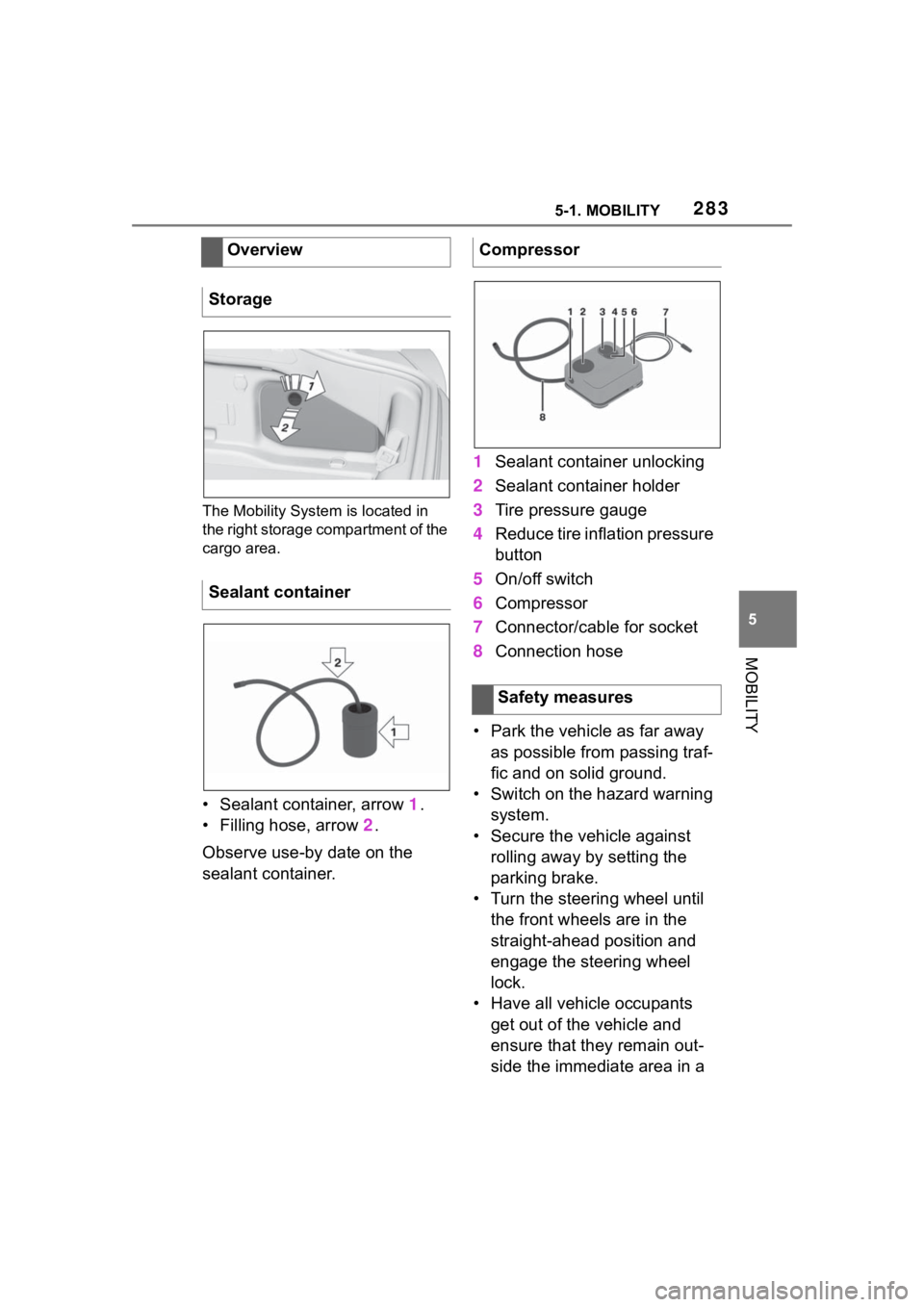
The Mobility System is located in
the right storage compartment of the
cargo area.
• Sealant container, arrow 1.
• Filling hose, arrow 2.
Observe use-by date on the
sealant container. 1
Sealant container unlocking
2 Sealant container holder
3 Tire pressure gauge
4 Reduce tire inflation pressure
button
5 On/off switch
6 Compressor
7 Connector/cable for socket
8 Connection hose
• Park the vehicle as far away as possible from passing traf-
fic and on solid ground.
• Switch on the hazard warning system.
• Secure the vehicle against rolling away by setting the
parking brake.
• Turn the steering wheel until the front wheels are in the
straight-ahead position and
engage the steering wheel
lock.
• Have all vehicle occupants get out of the vehicle and
ensure that they remain out-
side the immediate area in a
Overview
Storage
Sealant container
Compressor
Safety measures
Page 284 of 372
2845-1. MOBILITY
safe place, such as behind a
guardrail.
• If necessary, set up a warning triangle at an appropriate dis-
tance.
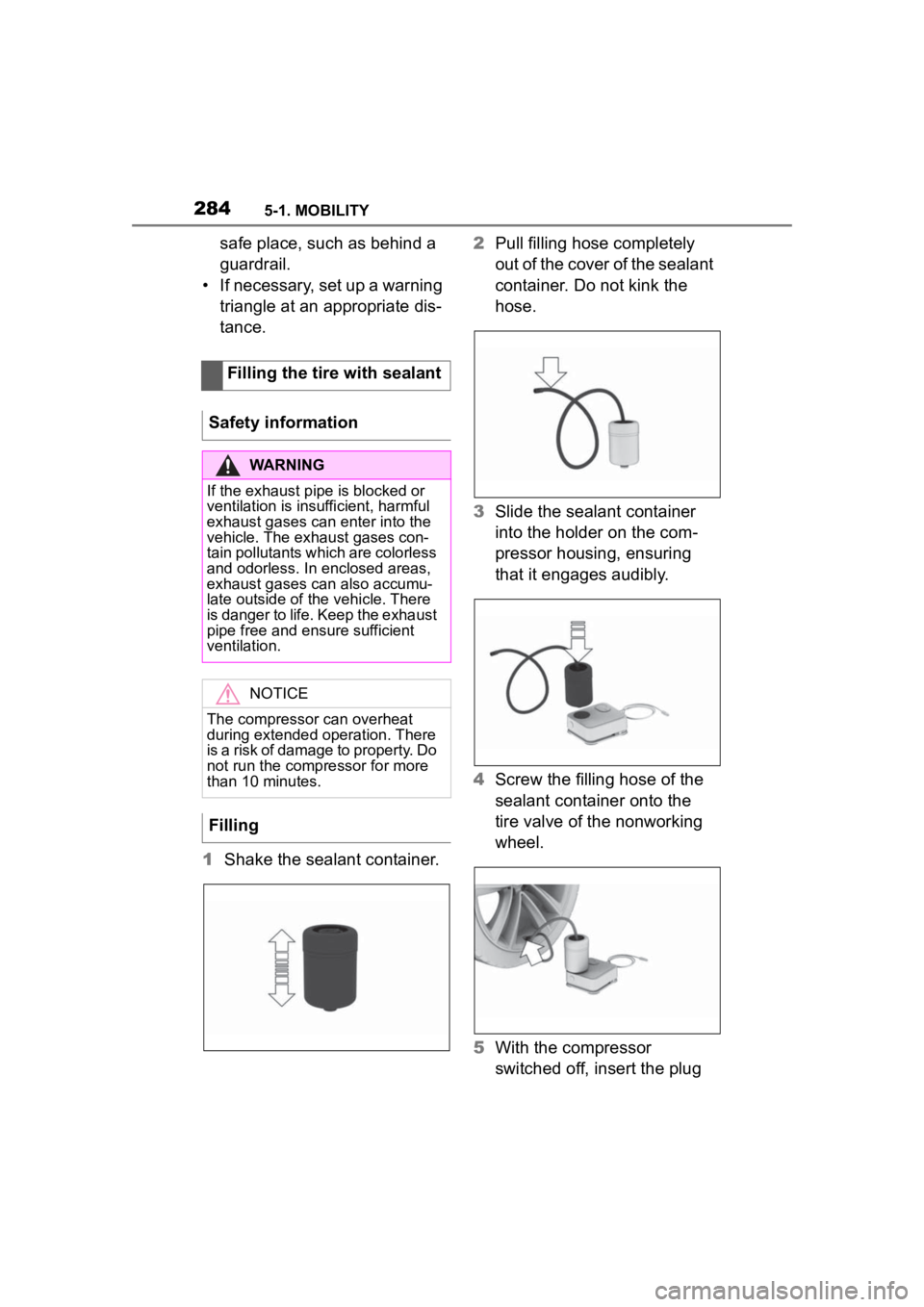
1 Shake the sealant container. 2
Pull filling hose completely
out of the cover of the sealant
container. Do not kink the
hose.
3 Slide the sealant container
into the holder on the com-
pressor housing, ensuring
that it engages audibly.
4 Screw the filling hose of the
sealant container onto the
tire valve of the nonworking
wheel.
5 With the compressor
switched off, insert the plug
Filling the tire with sealant
Safety information
WARNING
If the exhaust pipe is blocked or
ventilation is insufficient, harmful
exhaust gases can enter into the
vehicle. The exhaust gases con-
tain pollutants which are colorless
and odorless. In enclosed areas,
exhaust gases can also accumu-
late outside of the vehicle. There
is danger to life. Keep the exhaust
pipe free and ensure sufficient
ventilation.
NOTICE
The compressor can overheat
during extended operation. There
is a risk of damage to property. Do
not run the compressor for more
than 10 minutes.
Filling
Page 285 of 372
2855-1. MOBILITY
5
MOBILITY
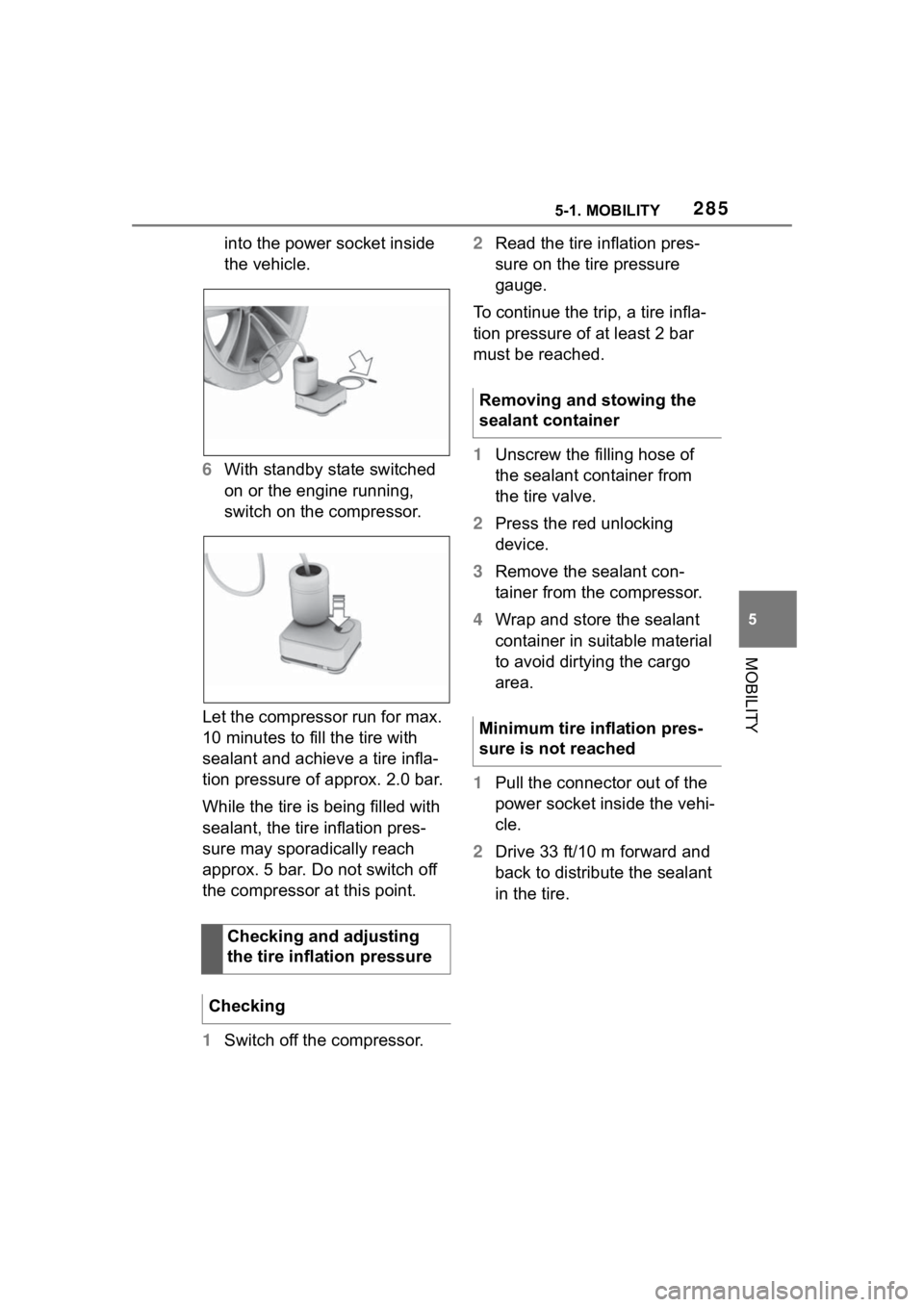
into the power socket inside
the vehicle.
6 With standby state switched
on or the engine running,
switch on the compressor.
Let the compressor run for max.
10 minutes to fill the tire with
sealant and achieve a tire infla-
tion pressure of approx. 2.0 bar.
While the tire is being filled with
sealant, the tire inflation pres-
sure may sporadically reach
approx. 5 bar. Do not switch off
the compressor at this point.
1 Switch off the compressor. 2
Read the tire inflation pres-
sure on the tire pressure
gauge.
To continue the trip, a tire infla-
tion pressure of at least 2 bar
must be reached.
1 Unscrew the filling hose of
the sealant container from
the tire valve.
2 Press the red unlocking
device.
3 Remove the sealant con-
tainer from the compressor.
4 Wrap and store the sealant
container in suitable material
to avoid dirtying the cargo
area.
1 Pull the connector out of the
power socket inside the vehi-
cle.
2 Drive 33 ft/10 m forward and
back to distribute the sealant
in the tire.
Checking and adjusting
the tire inflation pressure
Checking
Removing and stowing the
sealant container
Minimum tire inflation pres-
sure is not reached
Page 296 of 372
2965-1. MOBILITY
tioning properly. Always
check the TPMS malfunction
telltale after replacing one or
more tires or wheels on your
vehicle to ensure that the
replacement or alternate tires
and wheels allow the TPMS
to continue to function prop-
erly.
If a tire is punctured and loses
pressure, it is not necessary to
replace the tire immediately if a
tire repair kit (Mobility System) is
used.
If needed, the tools for changing
wheels are available as acces-
sories from your Toyota dealer.
*: if equipped
The wheel lug bolts have a spe-
cial coding. The lug bolts can
only be released with the
adapter which matches the cod- ing.
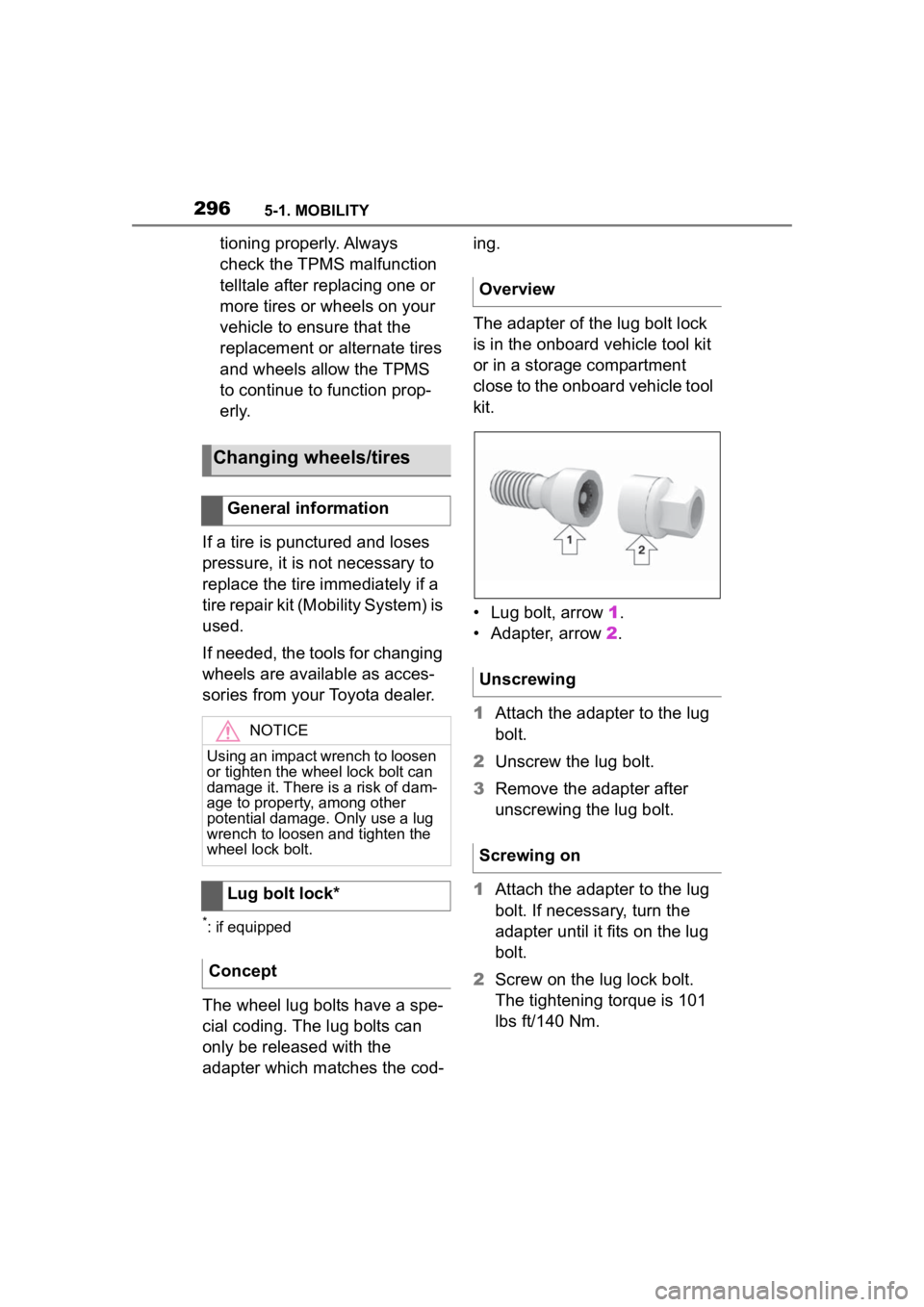
The adapter of the lug bolt lock
is in the onboard vehicle tool kit
or in a storage compartment
close to the onboard vehicle tool
kit.
• Lug bolt, arrow
1.
• Adapter, arrow 2.
1 Attach the adapter to the lug
bolt.
2 Unscrew the lug bolt.
3 Remove the adapter after
unscrewing the lug bolt.
1 Attach the adapter to the lug
bolt. If necessary, turn the
adapter until it fits on the lug
bolt.
2 Screw on the lug lock bolt.
The tightening torque is 101
lbs ft/140 Nm.
Changing wheels/tires
General information
NOTICE
Using an impact wrench to loosen
or tighten the wheel lock bolt can
damage it. There is a risk of dam-
age to property, among other
potential damage. Only use a lug
wrench to loosen and tighten the
wheel lock bolt.
Lug bolt lock*
Concept
Overview
Unscrewing
Screwing on
Page 299 of 372
2995-1. MOBILITY
5
MOBILITY
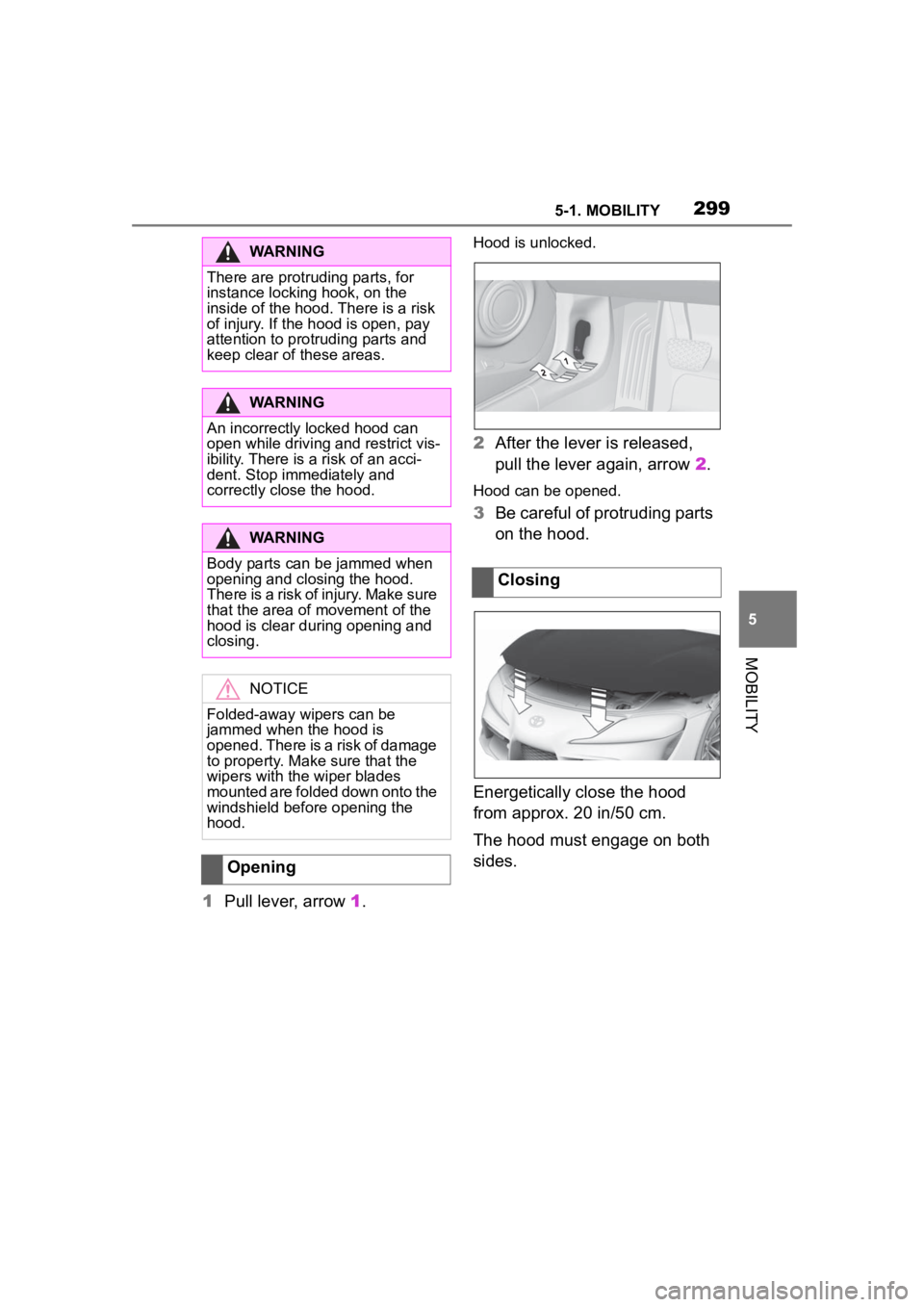
1Pull lever, arrow 1.
Hood is unlocked.
2After the lever is released,
pull the lever again, arrow 2.
Hood can be opened.
3Be careful of protruding parts
on the hood.
Energetically close the hood
from approx. 20 in/50 cm.
The hood must engage on both
sides.
WARNING
There are protruding parts, for
instance locking hook, on the
inside of the hood. There is a risk
of injury. If the hood is open, pay
attention to protruding parts and
keep clear of these areas.
WARNING
An incorrectly locked hood can
open while driving and restrict vis-
ibility. There is a risk of an acci-
dent. Stop immediately and
correctly close the hood.
WARNING
Body parts can be jammed when
opening and closing the hood.
There is a risk of injury. Make sure
that the area of movement of the
hood is clear during opening and
closing.
NOTICE
Folded-away wipers can be
jammed when the hood is
opened. There is a risk of damage
to property. Make sure that the
wipers with the wiper blades
mounted are folded down onto the
windshield before opening the
hood.
Opening
Closing
Page 304 of 372
3045-1. MOBILITY
The oil filler neck is located in
the engine compartment, refer
to page 298.
1Open the hood, refer to page
299. 2
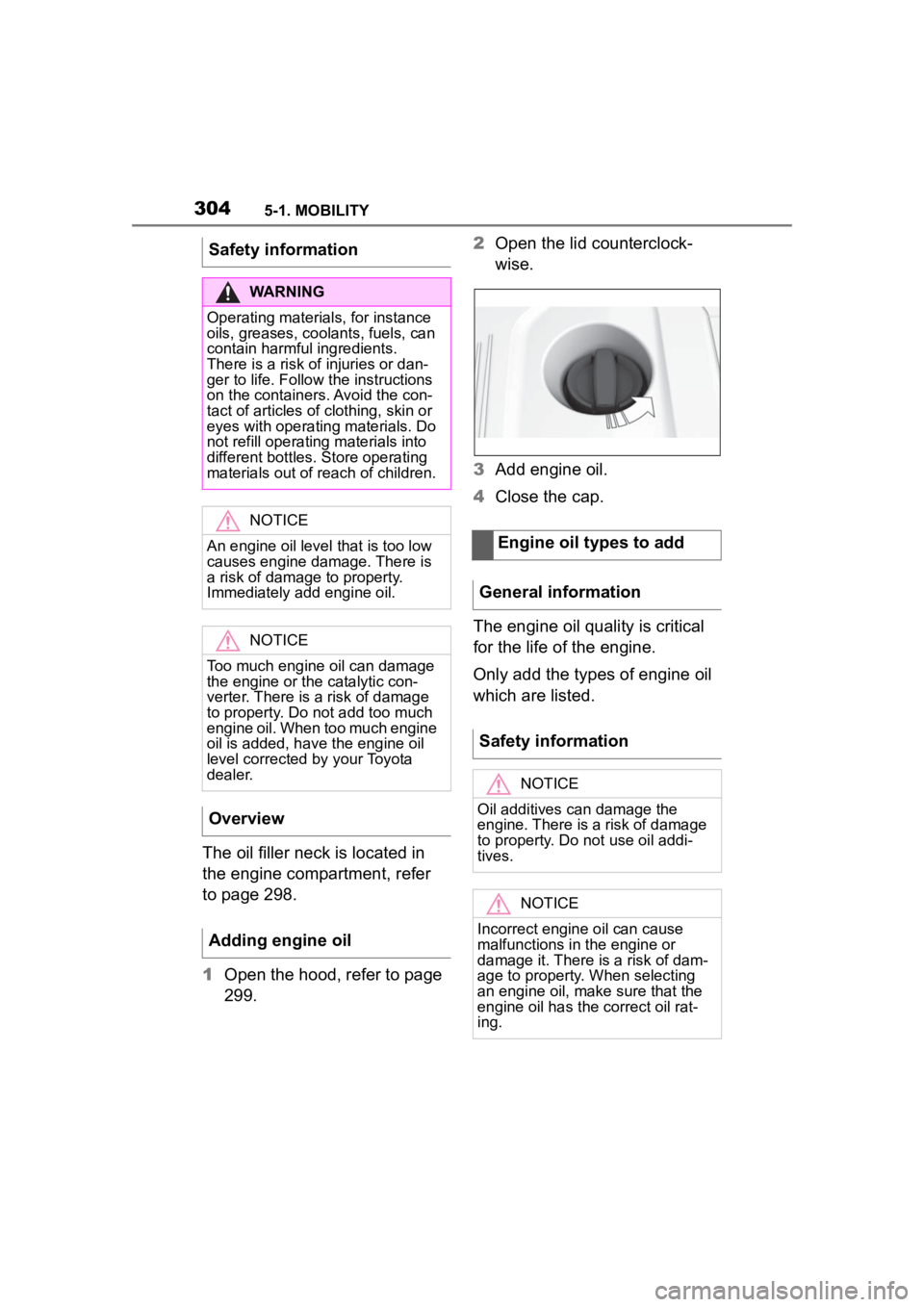
Open the lid counterclock-
wise.
3 Add engine oil.
4 Close the cap.
The engine oil quality is critical
for the life of the engine.
Only add the types of engine oil
which are listed.
Safety information
WARNING
Operating material
s, for instance
oils, greases, coolants, fuels, can
contain harmful ingredients.
There is a risk o f injuries or dan-
ger to life. Follow the instructions
on the containers. Avoid the con-
tact of articles of clothing, skin or
eyes with operating materials. Do
not refill operating materials into
different bottles. Store operating
materials out of reach of children.
NOTICE
An engine oil level that is too low
causes engine damage. There is
a risk of damage to property.
Immediately add engine oil.
NOTICE
Too much engine oil can damage
the engine or the catalytic con-
verter. There is a risk of damage
to property. Do not add too much
engine oil. When too much engine
oil is added, have the engine oil
level corrected by your Toyota
dealer.
Overview
Adding engine oil
Engine oil types to add
General information
Safety information
NOTICE
Oil additives can damage the
engine. There is a risk of damage
to property. Do not use oil addi-
tives.
NOTICE
Incorrect engine oil can cause
malfunctions in the engine or
damage it. There is a risk of dam-
age to property. When selecting
an engine oil, make sure that the
engine oil has the correct oil rat-
ing.
Page 306 of 372
3065-1. MOBILITY
mercially available additives are
suitable for the vehicle. The
vehicle manufacturer recom-
mends using coolant with the
BMW LC-18 specification. Do
not mix additives of different col-
ors. Observe the water - additive
mixture ratio of 50:50. Informa-
tion about suitable additives is
available from your Toyota
dealer.
Depending on the motorization,
there are up to two coolant res-
ervoirs in the engine compart-
ment. Check and top up the
coolant levels on a regular
basis.The coolant may be overfilled in
the coolant reservoir when the
vehicle is delivered from the fac-
tory. The normal coolant level is
achieved by operating the vehi-
cle for a longer period.
The coolant level is indicated
using the maximum mark in the
filler neck of the coolant reser-
voir.
Additional information:
For an overview, refer to page
298.
1
Let the engine cool.
2 Open the hood, refer to page
299.
3 Turn the lid of the coolant
reservoir slightly counter-
clockwise to allow any
excess pressure to dissi-
pate, then open it.
4 Open the coolant reservoir
lid.
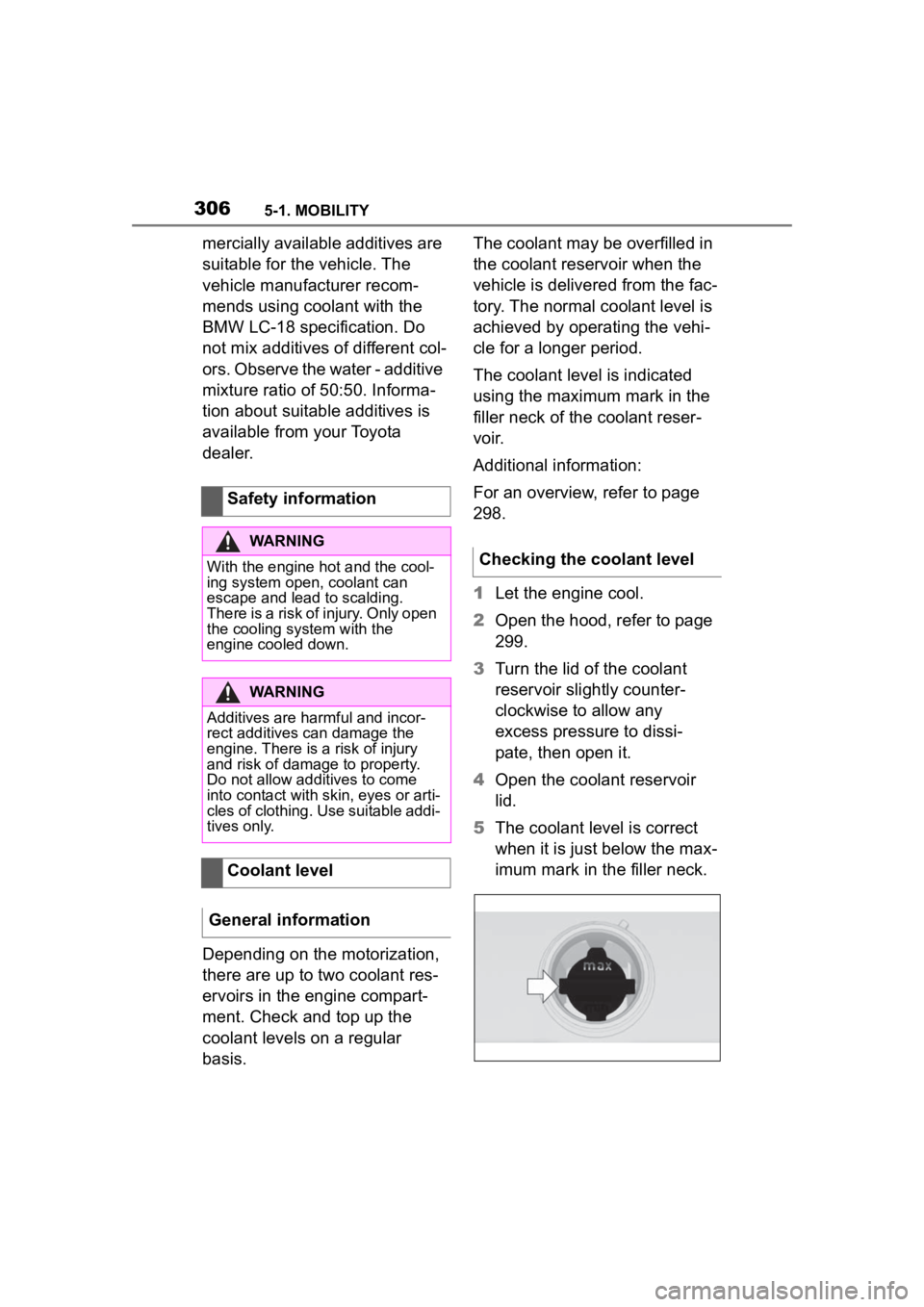
5 The coolant level is correct
when it is just below the max-
imum mark in the filler neck.
Safety information
WARNING
With the engine hot and the cool-
ing system open, coolant can
escape and lead to scalding.
There is a risk of injury. Only open
the cooling system with the
engine cooled down.
WARNING
Additives are harmful and incor-
rect additives can damage the
engine. There is a risk of injury
and risk of damage to property.
Do not allow additives to come
into contact with skin, eyes or arti-
cles of clothing. Use suitable addi-
tives only.
Coolant level
General information
Checking the coolant level
Page 307 of 372
3075-1. MOBILITY
5
MOBILITY
6Close the cap.
1 Let the engine cool.
2 Open the hood, refer to page
299.
3 Turn the lid of the coolant
reservoir slightly counter-
clockwise to allow any
excess pressure to dissi-
pate, then open it.
4 Open the coolant reservoir
lid.
5 If the coolant is low, slowly
add coolant up to the speci-
fied level; do not overfill.
6 Close the cap.
7 Have the cause of the cool-
ant loss eliminated as soon
as possible.
Comply with the relevant envi-
ronmental protection regulations
when disposing of coolant and
coolant additives.
All washer nozzles are supplied
from one reservoir.
Use a mixture of tap water and windshield washer concentrate.
If desired, a windshield washer
concentrate containing anti-
freeze can be used.
Recommended minimum fill
quantity:0.2 US gal/1 liter.
Adding
Disposal
Washer fluid
General information
Safety information
WARNING
Some antifreeze agents can con-
tain harmful substances and are
flammable. There i s a risk of fire
and a risk of inj ury. Follow the
instructions on the containers.
Keep antifreeze away from igni-
tion sources. Do no t refill operat-
ing materials into different bottles.
Store operating materials out of
reach of children.
United States: th e washer fluid
mixture ratio is regulated by the
U.S. EPA and many individual
states; do not exceed the allow-
able washer fluid dilution ratio lim-
its that apply. Follow the usage
instructions on th e washer fluid
container.
WARNING
Washer fluid can ignite and catch
fire on contact with hot engine
parts. There is a risk of injury or
risk of damage to property. Only
add washer fluid when the engine
is cooled down. Next, fully close
the lid of the washer fluid reser-
v oi r.
Page 309 of 372
3095-1. MOBILITY
5
MOBILITY
Condition Based Service CBS
determines the maintenance
recommendation using sensors
and special algorithms that take
into account the driving condi-
tions of the vehicle.
The system makes it possible to
adapt the amount of mainte-
nance corresponding to your
user profile.
Information on service notifica-
tions, refer to page 147, can be
displayed on the Control Dis-
play.
Storage periods during which
the vehicle battery was discon-
nected are not taken into
account.
If this occurs, have a Toyota
dealer update the time-depen-
dent maintenance procedures,
such as checking brake fluid
and, if necessary, changing the
engine oil and the microfil-
ter/activated-charcoal filter.Please consult “Owner's War-
ranty Information Booklet” or
“Owner's Manual Supplement”
for additional information on ser-
vice and maintenance work.
The manufacturer of your vehi-
cle recommends that mainte-
nance and repair be performed
by a Toyota dealer. Records of
regular maintenance and repair
work should be retained.
Scheduled maintenance should
be performed at specified inter-
vals according to the mainte-
nance schedule.
For details about maintenance
items and schedules, refer to
the "Scheduled Maintenance
Guide" or "Owner's Manual Sup-
plement".
Devices connected to the OBD
socket trigger the alarm system
when the vehicle is locked.
Remove any devices con-
nected at the OBD socket
Condition Based Service
CBS
Concept
General information
Storage periods
"Owner's Warranty Infor-
mation Booklet" or
"Owner's Manual Supple-
ment"
Scheduled maintenance
Socket for OBD Onboard
Diagnosis
General information
Page 310 of 372
3105-1. MOBILITY
before locking the vehicle.
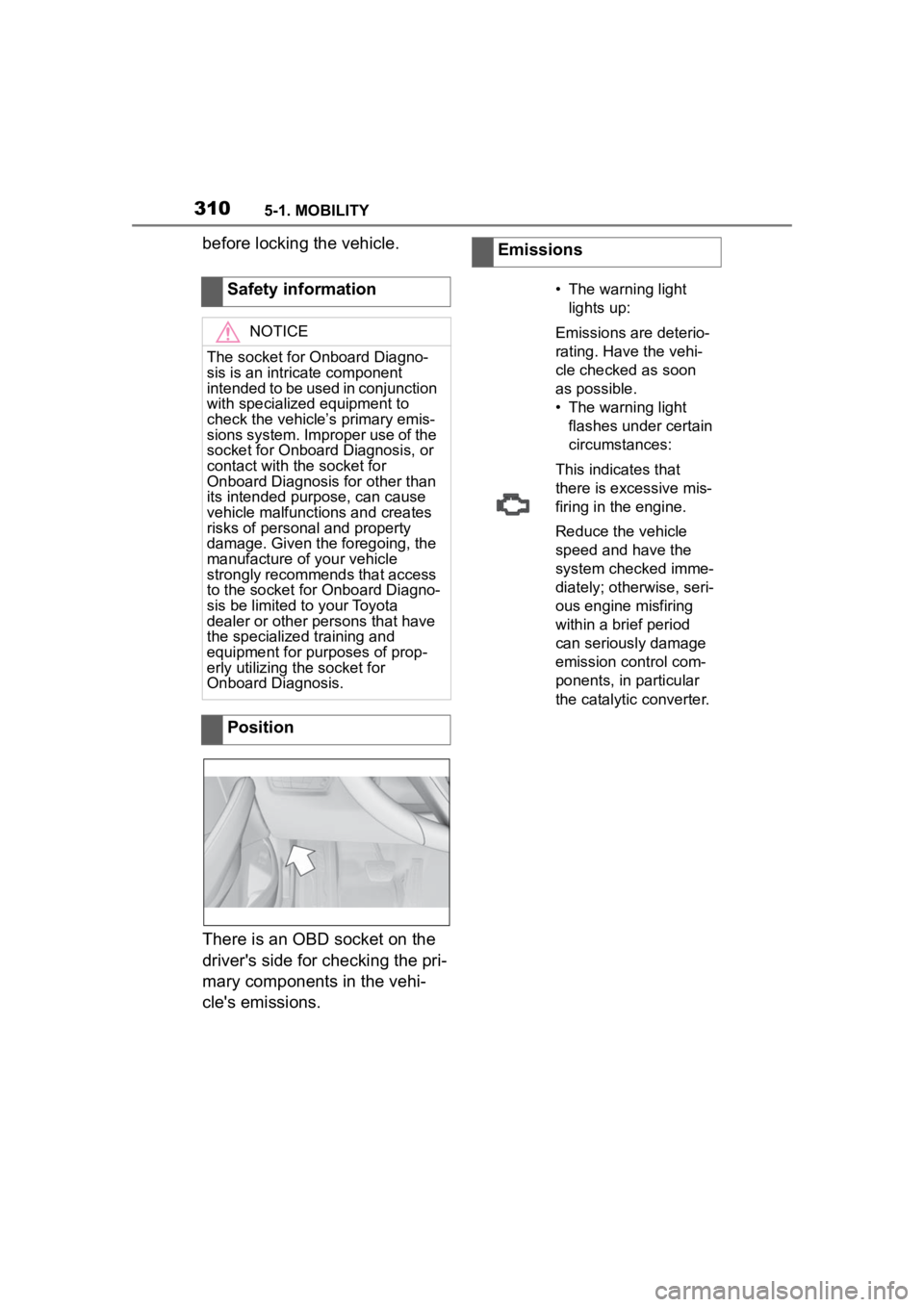
There is an OBD socket on the
driver's side for checking the pri-
mary components in the vehi-
cle's emissions.Safety information
NOTICE
The socket for Onboard Diagno-
sis is an intricate component
intended to be used in conjunction
with specialized equipment to
check the vehicle’s primary emis-
sions system. Improper use of the
socket for Onboard Diagnosis, or
contact with the socket for
Onboard Diagnosis for other than
its intended purpose, can cause
vehicle malfunctions and creates
risks of personal and property
damage. Given the foregoing, the
manufacture of your vehicle
strongly recommends that access
to the socket for Onboard Diagno-
sis be limited to your Toyota
dealer or other persons that have
the specialized
training and
equipment for purposes of prop-
erly utilizing the socket for
Onboard Diagnosis.
Position
Emissions
• The warning light
lights up:
Emissions are deterio-
rating. Have the vehi-
cle checked as soon
as possible.
• The warning light flashes under certain
circumstances:
This indicates that
there is excessive mis-
firing in the engine.
Reduce the vehicle
speed and have the
system checked imme-
diately; otherwise, seri-
ous engine misfiring
within a brief period
can seriously damage
emission control com-
ponents, in particular
the catalytic converter.