light TOYOTA TACOMA 1996 User Guide
[x] Cancel search | Manufacturer: TOYOTA, Model Year: 1996, Model line: TACOMA, Model: TOYOTA TACOMA 1996Pages: 196, PDF Size: 1.8 MB
Page 22 of 196
21
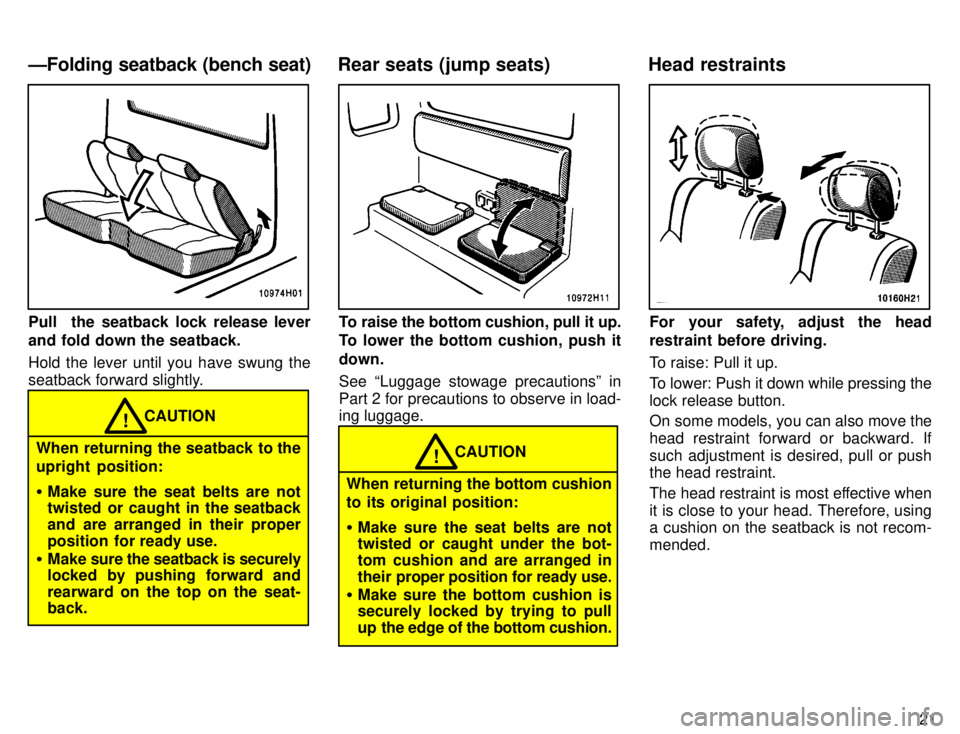
Pull the seatback lock release lever
and fold down the seatback.
Hold the lever until you have swung the
seatback forward slightly.
CAUTION!
When returning the seatback to the upright position: Make sure the seat belts are not
twisted or caught in the seatback
and are arranged in their proper
position for ready use.
Make sure the seatback is securely
locked by pushing forward and rearward on the top on the seat- back.
To raise the bottom cushion, pull it up.
To lower the bottom cushion, push it down. See Luggage stowage precautionsº in
Part 2 for precautions to observe in load- ing luggage.
CAUTION!
When returning the bottom cushion
to its original position: Make sure the seat belts are not twisted or caught under the bot-
tom cushion and are arranged in
their proper position for ready use.
Make sure the bottom cushion is securely locked by trying to pull
up the edge of the bottom cushion.
For your safety, adjust the head
restraint before driving.
To raise: Pull it up.
To lower: Push it down while pressing the lock release button.
On some models, you can also move the
head restraint forward or backward. If
such adjustment is desired, pull or push the head restraint.
The head restraint is most effective when
it is close to your head. Therefore, using a cushion on the seatback is not recom- mended.
ÐFolding seatback (bench seat) Rear seats (jump seats) Head restraints
Page 25 of 196
23
Small-framed person or youth in a
3-point type seat belt.
On models with
a bench seat, have a small-framed per-
son or youth sit slightly closer to the center
of the vehicle (so the shoulder belt does
not cross over the neck). On models withseparate seats, move the seat fully back- ward.
Pregnant woman. Toyota recommends
the use of a seat belt. Ask your doctor for
specific recommendations. The lap belt
should be worn securely and as low as
possible over the hips and not on the waist.
Injured person. Toyota recommends the
use of a seat belt. Depending on the injury,
however, first check with your doctor.
CAUTION!
Persons should ride in their seats
properly wearing their seat belts whenever the vehicle is moving.
Otherwise, they are much more like-
ly to suffer serious bodily injury in
the event of sudden braking or acollision.
When using the seat belts, observe the following: Use the belt for only one person at
a time. Do not use a single belt for
two or more peopleÐeven children.
Avoid reclining the seatbacks too
much. The seat belts provide max-
imum protection when the seat-
backs are in the upright position. (See the seat adjustment instruc-tions.)
Be careful not to damage the belt
webbing or hardware. Take care
that they do not get caught or
pinched in the seat or side doors.
Inspect the belt system periodical-
ly. Check for cuts, fraying, and
loose parts. Damaged parts
should be replaced. Do not disas- semble or modify the system.
Keep the belts clean and dry. If
they need cleaning, use a mild
soap solution or lukewarm water.
Never use bleach, dye, or abrasive
cleanersÐthey may severely
weaken the belts.
Replace the belt assembly (includ-
ing bolts) If it has been used in a
severe impact. The entire assem-
bly should be replaced even if
damage is not obvious.
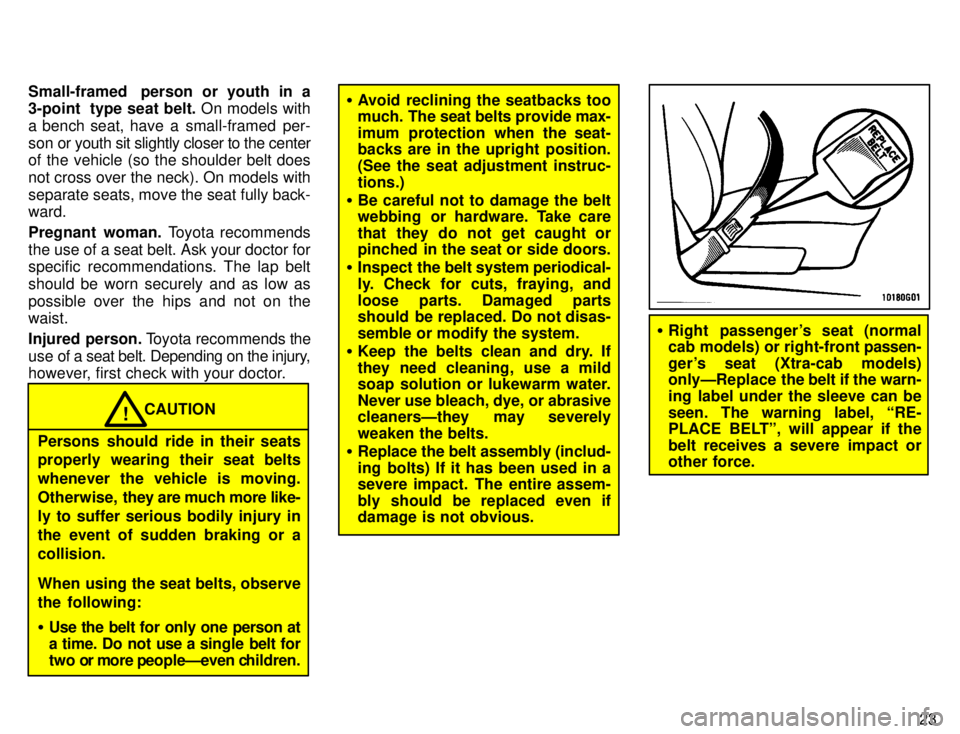
Right passenger's seat (normal
cab models) or right-front passen-
ger 's seat (Xtra-cab models)
onlyÐReplace the belt if the warn-
ing label under the sleeve can be
seen. The warning label, RE-
PLACE BELTº, will appear if the
belt receives a severe impact or
other force.
Page 26 of 196
24
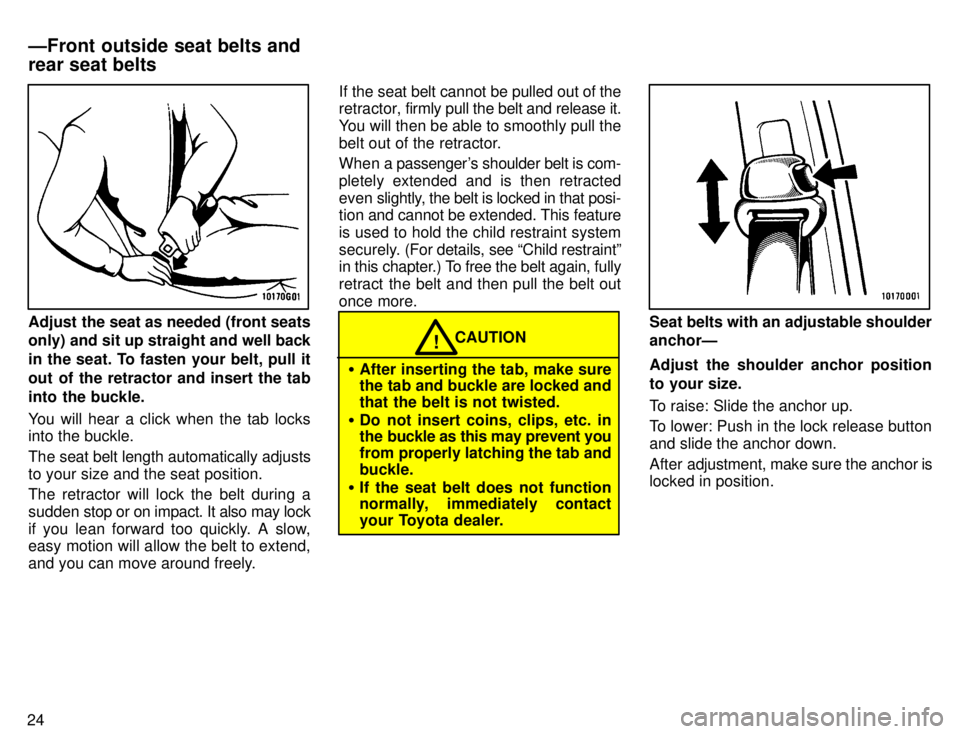
Adjust the seat as needed (front seats only) and sit up straight and well back
in the seat. To fasten your belt, pull it
out of the retractor and insert the tab
into the buckle.
You will hear a click when the tab locks into the buckle.
The seat belt length automatically adjusts
to your size and the seat position.
The retractor will lock the belt during a
sudden stop or on impact. It also may lock
if you lean forward too quickly. A slow, easy motion will allow the belt to extend,
and you can move around freely. If the seat belt cannot be pulled out of the
retractor,
firmly pull the belt and release it.
You will then be able to smoothly pull the
belt out of the retractor.
When a passenger's shoulder belt is com-
pletely extended and is then retracted
even slightly, the belt is locked in that posi-
tion and cannot be extended. This feature
is used to hold the child restraint system
securely. (For details, see Child restraintº
in this chapter.) To free the belt again, fully
retract the belt and then pull the belt out
once more.CAUTION!
After inserting the tab, make sure
the tab and buckle are locked and
that the belt is not twisted.
Do not insert coins, clips, etc. in
the buckle as this may prevent you
from properly latching the tab andbuckle.
If the seat belt does not function
normally, immediately contact
your Toyota dealer.
Seat belts with an adjustable shoulder anchorÐ
Adjust the shoulder anchor position
to your size.
To raise: Slide the anchor up.
To lower: Push in the lock release button and slide the anchor down.
After adjustment, make sure the anchor is
locked in position.
ÐFront outside seat belts and rear seat belts
Page 31 of 196

29
This indicator comes on when the
ignition key is turned to the ACCº or
ONº position. It goes off after about 6
seconds. This means the SRS airbag
is operating properly.
The SRS airbag warning light system
monitors the airbag sensor assembly,
inflator, warning light, interconnecting wir-
ing and power sources.The SRS airbag system is designed to
activate in response to a severe frontal
impact within the shaded area be-
tween the arrows in the illustration.
The SRS airbags will deploy if the severity
of the impact is above the designed
threshold level, comparable to an approxi-
mate 20 km/h (14 mph) collision when im-
pacting straight into a fixed barrier that
does not move or deform.
If the severity of the impact is below the
above threshold level, the SRS airbag
may not deploy. However, this threshold velocity will be
considerably higher if the vehicle strikes
an object, such as a parked vehicle or sign
pole, which can move or deform on im-
pact, or if it is
involved in an underride col-
lision (a collision in which the nose of the
vehicle underridesº, or goes under, the
bed of a truck).
For your safety, be sure to always wear your seat belt.
Page 32 of 196

30
The SRS airbag is not designed to in-
flate if the vehicle is subjected to a side
or rear impact, if it rolls over, or if it is in-
volved in a low- speed frontal collision.The SRS airbag system mainly consists
of the following components and their
locations are shown in the illustration.
1. SRS airbag warning light
2. Steering wheel pad (airbag and inflator)
3. Airbag sensor assembly
The airbag sensor assembly consists of a
safing sensor and airbag sensor.In a severe frontal impact, sensor detects
deceleration and the system triggers the
airbag inflator. Then a chemical reaction
in the inflator momentarily fills the airbag
with non-toxic nitrogen gas to help re-
strain the forward motion of the driver. When the airbag inflates, it produces a fairly loud noise and releases some
smoke along with the nitrogen gas. This isnot harmful and does not indicate a fire.
Be sure to wash off any residue as soon
as possible to prevent minor skin irritation.
Deployment of the airbag happens in a
fraction of a
second, so the airbag must in-
flate with considerable force. While the
system is designed to reduce serious inju-
ries, it may also cause minor burns or
abrasions and swellings.
The steering wheel hub may be hot for
several m inutes, but the airbag will not be
hot. The airbag is designed to inflate only once.
Page 34 of 196
32
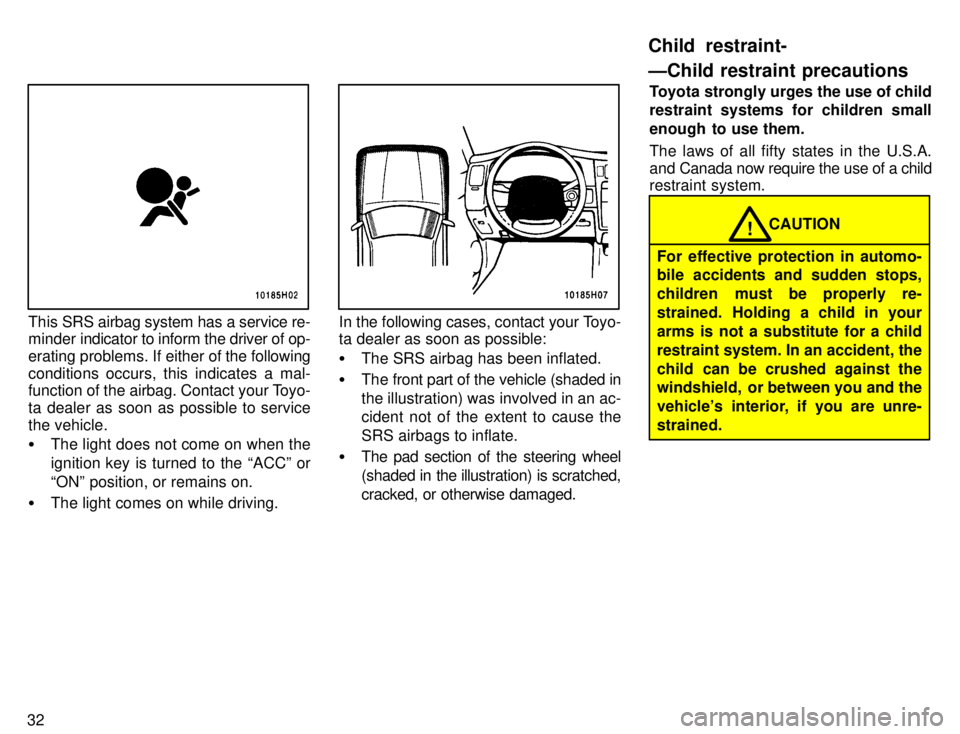
This SRS airbag system has a service re-
minder indicator to inform the driver of op-
erating problems. If either of the following
conditions occurs, this indicates a mal-
function of the airbag. Contact your Toyo-
ta dealer as soon as possible to servicethe vehicle. The light does not come on when the
ignition key is turned to the ACCº or
ONº position, or remains on.
The light comes on while driving.In the following cases, contact your Toyo-
ta dealer as soon as possible: The SRS airbag has been inflated.
The front part of the vehicle (shaded in the illustration) was involved in an ac-
cident not of the extent to cause the
SRS airbags to inflate.
The pad section of the steering wheel
(shaded in the illustration) is scratched,
cracked, or otherwise damaged. Toyota strongly urges the use of child
restraint systems for children small
enough to use them.
The laws of all fifty states in the U.S.A.
and Canada now require the use of a child
restraint system.
CAUTION!
For effective protection in automo-
bile accidents and sudden stops,
children must be properly re-
strained. Holding a child in your
arms is not a substitute for a child
restraint system. In an accident, the
child can be crushed against the
windshield, or between you and the
vehicle's interior, if you are unre-strained.
Child restraint- ÐChild restraint precautions
Page 35 of 196
32
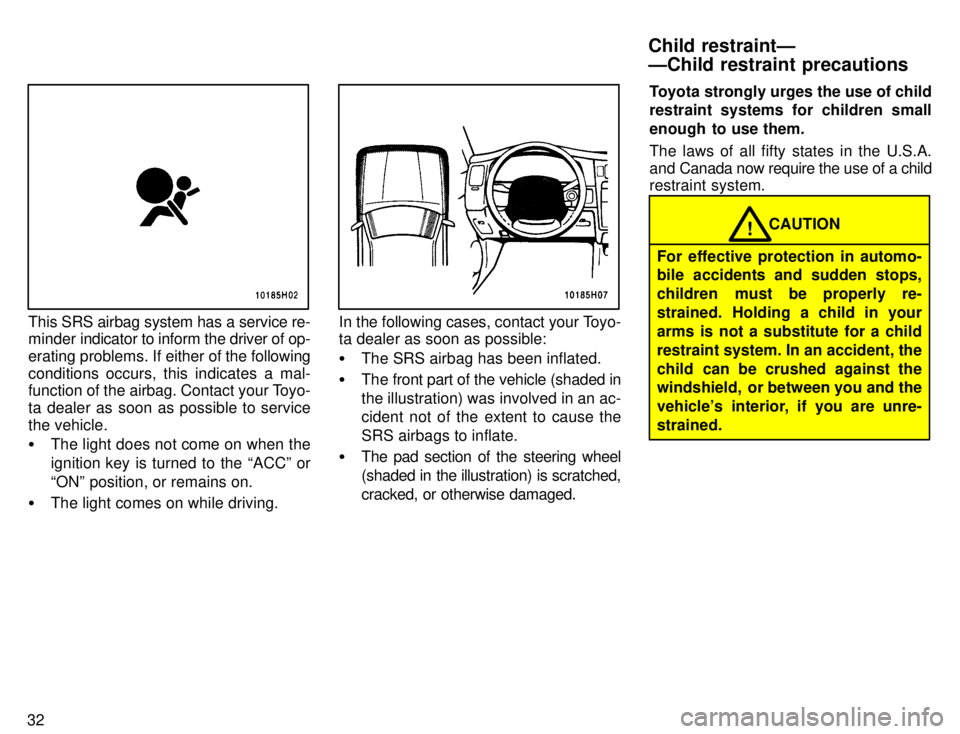
This SRS airbag system has a service re-
minder indicator to inform the driver of op-
erating problems. If either of the following
conditions occurs, this indicates a mal-
function of the airbag. Contact your Toyo-
ta dealer as soon as possible to servicethe vehicle. The light does not come on when the
ignition key is turned to the ACCº or
ONº position, or remains on.
The light comes on while driving.In the following cases, contact your Toyo-
ta dealer as soon as possible: The SRS airbag has been inflated.
The front part of the vehicle (shaded in the illustration) was involved in an ac-
cident not of the extent to cause the
SRS airbags to inflate.
The pad section of the steering wheel
(shaded in the illustration) is scratched,
cracked, or otherwise damaged. Toyota strongly urges the use of child
restraint systems for children small
enough to use them.
The laws of all fifty states in the U.S.A.
and Canada now require the use of a child
restraint system.
CAUTION!
For effective protection in automo-
bile accidents and sudden stops,
children must be properly re-
strained. Holding a child in your
arms is not a substitute for a child
restraint system. In an accident, the
child can be crushed against the
windshield, or between you and the
vehicle's interior, if you are unre-strained.
Child restraintÐÐChild restraint precautions
Page 44 of 196

40
To reduce glare from the headlights of
the vehicle behind you during night
driving, operate the lever on the lower
edge of the mirror. Daylight drivingÐLever at position 1
The reflection in the mirror has greater
clarity at this position. Night drivingÐLever at position 2 Remember that by reducing glare you
also lose some rear view clarity.
Anti- glare inside rear view mirror
Page 45 of 196
Part 1Headlights and turn signals
41
OPERATION OF INSTRUMENTS AND CONTROLSÐ
Chapter 1-4
Lights and Wipers
Headlights and turn signals
Emergency flashers
Instrument panel light control
Interior lights
Personal lights
Ignition switch light
Windshield wipers and washer
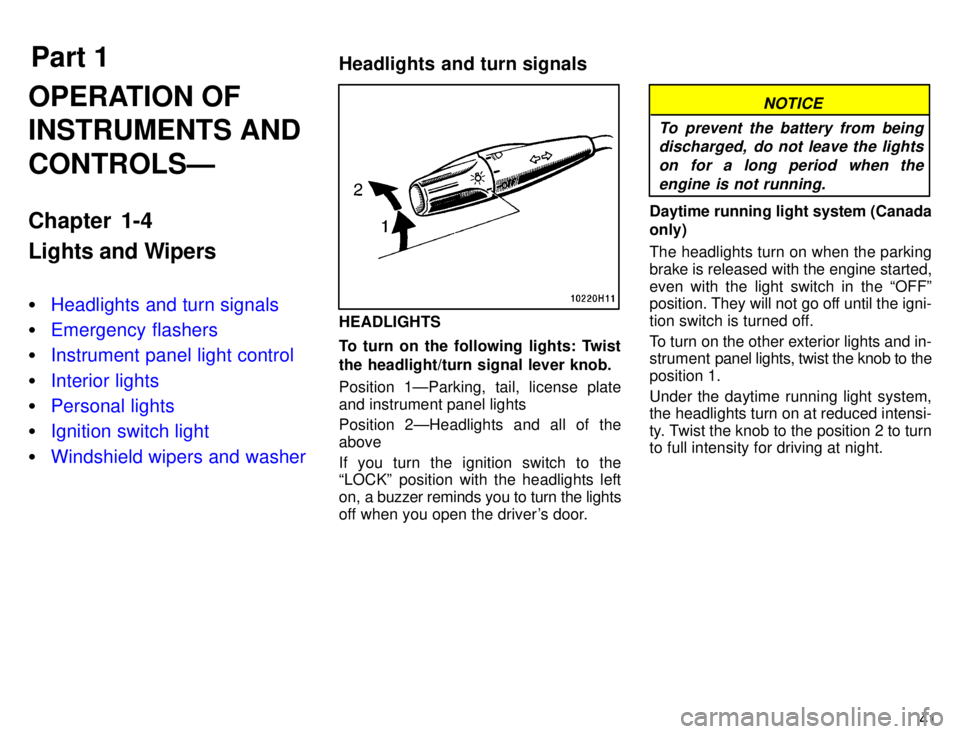
HEADLIGHTS
To turn on the following lights: Twist
the headlight/turn signal lever knob. Position 1ÐParking, tail, license plate
and instrument panel lights Position 2ÐHeadlights and all of the above If you turn the ignition switch to the
LOCKº position with the headlights left
on, a buzzer reminds you to turn the lights
off when you open the driver's door.
NOTICE
To prevent the battery from being discharged, do not leave the lights
on for a long period when theengine is not running.
Daytime running light system (Canada only)
The headlights turn on when the parking brake is released with the engine started,
even with the light switch in the OFFº
position. They will not go off until the igni-
tion switch is turned off.
To turn on the other exterior lights and in-
strument panel lights, twist the knob to the
position 1.
Under the daytime running light system,
the headlights turn on at reduced intensi-
ty. Twist the knob to the position 2 to turn
to full intensity for driving at night.
Page 46 of 196

42
High-Low beamsÐFor high beams,
turn the headlights on and push the lever away from you (position 1). Pull the levertoward you (position 2) for low beams.
The headlight high beam indicator light
(blue light) on the instrument panel will tell
you that the high beams are on.
Flashing the high beam headlights
(position 3) ÐPull the lever all the way
back. The high beam headlights turn off
when you release the lever.
You can flash the high beam headlights with knob turned to OFFº.TURN SIGNALS
To signal a turn, push the headlight/
turn signal lever up or down to posi-
tion 1. The key must be in the ONº position. The lever automatically returns after you make a turn, but you may have to returnit by hand after you change lanes.
To signal a lane change, move the lever
up or down to the pressure point (position2) and hold it.
If the turn signal indicator lights (green
lights) on the instrument panel flash faster
than normal, a front or rear turn signal bulb is burned out.To turn on the emergency flashers,
push the switch.
All the turn signal lights will flash. To turn
them off, push the switch once again.
Turn on the emergency flashers to warn other drivers if your vehicle must be
stopped where it might be a traf fic hazard.
Always pull as far off the road as possible.
The turn signal light switch will not work
when the emergency flashers are operat-ing. Emergency flashers