ECU TOYOTA TACOMA 2009 (in English) User Guide
[x] Cancel search | Manufacturer: TOYOTA, Model Year: 2009, Model line: TACOMA, Model: TOYOTA TACOMA 2009Pages: 520, PDF Size: 10.75 MB
Page 76 of 520
76
1-6. Theft deterrent system
Engine immobilizer system (if equipped)
■System maintenance
The vehicle has a maintenance-free type of engine immobilizer system.
■ Conditions that may cause the system to malfunction
●If the key is in contact with a metallic object
● If the key is in close proximity to or touching a key to the security system
(key with a built-in transponder chip) of another vehicle
■ Certifications for the engine immobilizer system
For vehicles sold in U.S.A.
FCC ID: MOZRI-21BTY
This device complies with Part 15 of the FCC Rules. Operation is subject to
the following two conditions: (1) this device may not cause harmful interfer-
ence, and (2) this device must accept any interference received, including
interference that may cause undesired operation.
FCC WARNING:
Changes or modifications not expressly approved by the party responsible
for compliance could void the user’s authority to operate the equipment.
The vehicle’s keys have built-in tr ansponder chips that prevent the
engine from starting if the key has not been previously registered in
the vehicle’s on-board computer.
Never leave the keys inside the vehicle when you leave the vehicle.
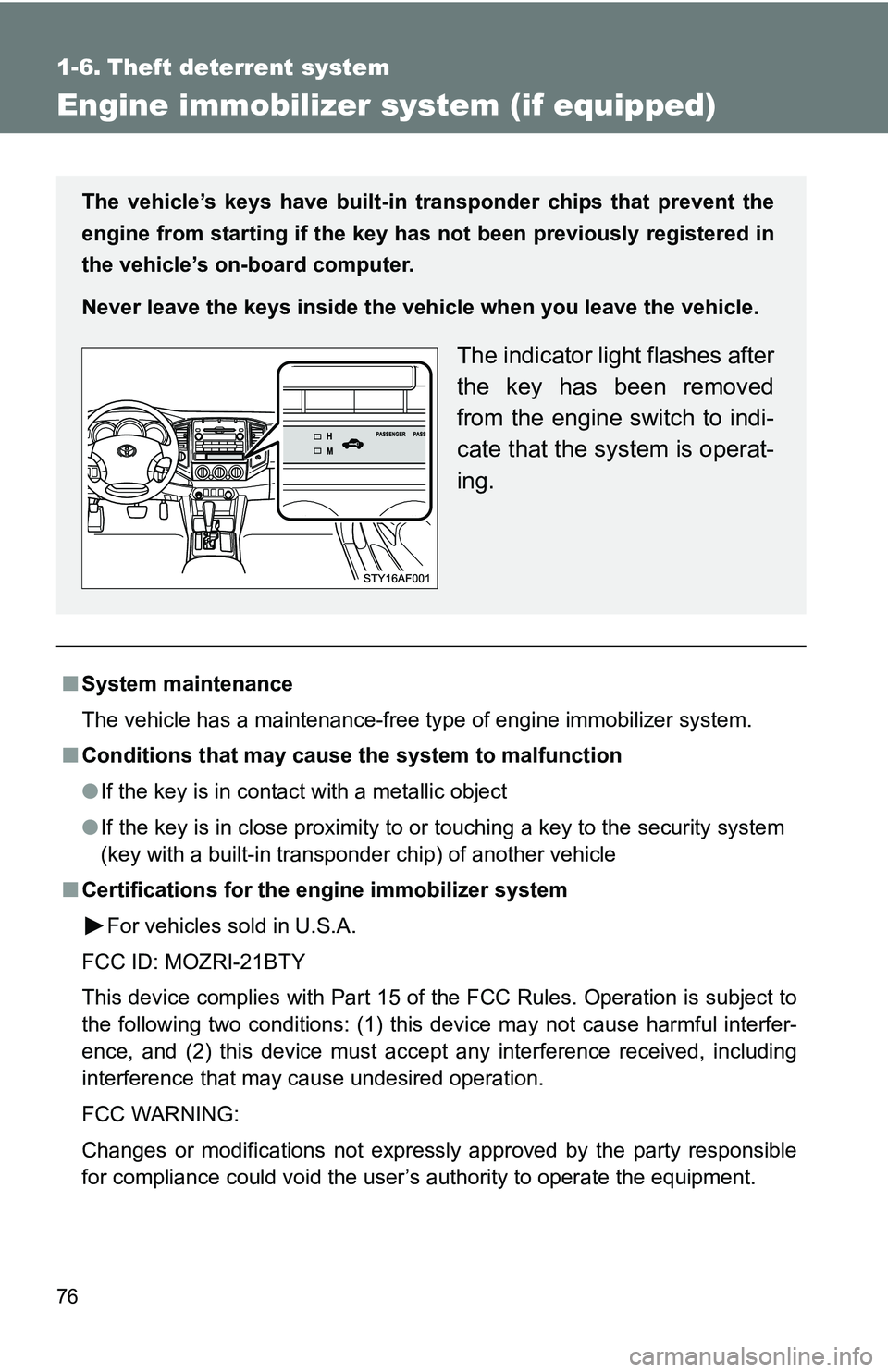
The indicator light flashes after
the key has been removed
from the engine switch to indi-
cate that the system is operat-
ing.
Page 83 of 520
83
1-7. Safety information
1
Before driving
Your vehicle is equipped with
ADVANCED AIRBAGS designed based
on US motor vehicle safety standards (FMVSS208). The airbag sys-
tem controls airbag deployment power for the driver and right front
passenger. The driver airbag system consists of the driver seat’s
position sensor etc. The front pass enger’s airbag system consists of
the front passenger occupant classification sensor etc.
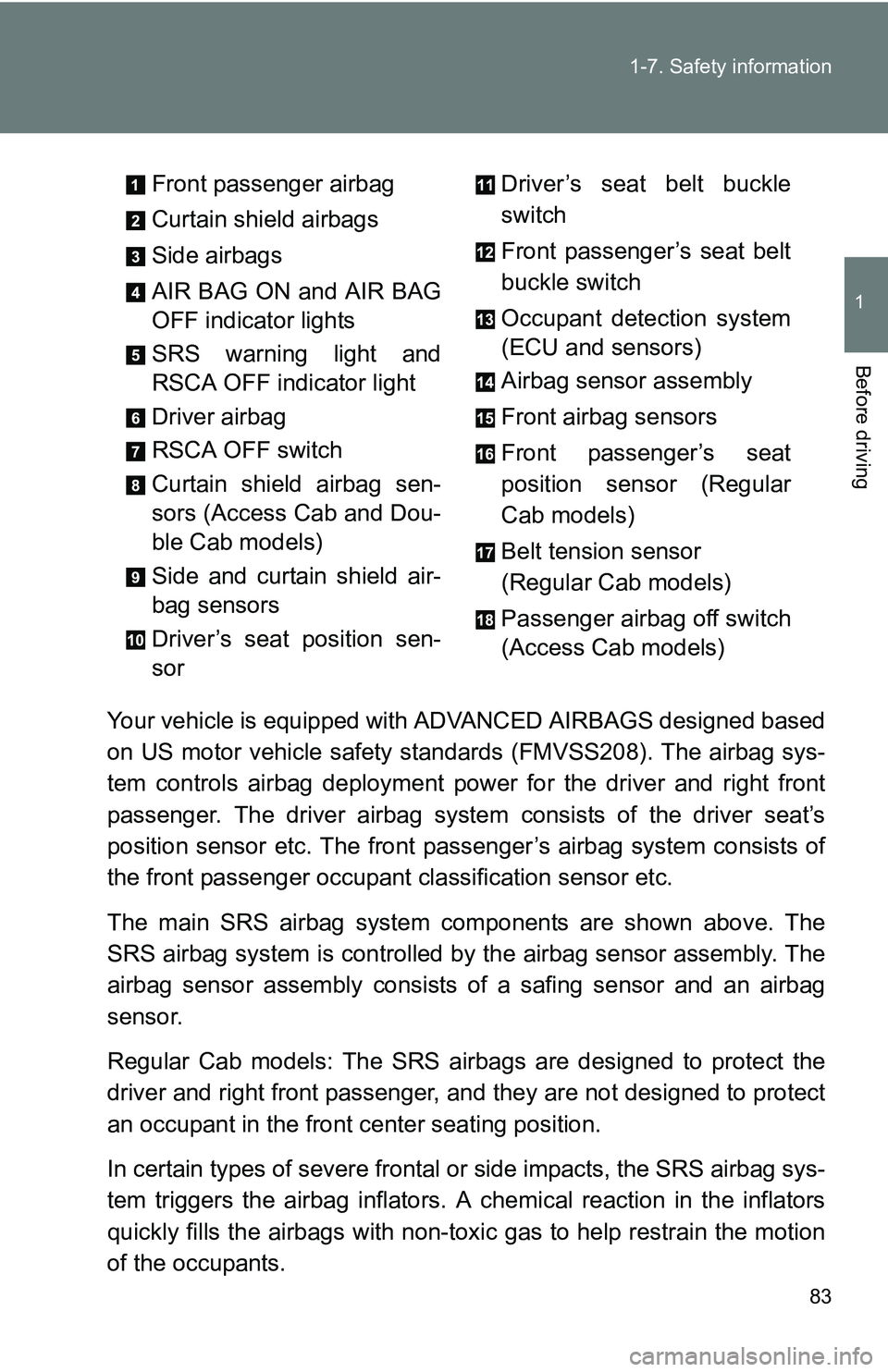
The main SRS airbag system components are shown above. The
SRS airbag system is controlled by the airbag sensor assembly. The
airbag sensor assembly consists of a safing sensor and an airbag
sensor.
Regular Cab models: The SRS airbags are designed to protect the
driver and right front passenger, and they are not designed to protect
an occupant in the front center seating position.
In certain types of severe frontal or side impacts, the SRS airbag sys-
tem triggers the airbag inflators. A chemical reaction in the inflators
quickly fills the airbags with non-toxic gas to help rest rain the motion
of the occupants. Front passenger airbag
Curtain shield airbags
Side airbags
AIR BAG ON and AIR BAG
OFF indicator lights
SRS warning light and
RSCA OFF indicator light
Driver airbag
RSCA OFF switch
Curtain shield airbag sen-
sors (Access Cab and Dou-
ble Cab models)
Side and curtain shield air-
bag sensors
Driver’s seat position sen-
sor
Driver’s seat belt buckle
switch
Front passenger’s seat belt
buckle switch
Occupant detection system
(ECU and sensors)
Airbag sensor assembly
Front airbag sensors
Front passenger’s seat
position sensor (Regular
Cab models)
Belt tension sensor
(Regular Cab models)
Passenger airbag off switch
(Access Cab models)
Page 89 of 520
89
1-7. Safety information
1
Before driving
CAUTION
■
SRS airbag precautions
The seat should be adjusted as recommended by NHTSA above, while still
maintaining control of the foot pedals and steering wheel, and your view of
the instrument panel controls.
●The SRS front passenger airbag also deploys with considerable force, and
can cause death or serious injury especially if the front passenger is very
close to the airbag. The front passenger seat should be as far from the air-
bag as possible with the seatback adjusted, so the front passenger sits
upright.
● Improperly seated and/or restrained infants and children can be killed or
seriously injured by a deploying airbag. An infant or child who is too small
to use a seat belt should be properly secured using a child restraint sys-
tem. Toyota strongly recommends that all infants and children be placed in
the rear seats of the vehicle and properly restrained. The rear seats are
the safest for infants and children. ( P. 104)
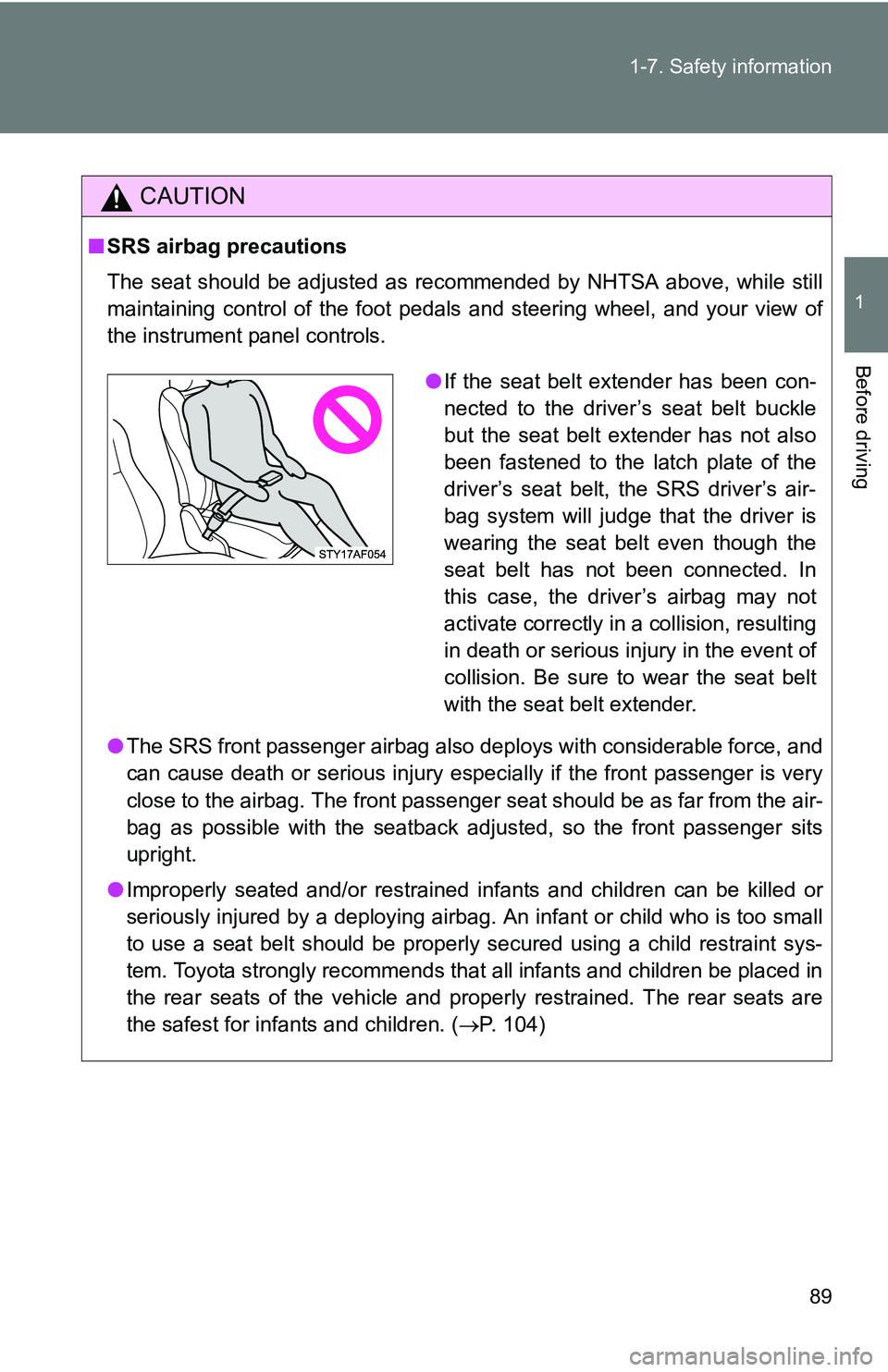
●If the seat belt extender has been con-
nected to the driver’s seat belt buckle
but the seat belt extender has not also
been fastened to the latch plate of the
driver’s seat belt, the SRS driver’s air-
bag system will judge that the driver is
wearing the seat belt even though the
seat belt has not been connected. In
this case, the driver’s airbag may not
activate correctly in a collision, resulting
in death or serious injury in the event of
collision. Be sure to wear the seat belt
with the seat belt extender.
Page 107 of 520
107
1-7. Safety information
1
Before driving
CAUTION
■
Child restraint precautions
●A forward-facing child restraint system should be allowed to be installed
on the front passenger seat only when it is unavoidable. Always move the
seat as far back as possible even if AIR BAG OFF indicator light is illumi-
nated, because the front passenger airbag could inflate with considerable
speed and force. Otherwise, the child may be killed or seriously injured.
● Access Cab models: A forward-facing child restraint system which belongs
to a passenger risk group should never be installed on the front passenger
seat with the passenger airbag off switch in the AUTO position, because
the force of the deploying airbag could cause death or serious injury to the
child in forward seating position. (P. 94)
● Regular Cab models: Do not install a child restraint system on the center
seat if it interferes with driving operations such as gear shifting. In this
case, install the child restraint system on the right passenger seat.
● Regular Cab models: The driver and passengers sit on a bench seat in
this vehicle. Therefore, when installing a child restraint system, the seat
must be moved back from the SRS airbag as far as possible while also
maintaining the driver’s seating position. Otherwise, the force of the rapid
inflation of the airbag could cause death or serious injury to the child.
● Do not use the seat belt extender when installing a child restraint system
on the front or rear passenger seat. If installing a child restraint system
with the seat belt extender connected to the seat belt, the seat belt will not
securely hold the child restraint system, which could cause death or seri-
ous injury to the child or other passengers in the event of collision.
● Do not allow the child to lean his/her head or any part of his/her body
against the door or the area of the seat , front and rear pillars or roof side
rail from which the side airbags or curtain shield airbags deploy even if the
child is seated in the child restraint system. It is dangerous if the side air-
bags and curtain shield airbags inflate, and the force of the rapid inflation
could cause death or serious injury to the child.
● Make sure you have complied with all installation instructions provided by
the child restraint manufacturer and that the system is properly secured. If
it is not secured properly, it may cause death or serious injury to the child
in the event of a sudden stop or accident.
Page 108 of 520
108 1-7. Safety information
CAUTION
■When the child restrain t system is not in use
● Keep the child restraint system properly secured on the seat even if it is
not in use. Do not store the restraint unsecured in the passenger compart-
ment.
● If it is necessary to detach the child restraint system, remove it from the
vehicle. This will prevent it from injuring passengers in the event of a sud-
den stop or accident.
Page 109 of 520
109
1
1-7. Safety information
Before driving
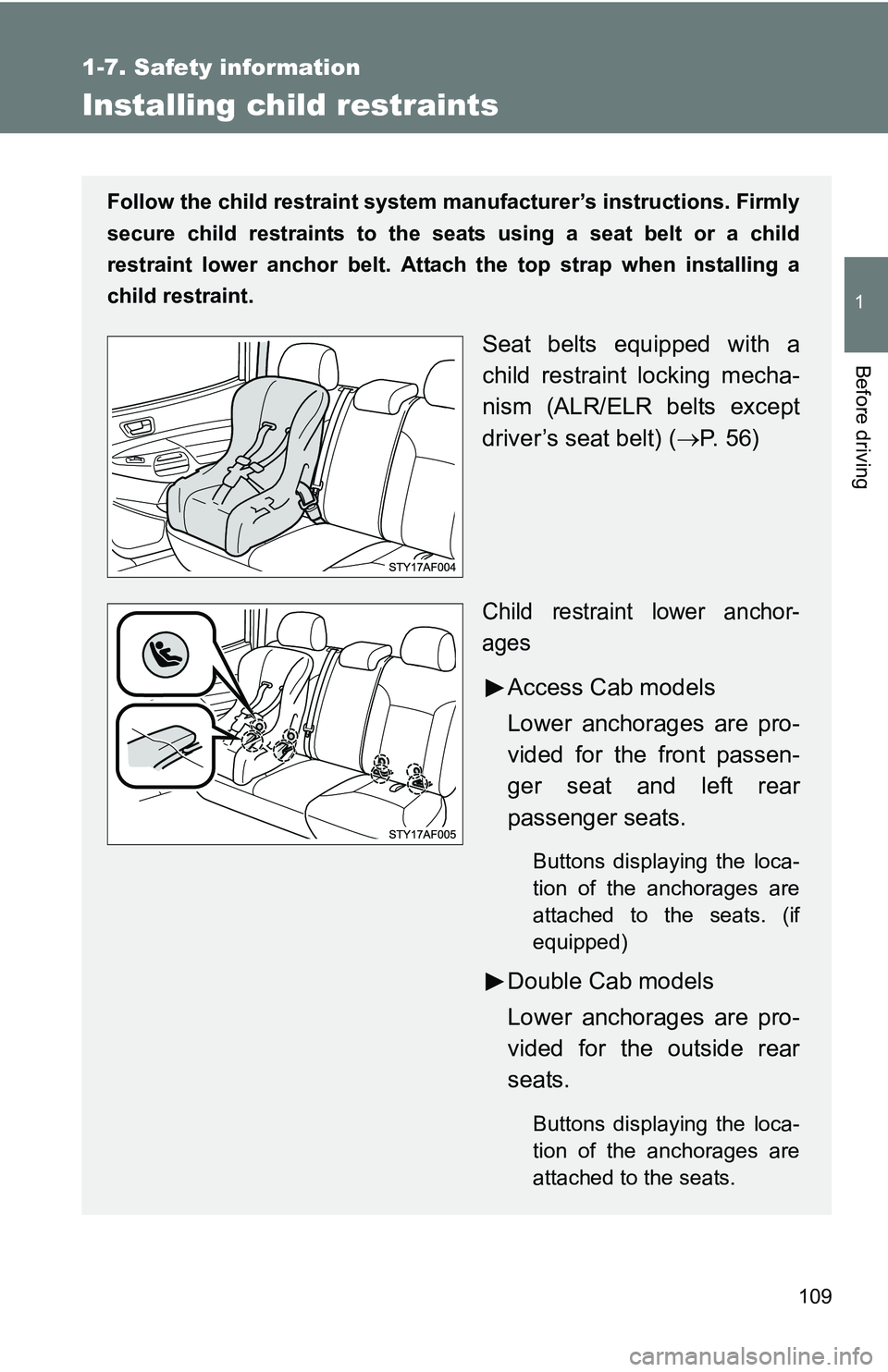
Installing child restraints
Follow the child restraint system manufacturer’s instructions. Firmly
secure child restraints to the seats using a seat belt or a child
restraint lower anchor belt. Attach the top strap when installing a
child restraint.
Seat belts equipped with a
child restraint locking mecha-
nism (ALR/ELR belts except
driver’s seat belt) ( P. 56)
Child restraint lower anchor-
ages
Access Cab models
Lower anchorages are pro-
vided for the front passen-
ger seat and left rear
passenger seats.
Buttons displaying the loca-
tion of the anchorages are
attached to the seats. (if
equipped)
Double Cab models
Lower anchorages are pro-
vided for the outside rear
seats.
Buttons displaying the loca-
tion of the anchorages are
attached to the seats.
Page 112 of 520
112 1-7. Safety information
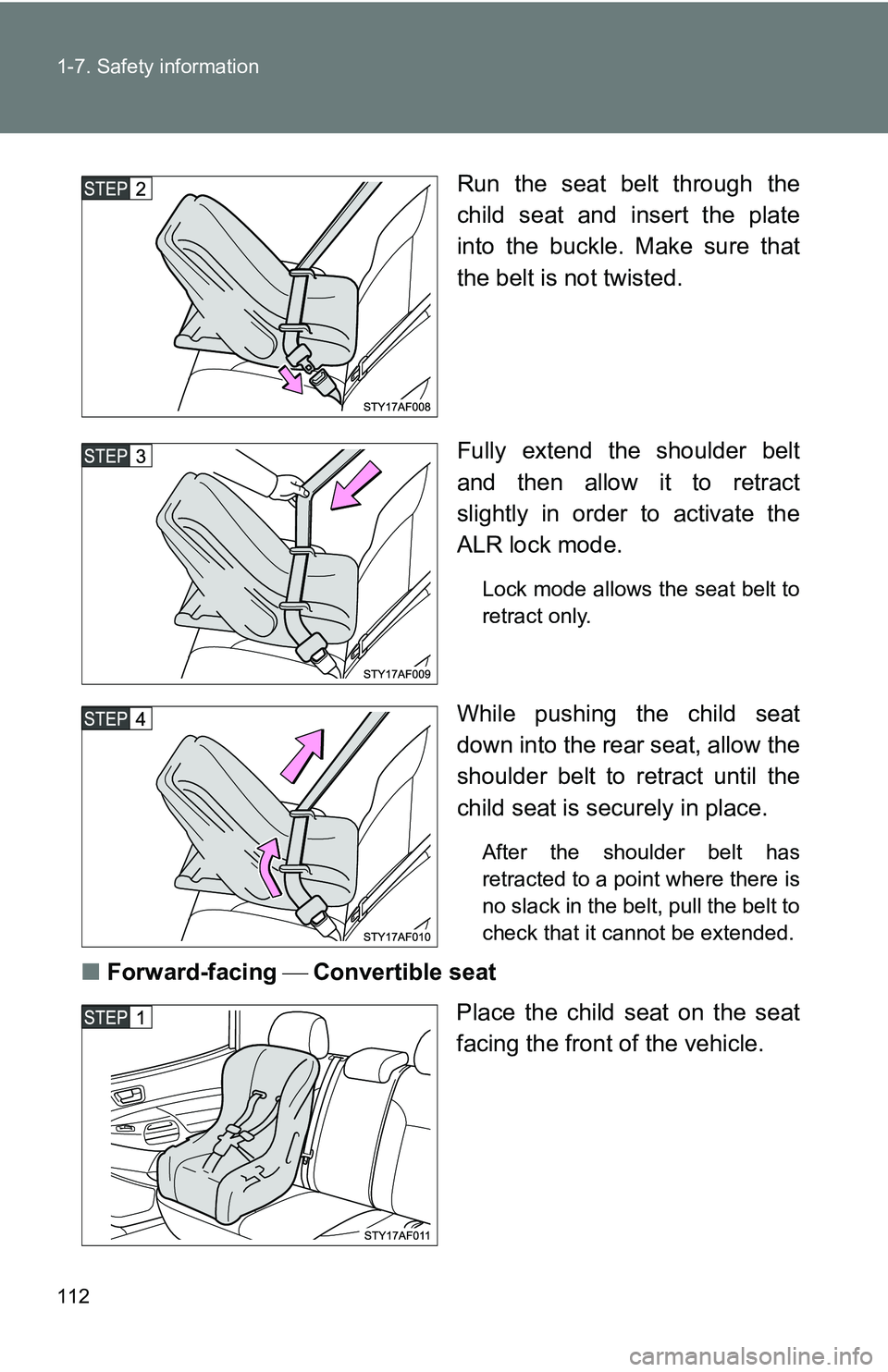
Run the seat belt through the
child seat and insert the plate
into the buckle. Make sure that
the belt is not twisted.
Fully extend the shoulder belt
and then allow it to retract
slightly in order to activate the
ALR lock mode.
Lock mode allows the seat belt to
retract only.
While pushing the child seat
down into the rear seat, allow the
shoulder belt to retract until the
child seat is securely in place.
After the shoulder belt has
retracted to a point where there is
no slack in the belt, pull the belt to
check that it cannot be extended.
■Forward-facing Convertible seat
Place the child seat on the seat
facing the front of the vehicle.
Page 113 of 520
113
1-7. Safety information
1
Before driving
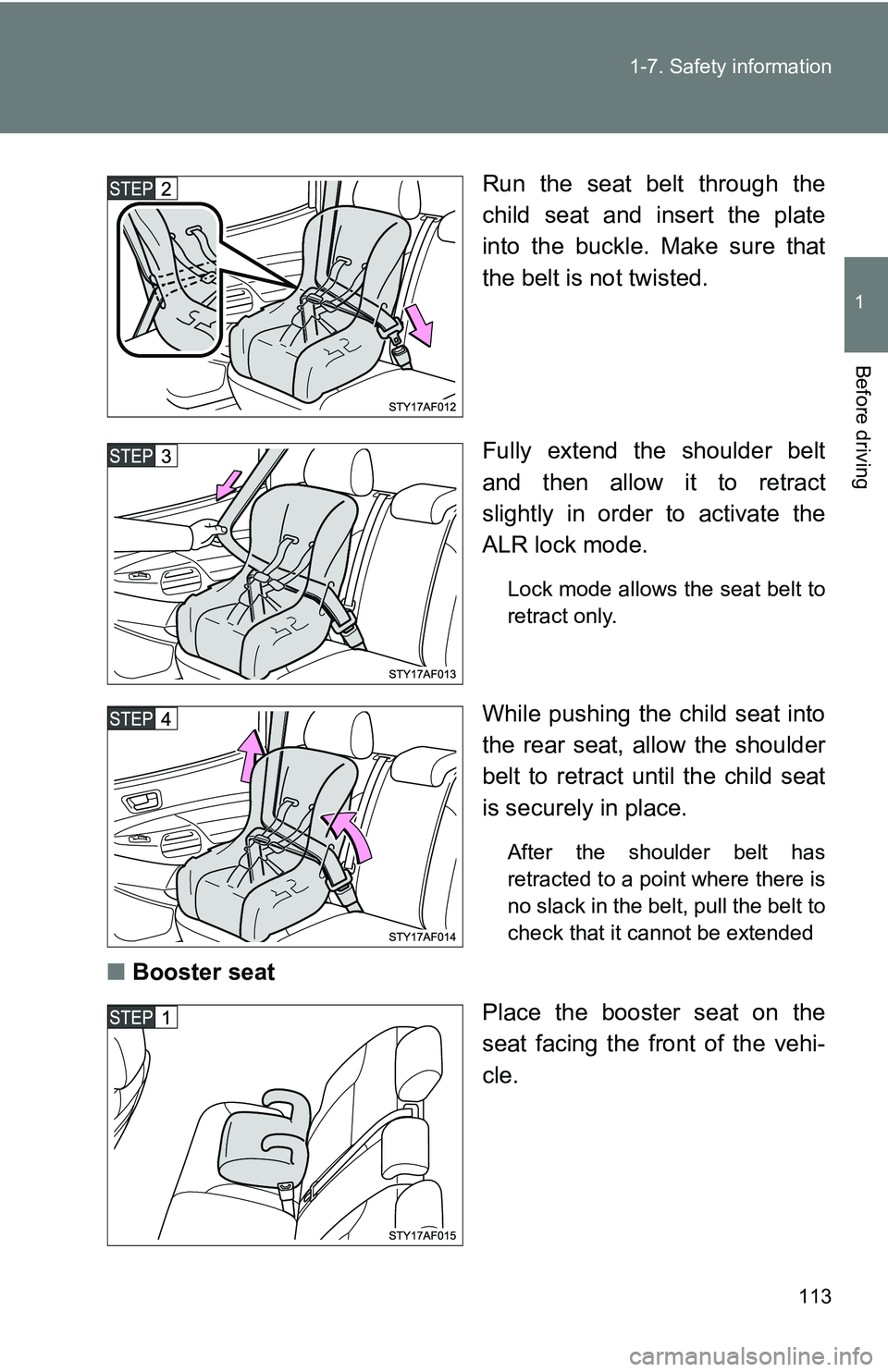
Run the seat belt through the
child seat and insert the plate
into the buckle. Make sure that
the belt is not twisted.
Fully extend the shoulder belt
and then allow it to retract
slightly in order to activate the
ALR lock mode.
Lock mode allows the seat belt to
retract only.
While pushing the child seat into
the rear seat, allow the shoulder
belt to retract until the child seat
is securely in place.
After the shoulder belt has
retracted to a point where there is
no slack in the belt, pull the belt to
check that it cannot be extended
■
Booster seat
Place the booster seat on the
seat facing the front of the vehi-
cle.
Page 120 of 520

120 1-7. Safety information
Swing the seatback forward
slightly (P. 46) and remove the
anchor bracket covers.
Installing position:
Right side passenger seat
Center passenger seat
Store the removed cover in a safe
place such as the glove box.
Right side passenger seat
Route the top strap through
the routing device as shown in
the illustration.
Make sure the top strap is not
twisted.
Latch the hook onto the
anchor bracket.
Return the seatback to its orig-
inal position.
Make sure the seatback is
securely locked by pushing for-
ward and rearward on the top of
the seatback.
Page 121 of 520
121
1-7. Safety information
1
Before driving
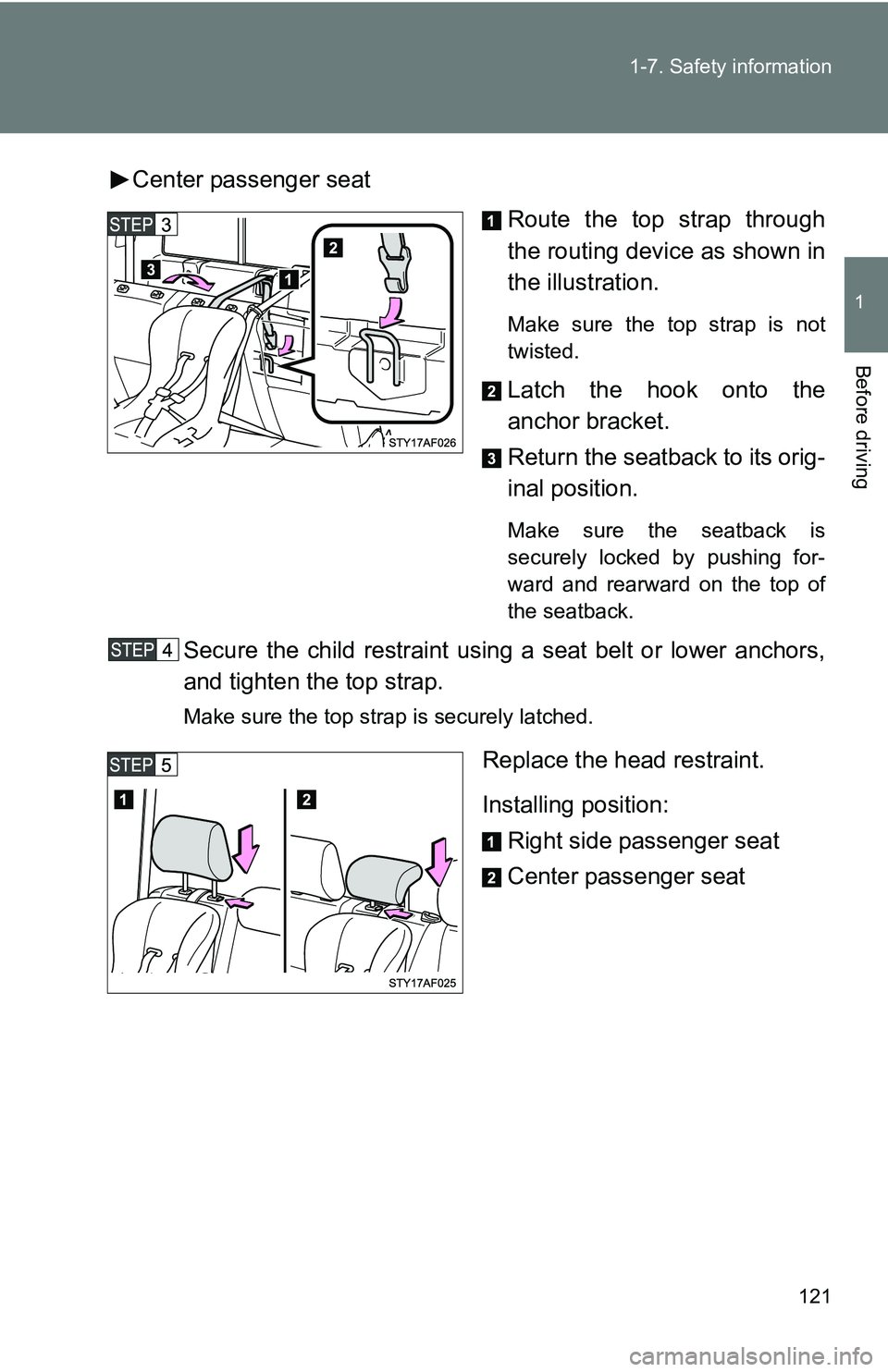
Center passenger seat
Route the top strap through
the routing device as shown in
the illustration.
Make sure the top strap is not
twisted.
Latch the hook onto the
anchor bracket.
Return the seatback to its orig-
inal position.
Make sure the seatback is
securely locked by pushing for-
ward and rearward on the top of
the seatback.
Secure the child restraint using a seat belt or lower anchors,
and tighten the top strap.
Make sure the top strap is securely latched.
Replace the head restraint.
Installing position:Right side passenger seat
Center passenger seat