light TOYOTA TACOMA 2009 (in English) User Guide
[x] Cancel search | Manufacturer: TOYOTA, Model Year: 2009, Model line: TACOMA, Model: TOYOTA TACOMA 2009Pages: 520, PDF Size: 10.75 MB
Page 13 of 520
13
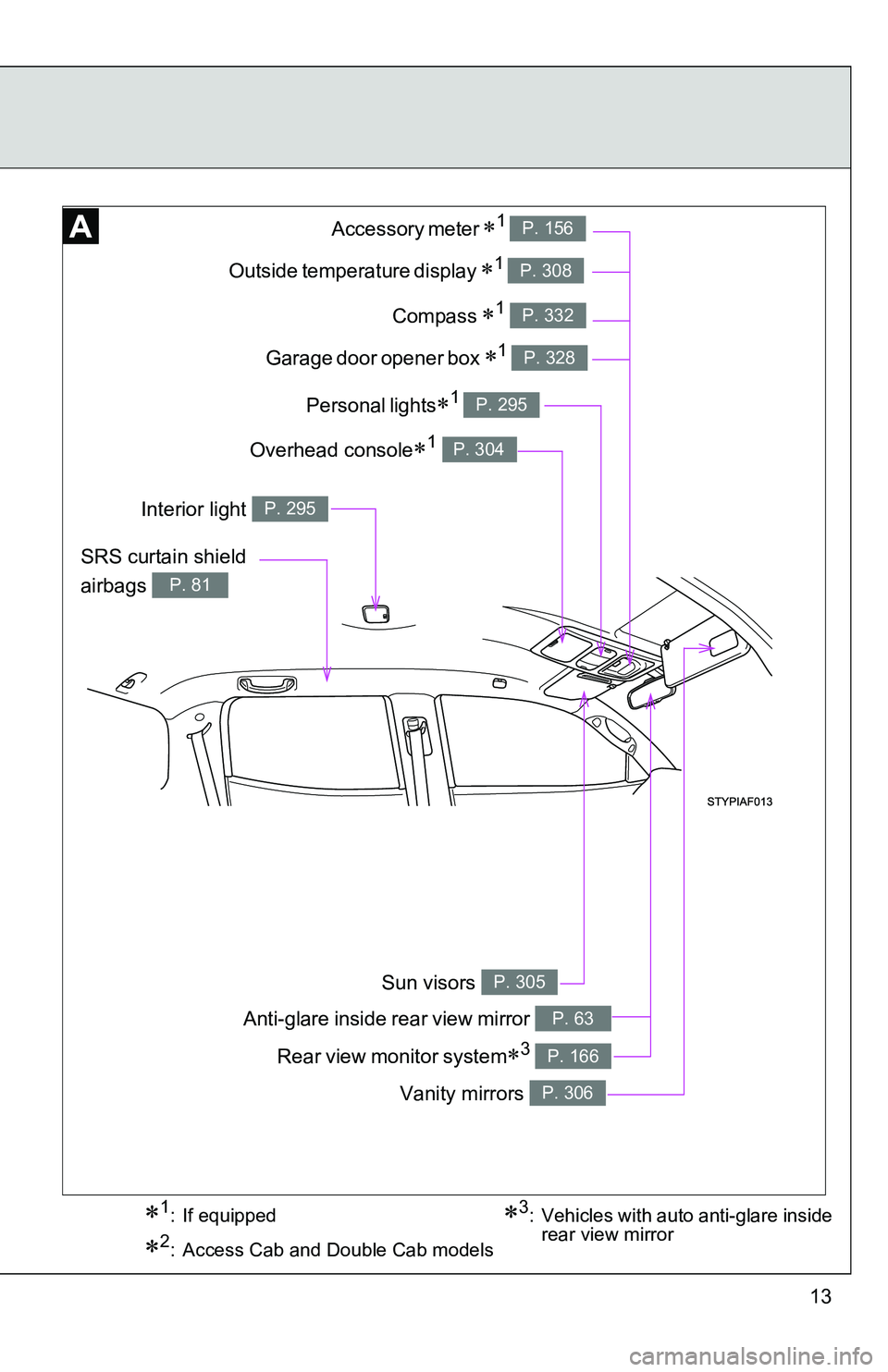
Anti-glare inside rear view mirror P. 63
Sun visors P. 305
SRS curtain shield
airbags
P. 81
Vanity mirrors P. 306
Interior light P. 295
Rear view monitor system3 P. 166
Overhead console1 P. 304
Garage door opener box 1 P. 328
Compass 1 P. 332
Personal lights1 P. 295
Outside temperature display 1 P. 308
Accessory meter 1 P. 156
3: Vehicles with auto anti-glare inside rear view mirror1: If equipped
2: Access Cab and Double Cab models
Page 18 of 520
18
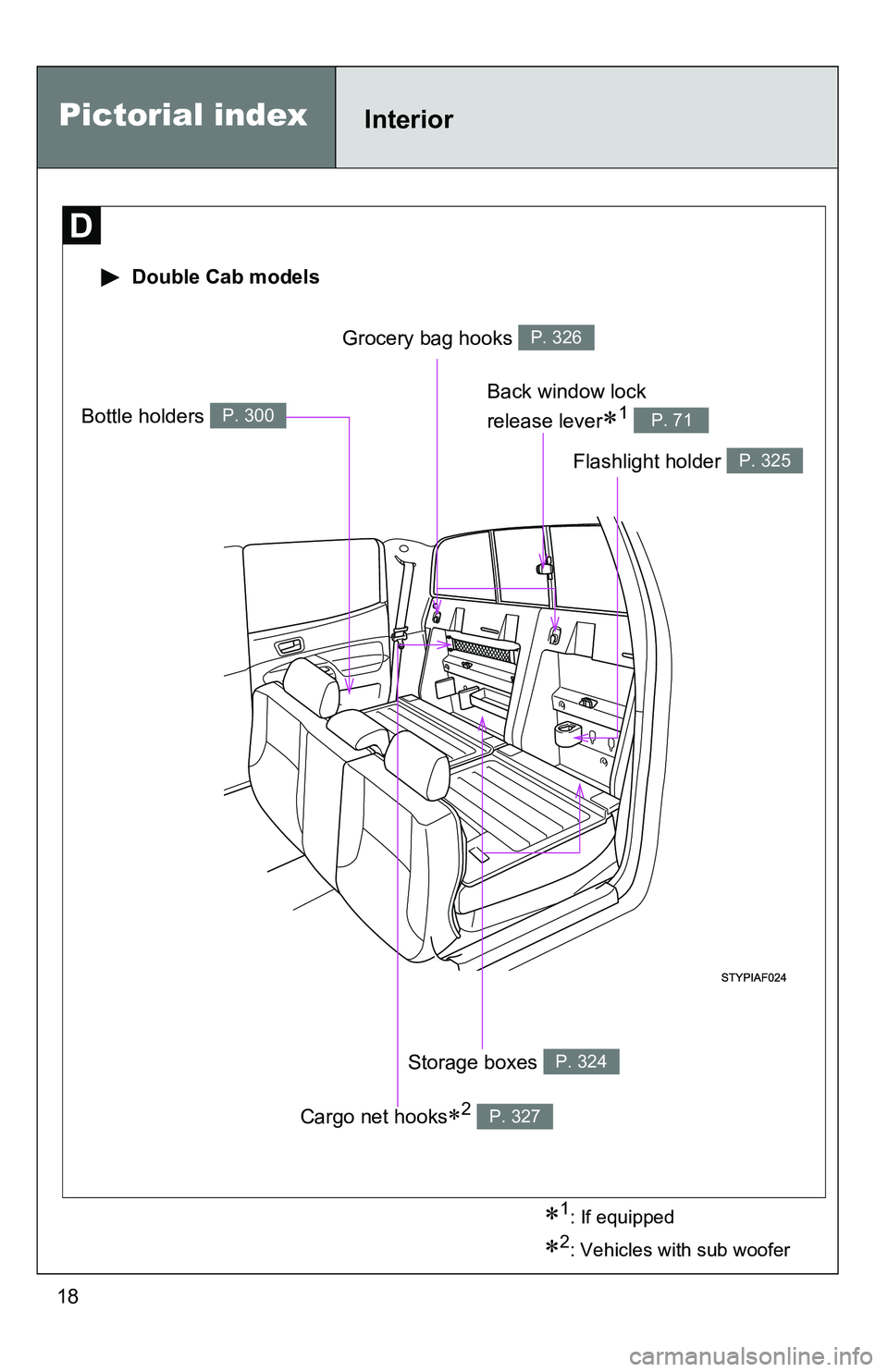
Double Cab models
Cargo net hooks2 P. 327
Bottle holders P. 300
Pictorial indexInterior
Grocery bag hooks P. 326
Back window lock
release lever
1 P. 71
Flashlight holder P. 325
Storage boxes P. 324
2: Vehicles with sub woofer
1: If equipped
Page 20 of 520
20
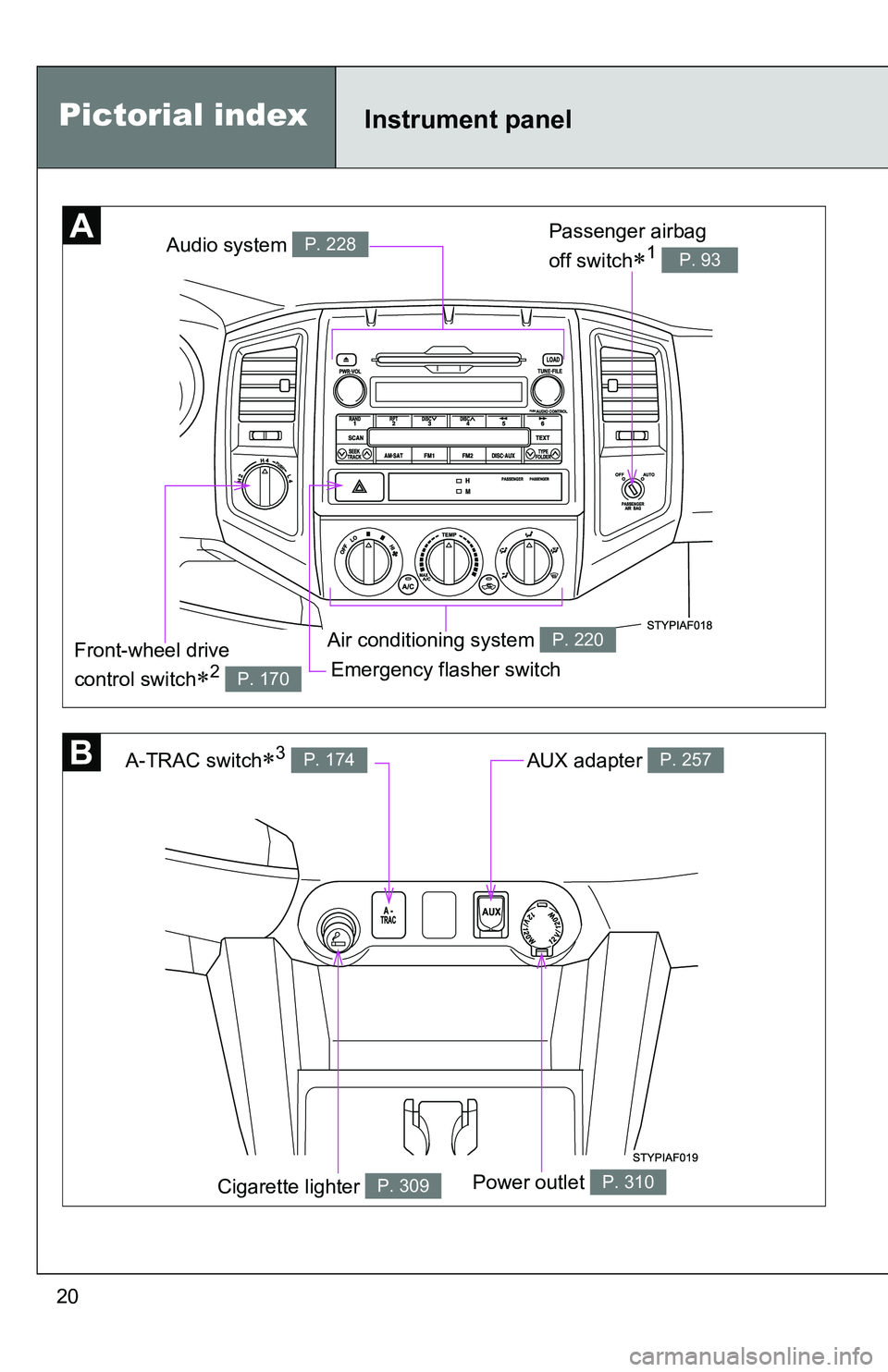
Emergency flasher switch
Audio system
P. 228
Air conditioning system P. 220
A-TRAC switch3 P. 174AUX adapter P. 257
Power outlet P. 310
Passenger airbag
off switch
1 P. 93
Front-wheel drive
control switch
2 P. 170
Cigarette lighter P. 309
Pictorial indexInstrument panel
Page 22 of 520
22
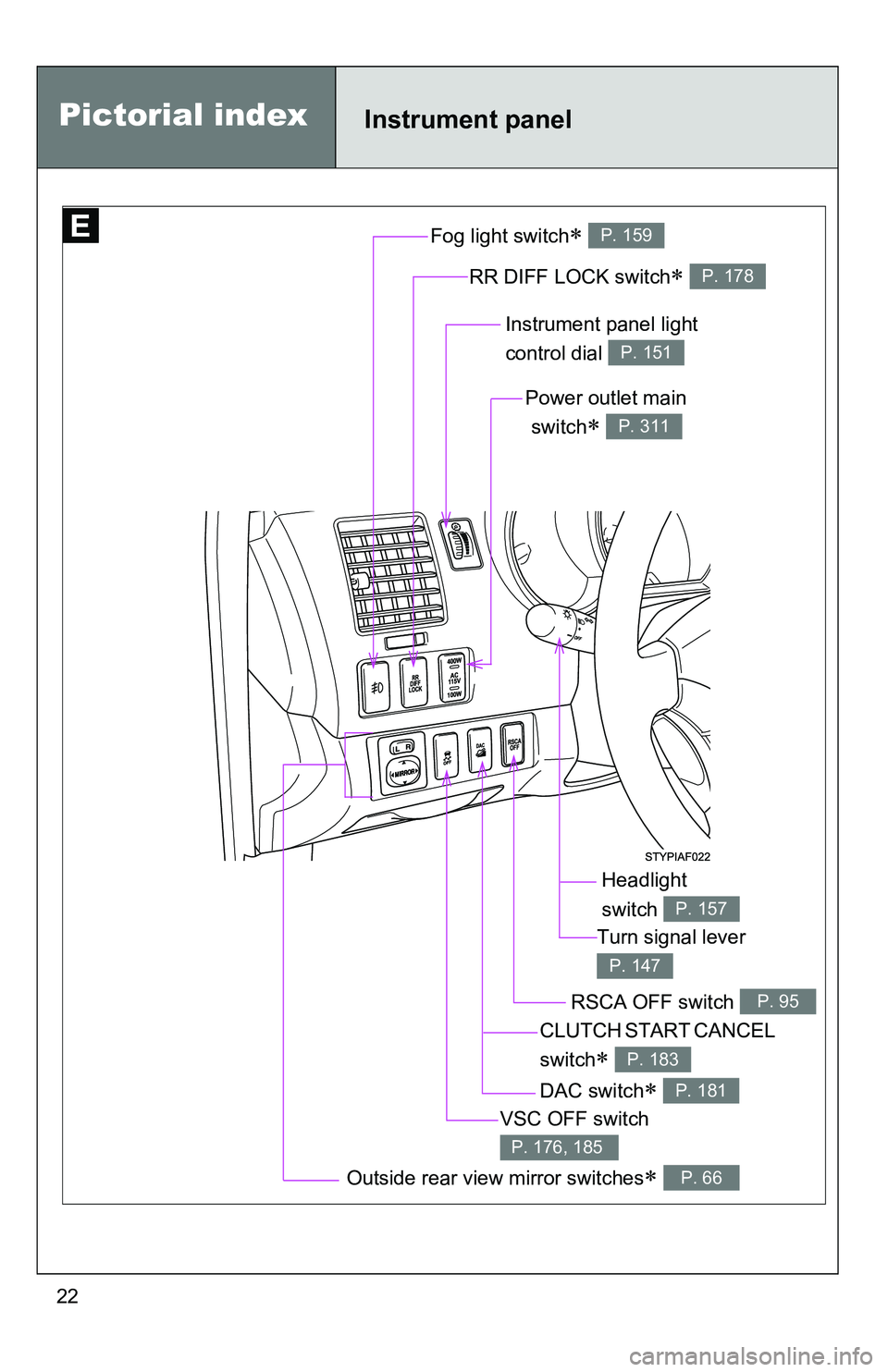
Instrument panel light
control dial
P. 151
Outside rear view mirror switches P. 66
RSCA OFF switch P. 95
Fog light switch P. 159
RR DIFF LOCK switch P. 178
Power outlet main
switch
P. 311
Headlight
switch
P. 157
Turn signal lever
P. 147
DAC switch P. 181
VSC OFF switch
P. 176, 185
Pictorial indexInstrument panel
CLUTCH START CANCEL
switch
P. 183
Page 26 of 520
26
CAUTION
■General precaution regarding children’s safety
Never leave children unattended in the vehicle, and never allow children to
have or use the key.
Children may be able to start the vehicle or shift the vehicle into neutral.
There is also a danger that children may injure themselves by playing with
the cigarette lighter, the windows, or other features of the vehicle. In addi-
tion, heat build-up or extremely cold temperatures inside the vehicle can be
fatal to children.
Page 31 of 520
31
1-1. Key information
1
Before driving
NOTICE
■
To prevent key damage (vehicles with engine immobilizer system)
● Do not subject the keys to strong shocks, expose them to high tempera-
tures by placing them in direct sunlight, or get them wet.
● Do not expose the keys to electromagnetic materials or attach any mate-
rial that blocks electromagnetic waves to the key surface.
Page 32 of 520
32
1-2. Opening, closing and locking the doors
Wireless remote control (if equipped)
■Operation signals
A buzzer sounds and the emergency flashers flash to indicate that the doors
have been locked/unlocked. (Locked: Once; Unlocked: Twice)
■Panic mode
■Door lock buzzer
If a door is not fully closed, a buzzer sounds for 10 seconds if an attempt to
lock the door is made. Fully close the door to stop the buzzer, and lock the
vehicle once more.
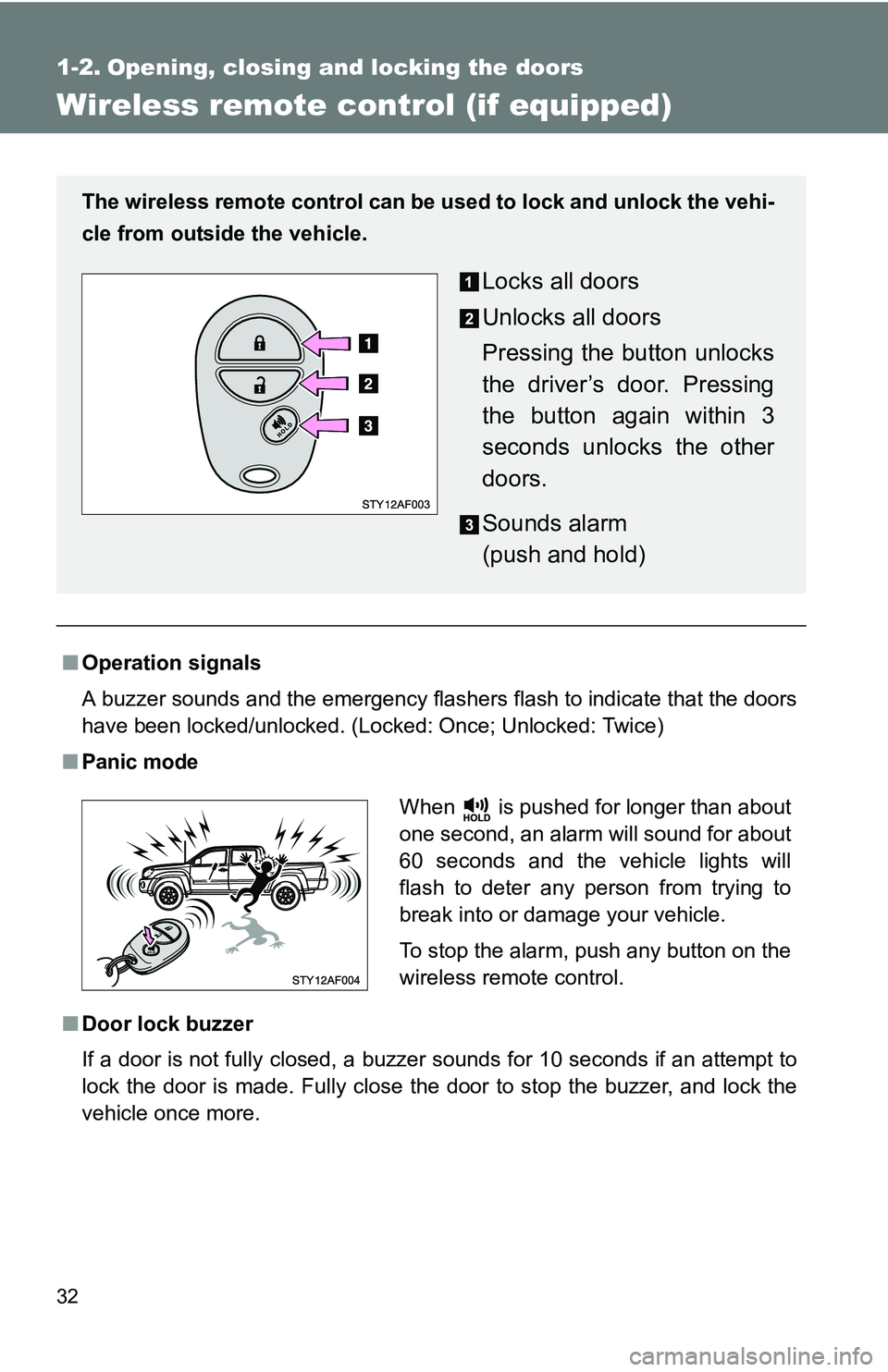
The wireless remote control can be used to lock and unlock the vehi-
cle from outside the vehicle.
Locks all doors
Unlocks all doors
Pressing the button unlocks
the driver’s door. Pressing
the button again within 3
seconds unlocks the other
doors.
Sounds alarm
(push and hold)
When is pushed for longer than about
one second, an alarm will sound for about
60 seconds and the vehicle lights will
flash to deter any person from trying to
break into or damage your vehicle.
To stop the alarm, push any button on the
wireless remote control.
Page 46 of 520
46 1-3. Adjustable components (seats, mirrors, steering wheel)
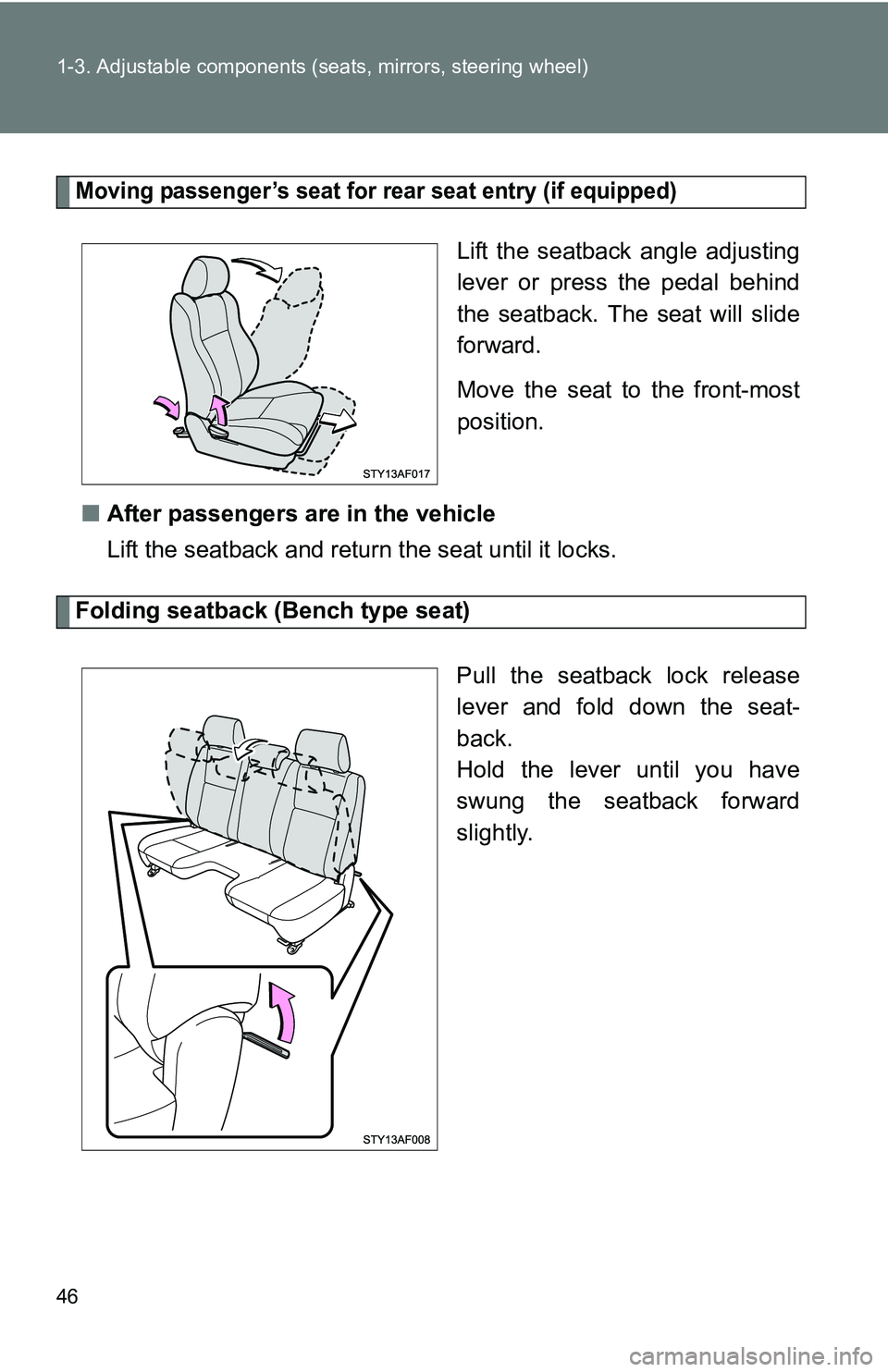
Moving passenger’s seat for rear seat entry (if equipped)
Lift the seatback angle adjusting
lever or press the pedal behind
the seatback. The seat will slide
forward.
Move the seat to the front-most
position.
■ After passengers are in the vehicle
Lift the seatback and retu rn the seat until it locks.
Folding seatback (Bench type seat)
Pull the seatback lock release
lever and fold down the seat-
back.
Hold the lever until you have
swung the seatback forward
slightly.
Page 48 of 520
48 1-3. Adjustable components (seats, mirrors, steering wheel)
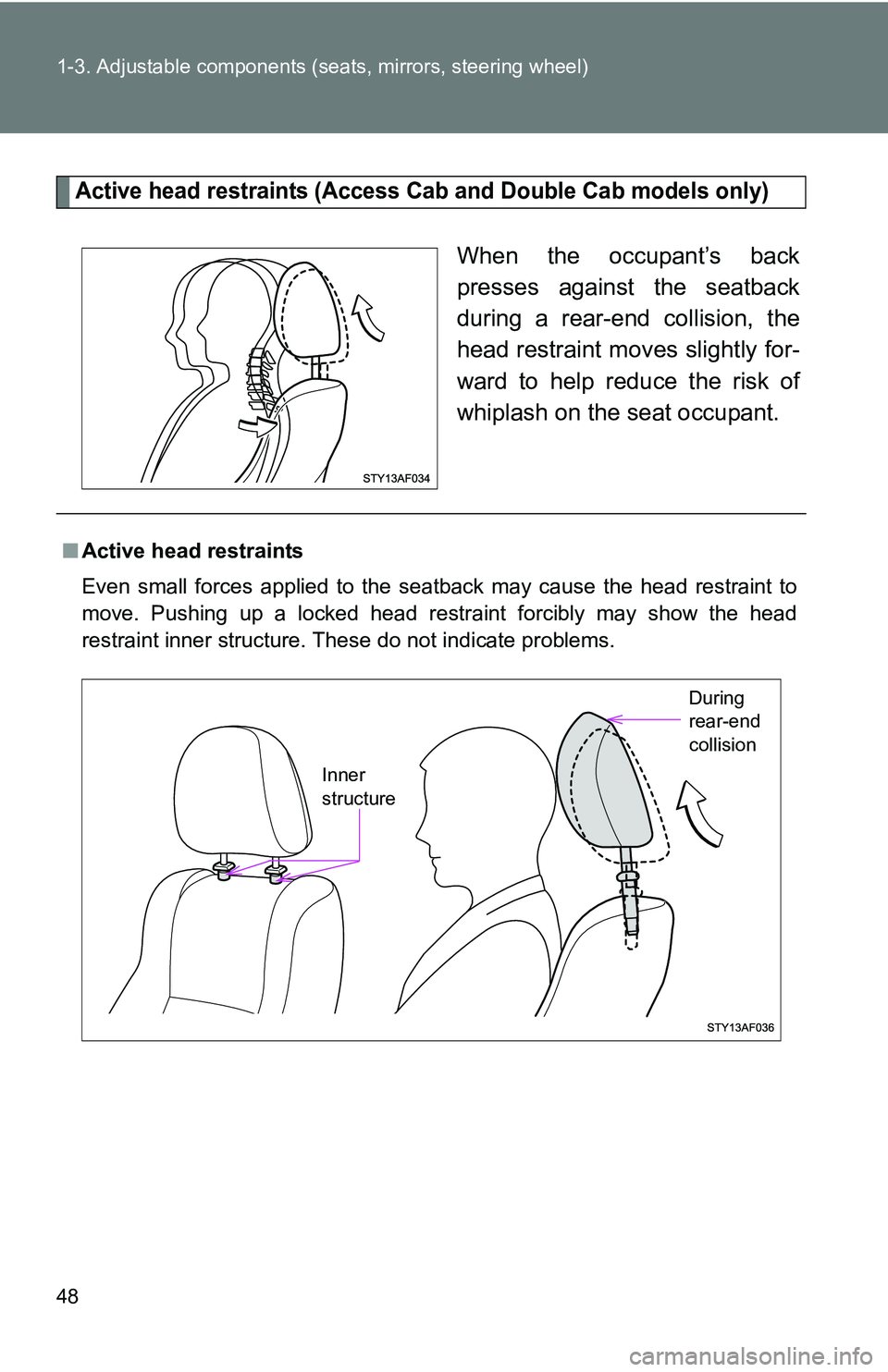
Active head restraints (Access Ca b and Double Cab models only)
When the occupant’s back
presses against the seatback
during a rear-end collision, the
head restraint moves slightly for-
ward to help reduce the risk of
whiplash on the seat occupant.
■Active head restraints
Even small forces applied to the seatback may cause the head restraint to
move. Pushing up a locked head restraint forcibly may show the head
restraint inner structure. These do not indicate problems.
Inner
structure
During
rear-end
collision
Page 58 of 520
58 1-3. Adjustable components (seats, mirrors, steering wheel)
■Emergency locking retractor (ELR)
The retractor will lock the belt during a sudden stop or on impact. It may also
lock if you lean forward too quickly. A slow, easy motion will allow the belt to
extend so that you can move around fully.
■ Automatic locking retractor (ALR)
When a passenger’s shoulder belt is completely extended and then
retracted even slightly, the belt is locked in that position and cannot be
extended. This feature is used to hold the child restraint system (CRS) firmly.
To free the belt again, fully retract the belt and then pull the belt out once
more. ( P. 104)
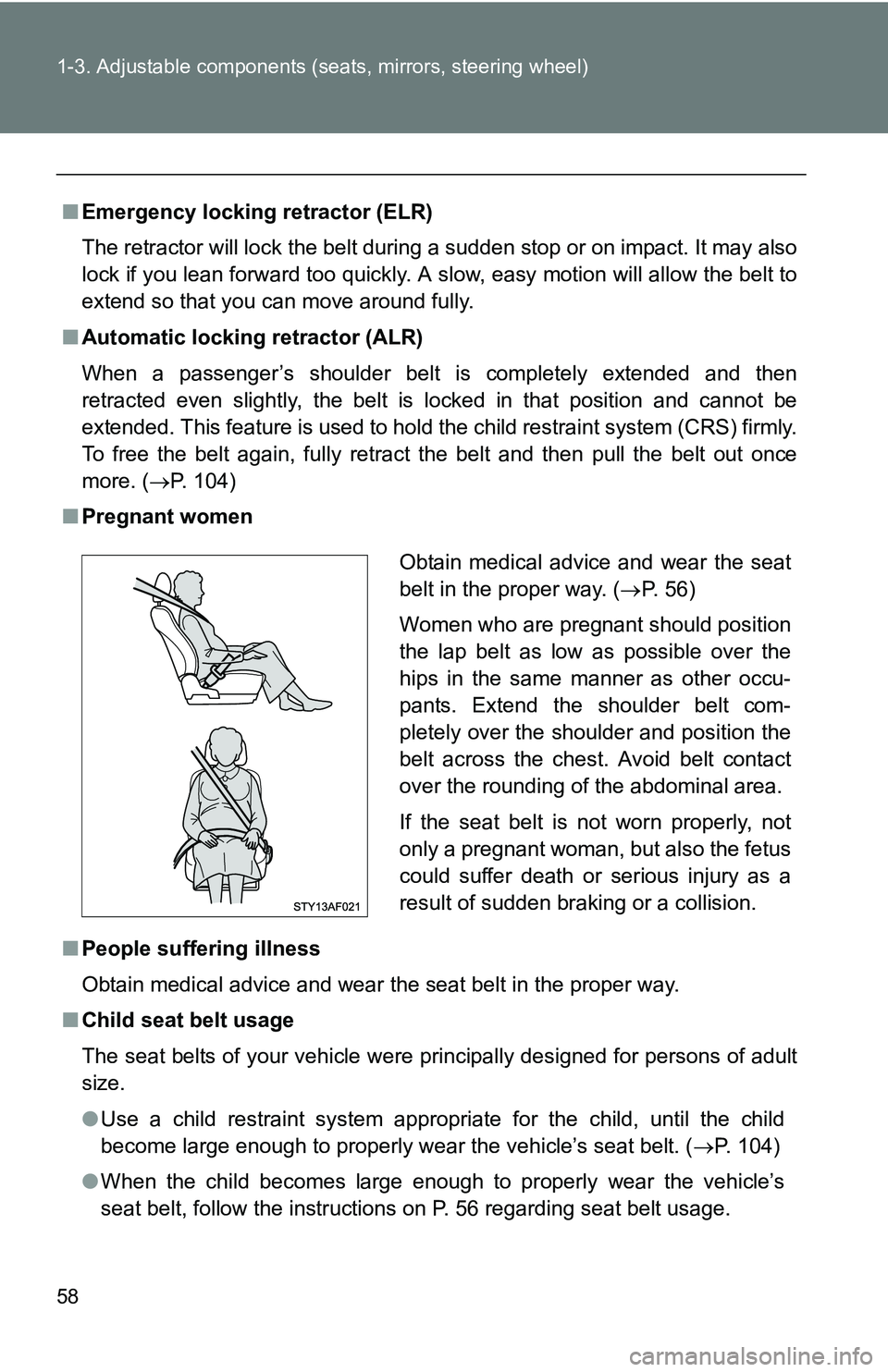
■ Pregnant women
■ People suffering illness
Obtain medical advice and wear the seat belt in the proper way.
■ Child seat belt usage
The seat belts of your vehicle were principally designed for persons of adult
size.
●Use a child restraint system appropriate for the child, until the child
become large enough to properly wear the vehicle’s seat belt. ( P. 104)
● When the child becomes large enough to properly wear the vehicle’s
seat belt, follow the instructions on P. 56 regarding seat belt usage.
Obtain medical advice and wear the seat
belt in the proper way. ( P. 56)
Women who are pregnant should position
the lap belt as low as possible over the
hips in the same manner as other occu-
pants. Extend the shoulder belt com-
pletely over the shoulder and position the
belt across the chest. Avoid belt contact
over the rounding of the abdominal area.
If the seat belt is not worn properly, not
only a pregnant woman, but also the fetus
could suffer death or serious injury as a
result of sudden braking or a collision.