light TOYOTA TACOMA 2009 (in English) Service Manual
[x] Cancel search | Manufacturer: TOYOTA, Model Year: 2009, Model line: TACOMA, Model: TOYOTA TACOMA 2009Pages: 520, PDF Size: 10.75 MB
Page 116 of 520
116 1-7. Safety information
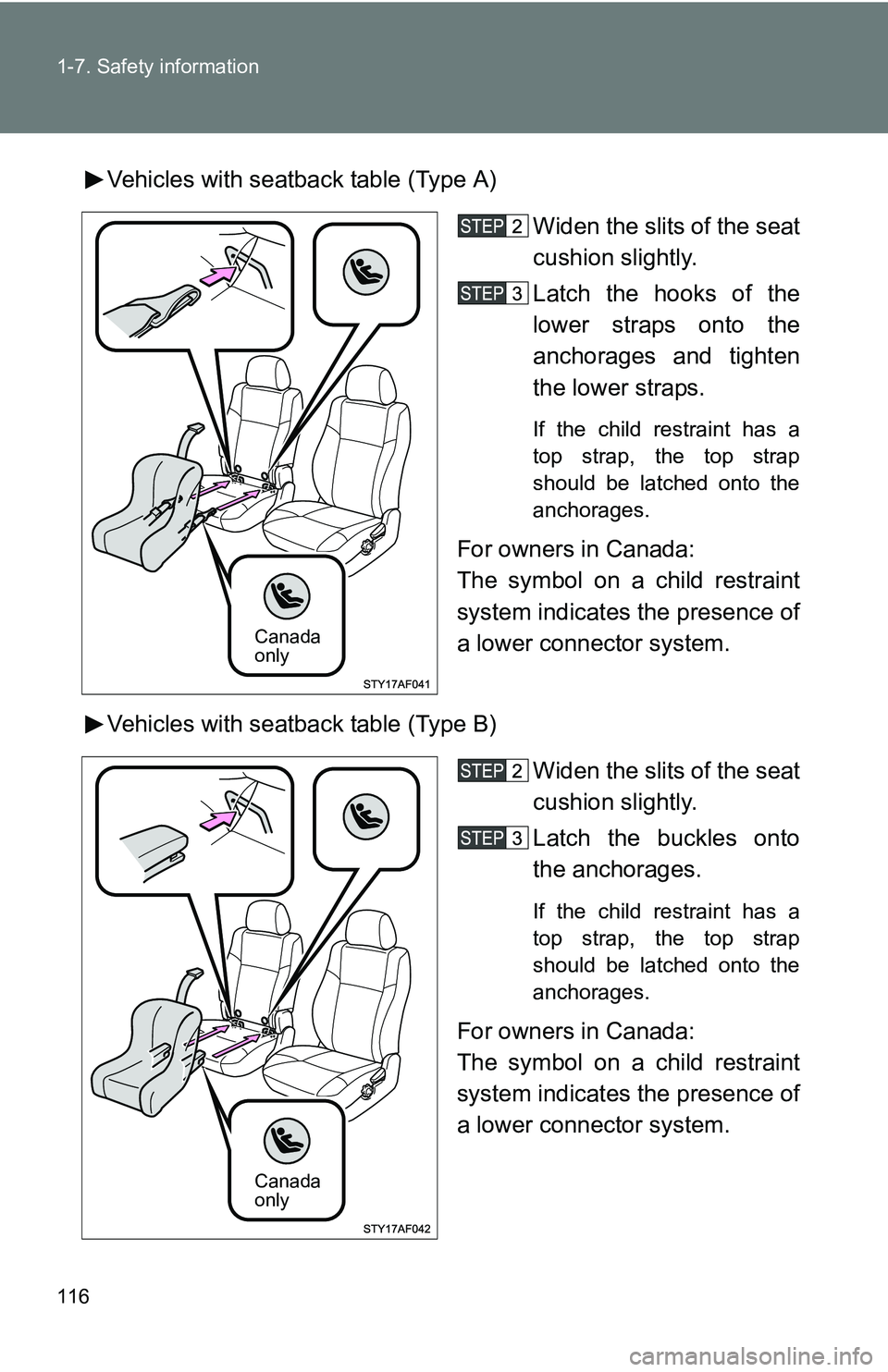
Vehicles with seatback table (Type A)Widen the slits of the seat
cushion slightly.
Latch the hooks of the
lower straps onto the
anchorages and tighten
the lower straps.
If the child restraint has a
top strap, the top strap
should be latched onto the
anchorages.
For owners in Canada:
The symbol on a child restraint
system indicates the presence of
a lower connector system.
Vehicles with seatback table (Type B) Widen the slits of the seat
cushion slightly.
Latch the buckles onto
the anchorages.
If the child restraint has a
top strap, the top strap
should be latched onto the
anchorages.
For owners in Canada:
The symbol on a child restraint
system indicates the presence of
a lower connector system.
Canada
only
Canada
only
Page 118 of 520
118 1-7. Safety information
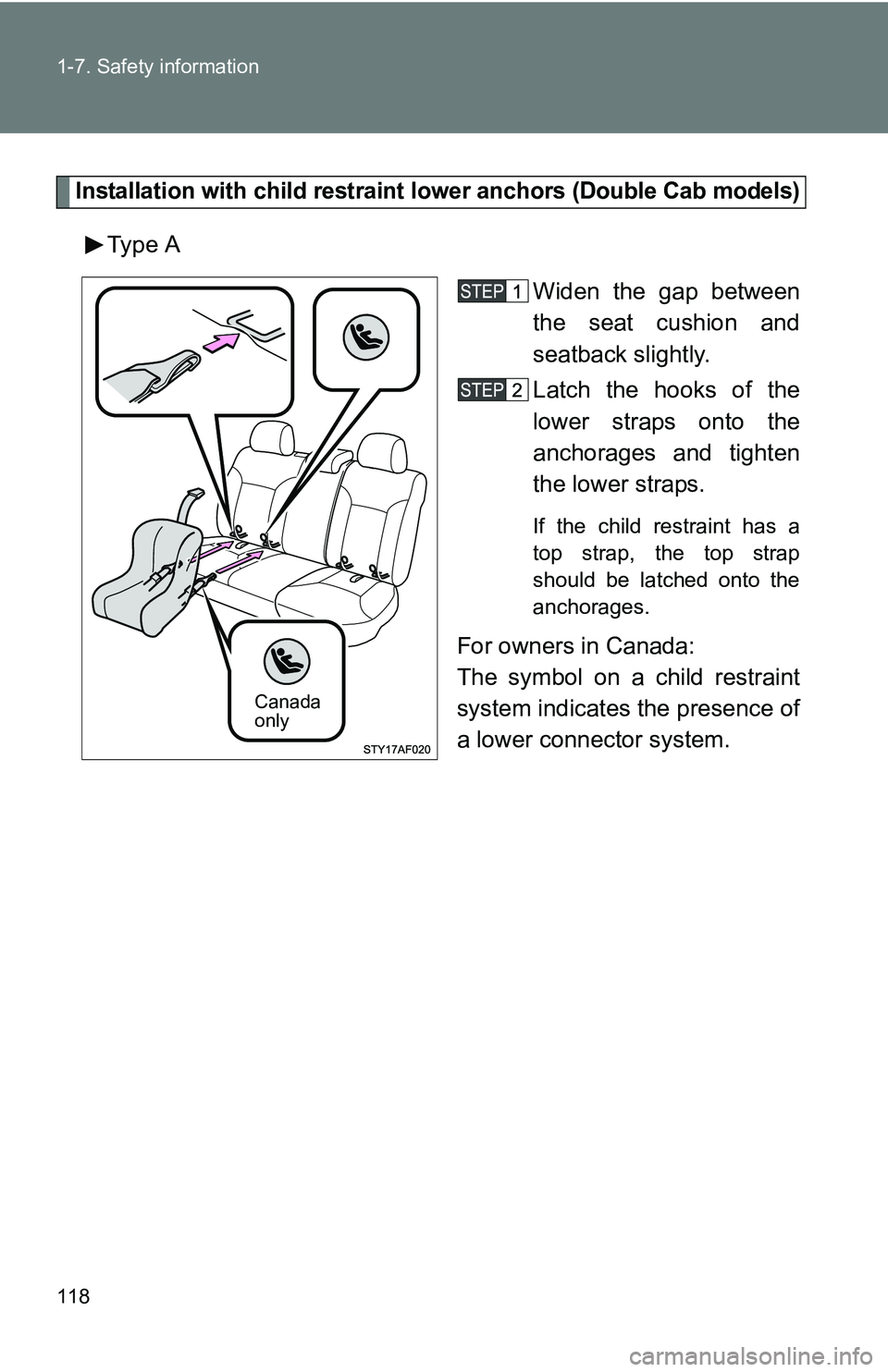
Installation with child restraint lower anchors (Double Cab models)
Type AWiden the gap between
the seat cushion and
seatback slightly.
Latch the hooks of the
lower straps onto the
anchorages and tighten
the lower straps.
If the child restraint has a
top strap, the top strap
should be latched onto the
anchorages.
For owners in Canada:
The symbol on a child restraint
system indicates the presence of
a lower connector system.
Canada
only
Page 119 of 520
119
1-7. Safety information
1
Before driving
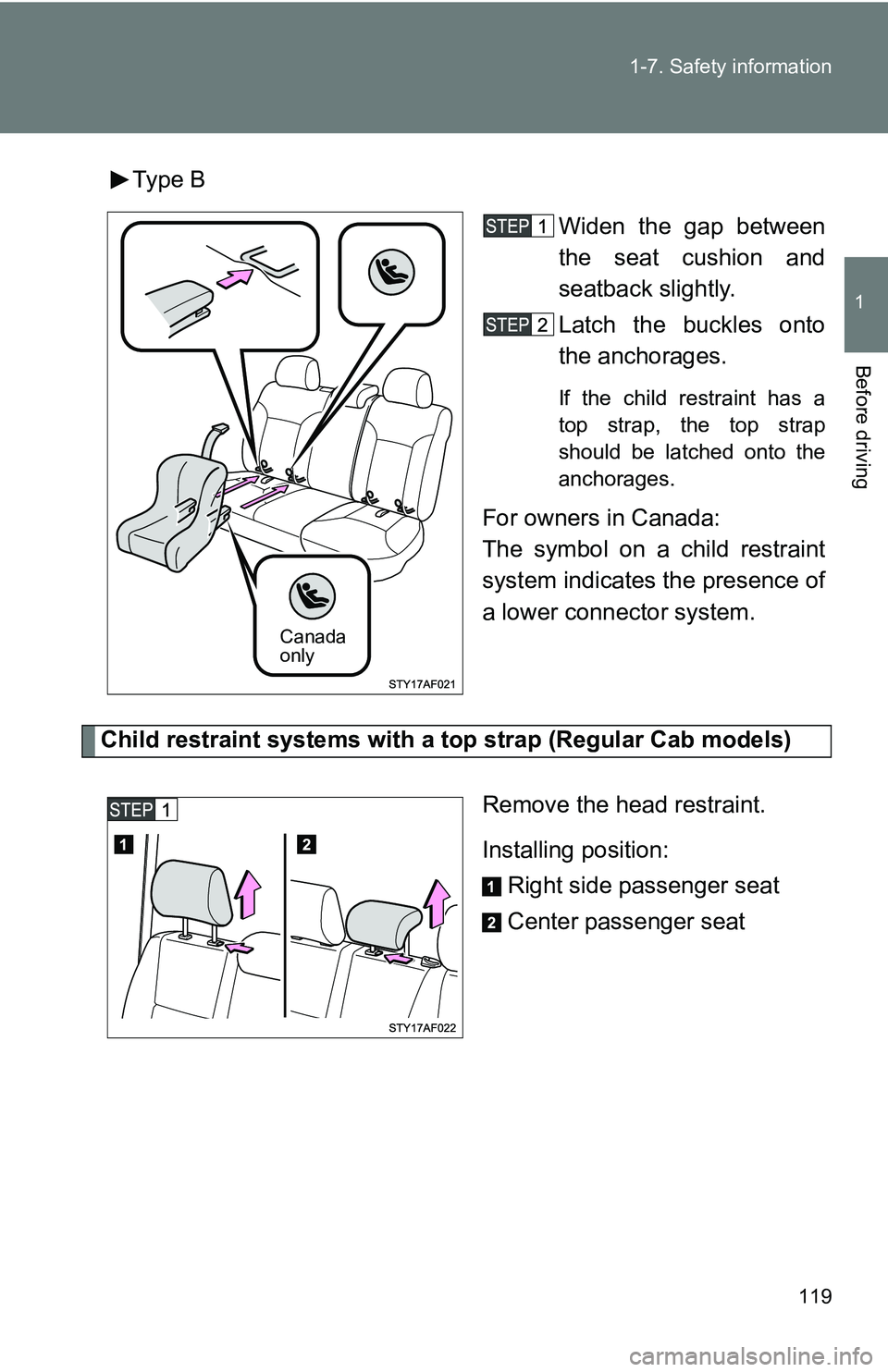
Type B
Widen the gap between
the seat cushion and
seatback slightly.
Latch the buckles onto
the anchorages.
If the child restraint has a
top strap, the top strap
should be latched onto the
anchorages.
For owners in Canada:
The symbol on a child restraint
system indicates the presence of
a lower connector system.
Child restraint systems with a top strap (Regular Cab models)
Remove the head restraint.
Installing position:Right side passenger seat
Center passenger seat
Canada
only
Page 120 of 520

120 1-7. Safety information
Swing the seatback forward
slightly (P. 46) and remove the
anchor bracket covers.
Installing position:
Right side passenger seat
Center passenger seat
Store the removed cover in a safe
place such as the glove box.
Right side passenger seat
Route the top strap through
the routing device as shown in
the illustration.
Make sure the top strap is not
twisted.
Latch the hook onto the
anchor bracket.
Return the seatback to its orig-
inal position.
Make sure the seatback is
securely locked by pushing for-
ward and rearward on the top of
the seatback.
Page 124 of 520
124 1-7. Safety information
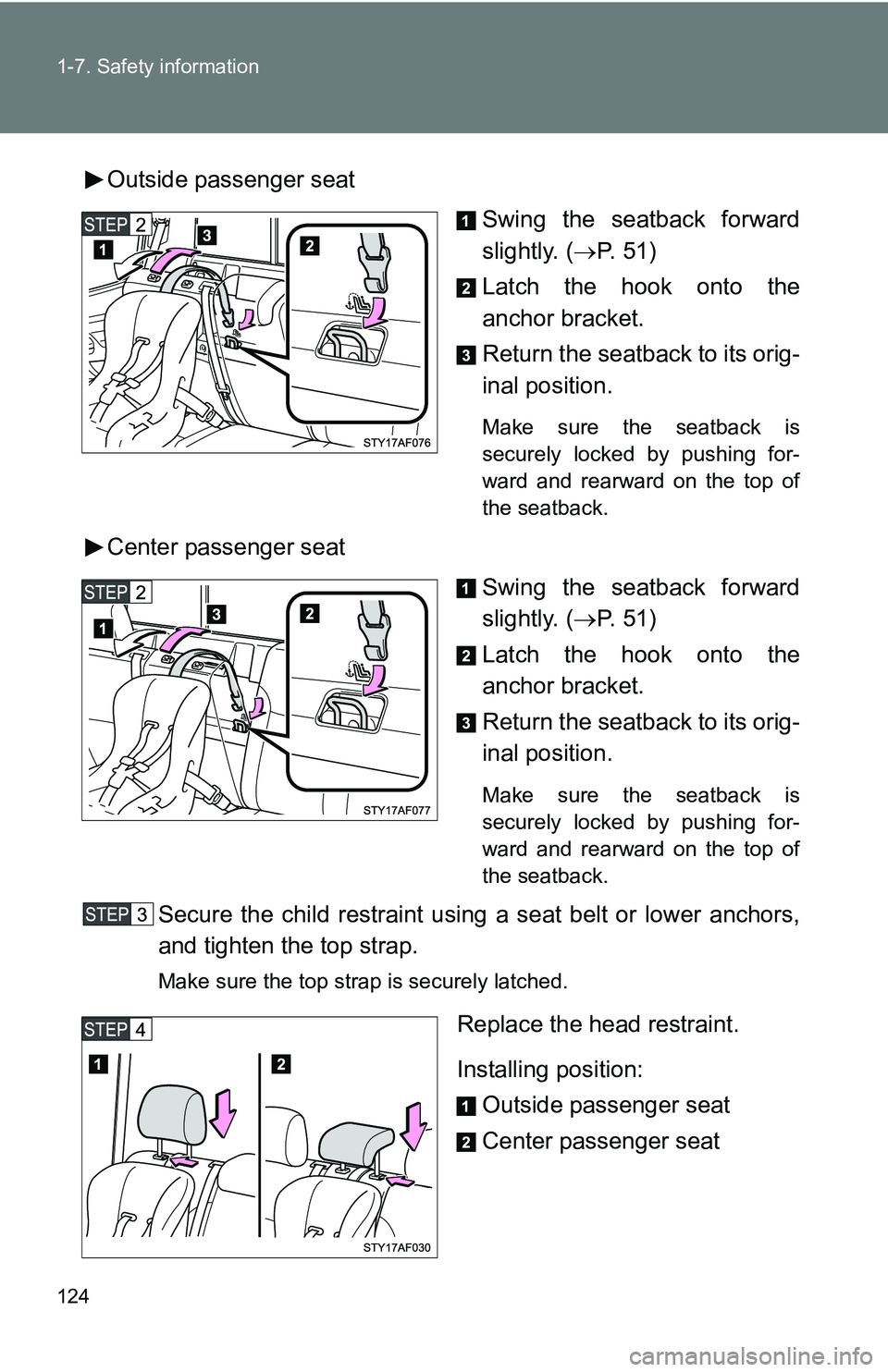
Outside passenger seatSwing the seatback forward
slightly. (P. 51)
Latch the hook onto the
anchor bracket.
Return the seatback to its orig-
inal position.
Make sure the seatback is
securely locked by pushing for-
ward and rearward on the top of
the seatback.
Center passenger seat
Swing the seatback forward
slightly. (P. 51)
Latch the hook onto the
anchor bracket.
Return the seatback to its orig-
inal position.
Make sure the seatback is
securely locked by pushing for-
ward and rearward on the top of
the seatback.
Secure the child restraint using a seat belt or lower anchors,
and tighten the top strap.
Make sure the top strap is securely latched.
Replace the head restraint.
Installing position: Outside passenger seat
Center passenger seat
Page 126 of 520
126 1-7. Safety information
CAUTION
■When installing a child restraint system
●When a booster seat is installed, always ensure that the shoulder belt is
positioned across the center of the child’s shoulder. The belt should be
kept away from the child’s neck, but not so that it could fall off the child’s
shoulder. Failing to do so may result in death or serious injury in the event
of an accident or sudden braking.
● Ensure that the belt and tab are securely locked and the seat belt is not
twisted.
● Push and pull the child restraint system in different directions to be sure it
is secure.
● Follow all installation instructions provided by the child restraint system
manufacturer.
● After securing the child restraint system, never slide or recline the seat.
■ Do not use a seat belt extender
If a seat belt extender is used when installing a child restraint system, the
seat belt will not securely hold the child restraint system, which could cause
death or serious injury to the child or other passengers in the event of a colli-
sion.
■ To correctly attach a child r estraint system to the anchorages
When using the lower anchorages, be sure that there are no foreign objects
around the anchorages and that the seat belt is not caught behind the child
restraint. Make sure the child restraint system is securely attached, or it may
cause death or serious injury to the child or other passengers in the event of
a sudden stop or accident.
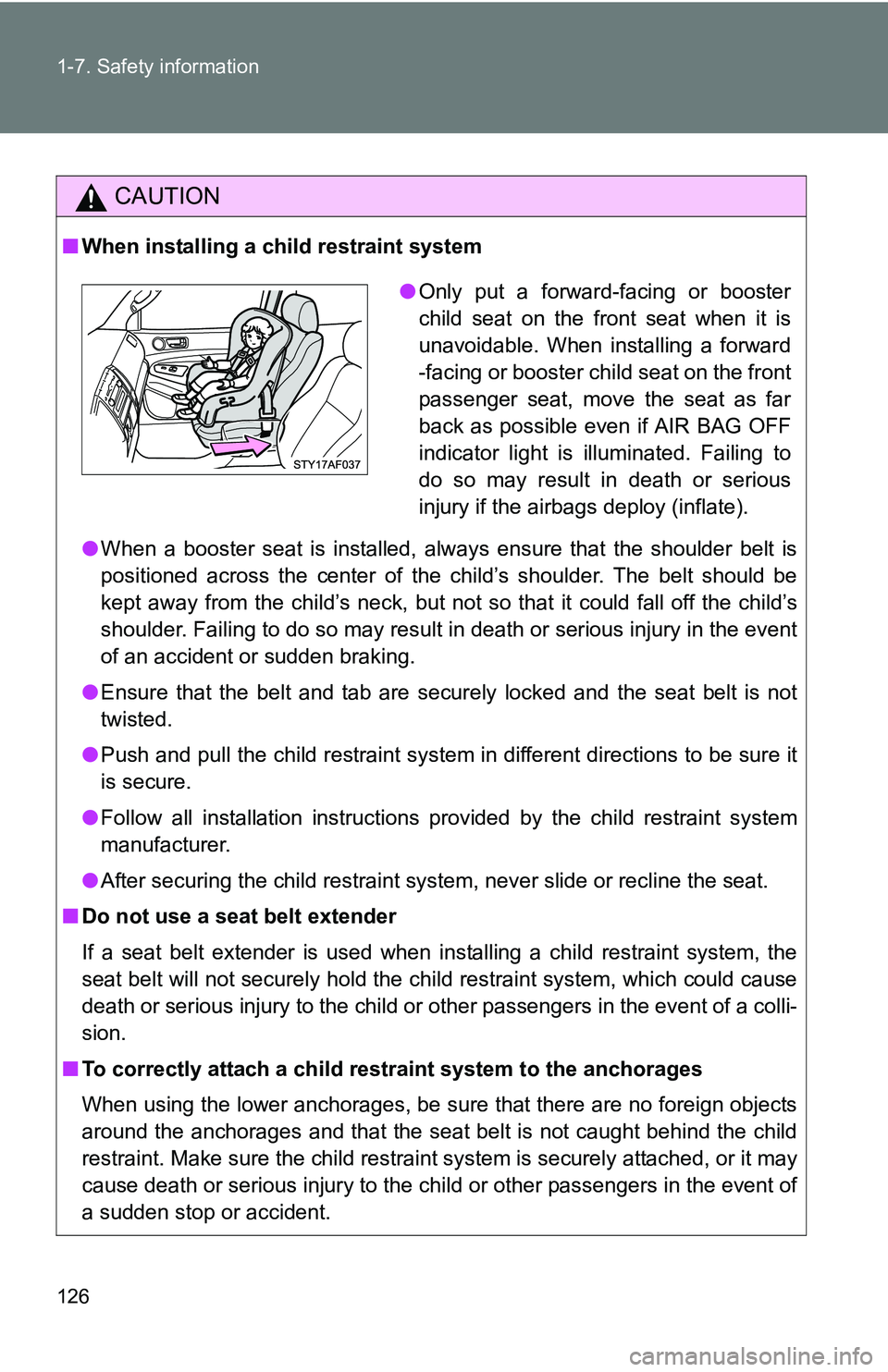
● Only put a forward-facing or booster
child seat on the front seat when it is
unavoidable. When installing a forward
-facing or booster child seat on the front
passenger seat, move the seat as far
back as possible even if AIR BAG OFF
indicator light is illuminated. Failing to
do so may result in death or serious
injury if the airbags deploy (inflate).
Page 127 of 520
When driving2
127
2-1. Driving procedures ........ 128Driving the vehicle............ 128
Engine (ignition) switch .... 138
Automatic
Transmission.... 141
Manual Transmission ....... 144
Turn signal lever .............. 147
Parking brake ................... 148
2-2. Gauges and meters........ 150 Gauges and meters ......... 150
Indicators and warning lights ............................. 153
Accessory meter .............. 156
2-3. Operating the lights and wipers ............................ 157
Headlight switch ............... 157
Fog light switch ................ 159
Windshield wipers and washer ........................... 160 2-4. Using other driving
systems ......................... 163
Cruise control ................... 163
Rear view monitor system (vehicles with auto
anti-glare inside rear
view mirror) .................... 166
Four-wheel drive system ........................... 170
Active traction control system .......................... 174
AUTO LSD system........... 176
Rear differential lock system ........................... 178
Downhill Assist Control system .......................... 181
Clutch start cancel switch ............................. 183
Driving assist systems ..... 184
2-5. Driving information ........ 190 Off-road precautions (4WD models and
PreRunner) .................... 190
Cargo and luggage .......... 195
Vehicle load limits ............ 199
Winter driving tips ............ 201
Trailer towing ................... 205
Dinghy towing .................. 218
Page 130 of 520
130 2-1. Driving procedures
Lightly depress the accelerator pedal at the same time as
gradually releasing the clutch pedal.
Release the parking brake.
■Driving in the rain
●Drive carefully when it is raining, because visibility will be reduced, the
windows may become fogged-up, and the road will be slippery.
● Drive carefully when it starts to rain, because the road surface will be
especially slippery.
● Refrain from high speeds when driving on an expressway in the rain,
because there may be a layer of water between the tires and the road
surface, preventing the steering and brakes from operating properly.
■ Breaking in your new Toyota
To extend the life of the vehicle, the following precautions are recommended
to observe:
●For the first 200 miles (300 km):
Avoid sudden stops.
● For the first 500 miles (800 km):
Do not tow a trailer.
● For the first 1000 miles (1600 km):
• Do not drive at extremely high speeds.
• Avoid sudden acceleration.
• Do not drive continuously in the low gears.
• Do not drive slowly with the manual transmission in a high gear.
• Do not drive at a constant speed for extended periods.
■ Operating your vehicle in a foreign country
Comply with the relevant vehicle registration laws and confirm the availability
of the correct fuel. ( P. 467)
■ Normal characteristics afte r turning off the engine
Approximately five hours after the engine is turned off, you may hear sound
coming from under the vehicle for several minutes. This is the sound of a
fuel evaporation leakage check and, it does not indicate a malfunction.
Page 131 of 520
131
2-1. Driving procedures
2
When driving
CAUTION
■
When starting the vehicle
Vehicles with an automatic transmission, always keep your foot on the brake
pedal while stopped with the engine running. This prevents the vehicle from
creeping.
■ When driving the vehicle
●Do not drive if you are unfamiliar with the location of the brake and accel-
erator pedals to avoid depressing the wrong pedal.
• Accidentally depressing the accelerator pedal instead of the brake
pedal will result in sudden acceleration that may lead to an accident
that could result in death or serious injury.
• When backing up, you may twist your body around, leading to a diffi- culty in operating the pedals. Make sure to operate the pedals properly.
• Make sure to keep a correct driving posture even when moving the vehicle only slightly, allowing you to depress the brake and accelerator
pedals properly.
• Depress the brake pedal using your right foot. Depressing the brake pedal using your left foot may delay response in an emergency, result-
ing in an accident.
● Do not drive the vehicle over or st op the vehicle near flammable materials.
The exhaust system and exhaust gases can be extremely hot. This may
cause a fire if there is any flammable material nearby.
● Vehicles with an automatic transmission, do not let the vehicle roll back-
wards while the shift lever is in a driving position, or roll forward while the
shift lever is in R.
Doing so may cause the engine to stall or lead to poor brake and steering
performance, resulting in an accident or damage to the vehicle.
● If the smell of exhaust is noticed inside the vehicle, open the windows and
check that the back window is closed. Large amounts of exhaust in the
vehicle can cause driver drowsiness and an accident, resulting in death or
a serious health hazard. Have the vehicle inspected by your Toyota dealer
immediately.
● Do not under any circumstances shift the shift lever to P, R or N (automatic
transmission) or R (manual transmission) while the vehicle is moving.
Doing so can cause significant damage to the transmission system and
may result in a loss of vehicle control.
Page 133 of 520
133
2-1. Driving procedures
2
When driving
CAUTION
■
When driving on slippery road surfaces
●After driving through a puddle, lightly depress the brake pedal to make
sure that the brakes are functioning properly. Wet brake pads may prevent
the brakes from functioning properly. If the brakes on only one side are wet
and not functioning properly, steering control may be affected, resulting in
an accident.
■ When shifting the shift lever
●Vehicles with an automatic transmission, be careful not to shift the shift
lever with the accelerator pedal depressed.
This may lead to unexpected rapid acceleration of the vehicle that may
cause an accident and result in death or serious injury.
■ When the vehicle is stopped
●Do not race the engine.
If the vehicle is in any gear other than P (automatic transmission only) or
N, the vehicle may accelerate suddenly and unexpectedly, and may cause
an accident.
● Do not leave the vehicle with the engine running for a long time.
If such a situation cannot be avoided, park the vehicle in an open space
and check that exhaust fumes do not enter the vehicle interior.
● Vehicles with an automatic transmission, always keep a foot on the brake
pedal while the engine is running to prevent an accident caused by the
vehicle moving.
■ When the vehicle is parked
●Do not leave glasses, cigarette lighters, spray cans, or soft drink cans in
the vehicle when it is in the sun.
Doing so may result in the following.
• Gas may leak from a cigarette lighter or spray can, and may lead to a
fire.
• The temperature inside the vehicle may cause the plastic lenses and plastic material of eye glasses to deform or crack.
• Soft drink cans may fracture, causing the contents to spray over the interior of the vehicle, and may also cause a short circuit in the vehi-
cle’s electrical components.