diff TOYOTA TACOMA 2017 (in English) Manual PDF
[x] Cancel search | Manufacturer: TOYOTA, Model Year: 2017, Model line: TACOMA, Model: TOYOTA TACOMA 2017Pages: 640, PDF Size: 11.07 MB
Page 516 of 640
5168-2. Steps to take in an emergency
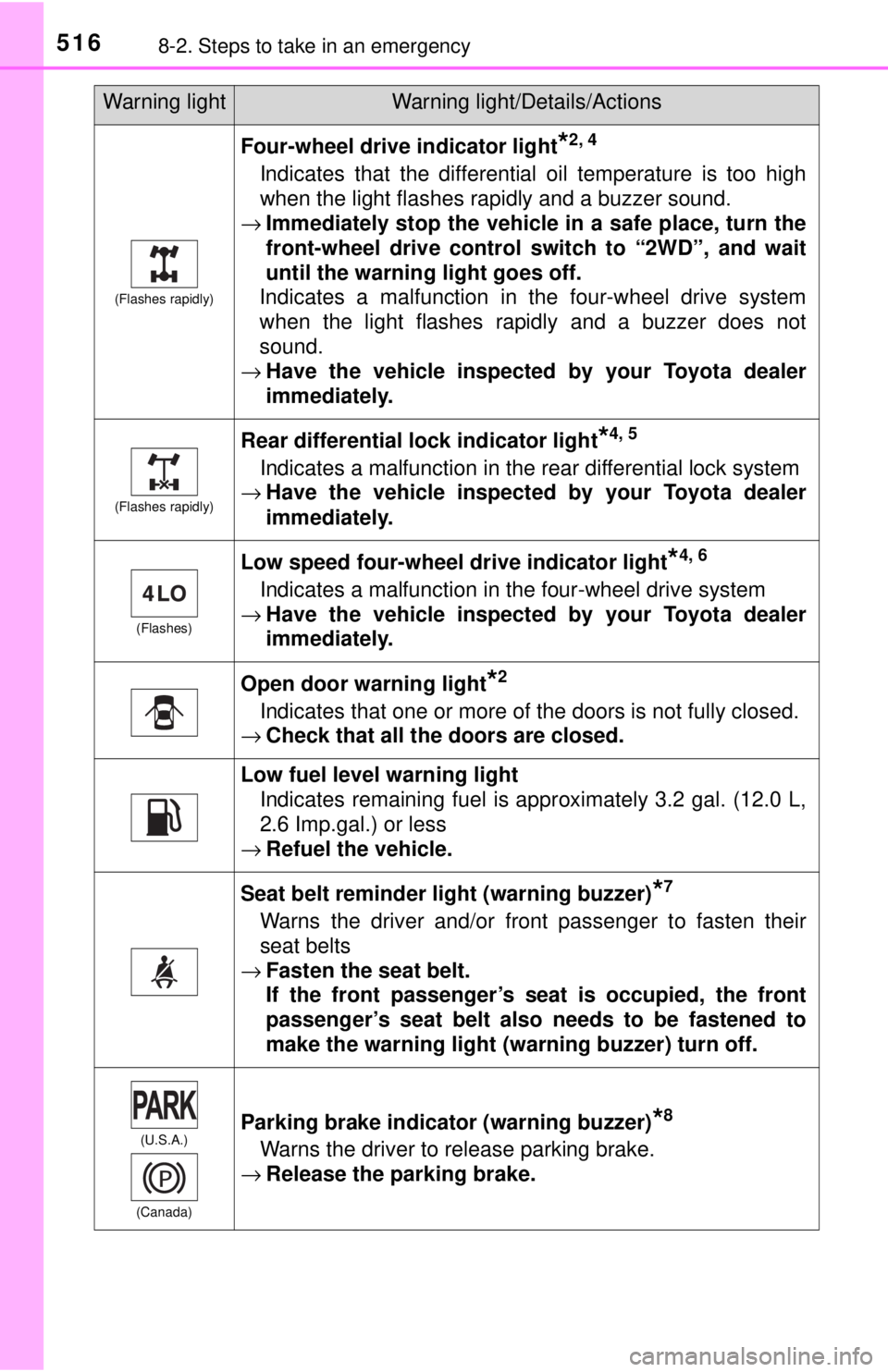
(Flashes rapidly)
Four-wheel drive indicator light*2, 4
Indicates that the differential oil temperature is too high
when the light flashes rapidly and a buzzer sound.
→ Immediately stop the vehicle in a safe place, turn the
front-wheel drive control sw itch to “2WD”, and wait
until the warning light goes off.
Indicates a malfunction in the four-wheel drive system
when the light flashes rapidly and a buzzer does not
sound.
→ Have the vehicle inspected by your Toyota dealer
immediately.
(Flashes rapidly)
Rear differential lock indicator light*4, 5
Indicates a malfunction in the rear differential lock system
→ Have the vehicle inspected by your Toyota dealer
immediately.
(Flashes)
Low speed four-wheel drive indicator light*4, 6
Indicates a malfunction in the four-wheel drive system
→ Have the vehicle inspected by your Toyota dealer
immediately.
Open door warning light*2
Indicates that one or more of the doors is not fully closed.
→ Check that all the doors are closed.
Low fuel level warning light
Indicates remaining fuel is approximately 3.2 gal. (12.0 L,
2.6 Imp.gal.) or less
→ Refuel the vehicle.
Seat belt reminder light (warning buzzer)*7
Warns the driver and/or front passenger to fasten their
seat belts
→ Fasten the seat belt.
If the front passenger’s seat is occupied, the front
passenger’s seat belt also needs to be fastened to
make the warning light (war ning buzzer) turn off.
(U.S.A.)
(Canada)Parking brake indicator (warning buzzer)*8
Warns the driver to release parking brake.
→ Release the parking brake.
Warning lightWarning light/Details/Actions
Page 519 of 640
5198-2. Steps to take in an emergency
8
When trouble arises
*7: Driver’s seat belt buzzer:The driver’s seat belt buzzer sounds to alert the driver that his or her seat
belt is not fastened. Once the engine switch is turned to the “ON” position
(vehicles without a smart key system) or IGNITION ON mode (vehicles
with a smart key system), the buzzer sounds for 6 seconds. If the vehicle
reaches a speed of 12 mph (20 km/h), the buzzer sounds once. If the seat
belt is still unfastened after 24 seconds, the buzzer will sound intermittently
for 10 seconds. Then, if the seat belt is still unfastened, the buzzer will
sound in a different tone for 20 more seconds.
Front passenger’s seat belt buzzer:
The front passenger’s seat belt buzzer sounds to alert the front passenger
that his or her seat belt is not fastened. The buzzer sounds once if the
vehicle reaches a speed of 12 mph (20 km/h). If the seat belt is sill unfas-
tened after 24 seconds, the buzzer will sound intermittently for 10 seconds.
Then, if the seat belt is still unfastened, the buzzer will sound in a different
tone for 20 more seconds.
*8: Parking brake engaged warning buzzer:
A buzzer will sound if the vehicle is driven at a speed of approximately
3 mph (5 km/h) or more.
*9: 2GR-FKS engine only
*10: Refer to the separate “Scheduled Maintenance Guide” or “Owner’s ManualSupplement” for the maintenance interval applicable to your vehicle.
■ SRS warning light
This warning light system monitors the airbag sensor assembly, front impact
sensors, side impact sensors (front), side impact sensors (rear), driver’s seat
position sensor, driver’s seat belt buckle switch, front passenger occupant
classification system (ECU and sensors), “AIR BAG ON” indicator light, “AIR
BAG OFF” indicator light, front passenger’s seat belt buckle switch, seat belt
pretensioners assemblies, airbags, interconnecting wiring and power
sources. ( →P. 36)
■ Front passenger detection sensor, seat belt reminder and warning
buzzer
● If luggage is placed on the front passenger seat, the front passenger de\
tec-
tion sensor may cause the warning light to flash and the warning buzzer to
sound even if a passenger is not sitting in the seat.
● If a cushion is placed on the seat, the sensor may not detect a passenger,
and the warning light may not operate properly.
Page 522 of 640
5228-2. Steps to take in an emergency
WARNING
Please note that the TPMS (tire pressure warning system) is not a sub-
stitute for proper tire maintenance, and it is the driver’s responsibility to
maintain correct tire pressure, even if under-inflation has not reached
the level to trigger illumination of the TPMS low tire pressure telltale (tire
pressure warning light).
Your vehicle has also been equipped with a TPMS (tire pressure warn-
ing system) malfunction indicator to indicate when the system is not
operating properly. The TPMS (tire pressure warning system) malfunc-
tion indicator is combined with the lo w tire pressure telltale (tire pressure
warning light). When the system detects a malfunction, the telltale will
flash for approximately one minute and then remain continuously illumi-
nated. This sequence w ill continue upon subsequ ent vehicle start-ups
as long as the malfunction exists. When the malfunction indicator is illu-
minated, the system may not be able to detect or signal low tire pres-
sure as intended.
TPMS (tire pressure warning system) malfunctions may occur for a vari-
ety of reasons, including the installation of replacement or alternate tires
or wheels on the vehicle that prevent the TPMS (tire pressure warning
system) from functioning properly. Always check the TPMS (tire pres-
sure warning system) malfunction te lltale after replacing one or more
tires or wheels on your vehicle to ensure that the replacement or alter-
nate tires and wheels allow the TPMS (tire pressure warning system) to
continue to function properly.
NOTICE
■To ensure the tire pressure warning system operates properly (if
equipped)
Do not install tires with different sp ecifications or makers, as the tire
pressure warning system may not operate properly.
Page 528 of 640
5288-2. Steps to take in an emergency
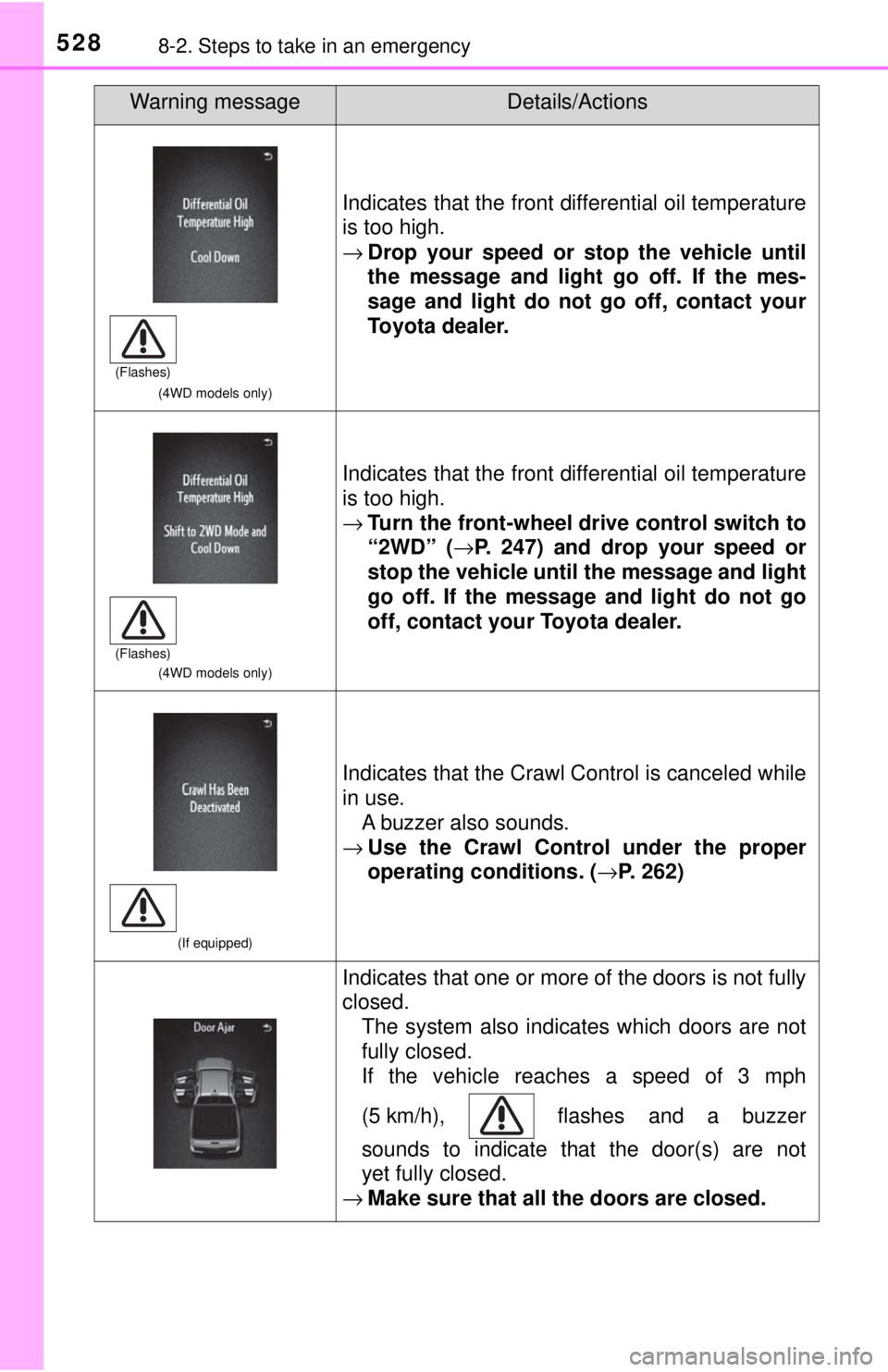
(4WD models only)
Indicates that the front differential oil temperature
is too high.
→Drop your speed or stop the vehicle until
the message and light go off. If the mes-
sage and light do not go off, contact your
Toyota dealer.
(4WD models only)
Indicates that the front differential oil temperature
is too high.
→ Turn the front-wheel dr ive control switch to
“2WD” ( →P. 247) and drop your speed or
stop the vehicle until the message and light
go off. If the message and light do not go
off, contact your Toyota dealer.
(If equipped)
Indicates that the Crawl Control is canceled while
in use. A buzzer also sounds.
→ Use the Crawl Control under the proper
operating conditions. ( →P. 262)
Indicates that one or more of the doors is not fully
closed.
The system also indicates which doors are not
fully closed.
If the vehicle reaches a speed of 3 mph
(5 km/h), flashes and a buzzer
sounds to indicate that the door(s) are not
yet fully closed.
→ Make sure that all the doors are closed.
Warning messageDetails/Actions
(Flashes)
(Flashes)
Page 565 of 640
565
8
When trouble arises
8-2. Steps to take in an emergency
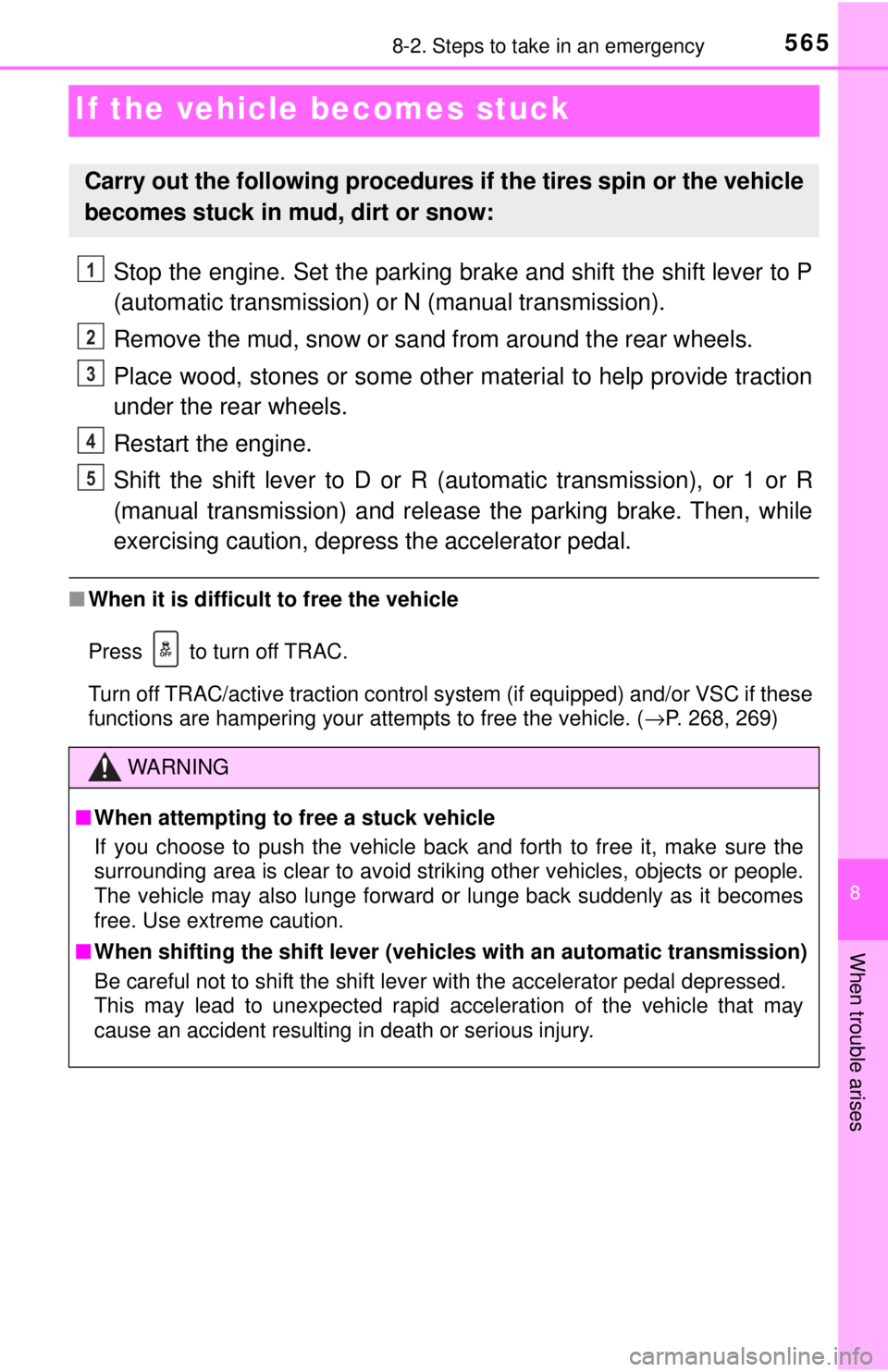
If the vehicle becomes stuck
Stop the engine. Set the parking brake and shift the shift lever to P
(automatic transmission) or N (manual transmission).
Remove the mud, snow or sand from around the rear wheels.
Place wood, stones or some other material to help provide traction
under the rear wheels.
Restart the engine.
Shift the shift lever to D or R (automatic transmission), or 1 or R
(manual transmission) and releas e the parking brake. Then, while
exercising caution, depre ss the accelerator pedal.
■When it is difficult to free the vehicle
Press to turn off TRAC.
Turn off TRAC/active traction control system (if equipped) and/or VSC if these
functions are hampering your attempts to free the vehicle. ( →P. 268, 269)
Carry out the following procedures if the tires spin or the vehicle
becomes stuck in mud, dirt or snow:
WARNING
■When attempting to free a stuck vehicle
If you choose to push the vehicle back and forth to free it, make sure the
surrounding area is clear to avoid striking other vehicles, objects or people.
The vehicle may also lunge forward or lunge back suddenly as it becomes
free. Use extreme caution.
■ When shifting the shift lever (vehic les with an automatic transmission)
Be careful not to shift the shift lever with the accelerator pedal depressed.
This may lead to unexpected rapid acceleration of the vehicle that may
cause an accident resulting in death or serious injury.
1
2
3
4
5
Page 576 of 640
5769-1. Specifications
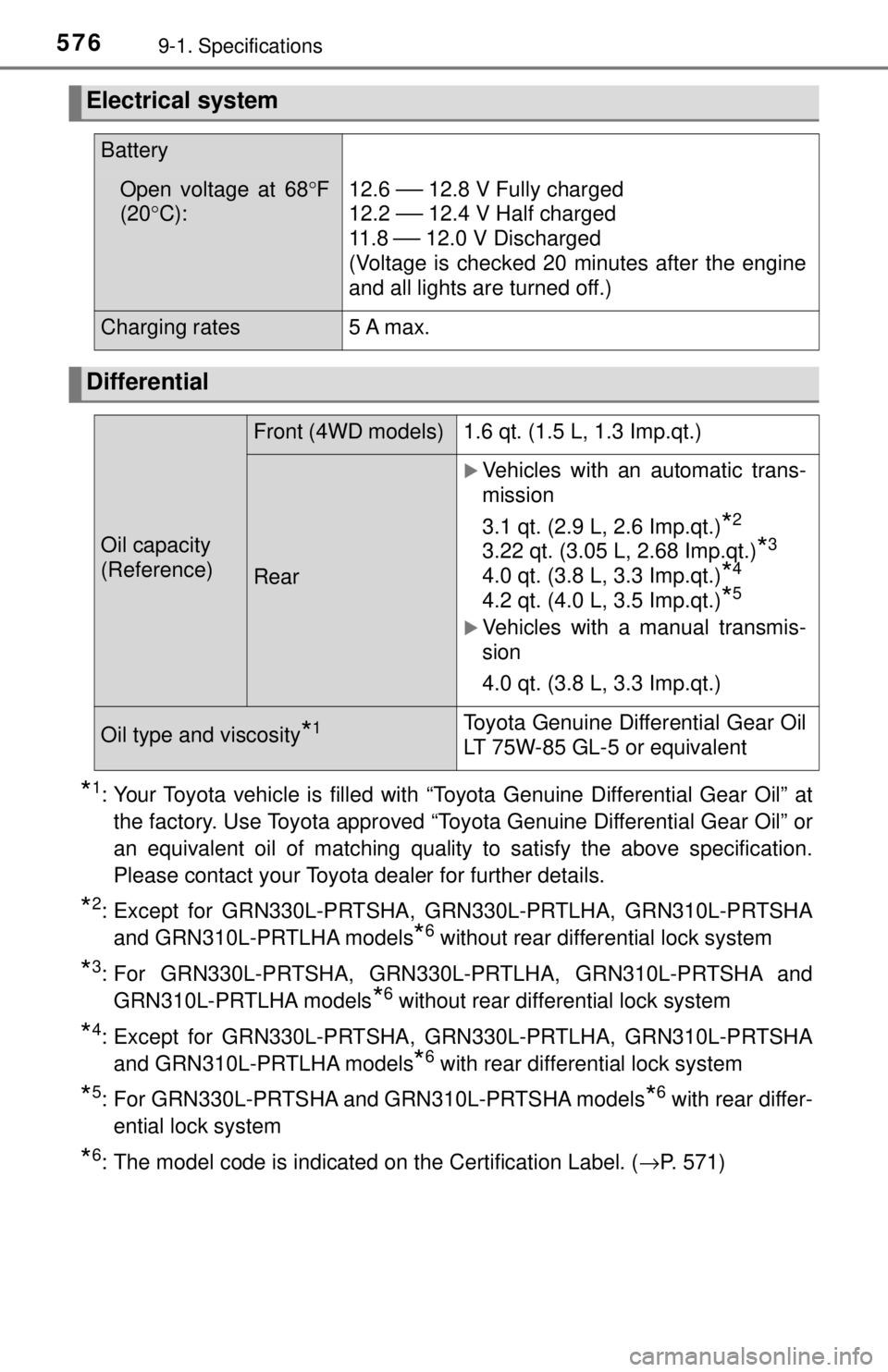
*1: Your Toyota vehicle is filled with “Toyota Genuine Differential Gear Oil” atthe factory. Use Toyota approved “Toyota Genuine Differential Gear Oil” or
an equivalent oil of matching quality to satisfy the above specification.
Please contact your Toyota dealer for further details.
*2: Except for GRN330L-PRTSHA, GRN330L-PRTLHA, GRN310L-PRTSHA
and GRN310L-PRTLHA models
*6 without rear differential lock system
*3: For GRN330L-PRTSHA, GRN330L -PRTLHA, GRN310L-PRTSHA and
GRN310L-PRTLHA models
*6 without rear differential lock system
*4: Except for GRN330L-PRTSHA, GRN330L-PRTLHA, GRN310L-PRTSHA
and GRN310L-PRTLHA models
*6 with rear differential lock system
*5: For GRN330L-PRTSHA and GRN310L-PRTSHA models*6 with rear differ-
ential lock system
*6: The model code is indicated on the Certification Label. ( →P. 571)
Electrical system
Battery
Open voltage at 68°F
(20° C):12.6 ⎯ 12.8 V Fully charged
12.2
⎯ 12.4 V Half charged
11 . 8
⎯ 12.0 V Discharged
(Voltage is checked 20 minutes after the engine
and all lights are turned off.)
Charging rates5 A max.
Differential
Oil capacity
(Reference)
Front (4WD models) 1.6 qt. (1.5 L, 1.3 Imp.qt.)
Rear
Vehicles with an automatic trans-
mission
3.1 qt. (2.9 L, 2.6 Imp.qt.)
*2
3.22 qt. (3.05 L, 2.68 Imp.qt.)*3
4.0 qt. (3.8 L, 3.3 Imp.qt.)*4
4.2 qt. (4.0 L, 3.5 Imp.qt.)*5
Vehicles with a manual transmis-
sion
4.0 qt. (3.8 L, 3.3 Imp.qt.)
Oil type and viscosity*1Toyota Genuine Differential Gear Oil
LT 75W-85 GL-5 or equivalent
Page 583 of 640
5839-1. Specifications
9
Vehicle specifications
NOTICE
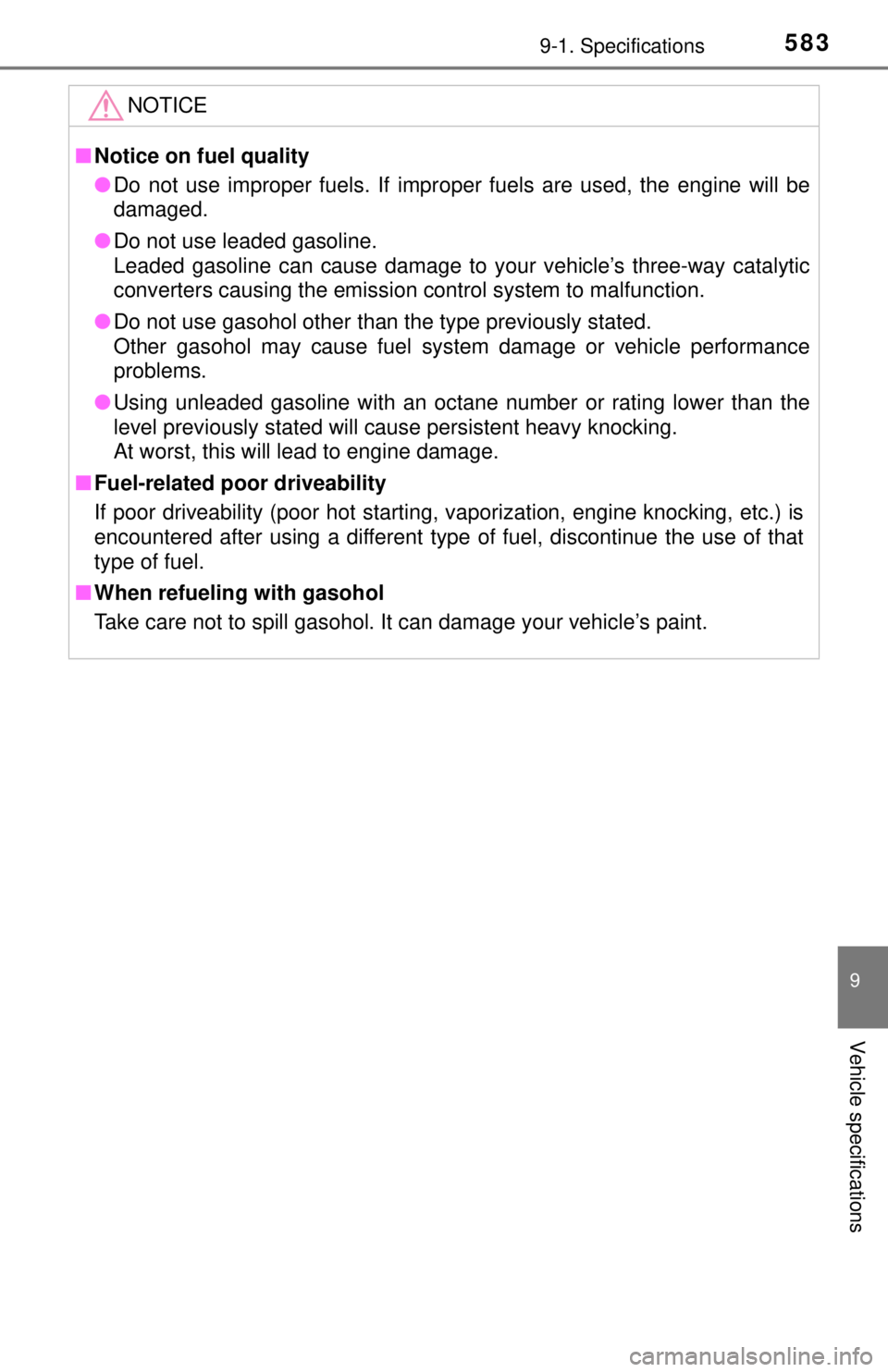
■Notice on fuel quality
● Do not use improper fuels. If improper fuels are used, the engine will be
damaged.
● Do not use leaded gasoline.
Leaded gasoline can cause damage to your vehicle’s three-way catalytic
converters causing the emission control system to malfunction.
● Do not use gasohol other than the type previously stated.
Other gasohol may cause fuel system damage or vehicle performance
problems.
● Using unleaded gasoline with an octane number or rating lower than the
level previously stated will cause persistent heavy knocking.
At worst, this will lead to engine damage.
■ Fuel-related poor driveability
If poor driveability (poor hot starting, vaporization, engine knocking, etc.) is
encountered after using a different type of fuel, discontinue the use of that
type of fuel.
■ When refueling with gasohol
Take care not to spill gasohol. It can damage your vehicle’s paint.
Page 588 of 640
5889-1. Specifications
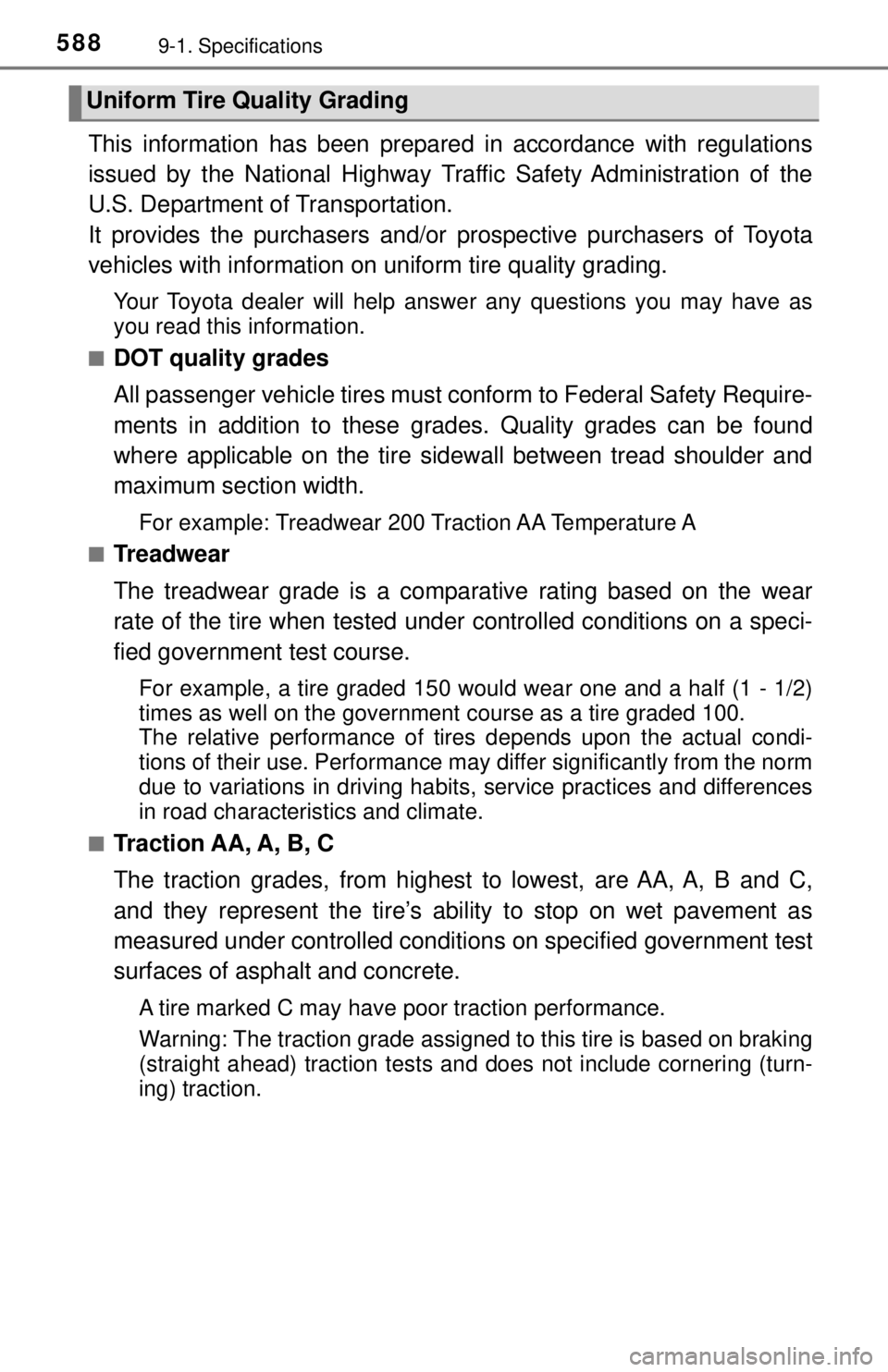
This information has been prepared in accordance with regulations
issued by the National Highway Traffic Safety Administration of the
U.S. Department of Transportation.
It provides the purchasers and/or prospective purchasers of Toyota
vehicles with information on uniform tire quality grading.
Your Toyota dealer will help answe r any questions you may have as
you read this information.
■DOT quality grades
All passenger vehicle tires must c onform to Federal Safety Require-
ments in addition to these grades. Quality grades can be found
where applicable on the tire sidewall between tread shoulder and
maximum section width.
For example: Treadwear 200 Traction AA Temperature A
■Treadwear
The treadwear grade is a comparative rating based on the wear
rate of the tire when tested under controlled conditions on a speci-
fied government test course.
For example, a tire graded 150 wo uld wear one and a half (1 - 1/2)
times as well on the government course as a tire graded 100.
The relative performance of tire s depends upon the actual condi-
tions of their use. Performance may differ significantly from the norm
due to variations in driving habits, service practices and differences
in road characteristics and climate.
■Traction AA, A, B, C
The traction grades, from highest to lowest, are AA, A, B and C,
and they represent the tire’s ability to stop on wet pavement as
measured under controlled conditio ns on specified government test
surfaces of asphalt and concrete.
A tire marked C may have poor traction performance.
Warning: The traction grade assigned to this tire is based on braking
(straight ahead) traction tests and does not include cornering (turn-
ing) traction.
Uniform Tire Quality Grading
Page 610 of 640
610
ATTENTION
■Précautions avec les coussins gonflables SRS
Respectez les précautions suivantes concernant les coussins gonflables
SRS.
À défaut, des blessures graves, voire mortelles, pourraient s’ensuivre.
● Le conducteur et tous les passagers à bord du véhicule doivent porter leur
ceinture de sécurité correctement.
Les coussins gonflables SRS sont des dispositifs de protection
complémentaires aux ceintures de sécurité.
● Le coussin gonflable SRS conducteur se déploie avec une puissance
considérable et peut occasionner des blessures graves, voire mortelles,
notamment lorsque le conducteur se trouve très près du coussin
gonflable. Conseils de la National Highway Traffic Safety Administration
(NHTSA):
Sachant que la zone de danger pour le coussin gonflable conducteur se
trouve dans les premiers 2 à 3 in. (50 à 75 mm) du déploiement, placez-
vous à 10 in. (250 mm) du coussin gonflable conducteur pour garantir
une marge de sécurité suffisante. Cette distance est à mesurer entre le
moyeu du volant de direction et le sternum. Si vous êtes assis à moins de
10 in. (250 mm), vous pouvez changer votre position de conduite de
plusieurs façons:
• Reculez votre siège le plus possible, tout en continuant à pouvoir
atteindre confortablement les pédales.
• Inclinez légèrement le dossier du siège.
Bien que les véhicules puissent être différents les uns des autres, la
plupart des conducteurs peuvent s’asseoir à une distance de 10 in.
(250 mm), même avec le siège conducteur complètement avancé,
simplement en inclinant un peu le dossier de siège. Si vous avez des
difficultés à voir la route après avoir incliné votre siège, utilisez un
coussin ferme et antidérapant pour vous rehausser ou, si votre véhicule
est équipé du réglage en hauteur du siège, remontez-le.
• Si votre volant de direction est réglable, inclinez-le vers le bas. Cela vous permet d’orienter le coussin gonflable vers votre buste plutôt que
vers la tête et le cou.
Le siège doit être réglé selon les recommandations de la NHTSA ci-
dessus, tout en conservant le contrôle des pédales et du volant, et la vue
des commandes au tableau de bord.
Page 613 of 640
613
10
For owners
ATTENTION
■Précautions avec les coussins gonflables SRS
● Ne suspendez aux crochets à vêtements aucun cintre nu ni aucun objet
dur. En cas de déploiement des coussins gonflables SRS rideau, tous ces
objets pourraient se transformer en projectiles et causer des blessures
graves, voire mortelles.
● Si une housse en vinyle recouvre la partie où le coussins gonflable SRS
de genoux se déploie, veillez à l’enlever.
● N’utilisez aucun accessoire de siège venant recouvrir les zones de
déploiement des coussins gonflables SRS latéraux, car il risquerait d’en
gêner le déploiement. De tels accessoires peuvent empêcher les coussins
gonflables latéraux de fonctionner correctement, désactiver le dispositif ou
entraîner le déploiement accidentel des coussins latéraux, entraînant la
mort ou des blessures graves.
● Évitez de faire subir des chocs ou des pressions excessives aux zones
renfermant les composants des coussins gonflables SRS.
En effet, cela pourrait entraîner un mauvais fonctionnement des coussins
gonflables SRS.
● Ne touchez à aucun composant des coussins gonflables SRS
immédiatement après leur déploiement (gonflage), car ils pourraient être
chauds.
● Si vous avez des difficultés à respirer après le déploiement des coussins
gonflables SRS, ouvrez une porte ou une vitre pour faire entrer de l’air
frais, ou bien descendez du véhicule si cela ne présente pas de danger.
Retirez tout résidu dès que possible afin d’éviter d’éventuelles irritations
de la peau.
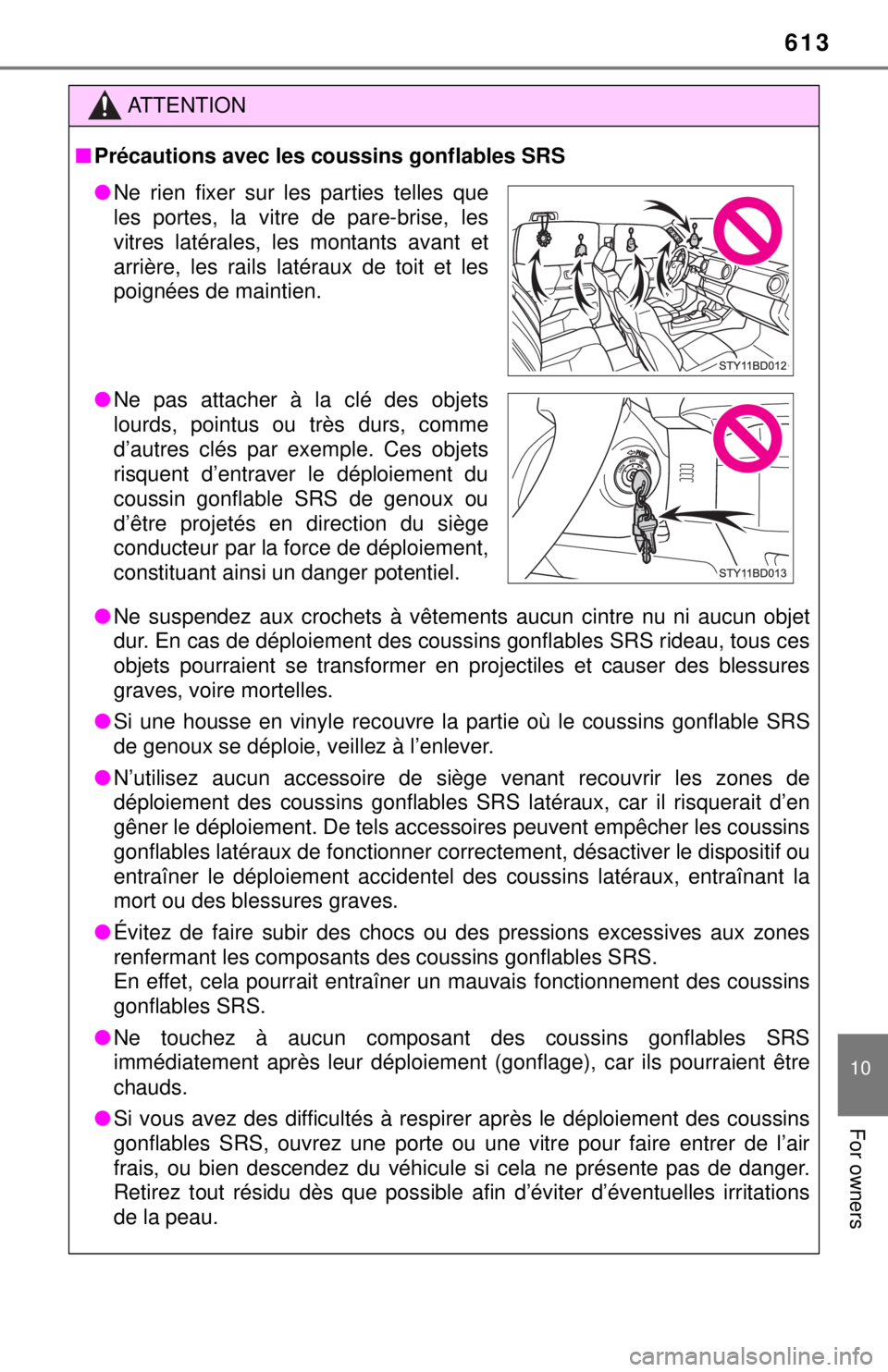
●Ne rien fixer sur les parties telles que
les portes, la vitre de pare-brise, les
vitres latérales, les montants avant et
arrière, les rails latéraux de toit et les
poignées de maintien.
● Ne pas attacher à la clé des objets
lourds, pointus ou très durs, comme
d’autres clés par exemple. Ces objets
risquent d’entraver le déploiement du
coussin gonflable SRS de genoux ou
d’être projetés en direction du siège
conducteur par la force de déploiement,
constituant ainsi un danger potentiel.