trailer TOYOTA TUNDRA 2020 (in English) User Guide
[x] Cancel search | Manufacturer: TOYOTA, Model Year: 2020, Model line: TUNDRA, Model: TOYOTA TUNDRA 2020Pages: 608, PDF Size: 13.19 MB
Page 192 of 608
1924-1. Before driving
Cargo and luggage
Cargo capacity depends on the total weight of the occupants.
(Cargo capacity) = (Total load capacity) (Total weight of occupants)
Steps for Determining Correct Load Limit —
(1) Locate the statement “The co mbined weight of occupants and
cargo should never exceed XXX kg or XXX lbs.” on your vehicle’s
placard.
(2) Determine the combined weight of the driver and passengers t hat
will be riding in your vehicle.
(3) Subtract the combined weight of the driver and passengers fr om
XXX kg or XXX lbs.
(4) The resulting figure equals the available amount of cargo an d lug-
gage load capacity.
For example, if the “XXX” amount equals 1400 lbs. and there wil l be
five 150 lb passengers in your vehicle, the amount of available
cargo and luggage load capacity is 650 lbs. (1400 750 (5150) =
650 lbs.)
(5) Determine the combined weight of luggage and cargo being loa ded
on the vehicle. That weight may n ot safely exceed the available
cargo and luggage load capac ity calculated in Step 4.
(6) If your vehicle will be towing a trailer, load from your tra iler will be
transferred to your vehicle. Consult this manual to determine h ow
this reduces the available cargo and luggage load capacity of y our
vehicle. ( P. 195)
Take notice of the following information about storage precau-
tions, cargo capacity and load:
Capacity and distribution
Page 195 of 608
1954-1. Before driving
4
Driving
Vehicle load limits
◆Total load capacity (vehicle capacity weight): P. 536
Total load capacity means the co mbined weight of occupants, cargo
and luggage.
◆Seating capacity
Vehicles with front se parated type seats —
5 occupants (Front 2, Rear 3)
Vehicles with front bench type seat —
6 occupants (Front 3, Rear 3)
Seating capacity means the max imum number of occupants whose
estimated average weight is 150 lb. (68 kg) per person.
Even if the number of occupants are within the seating capacity , do
not exceed the tota l load capacity.
◆TWR (Trailer Weight Rating): P. 201
TWR means the maximum gross trai ler weight (trailer weight plus
its cargo weight) that your vehicle is able to tow.
◆Cargo capacity
Cargo capacity may increase or decrease depending on the weight
and the number o f occupants.
■Total load capacity and seating capacity
These details are also described on the tire and loading inform ation label.
( P. 440)
Vehicle load limits include total load capacity, seating capaci ty,
TWR (Trailer Weight Rati ng) and cargo capacity.
Page 197 of 608
1974-1. Before driving
4
Driving
Trailer towing
Contact your Toyota dealer for further information about additi onal
requirements such as a towing kit, etc.
Your vehicle is designed primarily as a passenger-and-load-car-
rying vehicle. Towing a trailer can have an adverse impact on
handling, performance, braking, durability, and fuel consump-
tion. For your safety and the safety of others, you must not ov er-
load your vehicle or trailer. You must also ensure that you are
using appropriate towing equipm ent, that the towing equipment
has been installed correctly a nd used properly, and that you
employ the requisite driving habits. (P. 214)
Vehicle-trailer stability and braking performance are affected by
trailer stability, brake performance and setting, trailer brake s,
the hitch and hitch systems (if equipped).
To tow a trailer safely, use extreme care and drive the vehicle in
accordance with your trailer’s characteristics and operating
conditions.
Toyota warranties do not apply to damage or malfunction
caused by towing a trailer for commercial purposes.
Page 198 of 608
1984-1. Before driving
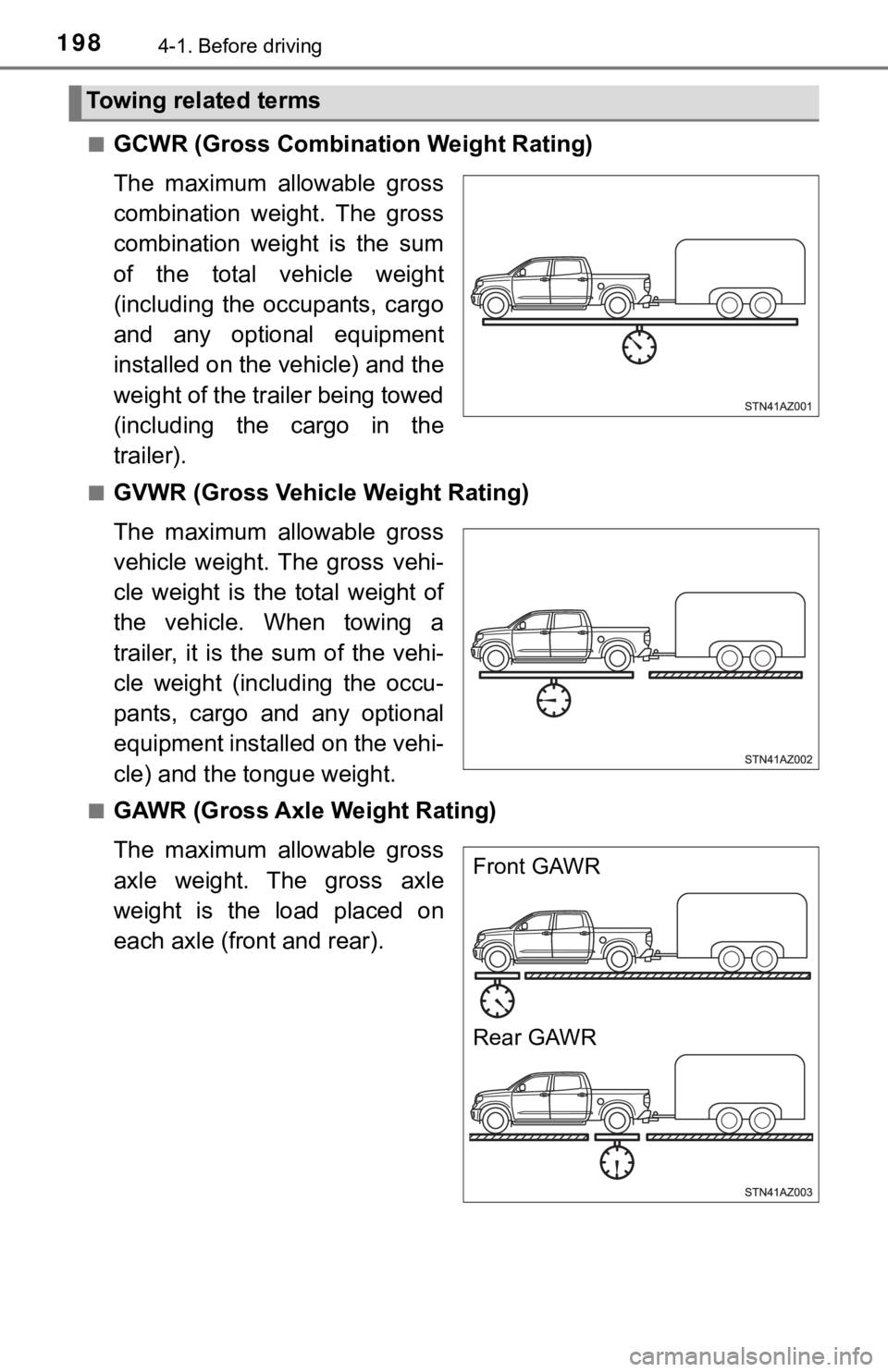
■GCWR (Gross Combination Weight Rating)
The maximum allowable gross
combination weight. The gross
combination weight is the sum
of the total vehicle weight
(including the occupants, cargo
and any optional equipment
installed on the vehicle) and the
weight of the trailer being towed
(including the cargo in the
trailer).
■GVWR (Gross Vehicle Weight Rating)
The maximum allowable gross
vehicle weight. The gross vehi-
cle weight is the total weight of
the vehicle. When towing a
trailer, it is the sum of the vehi-
cle weight (including the occu-
pants, cargo and any optional
equipment installed on the vehi-
cle) and the tongue weight.
■GAWR (Gross Axle Weight Rating)
The maximum allowable gross
axle weight. The gross axle
weight is the load placed on
each axle (front and rear).
Towing related terms
Front GAWR
Rear GAWR
Page 199 of 608
1994-1. Before driving
4
Driving
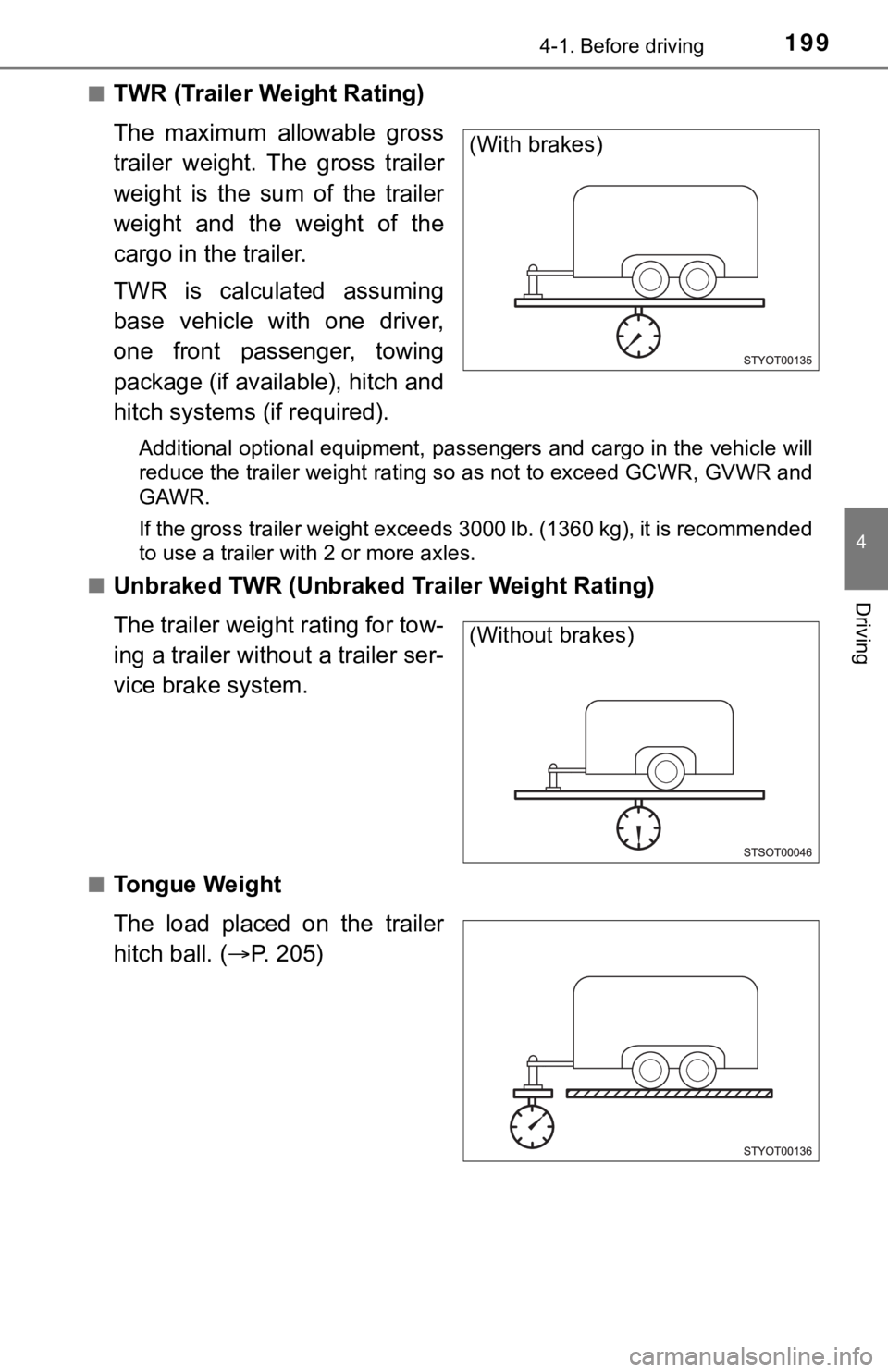
■TWR (Trailer Weight Rating)
The maximum allowable gross
trailer weight. The gross trailer
weight is the sum of the trailer
weight and the weight of the
cargo in the trailer.
TWR is calculated assuming
base vehicle with one driver,
one front passenger, towing
package (if available), hitch and
hitch systems (if required).
Additional optional equipment, passengers and cargo in the vehicle will
reduce the trailer weight rating so as not to exceed GCWR, GVWR and
GAWR.
If the gross trailer weight exceeds 3000 lb. (1360 kg), it is r ecommended
to use a trailer with 2 or more axles.
■
Unbraked TWR (Unbraked Trailer Weight Rating)
The trailer weight rating for tow-
ing a trailer without a trailer ser-
vice brake system.
■Tongue Weight
The load placed on the trailer
hitch ball. ( P. 205)
(With brakes)
(Without brakes)
Page 200 of 608
2004-1. Before driving
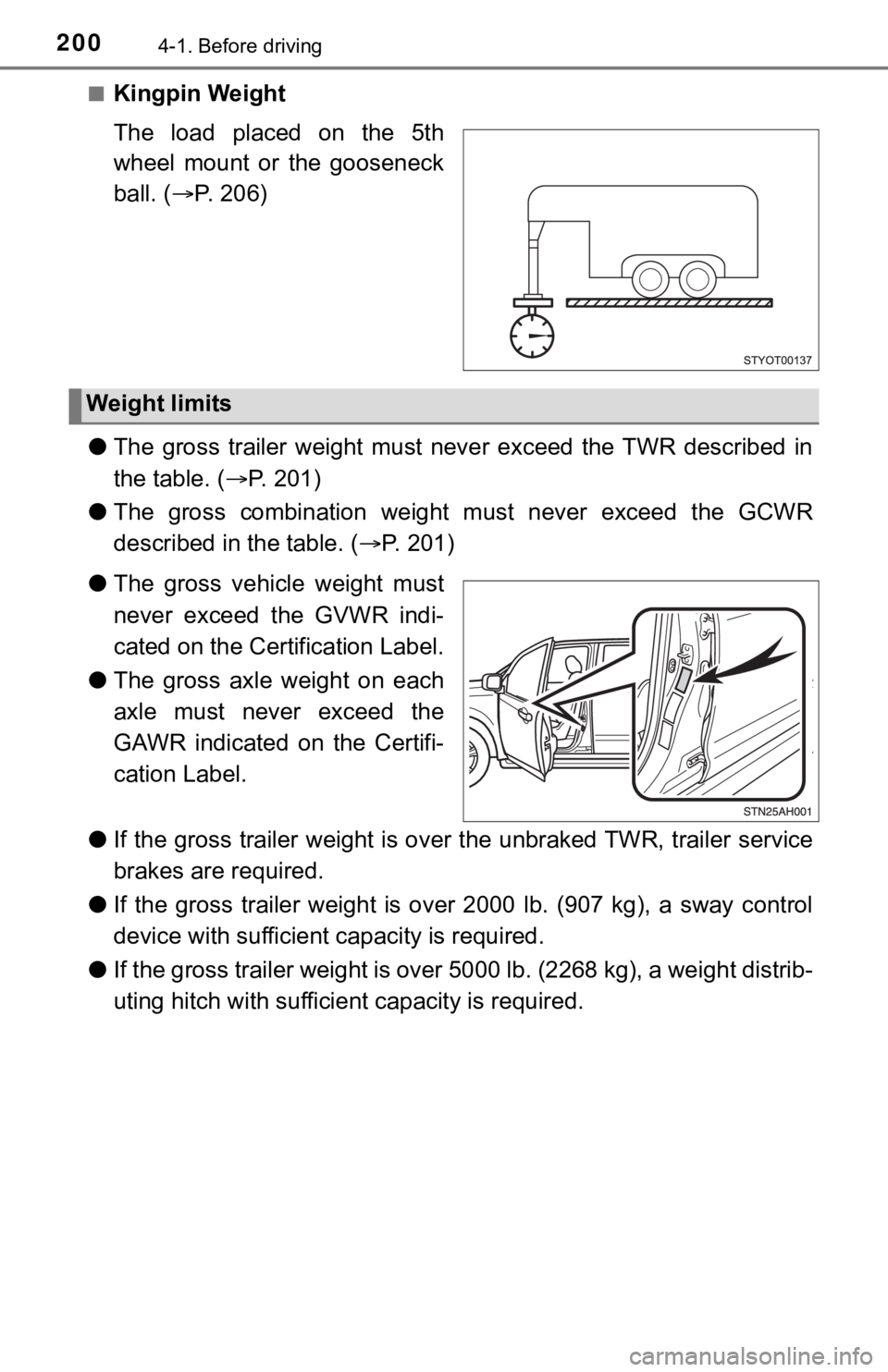
■Kingpin Weight
The load placed on the 5th
wheel mount or the gooseneck
ball. (P. 2 0 6 )
● The gross trailer weight must never exceed the TWR described in
the table. ( P. 2 0 1 )
● The gross combination weight must never exceed the GCWR
described in the table. ( P. 2 0 1 )
● The gross vehicle weight must
never exceed the GVWR indi-
cated on the Certification Label.
● The gross axle weight on each
axle must never exceed the
GAWR indicated on the Certifi-
cation Label.
● If the gross trailer weight is over the unbraked TWR, trailer s ervice
brakes are required.
● If the gross trailer weight is over 2000 lb. (907 kg), a sway c ontrol
device with sufficient capacity is required.
● If the gross trailer weight is over 5000 lb. (2268 kg), a weigh t distrib-
uting hitch with suffici ent capacity is required.
Weight limits
Page 201 of 608
2014-1. Before driving
4
Driving
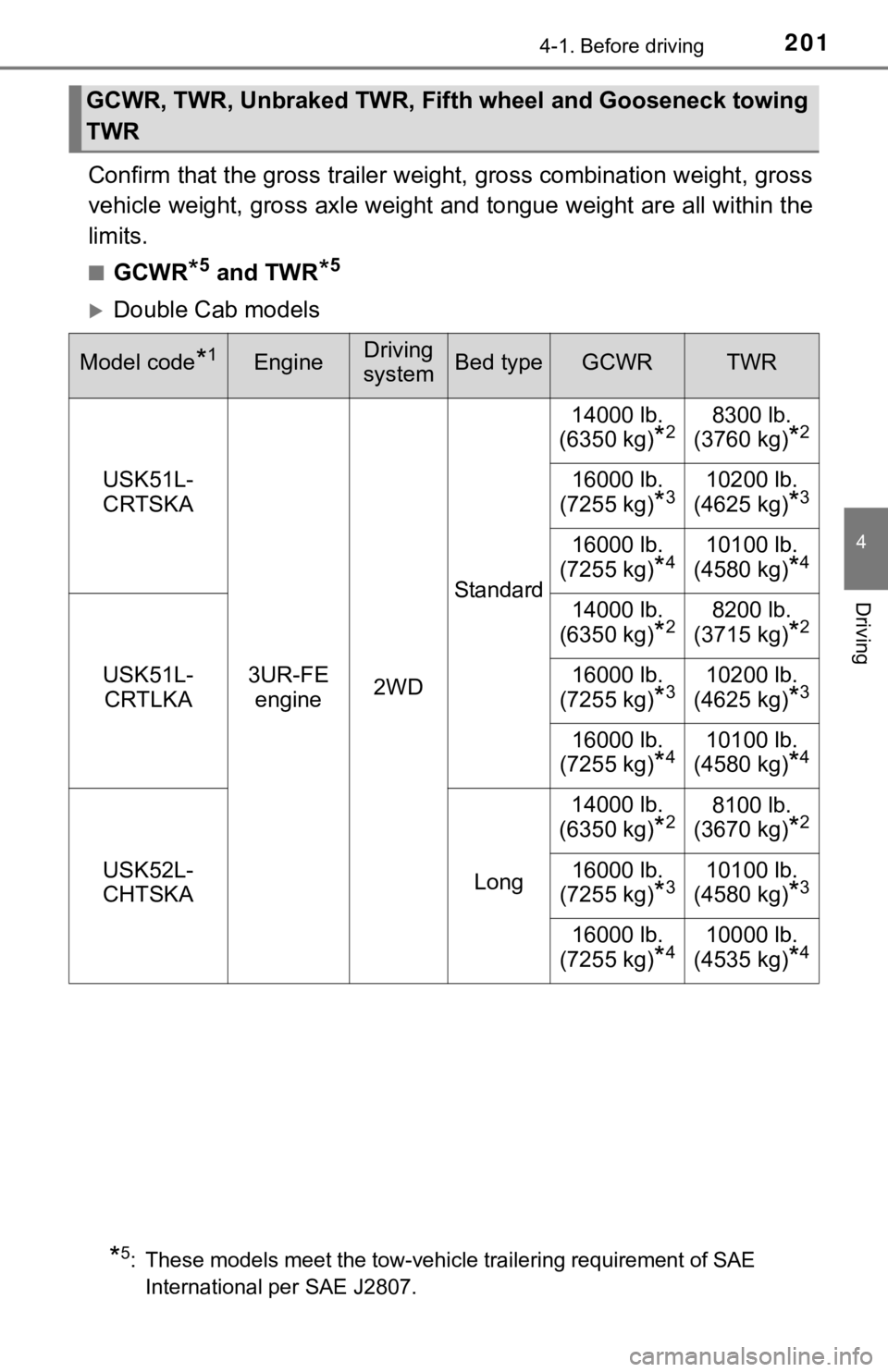
Confirm that the gross trailer weight, gross combination weight, gross
vehicle weight, gross axle weight and tongue weight are all within the
limits.
■GCWR*5 and TWR*5
Double Cab models
GCWR, TWR, Unbraked TWR, Fifth wheel and Gooseneck towing
TWR
*5: These models meet the tow-vehicle trailering requirement of SAE International per SAE J2807.
Model code*1EngineDriving
systemBed typeGCWRTWR
USK51L- CRTSKA
3UR-FE engine 2WDStandard 14000 lb.
(6350 kg)
*28300 lb.
(3760 kg)
*2
16000 lb.
(7255 kg)
*310200 lb.
(4625 kg)
*3
16000 lb.
(7255 kg)
*410100 lb.
(4580 kg)
*4
USK51L- CRTLKA 14000 lb.
(6350 kg)
*28200 lb.
(3715 kg)
*2
16000 lb.
(7255 kg)
*310200 lb.
(4625 kg)
*3
16000 lb.
(7255 kg)
*410100 lb.
(4580 kg)
*4
USK52L-
CHTSKA Long14000 lb.
(6350 kg)
*28100 lb.
(3670 kg)
*2
16000 lb.
(7255 kg)
*310100 lb.
(4580 kg)
*3
16000 lb.
(7255 kg)
*410000 lb.
(4535 kg)
*4
Page 204 of 608
2044-1. Before driving
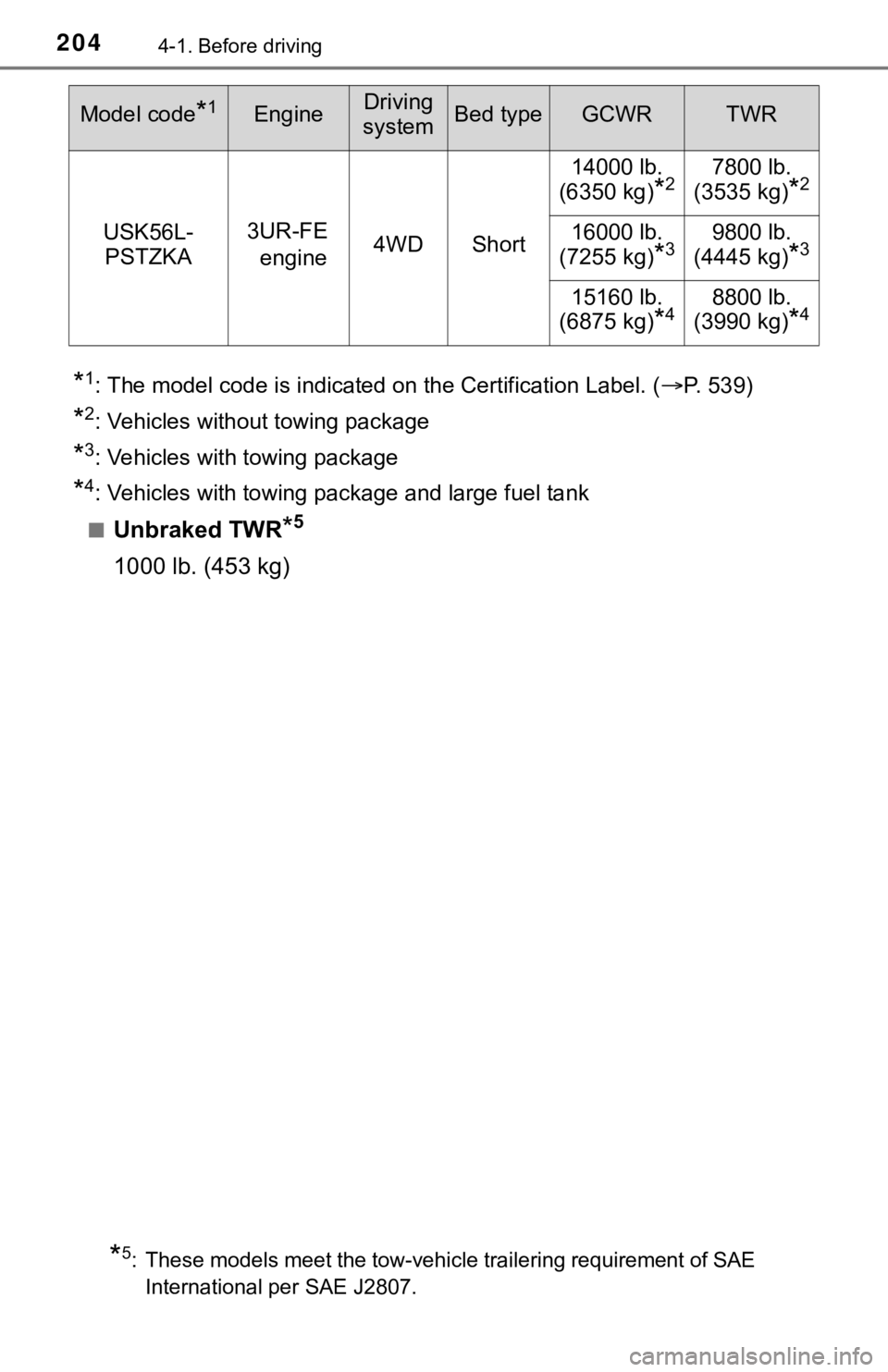
*1: The model code is indicated on the Certification Label. (P. 539)
*2: Vehicles without towing package
*3: Vehicles with towing package
*4: Vehicles with towing package and large fuel tank
■Unbraked TWR*5
1000 lb. (453 kg)
USK56L-
PSTZKA 3UR-FE
engine 4WD Short 14000 lb.
(6350 kg)
*27800 lb.
(3535 kg)
*2
16000 lb.
(7255 kg)
*39800 lb.
(4445 kg)
*3
15160 lb.
(6875 kg)
*48800 lb.
(3990 kg)
*4
*5: These models meet the tow-vehicle trailering requirement of SAE
International per SAE J2807.
Model code*1EngineDriving
systemBed typeGCWRTWR
Page 205 of 608
2054-1. Before driving
4
Driving
●A recommended tongue weight or kingpin weight varies in accor-
dance with the types of trailer s or towing as described below.
● To ensure the recommended values shown below, the trailer must
be loaded by referring to t he following instructions.
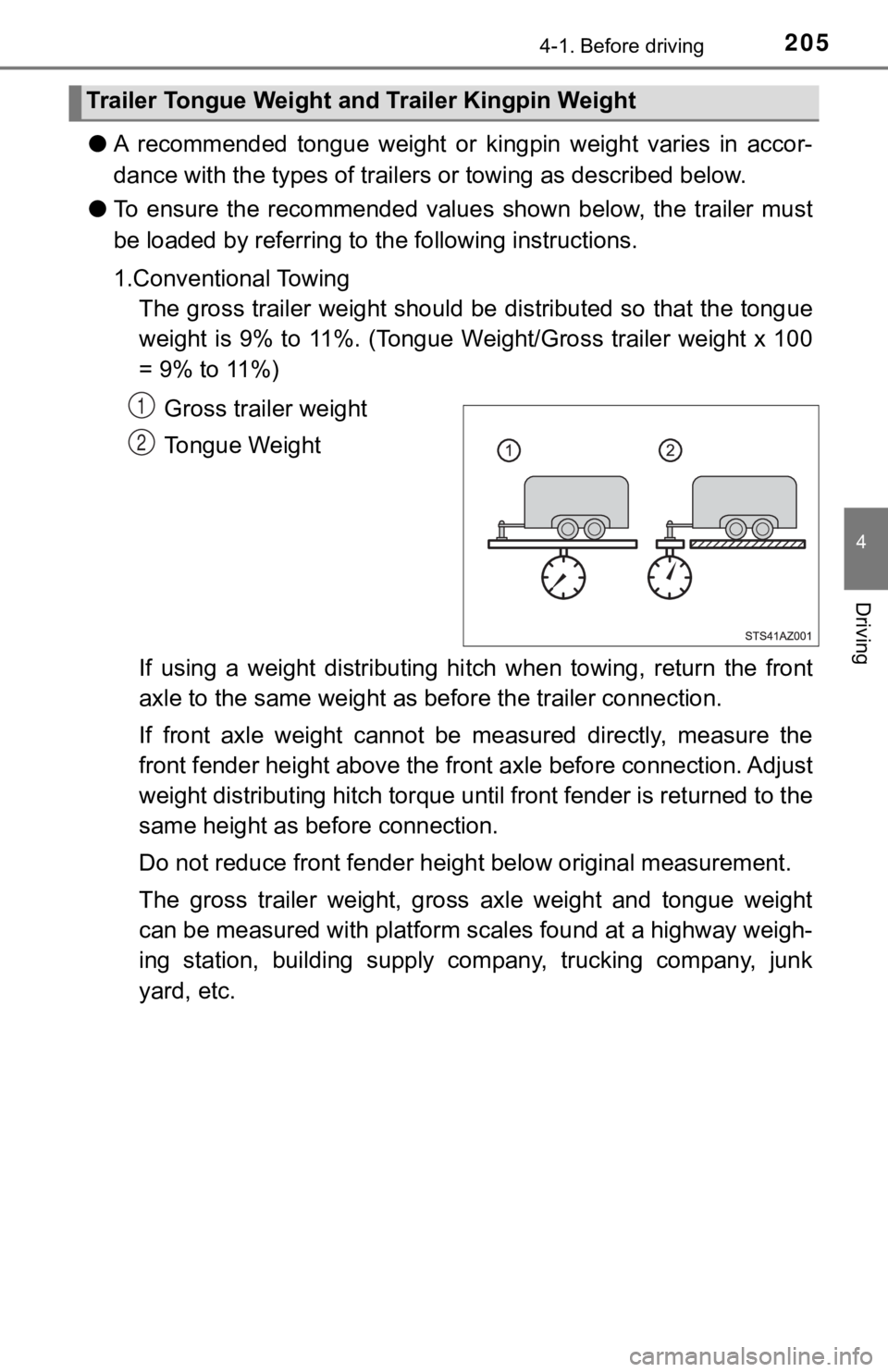
1.Conventional Towing The gross trailer weight should be distributed so that the tong ue
weight is 9% to 11%. (Tongue We ight/Gross trailer weight x 100
= 9% to 11%)
Gross trailer weight
Tongue Weight
If using a weight distributing hi tch when towing, return the front
axle to the same weight as b efore the trailer connection.
If front axle weight cannot be measured directly, measure the
front fender height above the front axle before connection. Adjust
weight distributing hitch torque until front fender is returned to the
same height as b efore connection.
Do not reduce front fender heigh t below original measurement.
The gross trailer weight, gross axle weight and tongue weight
can be measured with platform sca les found at a highway weigh-
ing station, building supply company, trucking company, junk
yard, etc.
Trailer Tongue Weight and Trailer Kingpin Weight
1
2
Page 206 of 608
2064-1. Before driving
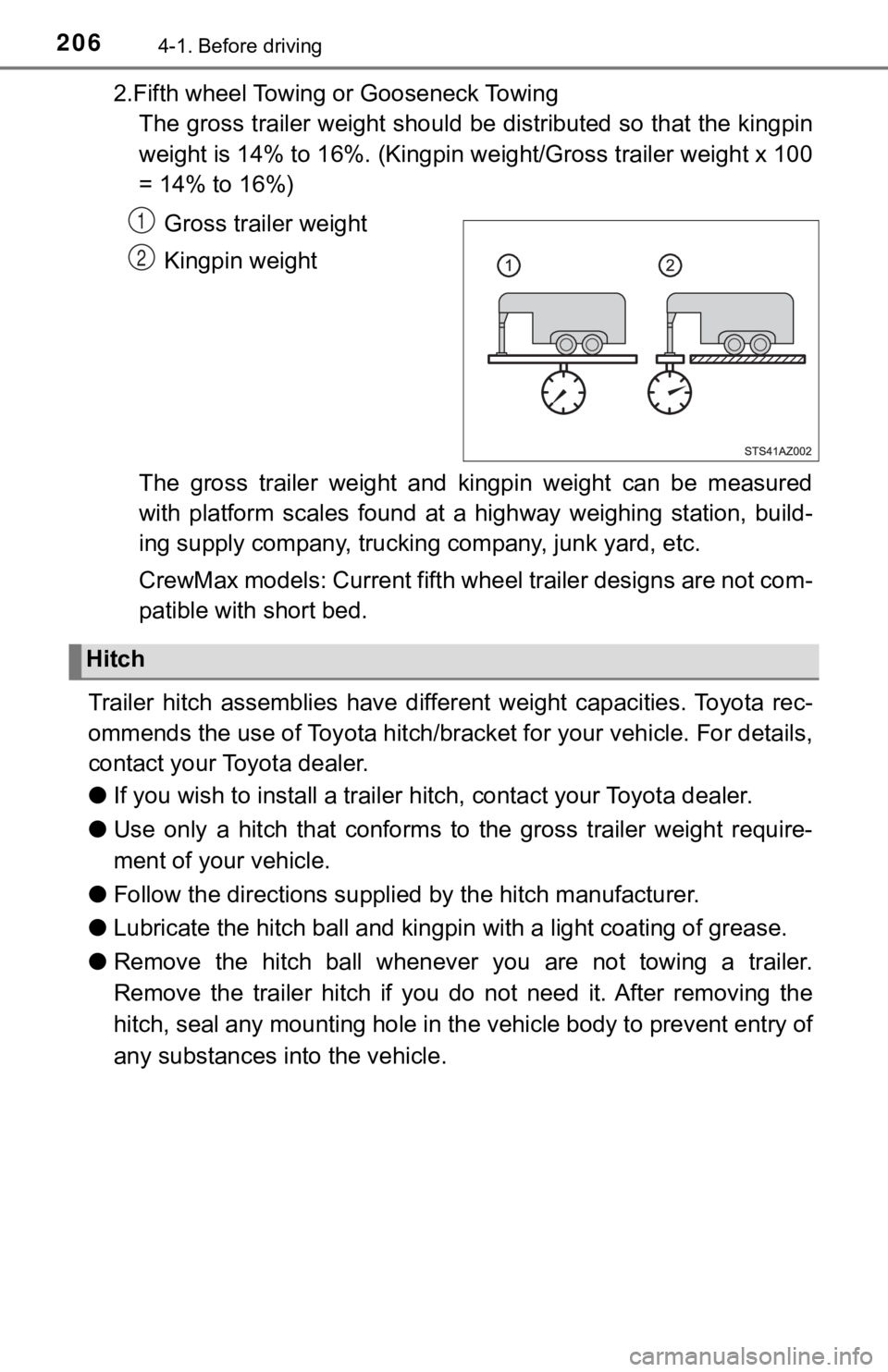
2.Fifth wheel Towing or Gooseneck TowingThe gross trailer weight should be distributed so that the king pin
weight is 14% to 16%. (Kingpin w eight/Gross trailer weight x 100
= 14% to 16%)
Gross trailer weight
Kingpin weight
The gross trailer weight and kingpin weight can be measured
with platform scales found at a h ighway weighing station, build-
ing supply company, trucki ng company, junk yard, etc.
CrewMax models: Current fifth wheel trailer designs are not com -
patible with short bed.
Trailer hitch assemblies have different weight capacities. Toyo ta rec-
ommends the use of Toy ota hitch/bracket for your vehicle. For d etails,
contact your Toyota dealer.
● If you wish to install a trailer hitch, contact your Toyota dea ler.
● Use only a hitch that conforms to the gross trailer weight requ ire-
ment of your vehicle.
● Follow the directions suppli ed by the hitch manufacturer.
● Lubricate the hitch ball and kingpin with a light coating of gr ease.
● Remove the hitch ball whenever you are not towing a trailer.
Remove the trailer hitch if you do not need it. After removing the
hitch, seal any mounting hole in the vehicle body to prevent en try of
any substances into the vehicle.
1
2
Hitch