DRIVING TOYOTA VERSO 2011 Owners Manual
[x] Cancel search | Manufacturer: TOYOTA, Model Year: 2011, Model line: VERSO, Model: TOYOTA VERSO 2011Pages: 588, PDF Size: 31.32 MB
Page 467 of 588
5
467 5-1. Essential information
When trouble arises
VERSO_WE_OM64524E
CAUTION
Caution while towing
Use extreme caution when towing the vehicle.
Avoid sudden starts or erratic driving maneuvers which place excessive
stress on the emergency towing eyelet and the cable or chain. Always be
cautious of the surroundings and other vehicles while towing.
If the engine is not running, the power assist for the brakes and steering
will not function, making steering and braking more difficult.
NOTICE
To prevent causing serious damage to the transmission
(vehicles with a Multidrive or an automatic transmission)
Never tow this vehicle from the rear with the front wheels on the ground.
This may cause serious damage to the transmission.
When towing a vehicle without using a towing dolly
(vehicles with a manual transmission)
Vehicles without smart entry & start system: Do not tow the vehicle with
the key removed or in the “LOCK” position.
Vehicles with smart entry & start system: Do not tow the vehicle with the
“ENGINE START STOP” switch OFF.
Page 473 of 588
5
473
5-1. Essential information
When trouble arises
VERSO_WE_OM64524E
If you think something is wrong
If you notice any of the following symptoms, your vehicle probably
needs adjustment or repair. Contact any authorized Toyota dealer or
repairer, or another duly qualified and equipped professional, as
soon as possible.
Visible symptoms
Fluid leaks under the vehicle
(Water dripping from the air conditioning after use is normal.)
Flat-looking tires or uneven tire wear
High engine coolant temperature warning light flashes or
comes on
Low engine coolant temperature indicator comes on or does
not come on continuously
Audible symptoms
Changes in exhaust sound
Excessive tire squeal when cornering
Strange noises related to the suspension system
Pinging or other noises related to the engine
Operational symptoms
Engine missing, stumbling or running rough
Appreciable loss of power
Vehicle pulls heavily to one side when braking
Vehicle pulls heavily to one side when driving on a level road
Loss of brake effectiveness, spongy feeling, pedal almost
touches the floor
Page 477 of 588
5
477 5-2. Steps to take in an emergency
When trouble arises
VERSO_WE_OM64524E
Follow the correction procedures.
After taking the specified steps to correct the suspected problem,
check that the warning light turns off.
If the malfunction indicator lamp comes on while driving
For some models, the malfunction indicator lamp will come on if the fuel tank
becomes completely empty. If the fuel tank is empty, refuel the vehicle
immediately. The malfunction indicator lamp will go off after several trips.
If the malfunction indicator lamp does not go off, contact any authorized Toy-
ota dealer or repairer, or another duly qualified and equipped professional.
Electric power steering warning light (warning buzzer)
The electric power steering warning light may come on and the warning
buzzer may sound when the voltage is low or the voltage drops.
CAUTION
When the electric power steering warning light comes on
The steering wheel may become extremely heavy.
If the steering wheel becomes heavier than usual when operating, firmly
hold and operate it using more force than usual.
Warning lightWarning light/DetailsCorrection procedure
Low fuel level warning
light
Gasoline engine:
Indicates that remaining
fuel is about 9.0 L (2.4
gal., 2.0 Imp. gal.) or less
Diesel engine:
Indicates that remaining
fuel is about 8.3 L (2.2
gal., 1.8 Imp. gal.) or lessRefuel the vehicle.
Page 486 of 588
486 5-2. Steps to take in an emergency
VERSO_WE_OM64524E
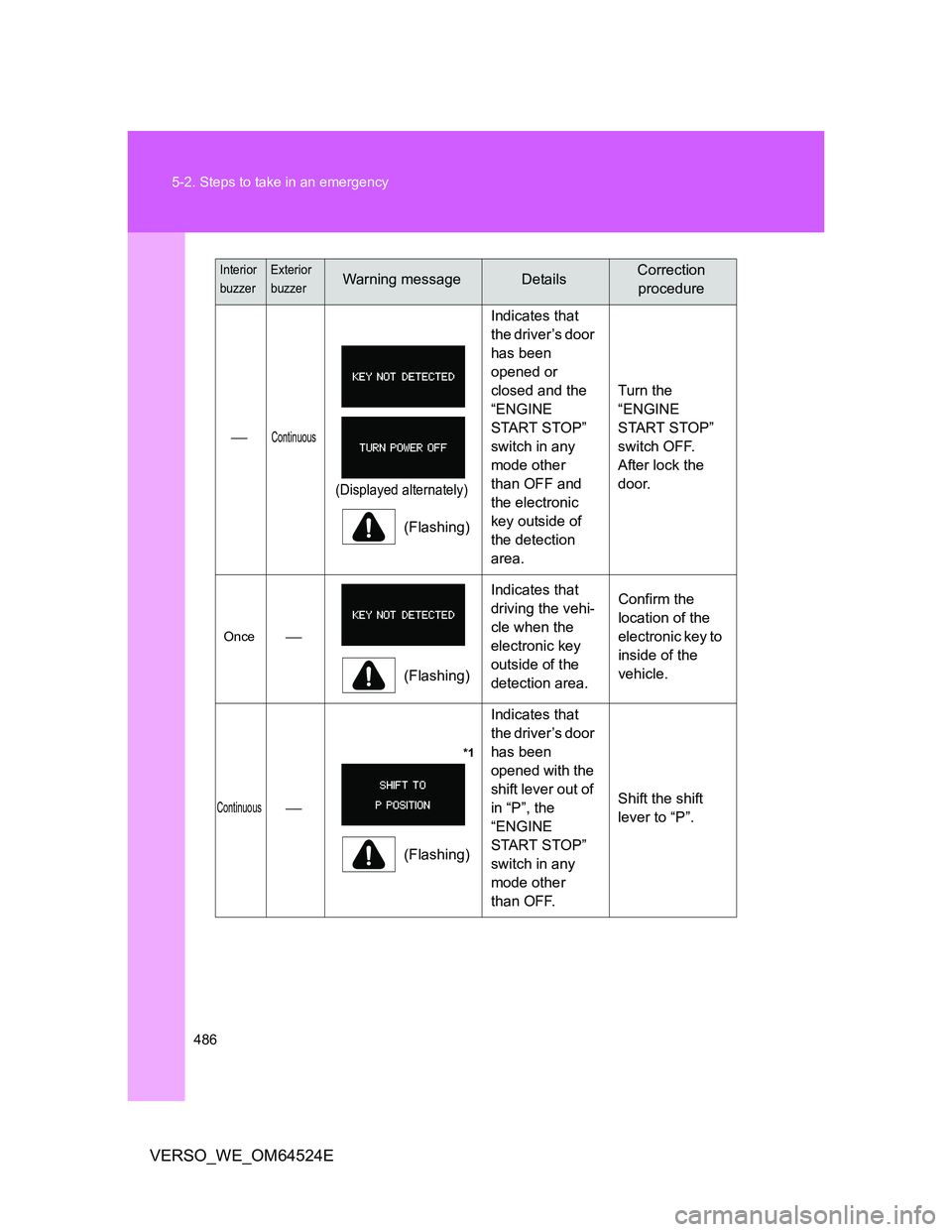
Continuous
(Displayed alternately)
(Flashing)Indicates that
the driver’s door
has been
opened or
closed and the
“ENGINE
START STOP”
switch in any
mode other
than OFF and
the electronic
key outside of
the detection
area.Turn the
“ENGINE
START STOP”
switch OFF.
After lock the
door.
Once
(Flashing)Indicates that
driving the vehi-
cle when the
electronic key
outside of the
detection area.Confirm the
location of the
electronic key to
inside of the
vehicle.
Continuous
*1
(Flashing)Indicates that
the driver’s door
has been
opened with the
shift lever out of
in “P”, the
“ENGINE
START STOP”
switch in any
mode other
than OFF.Shift the shift
lever to “P”.
Interior
buzzerExterior
buzzerWarning messageDetailsCorrection
procedure
Page 504 of 588
504 5-2. Steps to take in an emergency
VERSO_WE_OM64524E
CAUTION
Replacing a flat tire
Failure to follow these precautions could cause the wheel nuts to loosen
and the tire to fall off, resulting in death or serious injury.
• Have the wheel nuts tightened with a torque wrench to 103 N·m (10.5
kgf·m, 76 ft·lbf) as soon as possible after changing wheels.
• When installing a tire, only use wheel nuts that have been specifically
designed for that wheel.
• If there are any cracks or deformations in the bolt screws, nut threads
or bolt holes of the wheel, have the vehicle inspected by any autho-
rized Toyota dealer or repairer, or another duly qualified and equipped
professional.
• When installing the wheel nuts, be sure to install them with the tapered
ends facing inward. (P. 427)
• Do not attach a heavily damaged wheel ornament, as it may fly off the
wheel while the vehicle is moving.
When using the full-size spare tire (vehicles with a spare tire of differ-
ent wheel type from the installed tires)
Replace the full-size spare tire with a standard tire as soon as possible.
Avoid sudden acceleration, deceleration and braking, as well as sharp cor-
nering.
When using the compact spare tire
Remember that your compact spare tire is specifically designed for use
with your vehicle. Do not use your compact spare tire on another vehicle.
Do not use two compact spare tires simultaneously.
Replace the compact spare tire with a standard tire as soon as possible.
Avoid sudden acceleration, deceleration and braking, as well as sharp cor-
nering.
Speed limit when using the compact spare tire
Do not drive at speeds in excess of 80 km/h (50 mph) when a compact spare
tire is installed on the vehicle.
The compact spare tire is not designed for driving at high speeds. Failing to
observe this precaution may lead to an accident causing death or serious
injury.
Page 505 of 588
5
505 5-2. Steps to take in an emergency
When trouble arises
VERSO_WE_OM64524E
CAUTION
When the spare tire is installed
The vehicle speed may not be correctly detected, and the following systems
may not operate correctly:
ABS & brake assist
VSC+ (if equipped)
TRC (if equipped)
Cruise control (if equipped)
Navigation system (if equipped)
NOTICE
Do not drive the vehicle with a flat tire
Do not continue driving with a flat tire.
Driving even a short distance with a flat tire can damage the tire and the
wheel beyond repair.
Be careful when driving over bumps with the compact spare tire
installed on the vehicle
The vehicle becomes lower when driving with the compact spare tire com-
pared to when driving with standard tires. Be careful when driving over
uneven road surfaces.
Driving with tire chains and the compact spare tire
Do not fit tire chains to the compact spare tire.
Tire chains may damage the vehicle body and adversely affect driving per-
formance.
Page 508 of 588
508 5-2. Steps to take in an emergency
VERSO_WE_OM64524E
Before putting the sealant into use
Check the degree of the tire damage before making use of the seal-
ant in the emergency tire puncture repair kit.
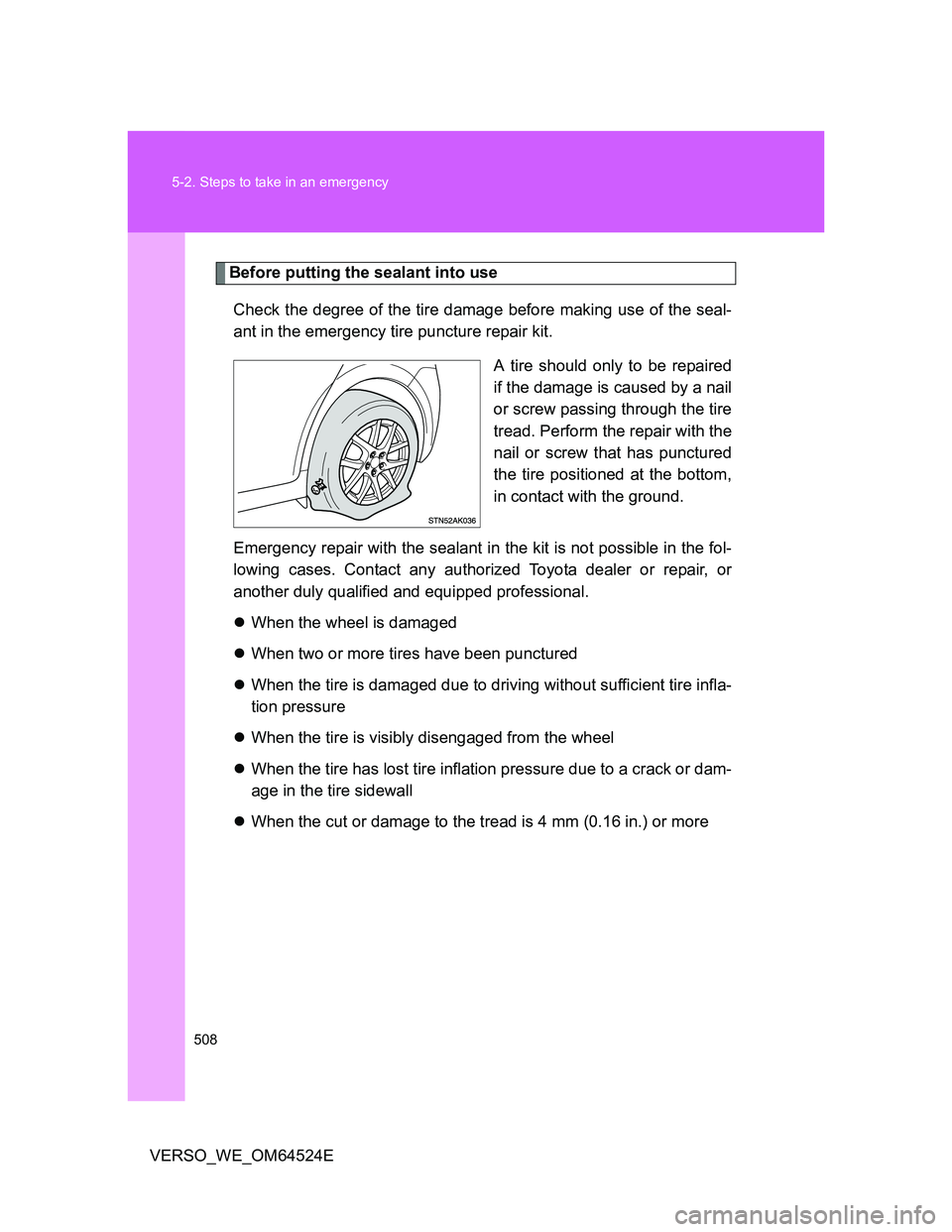
A tire should only to be repaired
if the damage is caused by a nail
or screw passing through the tire
tread. Perform the repair with the
nail or screw that has punctured
the tire positioned at the bottom,
in contact with the ground.
Emergency repair with the sealant in the kit is not possible in the fol-
lowing cases. Contact any authorized Toyota dealer or repair, or
another duly qualified and equipped professional.
When the wheel is damaged
When two or more tires have been punctured
When the tire is damaged due to driving without sufficient tire infla-
tion pressure
When the tire is visibly disengaged from the wheel
When the tire has lost tire inflation pressure due to a crack or dam-
age in the tire sidewall
When the cut or damage to the tread is 4 mm (0.16 in.) or more
Page 513 of 588
5
513 5-2. Steps to take in an emergency
When trouble arises
VERSO_WE_OM64524ETurn the compressor switch ON
and fill the tire with air until the
specified inflation pressure is
reached.
Turn the switch OFF when the pressure gauge connected to
the hose reads the specified pressure.
If the inflation pressure is not attained within 5 minutes, emergency
repair is not possible due to severe damage. Contact any authorized
Toyota dealer or repairer, or another duly qualified and equipped pro-
fessional.
After completely filling the tire with air, disconnect the hose
from the valve on the tire.
Pull the power plug of the compressor out of the power outlet
on the vehicle.
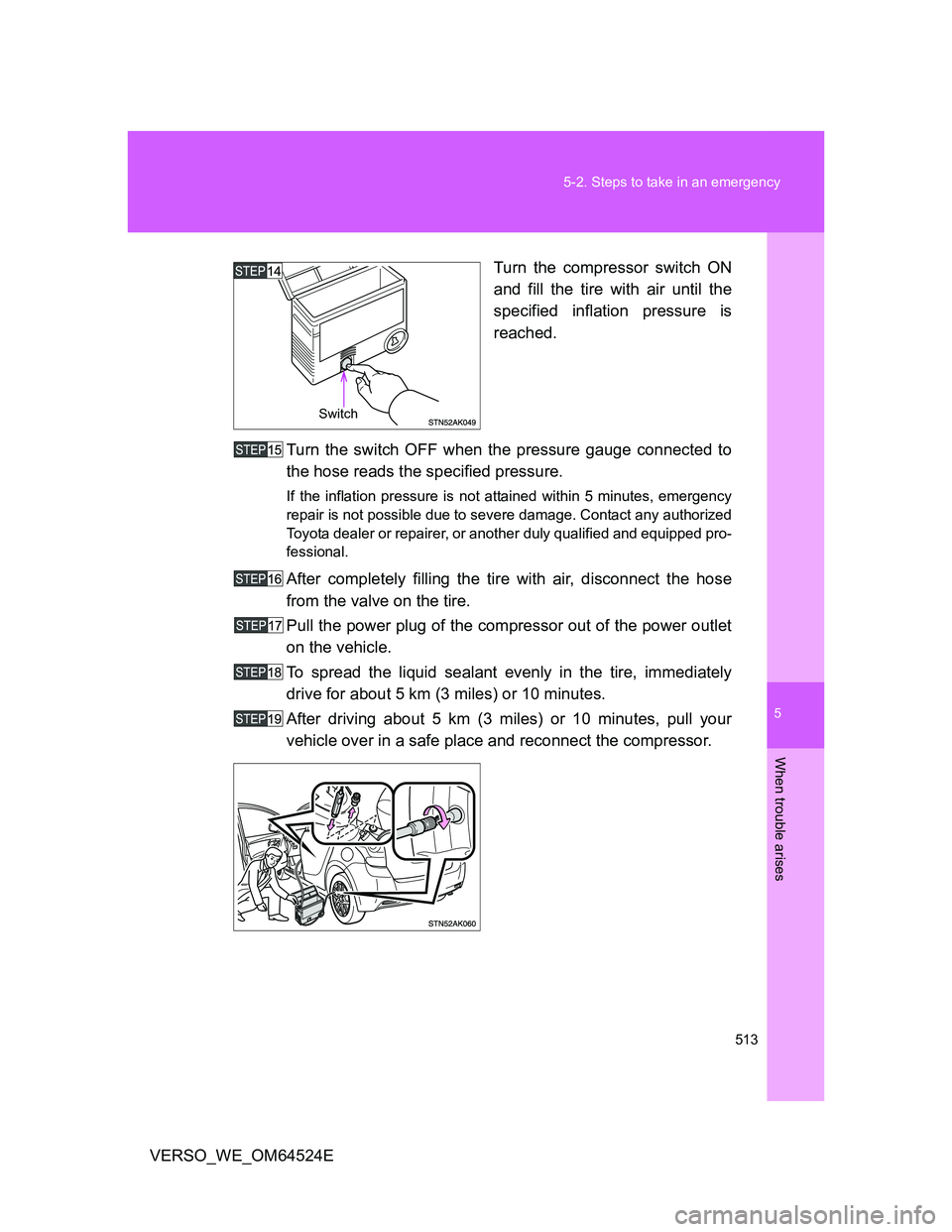
To spread the liquid sealant evenly in the tire, immediately
drive for about 5 km (3 miles) or 10 minutes.
After driving about 5 km (3 miles) or 10 minutes, pull your
vehicle over in a safe place and reconnect the compressor.
Switch
Page 517 of 588
5
517 5-2. Steps to take in an emergency
When trouble arises
VERSO_WE_OM64524E
CAUTION
Precaution for children
Keep the emergency tire puncture repair kit out of the reach of children and
store it properly.
Sealant precautions
The sealant in the emergency tire puncture repair kit is not for human con-
sumption.
If the sealant is consumed inadvertently, drink a large quantity of water
and get medical attention immediately.
If sealant gets in your eyes or on your skin, thoroughly wash with a large
quantity of water. If necessary, get medical attention.
When fixing the flat tire
Stop your vehicle in a safe and flat area.
If force is used to turn the valve core tool while air remains in the tire, spe-
cial care should be taken because the valve core could fly out.
Be careful, as sealant may fly out if you shake the bottle with the hose
installed.
If the hose is not securely installed, sealant may leak out when filling.
Connect the valve and hose securely with the tire installed on the vehicle.
Be careful handling the compressor, as parts of the compressor get hot
during operation. Some parts of the compressor may remain hot after use.
Driving to spread the liquid sealant evenly
Drive your vehicle with due care. Be especially careful when turning and cor-
nering.
Page 518 of 588
518 5-2. Steps to take in an emergency
VERSO_WE_OM64524E
NOTICE
Vehicles with a flat tire
Do not continue driving with a flat tire.
Driving even a short distance with a flat tire can damage the tire and the
wheel beyond repair.
When performing an emergency repair
Perform the emergency repair without removing the nail or screw that has
punctured the tread of the tire. If the object that has punctured the tire is
removed, the repair using the sealant in the emergency tire puncture repair
kit may fail.
When fixing the flat tire
Do not put the valve core on dirty ground or in the sand.
Store it in a clean place.
Do not remove the inside cap of the sealant bottle.
Turn the valve core tool with your hand when screwing it in. If you use
another tool in conjunction with the valve core tool, damage may occur.
Do not operate the compressor continuously for more than 7 minutes. The
motor may overheat and be damaged. Let the compressor cool before
using it again.
Compressor precautions
The compressor power source should be 12V DC suitable for vehicle use.
Do not connect the compressor to 24V DC or any other power source.
The compressor is an oil-less type. Do not lubricate with oil.