air condition TOYOTA VERSO 2014 User Guide
[x] Cancel search | Manufacturer: TOYOTA, Model Year: 2014, Model line: VERSO, Model: TOYOTA VERSO 2014Pages: 650, PDF Size: 36.61 MB
Page 125 of 650
125 1-6. Theft deterrent system
1
Before driving
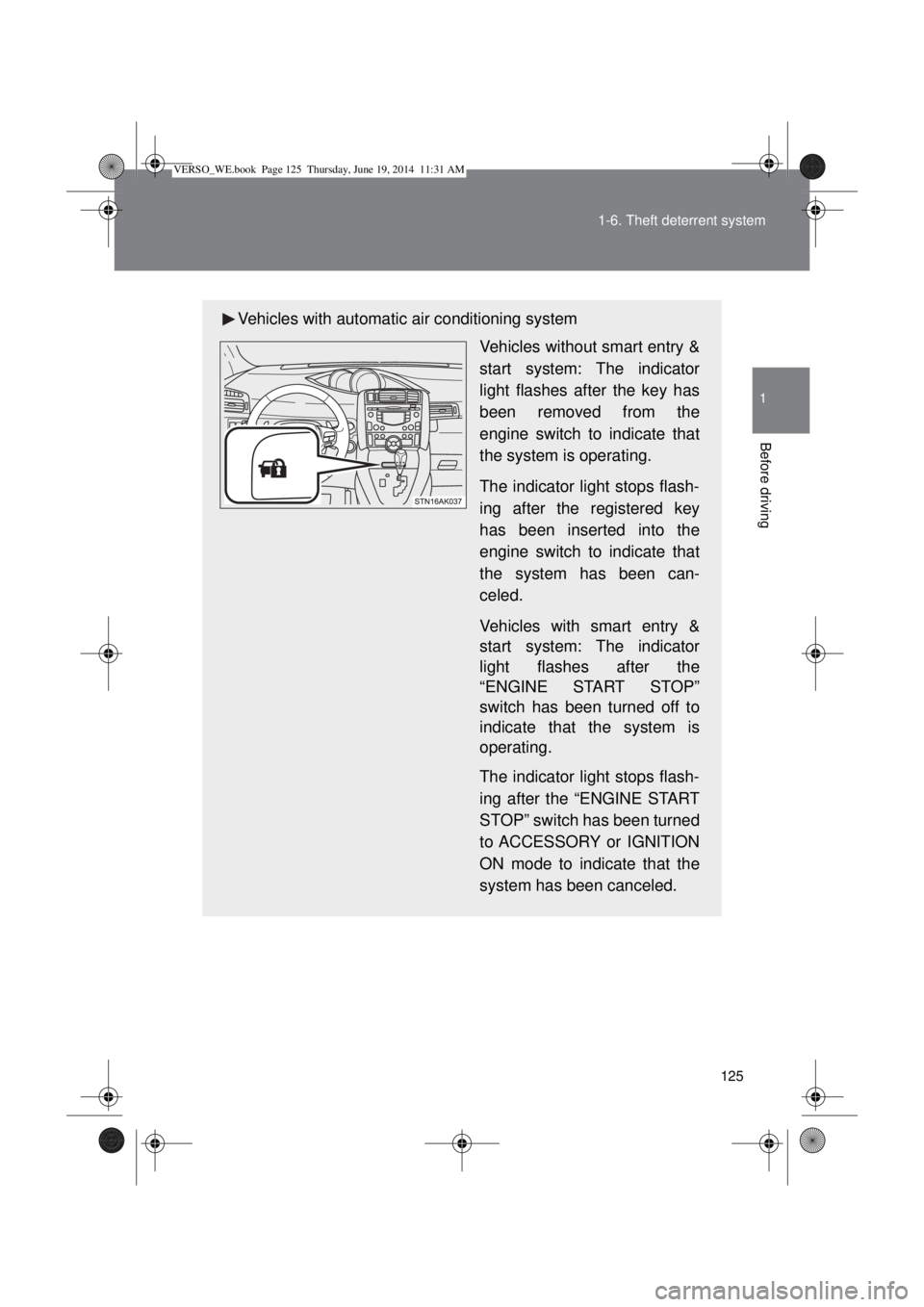
Vehicles with automatic air conditioning system
Vehicles without smart entry &
start system: The indicator
light flashes after the key has
been removed from the
engine switch to indicate that
the system is operating.
The indicator light stops flash-
ing after the registered key
has been inserted into the
engine switch to indicate that
the system has been can-
celed.
Vehicles with smart entry &
start system: The indicator
light flashes after the
“ENGINE START STOP”
switch has been turned off to
indicate that the system is
operating.
The indicator light stops flash-
ing after the “ENGINE START
STOP” switch has been turned
to ACCESSORY or IGNITION
ON mode to indicate that the
system has been canceled.
VERSO_WE.book Page 125 Thursday, June 19, 2014 11:31 AM
Page 137 of 650
137 1-6. Theft deterrent system
1
Before driving
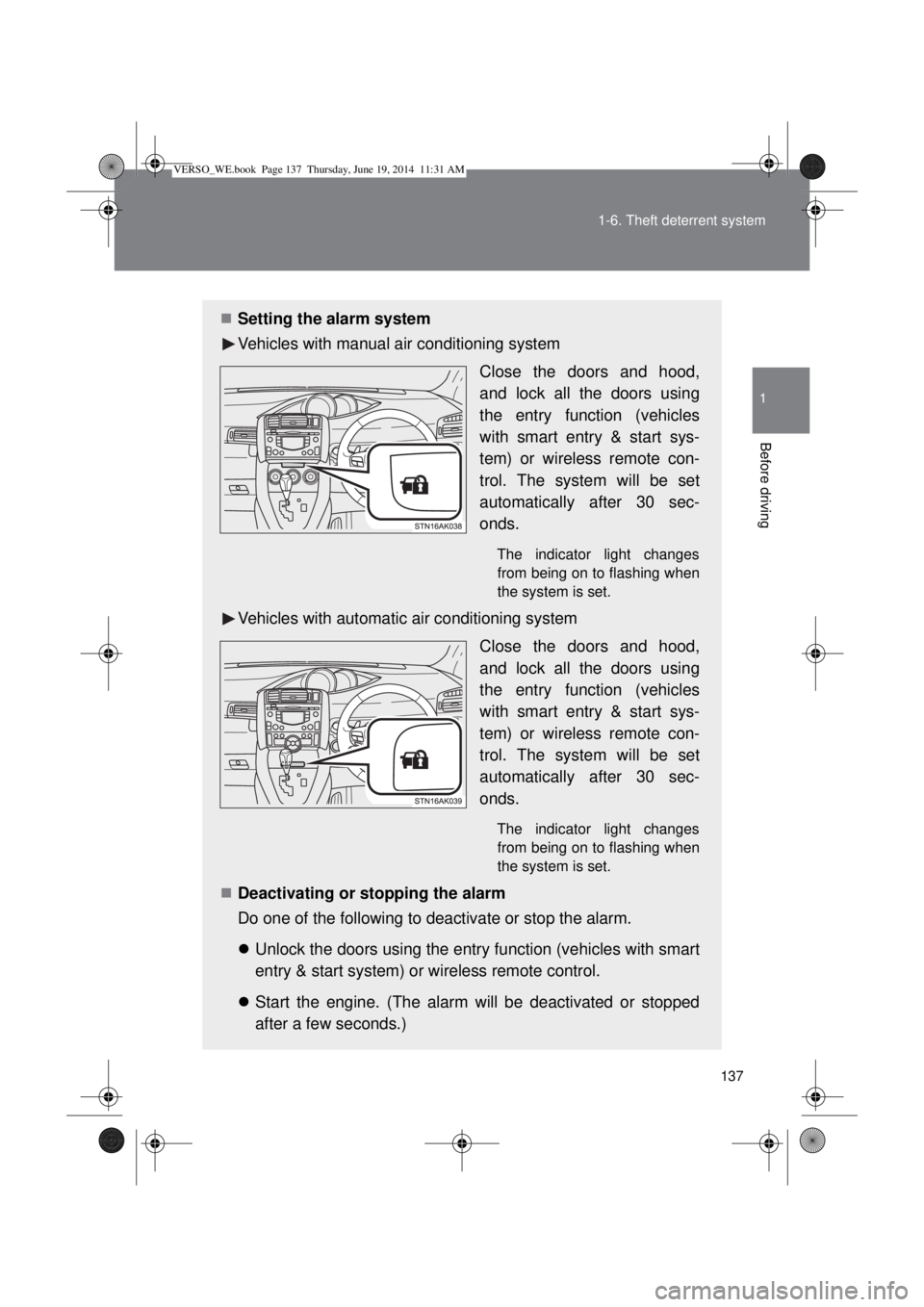
Setting the alarm system
Vehicles with manual air conditioning system
Close the doors and hood,
and lock all the doors using
the entry function (vehicles
with smart entry & start sys-
tem) or wireless remote con-
trol. The system will be set
automatically after 30 sec-
onds.
The indicator light changes
from being on to flashing when
the system is set.
Vehicles with automatic air conditioning system
Close the doors and hood,
and lock all the doors using
the entry function (vehicles
with smart entry & start sys-
tem) or wireless remote con-
trol. The system will be set
automatically after 30 sec-
onds.
The indicator light changes
from being on to flashing when
the system is set.
Deactivating or stopping the alarm
Do one of the following to deactivate or stop the alarm.
Unlock the doors using the entry function (vehicles with smart
entry & start system) or wireless remote control.
Start the engine. (The alarm will be deactivated or stopped
after a few seconds.)
VERSO_WE.book Page 137 Thursday, June 19, 2014 11:31 AM
Page 149 of 650
149 1-7. Safety information
1
Before driving
If the SRS airbags deploy (inflate)
Bruising and slight abrasions may result from contact with a deploying
(inflating) SRS airbag.
A loud noise and white powder will be emitted.
Vehicles without SRS curtain shield airbags: Parts of the airbag module
(steering wheel hub, airbag cover and inflator) as well as the front seats
may be hot for several minutes. The airbag itself may also be hot.
Vehicles with SRS curtain shield airbags: Parts of the airbag module
(steering wheel hub, airbag cover and inflator) as well as the front seats,
parts of the front and rear pillars, and roof side rails, may be hot for sev-
eral minutes. The airbag itself may also be hot.
The windshield may crack.
Operating conditions (SRS front airbags)
The SRS front airbags will deploy in the event of an impact that exceeds
the set threshold level (the level of force corresponding to an approxi-
mately 20-30 km/h [12-18 mph] frontal collision with a fixed wall that does
not move or deform).
However, this threshold velocity will be considerably higher in the following
situations:
• If the vehicle strikes an object, such as a parked vehicle or sign pole,
which can move or deform on impact
• If the vehicle is involved in an underride collision, such as a collision in
which the front of the vehicle “underrides”, or goes under, the bed of a
truck
Depending on the type of collision, it is possible that only the seat belt
pretensioners will activate.
Operating conditions (SRS side airbags and curtain shield airbags [if
equipped])
The SRS side airbags and curtain shield airbags (if equipped) will deploy in
the event of an impact that exceeds the set threshold level (the level of force
corresponding to the impact force produced by an approximately 1500 kg
[3300 lb.] vehicle colliding with the vehicle cabin from a direction perpendicu-
lar to the vehicle orientation at an approximate speed of 20-30 km/h [12-18
mph]).
VERSO_WE.book Page 149 Thursday, June 19, 2014 11:31 AM
Page 150 of 650
150 1-7. Safety information
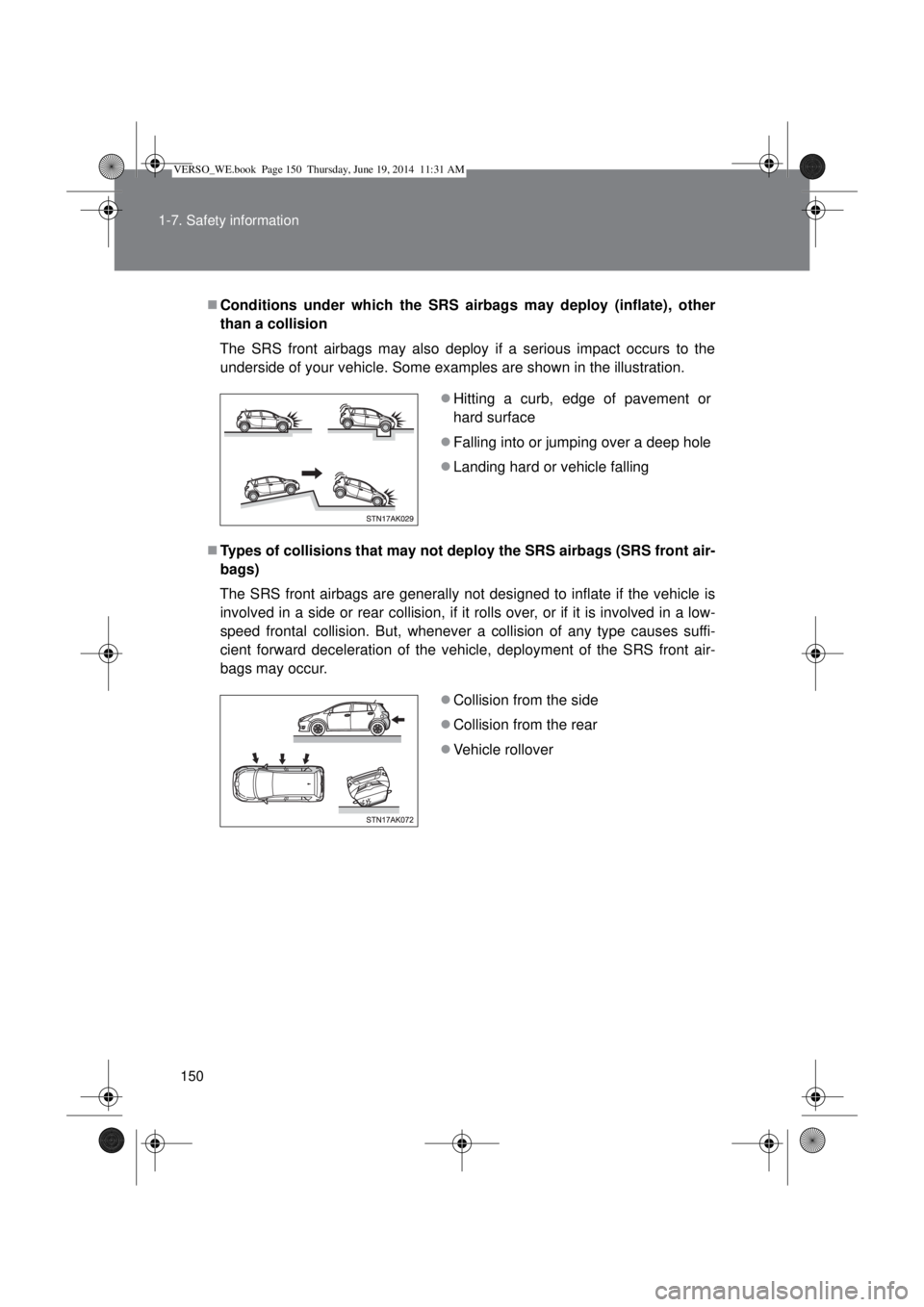
Conditions under which the SRS airbags may deploy (inflate), other
than a collision
The SRS front airbags may also deploy if a serious impact occurs to the
underside of your vehicle. Some examples are shown in the illustration.
Types of collisions that may not deploy the SRS airbags (SRS front air-
bags)
The SRS front airbags are generally not designed to inflate if the vehicle is
involved in a side or rear collision, if it rolls over, or if it is involved in a low-
speed frontal collision. But, whenever a collision of any type causes suffi-
cient forward deceleration of the vehicle, deployment of the SRS front air-
bags may occur.Hitting a curb, edge of pavement or
hard surface
Falling into or jumping over a deep hole
Landing hard or vehicle falling
Collision from the side
Collision from the rear
Vehicle rollover
VERSO_WE.book Page 150 Thursday, June 19, 2014 11:31 AM
Page 177 of 650
177
1
1-7. Safety information
Before driving
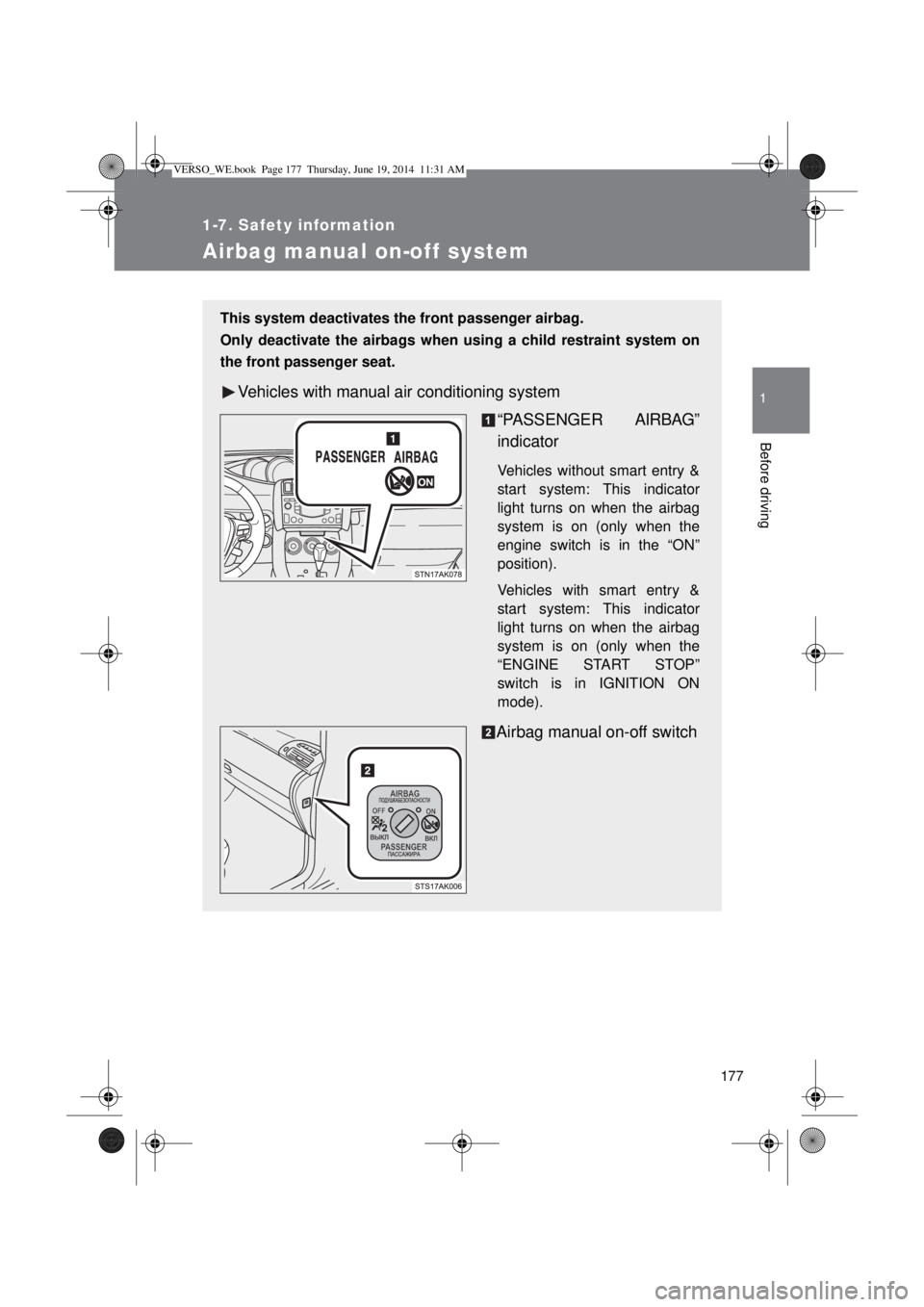
Airbag manual on-off system
This system deactivates the front passenger airbag.
Only deactivate the airbags when using a child restraint system on
the front passenger seat.
Vehicles with manual air conditioning system
“PASSENGER AIRBAG”
indicator
Vehicles without smart entry &
start system: This indicator
light turns on when the airbag
system is on (only when the
engine switch is in the “ON”
position).
Vehicles with smart entry &
start system: This indicator
light turns on when the airbag
system is on (only when the
“ENGINE START STOP”
switch is in IGNITION ON
mode).
Airbag manual on-off switch
VERSO_WE.book Page 177 Thursday, June 19, 2014 11:31 AM
Page 178 of 650
178 1-7. Safety information
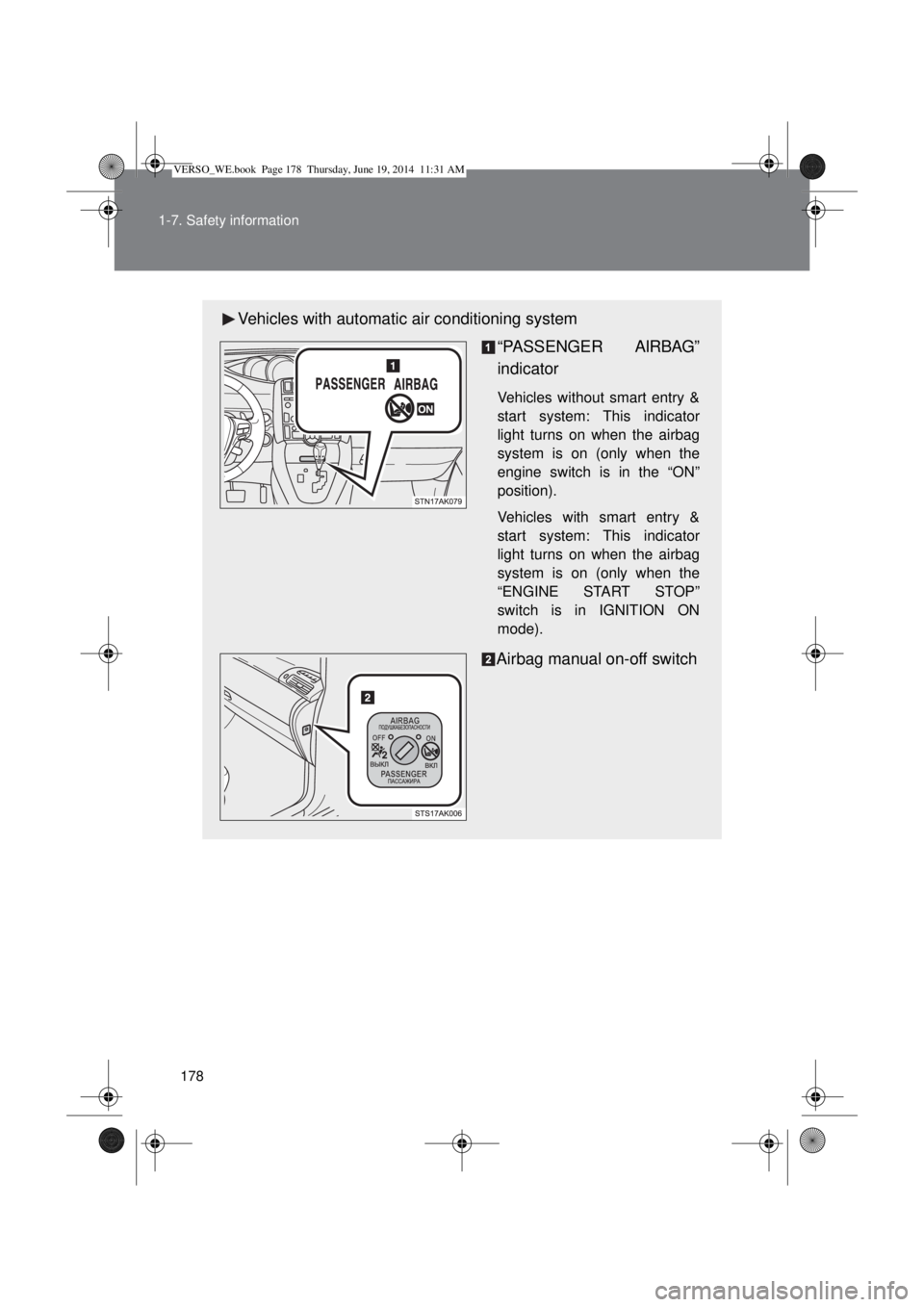
Vehicles with automatic air conditioning system
“PASSENGER AIRBAG”
indicator
Vehicles without smart entry &
start system: This indicator
light turns on when the airbag
system is on (only when the
engine switch is in the “ON”
position).
Vehicles with smart entry &
start system: This indicator
light turns on when the airbag
system is on (only when the
“ENGINE START STOP”
switch is in IGNITION ON
mode).
Airbag manual on-off switch
VERSO_WE.book Page 178 Thursday, June 19, 2014 11:31 AM
Page 185 of 650

185 2-1. Driving procedures
2
When driving
Engine speed while driving (vehicles with a Multidrive or an automatic
transmission)
In the following conditions, the engine speed may become high while driving.
This is due to automatic up-shifting control or down-shifting implementation
to meet driving conditions. It does not indicate sudden acceleration.
The vehicle is judged to be driving uphill or downhill
When the accelerator pedal is released
When the brake pedal is depressed while “SPORT” mode is selected
Breaking in your new Toyota
To extend the life of the vehicle, the following precautions are recommended
to observe:
For the first 300 km (200 miles):
Avoid sudden stops.
For the first 800 km (500 miles):
Do not tow a trailer.
For the first 1000 km (600 miles):
• Do not drive at extremely high speeds.
• Avoid sudden acceleration.
• Do not drive continuously in the low gears.
• Do not drive at a constant speed for extended periods.
Drum-in-disc type parking brake system
Your vehicle has a drum-in-disc type parking brake system. This type of
brake system needs bedding-down of the brake shoes periodically or when-
ever the parking brake shoes and/or drum are replaced. Have any autho-
rized Toyota dealer or repairer, or another duly qualified and equipped
professional, perform the bedding down.
VERSO_WE.book Page 185 Thursday, June 19, 2014 11:31 AM
Page 195 of 650

195 2-1. Driving procedures
2
When driving
NOTICE
When encountering flooded roads
Do not drive on a road that has flooded after heavy rain etc. Doing so may
cause the following serious damage to the vehicle.
Engine stalling
Short in electrical components
Engine damage caused by water immersion
In the event that you drive on a flooded road and the vehicle is flooded, be
sure to have any authorized Toyota dealer or repairer, or another duly quali-
fied and equipped professional check the following.
Brake function
Changes in quantity and quality of engine oil, transmission fluid, etc.
Lubricant condition for the bearings and suspension joints (where possi-
ble) and the function of all joints, bearings, etc.
VERSO_WE.book Page 195 Thursday, June 19, 2014 11:31 AM
Page 203 of 650
203 2-1. Driving procedures
2
When driving
If the engine does not start
The engine immobilizer system may not have been deactivated. (P. 124)
Contact any authorized Toyota dealer or repairer, or another duly qualified
and equipped professional.
Steering lock
When the “ENGINE START STOP” switch is turned off and then a door is
opened and closed, the steering lock function locks the steering wheel in its
current position. The steering lock is disabled when the “ENGINE START
STOP” switch is operated again.
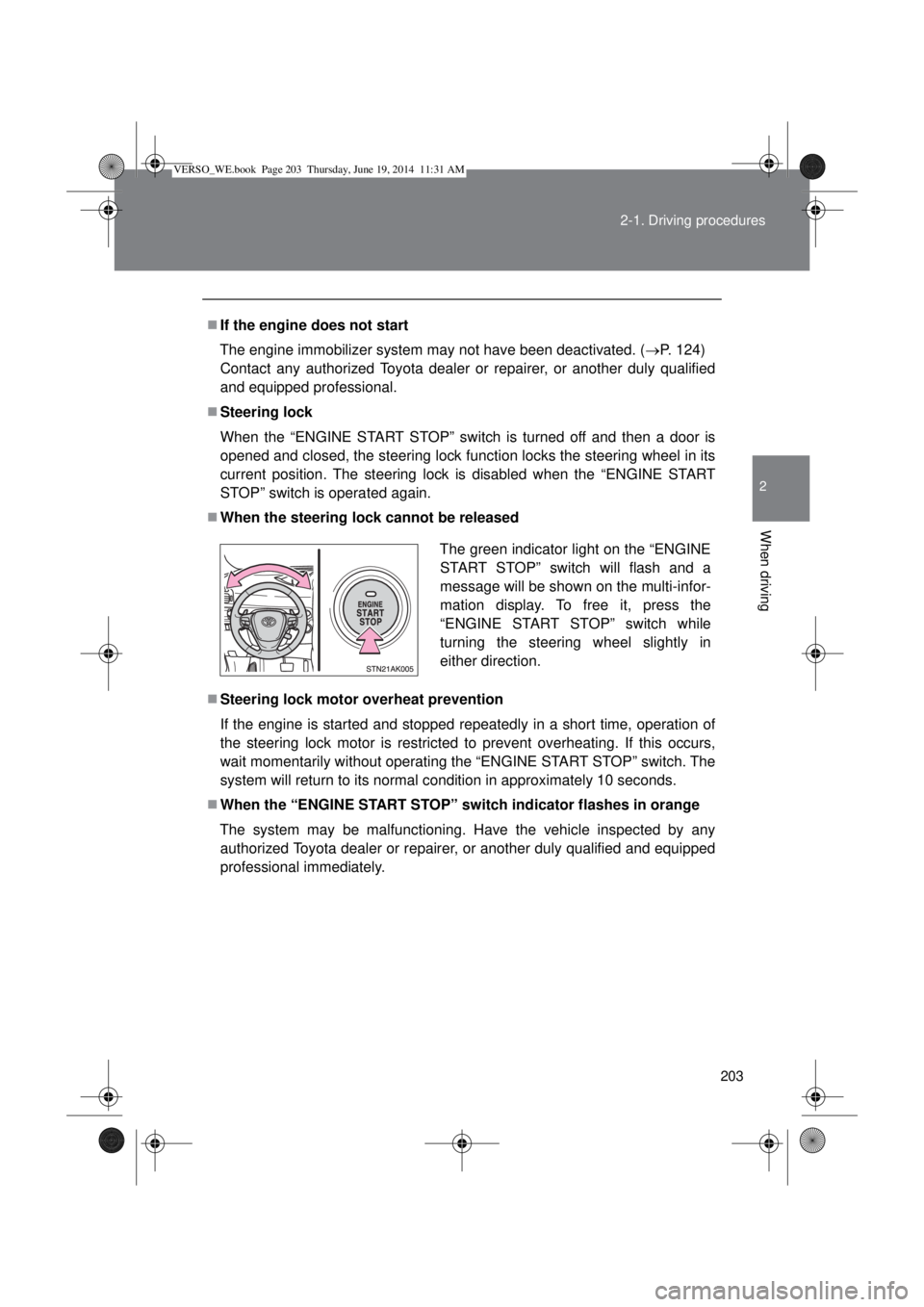
When the steering lock cannot be released
Steering lock motor overheat prevention
If the engine is started and stopped repeatedly in a short time, operation of
the steering lock motor is restricted to prevent overheating. If this occurs,
wait momentarily without operating the “ENGINE START STOP” switch. The
system will return to its normal condition in approximately 10 seconds.
When the “ENGINE START STOP” switch indicator flashes in orange
The system may be malfunctioning. Have the vehicle inspected by any
authorized Toyota dealer or repairer, or another duly qualified and equipped
professional immediately.The green indicator light on the “ENGINE
START STOP” switch will flash and a
message will be shown on the multi-infor-
mation display. To free it, press the
“ENGINE START STOP” switch while
turning the steering wheel slightly in
either direction.
VERSO_WE.book Page 203 Thursday, June 19, 2014 11:31 AM
Page 205 of 650
205 2-1. Driving procedures
2
When driving
CAUTION
Caution while driving
If the vehicle is coasting without engine power, for example if the engine
stalls, do not open a door or operate the locks until the vehicle is completely
stopped in a safe condition. Driving with the steering locked may cause an
accident, resulting in death or serious injury.
Stopping the engine in an emergency
If you want to stop the engine in an emergency while driving the vehicle,
press and hold the “ENGINE START STOP” switch for more than 2 seconds,
or press it briefly 3 times or more in succession. (P. 595)
However, do not touch the “ENGINE START STOP” switch while driving
except in an emergency. Turning the engine off while driving will not cause
loss of steering or braking control, but the power assist to these systems will
be lost. This will make it more difficult to steer and brake, so you should pull
over and stop the vehicle as soon as it is safe to do so.
NOTICE
To prevent battery discharge
Do not leave the “ENGINE START STOP” switch in ACCESSORY or IGNI-
TION ON mode for long periods without the engine running.
When starting the engine
Do not race a cold engine.
If the engine becomes difficult to start or stalls frequently, have your vehi-
cle checked by any authorized Toyota dealer or repairer, or another duly
qualified and equipped professional immediately.
“ENGINE START STOP” switch operation
If you feel something catching or sense irregular resistance when operating
the “ENGINE START STOP” switch, then there may be a malfunction. Imme-
diately contact any authorized Toyota dealer or repairer, or another duly
qualified and equipped professional.
VERSO_WE.book Page 205 Thursday, June 19, 2014 11:31 AM