light TOYOTA VERSO 2014 User Guide
[x] Cancel search | Manufacturer: TOYOTA, Model Year: 2014, Model line: VERSO, Model: TOYOTA VERSO 2014Pages: 650, PDF Size: 36.61 MB
Page 27 of 650
27
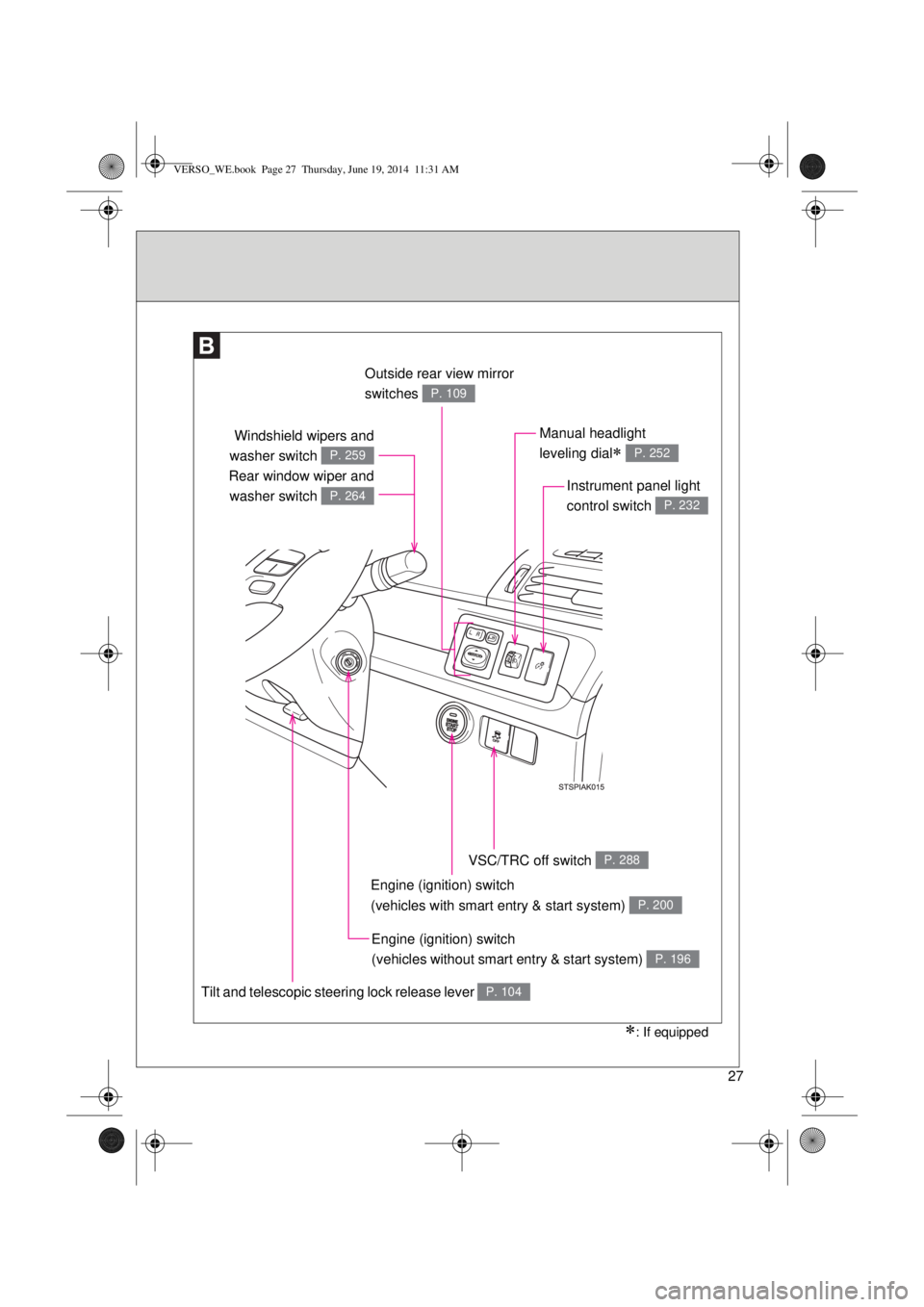
Outside rear view mirror
switches
P. 109
Manual headlight
leveling dial
P. 252
VSC/TRC off switch P. 288
Tilt and telescopic steering lock release lever P. 104
Engine (ignition) switch
(vehicles with smart entry & start system)
P. 200
Engine (ignition) switch
(vehicles without smart entry & start system)
P. 196
Windshield wipers and
washer switch
Rear window wiper and
washer switch
P. 259
P. 264Instrument panel light
control switch
P. 232
: If equipped
VERSO_WE.book Page 27 Thursday, June 19, 2014 11:31 AM
Page 31 of 650
31
: If equipped
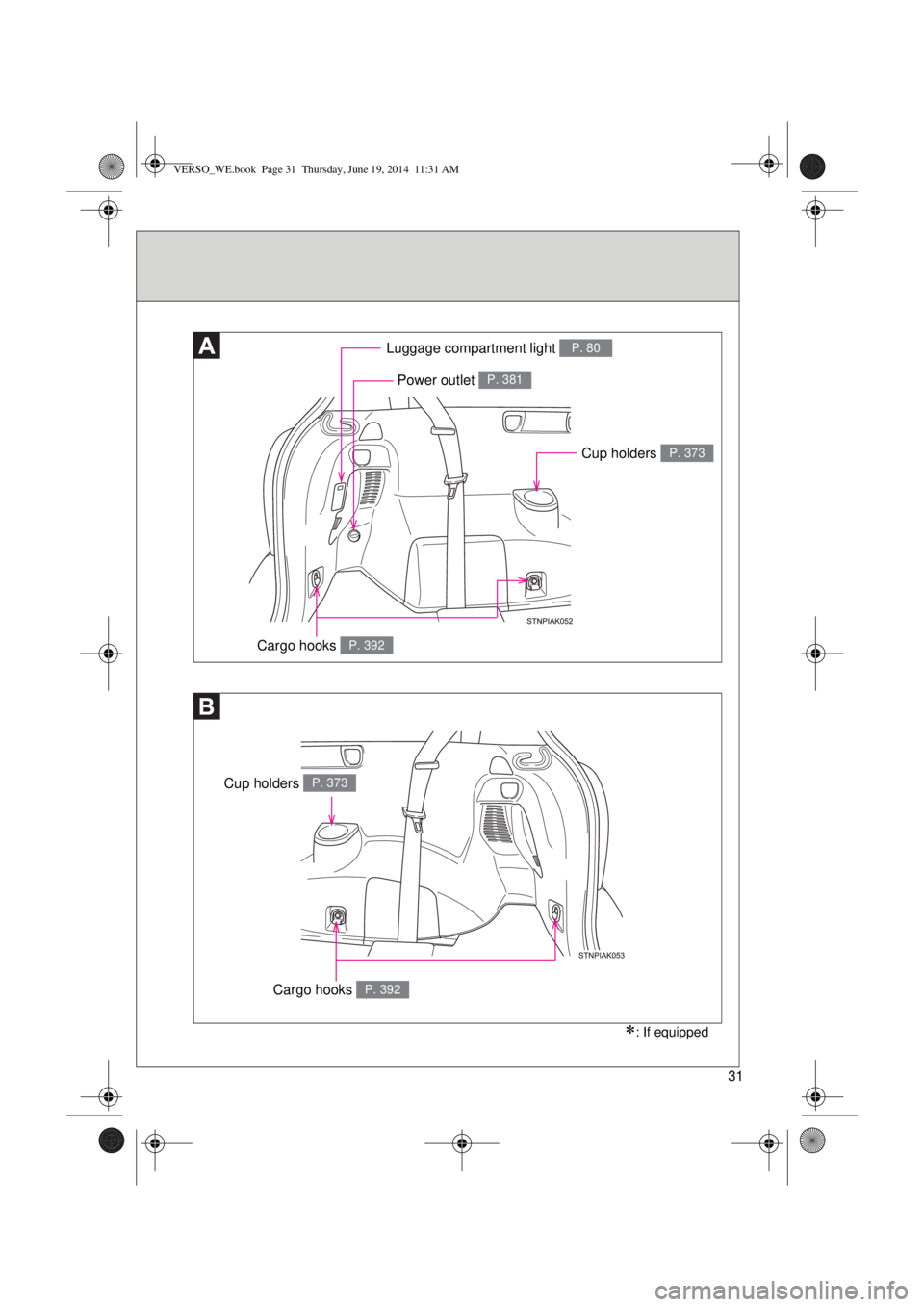
Luggage compartment light P. 80
Cargo hooks P. 392
Power outlet P. 381
Cargo hooks P. 392
Cup holders P. 373
Cup holders P. 373
VERSO_WE.book Page 31 Thursday, June 19, 2014 11:31 AM
Page 34 of 650
34
CAUTION
General precautions while driving
Driving under the influence: Never drive your vehicle when under the influ-
ence of alcohol or drugs that have impaired your ability to operate your vehi-
cle. Alcohol and certain drugs delay reaction time, impair judgment and
reduce coordination, which could lead to an accident that could result in
death or serious injury.
Defensive driving: Always drive defensively. Anticipate mistakes that other
drivers or pedestrians might make and be ready to avoid accidents.
Driver distraction: Always give your full attention to driving. Anything that dis-
tracts the driver, such as adjusting controls, talking on a cellular phone or
reading can result in a collision with resulting death or serious injury to you,
your occupants or others.
General precautions regarding children’s safety
Never leave children unattended in the vehicle, and never allow children to
have or use the key.
Children may be able to start the vehicle or shift the vehicle into neutral.
There is also a danger that children may injure themselves by playing with
the cigarette lighter, the windows, or other features of the vehicle. In addi-
tion, heat build-up or extremely cold temperatures inside the vehicle can be
fatal to children.
Your vehicle contains batteries and/or accumulators. Do not discard
them into the environment but cooperate with separate collection
(Directive 2006/66/EC).
VERSO_WE.book Page 34 Thursday, June 19, 2014 11:31 AM
Page 41 of 650
41 1-1. Key information
1
Before driving
NOTICE
To prevent key damage (vehicles without smart entry & start system)
Do not subject the keys to strong shocks, expose them to high tempera-
tures by placing them in direct sunlight, or get them wet.
Do not expose the keys to electromagnetic materials or attach any mate-
rial that blocks electromagnetic waves to the key surface.
Do not disassemble the key.
To prevent key damage (vehicles with smart entry & start system)
The electronic key is a precision instrument. Be sure to observe the follow-
ing.
Do not drop the keys, subject them to strong shocks or bend them.
Do not expose the keys to high temperatures for a long period of time.
Do not get the keys wet or wash them in an ultrasonic washer etc.
Do not attach metallic or magnetic materials to the keys or place the keys
close to such materials.
Do not disassemble the electronic key.
Do not put a sticker or equivalent on the key surface.
Do not place the key near objects that produce magnetic fields, such as
TVs, audio systems, induction cookers, or medical electrical equipment,
such as low-frequency therapy equipment.
When carrying the keys (vehicles with smart entry & start system)
Do not place the key within 0.1 m (0.33 ft.) of any other electric appliances
when their power is on. Otherwise, the key may not operate properly due to
radio wave interference from the appliances.
When bringing the vehicle to your Toyota dealer or repairer, or another
duly qualified and equipped professional due to problems with the
smart entry & start system (vehicles with smart entry & start system)
Bring in all electronic keys of the vehicle.
When the key is lost
If a key is lost, there is a high risk of the vehicle being stolen. Bring all
remaining electric keys and immediately consult your Toyota dealer or
repairer, or another duly qualified and equipped professional.
VERSO_WE.book Page 41 Thursday, June 19, 2014 11:31 AM
Page 47 of 650
47 1-2. Opening, closing and locking the doors
1
Before driving
Electronic key battery depletion
The standard battery life is 1 to 2 years.
If the battery becomes low, an alarm will sound in the cabin when the
engine stops. (P. 530)
Since the electronic key receives radio waves all the time, the key battery
will be depleted even when the electronic key is not being used. If any of
the following problems occurs, it is assumed that the key battery has
been depleted. Replace it with a new battery.
• The smart entry & start system or wireless remote control does not
work
• The operating range has narrowed
• The electronic key LED light does not come on
To prevent the electronic key battery from being depleted significantly, do
not place the key within 1 m (3 ft.) of the following electrical appliances,
which produce magnetism.
• TVs
• Personal computers
• Mobile and cordless phones, and their battery chargers
• Lamps
• Induction cookers
To operate the system properly
Make sure to carry the electronic key when operating the system.
Note for electronic key operation
Do not get the electronic key too close to the vehicle when operating the
system from the outside of the vehicle. Depending on the position and
holding conditions of the electronic key, the key may not be detected cor-
rectly and the system may not operate properly. (The alarm may go off
accidentally, or the door lock prevention may not function.)
Even when the electronic key is within the effective range (detection
areas), the system may not operate properly in the following cases.
• When locking or unlocking the doors, the electronic key is too close to
a door window or door handle, near the ground, or in a high place.
• The electronic key is on the instrument panel, interior floor, or in a door
pocket, or inside the glove box.
VERSO_WE.book Page 47 Thursday, June 19, 2014 11:31 AM
Page 80 of 650
80 1-2. Opening, closing and locking the doors
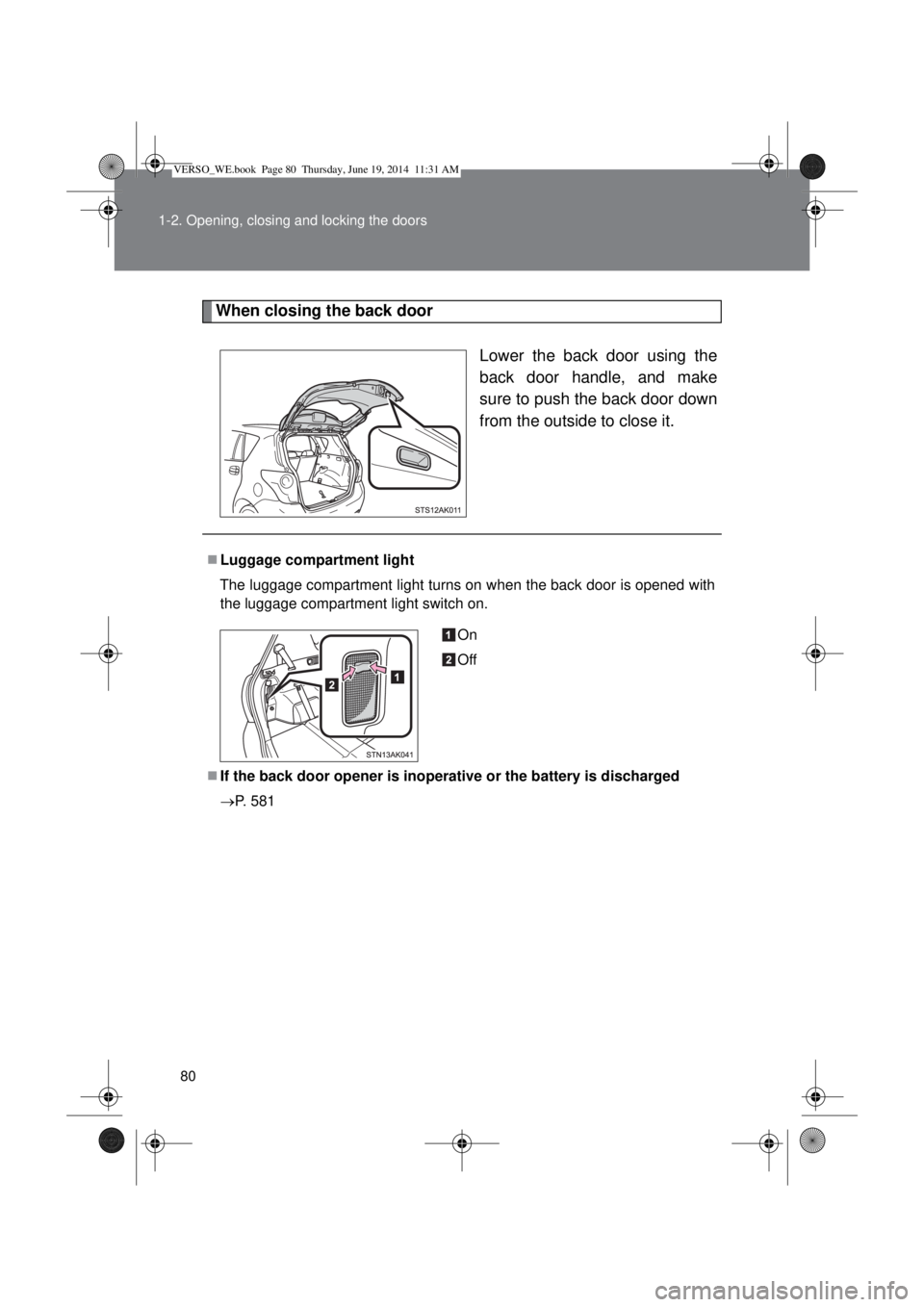
When closing the back door
Lower the back door using the
back door handle, and make
sure to push the back door down
from the outside to close it.
Luggage compartment light
The luggage compartment light turns on when the back door is opened with
the luggage compartment light switch on.
If the back door opener is inoperative or the battery is discharged
P. 581On
Off
VERSO_WE.book Page 80 Thursday, June 19, 2014 11:31 AM
Page 82 of 650
82 1-2. Opening, closing and locking the doors
CAUTION
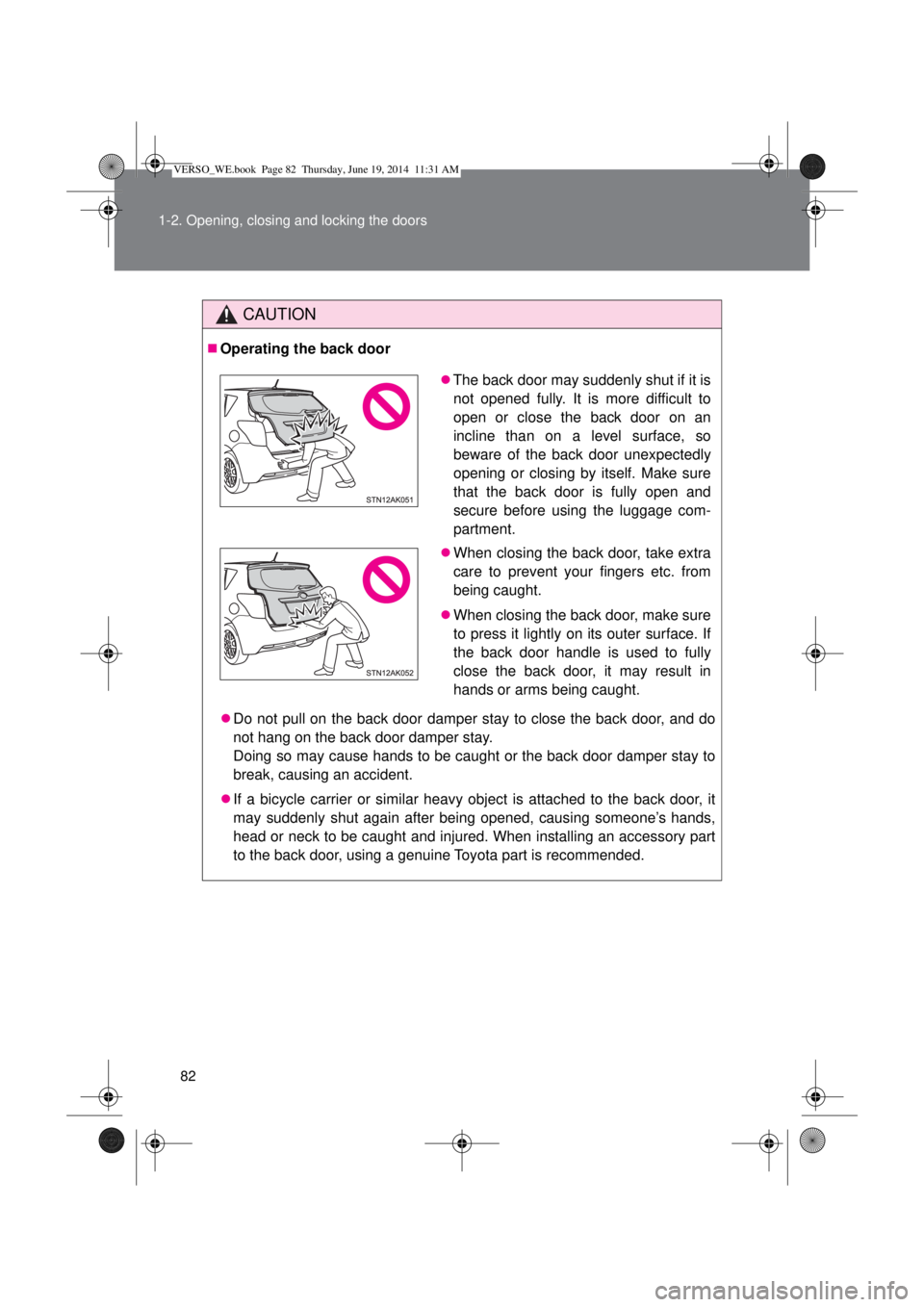
Operating the back door
Do not pull on the back door damper stay to close the back door, and do
not hang on the back door damper stay.
Doing so may cause hands to be caught or the back door damper stay to
break, causing an accident.
If a bicycle carrier or similar heavy object is attached to the back door, it
may suddenly shut again after being opened, causing someone’s hands,
head or neck to be caught and injured. When installing an accessory part
to the back door, using a genuine Toyota part is recommended.
The back door may suddenly shut if it is
not opened fully. It is more difficult to
open or close the back door on an
incline than on a level surface, so
beware of the back door unexpectedly
opening or closing by itself. Make sure
that the back door is fully open and
secure before using the luggage com-
partment.
When closing the back door, take extra
care to prevent your fingers etc. from
being caught.
When closing the back door, make sure
to press it lightly on its outer surface. If
the back door handle is used to fully
close the back door, it may result in
hands or arms being caught.
VERSO_WE.book Page 82 Thursday, June 19, 2014 11:31 AM
Page 84 of 650
84
1-3. Adjustable components (seats, mirrors, steering wheel)
Front seats
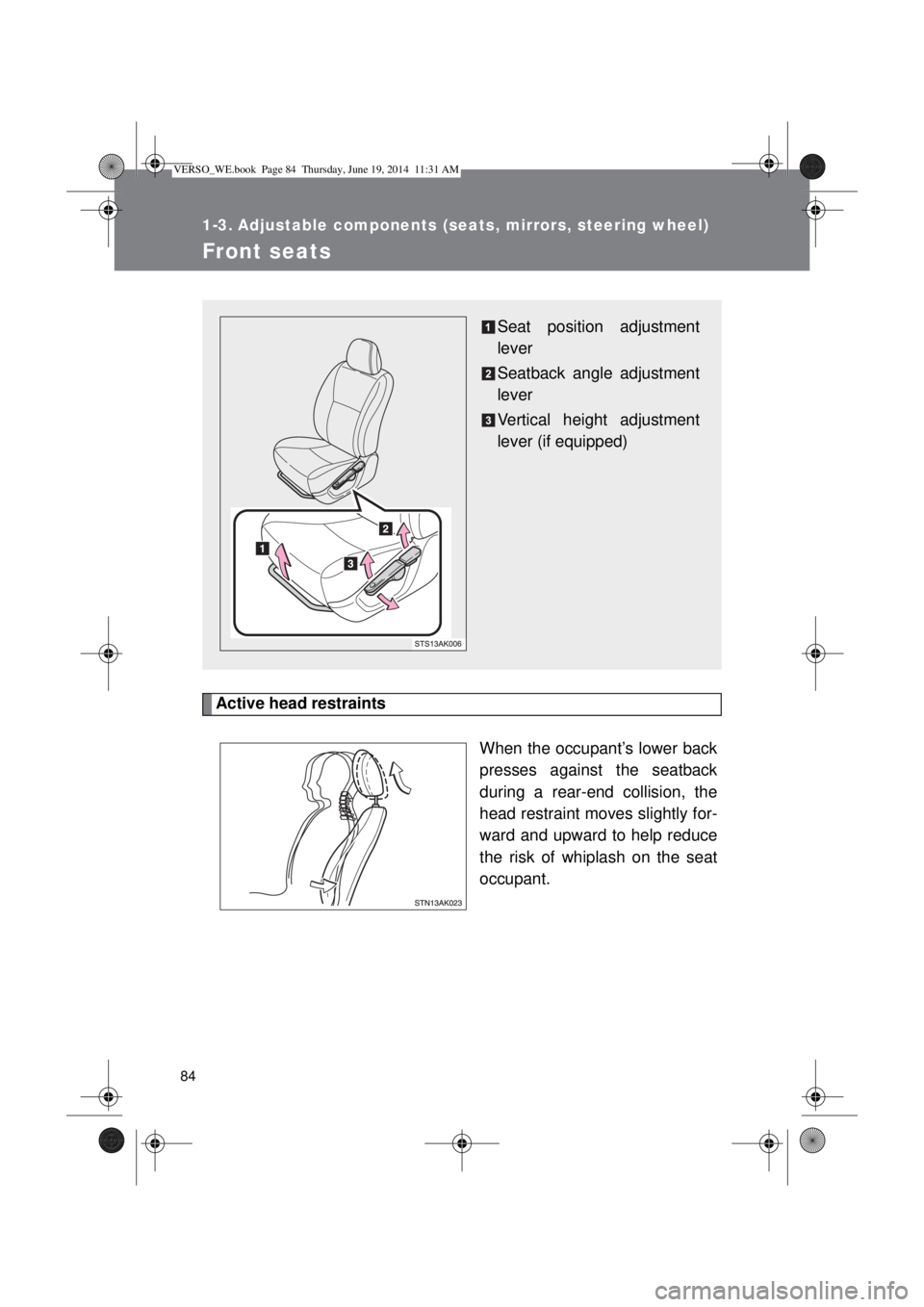
Active head restraints
When the occupant’s lower back
presses against the seatback
during a rear-end collision, the
head restraint moves slightly for-
ward and upward to help reduce
the risk of whiplash on the seat
occupant.
Seat position adjustment
lever
Seatback angle adjustment
lever
Vertical height adjustment
lever (if equipped)
VERSO_WE.book Page 84 Thursday, June 19, 2014 11:31 AM
Page 102 of 650
102 1-3. Adjustable components (seats, mirrors, steering wheel)
CAUTION
When children are in the vehicle
Do not allow children to play with the seat belt. If the seat belt becomes
twisted around a child’s neck, it may lead to choking or other serious injuries
that could result in death.
If this occurs and the buckle cannot be unfastened, scissors should be used
to cut the belt.
Seat belt pretensioners
If the pretensioner has activated, the SRS warning light will come on. In that
case, the seat belt cannot be used again and must be replaced at any autho-
rized Toyota dealer or repairer, or another duly qualified and equipped pro-
fessional.
Adjustable shoulder anchor
Always make sure the shoulder belt is positioned across the center of your
shoulder. The belt should be kept away from your neck, but not falling off
your shoulder. Failure to do so could reduce the amount of protection in an
accident and cause death or serious injuries in the event or a sudden stop,
sudden swerve or accident. (P. 97)
Seat belt damage and wear
Do not damage the seat belts by allowing the belt, plate, or buckle to be
jammed in the door.
Inspect the seat belt system periodically. Check for cuts, fraying, and loose
parts. Do not use a damaged seat belt until it is replaced. Damaged seat
belt cannot protect an occupant from death or serious injury.
Ensure that the belt and plate are locked and the belt is not twisted.
If the seat belt does not function correctly, immediately contact any autho-
rized Toyota dealer or repairer, or another duly qualified and equipped pro-
fessional.
Replace the seat assembly, including the belts, if your vehicle has been
involved in a serious accident, even if there is no obvious damage.
VERSO_WE.book Page 102 Thursday, June 19, 2014 11:31 AM
Page 106 of 650
106 1-3. Adjustable components (seats, mirrors, steering wheel)
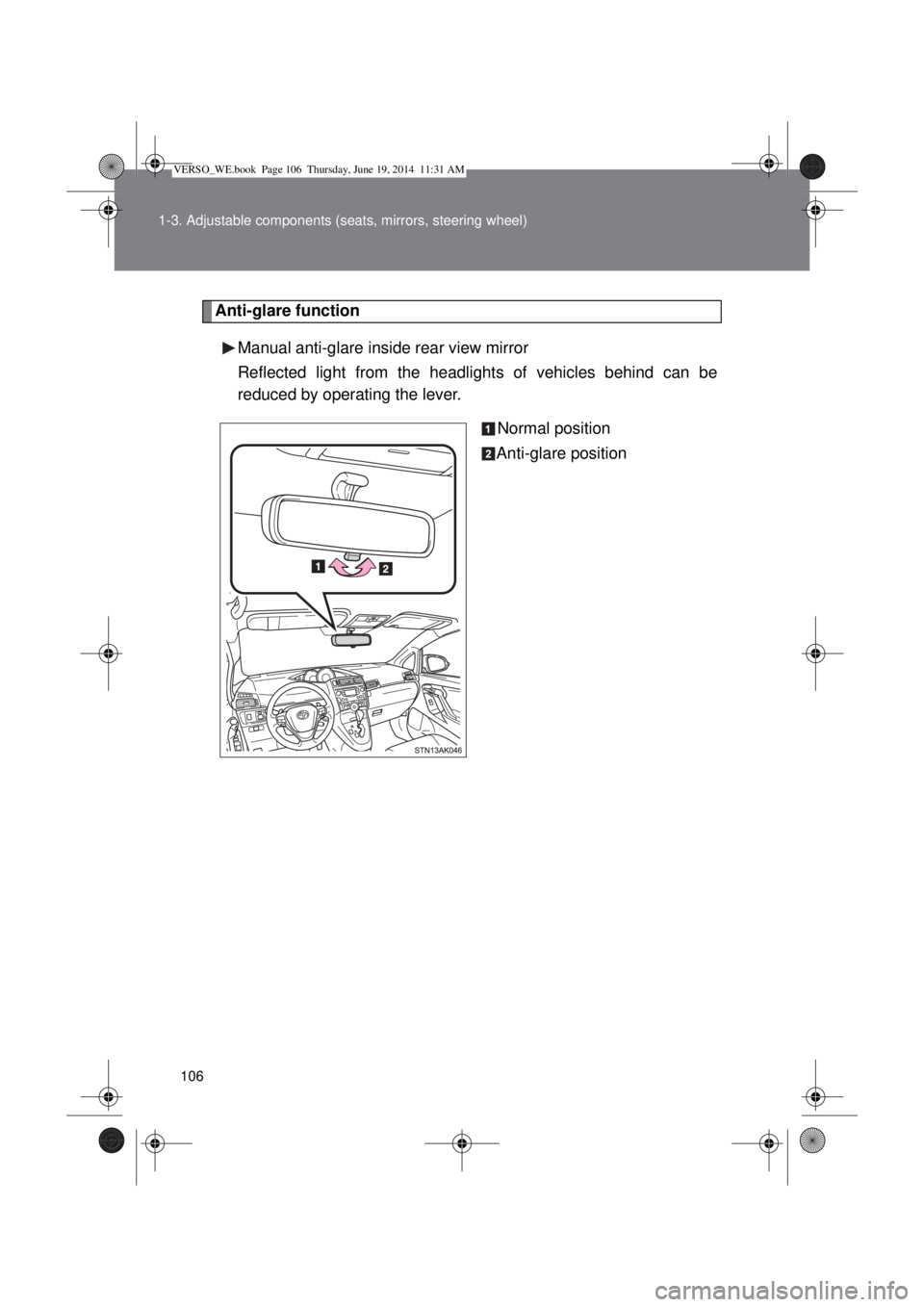
Anti-glare function
Manual anti-glare inside rear view mirror
Reflected light from the headlights of vehicles behind can be
reduced by operating the lever.
Normal position
Anti-glare position
VERSO_WE.book Page 106 Thursday, June 19, 2014 11:31 AM