wheel TOYOTA VERSO 2014 Repair Manual
[x] Cancel search | Manufacturer: TOYOTA, Model Year: 2014, Model line: VERSO, Model: TOYOTA VERSO 2014Pages: 650, PDF Size: 36.61 MB
Page 362 of 650
362
3-2. Using the audio system
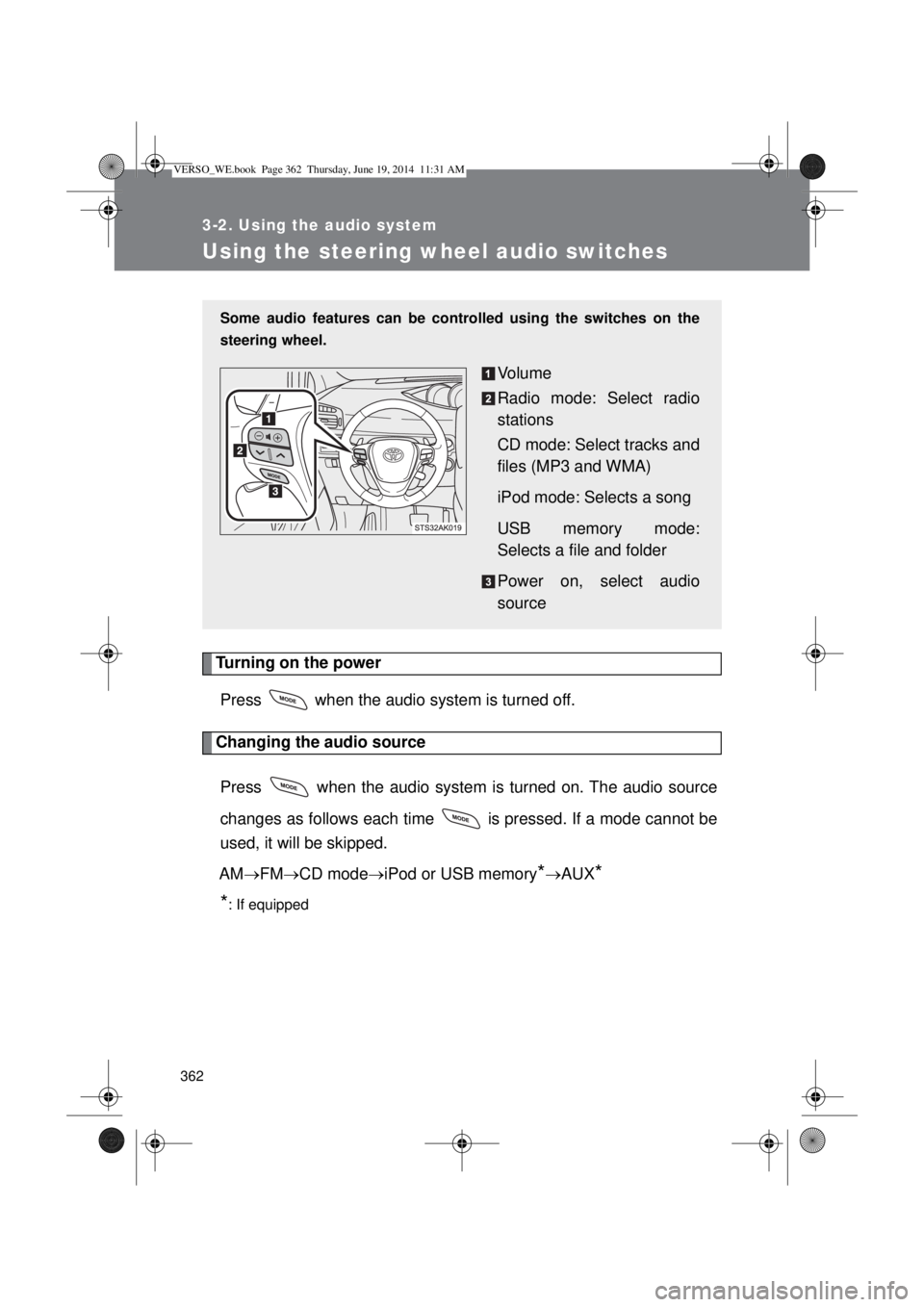
Using the steering wheel audio switches
Turning on the power
Press when the audio system is turned off.
Changing the audio source
Press when the audio system is turned on. The audio source
changes as follows each time is pressed. If a mode cannot be
used, it will be skipped.
AMFMCD modeiPod or USB memory
*AUX*
*
: If equipped
Some audio features can be controlled using the switches on the
steering wheel.
Volume
Radio mode: Select radio
stations
CD mode: Select tracks and
files (MP3 and WMA)
iPod mode: Selects a song
USB memory mode:
Selects a file and folder
Power on, select audio
source
VERSO_WE.book Page 362 Thursday, June 19, 2014 11:31 AM
Page 364 of 650

364 3-2. Using the audio system
CAUTION
To reduce the risk of an accident
Exercise care when operating the audio switches on the steering wheel.
VERSO_WE.book Page 364 Thursday, June 19, 2014 11:31 AM
Page 401 of 650
4Maintenance and care
401
4-1. Maintenance and care
Cleaning and protecting
the vehicle exterior ......... 402
Cleaning and protecting
the vehicle interior .......... 406
4-2. Maintenance
Maintenance
requirements................... 409
4-3. Do-it-yourself maintenance
Do-it-yourself service
precautions ..................... 412
Hood ................................. 416
Positioning a floor jack ...... 418
Engine compartment......... 420
Tires .................................. 443
Tire inflation pressure ....... 457
Wheels .............................. 459
Air conditioning filter ......... 462
Key battery........................ 465
Checking and replacing
fuses ............................... 469
Light bulbs ........................ 484
VERSO_WE.book Page 401 Thursday, June 19, 2014 11:31 AM
Page 402 of 650
402
4-1. Maintenance and care
Cleaning and protecting the vehicle exterior
Automatic car washes
Fold the mirrors and remove the antenna before washing the vehicle.
Start washing from the front of the vehicle. Make sure to re-install the
antenna and extend the mirrors before driving.
Brushes used in automatic car washes may scratch the vehicle surface
and harm your vehicle’s paint.
Vehicles with rain-sensing windshield wipers: Turn the wipers off before
washing the vehicle. (P. 403)
High pressure car washes
Do not allow the nozzles of the car wash to come within close proximity
of the windows.
Before using car wash, check that the fuel filler door on your vehicle is
closed properly. Perform the following to protect the vehicle and maintain it in prime
condition.
Working from top to bottom, liberally apply water to the vehicle
body, wheel wells and underside of the vehicle to remove any
dirt and dust.
Wash the vehicle body using a sponge or soft cloth, such as a
chamois.
For hard-to-remove marks, use car wash soap and rinse thor-
oughly with water.
Wipe away any water.
Wax the vehicle when the waterproof coating deteriorates.
If water does not bead on a clean surface, apply wax when the vehicle
body is cool.
VERSO_WE.book Page 402 Thursday, June 19, 2014 11:31 AM
Page 403 of 650
403 4-1. Maintenance and care
4
Maintenance and care
Aluminum wheels (if equipped)
Remove any dirt immediately by using a neutral detergent. Do not use
hard brushes or abrasive cleaners. Do not use strong or harsh chemical
cleaners. Use the same mild detergent and wax as used on the paint.
Do not use detergent on the wheels when they are hot, for example after
driving for long distance in the hot weather.
Wash detergent from the wheels immediately after use.
Bumpers and side moldings
Do not scrub with abrasive cleaners.
CAUTION
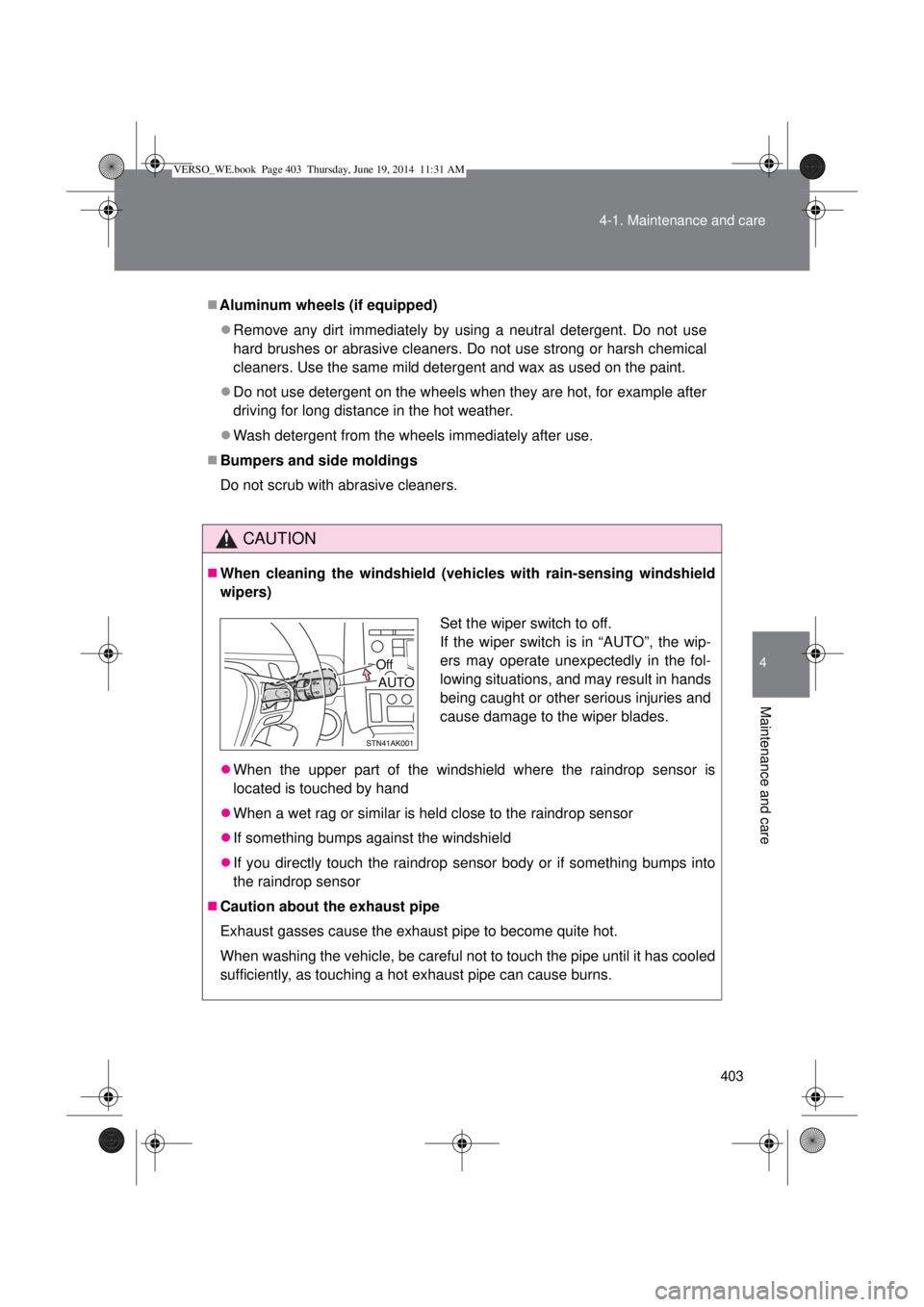
When cleaning the windshield (vehicles with rain-sensing windshield
wipers)
When the upper part of the windshield where the raindrop sensor is
located is touched by hand
When a wet rag or similar is held close to the raindrop sensor
If something bumps against the windshield
If you directly touch the raindrop sensor body or if something bumps into
the raindrop sensor
Caution about the exhaust pipe
Exhaust gasses cause the exhaust pipe to become quite hot.
When washing the vehicle, be careful not to touch the pipe until it has cooled
sufficiently, as touching a hot exhaust pipe can cause burns.
Set the wiper switch to off.
If the wiper switch is in “AUTO”, the wip-
ers may operate unexpectedly in the fol-
lowing situations, and may result in hands
being caught or other serious injuries and
cause damage to the wiper blades.
AUTO
Off
VERSO_WE.book Page 403 Thursday, June 19, 2014 11:31 AM
Page 404 of 650

404 4-1. Maintenance and care
NOTICE
To prevent paint deterioration and corrosion on the body and compo-
nents (aluminum wheels etc.)
Wash the vehicle immediately in the following cases:
• After driving near the sea coast
• After driving on salted roads
• If coal tar or tree sap is present on the paint surface
• If dead insects, insect droppings or bird droppings are present on the
paint surface
• After driving in an area contaminated with soot, oily smoke, mine dust,
iron powder or chemical substances
• If the vehicle becomes heavily soiled in dust or mud
• If liquids such as benzene and gasoline are spilled on the paint surface
If the paint is chipped or scratched, have it repaired immediately.
To prevent the wheels from corroding, remove any dirt and store in a place
with low humidity when storing the wheels.
Cleaning the exterior lights
Wash carefully. Do not use organic substances or scrub with a hard brush.
This may damage the surfaces of the lights.
Do not apply wax on the surfaces of the lights.
Wax may cause damage to the lenses.
Antenna installation and removal precautions
Before driving, ensure that the antenna is installed.
When the antenna is removed, such as before entering an automatic car
wash, make sure to store it in a suitable place so as not to lose it. Also,
before driving, make sure to reinstall the antenna in its original position.
To prevent damage to the windshield wiper arms
When lifting the wiper arms away from the windshield pull the driver side
wiper arm upward first, and repeat for the passenger side. When returning
the wipers to their original position, do so from the passenger side first.
When using an automatic car wash (vehicles with rain-sensing wind-
shield wipers)
Set the wiper switch to off. If the wiper switch is in “AUTO”, the wipers may
operate and the wiper blades may be damaged.
VERSO_WE.book Page 404 Thursday, June 19, 2014 11:31 AM
Page 443 of 650
443
4-3. Do-it-yourself maintenance
4
Maintenance and care
Tires
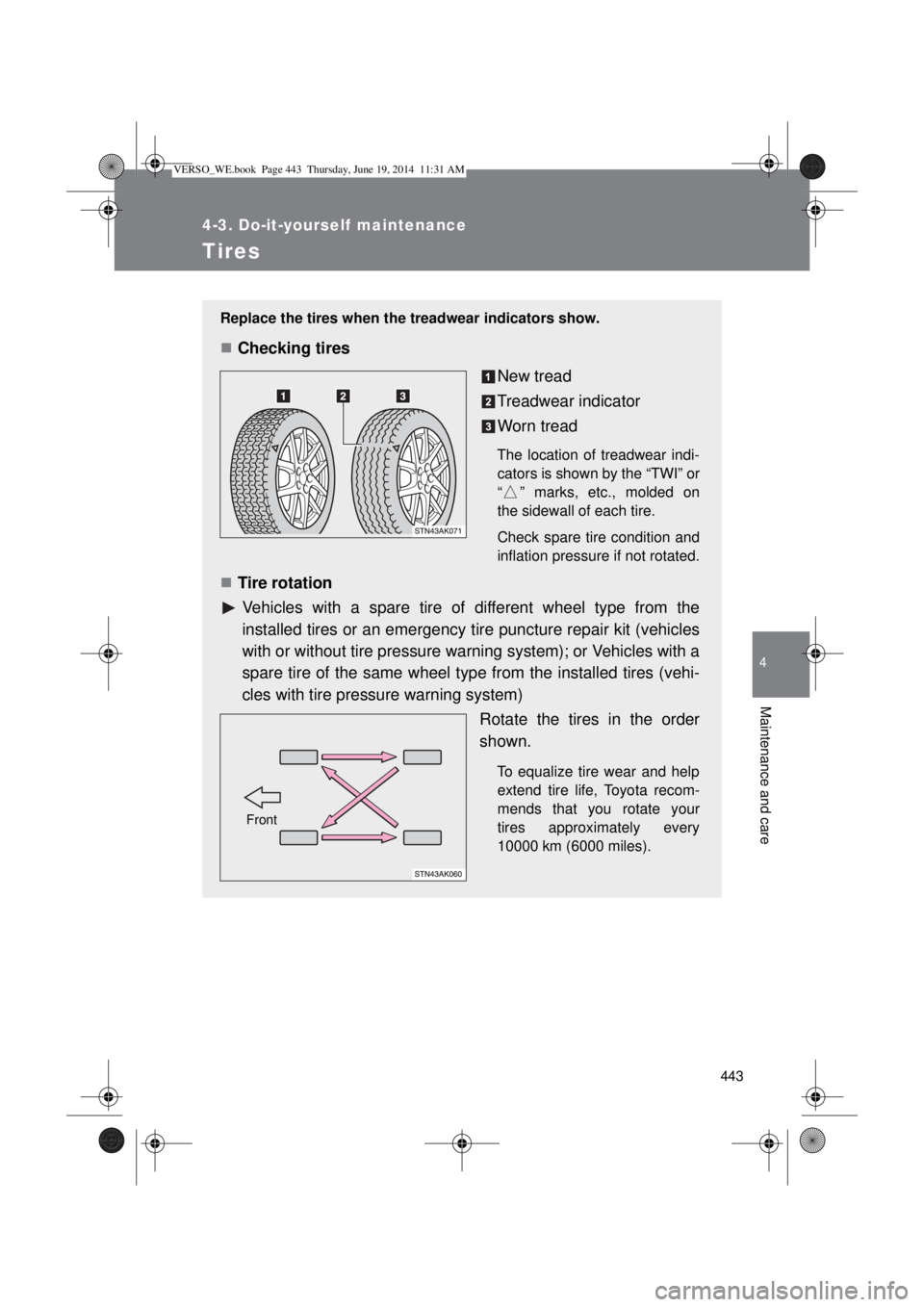
Replace the tires when the treadwear indicators show.
Checking tires
New tread
Treadwear indicator
Worn tread
The location of treadwear indi-
cators is shown by the “TWI” or
“ ” marks, etc., molded on
the sidewall of each tire.
Check spare tire condition and
inflation pressure if not rotated.
Tire rotation
Vehicles with a spare tire of different wheel type from the
installed tires or an emergency tire puncture repair kit (vehicles
with or without tire pressure warning system); or Vehicles with a
spare tire of the same wheel type from the installed tires (vehi-
cles with tire pressure warning system)
Rotate the tires in the order
shown.
To equalize tire wear and help
extend tire life, Toyota recom-
mends that you rotate your
tires approximately every
10000 km (6000 miles).
Front
VERSO_WE.book Page 443 Thursday, June 19, 2014 11:31 AM
Page 444 of 650
444 4-3. Do-it-yourself maintenance
Installing tire pressure warning valves and transmitters (if equipped)
When replacing tires or wheels, tire pressure warning valves and
transmitters must also be installed.
When new tire pressure warning valves and transmitters are
installed, new ID codes must be registered in the tire pressure warn-
ing computer and the tire pressure warning system must be initial-
ized. Have tire pressure warning valve and transmitter ID codes
registered by any authorized Toyota dealer or repairer, or another
duly qualified and equipped professional. (P. 447)
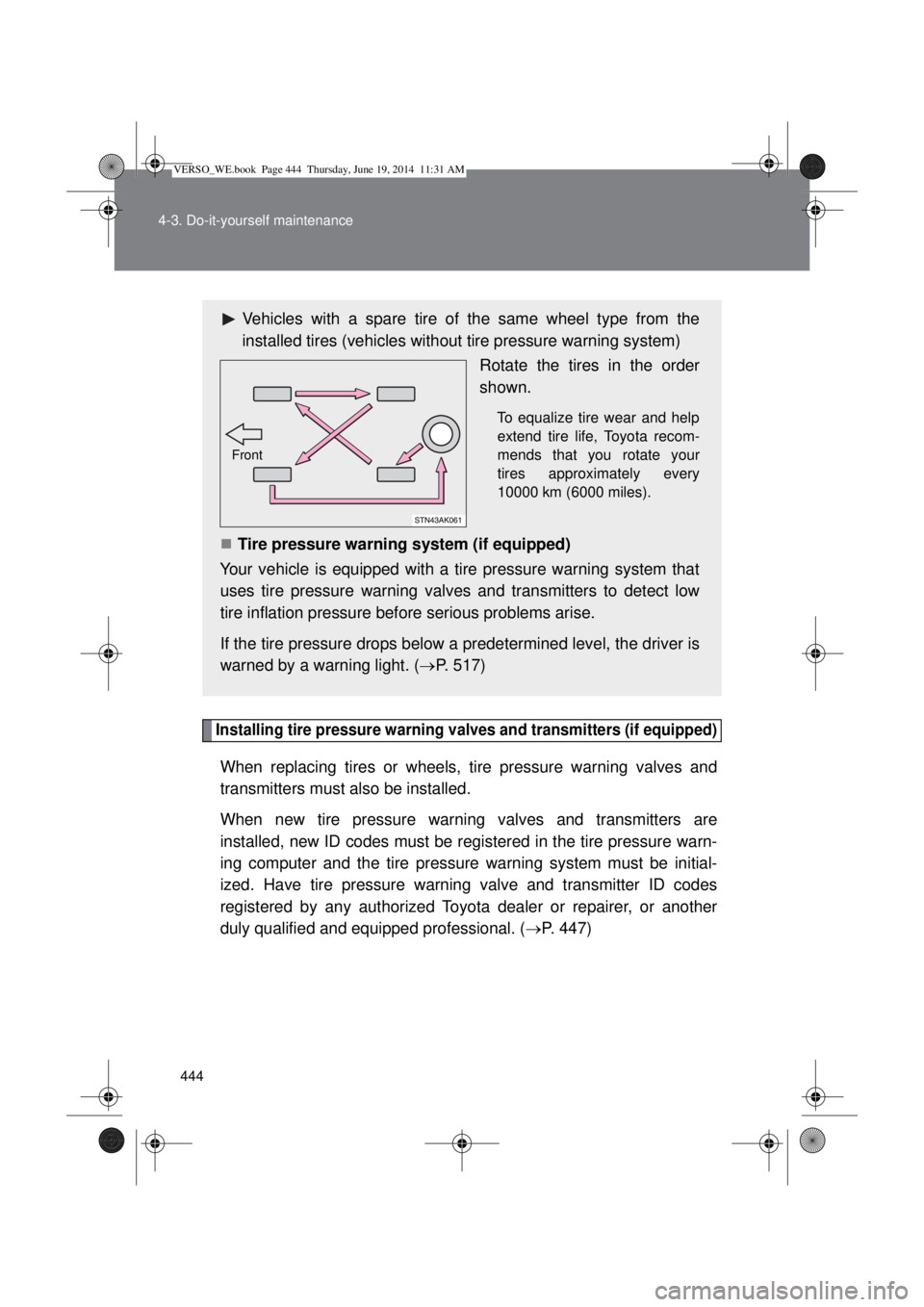
Vehicles with a spare tire of the same wheel type from the
installed tires (vehicles without tire pressure warning system)
Rotate the tires in the order
shown.
To equalize tire wear and help
extend tire life, Toyota recom-
mends that you rotate your
tires approximately every
10000 km (6000 miles).
Tire pressure warning system (if equipped)
Your vehicle is equipped with a tire pressure warning system that
uses tire pressure warning valves and transmitters to detect low
tire inflation pressure before serious problems arise.
If the tire pressure drops below a predetermined level, the driver is
warned by a warning light. (P. 517)
Front
VERSO_WE.book Page 444 Thursday, June 19, 2014 11:31 AM
Page 447 of 650

447 4-3. Do-it-yourself maintenance
4
Maintenance and care
Registering ID codes (vehicles with the tire pressure warning system)
The tire pressure warning valve and transmitter is equipped with a
unique ID code. When replacing a tire pressure warning valve and
transmitter, it is necessary to register the ID code. Have the ID code
registered by any authorized Toyota dealer or repairer, or another
duly qualified and equipped professional.
When to replace your vehicle’s tires
Tires should be replaced if:
You have tire damage such as cuts, splits, cracks deep enough to
expose the fabric or bulges indicating internal damage
A tire goes flat repeatedly or cannot be properly repaired due to the size
or location of a cut or other damage
If you are not sure, consult with any authorized Toyota dealer or repairer, or
another duly qualified and equipped professional.
Replacing tire and wheels (vehicles with the tire pressure warning sys-
tem)
If the ID code of the tire pressure warning valve and transmitter is not regis-
tered, the tire pressure warning system will not work properly. After driving
for about 10 minutes, the tire pressure warning light blinks for 1 minute and
stays on to indicate a system malfunction.
Tire life
Any tires over 6 years old must be checked by a qualified technician even if
they have seldom or never been used or damage is not obvious.
VERSO_WE.book Page 447 Thursday, June 19, 2014 11:31 AM
Page 456 of 650

456 4-3. Do-it-yourself maintenance
NOTICE
Repairing or replacing tires, wheels, tire pressure warning valves,
transmitters and tire valve caps (vehicles with the tire pressure warn-
ing system)
When removing or fitting the wheels, tires or the tire pressure warning
valves and transmitters, contact any authorized Toyota dealer or repairer,
or another duly qualified and equipped professional as the tire pressure
warning valves and transmitters may be damaged if not handled correctly.
Make sure to install the tire valve caps. If the tire valve caps are not
installed, water could enter the tire pressure warning valves and the tire
pressure warning valves could be bound.
When replacing tire valve caps, do not use tire valve caps other than those
specified. The cap may become stuck.
To avoid damage to the tire pressure warning valves and transmitters
(vehicles with the tire pressure warning system)
When a tire is repaired with liquid sealants, the tire pressure warning valve
and transmitter may not operate properly. If a liquid sealant is used, contact
any authorized Toyota dealer or repairer, or another duly qualified and
equipped professional or other qualified service shop as soon as possible.
Make sure to replace the tire pressure warning valve and transmitter when
replacing the tire. (P. 444)
Driving on rough roads
Take particular care when driving on roads with loose surfaces or pot holes.
These conditions may cause losses in tire inflation pressure, reducing the
cushioning ability of the tires. In addition driving on rough roads may cause
damage to the tires themselves, as well as the vehicle’s wheels and body.
If tire inflation pressures become low while driving
Do not continue driving, or your tires and/or wheels may be ruined.
VERSO_WE.book Page 456 Thursday, June 19, 2014 11:31 AM