roof TOYOTA VERSO 2015 User Guide
[x] Cancel search | Manufacturer: TOYOTA, Model Year: 2015, Model line: VERSO, Model: TOYOTA VERSO 2015Pages: 650, PDF Size: 36.61 MB
Page 116 of 650
116 1-4. Opening and closing the windows and panoramic roof shade
CAUTION
When closing the panoramic roof shade
Observe the following precautions.
Failing to do so may result in death or serious injury.
Check to make sure that all passengers do not have any part of their bod-
ies in a position where they could be caught when the panoramic roof
shade is being operated.
Do not allow children to operate the panoramic roof shade.
Closing the panoramic roof shade on someone can cause death or serious
injury. The driver is responsible for instructing children not to operate the
panoramic roof shade.
Jam protection function
Never try jamming any part of your body to activate the jam protection
function intentionally.
The jam protection function may not work if something gets caught just
before the panoramic roof shade fully closes.
To prevent burns or injury
Observe the following precautions.
Although the jam protection function has been installed, make sure that
passenger’s hands and faces are not caught in the panoramic roof shade
while it is closing. Also, as there is a chance that the jam protection func-
tion will not react just before closing, make sure not to catch fingers etc. in
the roof.
The opening or closing of the panoramic roof shade can be stopped by
pressing the switch.
If the panoramic roof shade will not close (for example, due to a malfunc-
tion in the jam protection function), the shade can be closed by pressing
and holding the switch.
The jam protection function may operate if a load or impact, similar to that
applied when a foreign object is caught in the roof shade, is applied by
environmental or driving conditions.
The underside of the roof will become hot if the vehicle is left in the direct
sunlight for a long period of time. Do not touch the parts inside the gap
between the roof underside and the roof shade, as you may burn yourself.
VERSO_WE.book Page 116 Thursday, June 19, 2014 11:31 AM
Page 117 of 650
117 1-4. Opening and closing the windows and panoramic roof shade
1
Before driving
CAUTION
To prevent burns or injury
Do not touch any rough or sheared parts of the roof underside, as you may
injure yourself.
NOTICE
To prevent battery discharge
Do not operate the panoramic roof shade when the engine is not running.
To ensure normal operation of the panoramic roof shade
Observe the following precautions:
Do not place excessive load on the motor or other components.
Do not place objects where they may hinder opening and closing opera-
tions.
Do not attach items to the panoramic roof shade.
Keep the opening clean and clear of obstructions.
Do not operate the panoramic roof shade continuously for long periods of
time.
VERSO_WE.book Page 117 Thursday, June 19, 2014 11:31 AM
Page 149 of 650
149 1-7. Safety information
1
Before driving
If the SRS airbags deploy (inflate)
Bruising and slight abrasions may result from contact with a deploying
(inflating) SRS airbag.
A loud noise and white powder will be emitted.
Vehicles without SRS curtain shield airbags: Parts of the airbag module
(steering wheel hub, airbag cover and inflator) as well as the front seats
may be hot for several minutes. The airbag itself may also be hot.
Vehicles with SRS curtain shield airbags: Parts of the airbag module
(steering wheel hub, airbag cover and inflator) as well as the front seats,
parts of the front and rear pillars, and roof side rails, may be hot for sev-
eral minutes. The airbag itself may also be hot.
The windshield may crack.
Operating conditions (SRS front airbags)
The SRS front airbags will deploy in the event of an impact that exceeds
the set threshold level (the level of force corresponding to an approxi-
mately 20-30 km/h [12-18 mph] frontal collision with a fixed wall that does
not move or deform).
However, this threshold velocity will be considerably higher in the following
situations:
• If the vehicle strikes an object, such as a parked vehicle or sign pole,
which can move or deform on impact
• If the vehicle is involved in an underride collision, such as a collision in
which the front of the vehicle “underrides”, or goes under, the bed of a
truck
Depending on the type of collision, it is possible that only the seat belt
pretensioners will activate.
Operating conditions (SRS side airbags and curtain shield airbags [if
equipped])
The SRS side airbags and curtain shield airbags (if equipped) will deploy in
the event of an impact that exceeds the set threshold level (the level of force
corresponding to the impact force produced by an approximately 1500 kg
[3300 lb.] vehicle colliding with the vehicle cabin from a direction perpendicu-
lar to the vehicle orientation at an approximate speed of 20-30 km/h [12-18
mph]).
VERSO_WE.book Page 149 Thursday, June 19, 2014 11:31 AM
Page 153 of 650
153 1-7. Safety information
1
Before driving
CAUTION
SRS airbag precautions
Observe the following precautions regarding the SRS airbags.
Failure to do so may cause death or serious injury.
The driver and all passengers in the vehicle must wear their seat belts
properly.
The SRS airbags are supplemental devices to be used with the seat belts.
The SRS driver airbag deploys with considerable force, and can cause
death or serious injury especially if the driver is very close to the airbag.
Since the risk zone for the driver’s airbag is the first 50 - 75 mm (2 - 3 in.)
of inflation, placing yourself 250 mm (10 in.) from your driver airbag pro-
vides you with a clear margin of safety. This distance is measured from the
center of the steering wheel to your breastbone. If you sit less than 250
mm (10 in.) away now, you can change your driving position in several
ways:
• Move your seat to the rear as far as you can while still reaching the
pedals comfortably.
• Slightly recline the back of the seat.
Although vehicle designs vary, many drivers can achieve the 250 mm
(10 in.) distance, even with the driver seat all the way forward, simply
by reclining the back of the seat somewhat. If reclining the back of your
seat makes it hard to see the road, raise yourself by using a firm, non-
slippery cushion, or raise the seat if your vehicle has that feature.
• If your steering wheel is adjustable, tilt it downward. This points the air-
bag toward your chest instead of your head and neck.
The seat should be adjusted as recommended above, while still maintaining
control of the foot pedals, steering wheel, and your view of the instrument
panel controls.
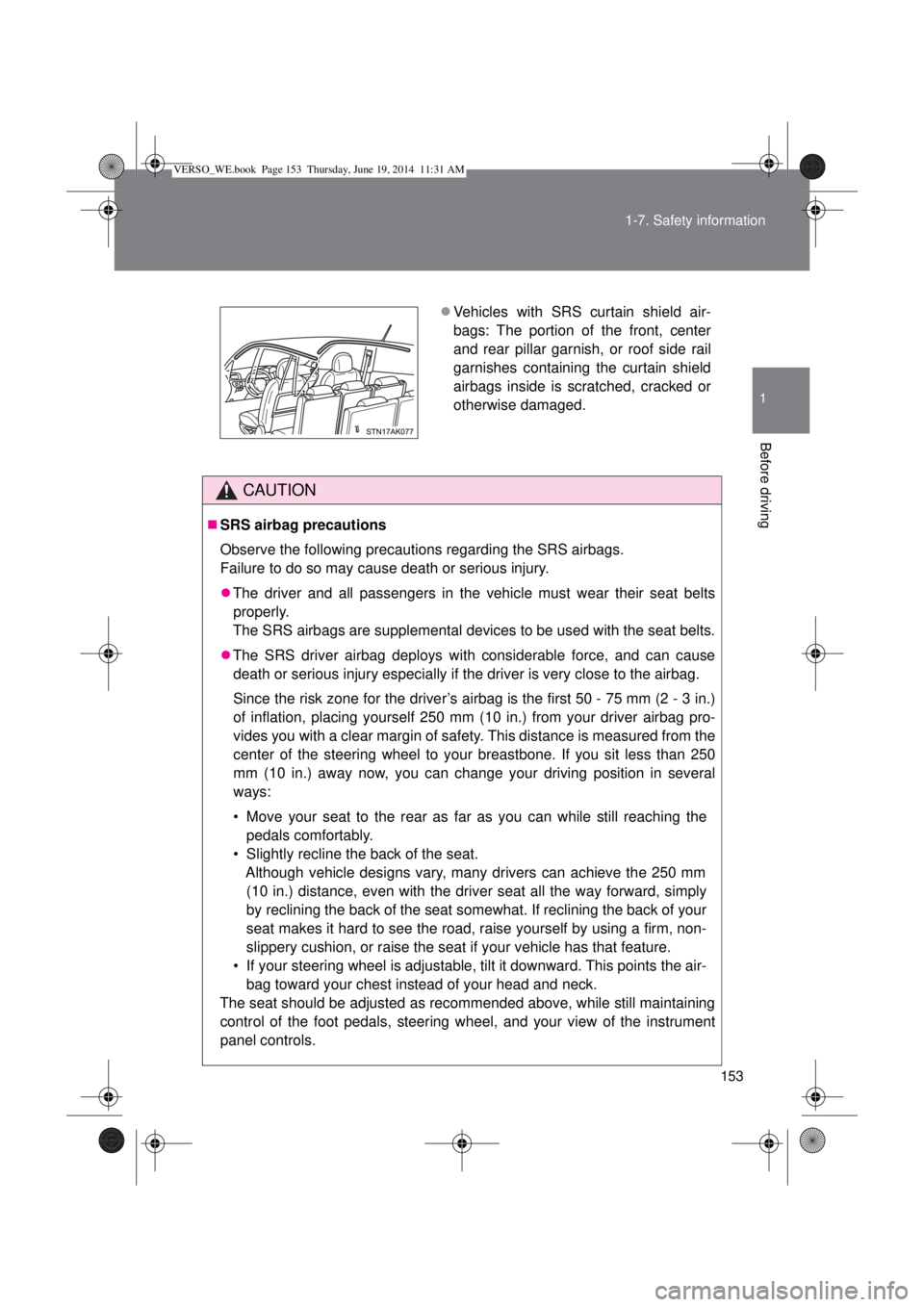
Vehicles with SRS curtain shield air-
bags: The portion of the front, center
and rear pillar garnish, or roof side rail
garnishes containing the curtain shield
airbags inside is scratched, cracked or
otherwise damaged.
VERSO_WE.book Page 153 Thursday, June 19, 2014 11:31 AM
Page 154 of 650
154 1-7. Safety information
CAUTION
SRS airbag precautions
The SRS front passenger airbag also deploys with considerable force, and
can cause death or serious injury especially if the front passenger is very
close to the airbag. The front passenger seat should be as far from the air-
bag as possible with the seatback adjusted, so the front passenger sits
upright.
Improperly seated and/or restrained infants and children can be killed or
seriously injured by a deploying airbag. An infant or child who is too small
to use a seat belt should be properly secured using a child restraint sys-
tem. Toyota strongly recommends that all infants and children be placed in
the rear seats of the vehicle and properly restrained. The rear seats are
safest for infants and children than the front passenger seat. (P. 158)
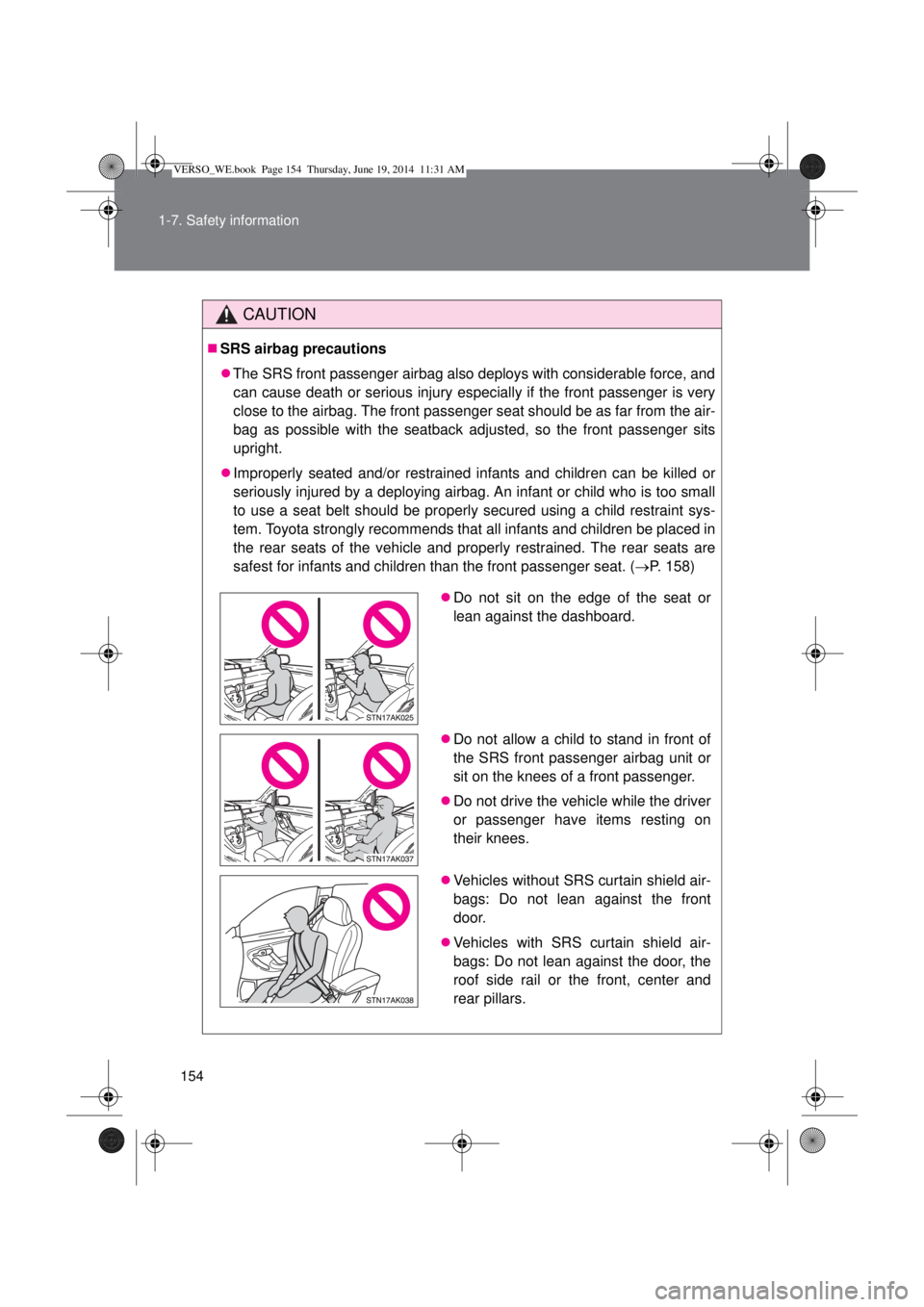
Do not sit on the edge of the seat or
lean against the dashboard.
Do not allow a child to stand in front of
the SRS front passenger airbag unit or
sit on the knees of a front passenger.
Do not drive the vehicle while the driver
or passenger have items resting on
their knees.
Vehicles without SRS curtain shield air-
bags: Do not lean against the front
door.
Vehicles with SRS curtain shield air-
bags: Do not lean against the door, the
roof side rail or the front, center and
rear pillars.
VERSO_WE.book Page 154 Thursday, June 19, 2014 11:31 AM
Page 155 of 650
155 1-7. Safety information
1
Before driving
CAUTION
SRS airbag precautions
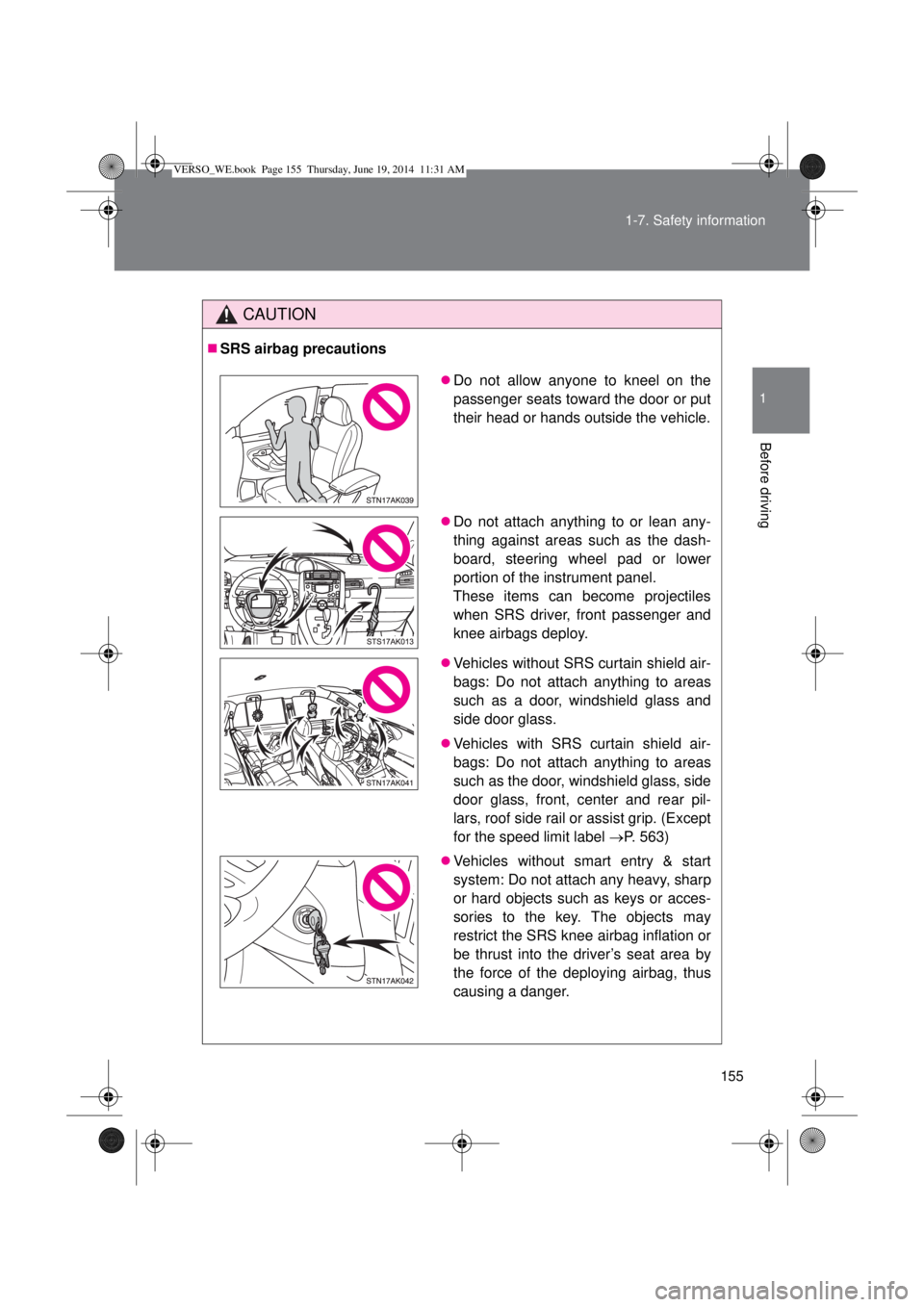
Do not allow anyone to kneel on the
passenger seats toward the door or put
their head or hands outside the vehicle.
Do not attach anything to or lean any-
thing against areas such as the dash-
board, steering wheel pad or lower
portion of the instrument panel.
These items can become projectiles
when SRS driver, front passenger and
knee airbags deploy.
Vehicles without SRS curtain shield air-
bags: Do not attach anything to areas
such as a door, windshield glass and
side door glass.
Vehicles with SRS curtain shield air-
bags: Do not attach anything to areas
such as the door, windshield glass, side
door glass, front, center and rear pil-
lars, roof side rail or assist grip. (Except
for the speed limit label P. 563)
Vehicles without smart entry & start
system: Do not attach any heavy, sharp
or hard objects such as keys or acces-
sories to the key. The objects may
restrict the SRS knee airbag inflation or
be thrust into the driver’s seat area by
the force of the deploying airbag, thus
causing a danger.
VERSO_WE.book Page 155 Thursday, June 19, 2014 11:31 AM
Page 157 of 650
157 1-7. Safety information
1
Before driving
CAUTION
Modification and disposal of SRS airbag system components
Do not dispose of your vehicle or perform any of the following modifications
without consulting any authorized Toyota dealer or repairer, or another duly
qualified and equipped professional.
The SRS airbags may malfunction or deploy (inflate) accidentally, causing
death or serious injury.
Installation, removal, disassembly and repair of the SRS airbags.
Repairs, modifications, removal or replacement of the steering wheel,
instrument panel, dashboard, seats or seat upholstery, front, center and
rear pillars or roof side rail.
Repairs or modifications of the front fender, front bumper, or side of the
occupant compartment.
Installation of a grille guard (bull bars, kangaroo bar, etc.), snow plows or
winches.
Modifications to the vehicle’s suspension system.
Installation of electronic devices such as mobile two-way radio (RF-trans-
mitter) or CD players.
VERSO_WE.book Page 157 Thursday, June 19, 2014 11:31 AM
Page 165 of 650
165 1-7. Safety information
1
Before driving
CAUTION
Child restraint precautions
Vehicles with SRS curtain shield airbags: Do not allow the child to lean his/
her head or any part of his/her body against the door or the area of the
seat, front and rear pillars or roof side rails from which the SRS side air-
bags or SRS curtain shield airbags deploy even if the child is seated in the
child restraint system. It is dangerous if the SRS side airbags and SRS
curtain shield airbags inflate, and the impact could cause death or serious
injury to the child.
Make sure you have complied with all installation instructions provided by
the child restraint manufacturer and that the system is properly secured. If
it is not secured properly, it may cause death or serious injury to the child
in the event of a sudden stop, sudden swerve or an accident.
When children are in the vehicle
Do not allow children to play with the seat belt. If the seat belt becomes
twisted around a child’s neck, it may lead to choking or other serious injuries
that could result in death.
If this occurs and the buckle cannot be unfastened, scissors should be used
to cut the belt.
When the child restraint system is not in use
Keep the child restraint system properly secured on the seat even if it is
not in use. Do not store the child restraint system unsecured in the pas-
senger compartment.
If it is necessary to detach the child restraint system, remove it from the
vehicle or store it securely in the luggage compartment. This will prevent it
from injuring passengers in the event of a sudden stop, sudden swerve or
accident.
VERSO_WE.book Page 165 Thursday, June 19, 2014 11:31 AM
Page 295 of 650
295
2
When driving
2-5. Driving information
Cargo and luggage
CAUTION
Things that must not be carried in the luggage compartment
The following things may cause a fire if loaded in the luggage compartment.
Receptacles containing gasoline
Aerosol cans
Take notice of the following information about storage precautions,
cargo capacity and load.
Stow cargo and luggage in the luggage compartment whenever
possible.
Be sure all items are secured in place.
Be careful to keep the vehicle level. Placing the weight as far for-
ward as possible helps maintain vehicle balance.
For better fuel economy, do not carry unnecessary weight.
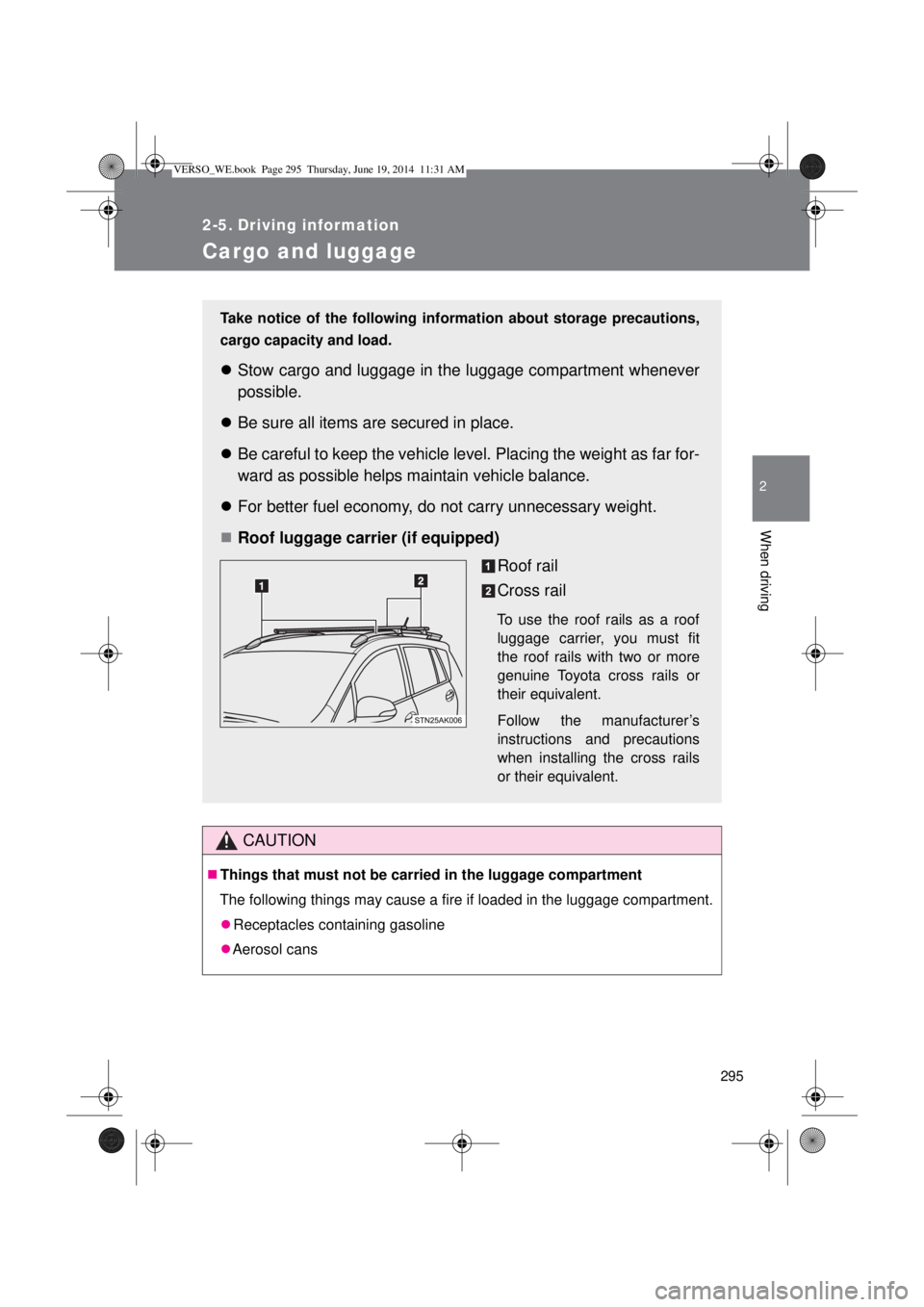
Roof luggage carrier (if equipped)
Roof rail
Cross rail
To use the roof rails as a roof
luggage carrier, you must fit
the roof rails with two or more
genuine Toyota cross rails or
their equivalent.
Follow the manufacturer’s
instructions and precautions
when installing the cross rails
or their equivalent.
VERSO_WE.book Page 295 Thursday, June 19, 2014 11:31 AM
Page 297 of 650
297 2-5. Driving information
2
When driving
CAUTION
Roof luggage carrier precautions (if equipped)
To use the roof rails as a roof luggage carrier, you must fit the roof rails with
two or more genuine Toyota cross rails or their equivalent.
Follow the manufacturer’s instructions and precautions when installing the
cross rails or their equivalent.
When you load cargo on the roof luggage carrier, observe the following:
Place the cargo so that its weight is distributed evenly between the front
and rear axles.
If loading long or wide cargo never exceed the vehicle overall length or
width.
Before driving, make sure the cargo is securely fastened on the roof lug-
gage carrier.
Loading cargo on the roof luggage carrier will make the center of the vehi-
cle gravity higher. Avoid high speeds, sudden starts, sharp turns, sudden
braking or abrupt maneuvers, otherwise it may result in loss of control or
vehicle rollover due to failure to operate this vehicle correctly and result in
death or serious injury.
If driving for a long distance, on rough roads, or at high speeds, stop the
vehicle now and then during the trip to make sure the cargo remains in its
place.
Do not exceed 100 kg (221 lb.) cargo weight on the roof rails. However, if
the allowable cargo weight of the cross rails is under 100 kg (221 lb.)
observe the load limit and other instructions for the cross rails.
VERSO_WE.book Page 297 Thursday, June 19, 2014 11:31 AM