steering TOYOTA VERSO 2016 Workshop Manual
[x] Cancel search | Manufacturer: TOYOTA, Model Year: 2016, Model line: VERSO, Model: TOYOTA VERSO 2016Pages: 664, PDF Size: 62.24 MB
Page 221 of 664
221
2-1. Driving procedures
2
When driving
VERSO_EE_OM64590E
Horn
■After adjusting the steering wheel
Make sure that the steering wheel is securely locked.
The horn may not sound if the steering wheel is not securely locked.
( P. 104)
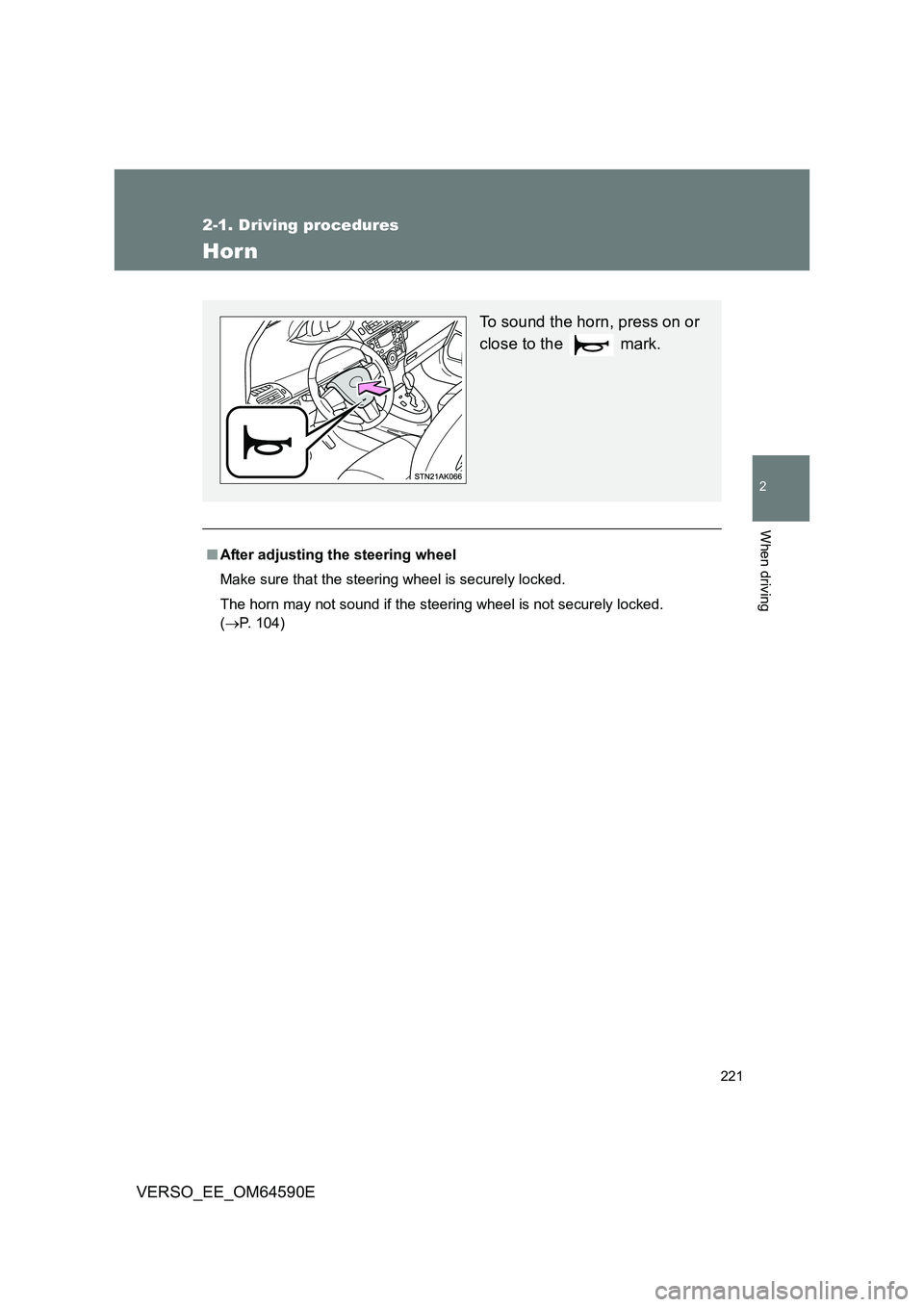
To sound the horn, press on or
close to the mark.
Page 224 of 664
224
2-2. Instrument cluster
VERSO_EE_OM64590E
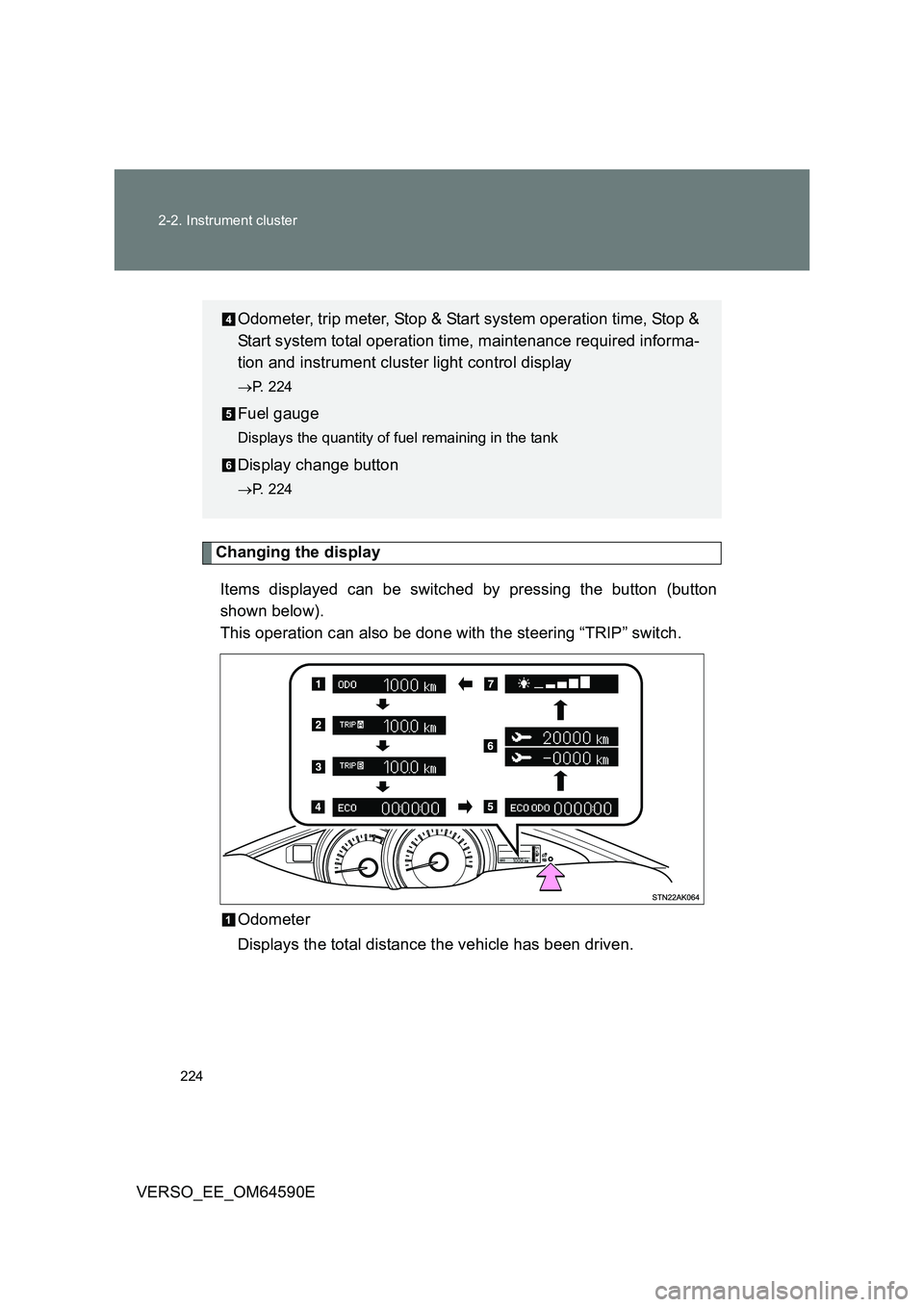
Changing the display
Items displayed can be switched by pressing the button (button
shown below).
This operation can also be done with the steering “TRIP” switch.
Odometer
Displays the total distance the vehicle has been driven.
Odometer, trip meter, Stop & Start system operation time, Stop &
Start system total operation time, maintenance required informa-
tion and instrument cluster light control display
P. 224
Fuel gauge
Displays the quantity of fuel remaining in the tank
Display change button
P. 224
Page 270 of 664
270
2-4. Toyota Safety Sense
VERSO_EE_OM64590E
■ Operational conditions
The pre-collision system is enabled and determines that the possibility of a
frontal collision with a vehicle (except motorcycles and bicycles) is high.
● Pre-collision warning:
• Vehicle speed is approximately 15 to 140 km/h (10 to 86 mph).
• The relative speed between your vehicle and the vehicle ahead is
greater than approximately 15 km/h (10 mph).
● Pre-collision brake assist:
• Vehicle speed is approximately 30 to 80 km/h (19 to 49 mph).
• The relative speed between your vehicle and the vehicle ahead is
greater than approximately 30 km/h (19 mph).
● Pre-collision braking:
• Vehicle speed is approximately 10 to 80 km/h (7 to 49 mph).
• The relative speed between your vehicle and the vehicle ahead is
greater than approximately 10 km/h (7 mph).
When the brake pedal is stepped on, the system judges if evasion actions
are being done by the driver and the start timing for pre-collision braking
may be delayed.
During the following, the driver oper ations takes precedence and the system
may not operate:
● The accelerator pedal is depressed strongly.
● The steering wheel is turned sharply or abruptly.
In case of the following, the system will not operate:
● If a battery terminal has been disconnected and reconnected and then
the vehicle has not been driven for a certain amount of time
● If VSC is disabled (only the pre-collision warning function will be opera-
tional)
● If the PCS warning light is flashing or illuminated
● When the shift position is in “R”
Page 271 of 664
271
2-4. Toyota Safety Sense
2
When driving
VERSO_EE_OM64590E
■ Cancelation of the pre-collision braking
● If either of the following situations occur while the pre-collision braking
function is operating, it will be canceled:
• The accelerator pedal is depressed strongly.
• The steering wheel is tu rned sharply or abruptly.
● If the vehicle is stopped by the operation of the pre-collision braking func-
tion, the operation of the pre-collision braking function will be canceled
after the vehicle has been stopped for approximately 2 seconds.
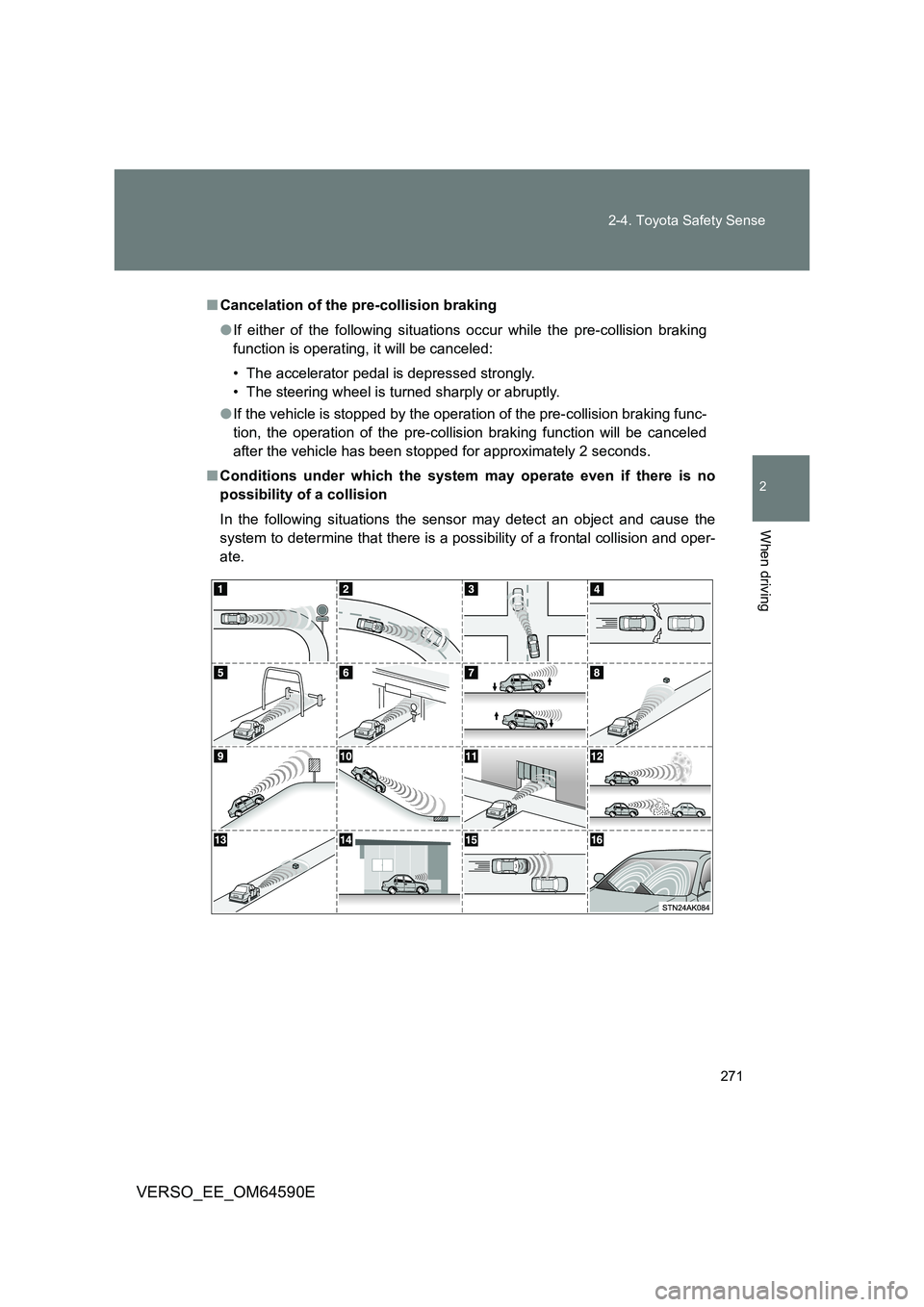
■ Conditions under which the system may operate even if there is no
possibility of a collision
In the following situations the sensor may detect an object and cause the
system to determine that there is a possibility of a frontal collision and oper-
ate.
Page 275 of 664
275
2-4. Toyota Safety Sense
2
When driving
VERSO_EE_OM64590E
WARNING
■ Limitations of the pre-collision system
● The driver is solely responsible for safe driving. Always drive safely, taking
care to observe your surroundings.
Do not use the pre-collision system instead of normal braking operations
under any circumstances. This system will not prevent collisions or lessen
damage or injuries in every situation. Do not overly rely on this system.
Failure to do so may lead to an accident, resulting in death or serious
injury.
Although this system is designed to help avoid and reduce the impact of a
collision, its effectiveness may change according to various conditions
( P. 270). As a result, the system may not always provide the same level
of performance.
● The pre-collision braking function may not operate if certain operations are
performed by the driver. If the accelerator pedal is being depressed
strongly or the steering wheel is bei ng turned, the system may determine
that the driver is taking evasive action and possibly prevent the pre-colli-
sion braking function from operating.
● In some situations, while the pre-collision braking function is operating,
operation of the function may be canceled if the accelerator pedal is
depressed strongly or the steering w heel is turned and the system deter-
mines that the driver is taking evasive action.
● While driving, the system may recognize front obstacles, such as the
crossing gate of a railway crossing, as a collision objects and operate the
pre-collision brake.
In the event that the vehicle gets caught within the railroad crossing, move
the vehicle with the following actions and depending on the situation main-
tain safety.
• Depress the accelerator pedal after the vehicle has stopped
• Strongly depress the accelerator pedal when decelerating ( P. 271)
• Turn the pre-collision system OFF ( P. 269)
● A large amount of braking force is applied while the pre-collision braking
function is operating. Additionally, as the vehicle may creep after the pre-
collision braking function has operated, the driver should depress the
brake pedal as necessary.
Page 282 of 664
282
2-4. Toyota Safety Sense
VERSO_EE_OM64590E
■ When changing the tires
Depending on the tires used, sufficient performance may not be maintain-
able.
■ Warning messages for the LDA system
Warning messages are used to indicate a system malfunction or to inform
the driver of the need for caution while driving.
WARNING
■ Before using the LDA system
Do not rely solely on the LDA system. The LDA system does not drive the
vehicle automatically, nor does it reduce the amount of care you need to
take. As such, the driver must always assume full responsibility for under-
standing his/her surroundings, for operating the steering wheel to correct the
driving line, and for driving safely.
Inappropriate or negligent driving could lead to an accident.
■ To avoid operating the LDA by mistake
Switch the LDA system off using the LDA switch when not in use.
NOTICE
■ To prevent damage to or incorrect operation of the LDA system
● Do not modify the headlights or attach stickers to the surface of the lights.
● Do not modify the suspension. If your suspension needs repairs, contact
any authorized Toyota dealer or repairer, or another duly qualified and
equipped professional.
● Do not install or place anything on the hood or the grille. Also, do not install
a grille guard (bull bars, kangaroo bar etc.).
Page 306 of 664
306
2-5. Using other driving systems
VERSO_EE_OM64590E
■ Operating conditions
● The Stop & Start system is operational when all of the following condi-
tions are met:
• The engine is adequately warmed up.
• The driver’s door is closed.
• The driver’s seat belt is fastened.
• The hood is closed.
• The clutch pedal is not being depressed.
• The shift lever is in “N”.
• The steering wheel is not in use.
● In the following circumstances the engine may not be stopped by the
Stop & Start system. This is not a malfunction of the Stop & Start system.
• Engine coolant temperature is too low or too high.
• The outside temperature is too low.
• Vehicles with an automatic air conditioning system: The air condition-
ing system is being used when the vehicle interior temperature is
extremely high such as after the vehicle was parked under the hot sun.
• Vehicles with an automatic air conditioning system: The windshield
defogger is being used.
• Vehicles with a power heater: The power heater is being used.
• The battery is not sufficiently charged, such as if the vehicle has been
parked for a long time and the battery charge has decreased; the elec-
tric load is large; the battery temperature is excessively low or the bat-
tery has deteriorated; or is undergoing a periodic recharge.
• The battery fluid temperature is extremely low or high.
• Due to traffic or other circumstances the vehicle is stopped repeatedly,
resulting in the amount of time the engine is stopped by the Stop &
Start system to become excessively high.
• The brake booster vacuum is low.
• A large amount of electricity is being used.
• At high altitude.
When the above conditions improve, the Stop & Start system will stop and
restart the engine from the next time the vehicle is stopped.
Page 307 of 664
307
2-5. Using other driving systems
2
When driving
VERSO_EE_OM64590E
● In the following situations, it may take longer than normal for the Stop &
Start system to activate.
• For a while after the battery terminals have been disconnected and
reconnected.
• For a while after the battery replacement.
• The engine coolant temperature is low.
■ Automatic engine start function
In the following situations, the engine may start even without the clutch pedal
being depressed.
• The brake pedal is pumped or strongly depressed.
• Vehicles with an automatic air c onditioning system: The air conditioning
system is being used or turned on.
• Vehicles with an automatic air conditioning system: The windshield
defogger is turned on.
• The battery is not sufficiently charged.
• The vehicle starts to roll on an incline.
• A large amount of electricity is being used.
• The driver’s door is opened.
• The driver’s seat belt is unfastened.
• The steering wheel is turned.
■ Automatic reactivation of the Stop & Start system
Vehicles without smart entry & start system
Even if the Stop & Start system is disabled by the Stop & Start cancel
switch, it will be automatically re-enabled once the engine switch is turned
to the “LOCK” position then to the “START” position.
Vehicles with smart entry & start system
Even if the Stop & Start system is disabled by the Stop & Start cancel
switch, it will be automatically re-enabled once the “ENGINE START
STOP” switch is turned off then the engine is started.
Page 308 of 664
308
2-5. Using other driving systems
VERSO_EE_OM64590E
■ The Stop & Start system protection feature
Vehicles without smart entry & start system
When an excessively loud sound is bei ng projected by the audio system,
the audio system may be automatically cut off in order to maintain power
for the Stop & Start system function.
If this occurs, turning the engine switch to the “LOCK” position then to the
“ACC” or “ON” position re-enables the audio system.
Vehicles with smart entry & start system
When an excessively loud sound is bei ng projected by the audio system,
the audio system may be automatically cut off in order to maintain power
for the Stop & Start system function.
If this occurs, turning the “ENGINE START STOP” switch off then to
ACCESSORY mode or IGNITION ON mode re-enables the audio system.
■ Steering wheel operation
When the engine is stopped by the Stop & Start system, the steering wheel
may become heavier than when driving.
■ Hood
If the hood is opened while the engine is stopped by the Stop & Start system,
the engine cannot be restarted by the Stop & Start system or by the auto-
matic engine start function. Restart the engine with the engine switch opera-
tion. ( P. 198, 202)
Even if the hood is closed after the engine is started with the hood open, the
Stop & Start system will not operate. Close the hood, turn the engine switch
off, wait 30 seconds or more, and then start the engine.
■ When to use the Stop & Start system
Use the Stop & Start system when stopping the vehicle temporarily at red
lights, intersections, etc. When stopp ing the vehicle for a longer period of
time, turn off the engine completely.
■ Stop & Start system warning buzzer
If the engine is stopped by the Stop & Start system and the following action
is performed, a buzzer will sound and the Stop & Start indicator will flash.
This indicates that the engine is only stopped by the Stop & Start system, not
that the engine has been turned off completely.
The shift lever is shifted to a position other than “N” with the clutch pedal
released.
Page 311 of 664
311
2-5. Using other driving systems
2
When driving
VERSO_EE_OM64590E
Driving assist systems
To help enhance driving safety and performance, the following sys-
tems operate automatically in resp onse to various driving situations.
Be aware, however, that these systems are supplementary and
should not be relied upon too heavily when operating the vehicle.
■ ABS (Anti-lock Brake System)
Helps to prevent wheel lock when the brakes are applied suddenly, or if
the brakes are applied while driving on a slippery road surface.
■ Brake assist
Generates an increased level of braking force after the brake pedal is
depressed, when the system detects a panic stop situation.
■ VSC+ (Vehicle Stability Control +)
Provides cooperative control of the ABS, TRC, VSC and EPS.
Helps to maintain directional stability when swerving on slippery road
surfaces by controlling steering performance.
■ TRC (Traction Control)
Helps to maintains drive power and prevents the front wheels from
spinning when starting the vehicle or accelerating on slippery roads.
■EPS (Electric Power Steering)
Employs an electric motor to reduce the amount of effort needed to turn
the steering wheel.
■ PCS (Pre-Collision System) (if equipped)
P. 267
■Hill-start assist control
Helps to prevent the vehicle from rolling backward when starting on an
incline or slippery slope.