airbag TOYOTA VERSO 2017 Owner's Manual
[x] Cancel search | Manufacturer: TOYOTA, Model Year: 2017, Model line: VERSO, Model: TOYOTA VERSO 2017Pages: 668, PDF Size: 49.7 MB
Page 153 of 668
153
1-7. Safety information
1
Before driving
VERSO_EE_OM64517E
■ When to contact any authorized Toyota dealer or repairer, or another
duly qualified and equipped professional
In the following cases, the vehicle will require inspection and/or repair. Con-
tact any authorized Toyota dealer or repairer, or another duly qualified and
equipped professional, as soon as possible.
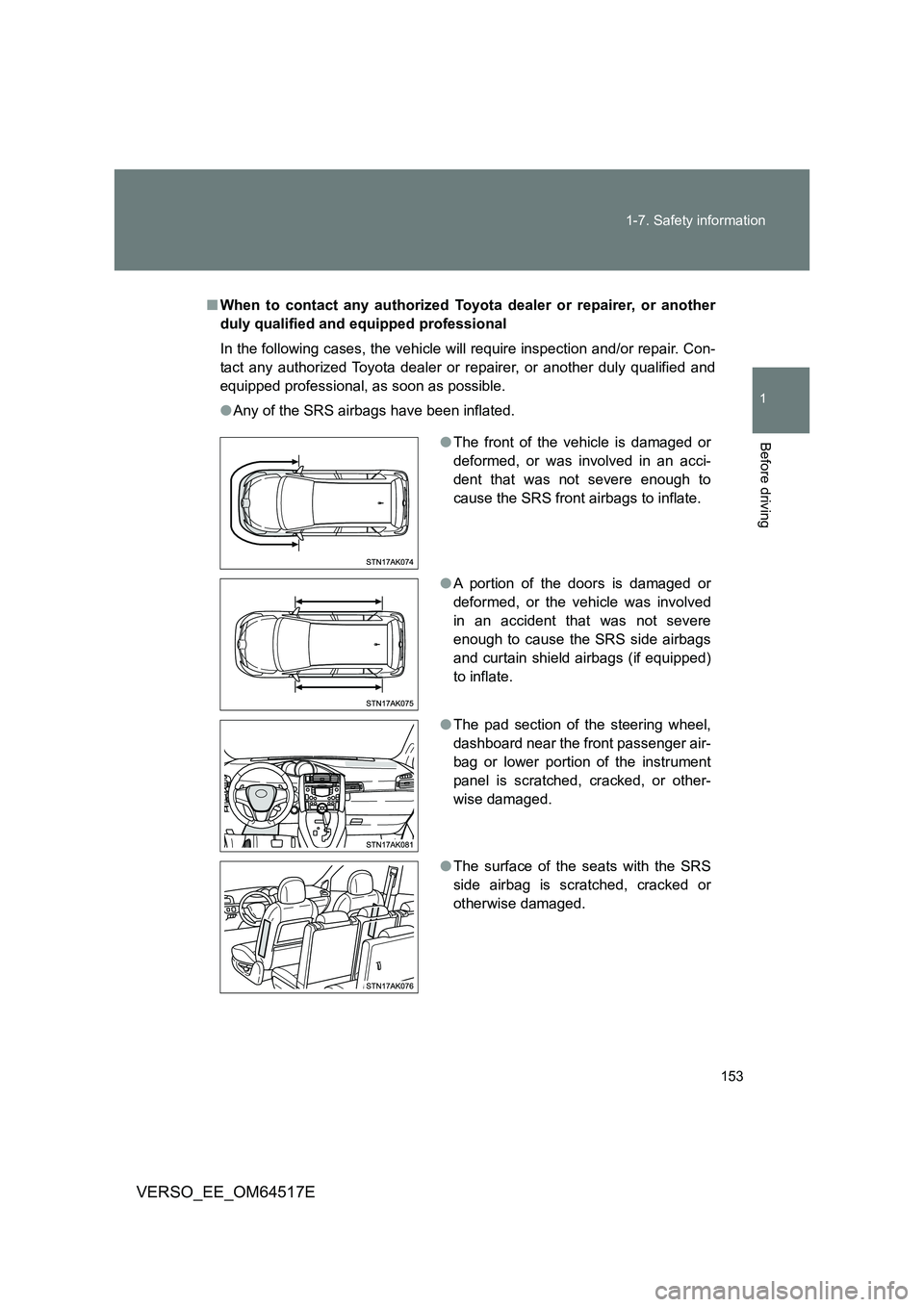
● Any of the SRS airbags have been inflated.
●The front of the vehicle is damaged or
deformed, or was involved in an acci-
dent that was not severe enough to
cause the SRS front airbags to inflate.
● A portion of the doors is damaged or
deformed, or the vehicle was involved
in an accident that was not severe
enough to cause the SRS side airbags
and curtain shield airbags (if equipped)
to inflate.
● The pad section of the steering wheel,
dashboard near the front passenger air-
bag or lower portion of the instrument
panel is scratched, cracked, or other-
wise damaged.
● The surface of the seats with the SRS
side airbag is scratched, cracked or
otherwise damaged.
Page 154 of 668
154
1-7. Safety information
VERSO_EE_OM64517E
WARNING
■ SRS airbag precautions
Observe the following precautions regarding the SRS airbags.
Failure to do so may cause death or serious injury.
● The driver and all passengers in the vehicle must wear their seat belts
properly.
The SRS airbags are supplemental devic es to be used with the seat belts.
● The SRS driver airbag deploys with considerable force, and can cause
death or serious injury especially if the driver is very close to the airbag.
Since the risk zone for the driver’s airbag is the first 50 - 75 mm (2 - 3 in.)
of inflation, placing yourself 250 mm ( 10 in.) from your driver airbag pro-
vides you with a clear margin of safety. This distance is measured from the
center of the steering wheel to your breastbone. If you sit less than
250 mm (10 in.) away now, you can change your driving position in several
ways:
• Move your seat to the rear as far as you can while still reaching the
pedals comfortably.
• Slightly recline the back of the seat.
Although vehicle designs vary, many drivers can achieve the 250 mm
(10 in.) distance, even with the driv er seat all the way forward, simply
by reclining the back of the seat somewhat. If reclining the back of your
seat makes it hard to see the road, raise yourself by using a firm, non-
slippery cushion, or raise the seat if your vehicle has that feature.
• If your steering wheel is adjustable, tilt it downward. This points the air-
bag toward your chest instead of your head and neck.
The seat should be adjusted as recommended above, while still maintaining
control of the foot pedals, steering wheel, and your view of the instrument
panel controls.
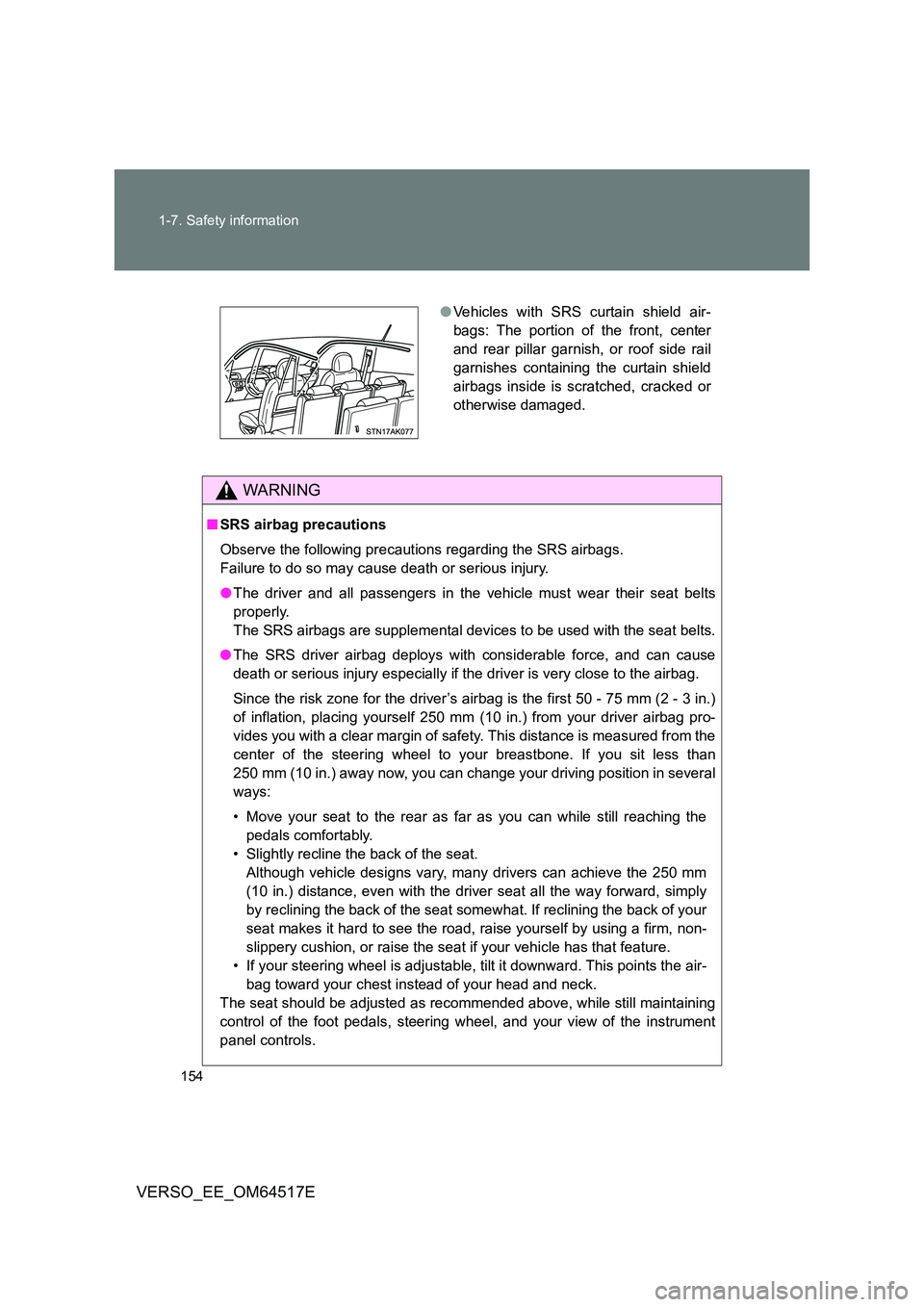
● Vehicles with SRS curtain shield air-
bags: The portion of the front, center
and rear pillar garnish, or roof side rail
garnishes containing the curtain shield
airbags inside is scratched, cracked or
otherwise damaged.
Page 155 of 668
155
1-7. Safety information
1
Before driving
VERSO_EE_OM64517E
WARNING
■ SRS airbag precautions
● The SRS front passenger airbag also deploys with considerable force, and
can cause death or serious injury especially if the front passenger is very
close to the airbag. The front passenger seat should be as far from the air-
bag as possible with the seatback adjusted, so the front passenger sits
upright.
● Improperly seated and/or restrained infants and children can be killed or
seriously injured by a deploying airbag. An infant or child who is too small
to use a seat belt should be properly secured using a child restraint sys-
tem. Toyota strongly recommends that all infants and children be placed in
the rear seats of the vehicle and proper ly restrained. The rear seats are
safest for infants and children than the front passenger seat. ( P. 159)
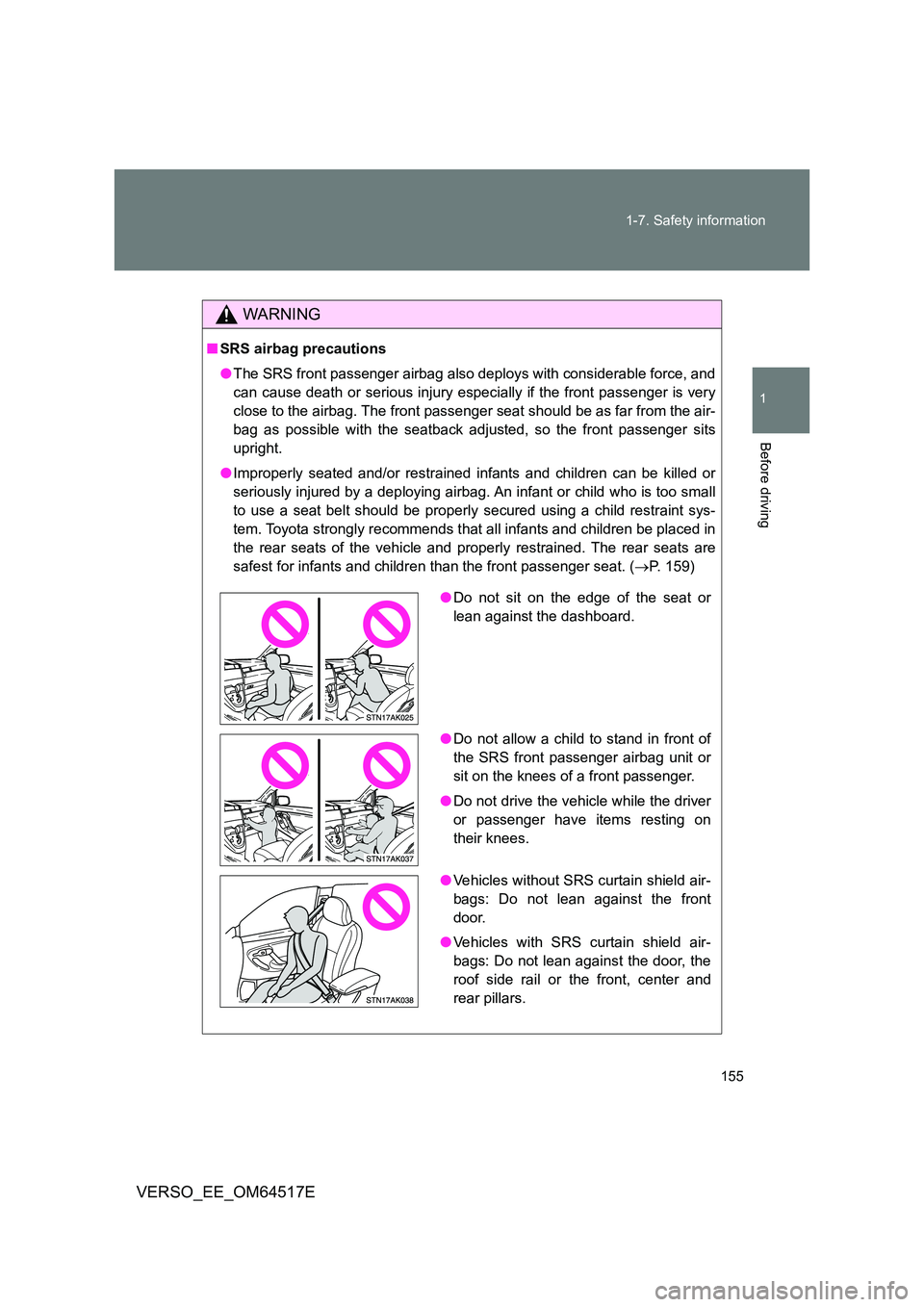
●Do not sit on the edge of the seat or
lean against the dashboard.
● Do not allow a child to stand in front of
the SRS front passenger airbag unit or
sit on the knees of a front passenger.
● Do not drive the vehicle while the driver
or passenger have items resting on
their knees.
● Vehicles without SRS curtain shield air-
bags: Do not lean against the front
door.
● Vehicles with SRS curtain shield air-
bags: Do not lean against the door, the
roof side rail or the front, center and
rear pillars.
Page 156 of 668
156
1-7. Safety information
VERSO_EE_OM64517E
WARNING
■ SRS airbag precautions
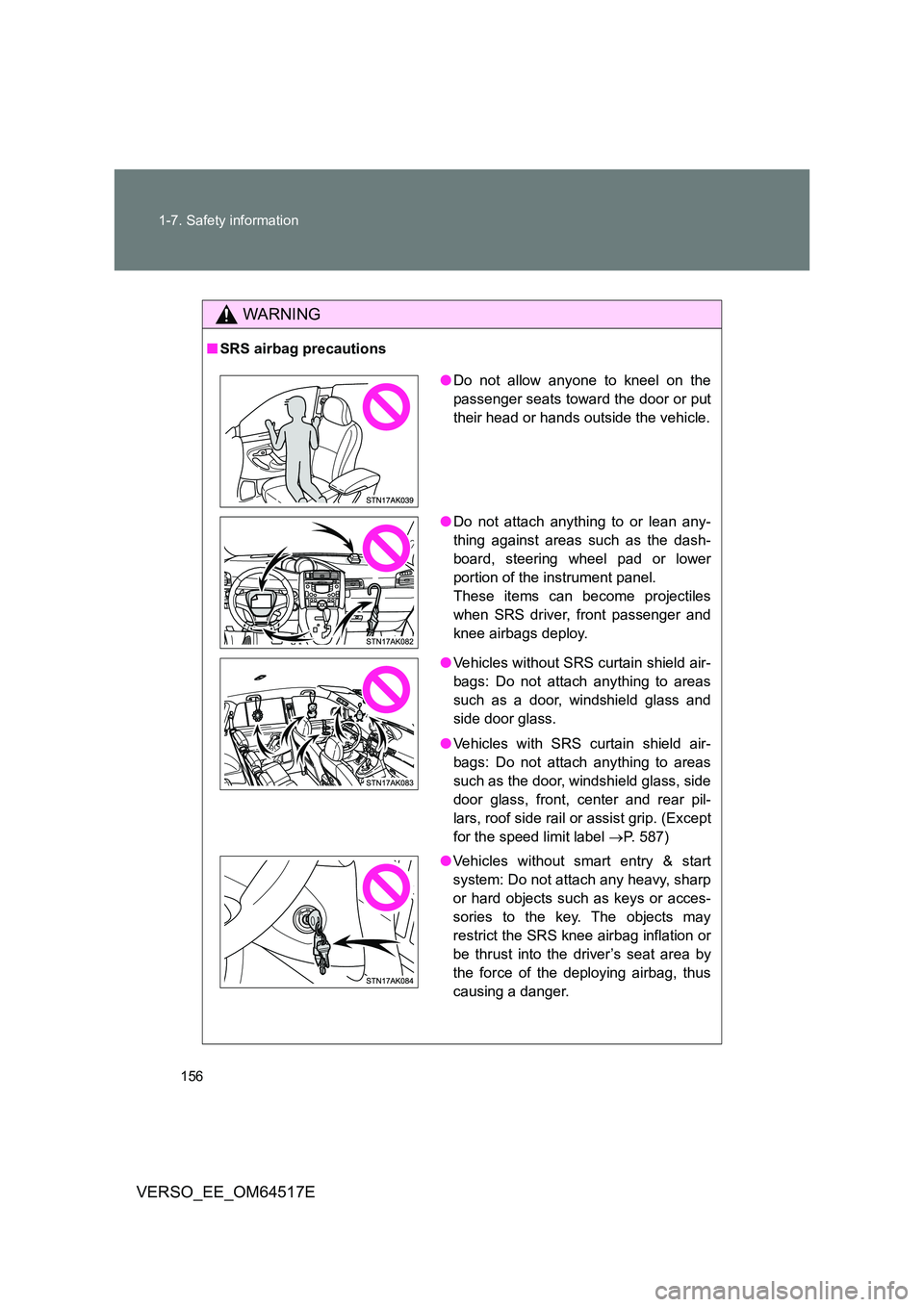
●Do not allow anyone to kneel on the
passenger seats toward the door or put
their head or hands outside the vehicle.
● Do not attach anything to or lean any-
thing against areas such as the dash-
board, steering wheel pad or lower
portion of the instrument panel.
These items can become projectiles
when SRS driver, front passenger and
knee airbags deploy.
● Vehicles without SRS curtain shield air-
bags: Do not attach anything to areas
such as a door, windshield glass and
side door glass.
● Vehicles with SRS curtain shield air-
bags: Do not attach anything to areas
such as the door, windshield glass, side
door glass, front, c enter and rear pil-
lars, roof side rail or assist grip. (Except
for the speed limit label P. 587)
● Vehicles without smart entry & start
system: Do not attach any heavy, sharp
or hard objects such as keys or acces-
sories to the key. The objects may
restrict the SRS knee airbag inflation or
be thrust into the driver’s seat area by
the force of the deploying airbag, thus
causing a danger.
Page 157 of 668
157
1-7. Safety information
1
Before driving
VERSO_EE_OM64517E
WARNING
■ SRS airbag precautions
● Vehicles with SRS curtain shield airbags: Do not hang coat hangers or
other hard objects on the coat hooks. All of these items could become pro-
jectiles and may cause death or serious injury, should the SRS curtain
shield airbag deploy.
● If the vinyl cover is put on the area where the SRS knee airbag will deploy,
be sure to remove it.
● Do not use seat accessories which cover the parts where the SRS side
airbags inflate as they may interfere with inflation of the airbags. Such
accessories may prevent the side airbags from activating correctly, disable
the system or cause the side airbags to inflate accidentally, resulting in
death or serious injury.
● Do not strike or apply significant levels of force to the area of the SRS air-
bag components. ( P. 149)
Doing so can cause the SRS airbags to malfunction.
● Do not touch any of the component parts immediately after the SRS air-
bags have deployed (inflated) as they may be hot.
● If breathing becomes difficult after the SRS airbags have deployed, open a
door or window to allow fresh air in, or leave the vehicle if it is safe to do
so. Wash off any residue as soon as possible to prevent skin irritation.
● Vehicles without SRS curtain shield airbags: If the areas where the SRS
airbags are stored, such as the steering wheel pad, are damaged or
cracked, have them replaced by any authorized Toyota dealer or repairer,
or another duly qualified and equipped professional.
● Vehicles with SRS curtain shield airbags: If the areas where the SRS
airbags are stored, such as the steer ing wheel pad and front and rear pillar
garnishes, are damaged or cracked, have them replaced by any
authorized Toyota dealer or repairer, or another duly qualified and
equipped professional.
Page 158 of 668
158
1-7. Safety information
VERSO_EE_OM64517E
WARNING
■ Modification and disposal of SRS airbag system components
Do not dispose of your vehicle or perform any of the following modifications
without consulting any authorized Toyota dealer or repairer, or another duly
qualified and equipped professional.
The SRS airbags may malfunction or deploy (inflate) accidentally, causing
death or serious injury.
● Installation, removal, disassembly and repair of the SRS airbags.
● Repairs, modifications, removal or replacement of the steering wheel,
instrument panel, dashboard, seats or seat upholstery, front, center and
rear pillars or roof side rail.
● Repairs or modifications of the front fender, front bumper, or side of the
occupant compartment.
● Installation of a grille guard (bull bars, kangaroo bar, etc.), snow plows or
winches.
● Modifications to the vehicle’s suspension system.
● Installation of electronic devices such as mobile two-way radios (RF-trans-
mitter) and CD players.
Page 161 of 668
161
1-7. Safety information
1
Before driving
VERSO_EE_OM64517E
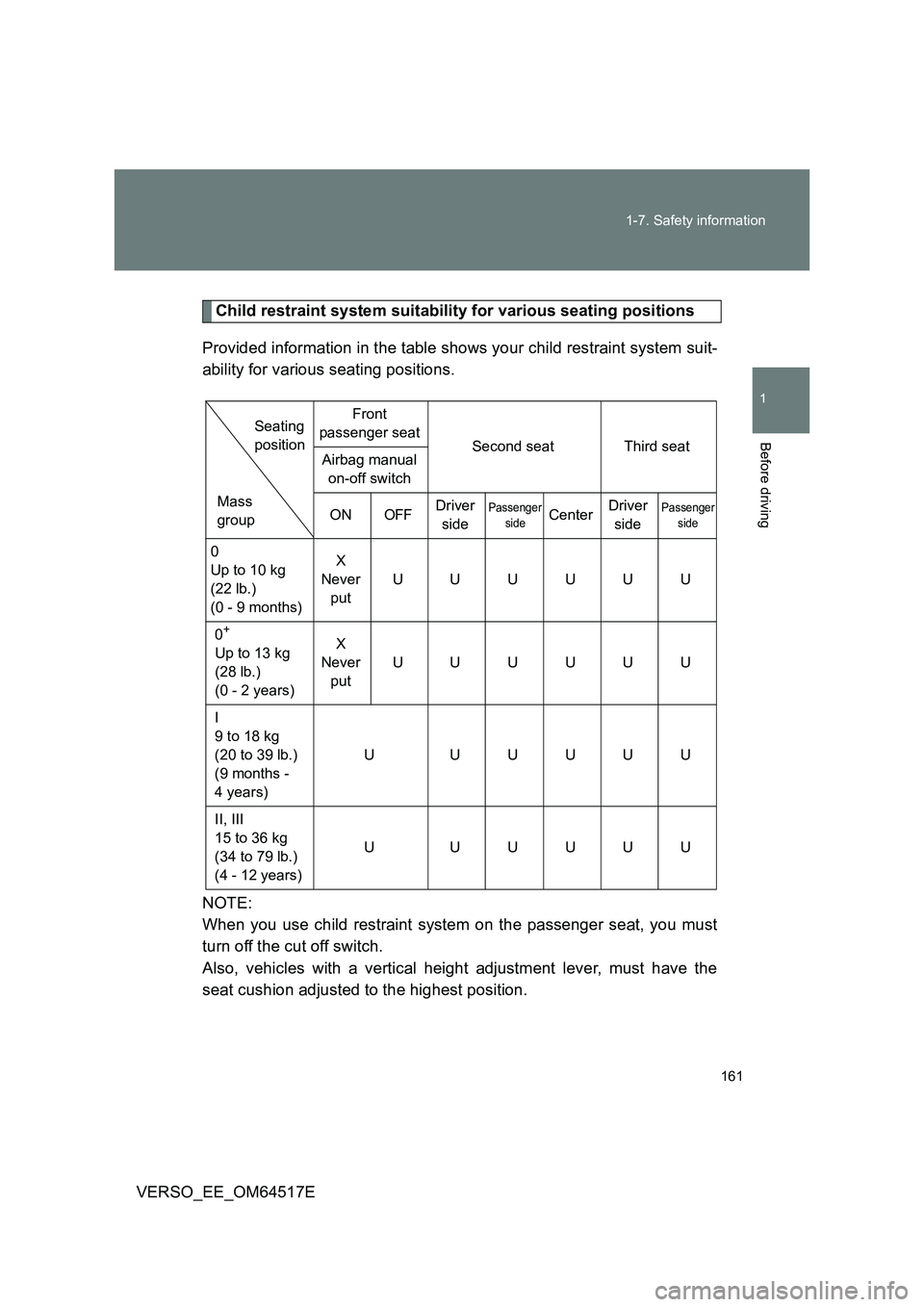
Child restraint system suitability for various seating positions
Provided information in the table shows your child restraint system suit-
ability for various seating positions.
NOTE:
When you use child restraint system on the passenger seat, you must
turn off the cut off switch.
Also, vehicles with a vertical height adjustment lever, must have the
seat cushion adjusted to the highest position.
Front
passenger seat Second seat Third seat Airbag manual
on-off switch
ONOFFDriver
side
Passenger sideCenter Driver
side
Passenger side
0
Up to 10 kg
(22 lb.)
(0 - 9 months)
X
Never
put
UUUUUU
0+
Up to 13 kg
(28 lb.)
(0 - 2 years)
X
Never
put
UUUUUU
I
9 to 18 kg
(20 to 39 lb.)
(9 months -
4 years)
U UUUUU
II, III
15 to 36 kg
(34 to 79 lb.)
(4 - 12 years)
U UUUUU
Mass
group
Seating
position
Page 165 of 668
165
1-7. Safety information
1
Before driving
VERSO_EE_OM64517E
WARNING
■ Using a child restraint system
The use of a child restraint system not suitable for the vehicle may not prop-
erly secure the infant or child. It may result in death or serious injury (in the
event of sudden braking or an accident).
■ Child restraint precautions
● For effective protection in automobile accidents and sudden stops, a child
must be properly restrained, using a seat belt or child restraint system
depending on the age and size of the child. Holding a child in your arms is
not a substitute for a child restraint system. In an accident, the child can be
crushed against the windshield, or between you and the vehicle’s interior.
● Toyota strongly urges the use of a proper child restraint system that con-
forms to the size of the child, installed on the rear seat. According to acci-
dent statistics, the child is safer w hen properly restrained in the rear seat
than in the front seat.
● Never install a rear-facing child restraint system on the front passenger
seat when the airbag manual on-off switch is “ON”. ( P. 179)
In the event of an accident, the force of the rapid inflation of the front pas-
senger airbag can cause death or serious injury to the child.
● A forward-facing child restraint system may be installed on the front pas-
senger seat only when it is unavoidable. A child restraint system that
requires a top tether strap should not be used in the front passenger seat
since there is no top tether strap anchor for the front passenger seat.
Adjust the seatback as upright as possible and always move the seat as
far back as possible because the front passenger airbag could inflate with
considerable speed and force. Otherwise, the child may be killed or seri-
ously injured.
● Vehicles without SRS curtain shield airbags: Do not allow the child to lean
his/her head or any part of his/her body against the door or the area of the
seat from which the SRS side airbags deploy even if the child is seated in
the child restraint system. It is dangerous if the SRS side airbags inflate,
and the impact could cause death or serious injury to the child.
Page 166 of 668
166
1-7. Safety information
VERSO_EE_OM64517E
WARNING
■ Child restraint precautions
● Vehicles with SRS curtain shield airbags: Do not allow the child to lean his/
her head or any part of his/her body against the door or the area of the
seat, front and rear pillars or roof side rails from which the SRS side air-
bags or SRS curtain shield airbags deploy even if the child is seated in the
child restraint system. It is dangerous if the SRS side airbags and SRS
curtain shield airbags inflate, and the impact could cause death or serious
injury to the child.
● Make sure you have complied with all installation instructions provided by
the child restraint manufacturer and that the system is properly secured. If
it is not secured properly, it may cause death or serious injury to the child
in the event of a sudden stop, sudden swerve or an accident.
■ When children are in the vehicle
Do not allow children to play with the seat belt. If the seat belt becomes
twisted around a child’s neck, it may lead to choking or other serious injuries
that could result in death.
If this occurs and the buckle cannot be unfastened, scissors should be used
to cut the belt.
■ When the child restraint system is not in use
● Keep the child restraint system properly secured on the seat even if it is
not in use. Do not store the child restraint system unsecured in the pas-
senger compartment.
● If it is necessary to detach the child restraint system, remove it from the
vehicle or store it securely in the luggage compartment. This will prevent it
from injuring passengers in the event of a sudden stop, sudden swerve or
accident.
Page 175 of 668
175
1-7. Safety information
1
Before driving
VERSO_EE_OM64517E
WARNING
■ When installing a child restraint system
Follow the directions given in the child restraint system installation manual
and fix the child restraint system securely in place.
If the child restraint system is not correctly fixed in place, the child or other
passengers may be seriously injured or even killed in the event of sudden
braking, sudden swerving or an accident.
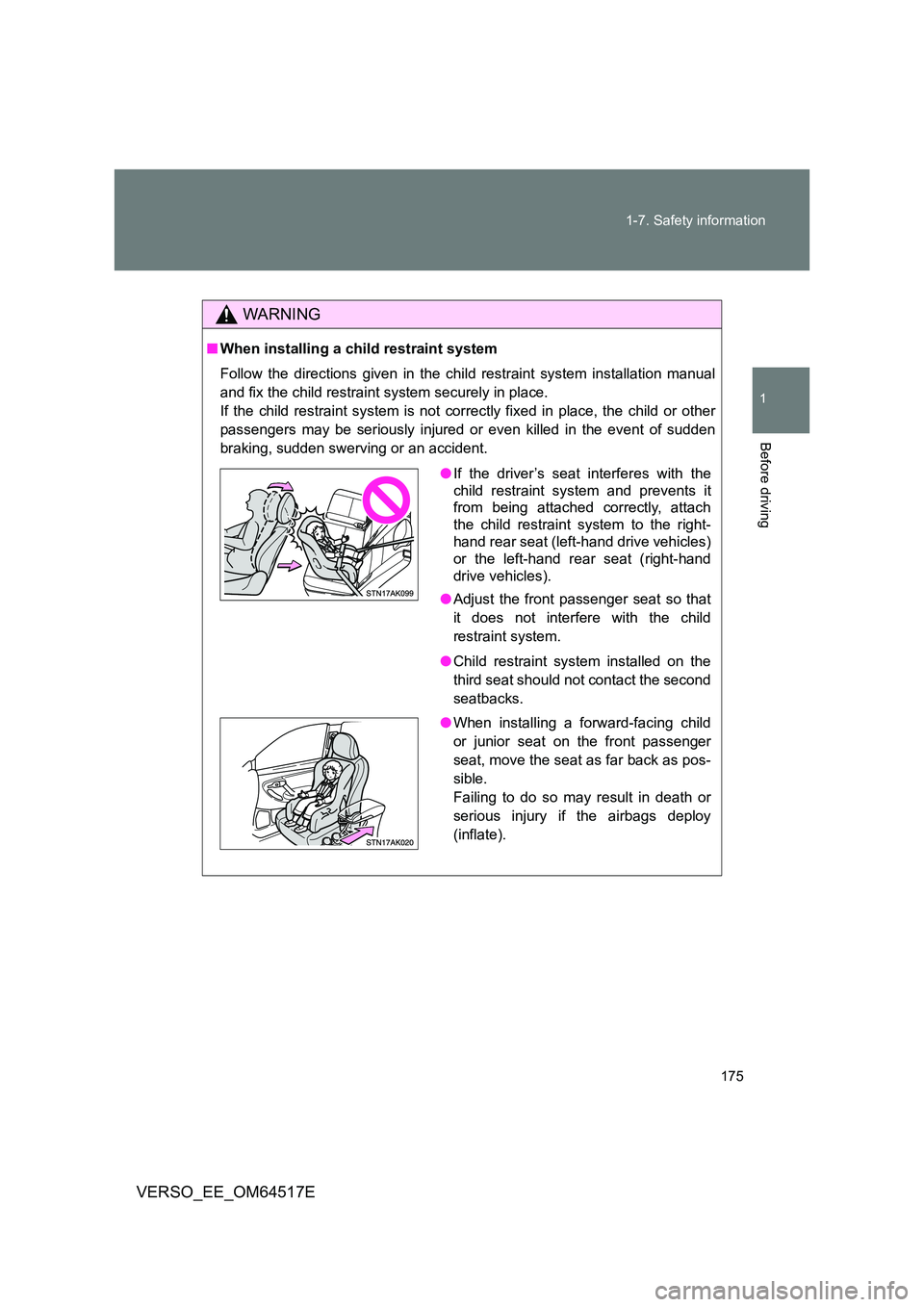
● If the driver’s seat interferes with the
child restraint system and prevents it
from being attached correctly, attach
the child restraint system to the right-
hand rear seat (left-hand drive vehicles)
or the left-hand rear seat (right-hand
drive vehicles).
● Adjust the front passenger seat so that
it does not interfere with the child
restraint system.
● Child restraint system installed on the
third seat should not contact the second
seatbacks.
● When installing a forward-facing child
or junior seat on the front passenger
seat, move the seat as far back as pos-
sible.
Failing to do so may result in death or
serious injury if the airbags deploy
(inflate).