warning TOYOTA VERSO S 2011 Owners Manual
[x] Cancel search | Manufacturer: TOYOTA, Model Year: 2011, Model line: VERSO S, Model: TOYOTA VERSO S 2011Pages: 664, PDF Size: 160.56 MB
Page 527 of 664
527
7 7-3. Do-it-yourself maintenance
Maintenance and care
●ID codes can be registered by your-
self, but depending on the driving con-
ditions and driving environment,
registration may take some time to
complete.
●As the tires will be warm when regis-
tration is completed, make sure to
allow the tires to cool before perform-
ing initialization.
■Canceling ID code registration
●To cancel ID code registration after it
has been started, select “Identifying
Each Wheel & Position” on the multi-
information display and press and
hold again.
●If ID code registration has been can-
celed, the tire pressure warning light
will blink for approximately 1 minute
when the power switch is turned to
ON and then illuminate. The tire pres-
sure warning system will be opera-
tional when the tire pressure warning
light turns off.
●If the warning light does not turn off
even after several minutes have
elapsed, ID code registration may not
have been canceled correctly. To can-
cel registration, perform the ID code
registration start procedure again and
then turn the power switch off before
driving.
■If ID codes are not registered prop-
erly
●In the following situations, ID code
registration may take longer than
usual to be completed or may not be
possible. Normally, registration com-
pletes within approximately 30 min-
utes.
If ID code registration is not complete
after driving for approximately 30 min-
utes, continue driving for a while.
• Vehicle is not parked for approxi-
mately 20 minutes or more before
driving
• Vehicle is not driven at approximately
40 km/h (25 mph) or more
• Vehicle is driven on unpaved roads
• Vehicle is driven near other vehicles and system cannot recognize tire
pressure warning valve and transmit-
ters of your vehicle over those of other
vehicles
• Wheel with tire pressure warning
valve and transmitter installed is
inside or near the vehicle
If registration does not complete after
driving for 1 hour or more, perform the
ID code registration procedure again
from the beginning.
●If the vehicle is reversed during regis-
tration, the data up to that point is
reset, so perform the registration pro-
cedure again from the beginning.
●In the following situations, ID code
registration will not be started or was
not completed properly and the sys-
tem will not operate properly. Perform
the ID code registration procedure
again.
• If, when attempting to start ID code
registration, the tire pressure warning
light does not blink slowly 3 times.
• If, when the vehicle has been driven
for about 10 minutes after performing
ID code registration, the tire pressure
warning light blinks for approximately
1 minute and then illuminates.
●If ID code registration cannot be com-
pleted after performing the above pro-
cedure, contact any authorized
Toyota retailer or Toyota authorized
repairer, or any reliable repairer.
Your vehicle is equipped with tire
pressure warning system with the
function to have ID codes regis-
tered for a second wheel set, for
example a winter set. You can reg-
ister a second wheel set by your-
self, any authorized Toyota retailer
or Toyota authorized repairer, or
any reliable repairer.
Selecting wheel set
Page 528 of 664
5287-3. Do-it-yourself maintenance
After registration of a second wheel
set, either of these two wheel sets
can be selected for usage with the
tire pressure warning system.
■Operating conditions for the
function
This function will perform the
change of wheel set only if a sec-
ond wheel set has been regis-
tered. If no second wheel set has
been registered, no change will
be made when selecting this
function in the menu.
Only a change between both
registered wheel set is possible,
mixing between these wheel sets
is not supported.
■How to change between wheel
sets
1Have the vehicle fitted with the
preferred wheel set.
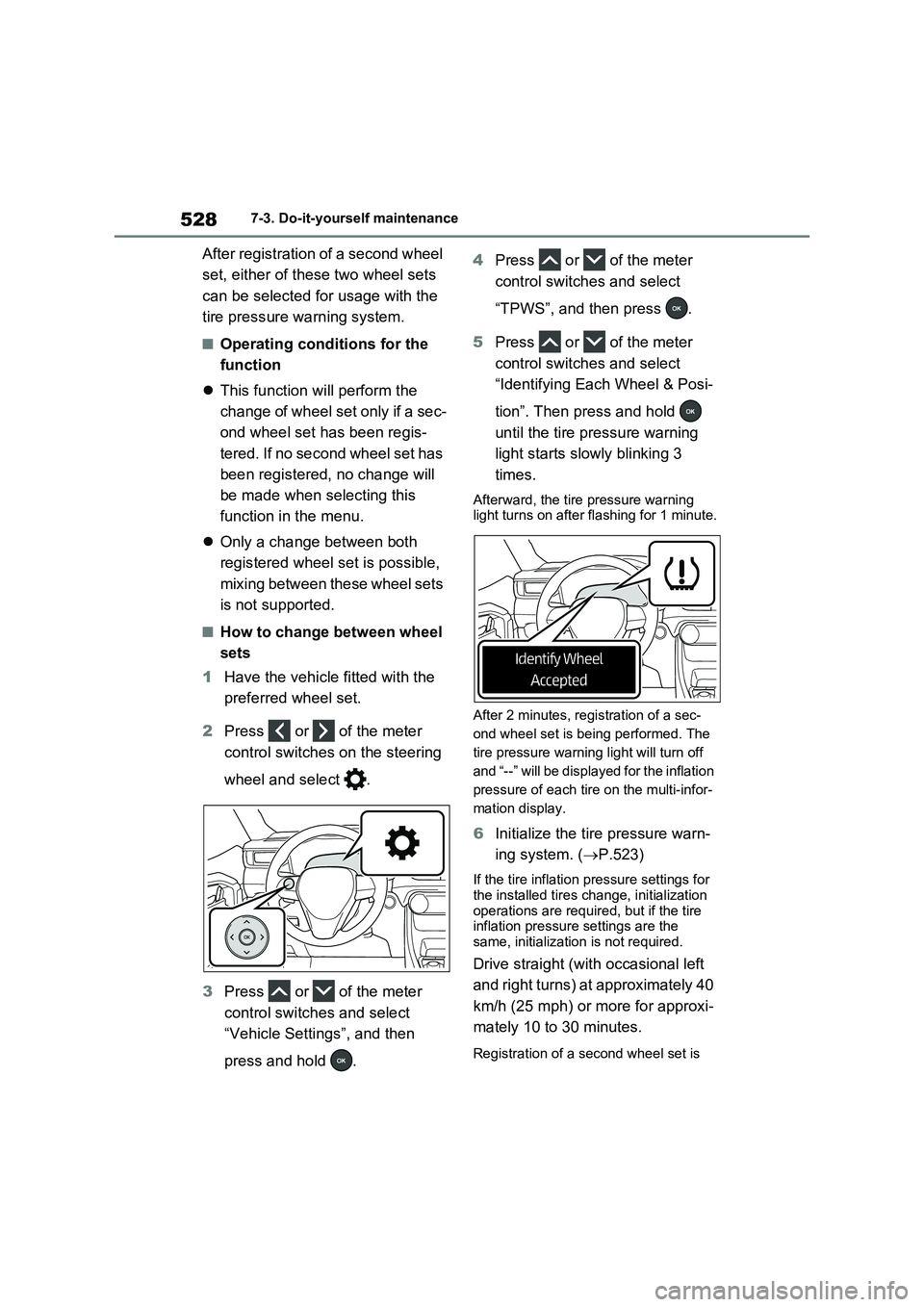
2Press or of the meter
control switches on the steering
wheel and select .
3Press or of the meter
control switches and select
“Vehicle Settings”, and then
press and hold .4Press or of the meter
control switches and select
“TPWS”, and then press .
5Press or of the meter
control switches and select
“Identifying Each Wheel & Posi-
tion”. Then press and hold
until the tire pressure warning
light starts slowly blinking 3
times.
Afterward, the tire pressure warning
light turns on after flashing for 1 minute.
After 2 minutes, registration of a sec-
ond wheel set is being performed. The
tire pressure warning light will turn off
and “--” will be displayed for the inflation
pressure of each tire on the multi-infor-
mation display.
6Initialize the tire pressure warn-
ing system. (P.523)
If the tire inflation pressure settings for
the installed tires change, initialization
operations are required, but if the tire
inflation pressure settings are the
same, initialization is not required.
Drive straight (with occasional left
and right turns) at approximately 40
km/h (25 mph) or more for approxi-
mately 10 to 30 minutes.
Registration of a second wheel set is
Page 530 of 664
5307-3. Do-it-yourself maintenance
should be placed so that the vehicle is
balanced.
When replacing wheels, care
should be taken to ensure that they
are equivalent to those removed in
load capacity, diameter, rim width
and inset*.
Replacement wheels are available
at any authorized Toyota retailer or
Toyota authorized repairer, or any
reliable repairer.
*: Conventionally referred to as offset.
Toyota does not recommend using
the following:
Wheels of different sizes or types
Used wheels
Bent wheels that have been
straightened
■When replacing wheels
The wheels of your vehicle are equipped with tire pressure warning valves and
transmitters that allow the tire pressure warning system to provide advance warning in the event of a loss in tire
inflation pressure. Whenever wheels are replaced, tire pressure warning valves and transmitters must be installed.
( P.511, 531)
WARNING
■Proper inflation is critical to save tire performance
Keep your tires properly inflated. If the tires are not properly inflated, the following conditions may occur
which could lead to an accident resulting in death or serious injury:
●Excessive wear
●Uneven wear
●Poor handling
●Possibility of blowouts resulting
from overheated tires
●Air leaking from between tire and
wheel
●Wheel deformation and/or tire dam-
age
●Greater possibility of tire damage
while driving (due to road hazards, expansion joints, sharp edges in the road, etc.)
NOTICE
■When inspecting and adjusting
tire inflation pressure
Be sure to put the tire valve caps back on.
If a valve cap is not installed, dirt or moisture may get into the valve and cause an air leak, resulting in
decreased tire inflation pressure.
Wheels
If a wheel is bent, cracked or
heavily corroded, it should be
replaced. Otherwise, the tire
may separate from the wheel
or cause a loss of handling
control.
Wheel selection
Page 531 of 664
531
7
7-3. Do-it-yourself maintenance
Maintenance and care
Use only Toyota wheel nuts and
wrenches designed for use with
your aluminum wheels.
When rotating, repairing or
changing your tires, check that
the wheel nuts are still tight after
driving 1600 km (1000 miles).
Be careful not to damage the
aluminum wheels when using
tire chains.
Use only Toyota genuine bal-
ance weights or equivalent and a
plastic or rubber hammer when
balancing your wheels.
WARNING
■When replacing wheels
●Do not use wheels that are a differ-
ent size from those recommended in the Owner’s Manual, as this may result in a loss of handling control.
●Never use an inner tube in a leak-ing wheel which is designed for a
tubeless tire. Doing so may result in an accident, causing death or seri-ous injury.
■When installing the wheel nuts
●Be sure to install the wheel nuts
with the tapered ends facing inward. ( P.597) Installing the nuts with the tapered ends facing out-
ward can cause the wheel to break and eventually cause the wheel to come off while driving, which could
lead to an accident resulting in death or serious injury.
●Never use oil or grease on the wheel bolts or wheel nuts. Oil and grease may cause the wheel nuts
to be excessively tightened, leading to bolt or disc wheel damage. In addition, the oil or grease can
cause the wheel nuts to loosen and the wheel may fall off, causing an accident and resulting in death or
serious injury. Remove any oil or grease from the wheel bolts or wheel nuts.
■Use of defective wheels prohib-ited
Do not use cracked or deformed wheels.
Doing so could cause the tire to leak
air during driving, possibly causing an accident.
NOTICE
■Replacing tire pressure warning valves and transmitters
●Because tire repair or replacement may affect the tire pressure warning valves and transmitters, make sure
to have tires serviced by any autho- rized Toyota retailer or Toyota authorized repairer, or any reliable
repairer or other qualified service shop. In addition, make sure to pur-chase your tire pressure warning
valves and transmitters at any authorized Toyota retailer or Toyota authorized repairer, or any reliable
repairer.
●Ensure that only genuine Toyota
wheels are used on your vehicle. Tire pressure warning valves and transmitters may not work properly
with non-genuine wheels.
Aluminum wheel precau-
tions
Page 535 of 664
535
7
7-3. Do-it-yourself maintenance
Maintenance and care
WARNING
■When replacing the air condition- ing filter
Observe the following precautions. Failure to do so may result in the air conditioning system operating during
the procedure, possibly resulting in injury.
●Check that the charging connector
is not connected
Check that the charging connector is not connected
The air conditioning may operate due to the “Climate Prep” ( P.144) set- ting.
●Do not use the Remote Air Condi-tioning System
NOTICE
■When using the air conditioning system
Make sure that a filter is always installed.
Using the air conditioning system without a filter may cause damage to the system.
■When removing the glove box
Always follow the specified procedure
to remove the glove box ( P.532). If the glove box is removed without fol-lowing the specified procedure, the
hinge of the glove box may become damaged.
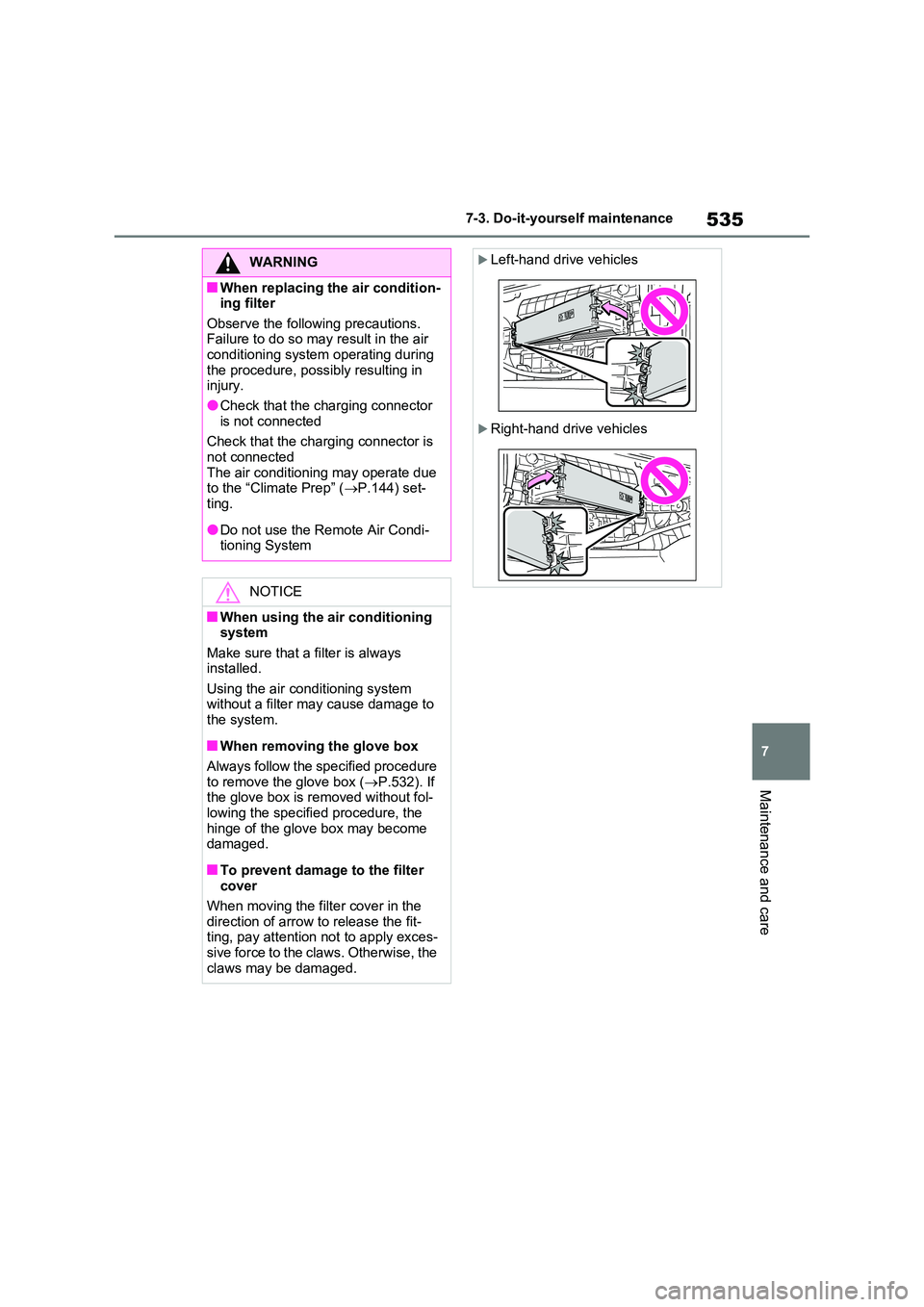
■To prevent damage to the filter cover
When moving the filter cover in the
direction of arrow to release the fit- ting, pay attention not to apply exces-sive force to the claws. Otherwise, the
claws may be damaged.
Left-hand drive vehicles
Right-hand drive vehicles
Page 538 of 664
5387-3. Do-it-yourself maintenance
8Using a Phillips screwdriver,
install the clip.
■Cleaning the air intake vent
●Dust in the air intake vent may inter- fere with the cooling of the DC/DC
converter. If the cooling perfor- mance/capacity of the DC/DC con-verter becomes limited, the 12-volt
battery may discharge. Inspect and clean the air intake vent periodically.
●Improper handling of the air intake vent cover and filter may result in damage to them. If you have any con-
cerns about cleaning the filter, contact any authorized Toyota retailer or Toyota authorized repairer, or any reli-
able repairer.
■If “Maintenance required for DCDC converter cooling parts See Owner’s Manual” is shown on the
multi-information display
●If this warning message is shown on
the multi-information display, remove the air intake vent cover and clean the filter. ( P.536)
●After cleaning the air intake vent, start the hybrid system and check that the
warning message is no longer shown. It may take approximately 20 minutes
after the hybrid system is started until the warning message disappears. If the warning message does not disap-
pear, have the vehicle inspected by any authorized Toyota retailer or Toyota authorized repairer, or any reli-
able repairer.
WARNING
■When cleaning the air intake vent
●Do not use water or other liquids to
clean the air intake vent. If water is applied to the DC/DC converter or other components, a malfunction or
fire may occur.
●Before cleaning the air intake vent, make sure to turn the power switch
off to stop the hybrid system.
NOTICE
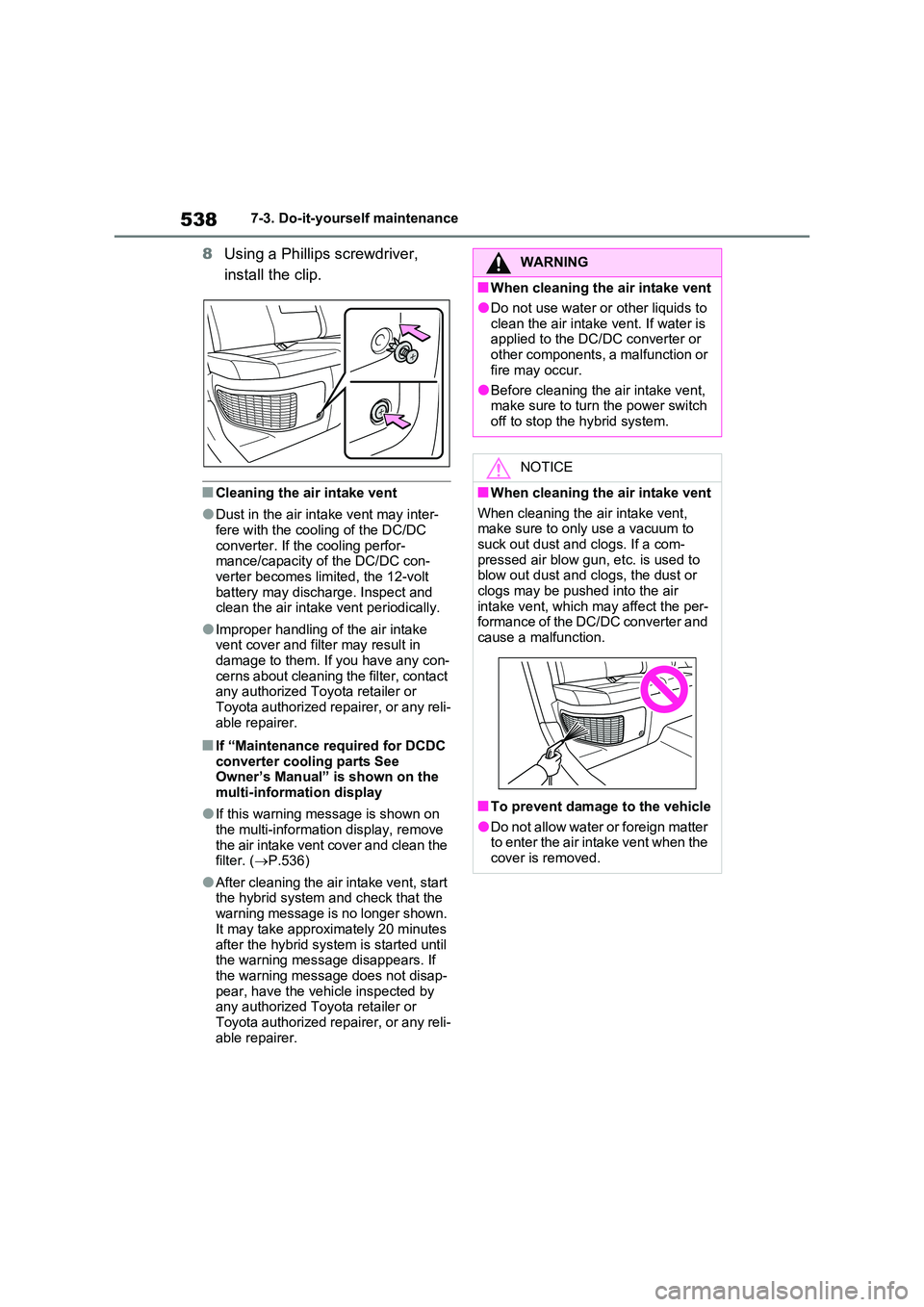
■When cleaning the air intake vent
When cleaning the air intake vent, make sure to only use a vacuum to suck out dust and clogs. If a com-
pressed air blow gun, etc. is used to blow out dust and clogs, the dust or clogs may be pushed into the air
intake vent, which may affect the per- formance of the DC/DC converter and cause a malfunction.
■To prevent damage to the vehicle
●Do not allow water or foreign matter to enter the air intake vent when the cover is removed.
Page 539 of 664
539
7
7-3. Do-it-yourself maintenance
Maintenance and care
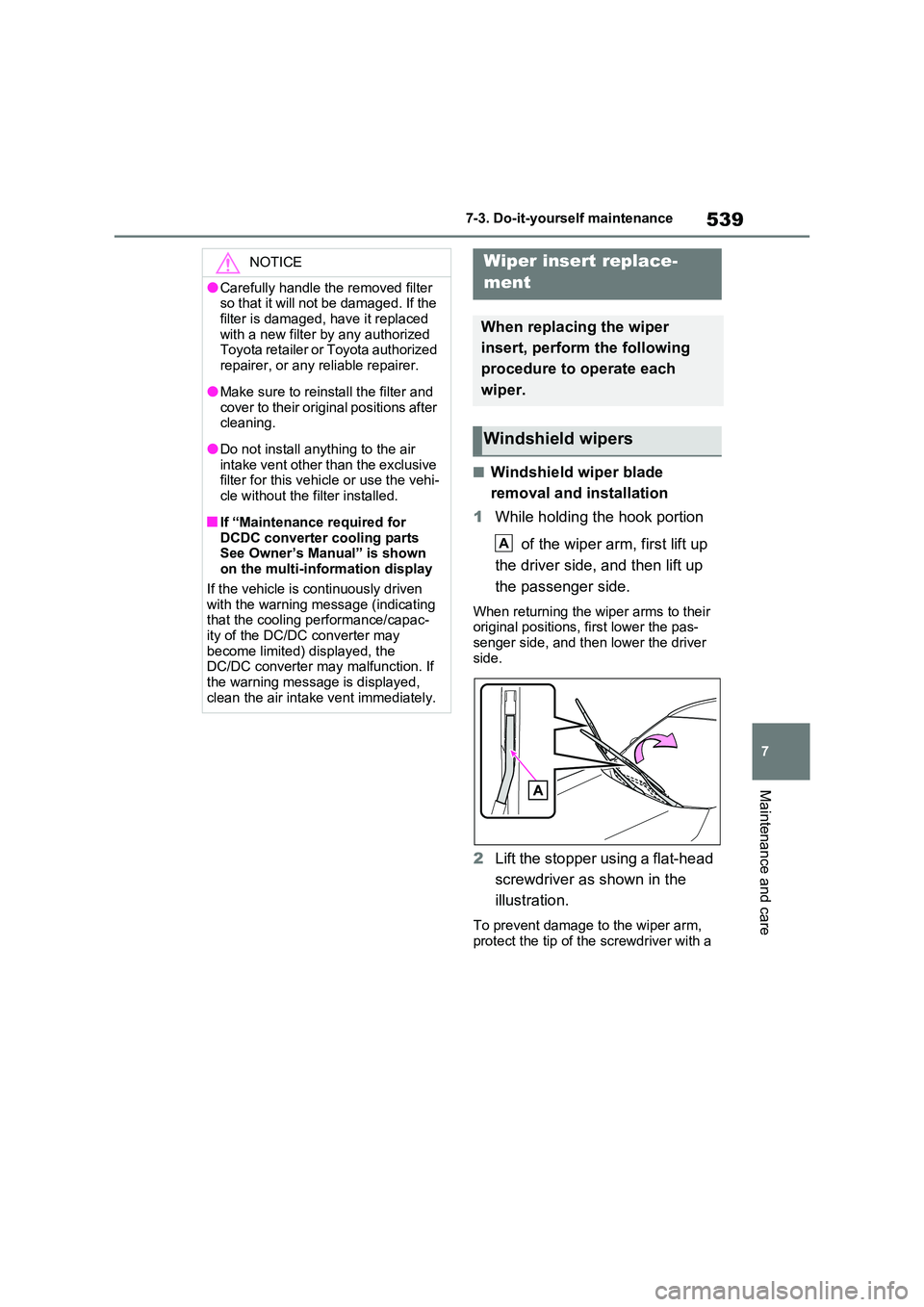
■Windshield wiper blade
removal and installation
1 While holding the hook portion
of the wiper arm, first lift up
the driver side, and then lift up
the passenger side.
When returning the wiper arms to their original positions, first lower the pas-senger side, and then lower the driver
side.
2 Lift the stopper using a flat-head
screwdriver as shown in the
illustration.
To prevent damage to the wiper arm, protect the tip of the screwdriver with a
NOTICE
●Carefully handle the removed filter so that it will not be damaged. If the
filter is damaged, have it replaced with a new filter by any authorized Toyota retailer or Toyota authorized
repairer, or any reliable repairer.
●Make sure to reinstall the filter and
cover to their original positions after cleaning.
●Do not install anything to the air intake vent other than the exclusive filter for this vehicle or use the vehi-
cle without the filter installed.
■If “Maintenance required for
DCDC converter cooling parts See Owner’s Manual” is shown on the multi-information display
If the vehicle is continuously driven with the warning message (indicating that the cooling performance/capac-
ity of the DC/DC converter may become limited) displayed, the DC/DC converter may malfunction. If
the warning message is displayed, clean the air intake vent immediately.
Wiper insert replace-
ment
When replacing the wiper
insert, perform the following
procedure to operate each
wiper.
Windshield wipers
A
Page 544 of 664
5447-3. Do-it-yourself maintenance
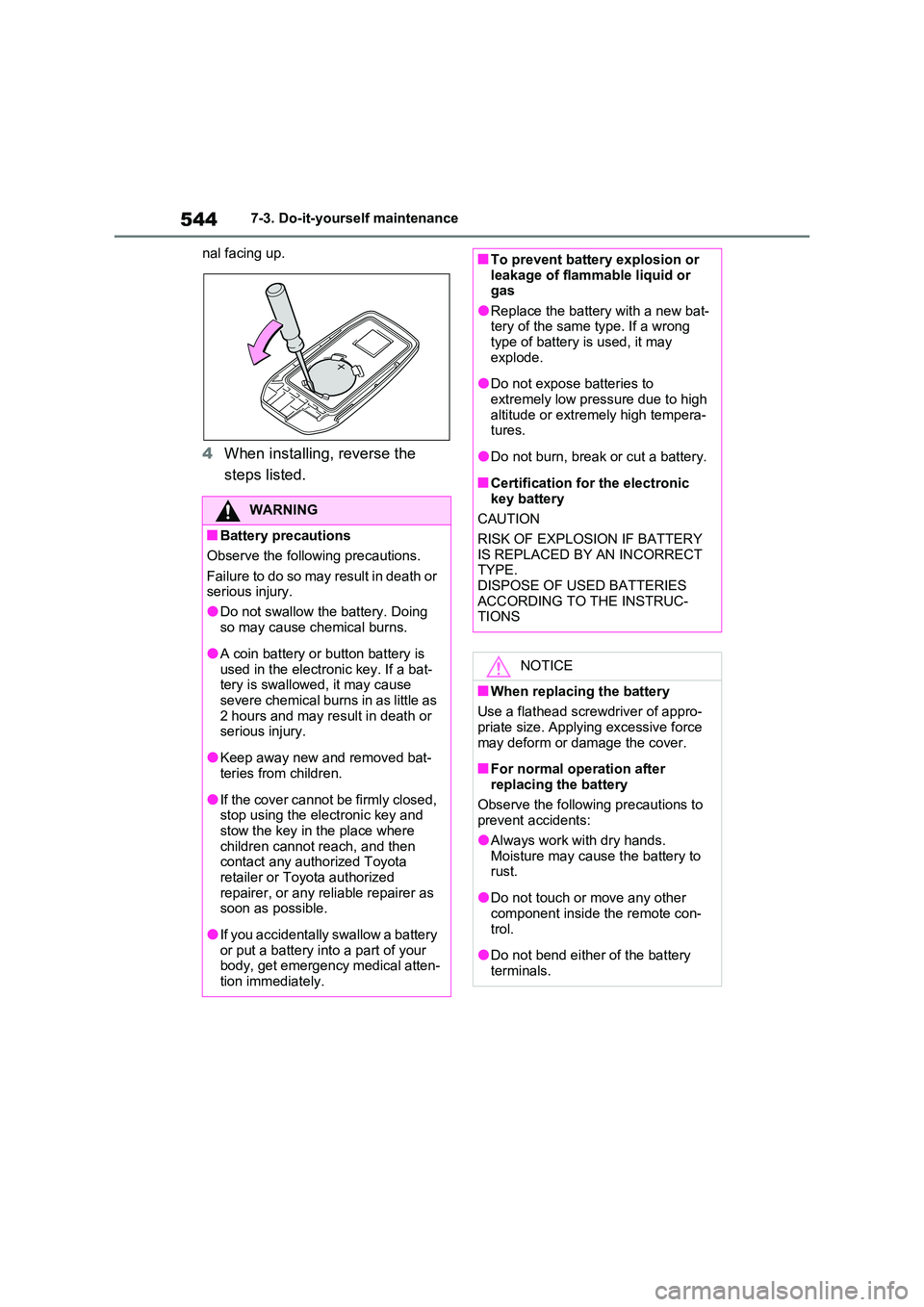
nal facing up.
4 When installing, reverse the
steps listed.
WARNING
■Battery precautions
Observe the following precautions.
Failure to do so may result in death or serious injury.
●Do not swallow the battery. Doing
so may cause chemical burns.
●A coin battery or button battery is
used in the electronic key. If a bat- tery is swallowed, it may cause severe chemical burns in as little as
2 hours and may result in death or serious injury.
●Keep away new and removed bat-teries from children.
●If the cover cannot be firmly closed, stop using the electronic key and stow the key in the place where
children cannot reach, and then contact any authorized Toyota retailer or Toyota authorized
repairer, or any reliable repairer as soon as possible.
●If you accidentally swallow a battery or put a battery into a part of your body, get emergency medical atten-
tion immediately.
■To prevent battery explosion or leakage of flammable liquid or gas
●Replace the battery with a new bat-tery of the same type. If a wrong type of battery is used, it may
explode.
●Do not expose batteries to
extremely low pressure due to high altitude or extremely high tempera-tures.
●Do not burn, break or cut a battery.
■Certification for the electronic key battery
CAUTION
RISK OF EXPLOSION IF BATTERY IS REPLACED BY AN INCORRECT TYPE.
DISPOSE OF USED BATTERIES ACCORDING TO THE INSTRUC-TIONS
NOTICE
■When replacing the battery
Use a flathead screwdriver of appro- priate size. Applying excessive force
may deform or damage the cover.
■For normal operation after
replacing the battery
Observe the following precautions to prevent accidents:
●Always work with dry hands.Moisture may cause the battery to rust.
●Do not touch or move any other component inside the remote con-
trol.
●Do not bend either of the battery
terminals.
Page 547 of 664
547
7
7-3. Do-it-yourself maintenance
Maintenance and care
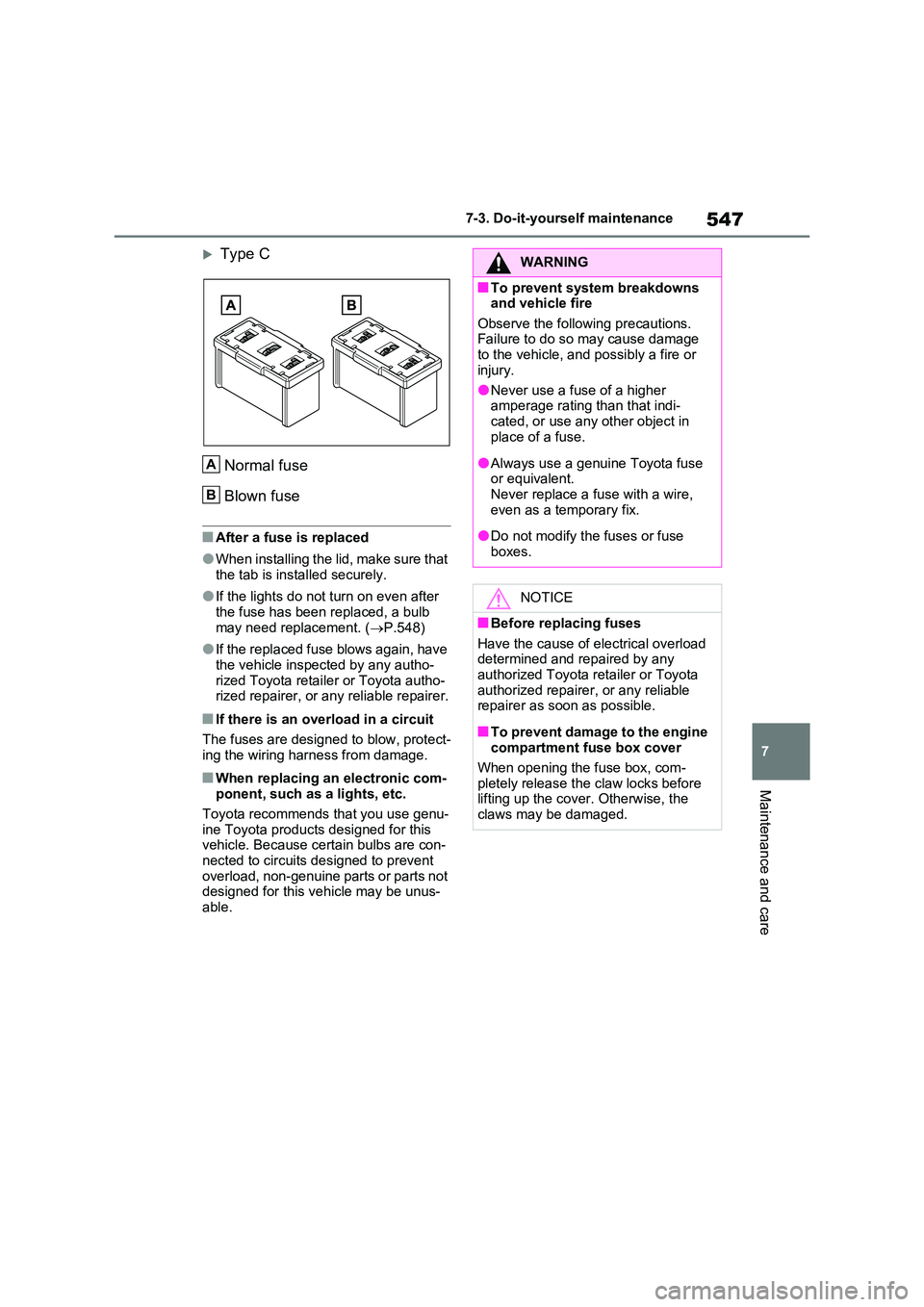
Type C
Normal fuse
Blown fuse
■After a fuse is replaced
●When installing the lid, make sure that
the tab is installed securely.
●If the lights do not turn on even after
the fuse has been replaced, a bulb may need replacement. ( P.548)
●If the replaced fuse blows again, have the vehicle inspected by any autho-
rized Toyota retailer or Toyota autho- rized repairer, or any reliable repairer.
■If there is an overload in a circuit
The fuses are designed to blow, protect-
ing the wiring harness from damage.
■When replacing an electronic com- ponent, such as a lights, etc.
Toyota recommends that you use genu-
ine Toyota products designed for this vehicle. Because certain bulbs are con-nected to circuits designed to prevent
overload, non-genuine parts or parts not designed for this vehicle may be unus-able.
A
B
WARNING
■To prevent system breakdowns and vehicle fire
Observe the following precautions. Failure to do so may cause damage to the vehicle, and possibly a fire or
injury.
●Never use a fuse of a higher amperage rating than that indi-
cated, or use any other object in place of a fuse.
●Always use a genuine Toyota fuse or equivalent.Never replace a fuse with a wire,
even as a temporary fix.
●Do not modify the fuses or fuse
boxes.
NOTICE
■Before replacing fuses
Have the cause of electrical overload determined and repaired by any authorized Toyota retailer or Toyota
authorized repairer, or any reliable repairer as soon as possible.
■To prevent damage to the engine compartment fuse box cover
When opening the fuse box, com- pletely release the claw locks before lifting up the cover. Otherwise, the
claws may be damaged.
Page 557 of 664
557
7
7-3. Do-it-yourself maintenance
Maintenance and care
WARNING
■Replacing light bulb
●Turn off the light. Do not attempt to
replace the bulb immediately after turning off the light. The bulb become very hot and may
cause burns.
●Do not touch the glass portion of
the light bulb with bare hands. When it is unavoidable to hold the glass portion, use and hold with a
clean dry cloth to avoid getting moisture and oils on the bulb. Also, if the bulb is scratched or
dropped, it may blow out or crack.
●Fully install light bulb and any parts
used to secure it. Failure to do so may result in heat damage, fire, or water entering the light unit. This
may damage the light or cause con- densation to build up on the lens.
●Do not attempt to repair or disas-semble light bulbs, connectors, electric circuits or component parts.
Doing so may result in death or serious injury due to electric shock.
■To prevent damage or fire
●Make sure bulb is fully seated and locked.
●Check the wattage of the bulb before installing to prevent heat
damage.