lights TOYOTA VERSO S 2011 Manual PDF
[x] Cancel search | Manufacturer: TOYOTA, Model Year: 2011, Model line: VERSO S, Model: TOYOTA VERSO S 2011Pages: 664, PDF Size: 160.56 MB
Page 552 of 664
5527-3. Do-it-yourself maintenance
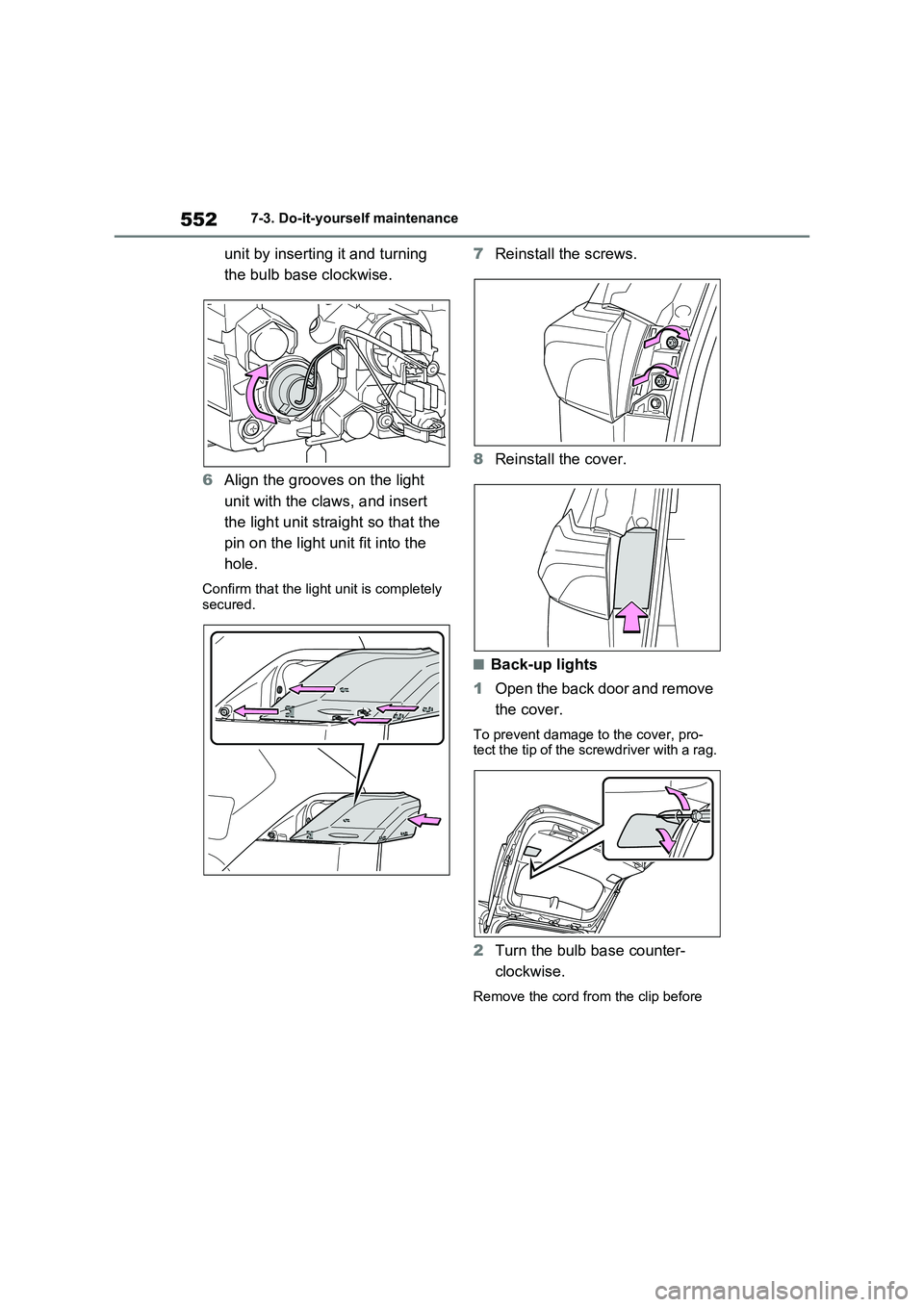
unit by inserting it and turning
the bulb base clockwise.
6Align the grooves on the light
unit with the claws, and insert
the light unit straight so that the
pin on the light unit fit into the
hole.
Confirm that the light unit is completely
secured.
7Reinstall the screws.
8Reinstall the cover.
■Back-up lights
1Open the back door and remove
the cover.
To prevent damage to the cover, pro-
tect the tip of the screwdriver with a rag.
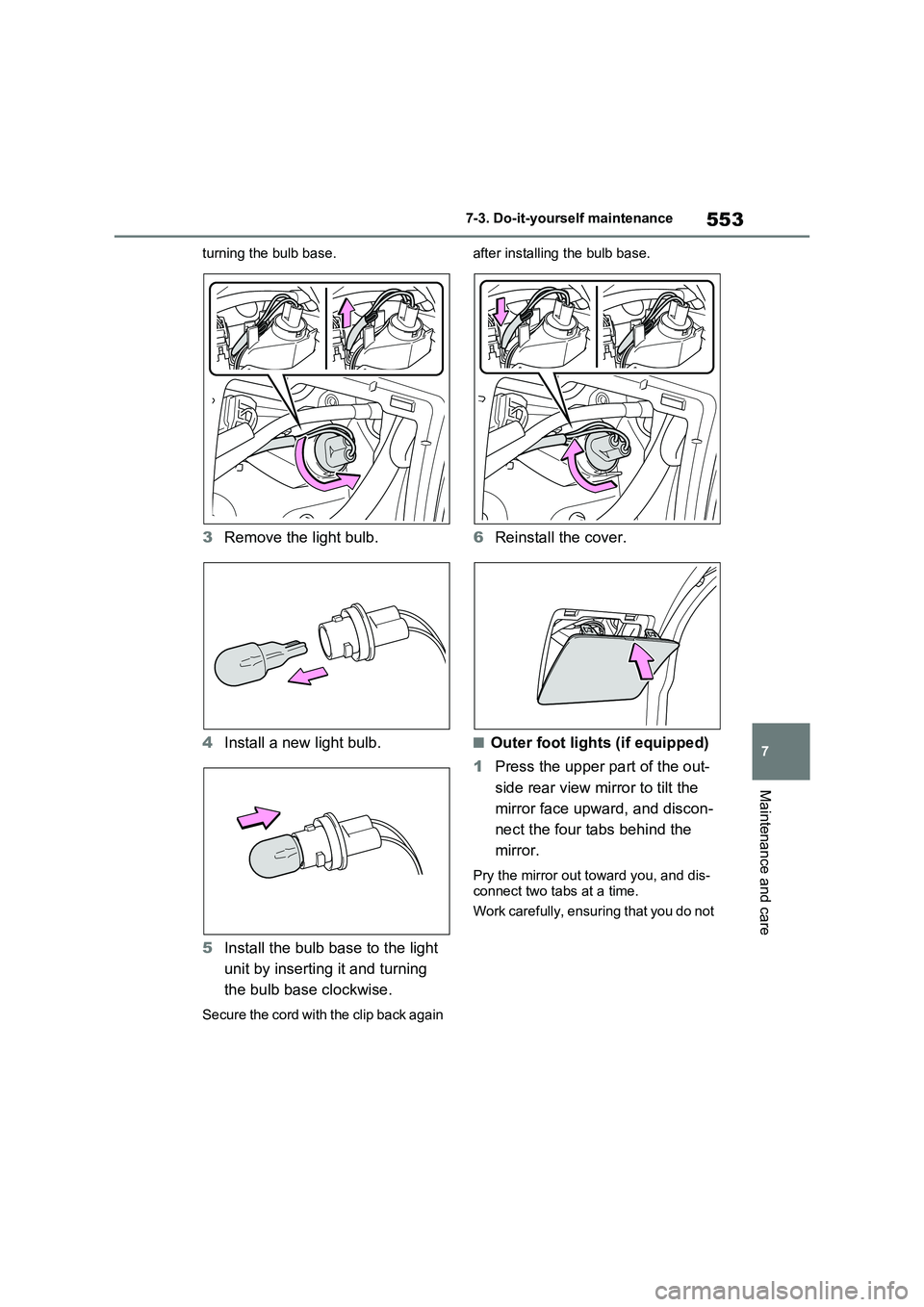
2Turn the bulb base counter-
clockwise.
Remove the cord from the clip before
Page 553 of 664
553
7 7-3. Do-it-yourself maintenance
Maintenance and care
turning the bulb base.
3Remove the light bulb.
4Install a new light bulb.
5Install the bulb base to the light
unit by inserting it and turning
the bulb base clockwise.
Secure the cord with the clip back again after installing the bulb base.
6Reinstall the cover.
■Outer foot lights (if equipped)
1Press the upper part of the out-
side rear view mirror to tilt the
mirror face upward, and discon-
nect the four tabs behind the
mirror.
Pry the mirror out toward you, and dis-
connect two tabs at a time.
Work carefully, ensuring that you do not
Page 560 of 664
5608-1. Essential information
8-1.Essential information
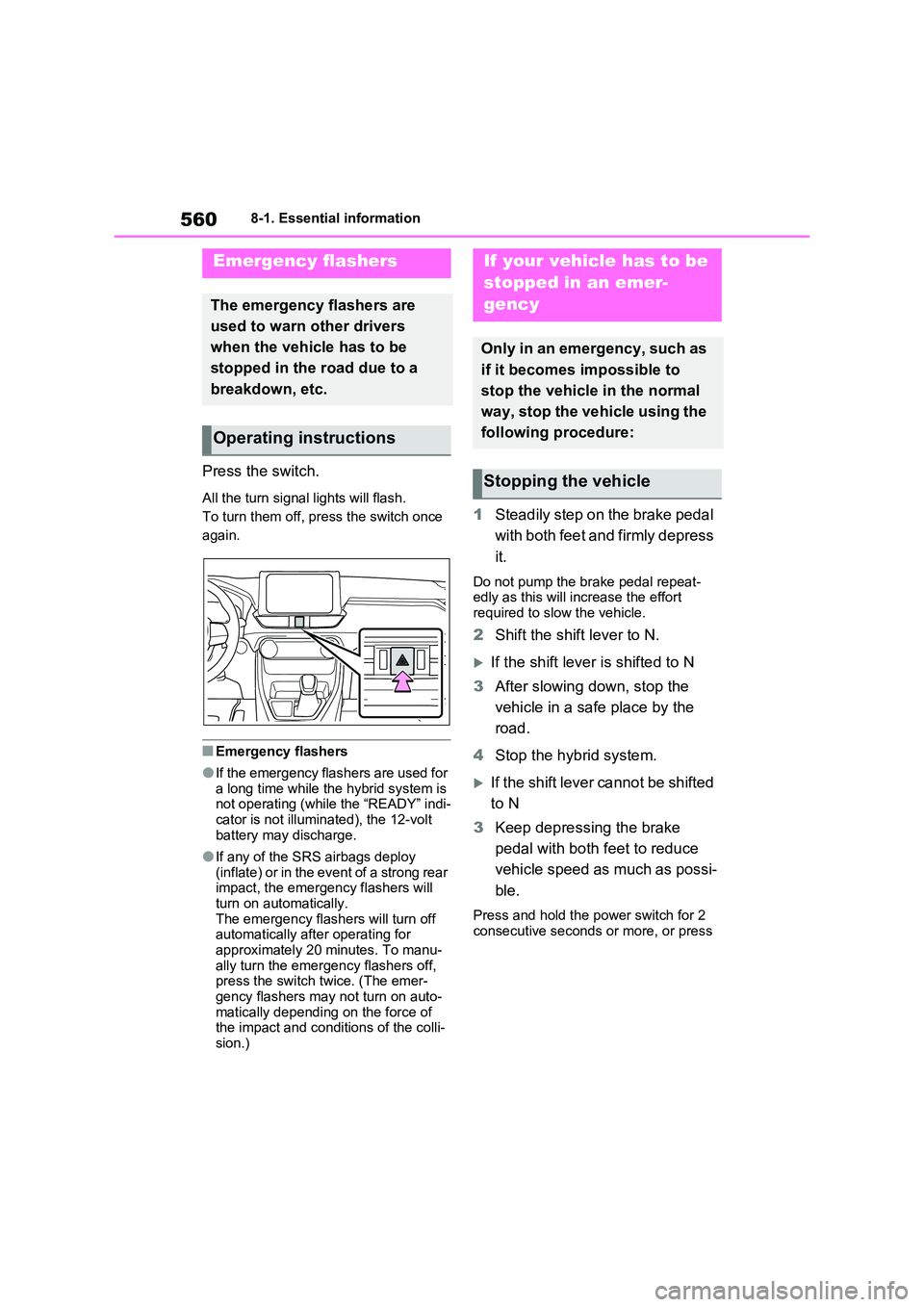
Press the switch.
All the turn signal lights will flash.
To turn them off, press the switch once
again.
■Emergency flashers
●If the emergency flashers are used for a long time while the hybrid system is not operating (while the “READY” indi-
cator is not illuminated), the 12-volt battery may discharge.
●If any of the SRS airbags deploy (inflate) or in the event of a strong rear impact, the emergency flashers will
turn on automatically. The emergency flashers will turn off automatically after operating for
approximately 20 minutes. To manu- ally turn the emergency flashers off, press the switch twice. (The emer-
gency flashers may not turn on auto- matically depending on the force of the impact and conditions of the colli-
sion.)
1 Steadily step on the brake pedal
with both feet and firmly depress
it.
Do not pump the brake pedal repeat- edly as this will increase the effort required to slow the vehicle.
2 Shift the shift lever to N.
If the shift lever is shifted to N
3 After slowing down, stop the
vehicle in a safe place by the
road.
4 Stop the hybrid system.
If the shift lever cannot be shifted
to N
3 Keep depressing the brake
pedal with both feet to reduce
vehicle speed as much as possi-
ble.
Press and hold the power switch for 2
consecutive seconds or more, or press
Emergency flashers
The emergency flashers are
used to warn other drivers
when the vehicle has to be
stopped in the road due to a
breakdown, etc.
Operating instructions
If your vehicle has to be
stopped in an emer-
gency
Only in an emergency, such as
if it becomes impossible to
stop the vehicle in the normal
way, stop the vehicle using the
following procedure:
Stopping the vehicle
Page 568 of 664
5688-2. Steps to take in an emergency
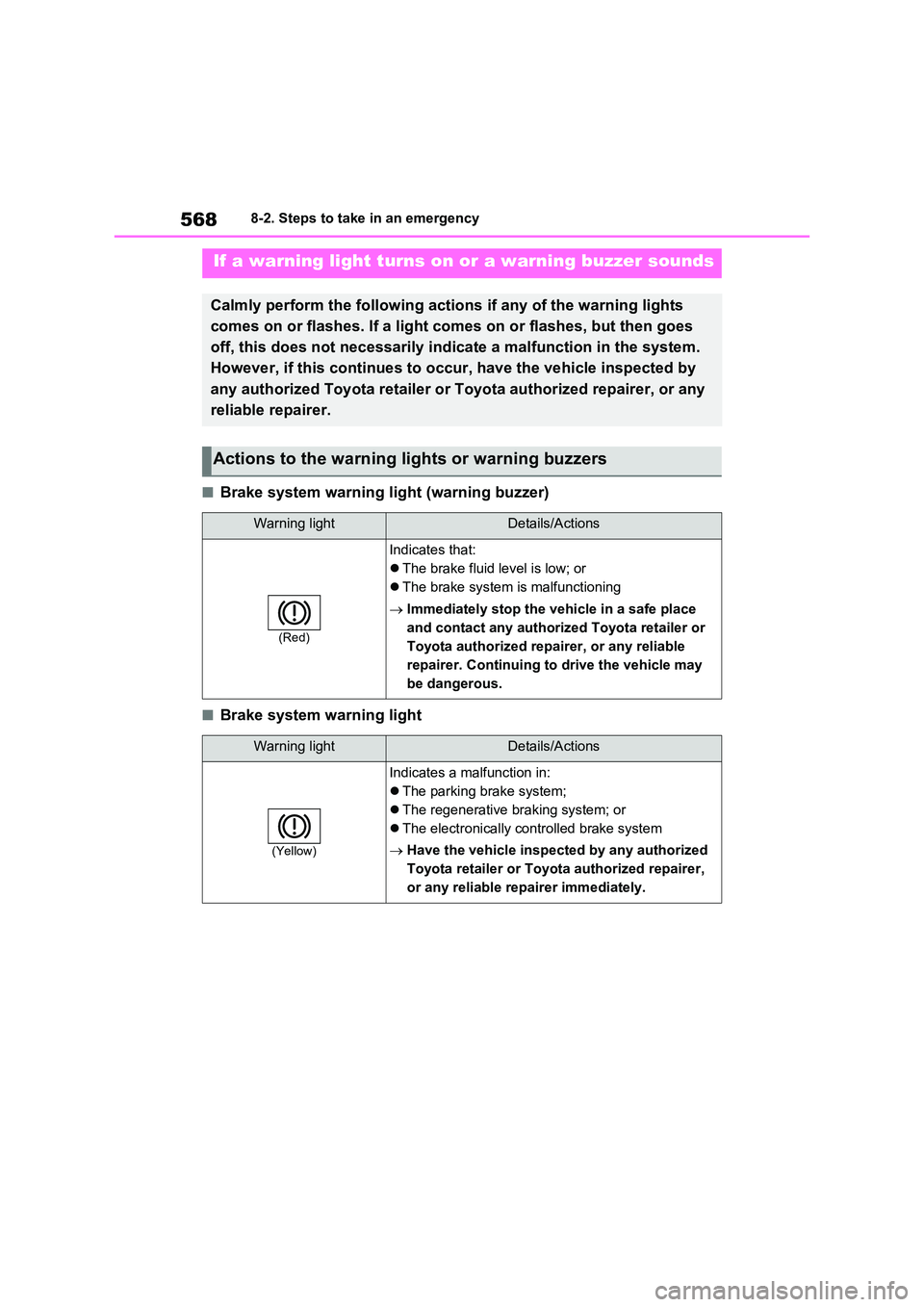
■Brake system warning light (warning buzzer)
■Brake system warning light
If a warning light turns on or a warning buzzer sounds
Calmly perform the following actions if any of the warning lights
comes on or flashes. If a light comes on or flashes, but then goes
off, this does not necessarily indicate a malfunction in the system.
However, if this continues to occur, have the vehicle inspected by
any authorized Toyota retailer or Toyota authorized repairer, or any
reliable repairer.
Actions to the warning lights or warning buzzers
Warning lightDetails/Actions
(Red)
Indicates that:
The brake fluid level is low; or
The brake system is malfunctioning
Immediately stop the vehicle in a safe place
and contact any authorized Toyota retailer or
Toyota authorized repairer, or any reliable
repairer. Continuing to drive the vehicle may
be dangerous.
Warning lightDetails/Actions
(Yellow)
Indicates a malfunction in:
The parking brake system;
The regenerative braking system; or
The electronically controlled brake system
Have the vehicle inspected by any authorized
Toyota retailer or Toyota authorized repairer,
or any reliable repairer immediately.
Page 576 of 664
5768-2. Steps to take in an emergency
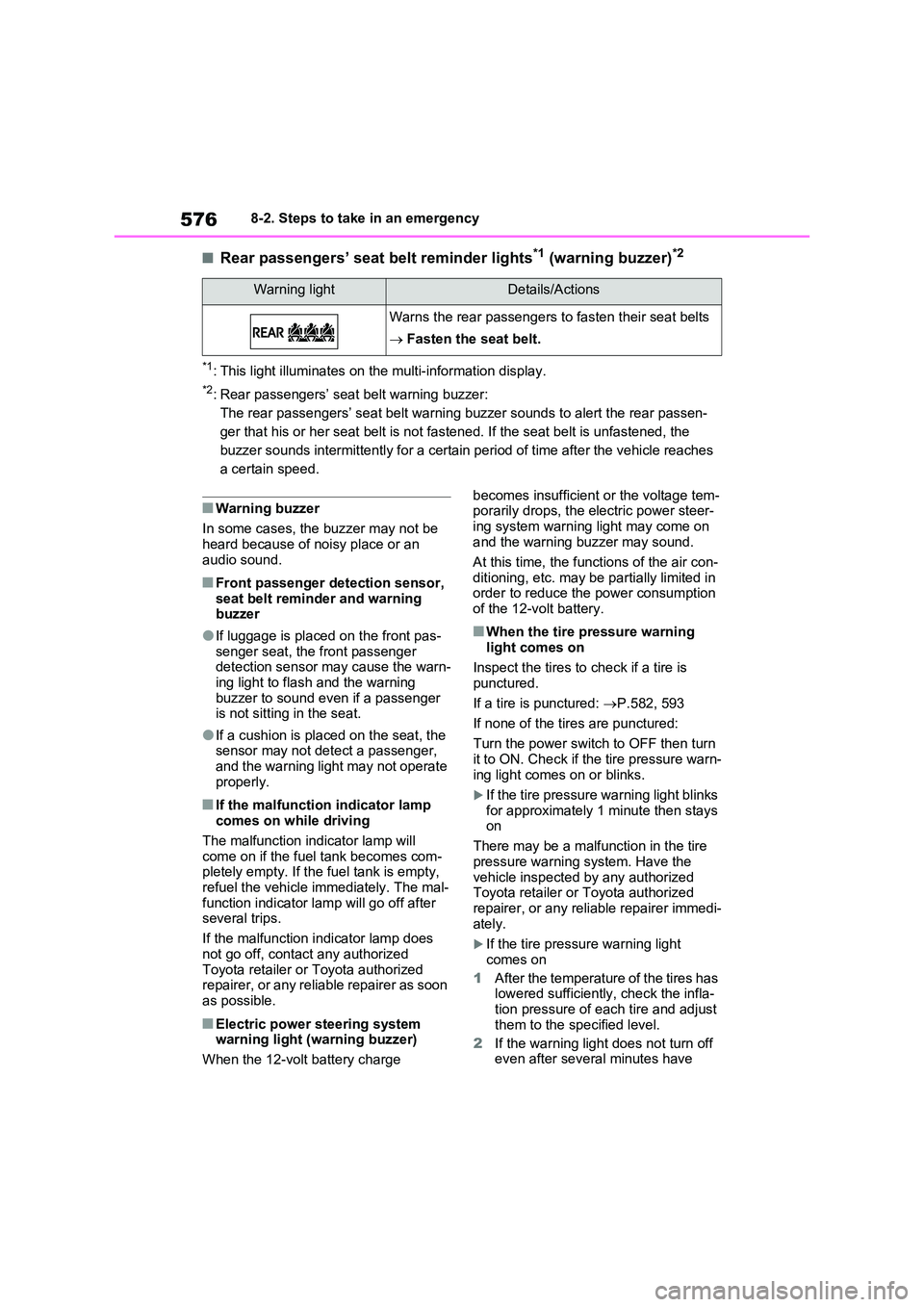
■Rear passengers’ seat belt reminder lights*1 (warning buzzer)*2
*1: This light illuminates on the multi-information display.
*2: Rear passengers’ seat belt warning buzzer:
The rear passengers’ seat belt warning buzzer sounds to alert the rear passen-
ger that his or her seat belt is not fastened. If the seat belt is unfastened, the
buzzer sounds intermittently for a certain period of time after the vehicle reaches
a certain speed.
■Warning buzzer
In some cases, the buzzer may not be heard because of noisy place or an
audio sound.
■Front passenger detection sensor, seat belt reminder and warning buzzer
●If luggage is placed on the front pas-
senger seat, the front passenger detection sensor may cause the warn-ing light to flash and the warning
buzzer to sound even if a passenger is not sitting in the seat.
●If a cushion is placed on the seat, the sensor may not detect a passenger, and the warning light may not operate
properly.
■If the malfunction indicator lamp comes on while driving
The malfunction indicator lamp will
come on if the fuel tank becomes com- pletely empty. If the fuel tank is empty, refuel the vehicle immediately. The mal-
function indicator lamp will go off after several trips.
If the malfunction indicator lamp does
not go off, contact any authorized Toyota retailer or Toyota authorized repairer, or any reliable repairer as soon
as possible.
■Electric power steering system warning light (warning buzzer)
When the 12-volt battery charge
becomes insufficient or the voltage tem- porarily drops, the electric power steer-
ing system warning light may come on and the warning buzzer may sound.
At this time, the functions of the air con-
ditioning, etc. may be partially limited in order to reduce the power consumption of the 12-volt battery.
■When the tire pressure warning
light comes on
Inspect the tires to check if a tire is punctured.
If a tire is punctured: P.582, 593
If none of the tires are punctured:
Turn the power switch to OFF then turn
it to ON. Check if the tire pressure warn- ing light comes on or blinks.
If the tire pressure warning light blinks
for approximately 1 minute then stays on
There may be a malfunction in the tire
pressure warning system. Have the vehicle inspected by any authorized Toyota retailer or Toyota authorized
repairer, or any reliable repairer immedi- ately.
If the tire pressure warning light
comes on
1 After the temperature of the tires has lowered sufficiently, check the infla-tion pressure of each tire and adjust
them to the specified level.
2 If the warning light does not turn off even after several minutes have
Warning lightDetails/Actions
Warns the rear passengers to fasten their seat belts
Fasten the seat belt.
Page 577 of 664
577
8
8-2. Steps to take in an emergency
When trouble arises
elapsed, check that the inflation
pressure of each tire is at the speci- fied level and perform initialization. ( P.523)
■The tire pressure warning light may
come on due to natural causes
The tire pressure warning light may come on due to natural causes such as
natural air leaks and tire inflation pres- sure changes caused by temperature. In this case, adjusting the tire inflation
pressure will turn off the warning light (after a few minutes).
■When a tire is replaced with a com-pact spare tire (vehicles with com-
pact spare tire)
The compact spare tire is not equipped with a tire pressure warning valve and
transmitter. If a tire goes flat, the tire pressure warning light will not turn off even though the flat tire has been
replaced with the spare tire. Replace the spare tire with the standard tire and adjust the tire inflation pressure. The tire
pressure warning light will go off after a few minutes.
■Conditions that the tire pressure warning system may not function
properly
P.512
WARNING
■If a warning light comes on or a
warning buzzer sounds when a warning message is shown on
the multi-information display*
Check and follow the message shown on the multi-information display.
Failure to do so may result in death or serious injury.*: Warning lights illuminate in red or
yellow and the warning buzzer
beeps once or sounds continu-
ously.
■When the electric power steer- ing system warning light comes on
When the light comes on yellow, the assist to the power steering is restricted. When the light comes on
red, the assist to the power steering is lost and handling operations of the steering wheel become extremely
heavy. If the steering wheel becomes heavier than usual when operating, hold firmly
and operate using more force than usual.
■If the tire pressure warning light comes on
Be sure to observe the following pre-
cautions. Failure to do so could cause a loss of vehicle control and result in death or serious injury.
●Stop your vehicle in a safe place as soon as possible. Adjust the tire inflation pressure immediately.
●If the tire pressure warning light comes on even after tire inflation
pressure adjustment, it is probable that you have a flat tire. Check the tires. If a tire is flat, change it with
the spare tire and have the flat tire repaired by the nearest authorized Toyota retailer or Toyota authorized
repairer, or any reliable repairer.
●Avoid abrupt maneuvering and
braking. If the vehicle tires deterio- rate, you could lose control of the steering wheel or the brakes.
■If a blowout or sudden air leak-age should occur
The tire pressure warning system may not activate immediately.
Page 602 of 664
![TOYOTA VERSO S 2011 Manual PDF 6028-2. Steps to take in an emergency
temperature of the hybrid battery
(traction battery) is extremely low
(approximately below -30°C [-
22°F]). ( P.318)
One of the following may be the](/img/14/49148/w960_49148-601.png "TOYOTA VERSO S 2011 Manual PDF 6028-2. Steps to take in an emergency
temperature of the hybrid battery
(traction battery) is extremely low
(approximately below -30°C [-
22°F]). ( P.318)
One of the following may be the")
6028-2. Steps to take in an emergency
temperature of the hybrid battery
(traction battery) is extremely low
(approximately below -30°C [-
22°F]). ( P.318)
One of the following may be the
cause of the problem:
The 12-volt battery may be dis-
charged. ( P.606)
The 12-volt battery terminal con-
nections may be loose or cor-
roded. ( P.508)
One of the following may be the
cause of the problem:
The 12-volt battery may be dis-
charged. ( P.606)
One or both of the 12-volt battery
terminals may be disconnected.
( P.508)
Contact any authorized Toyota
retailer or Toyota authorized
repairer, or any reliable repairer if
the problem cannot be repaired, or
if repair procedures are unknown.
When the hybrid system does not
start, the following steps can be
used as an interim measure to start
the hybrid system if the power
switch is functioning normally.
Do not use this starting procedure
except in cases of emergency.
1 Pull the parking brake switch to
check that the parking brake is
set. ( P.326)
Parking brake indicator will come on.
2Shift the shift lever to P.
3 Turn the power switch to ACC.
4 Press and hold the power switch
for about 15 seconds while
depressing the brake pedal
firmly.
Even if the hybrid system can be
started using the above steps, the
system may be malfunctioning.
Have the vehicle inspected by any
authorized Toyota retailer or Toyota
authorized repairer, or any reliable
repairer.
The interior lights and head-
lights are dim, or the horn
does not sound or sounds at
a low volume
The interior lights and head-
lights do not turn on, or the
horn does not sound
Starting the hybrid system
in an emergency
Page 608 of 664
6088-2. Steps to take in an emergency
minutes to recharge the 12-volt
battery of your vehicle.
6 Open and close any of the doors
of your vehicle with the power
switch off.
7 Maintain the engine speed of
the second vehicle and start the
hybrid system of your vehicle by
turning the power switch to ON.
8 Make sure the “READY” indica-
tor comes on. If the indicator
light does not come on, contact
any authorized Toyota retailer or
Toyota authorized repairer, or
any reliable repairer.
9 Once the hybrid system has
started, remove the jumper
cables in the exact reverse
order from which they were con-
nected.
10 Close the exclusive jump start-
ing terminal cover, and reinstall
the fuse box cover to its original
position.
Once the hybrid system starts,
have the vehicle inspected at any
authorized Toyota retailer or Toyota
authorized repairer, or any reliable
repairer as soon as possible.
■Starting the hybrid system when
the 12-volt battery is discharged
The hybrid system cannot be started by push-starting.
■To prevent 12-volt battery dis-
charge
●Turn off the headlights and the audio
system while the hybrid system is off.
●Turn off any unnecessary electrical
components when the vehicle is run- ning at a low speed for an extended period, such as in heavy traffic.
■When the 12-volt battery is
removed or discharged
●Information stored in the ECU is
cleared. When the 12-volt battery is depleted, have the vehicle inspected at any authorized Toyota retailer or
Toyota authorized repairer, or any reli- able repairer.
●Some systems may require initializa-tion. ( P.643)
■When removing the 12-volt battery terminals
When the 12-volt battery terminals are removed, the information stored in the ECU is cleared. Before removing the 12-
volt battery terminals, contact any authorized Toyota retailer or Toyota authorized repairer, or any reliable
repairer.
■Charging the 12-volt battery
The electricity stored in the 12-volt bat- tery will discharge gradually even when
the vehicle is not in use, due to natural discharge and the draining effects of certain electrical appliances. If the vehi-
cle is left for a long time, the 12-volt bat- tery may discharge, and the hybrid system may be unable to start. (The 12-
volt battery recharges automatically while the hybrid system is operating.)
■When recharging or replacing the 12-volt battery
●In some cases, it may not be possible to unlock the doors using the smart
entry & start system when the 12-volt battery is discharged. Use the wire-less remote control or the mechanical
key to lock or unlock the doors.
●The hybrid system may not start on
the first attempt after reinstalling the 12-volt battery. In that case, start the hybrid system in the same manner as
when the electronic key does not operate properly ( P.605). This is not
Page 623 of 664
623
9
9-1. Specifications
Vehicle specifications
authorized repairer, or any reliable repairer.
*: The fluid capacity is the quantity of reference.
If replacement is necessary, contact any authorized Toyota retailer or Toyota
authorized repairer, or any reliable repairer.
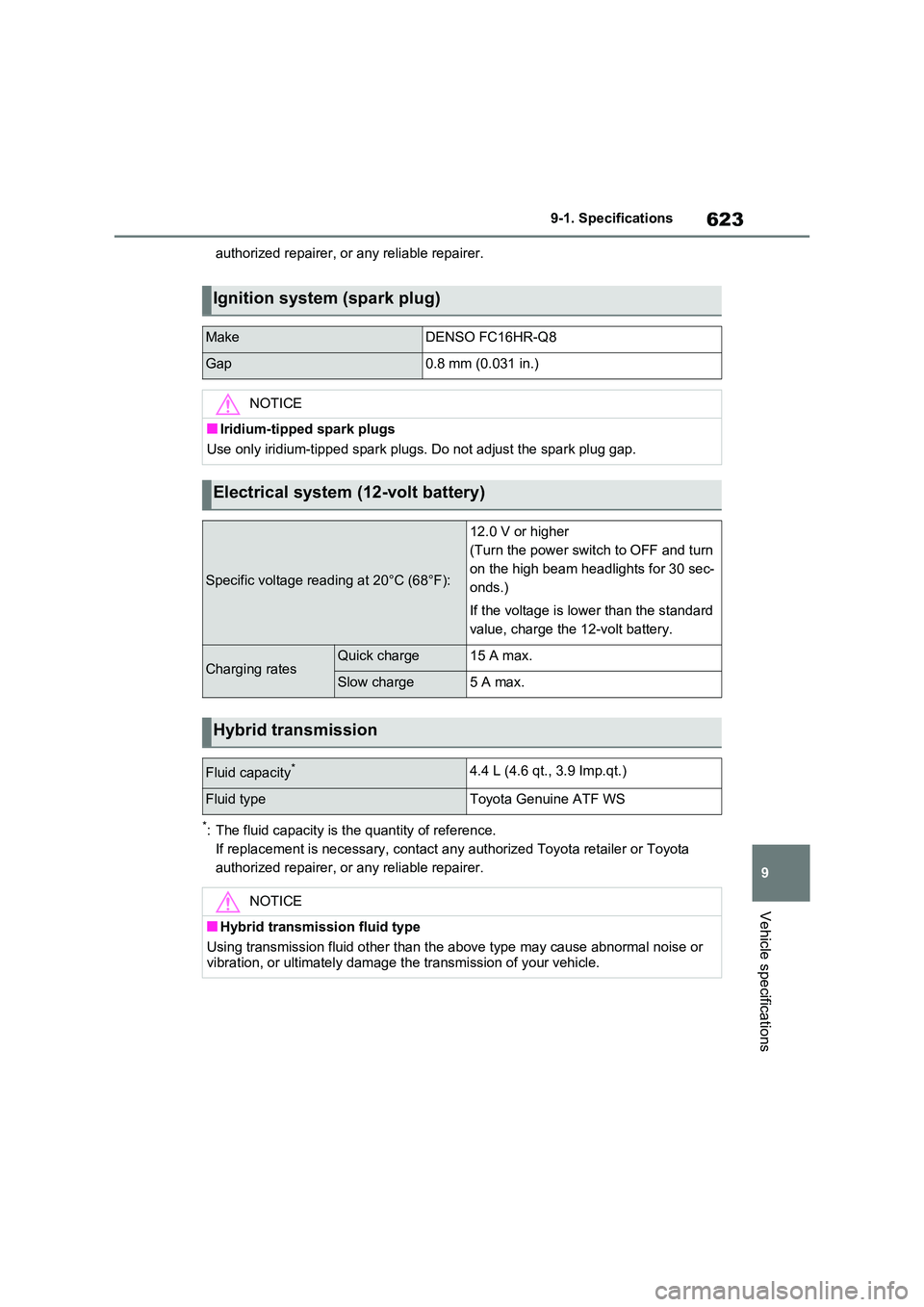
Ignition system (spark plug)
MakeDENSO FC16HR-Q8
Gap0.8 mm (0.031 in.)
NOTICE
■Iridium-tipped spark plugs
Use only iridium-tipped spark plugs. Do not adjust the spark plug gap.
Electrical system (12-volt battery)
Specific voltage reading at 20°C (68°F):
12.0 V or higher
(Turn the power switch to OFF and turn
on the high beam headlights for 30 sec-
onds.)
If the voltage is lower than the standard
value, charge the 12-volt battery.
Charging ratesQuick charge15 A max.
Slow charge5 A max.
Hybrid transmission
Fluid capacity*4.4 L (4.6 qt., 3.9 Imp.qt.)
Fluid typeToyota Genuine ATF WS
NOTICE
■Hybrid transmission fluid type
Using transmission fluid other than the above type may cause abnormal noise or
vibration, or ultimately damage the transmission of your vehicle.
Page 625 of 664
625
9 9-1. Specifications
Vehicle specifications
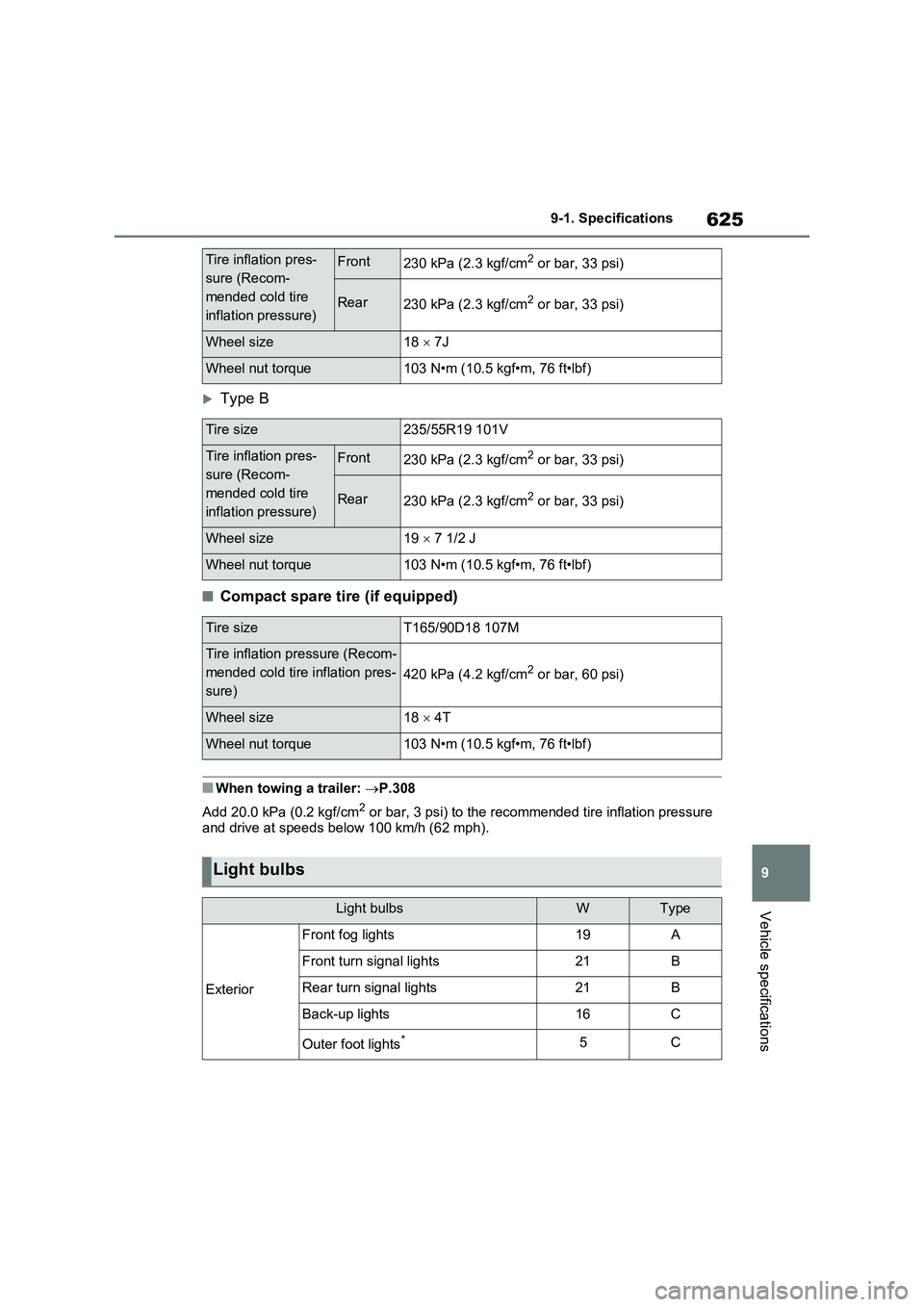
Type B
■Compact spare tire (if equipped)
■When towing a trailer: P.308
Add 20.0 kPa (0.2 kgf/cm
2 or bar, 3 psi) to the recommended tire inflation pressure
and drive at speeds below 100 km/h (62 mph).
Tire inflation pres-
sure (Recom-
mended cold tire
inflation pressure)Front230 kPa (2.3 kgf/cm2 or bar, 33 psi)
Rear230 kPa (2.3 kgf/cm2 or bar, 33 psi)
Wheel size18 7J
Wheel nut torque103 N•m (10.5 kgf•m, 76 ft•lbf)
Tire size235/55R19 101V
Tire inflation pres-
sure (Recom-
mended cold tire
inflation pressure)Front230 kPa (2.3 kgf/cm2 or bar, 33 psi)
Rear230 kPa (2.3 kgf/cm2 or bar, 33 psi)
Wheel size19 7 1/2 J
Wheel nut torque103 N•m (10.5 kgf•m, 76 ft•lbf)
Tire sizeT165/90D18 107M
Tire inflation pressure (Recom-
mended cold tire inflation pres-
sure)
420 kPa (4.2 kgf/cm2 or bar, 60 psi)
Wheel size18 4T
Wheel nut torque103 N•m (10.5 kgf•m, 76 ft•lbf)
Light bulbs
Light bulbsWType
Exterior
Front fog lights19A
Front turn signal lights21B
Rear turn signal lights21B
Back-up lights16C
Outer foot lights*5C