check engine TOYOTA VERSO S 2015 Owner's Manual
[x] Cancel search | Manufacturer: TOYOTA, Model Year: 2015, Model line: VERSO S, Model: TOYOTA VERSO S 2015Pages: 564, PDF Size: 18.47 MB
Page 225 of 564
225 2-3. Operating the lights and wipers
2
When driving
Vehicles with a smart entry & start system
If the wiper switch is turned to the “AUTO” position while the “ENGINE
START STOP” switch is in IGNITION ON mode, the wiper will operate
once to show that “AUTO” mode is activated.
When the sensor sensitivity ring is turned toward high while in “AUTO”
mode, the wiper will operate once to indicate that the sensor sensitivity is
enhanced.
If the temperature of the raindrop sensor is 90C (194F) or higher, or
-15C (5F) or lower, automatic operation may not occur. In this case,
operate the wiper in any mode other than “AUTO”.
If no windshield washer fluid sprays
Check that the washer nozzles are not blocked if there is washer fluid in the
windshield washer fluid reservoir.
CAUTION
Caution regarding the use of windshield wiper in “AUTO” mode (vehi-
cles with rain-sensing windshield wiper)
The windshield wiper may operate unexpectedly if the sensor is touched or
the windshield is subject to vibration in “AUTO” mode. Take care that your
fingers etc. do not become caught in the windshield wiper.
Page 230 of 564
230 2-4. Using other driving systems
Vehicles with a manual transmission
With the clutch pedal fully depressed, stop the vehicle.
Then shift the shift lever to N.
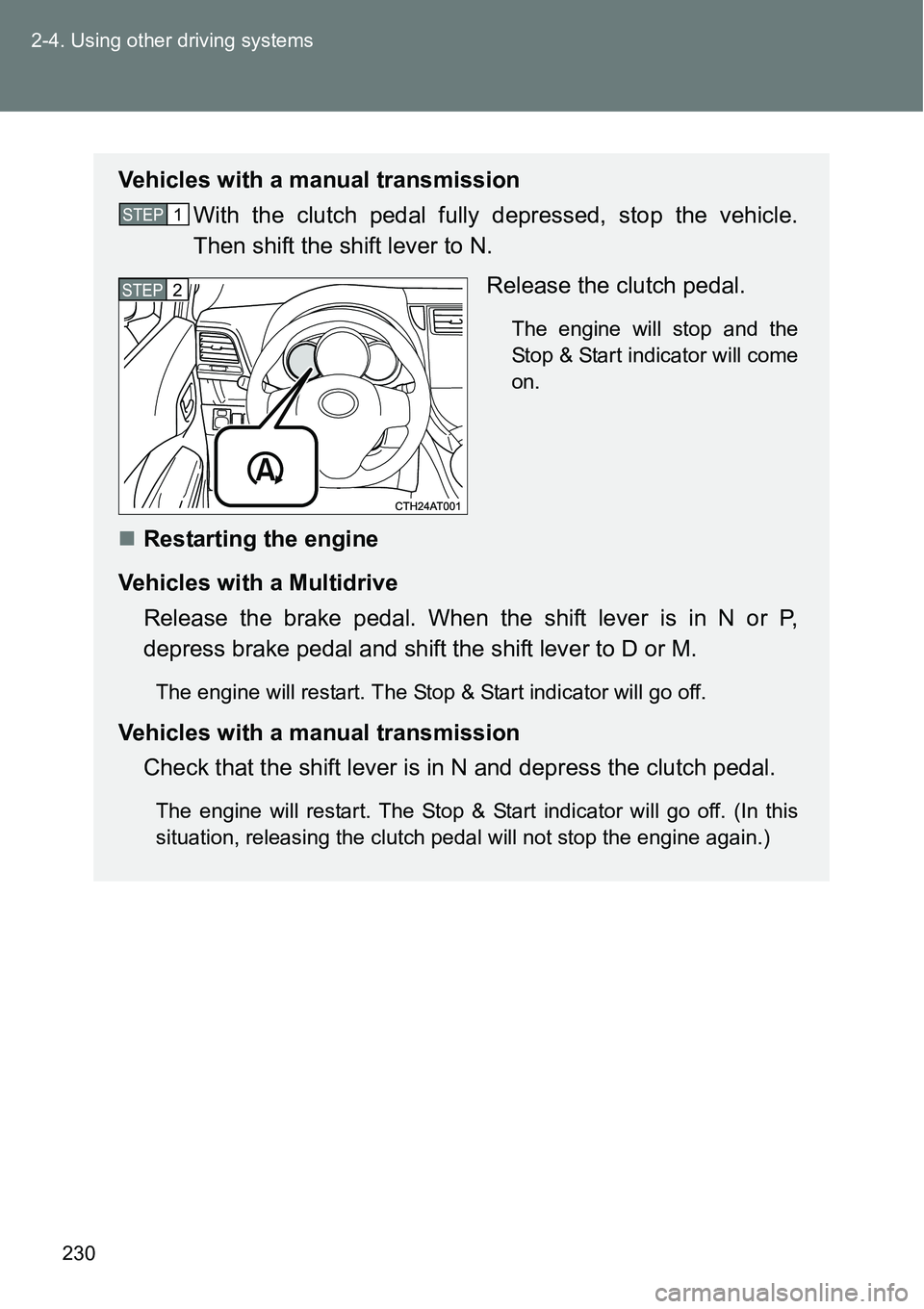
Release the clutch pedal.
The engine will stop and the
Stop & Start indicator will come
on.
Restarting the engine
Vehicles with a Multidrive
Release the brake pedal. When the shift lever is in N or P,
depress brake pedal and shift the shift lever to D or M.
The engine will restart. The Stop & Start indicator will go off.
Vehicles with a manual transmission
Check that the shift lever is in N and depress the clutch pedal.
The engine will restart. The Stop & Start indicator will go off. (In this
situation, releasing the clutch pedal will not stop the engine again.)
STEP1
STEP2
Page 235 of 564
235 2-4. Using other driving systems
2
When driving
CAUTION
When the Stop & Start system is operating
Keep the shift lever in N and apply the brake pedal or parking brake for
safety while the engine is stopped due to the Stop & Start system (while
the Stop & Start indicator is on).
Unexpected accidents may occur due to the automatic engine start func-
tion.
Do not leave the vehicle while the engine is stopped due to the Stop &
Start system (while the Stop & Start indicator is on).
Unexpected accidents may occur due to the automatic engine start func-
tion.
Ensure that the engine is not stopped by the Stop & Start system while the
vehicle is in a poorly ventilated area. The engine may restart due to the
automatic engine start function, causing exhaust gases to collect and
enter the vehicle and resulting in death or a serious health hazard.
NOTICE
To ensure the system operates correctly
If any one of the following situations occurs, the Stop & Start system may not
operate correctly, thus, please have your vehicle checked by any authorized
Toyota dealer or repairer, or another duly qualified and equipped profes-
sional.
While the driver’s seat belt is fastened, the driver’s and front passenger’s
seat belt reminder light flashes.
Even when the driver’s seat belt is not fastened, the driver’s and front pas-
senger’s seat belt reminder light remains off.
Even when the driver’s door is closed, the open door warning light comes
on, or the interior light comes on when the interior light switch is in the door
position.
Even when the driver’s door is opened, the open door warning light does
not come on, or the interior light does not come on when the interior light
switch is in the door position.
Page 250 of 564
250
2-5. Driving information
Winter driving tips
Carry out the necessary preparations and inspections before driving
the vehicle in winter. Always drive the vehicle in a manner appropri-
ate to the prevailing weather conditions.
Pre-winter preparations
Use fluids that are appropriate to the prevailing outside tem-
peratures.
• Engine oil
• Engine coolant
• Washer fluid
Have a service technician inspect the level and specific grav-
ity of battery electrolyte.
Have the vehicle fitted with four snow tires or purchase a set
of tire chains for the front tires.
Ensure that all tires are the same size and brand and that their wear
level is not noticeably different with each other. Also make sure that
chains match the size of the tires.
Before driving the vehicle
Perform the following according to the driving conditions:
Do not try to forcibly open a window or move a wiper that is
frozen. Pour warm water over the frozen area to melt the ice.
Wipe away the water immediately to prevent it from freezing.
To ensure proper operation of the climate control system fan,
remove any snow that has accumulated on the air inlet vents
in front of the windshield.
Remove any ice that has accumulated on the vehicle chassis.
Periodically check for and remove any excess ice or snow
that may have accumulated in the wheel well or on the
brakes.
Page 280 of 564
280 3-1. Using the air conditioning system and defogger
CAUTION
To prevent burns or damage to your vehicle
NOTICE
To prevent damage to your vehicle
Do not turn the heater on and off repeatedly in 5 minute intervals as this
can shorten the life of the heater components. If the engine must be turned
on and off repeatedly within short intervals (such as when the vehicle is
being used for delivery purposes), turn the heater off.
Do not modify or open the heater without consulting any authorized Toyota
dealer or repairer, or another duly qualified and equipped professional, as
this may cause a heater malfunction or a fire.
Be careful not to splash or spill liquid directly on the heater or on the
heater fuel pump, as this may cause the heater to malfunction.
Keep the intake and exhaust pipes of the heater free from water, snow,
ice, mud, etc. If the pipes become clogged, this can cause the heater to
malfunction.
If you notice anything unusual, such as a fluid leak, smoke and poor oper-
ation, turn off the heater and have your vehicle checked by any authorized
Toyota dealer or repairer, or another duly qualified and equipped profes-
sional.
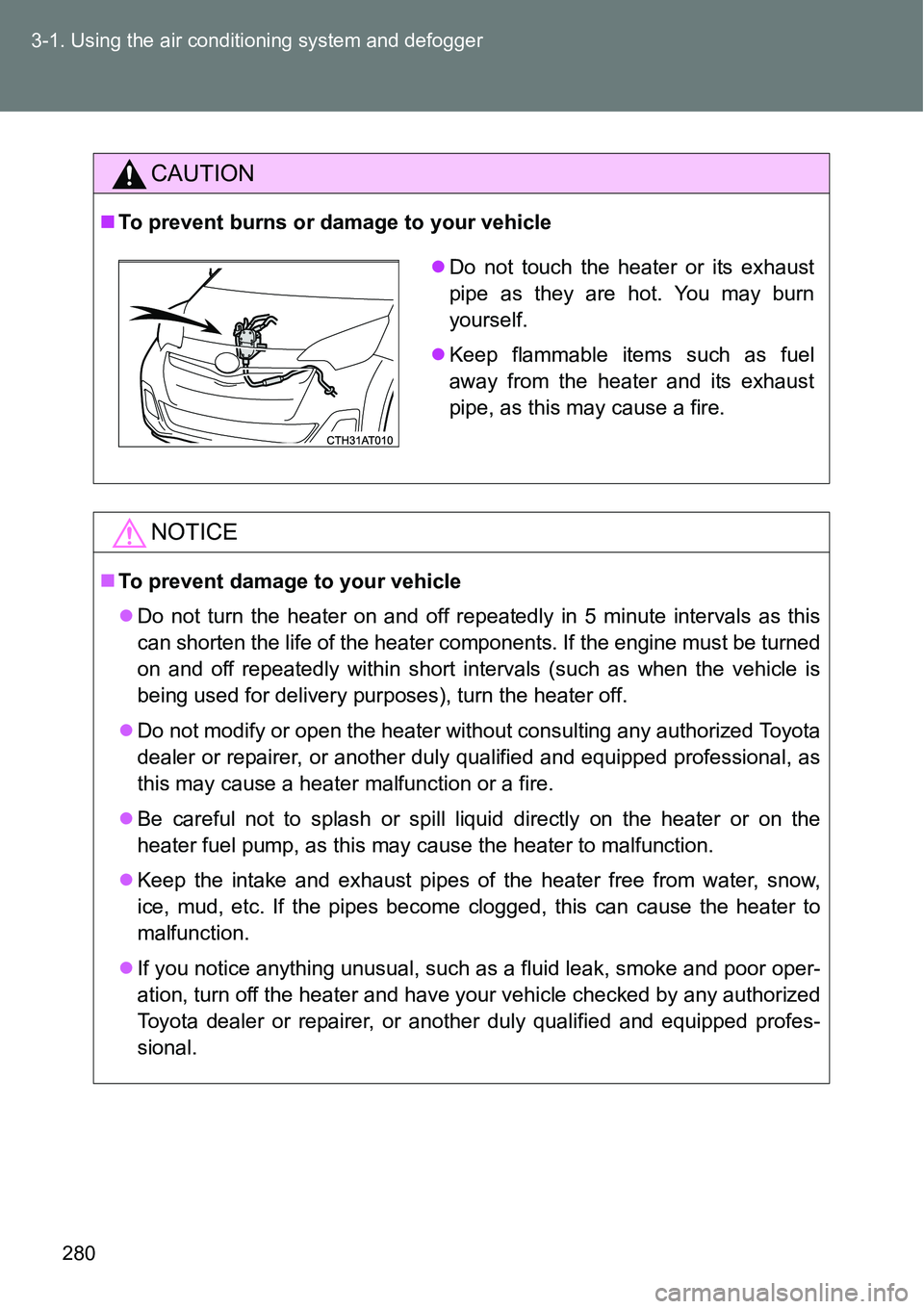
Do not touch the heater or its exhaust
pipe as they are hot. You may burn
yourself.
Keep flammable items such as fuel
away from the heater and its exhaust
pipe, as this may cause a fire.
Page 346 of 564
346 3-5. Other interior features
CAUTION
Observe the following precautions.
Failure to do so may cause the driver's floor mat to slip, possibly interfering
with the pedals while driving. An unexpectedly high speed may result or it may
become difficult to stop the vehicle, leading to a serious accident.
When installing the driver's floor mat
Do not use floor mats designed for other models or different model year
vehicles, even if they are Toyota Genuine floor mats.
Only use floor mats designed for the driver's seat.
Always install the floor mat securely using the retaining hooks (clips) pro-
vided.
Do not use two or more floor mats on top of each other.
Do not place the floor mat bottom-side up or upside-down.
Before driving
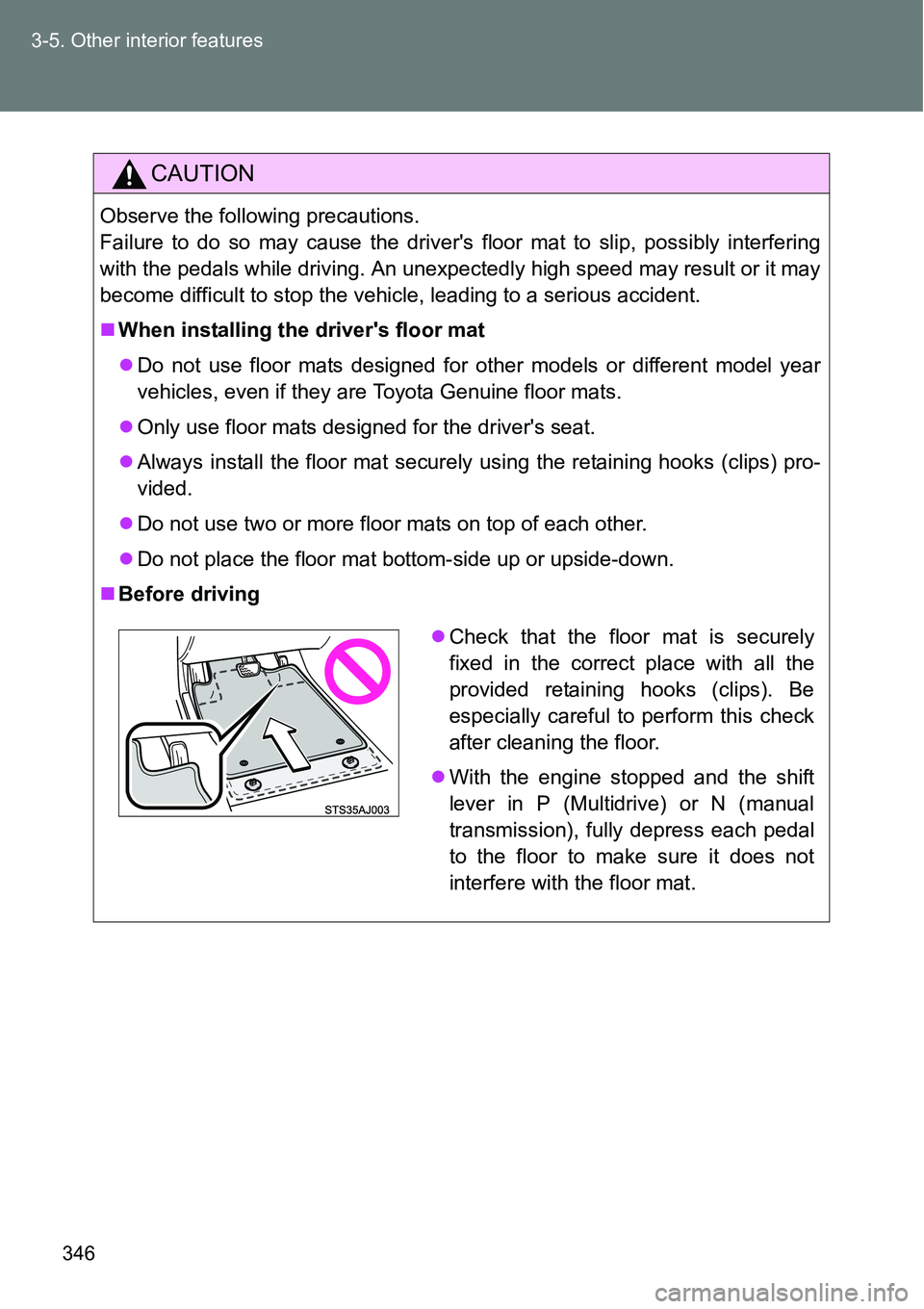
Check that the floor mat is securely
fixed in the correct place with all the
provided retaining hooks (clips). Be
especially careful to perform this check
after cleaning the floor.
With the engine stopped and the shift
lever in P (Multidrive) or N (manual
transmission), fully depress each pedal
to the floor to make sure it does not
interfere with the floor mat.
Page 353 of 564
4Maintenance and care
353
4-1. Maintenance and care
Cleaning and protecting
the vehicle exterior ......... 354
Cleaning and protecting
the vehicle interior .......... 358
4-2. Maintenance
Maintenance
requirements................... 361
4-3. Do-it-yourself
maintenance
Do-it-yourself service
precautions ..................... 364
Hood ................................. 367
Positioning a floor
jack ................................. 368
Engine compartment......... 370
Tires .................................. 384
Tire inflation pressure ....... 395
Wheels .............................. 397
Air conditioning filter ......... 400
Wireless remote control/
electronic key battery...... 403
Checking and replacing
fuses ............................... 407
Light bulbs ........................ 423
Page 362 of 564
362 4-2. Maintenance
Where to go for maintenance service?
In order to maintain your vehicle in the best possible condition, Toyota rec-
ommends that maintenance service operations as well as other inspections
and repairs be carried out by authorized Toyota dealers or repairers or other
duly qualified and equipped professionals. For repairs and services covered
by your warranty, please visit an authorized Toyota dealer or repairer, who
will use genuine Toyota parts in repairing any difficulties you may encounter.
There can also be advantages in utilizing authorized Toyota dealers or
repairers for non-warranty repairs and services, as members of the Toyota
network will be able to expertly assist you with any difficulties you may
encounter.
Your Toyota dealer or repairer, or another duly qualified and equipped pro-
fessional will perform all of the scheduled maintenance on your vehicle reli-
ably and economically due to their experience with Toyota vehicles.
Does your vehicle need repairs?
Be on the alert for changes in performance and sounds, and visual tip-offs
that indicate service is needed. Some important clues are:
Engine missing, stumbling or pinging
Appreciable loss of power
Strange engine noises
A fluid leak under the vehicle (However, water dripping from the air condi-
tioning system after use is normal.)
Change in exhaust sound (This may indicate a dangerous carbon mon-
oxide leak. Drive with the windows open and have the exhaust system
checked immediately.)
Flat-looking tires, excessive tire squeal when cornering, uneven tire wear
Vehicle pulls to one side when driven straight on a level road
Strange noises related to suspension movement
Loss of brake effectiveness, spongy feeling brake pedal or clutch pedal
(vehicles with a manual transmission), pedal almost touches the floor,
vehicle pulls to one side when braking
Page 372 of 564
372 4-3. Do-it-yourself maintenance
Engine oil
With the engine at operating temperature and turned off, check the oil
level on the dipstick.
Checking the engine oil
Gasoline engine: Park the vehicle on level ground. After turn-
ing off the engine, wait more than 5 minutes for the oil to drain
back into the bottom of the engine.
Diesel engine: Park the vehicle on level ground. After warm-
ing up the engine and turning it off, wait more than 5 minutes
for the oil to drain back into the bottom of the engine.
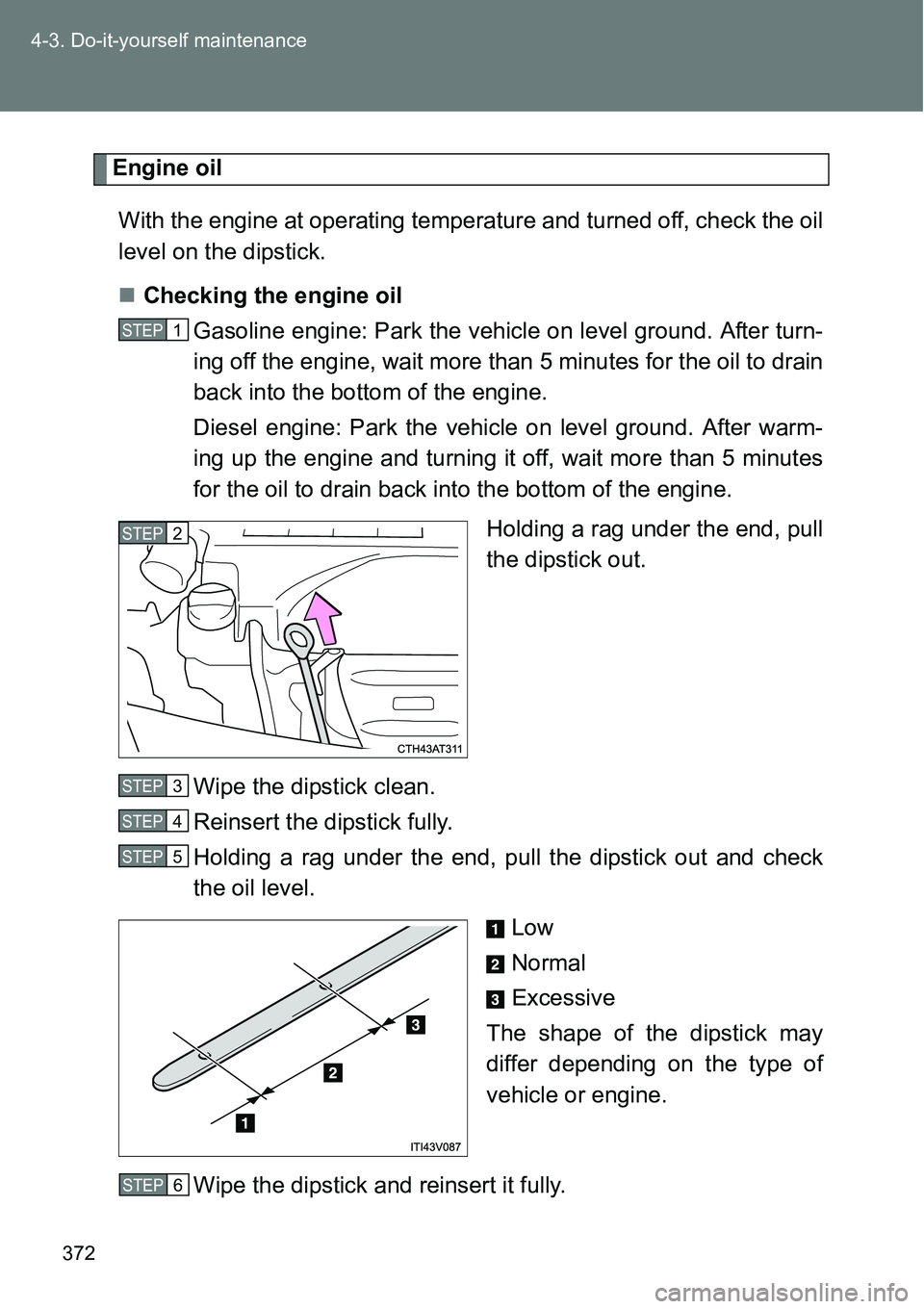
Holding a rag under the end, pull
the dipstick out.
Wipe the dipstick clean.
Reinsert the dipstick fully.
Holding a rag under the end, pull the dipstick out and check
the oil level.
Low
Normal
Excessive
The shape of the dipstick may
differ depending on the type of
vehicle or engine.
Wipe the dipstick and reinsert it fully.
STEP1
STEP2
STEP3
STEP4
STEP5
STEP6
Page 373 of 564
373 4-3. Do-it-yourself maintenance
4
Maintenance and care
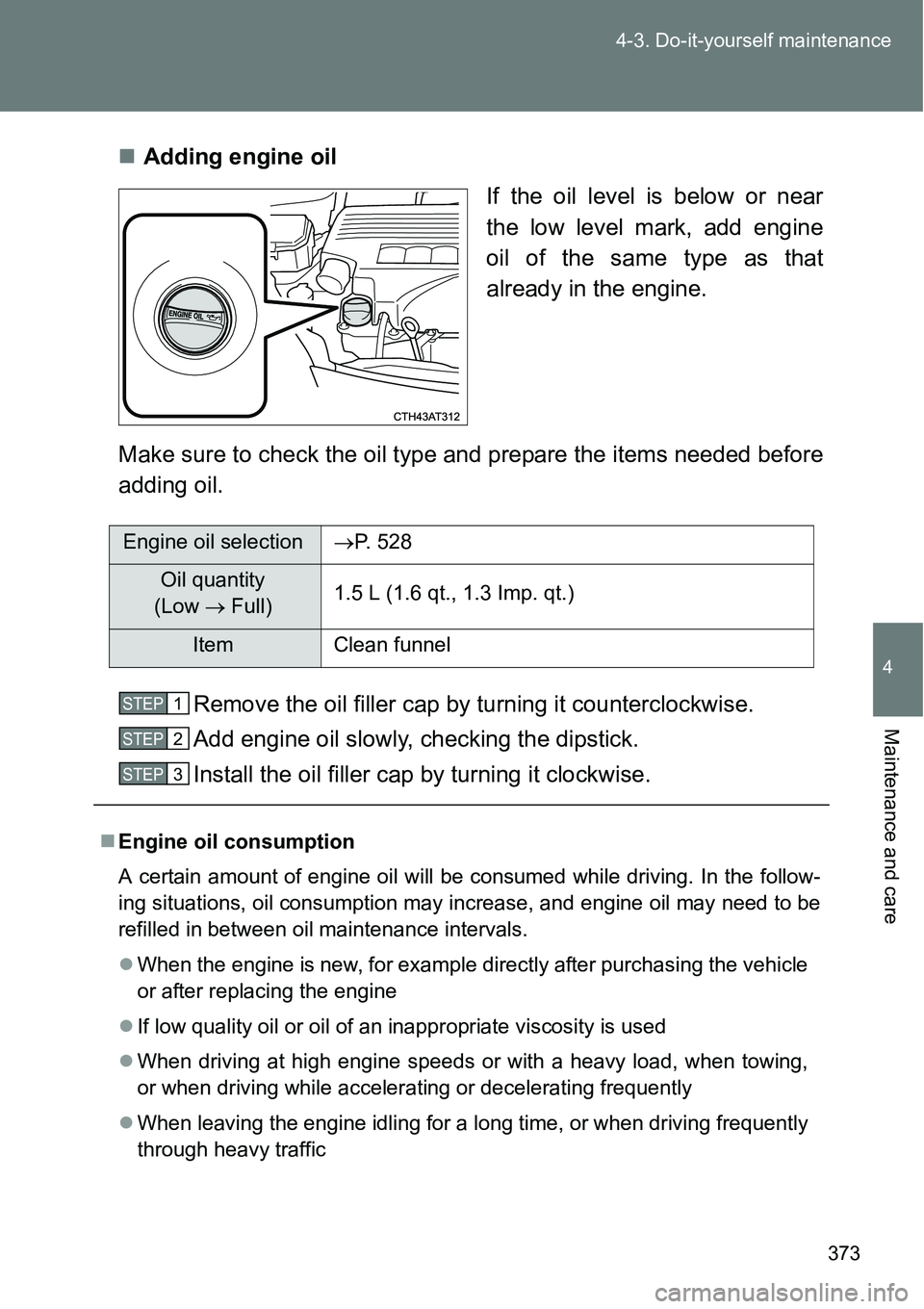
Adding engine oil
If the oil level is below or near
the low level mark, add engine
oil of the same type as that
already in the engine.
Make sure to check the oil type and prepare the items needed before
adding oil.
Remove the oil filler cap by turning it counterclockwise.
Add engine oil slowly, checking the dipstick.
Install the oil filler cap by turning it clockwise.
Engine oil selectionP. 528
Oil quantity
(Low Full)1.5 L (1.6 qt., 1.3 Imp. qt.)
Item Clean funnel
Engine oil consumption
A certain amount of engine oil will be consumed while driving. In the follow-
ing situations, oil consumption may increase, and engine oil may need to be
refilled in between oil maintenance intervals.
When the engine is new, for example directly after purchasing the vehicle
or after replacing the engine
If low quality oil or oil of an inappropriate viscosity is used
When driving at high engine speeds or with a heavy load, when towing,
or when driving while accelerating or decelerating frequently
When leaving the engine idling for a long time, or when driving frequently
through heavy traffic
STEP1
STEP2
STEP3