pressure TOYOTA YARIS 2013 Owners Manual
[x] Cancel search | Manufacturer: TOYOTA, Model Year: 2013, Model line: YARIS, Model: TOYOTA YARIS 2013Pages: 712, PDF Size: 30.2 MB
Page 5 of 712
1
2
3
4
5
6
YARIS_F(including HV)_WE_52E26E
5
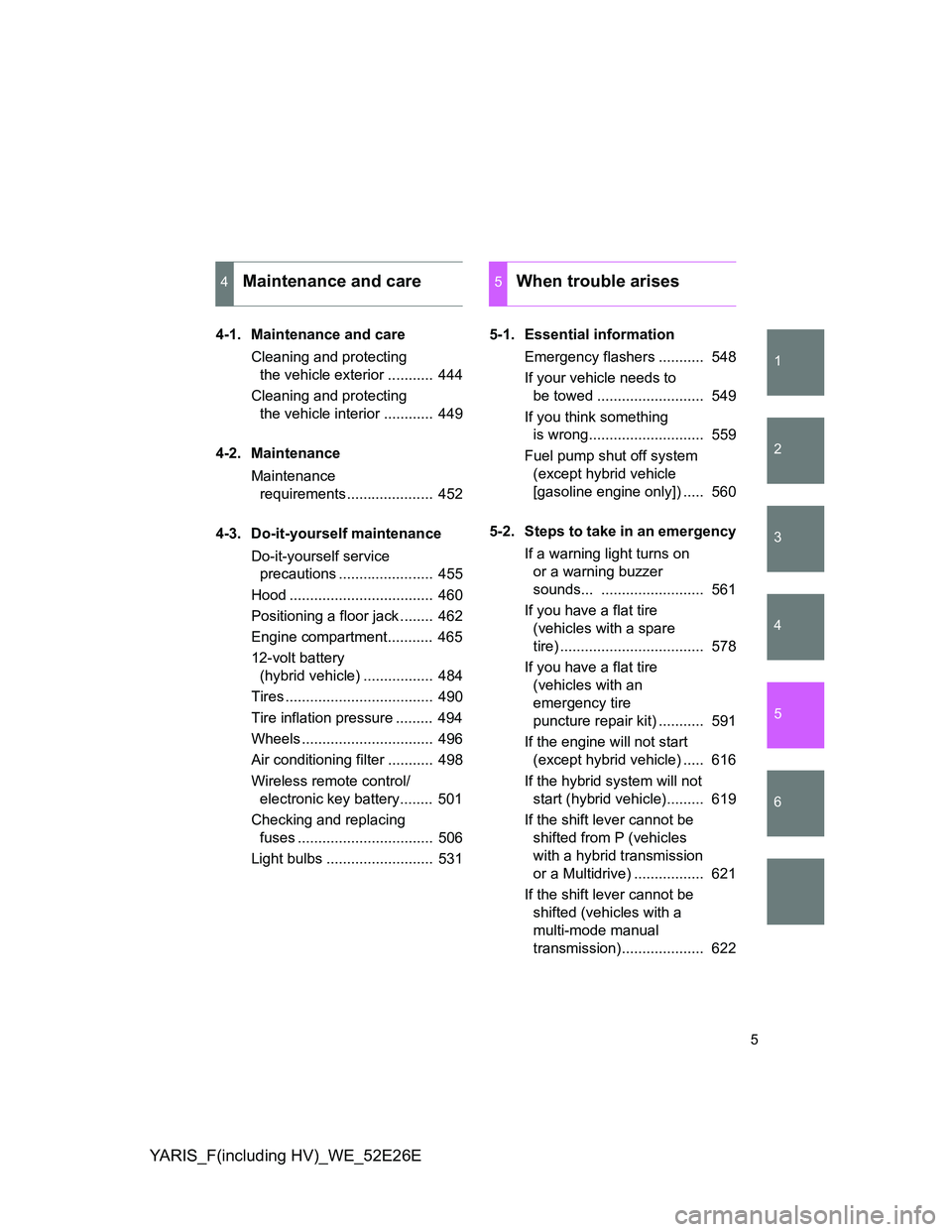
4-1. Maintenance and care
Cleaning and protecting
the vehicle exterior ........... 444
Cleaning and protecting
the vehicle interior ............ 449
4-2. Maintenance
Maintenance
requirements..................... 452
4-3. Do-it-yourself maintenance
Do-it-yourself service
precautions ....................... 455
Hood ................................... 460
Positioning a floor jack ........ 462
Engine compartment........... 465
12-volt battery
(hybrid vehicle) ................. 484
Tires .................................... 490
Tire inflation pressure ......... 494
Wheels ................................ 496
Air conditioning filter ........... 498
Wireless remote control/
electronic key battery........ 501
Checking and replacing
fuses ................................. 506
Light bulbs .......................... 5315-1. Essential information
Emergency flashers ........... 548
If your vehicle needs to
be towed .......................... 549
If you think something
is wrong............................ 559
Fuel pump shut off system
(except hybrid vehicle
[gasoline engine only]) ..... 560
5-2. Steps to take in an emergency
If a warning light turns on
or a warning buzzer
sounds... ......................... 561
If you have a flat tire
(vehicles with a spare
tire) ................................... 578
If you have a flat tire
(vehicles with an
emergency tire
puncture repair kit) ........... 591
If the engine will not start
(except hybrid vehicle) ..... 616
If the hybrid system will not
start (hybrid vehicle)......... 619
If the shift lever cannot be
shifted from P (vehicles
with a hybrid transmission
or a Multidrive) ................. 621
If the shift lever cannot be
shifted (vehicles with a
multi-mode manual
transmission).................... 622
4Maintenance and care5When trouble arises
Page 9 of 712
YARIS_F(including HV)_WE_52E26E
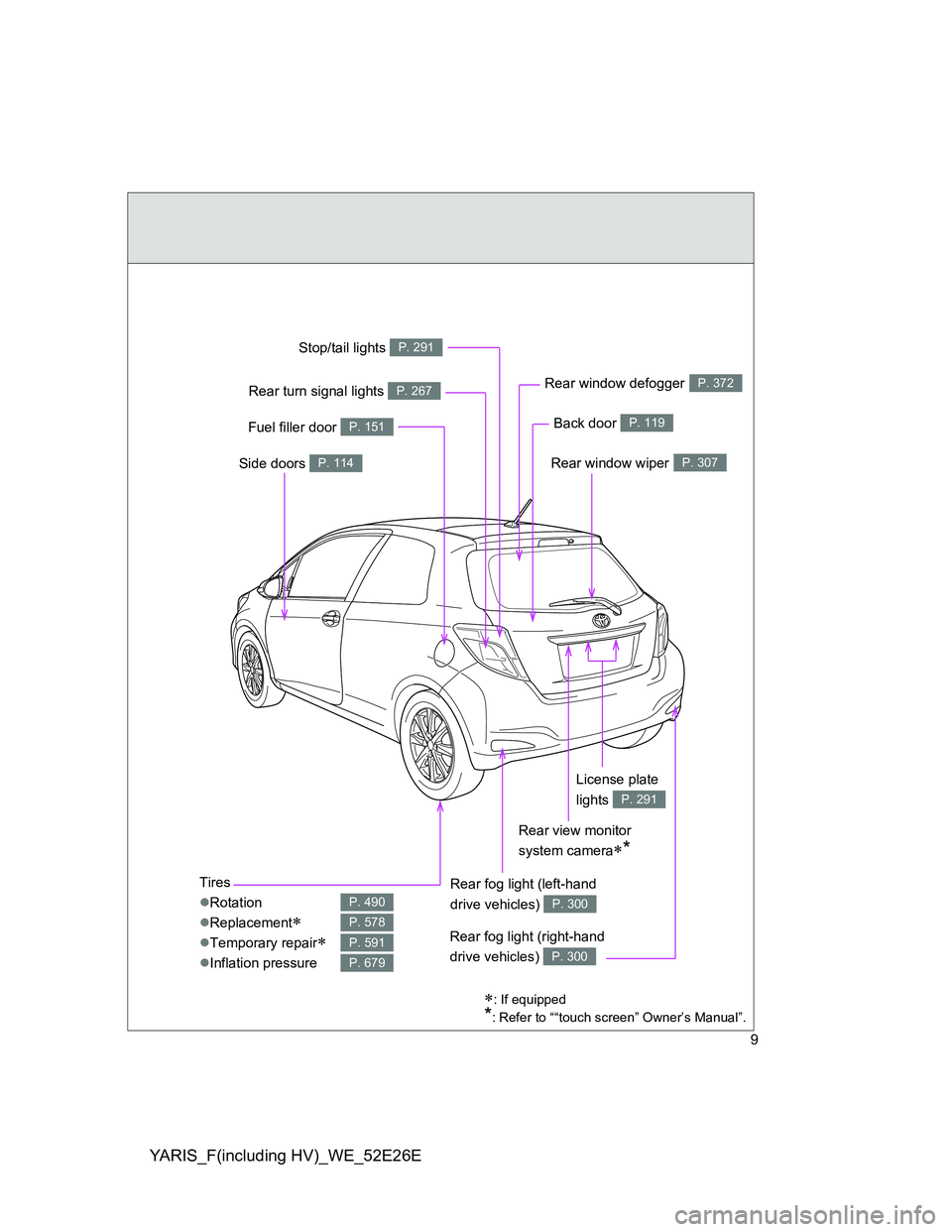
9
: If equipped
*: Refer to ““touch screen” Owner’s Manual”.
Tires
Rotation
Replacement
Temporary repair
Inflation pressure
P. 490
P. 578
P. 591
P. 679
Back door P. 119
Side doors P. 114
Fuel filler door P. 151
Rear turn signal lights P. 267Rear window defoggerP. 372
License plate
lights
P. 291
Stop/tail lights P. 291
Rear window wiperP. 307
Rear fog light (left-hand
drive vehicles)
P. 300
Rear fog light (right-hand
drive vehicles)
P. 300
Rear view monitor
system camera
*
Page 11 of 712
YARIS_F(including HV)_WE_52E26E
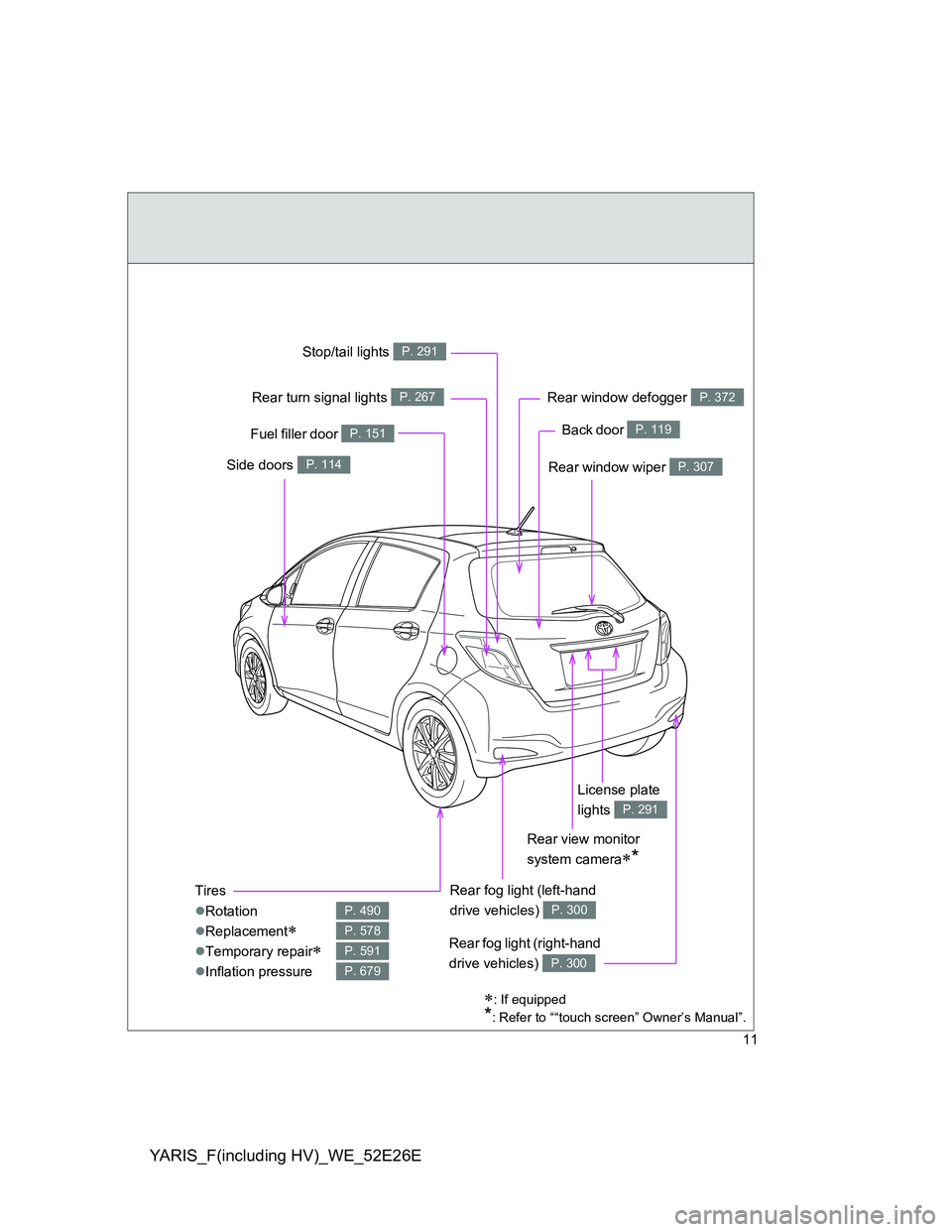
11
Rear window wiper P. 307
Tires
Rotation
Replacement
Temporary repair
Inflation pressure
P. 490
P. 578
P. 591
P. 679
Back door P. 119
Side doors P. 114
Rear window defogger P. 372
License plate
lights
P. 291
Rear fog light (right-hand
drive vehicles)
P. 300
Fuel filler door P. 151
Stop/tail lights P. 291
Rear turn signal lights P. 267
Rear fog light (left-hand
drive vehicles)
P. 300
Rear view monitor
system camera
*
: If equipped
*: Refer to ““touch screen” Owner’s Manual”.
Page 13 of 712
YARIS_F(including HV)_WE_52E26E
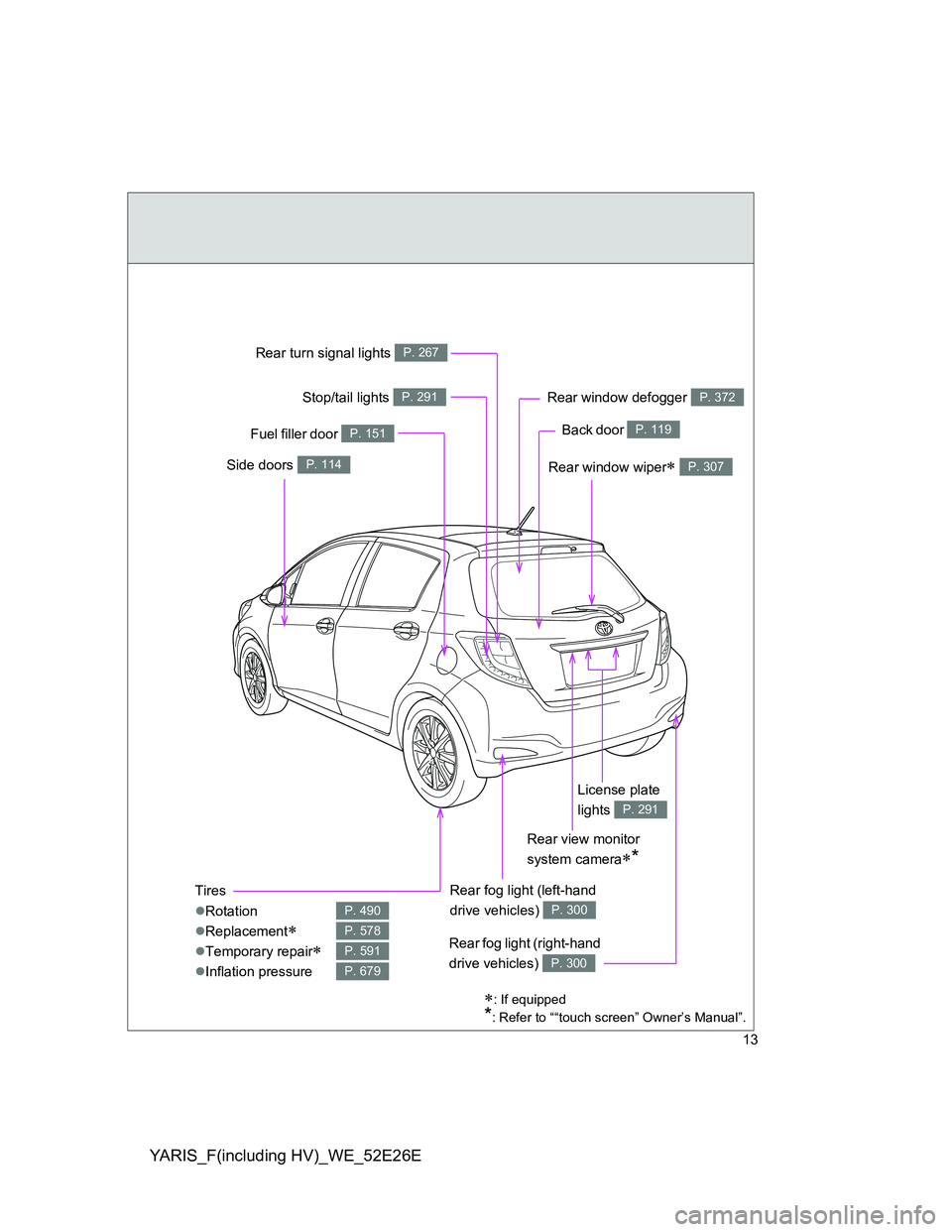
13
Rear window wiper P. 307
Tires
Rotation
Replacement
Temporary repair
Inflation pressure
P. 490
P. 578
P. 591
P. 679
Back door P. 119
Side doors P. 114
Rear window defogger P. 372
License plate
lights
P. 291
Rear fog light (right-hand
drive vehicles)
P. 300
Fuel filler door P. 151
Stop/tail lights P. 291
Rear turn signal lights P. 267
Rear fog light (left-hand
drive vehicles)
P. 300
Rear view monitor
system camera
*
: If equipped
*: Refer to ““touch screen” Owner’s Manual”.
Page 63 of 712
63 1-1. Hybrid system (hybrid vehicle)
1
Before driving
YARIS_F(including HV)_WE_52E26E
Checking tire inflation pressure
Make sure to check the tire inflation pressure frequently. Improper tire
inflation pressure can cause poor fuel consumption.
Also, as snow tires can cause large amounts of friction, their use on dry
roads can lead to poor fuel consumption. Use a tire that is appropriate
for the season.
Luggage
Carrying heavy luggage can lead to poor fuel consumption. Avoid car-
rying unnecessary luggage. Installing a large roof rack can also cause
poor fuel consumption.
Warming up before driving
Since the gasoline engine starts up and cuts out automatically when
cold, warming up the engine is unnecessary. Moreover, frequently driv-
ing short distances will cause the engine to repeatedly warm up, which
can lead to poor fuel consumption.
Page 329 of 712
329 2-4. Using other driving systems
2
When driving
YARIS_F(including HV)_WE_52E26E
CAUTION
When the VSC is activated
The slip indicator light flashes. Always drive carefully. Reckless driving may
cause an accident. Exercise particular care when the indicator light flashes.
When the TRC/VSC systems are turned off (except hybrid vehicle)
Be especially careful and drive at a speed appropriate to the road condi-
tions. Do not turn the TRC/VSC systems off unless necessary, as these are
the systems to ensure vehicle stability and driving force by automatically
controlling braking and engine outputs.
Replacing tires
Make sure that all tires are of the specified size, brand, tread pattern and
total load capacity. In addition, make sure that the tires are inflated to the
recommended tire inflation pressure level.
The ABS, TRC and VSC systems will not function correctly if different tires
are installed on the vehicle.
Contact any authorized Toyota dealer or repairer, or another duly qualified
and equipped professional for further information when replacing tires or
wheels.
Handling of tires and the suspension
Using tires with any kind of problem or modifying the suspension will affect
the driving assist systems, and may cause a system to malfunction.
Page 330 of 712
330
2-4. Using other driving systems
YARIS_F(including HV)_WE_52E26E
Hill-start assist control (hybrid vehicle)
Hill-start assist control operating conditions
The system operates in the following situations:
• The shift lever is in a position other than P.
• The parking brake is not applied.
• The accelerator pedal is not depressed.
Hill-start assist control cannot be operated while the slip indicator light is
illuminated.
Hill-start assist control
While hill-start assist control is operating, the brakes remain automati-
cally applied after the driver releases the brake pedal. The stop lights and
the high mounted stoplight turn on.
Hill-start assist control operates for about 2 seconds after the brake pedal
is released.
If the slip indicator does not flash and the buzzer does not sound when
the brake pedal is further depressed, slightly reduce the pressure on the
brake pedal (do not allow the vehicle to roll backward) and then firmly
depress it again. If the system still does not operate, check that the oper-
ating conditions explained above have been met.
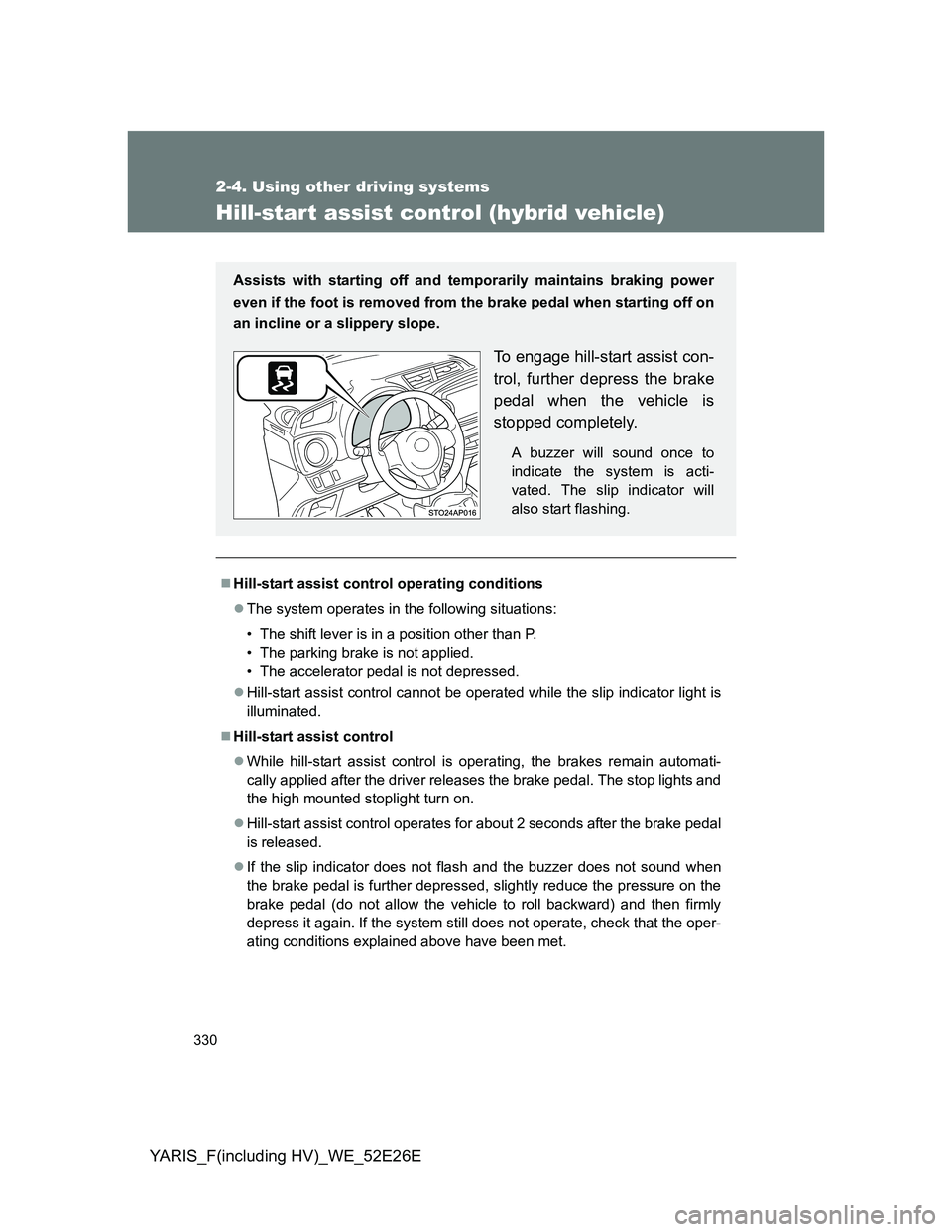
Assists with starting off and temporarily maintains braking power
even if the foot is removed from the brake pedal when starting off on
an incline or a slippery slope.
To engage hill-start assist con-
trol, further depress the brake
pedal when the vehicle is
stopped completely.
A buzzer will sound once to
indicate the system is acti-
vated. The slip indicator will
also start flashing.
Page 339 of 712
339 2-5. Driving information
2
When driving
YARIS_F(including HV)_WE_52E26E
CAUTION
Driving with snow tires
Observe the following precautions to reduce the risk of accidents.
Failure to do so may result in a loss of vehicle control and cause death or
serious injury.
Use tires of the specified size.
Maintain the recommended level of air pressure.
Do not drive at speeds in excess of the speed limit or the speed limit spec-
ified for the snow tires being used.
Use snow tires on all, not just some wheels.
Do not use tires of noticeably different wear level.
Driving with tire chains
Observe the following precautions to reduce the risk of accidents.
Failure to do so may result in the vehicle being unable to be driven safely,
and may cause death or serious injury.
Do not drive in excess of the speed limit specified for the tire chains being
used, or 50 km/h (30 mph), whichever is lower.
Avoid driving on bumpy road surfaces or over potholes.
Avoid sudden acceleration, abrupt steering, sudden braking and shifting
operations that cause sudden to engine braking.
Slow down sufficiently before entering a curve to ensure that vehicle con-
trol is maintained.
Page 347 of 712
347 2-5. Driving information
2
When driving
YARIS_F(including HV)_WE_52E26E
Tire information
Ensure that your vehicle's tires are properly inflated. Adjust the tire pres-
sure to the recommended pressure. (P. 679)
Increase the air pressure of the trailer tires in accordance with the total
trailer weight and according to the values recommended by the manufac-
turer of your trailer.
Trailer lights
Check that the turn signal lights and stoplights are operating correctly every
time you hitch up the trailer. Directly wiring up to your vehicle may damage
the electrical system and stop the lights from functioning correctly.
Break-in schedule
Toyota recommends that vehicles fitted with new power train components
should not be used for towing trailers for the first 800 km (500 miles).
Safety checks before towing
Check that the maximum load limit for the towing hitch/bracket and hitch
ball is not exceeded. Bear in mind that the coupling weight of the trailer
will add to the load exerted on the vehicle. Also make sure that the total
load exerted on the vehicle is within the range of the weight limits.
(P. 342)
Ensure that the trailer load is secure.
Supplementary outside rear view mirrors should be added to the vehicle
if the traffic behind cannot be clearly seen with standard mirrors. Adjust
the extending arms of these mirrors on both sides of the vehicle so that
they always provide maximum visibility of the road behind.
Maintenance
Maintenance must be performed more frequently when using the vehicle
for towing due to the greater weight burden placed on the vehicle com-
pared to normal driving.
Retighten all bolts securing the hitching ball and bracket after towing for
approximately 1000 km (600 miles).
Page 401 of 712
401 3-2. Using the audio system
3
Interior features
YARIS_F(including HV)_WE_52E26E
CAUTION
Caution while driving
Do not connect iPod or operate the controls.
NOTICE
To prevent damage to iPod
Do not leave iPod in the vehicle. The temperature inside the vehicle may
become high, resulting in damage to the iPod.
Do not push down on or apply unnecessary pressure to the iPod while it is
connected as this may damage the iPod or its terminal.
Do not insert foreign objects into the port as this may damage the iPod or
its terminal.