sensor TOYOTA YARIS 2017 User Guide
[x] Cancel search | Manufacturer: TOYOTA, Model Year: 2017, Model line: YARIS, Model: TOYOTA YARIS 2017Pages: 549, PDF Size: 33.09 MB
Page 213 of 549
2134-3. Operating the lights and wipers
4
Driving
YARIS_F_OM_Europe_OM52J20E
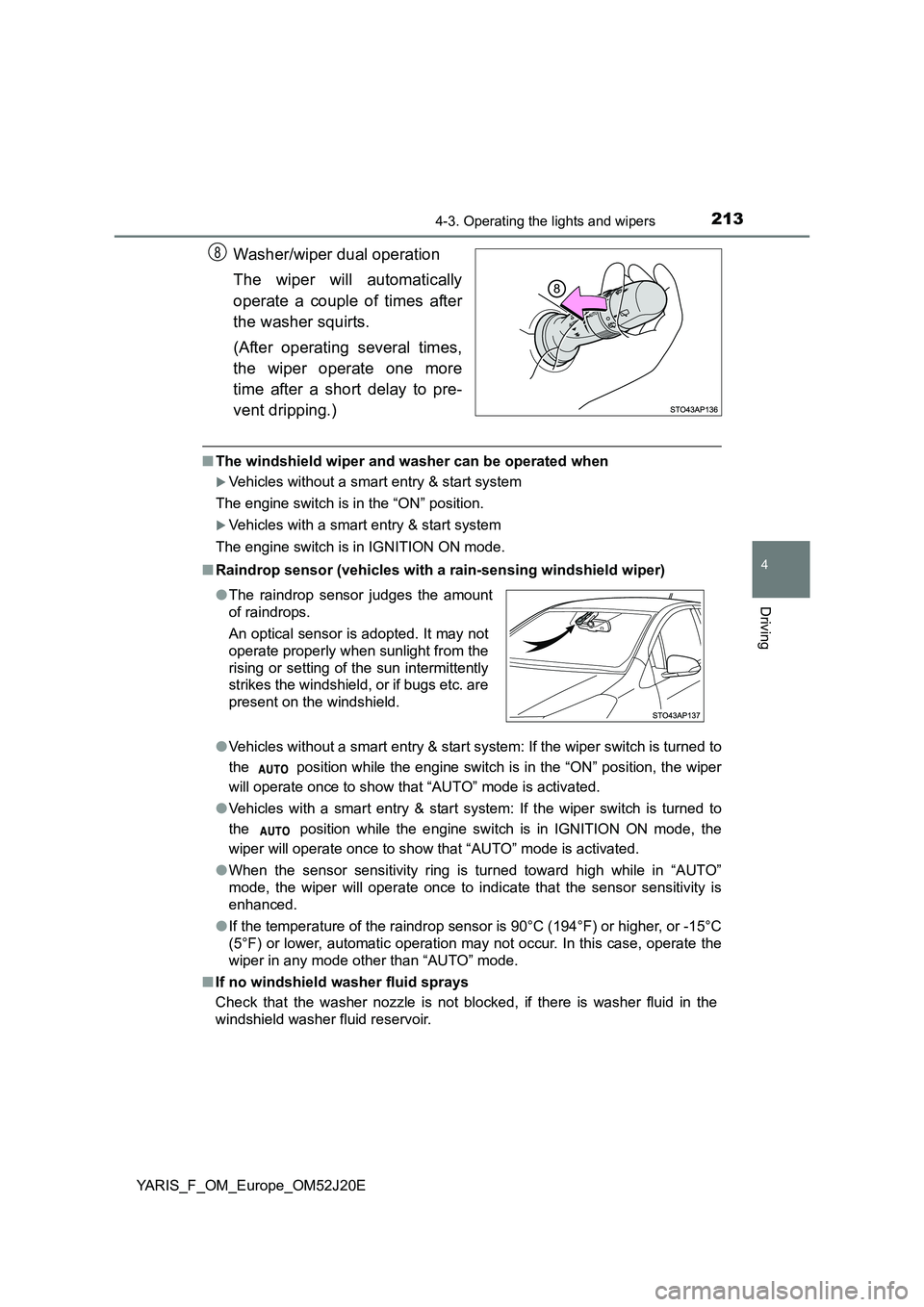
Washer/wiper dual operation
The wiper will automatically
operate a couple of times after
the washer squirts.
(After operating several times,
the wiper operate one more
time after a short delay to pre-
vent dripping.)
■ The windshield wiper and washer can be operated when
Vehicles without a smart entry & start system
The engine switch is in the “ON” position.
Vehicles with a smart entry & start system
The engine switch is in IGNITION ON mode.
■ Raindrop sensor (vehicles with a rain-sensing windshield wiper)
● Vehicles without a smart entry & start system: If the wiper switch is turned to
the position while the engine switch is in the “ON” position, the wiper
will operate once to show that “AUTO” mode is activated.
● Vehicles with a smart entry & start system: If the wiper switch is turned to
the position while the engine switch is in IGNITION ON mode, the
wiper will operate once to show that “AUTO” mode is activated.
● When the sensor sensitivity ring is turned toward high while in “AUTO”
mode, the wiper will operate once to indicate that the sensor sensitivity is
enhanced.
● If the temperature of the raindrop sensor is 90°C (194°F) or higher, or -15°C
(5°F) or lower, automatic operation may not occur. In this case, operate the
wiper in any mode other than “AUTO” mode.
■ If no windshield washer fluid sprays
Check that the washer nozzle is not blocked, if there is washer fluid in the
windshield washer fluid reservoir.
8
● The raindrop sensor judges the amount
of raindrops.
An optical sensor is adopted. It may not
operate properly when sunlight from the
rising or setting of the sun intermittently
strikes the windshield, or if bugs etc. are
present on the windshield.
Page 214 of 549
2144-3. Operating the lights and wipers
YARIS_F_OM_Europe_OM52J20E
WARNING
■Caution regarding the use of windshield wiper in “AUTO” mode (vehi-
cles with a rain-sensing windshield wiper)
The windshield wiper may operate unexpectedly if the sensor is touched or
the windshield is subject to vibration in “AUTO” mode. Take care that your
fingers, etc., do not become caught in the windshield wiper.
■ Caution regarding the use of washer fluid
When it is cold, do not use the washer fluid until the windshield becomes
warm. The fluid may freeze on the windshield and cause low visibility. This
may lead to an accident, resulting in death or serious injury.
NOTICE
■ When the windshield is dry
Do not use the wiper, as they may damage the windshield.
■ When there is no washer fluid spray from the nozzle
Damage to the washer fluid pump may be caused if the lever is pulled
toward you and held continually.
■ When a nozzle becomes blocked
In this case, contact any authorized Toyota dealer or repairer, or another
duly qualified and equipped professional.
Do not try to clear it with a pin or other object. The nozzle will be damaged.
Page 222 of 549
2224-5. Toyota Safety Sense
YARIS_F_OM_Europe_OM52J20E
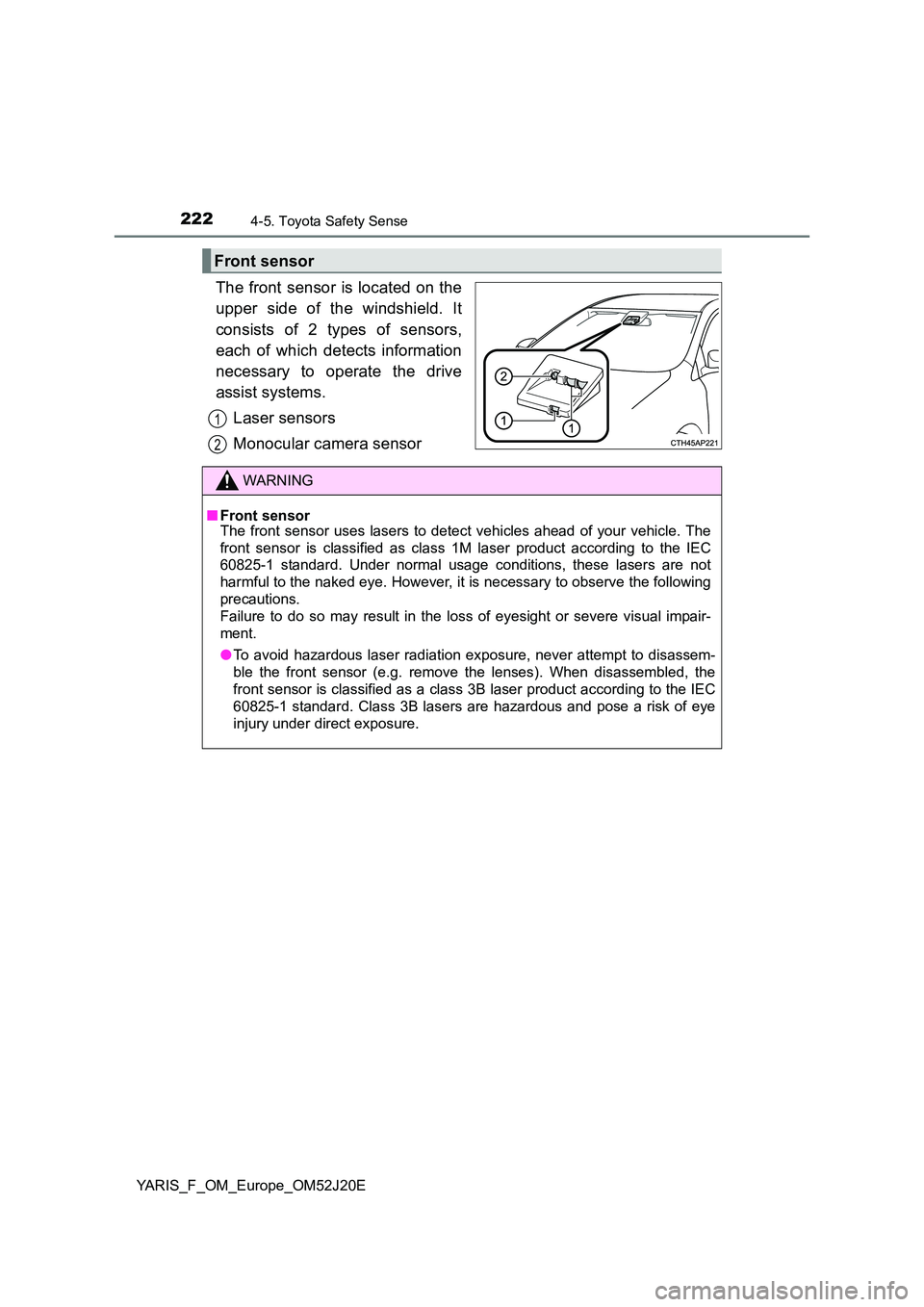
The front sensor is located on the
upper side of the windshield. It
consists of 2 types of sensors,
each of which detects information
necessary to operate the drive
assist systems.
Laser sensors
Monocular camera sensor
Front sensor
1
2
WARNING
■ Front sensor The front sensor uses lasers to detect vehicles ahead of your vehicle. The
front sensor is classified as class 1M laser product according to the IEC
60825-1 standard. Under normal usage conditions, these lasers are not
harmful to the naked eye. However, it is necessary to observe the following
precautions.
Failure to do so may result in the loss of eyesight or severe visual impair-
ment.
● To avoid hazardous laser radiation exposure, never attempt to disassem-
ble the front sensor (e.g. remove the lenses). When disassembled, the
front sensor is classified as a class 3B laser product according to the IEC
60825-1 standard. Class 3B lasers are hazardous and pose a risk of eye
injury under direct exposure.
Page 223 of 549
2234-5. Toyota Safety Sense
4
Driving
YARIS_F_OM_Europe_OM52J20E
WARNING
●Do not attempt to look into the front sensor with a magnifying glass, micro-
scope or other optical instrument within a distance of less than 100 mm
(3.9 in.).
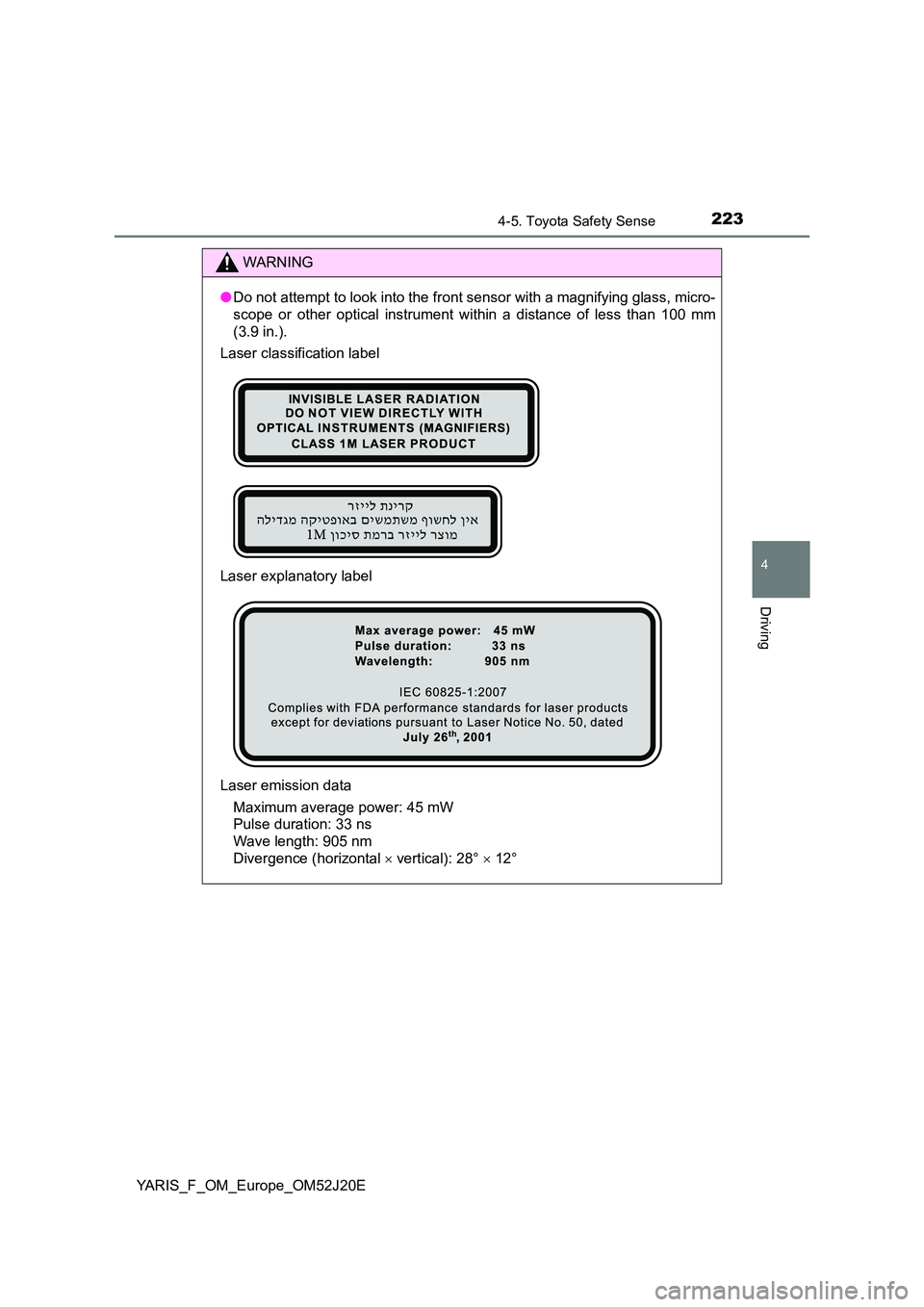
Laser classification label
Laser explanatory label
Laser emission data
Maximum average power: 45 mW
Pulse duration: 33 ns
Wave length: 905 nm
Divergence (horizontal vertical): 28° 12°
Page 224 of 549
2244-5. Toyota Safety Sense
YARIS_F_OM_Europe_OM52J20E
WARNING
■To avoid malfunction of the front sensor Observe the following precautions.
Otherwise, the front sensor may not operate properly, possibly leading to an
accident resulting in death or serious injury.
● Keep the windshield clean at all times. If the windshield is dirty or covered
with an oily film, water droplets, snow, etc., clear the windshield. If the
inner side of the windshield in front of the front sensor is dirty, contact any
authorized Toyota dealer or repairer, or another duly qualified and
equipped professional.
● If there is a large difference in temperature between the inside and outside
of the vehicle, such as in winter, t he windshield is likely to fog up easily. If
the part of the windshield in front of the front sensor is fogged up or cov-
ered with condensation or ice, the PCS warning light may illuminate and
the system may be temporarily disabled. In this case, use the windshield
defogger to remove the fog, etc. ( P. 314, 324)
● If the area of the windshield in front of the front sensor is covered with
water droplets, use the windshield wipers to remove them.
If the water droplets are not sufficiently removed, the performance of the
front sensor may be reduced.
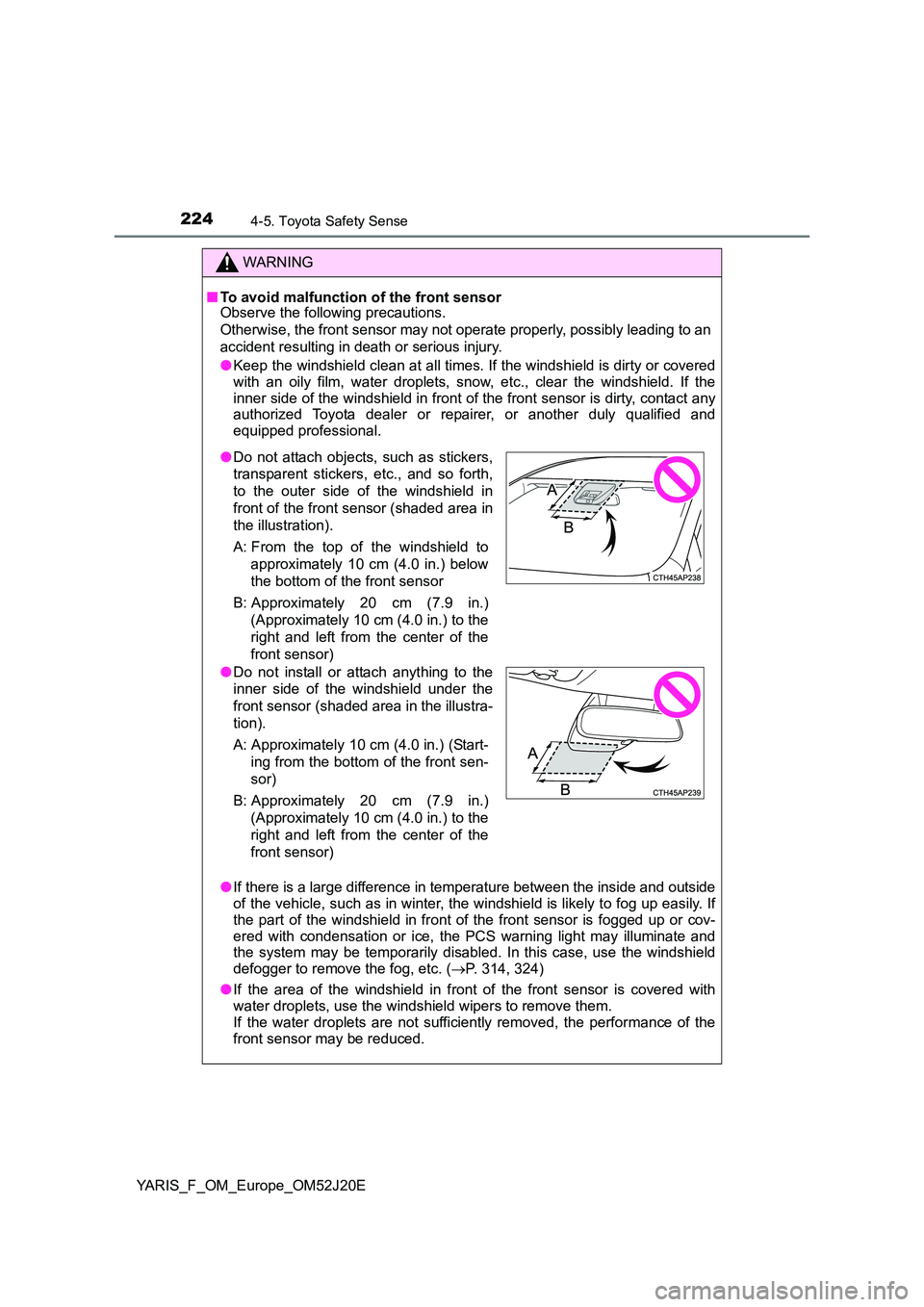
● Do not attach objects, such as stickers,
transparent stickers, etc., and so forth,
to the outer side of the windshield in
front of the front sensor (shaded area in
the illustration).
A: From the top of the windshield to
approximately 10 cm (4.0 in.) below
the bottom of the front sensor
B: Approximately 20 cm (7.9 in.)
(Approximately 10 cm (4.0 in.) to the
right and left from the center of the
front sensor)
● Do not install or attach anything to the
inner side of the windshield under the
front sensor (shaded area in the illustra-
tion).
A: Approximately 10 cm (4.0 in.) (Start-
ing from the bottom of the front sen-
sor)
B: Approximately 20 cm (7.9 in.)
(Approximately 10 cm (4.0 in.) to the
right and left from the center of the
front sensor)
Page 225 of 549
2254-5. Toyota Safety Sense
4
Driving
YARIS_F_OM_Europe_OM52J20E
WARNING
●If water droplets cannot be properly removed from the area of the wind-
shield in front of the front sensor by the windshield wipers, replace the
wiper insert or wiper blade.
If the wiper inserts or wiper blades need to be replaced, contact any autho-
rized Toyota dealer or repairer, or another duly qualified and equipped
professional.
● Do not attach window tinting to the windshield.
● Replace the windshield if it is damaged or cracked.
If the windshield needs to be replaced, contact any authorized Toyota
dealer or repairer, or another dul y qualified and equipped professional.
● Do not install an antenna in front of the sensor.
● Do not get the front sensor wet.
● Do not allow bright lights to shine into the front sensor.
● Do not dirty or damage the front sensor.
When cleaning the inside of the windshi eld, do not allow glass cleaner to
contact the lens. Also, do not touch the lens.
If the lens is dirty or damaged, contact any authorized Toyota dealer or
repairer, or another duly qualified and equipped professional.
● Do not subject the front sensor to a strong impact.
● Do not change the installation position or direction of the front sensor or
remove it.
● Do not disassemble the front sensor.
● Do not install an electronic device or device that emits strong electric
waves near the front sensor.
● Do not modify any components of the vehicle around the front sensor
(inside rear view mirror, sun visors, etc.) or ceiling.
● Do not attach any accessories that may obstruct the front sensor to the
hood, front grille or front bumper. C ontact any authorized Toyota dealer or
repairer, or another duly qualified and equipped professional for details.
● If a surfboard or other long object is to be mounted on the roof, make sure
that it will not obstruct the front sensor.
● Do not modify the headlights or other lights.
● Do not attach anything to or place anything on the dashboard.
■ Installation area of front sensor on windshield When the windshield is fogging up easily, the glass around the front sensor
may be hot due to the heater running. If the glass is touched, it may result in
burns.
Page 226 of 549
2264-5. Toyota Safety Sense
YARIS_F_OM_Europe_OM52J20E
PCS (Pre-Crash Safety system)
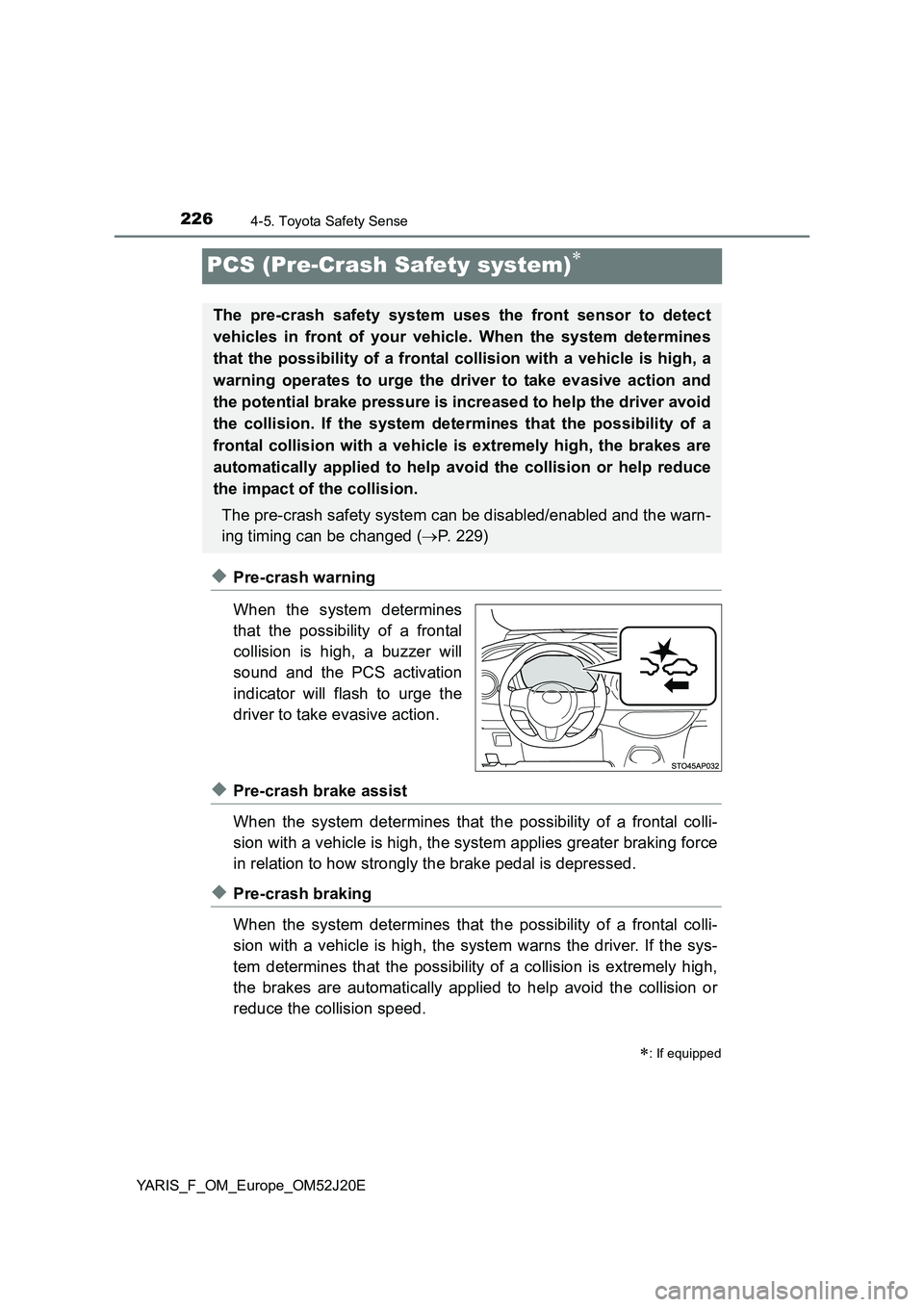
◆Pre-crash warning
When the system determines
that the possibility of a frontal
collision is high, a buzzer will
sound and the PCS activation
indicator will flash to urge the
driver to take evasive action.
◆Pre-crash brake assist
When the system determines that the possibility of a frontal colli-
sion with a vehicle is high, the system applies greater braking force
in relation to how strongly the brake pedal is depressed.
◆Pre-crash braking
When the system determines that the possibility of a frontal colli-
sion with a vehicle is high, the system warns the driver. If the sys-
tem determines that the possibility of a collision is extremely high,
the brakes are automatically applied to help avoid the collision or
reduce the collision speed.
: If equipped
The pre-crash safety system uses the front sensor to detect
vehicles in front of your vehicle. When the system determines
that the possibility of a frontal collision with a vehicle is high, a
warning operates to urge the driver to take evasive action and
the potential brake pressure is increased to help the driver avoid
the collision. If the system determines that the possibility of a
frontal collision with a vehicle is extremely high, the brakes are
automatically applied to help avoid the collision or help reduce
the impact of the collision.
The pre-crash safety system can be disabled/enabled and the warn-
ing timing can be changed ( P. 229)
Page 235 of 549
2354-5. Toyota Safety Sense
4
Driving
YARIS_F_OM_Europe_OM52J20E
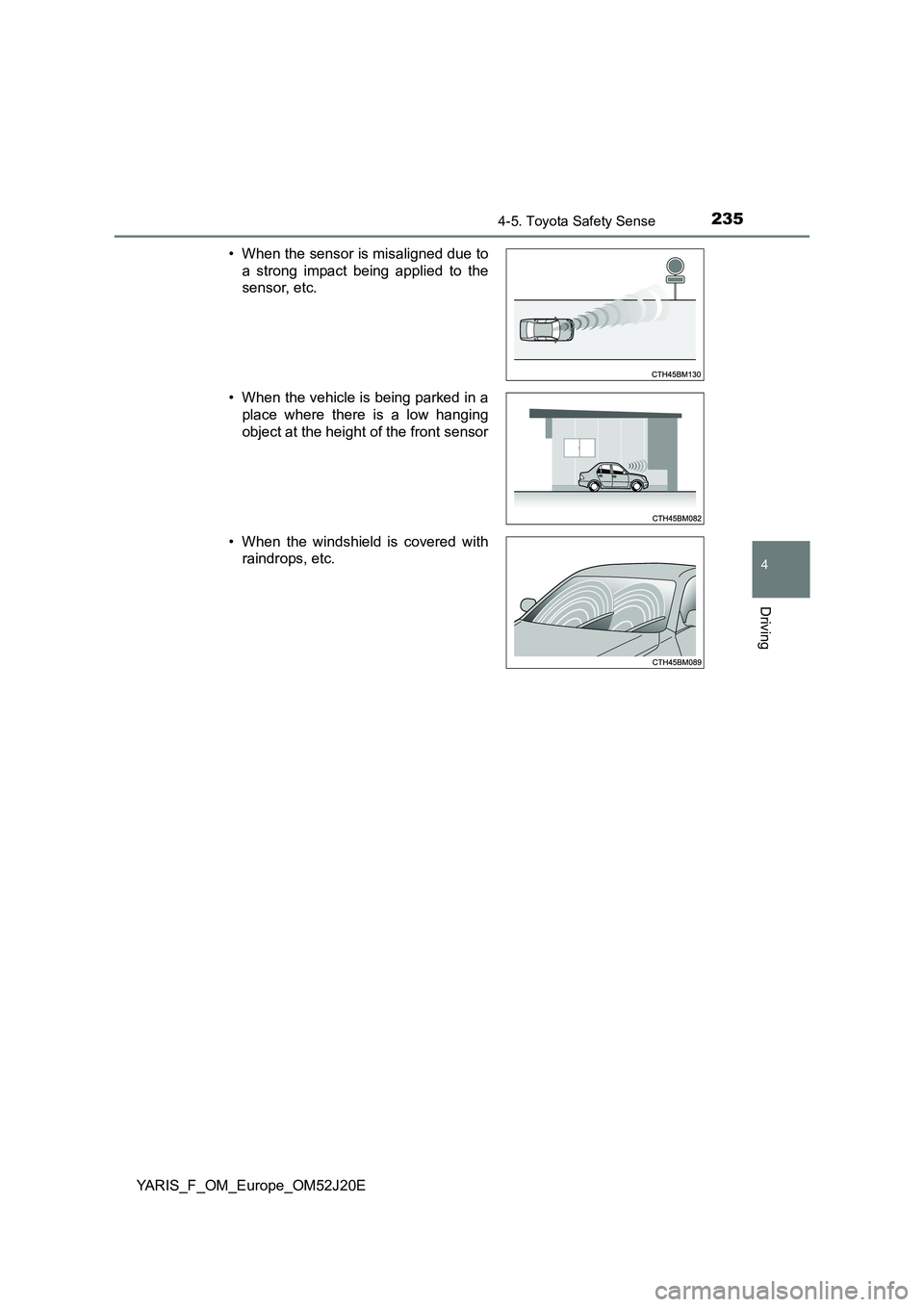
• When the sensor is misaligned due to
a strong impact being applied to the
sensor, etc.
• When the vehicle is being parked in a
place where there is a low hanging
object at the height of the front sensor
• When the windshield is covered with
raindrops, etc.
Page 236 of 549
2364-5. Toyota Safety Sense
YARIS_F_OM_Europe_OM52J20E
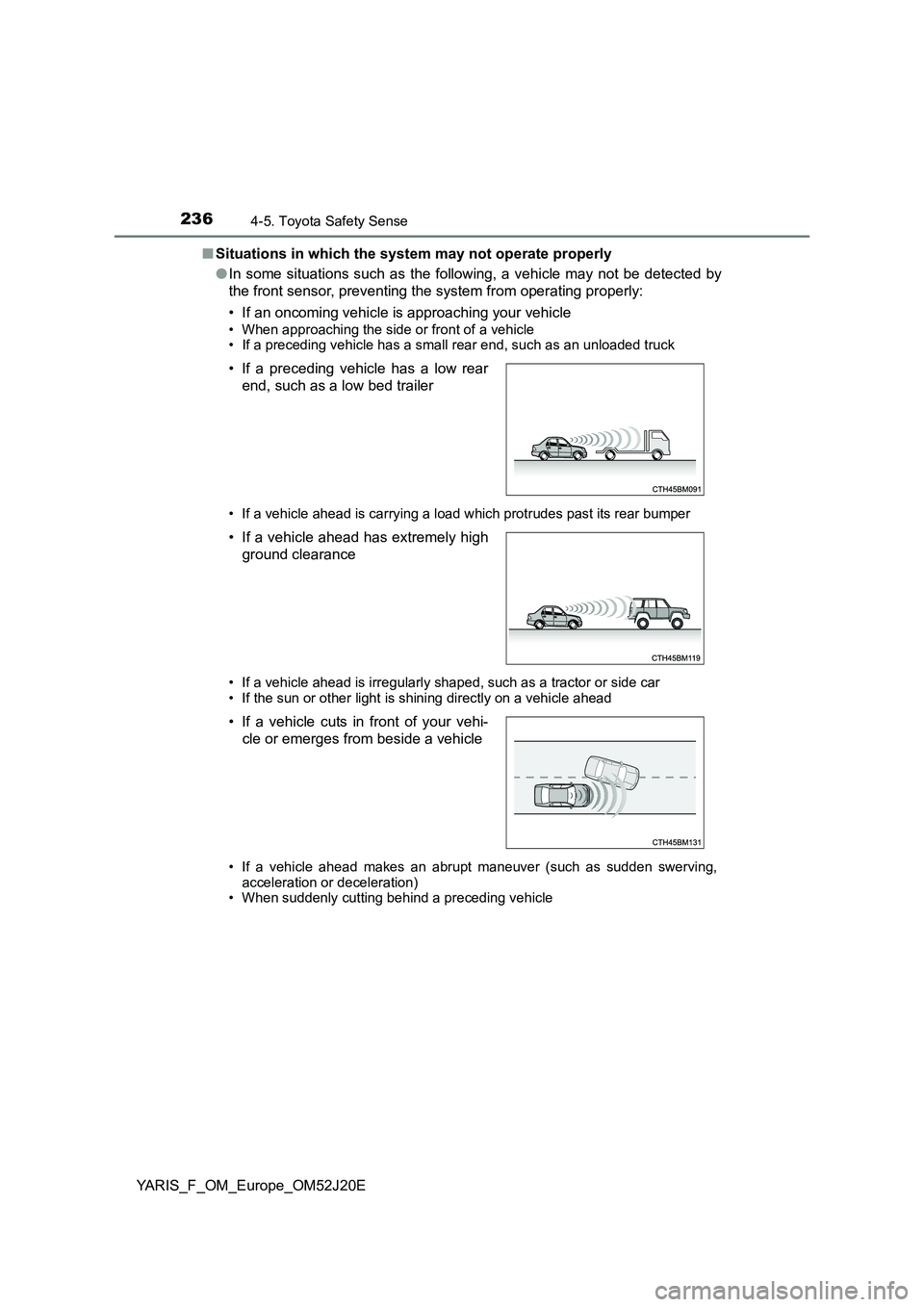
■ Situations in which the system may not operate properly
● In some situations such as the following, a vehicle may not be detected by
the front sensor, preventing the system from operating properly:
• If an oncoming vehicle is approaching your vehicle
• When approaching the side or front of a vehicle • If a preceding vehicle has a small rear end, such as an unloaded truck
• If a vehicle ahead is carrying a load which protrudes past its rear bumper
• If a vehicle ahead is irregularly shaped, such as a tractor or side car
• If the sun or other light is shining directly on a vehicle ahead
• If a vehicle ahead makes an abrupt maneuver (such as sudden swerving, acceleration or deceleration)• When suddenly cutting behind a preceding vehicle
• If a preceding vehicle has a low rear
end, such as a low bed trailer
• If a vehicle ahead has extremely high
ground clearance
• If a vehicle cuts in front of your vehi-
cle or emerges from beside a vehicle
Page 237 of 549
2374-5. Toyota Safety Sense
4
Driving
YARIS_F_OM_Europe_OM52J20E
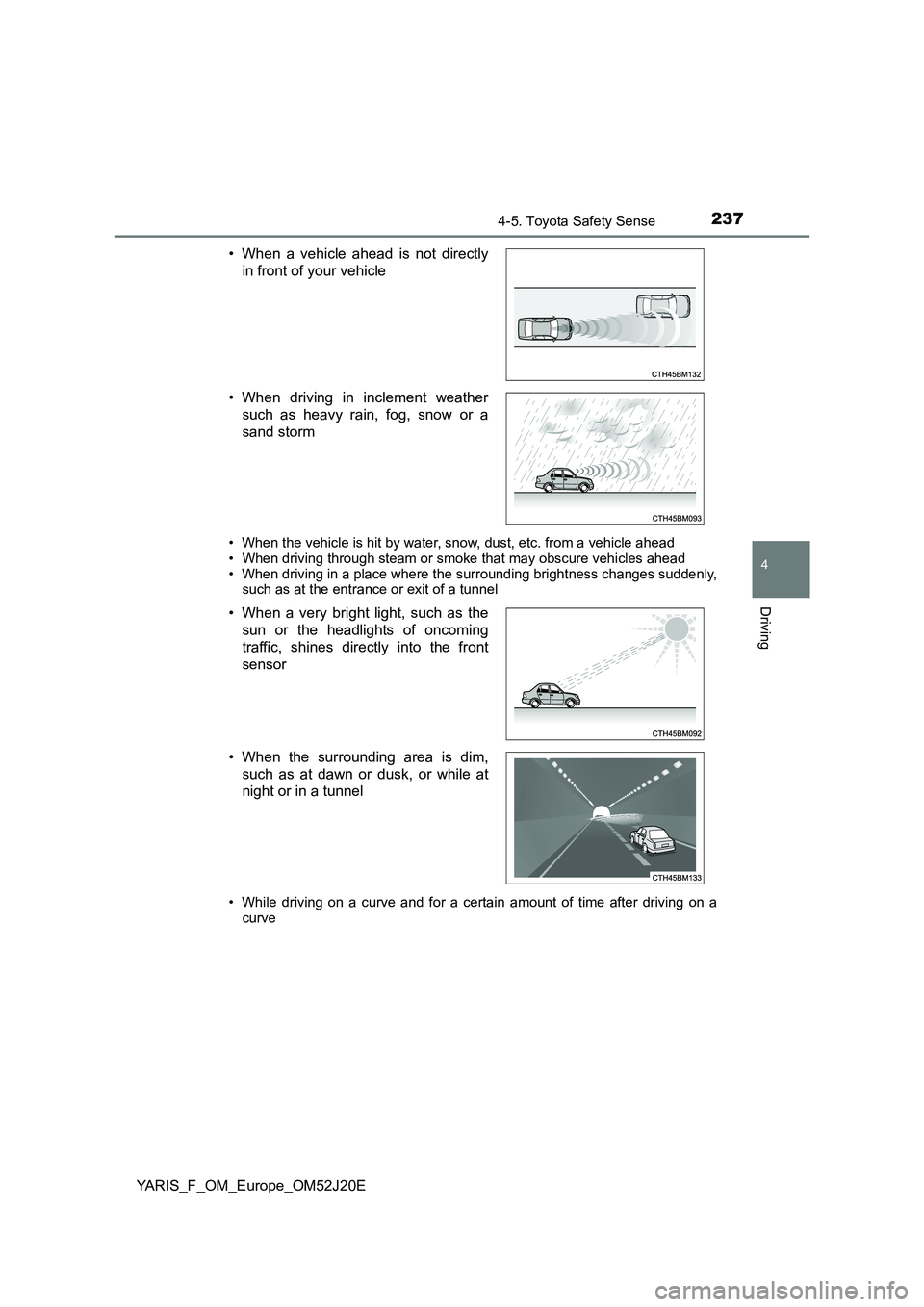
• When the vehicle is hit by water, snow, dust, etc. from a vehicle ahead
• When driving through steam or smoke that may obscure vehicles ahead • When driving in a place where the surrounding brightness changes suddenly,such as at the entrance or exit of a tunnel
• While driving on a curve and for a certain amount of time after driving on a
curve
• When a vehicle ahead is not directly
in front of your vehicle
• When driving in inclement weather
such as heavy rain, fog, snow or a
sand storm
• When a very bright light, such as the
sun or the headlights of oncoming
traffic, shines directly into the front
sensor
• When the surrounding area is dim,
such as at dawn or dusk, or while at
night or in a tunnel