brake TOYOTA YARIS 2017 Owner's Guide
[x] Cancel search | Manufacturer: TOYOTA, Model Year: 2017, Model line: YARIS, Model: TOYOTA YARIS 2017Pages: 549, PDF Size: 33.09 MB
Page 226 of 549
2264-5. Toyota Safety Sense
YARIS_F_OM_Europe_OM52J20E
PCS (Pre-Crash Safety system)
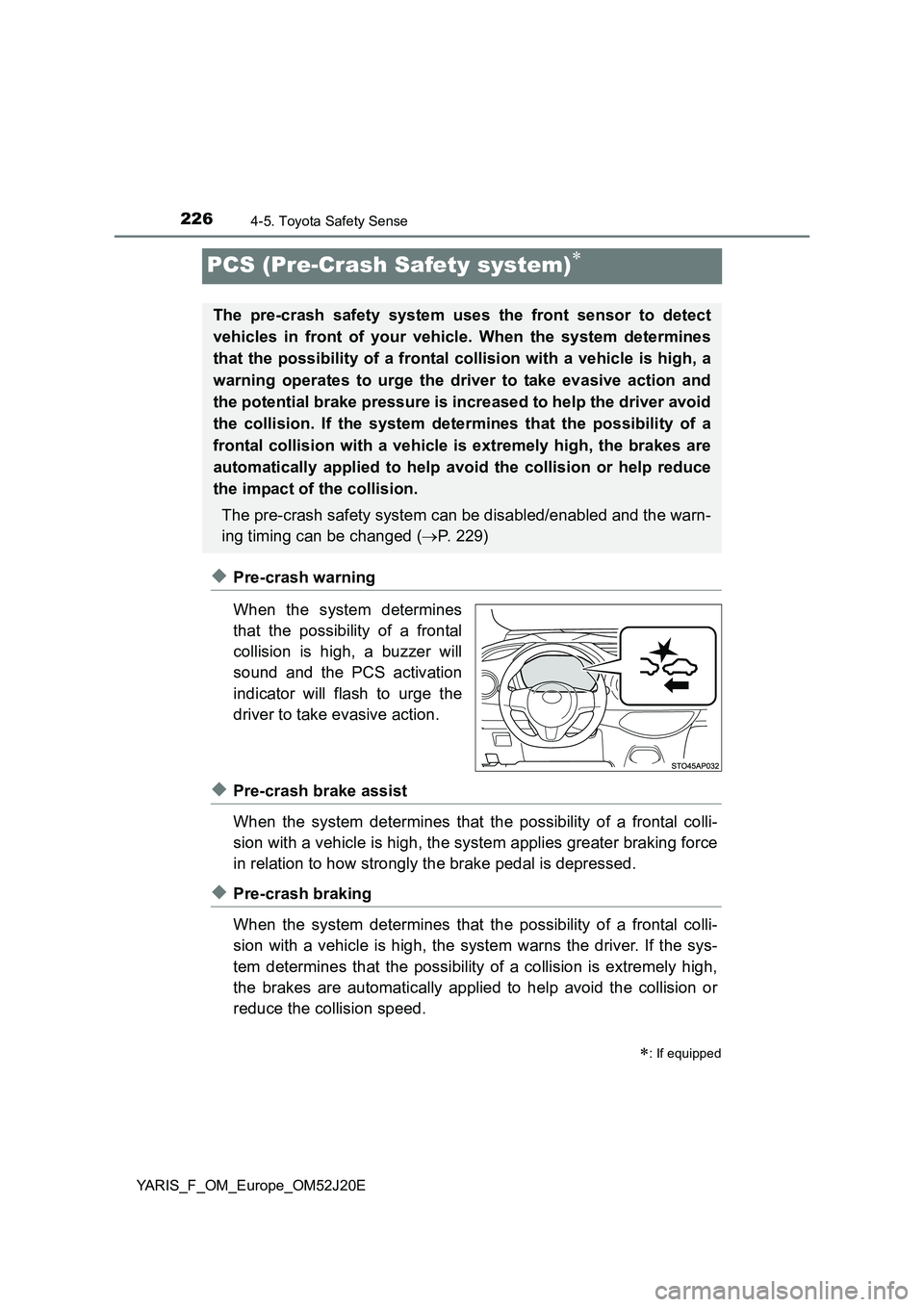
◆Pre-crash warning
When the system determines
that the possibility of a frontal
collision is high, a buzzer will
sound and the PCS activation
indicator will flash to urge the
driver to take evasive action.
◆Pre-crash brake assist
When the system determines that the possibility of a frontal colli-
sion with a vehicle is high, the system applies greater braking force
in relation to how strongly the brake pedal is depressed.
◆Pre-crash braking
When the system determines that the possibility of a frontal colli-
sion with a vehicle is high, the system warns the driver. If the sys-
tem determines that the possibility of a collision is extremely high,
the brakes are automatically applied to help avoid the collision or
reduce the collision speed.
: If equipped
The pre-crash safety system uses the front sensor to detect
vehicles in front of your vehicle. When the system determines
that the possibility of a frontal collision with a vehicle is high, a
warning operates to urge the driver to take evasive action and
the potential brake pressure is increased to help the driver avoid
the collision. If the system determines that the possibility of a
frontal collision with a vehicle is extremely high, the brakes are
automatically applied to help avoid the collision or help reduce
the impact of the collision.
The pre-crash safety system can be disabled/enabled and the warn-
ing timing can be changed ( P. 229)
Page 227 of 549
2274-5. Toyota Safety Sense
4
Driving
YARIS_F_OM_Europe_OM52J20E
WARNING
■Limitations of the pre-crash safety system
● The driver is solely responsible for safe driving. Always drive safely, taking
care to observe your surroundings.
Do not use the pre-crash safety system instead of normal braking opera-
tions under any circumstances. This system will not prevent collisions or
lessen collision damage or injury in every situation. Do not overly rely on
this system. Failure to do so may lead to an accident, resulting in death or
serious injury.
● Although this system is designed to help avoid and reduce the impact of a
collision, its effectiveness may change according to various conditions,
therefore the system may not always be able to achieve the same level of
performance.
Read the following conditions carefully. Do not overly rely on this system
and always drive carefully.
• Conditions under which the system may operate even if there is no pos-
sibility of a collision: P. 232
• Conditions under which the system may not operate properly: P. 2 3 6
● Do not attempt to test the operation of the pre-crash safety system your-
self, as the system may not operate properly, possibly leading to an acci-
dent.
■ Pre-crash braking
● The pre-crash braking function may not operate if certain operations are
performed by the driver. If the accelerator pedal is being depressed
strongly or the steering wheel is bei ng turned, the system may determine
that the driver is taking evasive action and possibly prevent the pre-crash
braking function from operating.
● In some situations, while the pre-crash braking function is operating, oper-
ation of the function may be canceled if the accelerator pedal is depressed
strongly or the steering wheel is turned and the system determines that
the driver is taking evasive action.
● A large amount of braking force is applied while the pre-crash braking
function is operating. Additionally, as the operation of the pre-crash brak-
ing function will be canceled af ter the vehicle has been stopped for
approximately 2 seconds if it is stopped by the operation of the pre-crash
braking function, the driver should depress the brake pedal as necessary.
● If the brake pedal is being depressed, the system may determine that the
driver is taking evasive action and possibly delay the operation timing of
the pre-crash braking function.
Page 231 of 549
2314-5. Toyota Safety Sense
4
Driving
YARIS_F_OM_Europe_OM52J20E
■Operational conditions
The pre-crash safety system is enabled and determines that the possibility of
a frontal collision with a vehicle is high.
Each function is operational at the following speeds:
● Pre-crash warning:
• Vehicle speed is approximately 15 to 140 km/h (10 to 86 mph).
• The relative speed between your vehicle and a preceding vehicle is
approximately 15 km/h (10 mph) or more.
● Pre-crash brake assist:
• Vehicle speed is approximately 30 to 80 km/h (19 to 49 mph).
• The relative speed between your vehicle and a preceding vehicle is
approximately 30 km/h (19 mph) or more.
● Pre-crash braking:
• Vehicle speed is approximately 10 to 80 km/h (7 to 49 mph).
• The relative speed between your vehicle and a preceding vehicle is
approximately 10 km/h (7 mph) or more.
The system may not operate in the following situations:
● If a battery terminal has been disconnected and reconnected and then the
vehicle has not been driven for a certain amount of time
● If the shift lever is in R
● If VSC is disabled (only the pre-crash warning function will be operational)
■ Cancelation of the pre-crash braking
● If either of the following occur while the pre-crash braking function is operat-
ing, it will be canceled:
• The accelerator pedal is depressed strongly.
• The steering wheel is turned sharply or abruptly.
● If the vehicle is stopped by the operation of the pre-crash braking function,
the operation of the pre-crash braking function will be canceled after the
vehicle has been stopped for approximately 2 seconds.
Page 238 of 549
2384-5. Toyota Safety Sense
YARIS_F_OM_Europe_OM52J20E
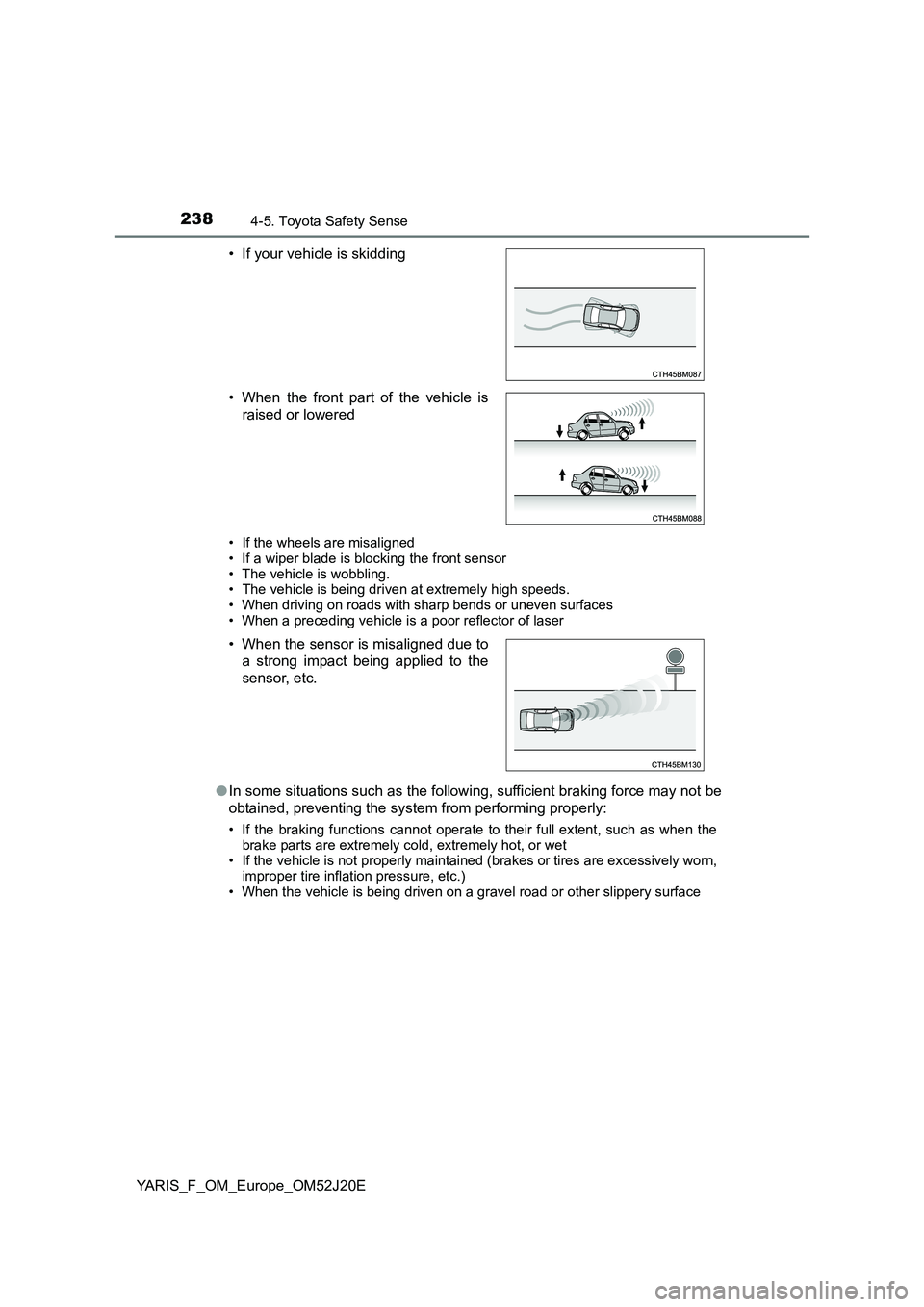
• If the wheels are misaligned
• If a wiper blade is blocking the front sensor • The vehicle is wobbling.• The vehicle is being driven at extremely high speeds.
• When driving on roads with sharp bends or uneven surfaces • When a preceding vehicle is a poor reflector of laser
● In some situations such as the following, sufficient braking force may not be
obtained, preventing the system from performing properly:
• If the braking functions cannot operate to their full extent, such as when the brake parts are extremely cold, extremely hot, or wet• If the vehicle is not properly maintained (brakes or tires are excessively worn,
improper tire inflation pressure, etc.) • When the vehicle is being driven on a gravel road or other slippery surface
• If your vehicle is skidding
• When the front part of the vehicle is
raised or lowered
• When the sensor is misaligned due to
a strong impact being applied to the
sensor, etc.
Page 239 of 549
2394-5. Toyota Safety Sense
4
Driving
YARIS_F_OM_Europe_OM52J20E
■ If the PCS warning light flashes or illuminates
The pre-crash safety system may be temporarily unavailable or there may be
a malfunction in the system.
● In the following situations, the warning light will be cleared and the system
will become operational when normal operating conditions return:
• When the area around the front sensor is hot, such as after the vehicle
has been parked in the sun
• When the windshield is fogged up or covered with condensation or ice
( P. 314, 324)
• When the front sensor or the area around either sensor is cold, such as in
an extremely cold environment
• If the area in front of the front sens or is obstructed, such as when the
hood is open
● If the PCS warning light continues to flash or illuminate, the system may be
malfunctioning. Have the vehicle inspected by any authorized Toyota dealer
or repairer, or another duly qualifi ed and equipped professional immediately.
■ If VSC is disabled
● If TRC and VSC are disabled (P. 267), the pre-crash brake assist and pre-
crash braking functions are also disabled. However, the pre-crash warning
function will still operate.
● The PCS warning light illuminates.
Page 250 of 549
2504-6. Using the driving support systems
YARIS_F_OM_Europe_OM52J20E
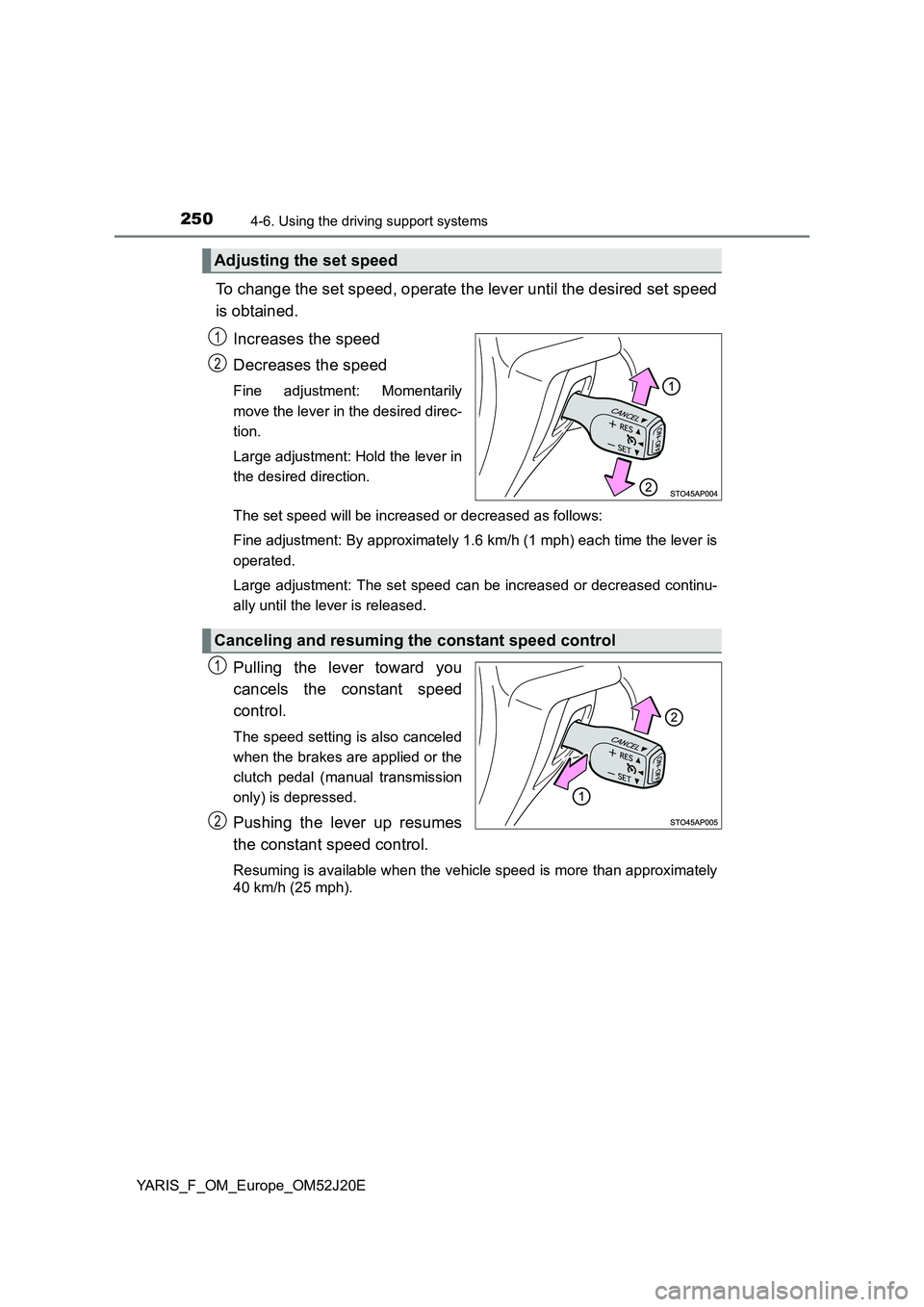
To change the set speed, operate the lever until the desired set speed
is obtained.
Increases the speed
Decreases the speed
Fine adjustment: Momentarily
move the lever in the desired direc-
tion.
Large adjustment: Hold the lever in
the desired direction.
The set speed will be increased or decreased as follows:
Fine adjustment: By approximately 1.6 km/h (1 mph) each time the lever is
operated.
Large adjustment: The set speed can be increased or decreased continu-
ally until the lever is released.
Pulling the lever toward you
cancels the constant speed
control.
The speed setting is also canceled
when the brakes are applied or the
clutch pedal (manual transmission
only) is depressed.
Pushing the lever up resumes
the constant speed control.
Resuming is available when the vehicle speed is more than approximately
40 km/h (25 mph).
Adjusting the set speed
1
2
Canceling and resuming the constant speed control
1
2
Page 257 of 549
257
4
4-6. Using the driving support systems
Driving
YARIS_F_OM_Europe_OM52J20E
Stop & star t system
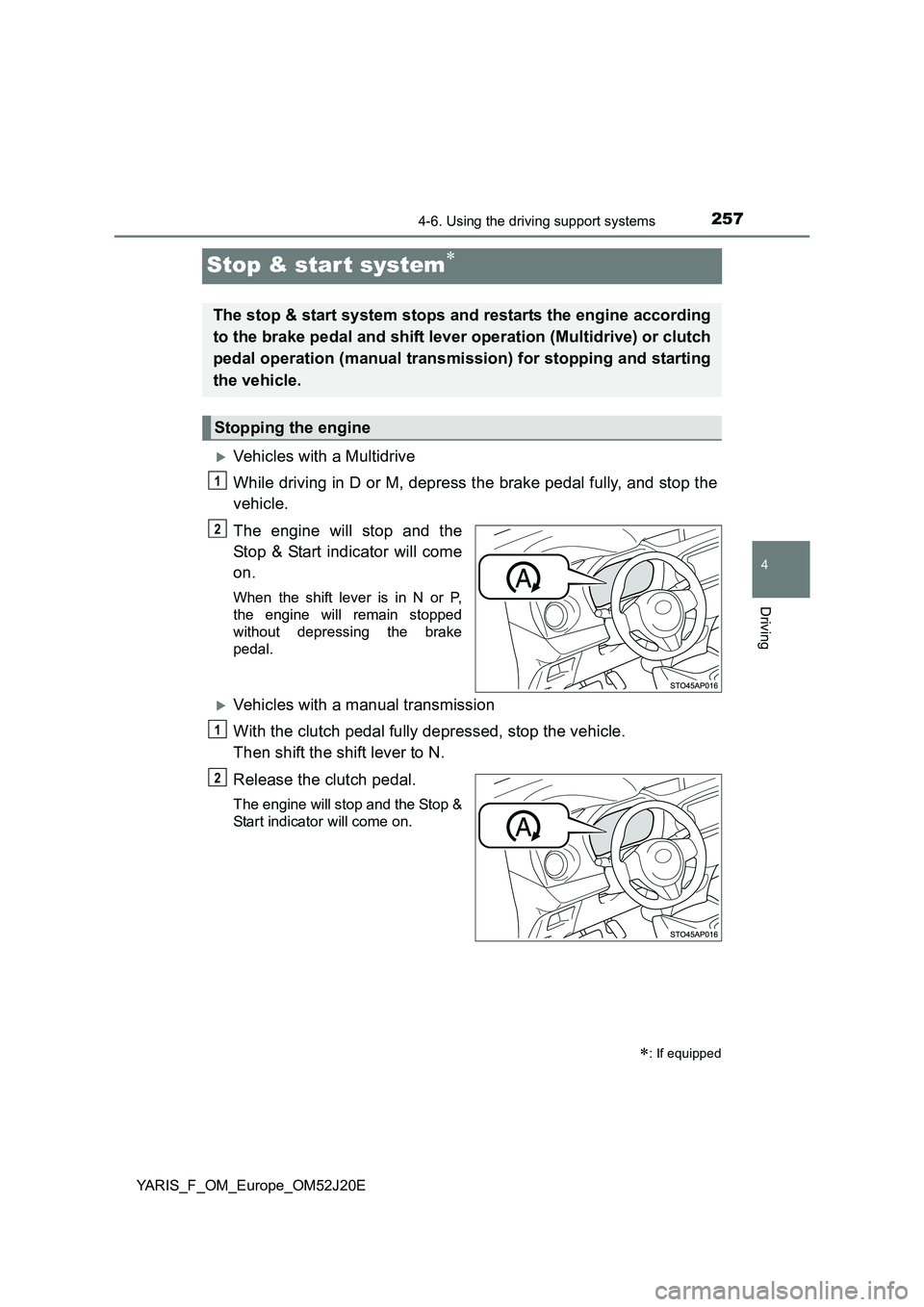
Vehicles with a Multidrive
While driving in D or M, depress the brake pedal fully, and stop the
vehicle.
The engine will stop and the
Stop & Start indicator will come
on.
When the shift lever is in N or P,
the engine will remain stopped
without depressing the brake
pedal.
Vehicles with a manual transmission
With the clutch pedal fully depressed, stop the vehicle.
Then shift the shift lever to N.
Release the clutch pedal.
The engine will stop and the Stop &
Start indicator will come on.
: If equipped
The stop & start system stops and restarts the engine according
to the brake pedal and shift lever operation (Multidrive) or clutch
pedal operation (manual transmission) for stopping and starting
the vehicle.
Stopping the engine
1
2
1
2
Page 258 of 549
2584-6. Using the driving support systems
YARIS_F_OM_Europe_OM52J20E
Vehicles with a Multidrive
Release the brake pedal. When the shift lever is in N or P, depress
brake pedal and shift the shift lever to D or M.
The engine will restart. The Stop & Start indicator will go off.
Vehicles with a manual transmission
Check that the shift lever is in N and depress the clutch pedal.
The engine will restart. The Stop & Start indicator will go off. (In this situa-
tion, releasing the clutch pedal will not stop the engine again.)
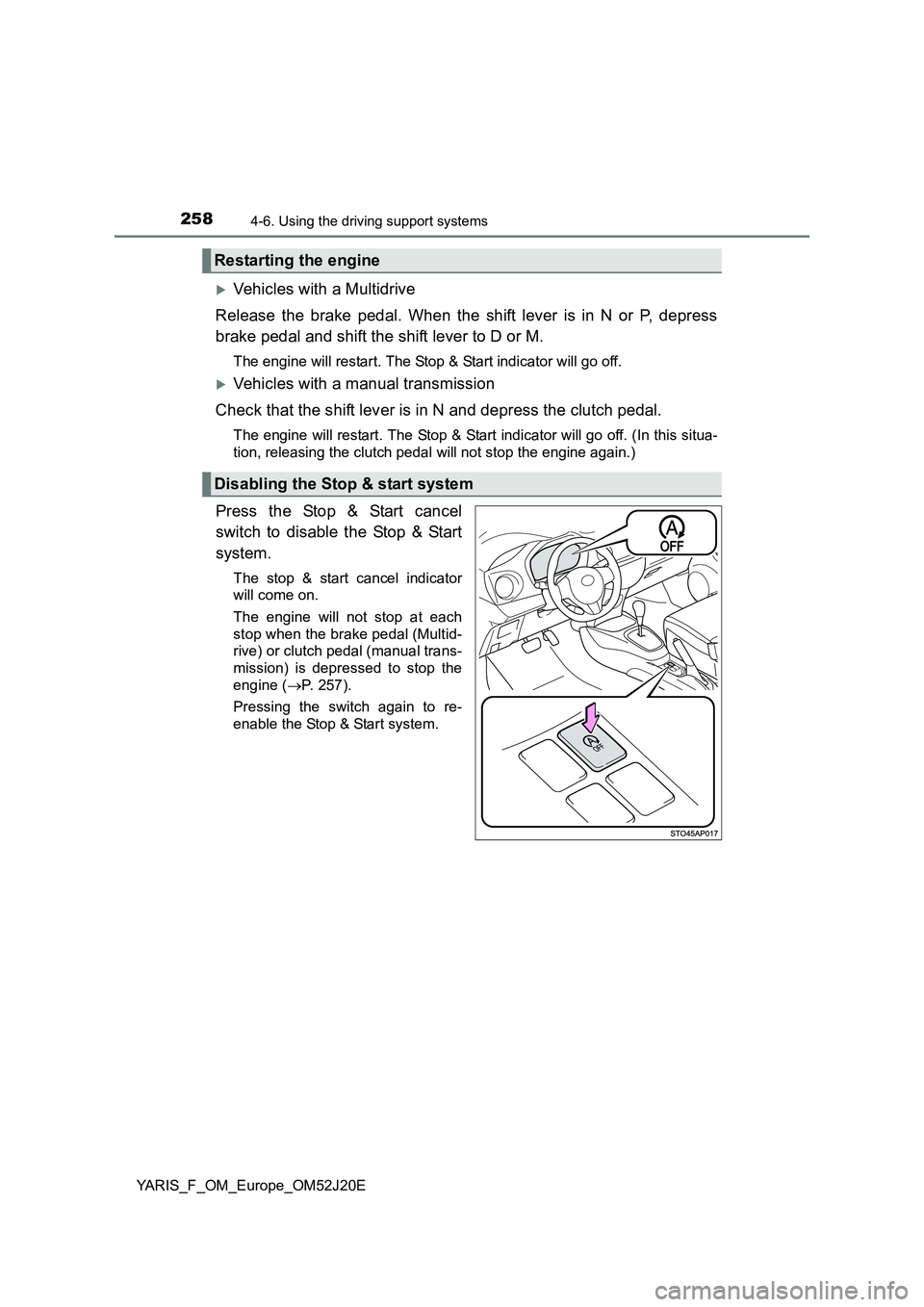
Press the Stop & Start cancel
switch to disable the Stop & Start
system.
The stop & start cancel indicator
will come on.
The engine will not stop at each
stop when the brake pedal (Multid-
rive) or clutch pedal (manual trans-
mission) is depressed to stop the
engine ( P. 257).
Pressing the switch again to re-
enable the Stop & Start system.
Restarting the engine
Disabling the Stop & start system
Page 260 of 549
2604-6. Using the driving support systems
YARIS_F_OM_Europe_OM52J20E
■Operating conditions
● The Stop & Start system is operational when all of the following conditions
are met:
• The engine is adequately warmed up.
• The battery is sufficiently charged.
• The driver’s door is closed.
• The driver’s seat belt is fastened.
• The hood is closed.
• The accelerator pedal is not being depressed.
• Vehicles with a Multidrive: The brake pedal is firmly depressed.
• Vehicles with a Multidrive: The shift lever is not in R.
• Vehicles with a manual transmission: The clutch pedal is not being
depressed.
• Vehicles with a manual transmission: The shift lever is in N.
● In the following circumstances the engine may not be stopped by the Stop &
Start system. This is not a malfunction of the Stop & Start system.
• Engine coolant temperature or transmi ssion fluid temperature is too low
or too high.
• The outside temperature is extremely low.
• The air conditioning system is being used when the outside temperature
is high or low.
• The air conditioning system is being used when the vehicle interior tem-
perature is extremely high such as after the vehicle was parked under the
hot sun.
• Vehicles with an automatic air c onditioning system: The windshield
defogger is being used.
• The battery is not sufficiently charged, or is undergoing a periodic
recharge.
• Due to traffic or other circumstances the vehicle is stopped repeatedly,
resulting in the amount of time the engine is stopped by the Stop & Start
system to become excessively high.
• The driver’s seat belt is unfastened.
• The driver’s door is opened.
• The hood is opened.
• The vehicle is stopped on a steep hill.
• The brake booster vacuum is low.
• A large amount of electricity is being used.
• At high altitude.
When the above conditions improve, the Stop & Start system will stop and
restart the engine from the next time the vehicle is stopped.
Page 261 of 549
2614-6. Using the driving support systems
4
Driving
YARIS_F_OM_Europe_OM52J20E
● In the following situations, the engine may start even without the brake
pedal being released (Multidrive) or clutch pedal being depressed (manual
transmission).
• The brake pedal is pumped or strongly depressed.
• The air conditioning system is being used or turned on.
• Vehicles with an automatic air c onditioning system: The windshield
defogger is turned on.
• The battery is not sufficiently charged.
• The vehicle starts to roll on an incline.
• Vehicles with a Multidrive: The hood is opened when the shift lever is in N
or P.
• Vehicles with a Multidrive: The shift lever is shifted into a position other
than N or P.
• The accelerator pedal is depressed.
• A large amount of electricity is being used.
• The driver’s door is opened.
• The driver’s seat belt is unfastened.
● In the following situations, it may take longer than normal for the Stop & Start
system to activate.
• The battery is discharged.
• After the battery terminals have been disconnected and reconnected
after a battery replacement, etc.
• The engine coolant temperature is low.
■ Automatic reactivation of the Stop & Start system
Vehicles without a smart entry & start system
Even if the Stop & Start system is disabled by the Stop & Start cancel switch,
it will be automatically re-enabled once the engine switch is turned to the
“LOCK” position then to the “START” position.
Vehicles with a smart entry & start system
Even if the Stop & Start system is disabled by the Stop & Start cancel switch,
it will be automatically re-enabled once the engine switch is turned off then
the engine is started.