tow TOYOTA YARIS 2019 User Guide
[x] Cancel search | Manufacturer: TOYOTA, Model Year: 2019, Model line: YARIS, Model: TOYOTA YARIS 2019Pages: 700, PDF Size: 65.2 MB
Page 168 of 700
1683-2. Opening, closing and locking the doors
YARIS_F_OM_Europe_OM52K19E
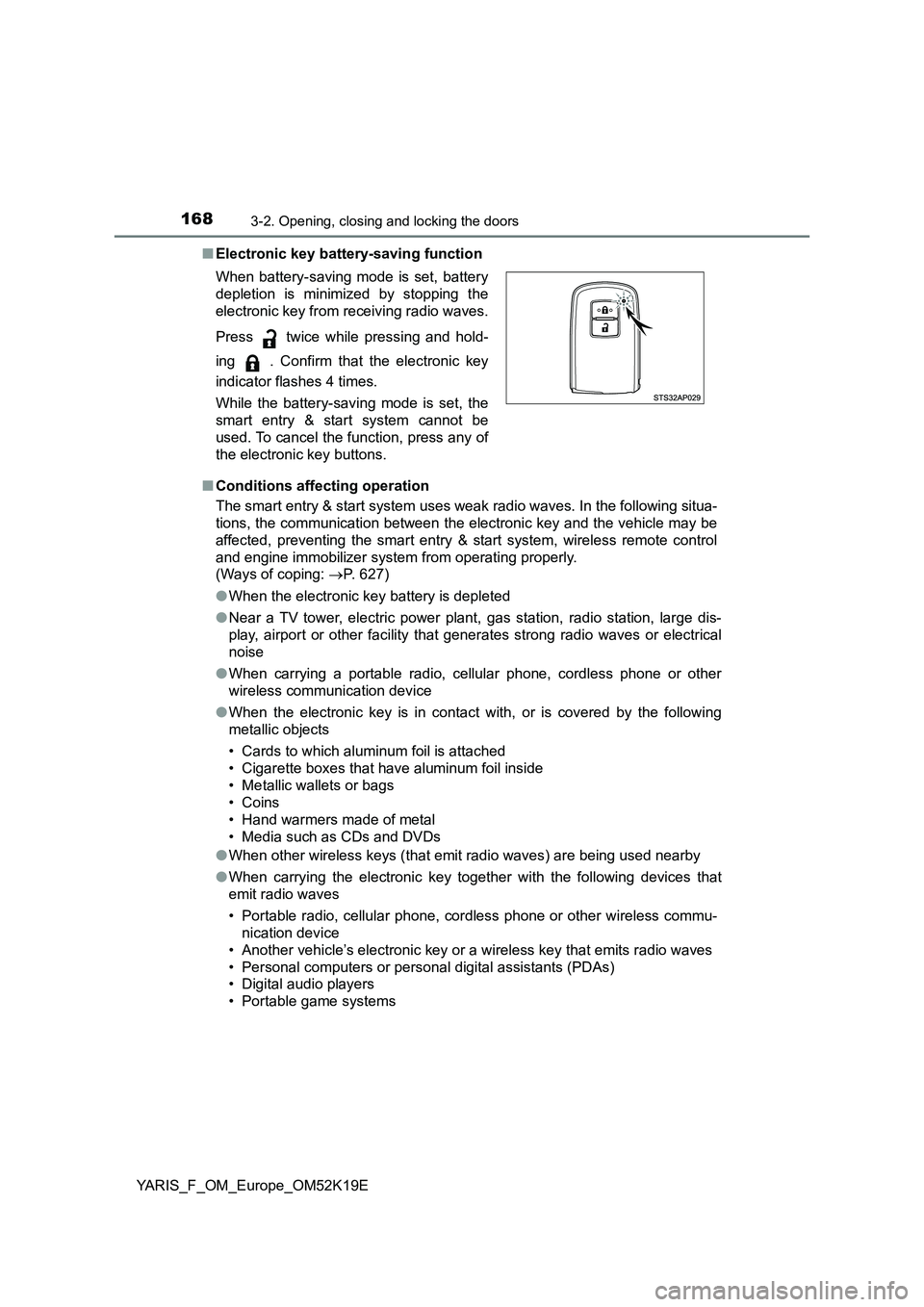
■ Electronic key battery-saving function
■ Conditions affecting operation
The smart entry & start system uses weak radio waves. In the following situa-
tions, the communication between the electronic key and the vehicle may be
affected, preventing the smart entry & start system, wireless remote control
and engine immobilizer system from operating properly.
(Ways of coping: P. 627)
● When the electronic key battery is depleted
● Near a TV tower, electric power plant, gas station, radio station, large dis-
play, airport or other facility that generates strong radio waves or electrical
noise
● When carrying a portable radio, cellular phone, cordless phone or other
wireless communication device
● When the electronic key is in contact with, or is covered by the following
metallic objects
• Cards to which aluminum foil is attached
• Cigarette boxes that have aluminum foil inside
• Metallic wallets or bags
• Coins
• Hand warmers made of metal
• Media such as CDs and DVDs
● When other wireless keys (that emit radio waves) are being used nearby
● When carrying the electronic key together with the following devices that
emit radio waves
• Portable radio, cellular phone, cordless phone or other wireless commu-
nication device
• Another vehicle’s electronic key or a wireless key that emits radio waves
• Personal computers or pers onal digital assistants (PDAs)
• Digital audio players
• Portable game systems
When battery-saving mode is set, battery
depletion is minimized by stopping the
electronic key from receiving radio waves.
Press twice while pressing and hold-
ing . Confirm that the electronic key
indicator flashes 4 times.
While the battery-saving mode is set, the
smart entry & start system cannot be
used. To cancel the function, press any of
the electronic key buttons.
Page 201 of 700
201
3
3-3. Adjusting the seats
Operation of each component
YARIS_F_OM_Europe_OM52K19E
Rear seats
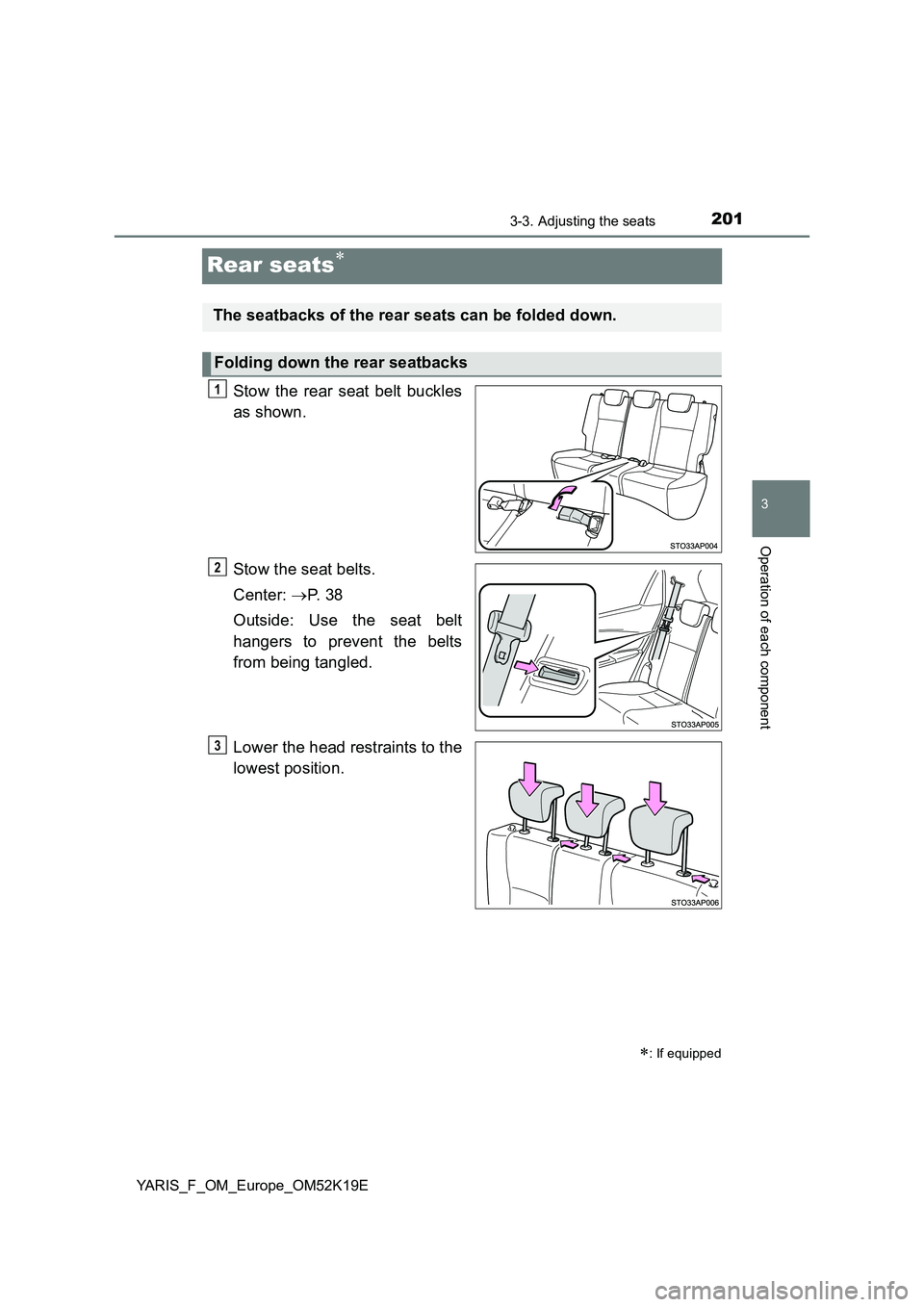
Stow the rear seat belt buckles
as shown.
Stow the seat belts.
Center: P. 3 8
Outside: Use the seat belt
hangers to prevent the belts
from being tangled.
Lower the head restraints to the
lowest position.
: If equipped
The seatbacks of the rear seats can be folded down.
Folding down the rear seatbacks
1
2
3
Page 203 of 700
2033-3. Adjusting the seats
3
Operation of each component
YARIS_F_OM_Europe_OM52K19E
WARNING
■When folding the rear seatbacks down
Observe the following precautions. Failure to do so may result in death or
serious injury.
● Do not fold the seatbacks down while driving.
● Stop the vehicle on level ground, set the parking brake and shift the shift
lever to P (Multidrive) or N (manual transmission).
● Do not allow anyone to sit on a folded seatback or in the luggage compart-
ment while driving.
● Do not allow children to enter the luggage compartment.
● Do not allow anyone to sit on the rear center seat if the rear right seat is
folded down, as the seat belt buckle for the rear center seat belt is then
concealed under the folded seat and cannot be used.
● Be careful not to catch your hand when folding the rear seatbacks.
● Depending on the position of the front seat, it may interfere when trying to
fold down the rear seatbacks. If this happens, adjust the position of the
front seat.
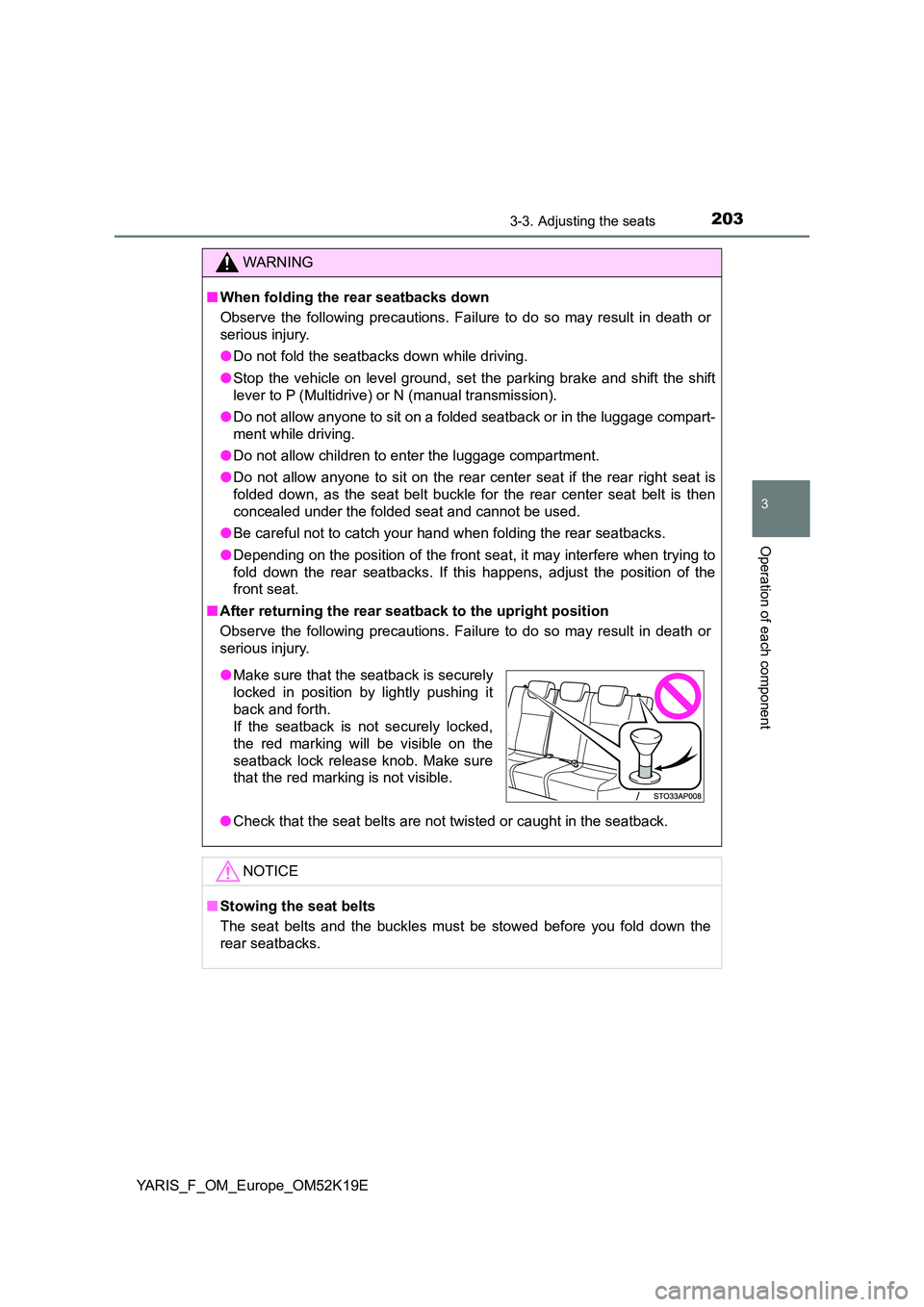
■ After returning the rear seatback to the upright position
Observe the following precautions. Failure to do so may result in death or
serious injury.
● Check that the seat belts are not twisted or caught in the seatback.
NOTICE
■Stowing the seat belts
The seat belts and the buckles must be stowed before you fold down the
rear seatbacks.
● Make sure that the seatback is securely
locked in position by lightly pushing it
back and forth.
If the seatback is not securely locked,
the red marking will be visible on the
seatback lock release knob. Make sure
that the red marking is not visible.
Page 206 of 700
2063-3. Adjusting the seats
YARIS_F_OM_Europe_OM52K19E
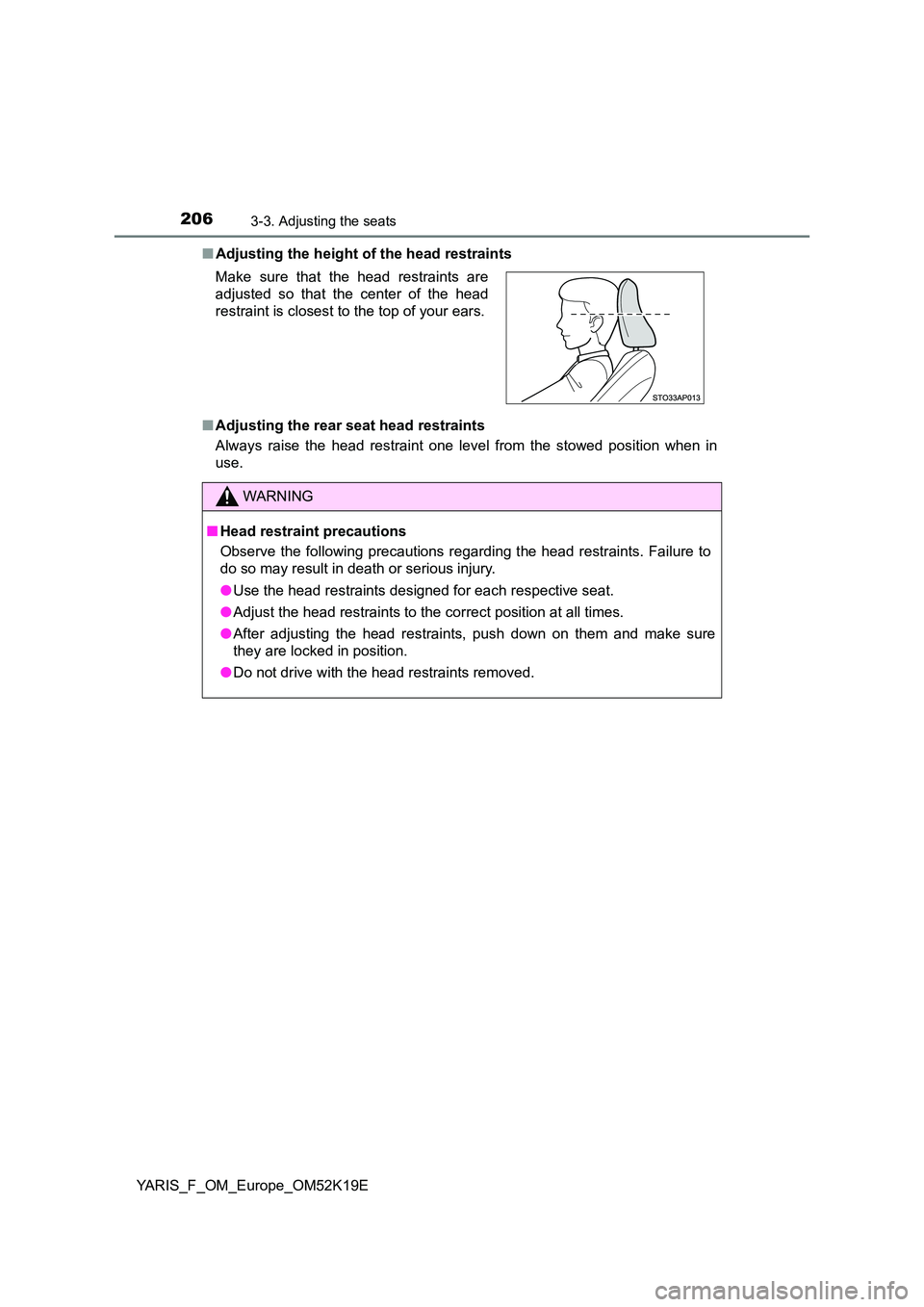
■ Adjusting the height of the head restraints
■ Adjusting the rear seat head restraints
Always raise the head restraint one level from the stowed position when in
use.
Make sure that the head restraints are
adjusted so that the center of the head
restraint is closest to the top of your ears.
WARNING
■ Head restraint precautions
Observe the following precautions regarding the head restraints. Failure to
do so may result in death or serious injury.
● Use the head restraints designed for each respective seat.
● Adjust the head restraints to the correct position at all times.
● After adjusting the head restraints, push down on them and make sure
they are locked in position.
● Do not drive with the head restraints removed.
Page 219 of 700
219
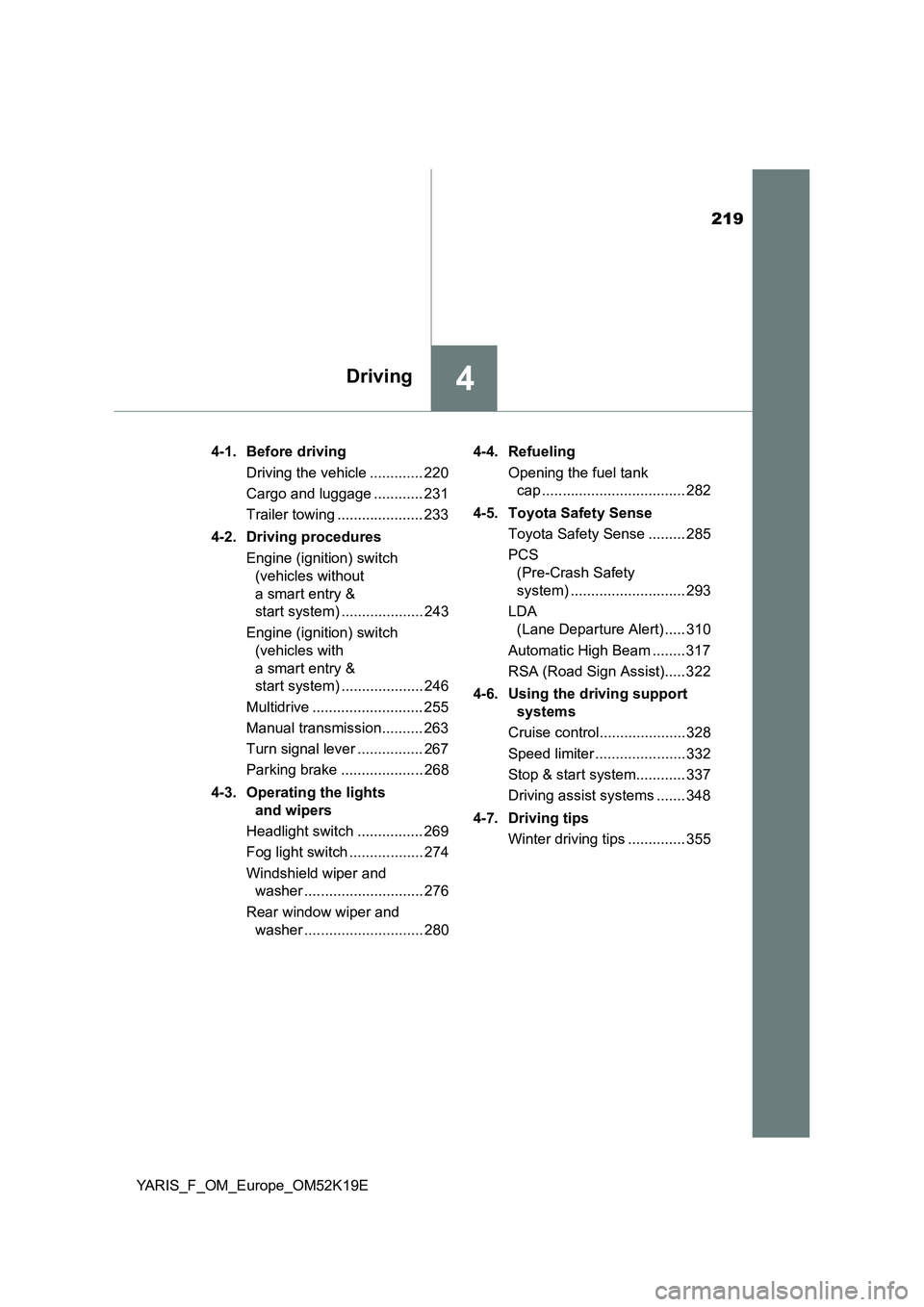
4Driving
YARIS_F_OM_Europe_OM52K19E
4-1. Before driving
Driving the vehicle ............. 220
Cargo and luggage ............ 231
Trailer towing ..................... 233
4-2. Driving procedures
Engine (ignition) switch
(vehicles without
a smart entry &
start system) .................... 243
Engine (ignition) switch
(vehicles with
a smart entry &
start system) .................... 246
Multidrive ........................... 255
Manual transmission.......... 263
Turn signal lever ................ 267
Parking brake .................... 268
4-3. Operating the lights
and wipers
Headlight switch ................ 269
Fog light switch .................. 274
Windshield wiper and
washer ............................. 276
Rear window wiper and
washer ............................. 280
4-4. Refueling
Opening the fuel tank
cap ................................... 282
4-5. Toyota Safety Sense
Toyota Safety Sense ......... 285
PCS
(Pre-Crash Safety
system) ............................ 293
LDA
(Lane Departure Alert) ..... 310
Automatic High Beam ........ 317
RSA (Road Sign Assist)..... 322
4-6. Using the driving support
systems
Cruise control..................... 328
Speed limiter ...................... 332
Stop & start system............ 337
Driving assist systems ....... 348
4-7. Driving tips
Winter driving tips .............. 355
Page 223 of 700
2234-1. Before driving
4
Driving
YARIS_F_OM_Europe_OM52K19E
■When starting off on an uphill
The hill-start assist control will activate. ( P. 351)
■ Driving in the rain
● Drive carefully when it is raining, because visibility will be reduced, the win-
dows may become fogged-up, and the road will be slippery.
● Drive carefully when it starts to rain, because the road surface will be espe-
cially slippery.
● Refrain from high speeds when driving on an expressway in the rain,
because there may be a layer of water between the tires and the road sur-
face, preventing the steering and brakes from operating properly.
■ Engine speed while driving (vehicles with a Multidrive)
In the following conditions, the engine speed may become high while driving.
This is due to automatic up-shifting c ontrol or down-shifting implementation to
meet driving conditions. It does not indicate sudden acceleration.
● The vehicle is judged to be driving uphill or downhill
● When the accelerator pedal is released
● When the brake pedal is depressed while sport mode is selected
■ Breaking in your new Toyota
To extend the life of the vehicle, observing the following precautions is recom-
mended:
● For the first 300 km (200 miles):
Avoid sudden stops.
● For the first 800 km (500 miles):
Do not tow a trailer.
● For the first 1000 km (600 miles):
• Do not drive at extremely high speeds.
• Avoid sudden acceleration.
• Do not drive continuously in low gears.
• Do not drive at a constant speed for extended periods.
Page 231 of 700
231
4
4-1. Before driving
Driving
YARIS_F_OM_Europe_OM52K19E
Cargo and luggage
Take notice of the following information about storage precau-
tions, cargo capacity and load:
WARNING
■ Things that must not be carried in the luggage compartment
The following things may cause a fire if loaded in the luggage compartment:
● Receptacles containing gasoline
● Aerosol cans
■ Storage precautions
Observe the following precautions.
Failure to do so may prevent t he pedals from being depressed properly,
may block the driver’s vision, or may re sult in items hitting the driver or pas-
sengers, possibly causing an accident.
● Stow cargo and luggage in the luggage compartment whenever possible.
● Do not stack anything in the luggage compartment higher than the seat-
backs.
● Do not place cargo or luggage in or on the following locations:
• At the feet of the driver
• On the front passenger or rear seats (when stacking items)
• On the luggage cover
• On the instrument panel
• On the dashboard
● Secure all items in the occupant compartment.
● Vehicles with rear seats: When you fold down the rear seats, long items
should not be place directly behind the front seats.
● Never allow anyone to ride in the luggage compartment. It is not designed
for passengers. They should ride in their seats with their seat belts prop-
erly fastened. Otherwise, they are much more likely to suffer death or seri-
ous bodily injury, in the event of sudden braking, sudden swerving or an
accident.
Page 233 of 700
233
4
4-1. Before driving
Driving
YARIS_F_OM_Europe_OM52K19E
Trailer towing
◆Weight limits
Check the allowable towing capacity, GVM (Gross Vehicle Mass),
MPAC (Maximum Permissible Axle Capacity), and permissible
drawbar load before towing. ( P. 646)
◆Towing hitch/bracket
Toyota recommends the use of the Toyota hitch/bracket for your
vehicle. Other products of a suitable nature and comparable quality
may also be used.
Your vehicle is designed primarily as a passenger carrying vehi-
cle. Towing a trailer will have an adverse effect on handling, per-
formance, braking, durability, and fuel consumption. Your safety
and satisfaction depend on the proper use of correct equipment
and cautions driving habits. For your safety and the safety of
others, do not overload the vehicle or trailer.
To tow a trailer safely, use extreme care and drive the vehicle in
accordance with the trailer’s characteristics and operating con-
ditions.
Toyota warranties do not apply to damage or malfunction
caused by towing a trailer for commercial purposes.
Ask your local authorized Toyota retailer or Toyota authorized
repairer, or any reliable repairer for further details before towing,
as there are additional legal requirements in some countries.
Page 234 of 700
2344-1. Before driving
YARIS_F_OM_Europe_OM52K19E
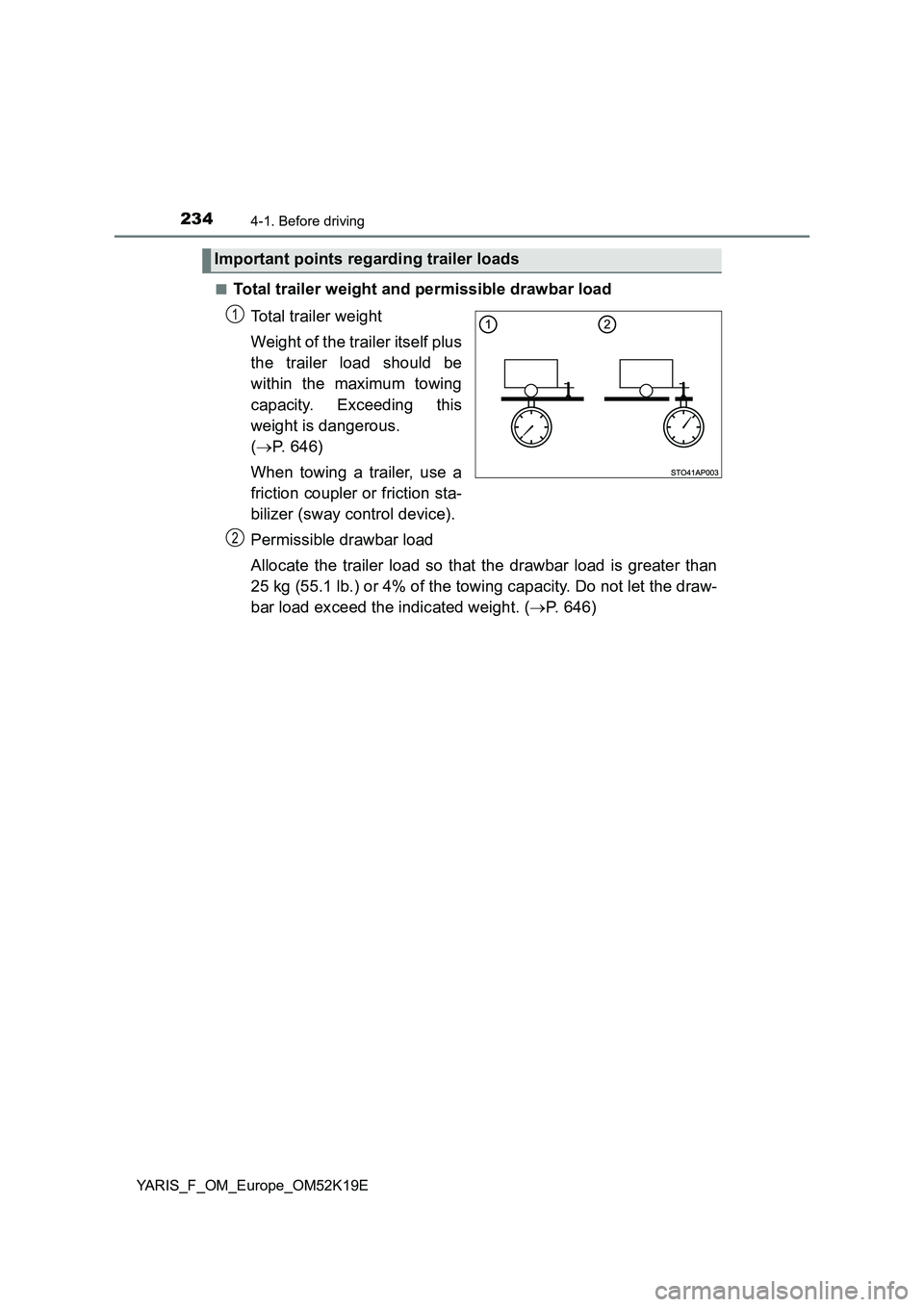
■Total trailer weight and permissible drawbar load
Total trailer weight
Weight of the trailer itself plus
the trailer load should be
within the maximum towing
capacity. Exceeding this
weight is dangerous.
( P. 646)
When towing a trailer, use a
friction coupler or friction sta-
bilizer (sway control device).
Permissible drawbar load
Allocate the trailer load so that the drawbar load is greater than
25 kg (55.1 lb.) or 4% of the towing capacity. Do not let the draw-
bar load exceed the indicated weight. ( P. 646)
Important points regarding trailer loads
1
2
Page 235 of 700
2354-1. Before driving
4
Driving
YARIS_F_OM_Europe_OM52K19E
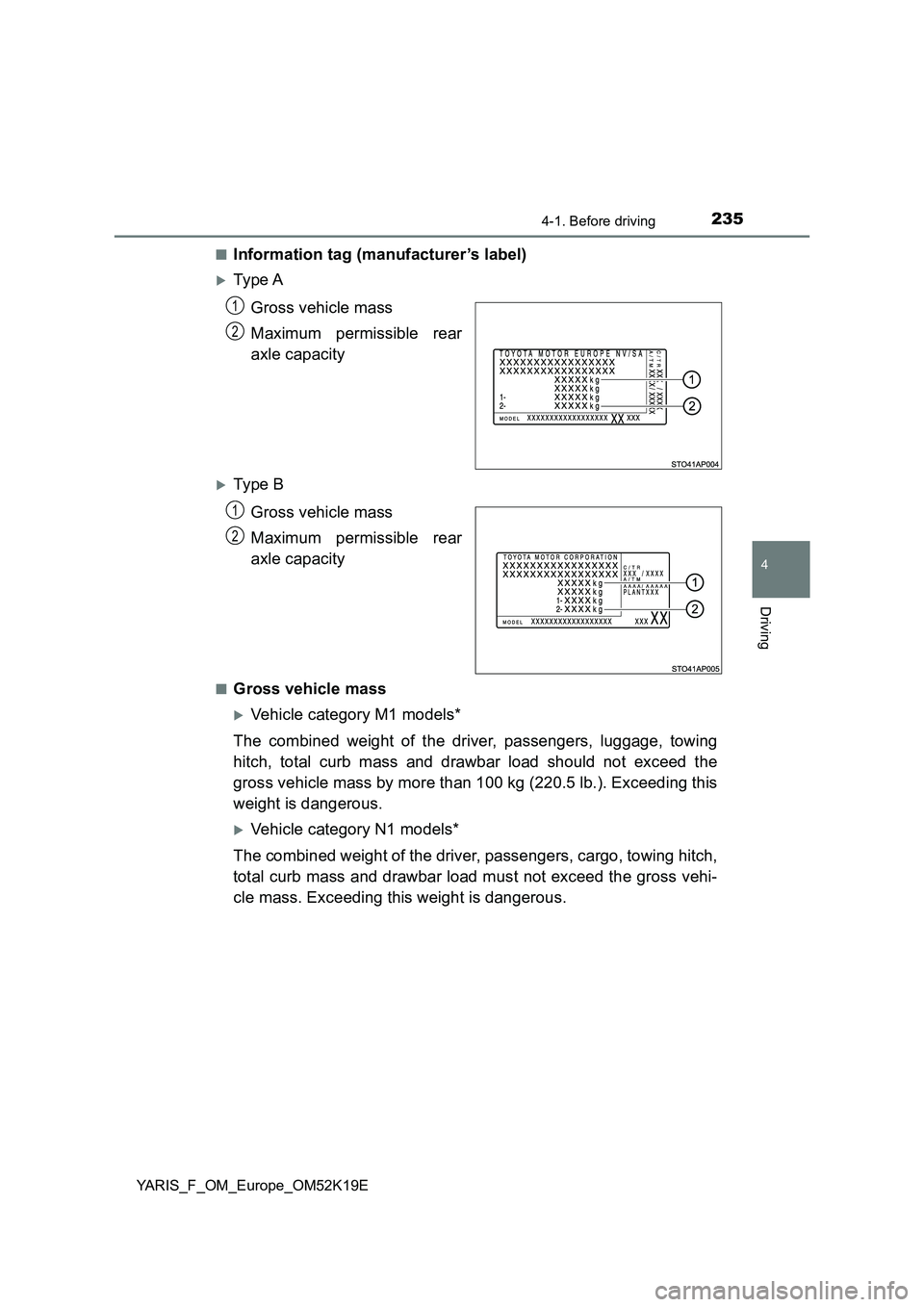
■Information tag (manufacturer’s label)
Ty pe A
Gross vehicle mass
Maximum permissible rear
axle capacity
Ty pe B
Gross vehicle mass
Maximum permissible rear
axle capacity
■Gross vehicle mass
Vehicle category M1 models*
The combined weight of the driver, passengers, luggage, towing
hitch, total curb mass and drawbar load should not exceed the
gross vehicle mass by more than 100 kg (220.5 lb.). Exceeding this
weight is dangerous.
Vehicle category N1 models*
The combined weight of the driver, passengers, cargo, towing hitch,
total curb mass and drawbar load must not exceed the gross vehi-
cle mass. Exceeding this weight is dangerous.
1
2
1
2