TRAN TOYOTA YARIS 2019 Repair Manual
[x] Cancel search | Manufacturer: TOYOTA, Model Year: 2019, Model line: YARIS, Model: TOYOTA YARIS 2019Pages: 700, PDF Size: 65.2 MB
Page 567 of 700
5678-2. Steps to take in an emergency
8
When trouble arises
YARIS_F_OM_Europe_OM52K19E
If your vehicle needs to be towed
The following may indicate a problem with your transmission. Contact
any authorized Toyota retailer or Toyota authorized repairer, or any
reliable repairer or commercial towing service before towing.
● The engine is running but the vehicle does not move.
● The vehicle makes an abnormal sound.
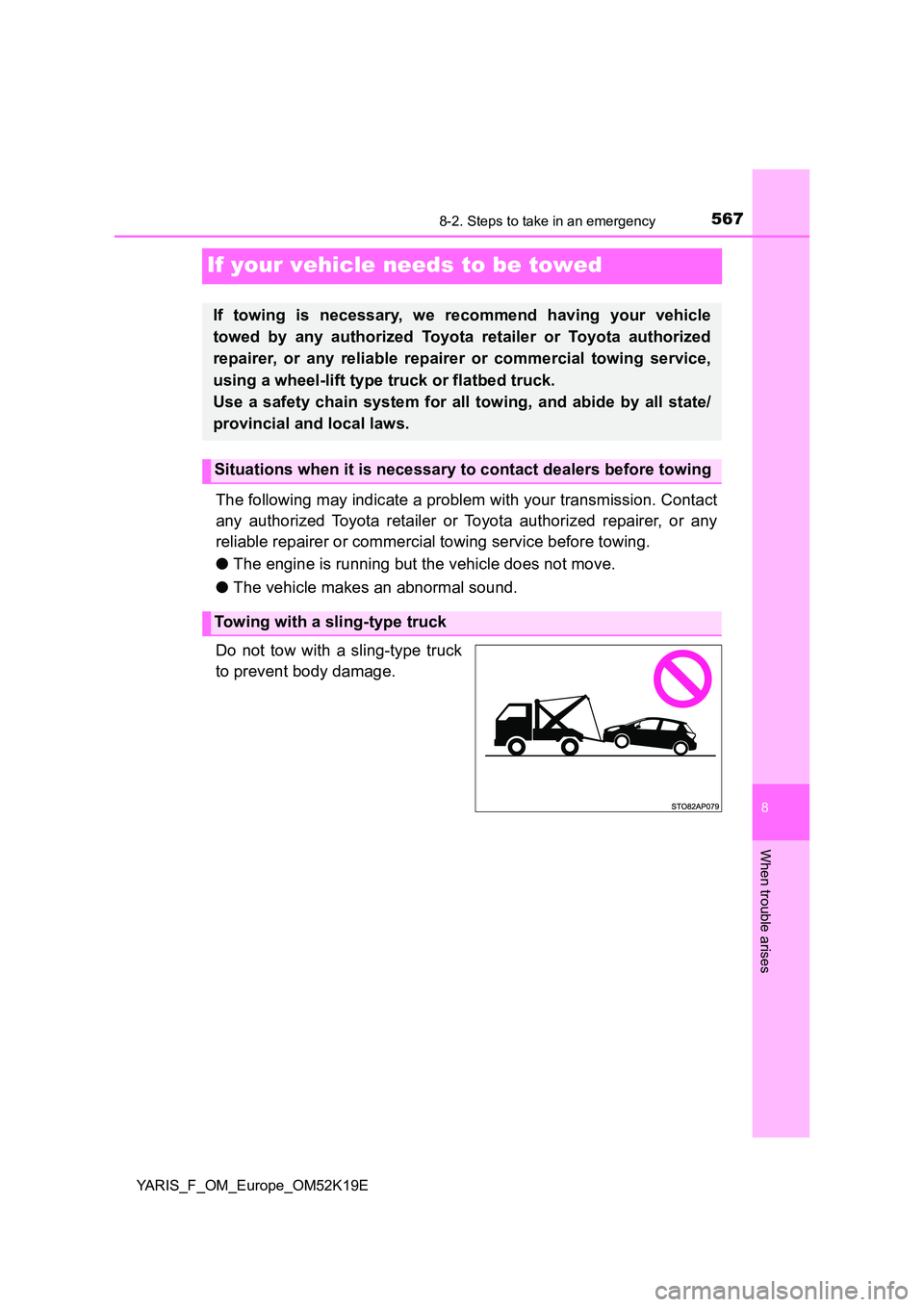
Do not tow with a sling-type truck
to prevent body damage.
If towing is necessary, we recommend having your vehicle
towed by any authorized Toyota retailer or Toyota authorized
repairer, or any reliable repairer or commercial towing service,
using a wheel-lift type truck or flatbed truck.
Use a safety chain system for all towing, and abide by all state/
provincial and local laws.
Situations when it is necessary to contact dealers before towing
Towing with a sling-type truck
Page 568 of 700
5688-2. Steps to take in an emergency
YARIS_F_OM_Europe_OM52K19E
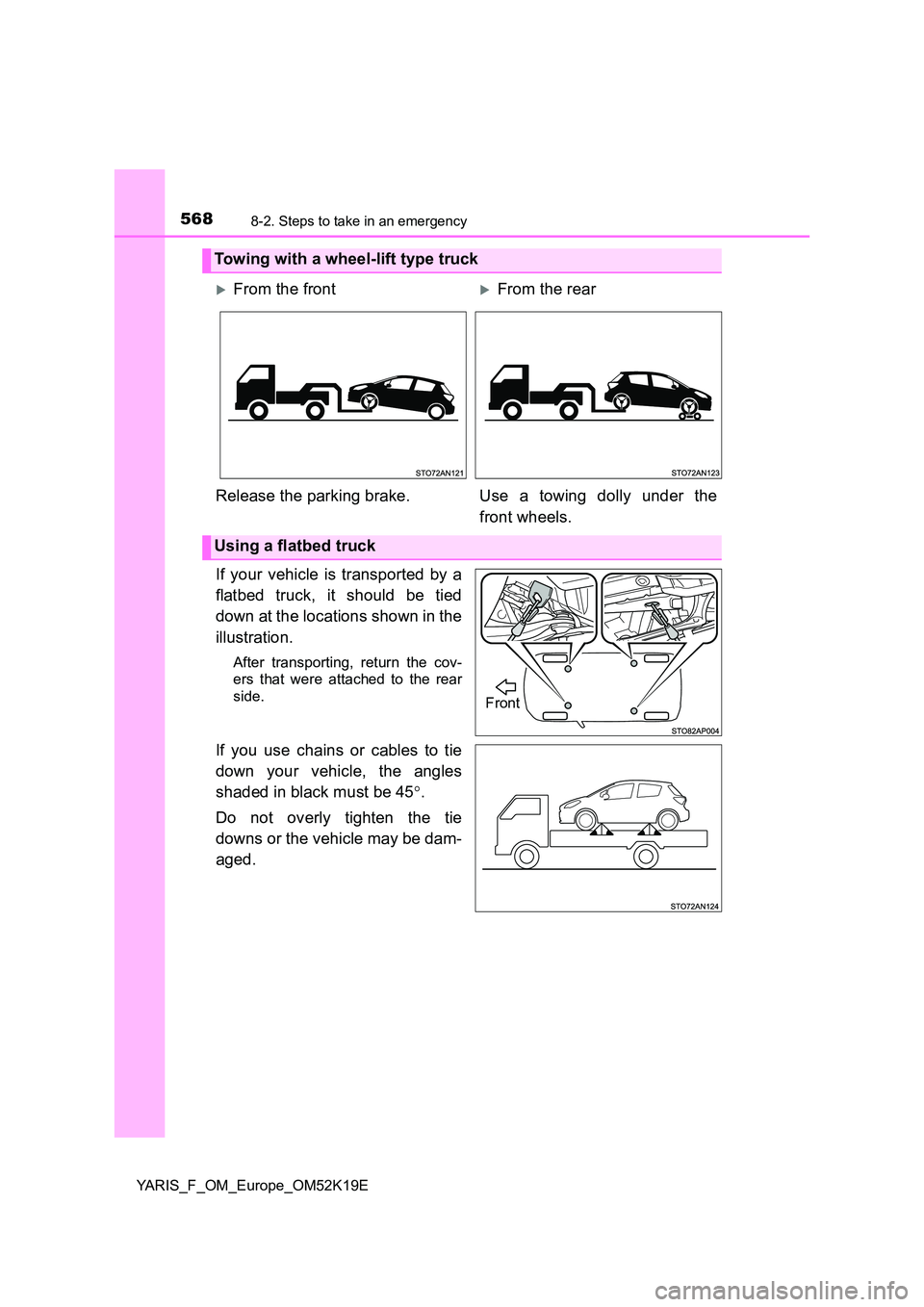
If your vehicle is transported by a
flatbed truck, it should be tied
down at the locations shown in the
illustration.
After transporting, return the cov-
ers that were attached to the rear
side.
If you use chains or cables to tie
down your vehicle, the angles
shaded in black must be 45 .
Do not overly tighten the tie
downs or the vehicle may be dam-
aged.
Towing with a wheel-lift type truck
From the frontFrom the rear
Release the parking brake. Use a towing dolly under the
front wheels.
Using a flatbed truck
Front
Page 572 of 700
5728-2. Steps to take in an emergency
YARIS_F_OM_Europe_OM52K19E
WARNING
Observe the following precautions.
Failure to do so may result in death or serious injury.
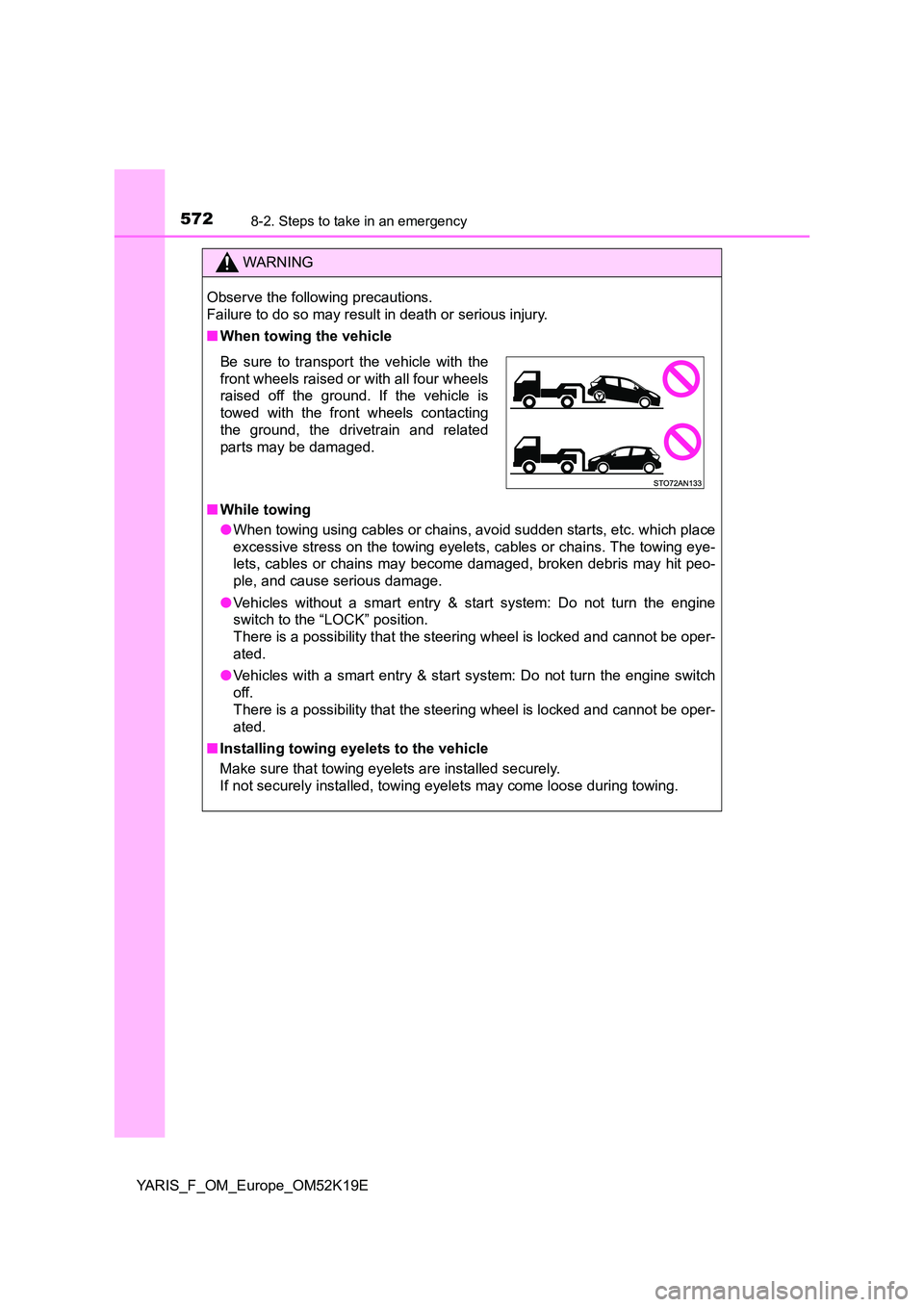
■ When towing the vehicle
■ While towing
● When towing using cables or chains, avoid sudden starts, etc. which place
excessive stress on the towing eyelets, cables or chains. The towing eye-
lets, cables or chains may become damaged, broken debris may hit peo-
ple, and cause serious damage.
● Vehicles without a smart entry & start system: Do not turn the engine
switch to the “LOCK” position.
There is a possibility that the steering wheel is locked and cannot be oper-
ated.
● Vehicles with a smart entry & start system: Do not turn the engine switch
off.
There is a possibility that the steering wheel is locked and cannot be oper-
ated.
■ Installing towing eyelets to the vehicle
Make sure that towing eyelets are installed securely.
If not securely installed, towing eyelets may come loose during towing.
Be sure to transport the vehicle with the
front wheels raised or with all four wheels
raised off the ground. If the vehicle is
towed with the front wheels contacting
the ground, the drivetrain and related
parts may be damaged.
Page 574 of 700
5748-2. Steps to take in an emergency
YARIS_F_OM_Europe_OM52K19E
If you think something is wrong
●Fluid leaks under the vehicle
(Water dripping from the air conditioning after use is normal)
● Flat-looking tires or uneven tire wear
● Vehicles with monochrome display: High engine coolant tempera-
ture warning light flashes or comes on
Vehicles with color display: Engine coolant temperature gauge nee-
dle continually points higher than normal
● Low engine coolant temperature indicator comes on or does not
come on continuously
● Changes in exhaust sound
● Excessive tire squeal when cornering
● Strange noises related to the suspension system
● Pinging or other noises related to the engine
● Engine misfire, stumbling or running roughly
● Appreciable loss of power
● Vehicle pulls heavily to one side when braking
● Vehicle pulls heavily to one side when driving on a level road
● Loss of brake effectiveness, spongy feeling, pedal almost touches
the floor
If you notice any of the following symptoms, your vehicle proba-
bly needs adjustment or repair. Contact any authorized Toyota
retailer or Toyota authorized repairer, or any reliable repairer as
soon as possible.
Visible symptoms
Audible symptoms
Operational symptoms
Page 583 of 700
5838-2. Steps to take in an emergency
8
When trouble arises
YARIS_F_OM_Europe_OM52K19E
■ When the tire pressure warning light comes on (vehicles with a tire pres-
sure warning system)
Inspect the appearance of the tire to check that the tire is not punctured.
If the tire is punctured: P. 592, 610
If the tire is not punctured:
Carry out the following procedure after the tire temperature has lowered suffi-
ciently.
● Check the tire inflation pressure and adjust to the appropriate level.
● If the warning light does not go out even after several minutes, check that
the tire inflation pressure is at the specified level and carry out initialization.
The warning light may come on again if the above operations are conducted
without first allowing the tire temperature to lower sufficiently.
■ The tire pressure warning light may come on due to natural causes
(vehicles with a tire pressure warning system)
The tire pressure warning light may come on due to natural causes such as
natural air leaks and tire inflation pressure changes caused by temperature.
In this case, adjusting the tire inflation pressure will turn off the warning light
(after a few minutes).
■ When a tire is replaced with a spare tire (include compact spare tire)
(vehicles with a tire pressure warning system)
The spare tire (include compact spare tire) is not equipped with a tire pres-
sure warning valve and transmitter. If a tire goes flat, the tire pressure warn-
ing light will not turn off even though the flat tire has been replaced with the
spare tire. Replace the spare tire wi th the repaired tire and adjust the tire
inflation pressure. The tire pressure warning light will go off after a few min-
utes.
■ Conditions that the tire pressure warning system may not function prop-
erly (vehicles with tire pressure warning system)
P. 508
■ If the tire pressure warning light frequently comes on after blinking for 1
minute (vehicles with a tire pressure warning system)
If the tire pressure warning light frequently comes on after blinking for 1 min-
ute when the engine switch is turned on, have it checked by any authorized
Toyota retailer or Toyota authorized repairer, or any reliable repairer.
Page 585 of 700
5858-2. Steps to take in an emergency
8
When trouble arises
YARIS_F_OM_Europe_OM52K19E
After taking the specified steps to correct the suspected problem,
check that the warning light goes off.
Follow the correction procedures (vehicles with a smart entry &
start system and with monochrome display).
Interior
buzzer
Exterior
buzzer
Warning
lightWarning light/Details/Actions
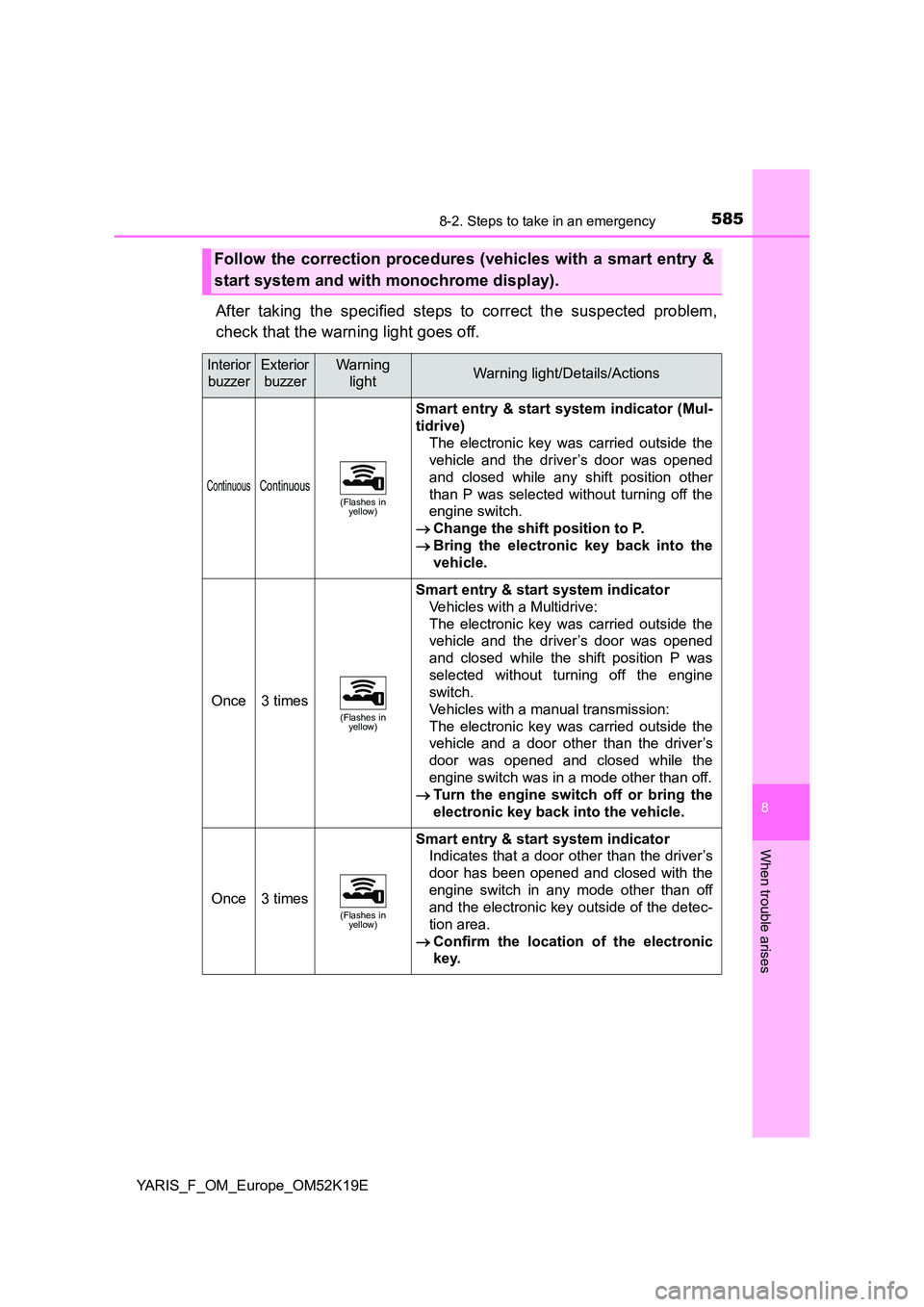
ContinuousContinuous(Flashes in yellow)
Smart entry & start system indicator (Mul-
tidrive)
The electronic key was carried outside the
vehicle and the driver’s door was opened
and closed while any shift position other
than P was selected without turning off the
engine switch.
Change the shift position to P.
Bring the electronic key back into the
vehicle.
Once3 times(Flashes in yellow)
Smart entry & start system indicator
Vehicles with a Multidrive:
The electronic key was carried outside the
vehicle and the driver’s door was opened
and closed while the shift position P was
selected without turning off the engine
switch.
Vehicles with a manual transmission:
The electronic key was carried outside the
vehicle and a door other than the driver’s
door was opened and closed while the
engine switch was in a mode other than off.
Turn the engine switch off or bring the
electronic key back into the vehicle.
Once3 times(Flashes in yellow)
Smart entry & start system indicator
Indicates that a door other than the driver’s
door has been opened and closed with the
engine switch in any mode other than off
and the electronic key outside of the detec-
tion area.
Confirm the location of the electronic
key.
Page 586 of 700
5868-2. Steps to take in an emergency
YARIS_F_OM_Europe_OM52K19E
OnceContinuous
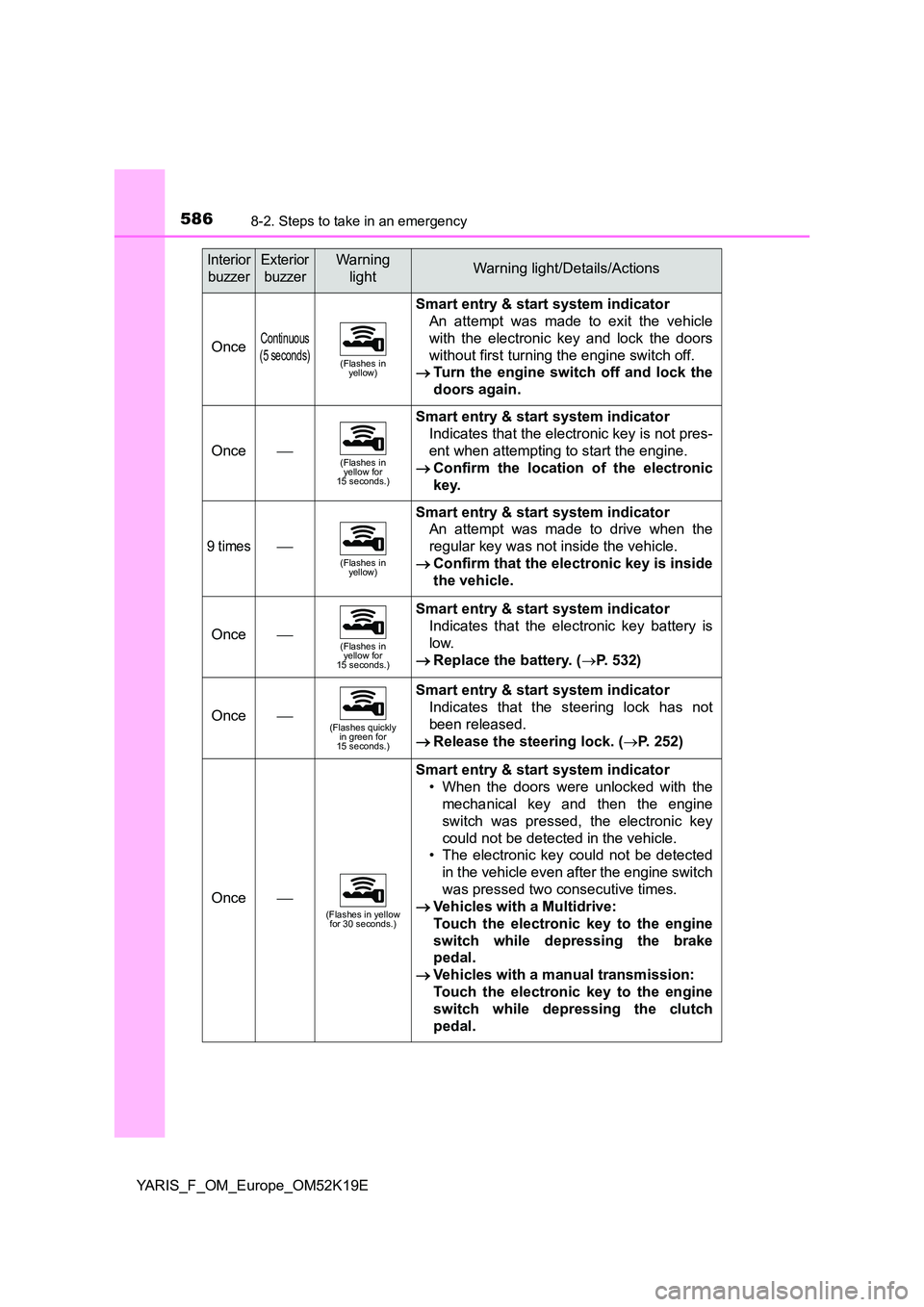
(5 seconds)(Flashes in yellow)
Smart entry & start system indicator
An attempt was made to exit the vehicle
with the electronic key and lock the doors
without first turning the engine switch off.
Turn the engine switch off and lock the
doors again.
Once(Flashes in yellow for 15 seconds.)
Smart entry & start system indicator
Indicates that the electronic key is not pres-
ent when attempting to start the engine.
Confirm the location of the electronic
key.
9 times(Flashes in yellow)
Smart entry & start system indicator
An attempt was made to drive when the
regular key was not inside the vehicle.
Confirm that the electronic key is inside
the vehicle.
Once(Flashes in yellow for 15 seconds.)
Smart entry & start system indicator
Indicates that the electronic key battery is
low.
Replace the battery. (P. 532)
Once(Flashes quickly in green for 15 seconds.)
Smart entry & start system indicator
Indicates that the steering lock has not
been released.
Release the steering lock. (P. 252)
Once(Flashes in yellow for 30 seconds.)
Smart entry & start system indicator
• When the doors were unlocked with the
mechanical key and then the engine
switch was pressed, the electronic key
could not be detected in the vehicle.
• The electronic key could not be detected
in the vehicle even after the engine switch
was pressed two consecutive times.
Vehicles with a Multidrive:
Touch the electronic key to the engine
switch while depressing the brake
pedal.
Vehicles with a manual transmission:
Touch the electronic key to the engine
switch while depressing the clutch
pedal.
Interior
buzzer
Exterior
buzzer
Warning
lightWarning light/Details/Actions
Page 593 of 700
5938-2. Steps to take in an emergency
8
When trouble arises
YARIS_F_OM_Europe_OM52K19E
●Stop the vehicle in a safe place on a hard, flat surface.
● Set the parking brake.
● Shift the shift lever to P (Multidrive) or N (manual transmission).
● Stop the engine.
● Turn on the emergency flashers. (P. 564)
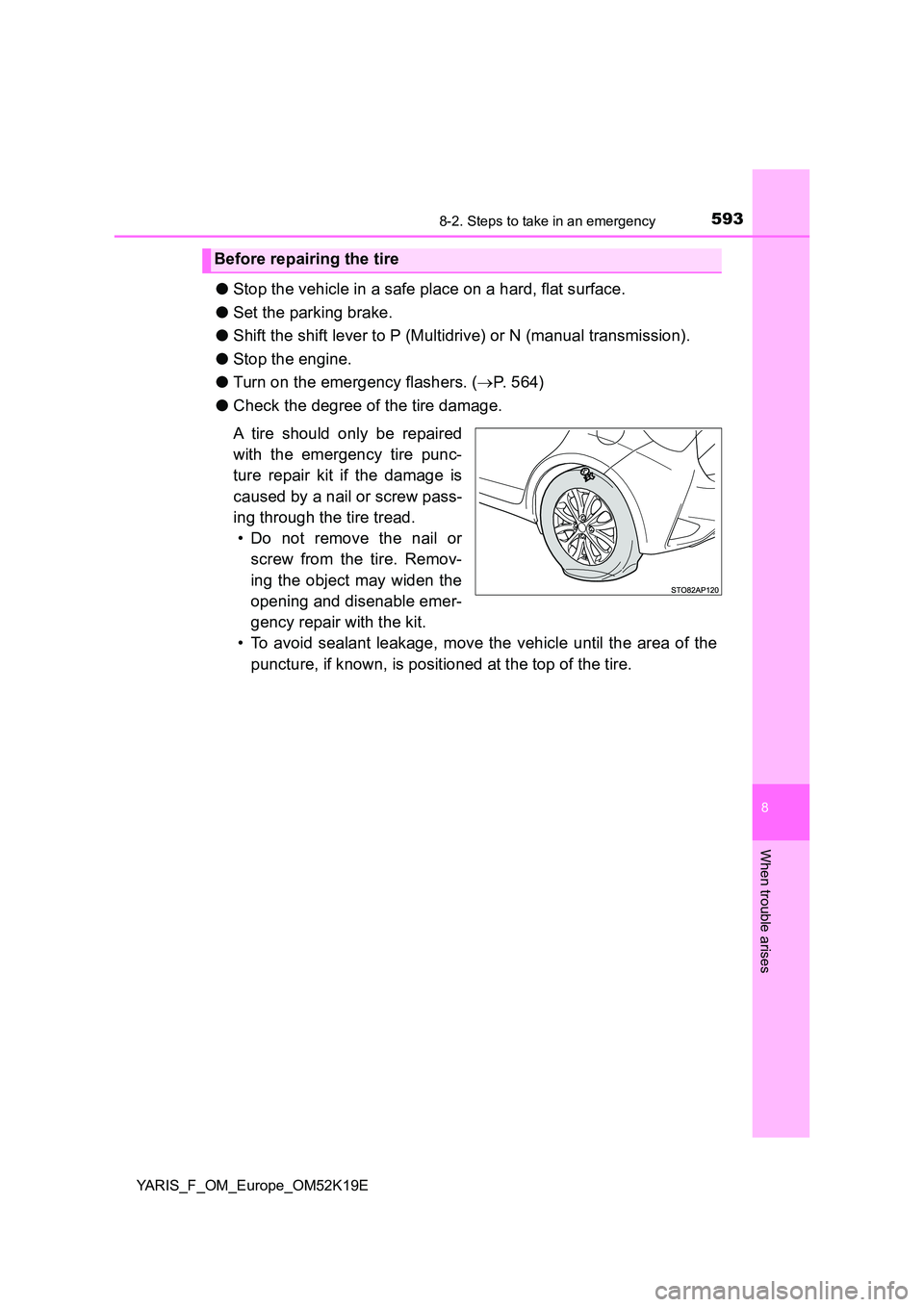
● Check the degree of the tire damage.
A tire should only be repaired
with the emergency tire punc-
ture repair kit if the damage is
caused by a nail or screw pass-
ing through the tire tread.
• Do not remove the nail or
screw from the tire. Remov-
ing the object may widen the
opening and disenable emer-
gency repair with the kit.
• To avoid sealant leakage, move the vehicle until the area of the
puncture, if known, is positioned at the top of the tire.
Before repairing the tire
Page 604 of 700
6048-2. Steps to take in an emergency
YARIS_F_OM_Europe_OM52K19E
Turn the compressor switch on to inflate the tire until the specified
air pressure is reached. Drive for about 5 km (3 miles) and then
perform .
Store the compressor in the luggage compartment.
Taking precautions to avoid sudden braking, sudden acceleration
and sharp turns, drive carefully at under 80 km/h (50 mph) to the
nearest authorized Toyota retailer or Toyota authorized repairer, or
any reliable repairer for tire repair or replacement.
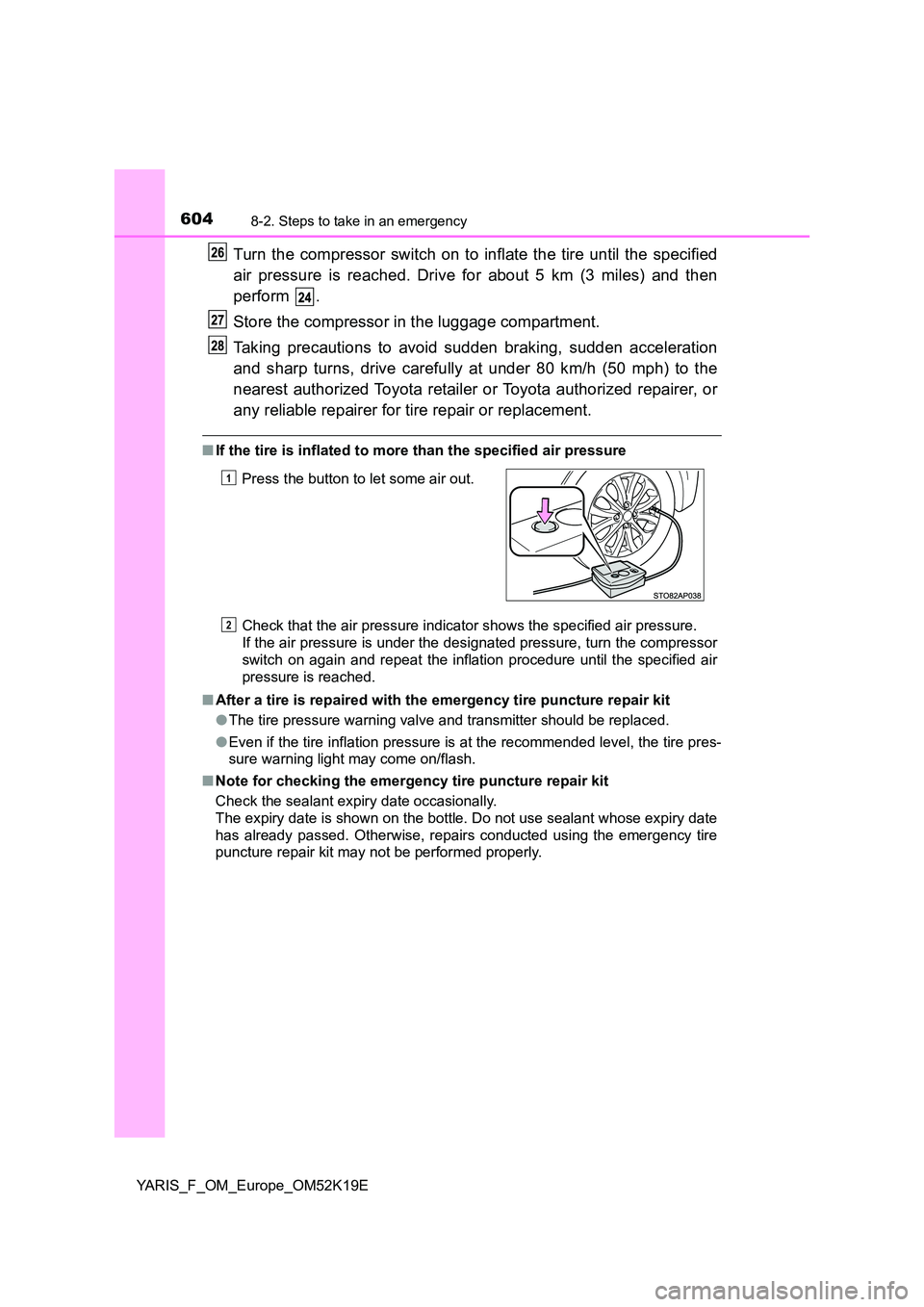
■ If the tire is inflated to more than the specified air pressure
Check that the air pressure indicator shows the specified air pressure.
If the air pressure is under the designated pressure, turn the compressor
switch on again and repeat the inflation procedure until the specified air
pressure is reached.
■ After a tire is repaired with the emergency tire puncture repair kit
● The tire pressure warning valve and transmitter should be replaced.
● Even if the tire inflation pressure is at the recommended level, the tire pres-
sure warning light may come on/flash.
■ Note for checking the emergency tire puncture repair kit
Check the sealant expiry date occasionally.
The expiry date is shown on the bottle. Do not use sealant whose expiry date
has already passed. Otherwise, repairs conducted using the emergency tire
puncture repair kit may not be performed properly.
Press the button to let some air out.1
2
Page 609 of 700
6098-2. Steps to take in an emergency
8
When trouble arises
YARIS_F_OM_Europe_OM52K19E
NOTICE
■When performing an emergency repair
● A tire should only be repaired with the emergency tire puncture repair kit if
the damage is caused by a sharp object such as nail or screw passing
through the tire tread.
Do not remove the sharp object from the tire. Removing the object may
widen the opening and disenable emergenc y repair with the repair kit.
● The repair kit is not waterproof. Make sure that the repair kit is not
exposed to water, such as when it is being used in the rain.
● Do not put the repair kit directly onto dusty ground such as sand at the
side of the road. If the repair kit vacuums up dust etc., a malfunction may
occur.
● Do not turn the bottle upside down when using it, as doing so may cause
damage to the compressor.
■ Precautions for the emergency tire puncture repair kit
● The repair kit power source should be 12 V DC suitable for vehicle use. Do
not connect the repair kit to any other source.
● If gasoline splatters on the repair kit, the repair kit may deteriorate. Take
care not to allow gasoline to contact it.
● Place the repair kit in a storage to prevent it from being exposed to dirt or
water.
● Store the repair kit in the luggage room out of reach of children.
● Do not disassemble or modify the repair kit. Do not subject parts such as
the air pressure indicator to impacts. This may cause a malfunction.
■ To avoid damage to the tire pressure warning valves and transmitters
(vehicles with a tire pressure warning system)
When a tire is repaired with liquid sealants, the tire pressure warning valve
and transmitter may not operate properly. If a liquid sealant is used, contact
any authorized Toyota retailer or Toyota authorized repairer, or any reliable
repairer or other qualified service shop as soon as possible. After use of liq-
uid sealant, make sure to replace the tire pressure warning valve and trans-
mitter when repairing or replacing the tire. ( P. 505)