TRAN TOYOTA YARIS 2019 Manual PDF
[x] Cancel search | Manufacturer: TOYOTA, Model Year: 2019, Model line: YARIS, Model: TOYOTA YARIS 2019Pages: 700, PDF Size: 65.2 MB
Page 610 of 700
6108-2. Steps to take in an emergency
YARIS_F_OM_Europe_OM52K19E
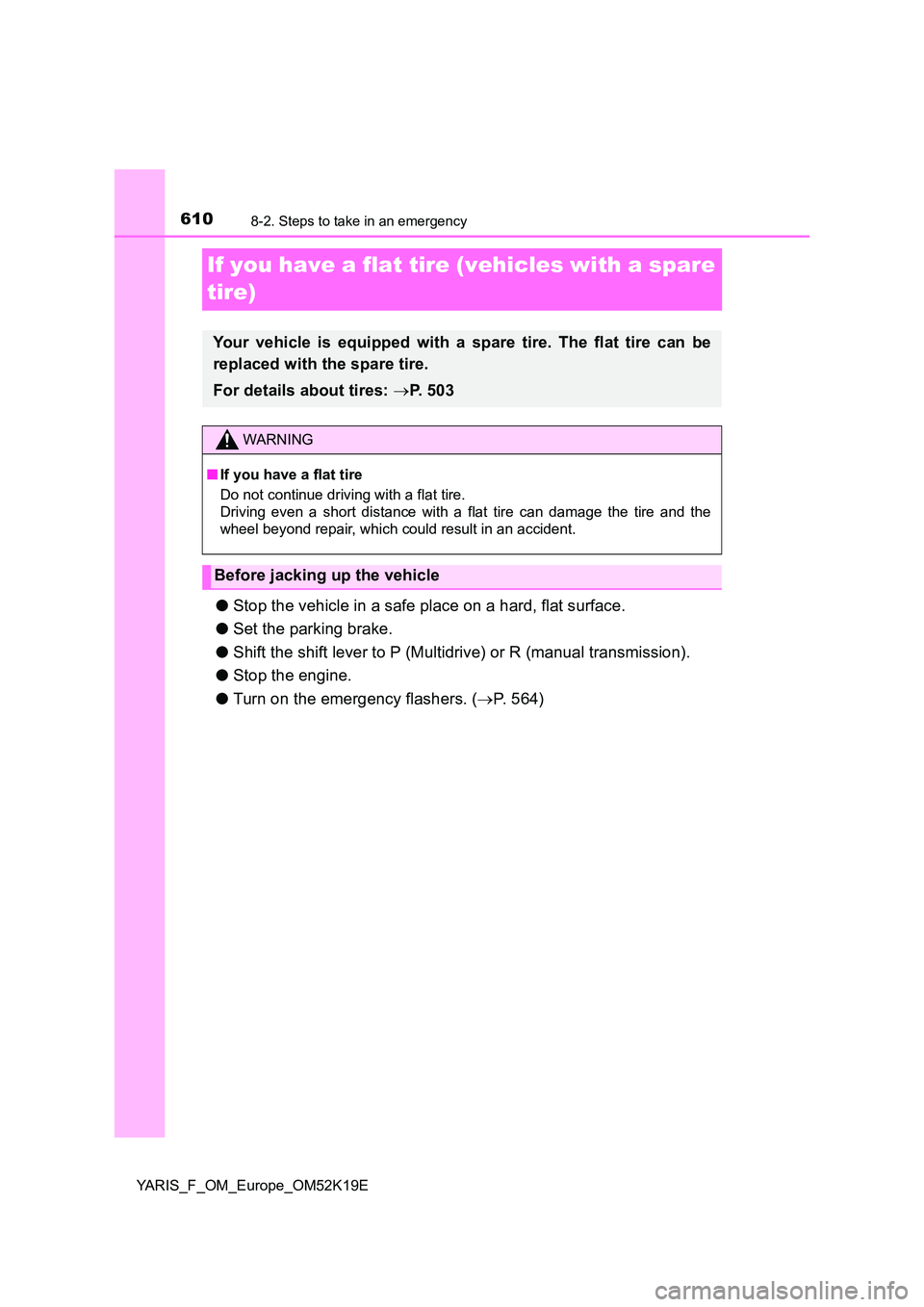
If you have a flat tire (vehicles with a spare
tire)
● Stop the vehicle in a safe place on a hard, flat surface.
● Set the parking brake.
● Shift the shift lever to P (Multidrive) or R (manual transmission).
● Stop the engine.
● Turn on the emergency flashers. (P. 564)
Your vehicle is equipped with a spare tire. The flat tire can be
replaced with the spare tire.
For details about tires: P. 5 0 3
WARNING
■If you have a flat tire
Do not continue driving with a flat tire.
Driving even a short distance with a flat tire can damage the tire and the
wheel beyond repair, which could result in an accident.
Before jacking up the vehicle
Page 621 of 700
6218-2. Steps to take in an emergency
8
When trouble arises
YARIS_F_OM_Europe_OM52K19E
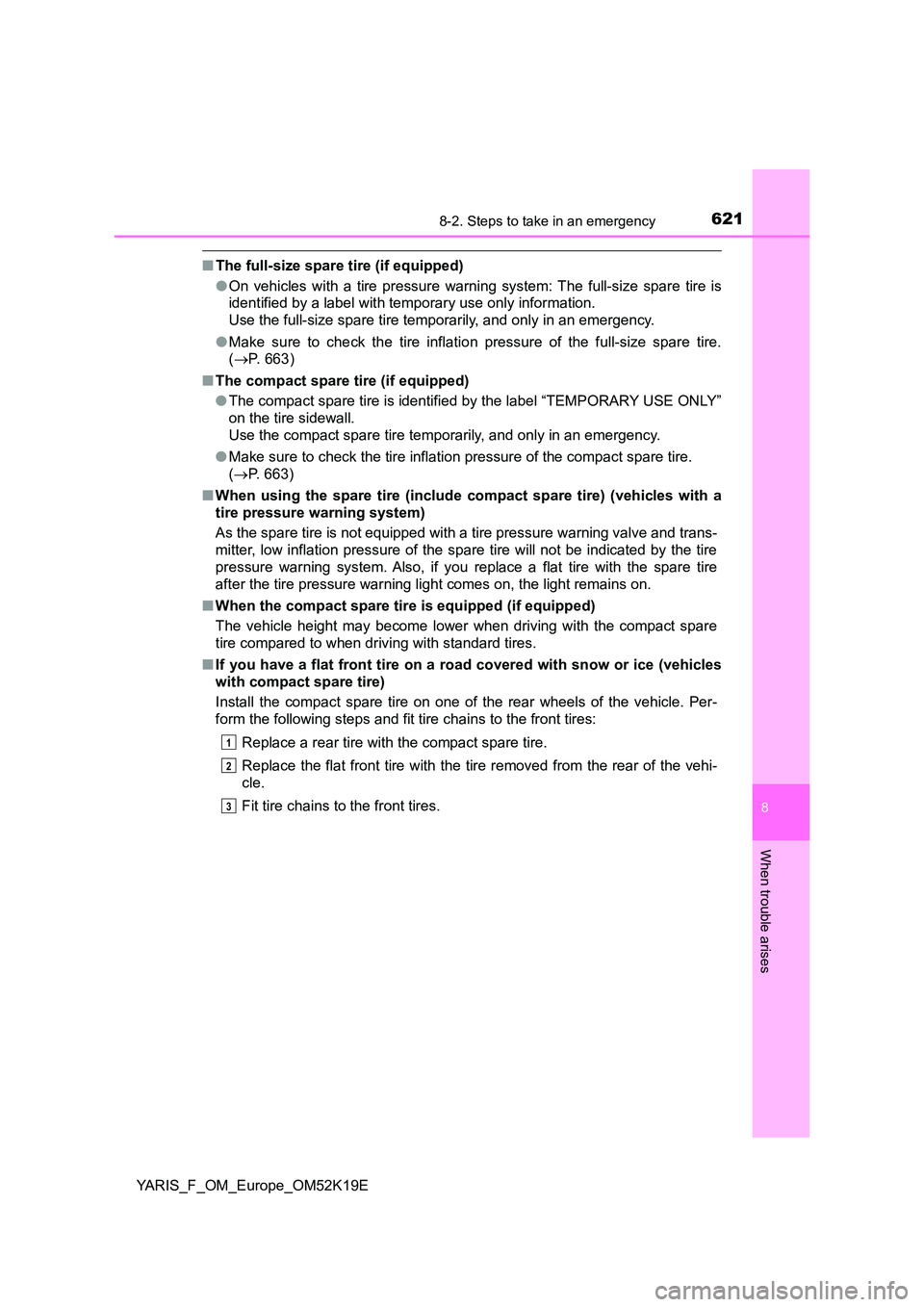
■The full-size spare tire (if equipped)
● On vehicles with a tire pressure warning system: The full-size spare tire is
identified by a label with temporary use only information.
Use the full-size spare tire temporarily, and only in an emergency.
● Make sure to check the tire inflation pressure of the full-size spare tire.
( P. 663)
■ The compact spare tire (if equipped)
● The compact spare tire is identified by the label “TEMPORARY USE ONLY”
on the tire sidewall.
Use the compact spare tire temporarily, and only in an emergency.
● Make sure to check the tire inflation pressure of the compact spare tire.
( P. 663)
■ When using the spare tire (include compact spare tire) (vehicles with a
tire pressure warning system)
As the spare tire is not equipped with a tire pressure warning valve and trans-
mitter, low inflation pressure of the spare tire will not be indicated by the tire
pressure warning system. Also, if you replace a flat tire with the spare tire
after the tire pressure warning light comes on, the light remains on.
■ When the compact spare tire is equipped (if equipped)
The vehicle height may become lower when driving with the compact spare
tire compared to when driving with standard tires.
■ If you have a flat front tire on a road covered with snow or ice (vehicles
with compact spare tire)
Install the compact spare tire on one of the rear wheels of the vehicle. Per-
form the following steps and fit tire chains to the front tires:
Replace a rear tire with the compact spare tire.
Replace the flat front tire with the tire removed from the rear of the vehi-
cle.
Fit tire chains to the front tires.
1
2
3
Page 624 of 700
6248-2. Steps to take in an emergency
YARIS_F_OM_Europe_OM52K19E
NOTICE
■Do not drive the vehicle with a flat tire
Do not continue driving with a flat tire.
Driving even a short distance with a flat tire can damage the tire and the
wheel beyond repair.
■ Be careful when driving over bumps with the compact spare tire
installed on the vehicle (if equipped)
The vehicle becomes lower when driving with the compact spare tire com-
pared to when driving with standard tires. Be careful when driving over
uneven road surfaces.
■ Driving with tire chains and the compact spare tire (if equipped)
Do not fit tire chains to the compact spare tire.
Tire chains may damage the vehicle body and adversely affect driving per-
formance.
■ When replacing the tires (vehicles with a tire pressure warning system)
When removing or fitting the wheels, tire s or the tire pressure warning valve
and transmitter, contact any authorized Toyota retailer or Toyota authorized
repairer, or any reliable repairer as the tire pressure warning valve and
transmitter may be damaged if not handled correctly.
■ To avoid damage to the tire pressure warning valves and transmitters
(if equipped)
When a tire is repaired with liquid sealants, the tire pressure warning valve
and transmitter may not operate properly. If a liquid sealant is used, contact
any authorized Toyota retailer or Toyota authorized repairer, or any reliable
repairer or other qualified service shop as soon as possible. Make sure to
replace the tire pressure warning va lve and transmitter when replacing the
tire. ( P. 505)
Page 626 of 700
6268-2. Steps to take in an emergency
YARIS_F_OM_Europe_OM52K19E
One of the following may be the cause of the problem:
● One or both of the battery terminals may be disconnected.
● The battery may be discharged. (P. 630)
● There may be a malfunction in the steering lock system (vehicles
with a smart entry & start system).
Contact any authorized Toyota retailer or Toyota authorized repairer, or any
reliable repairer if the problem cannot be repaired, or if repair procedures
are unknown.
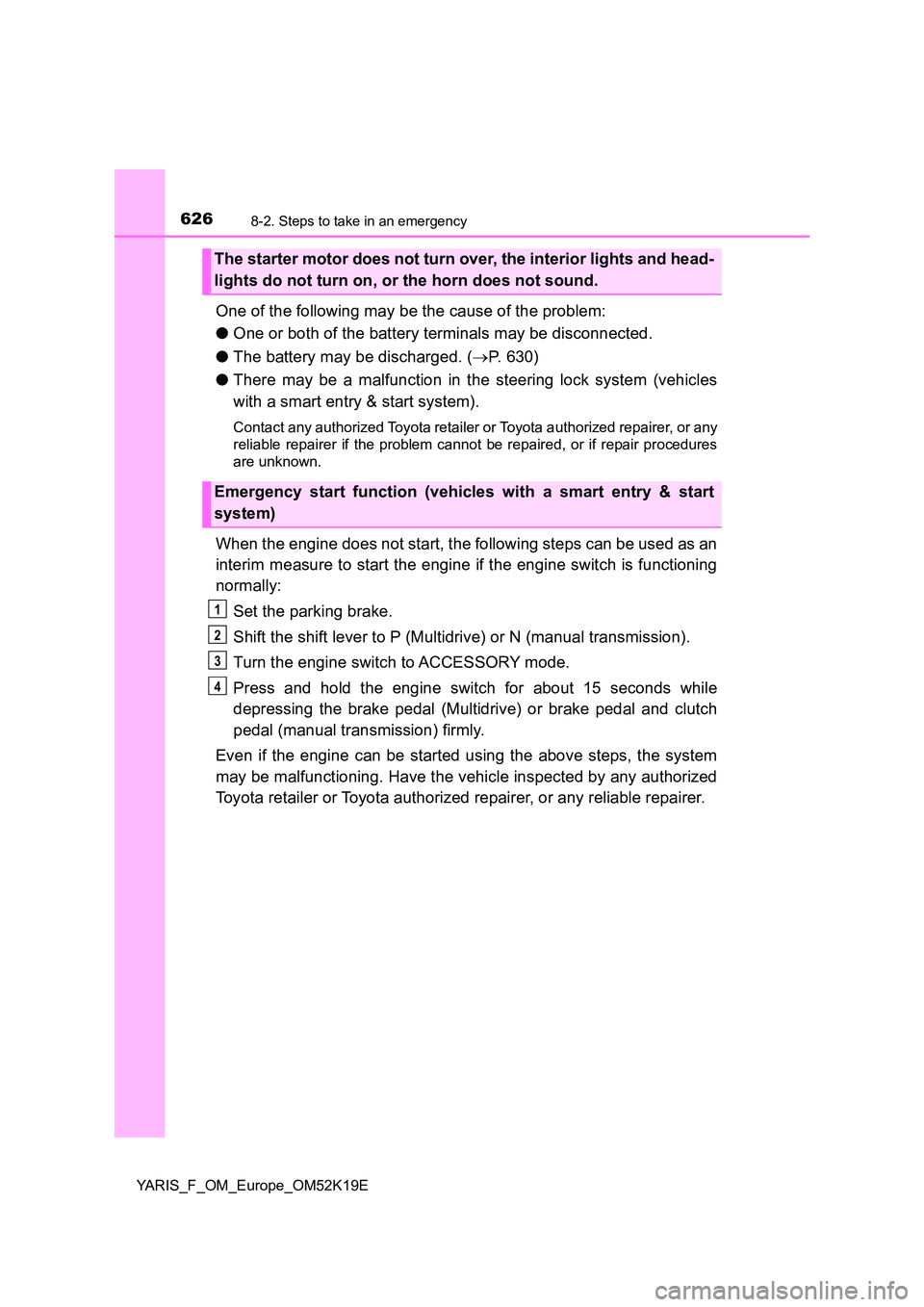
When the engine does not start, the following steps can be used as an
interim measure to start the engine if the engine switch is functioning
normally:
Set the parking brake.
Shift the shift lever to P (Multidrive) or N (manual transmission).
Turn the engine switch to ACCESSORY mode.
Press and hold the engine switch for about 15 seconds while
depressing the brake pedal (Multidrive) or brake pedal and clutch
pedal (manual transmission) firmly.
Even if the engine can be started using the above steps, the system
may be malfunctioning. Have the vehicle inspected by any authorized
Toyota retailer or Toyota authorized repairer, or any reliable repairer.
The starter motor does not turn over, the interior lights and head-
lights do not turn on, or the horn does not sound.
Emergency start function (vehicles with a smart entry & start
system)
1
2
3
4
Page 627 of 700
6278-2. Steps to take in an emergency
8
When trouble arises
YARIS_F_OM_Europe_OM52K19E
If the electronic key does not operate properly
(vehicles with a smart entry & start system)
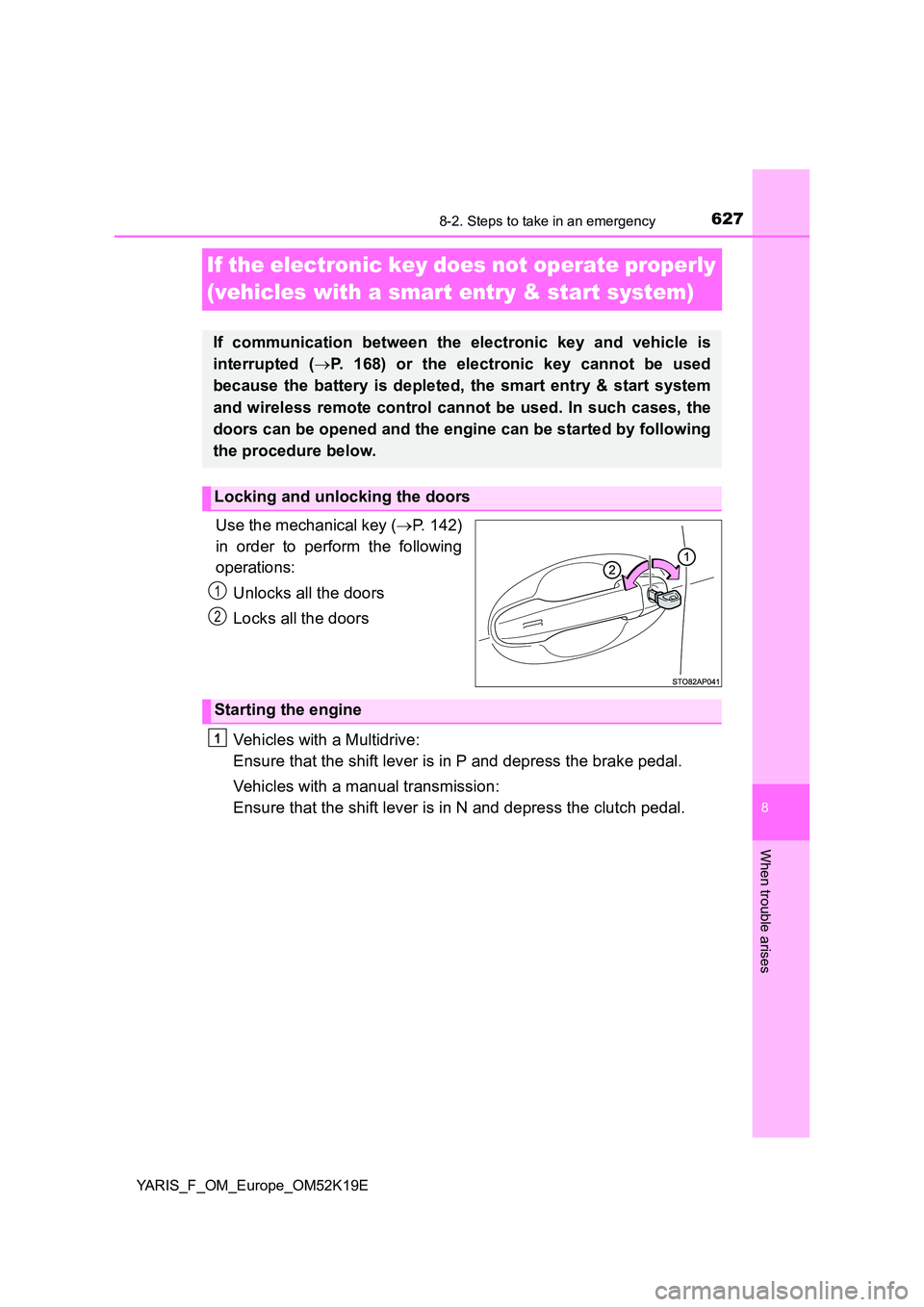
Use the mechanical key ( P. 142)
in order to perform the following
operations:
Unlocks all the doors
Locks all the doors
Vehicles with a Multidrive:
Ensure that the shift lever is in P and depress the brake pedal.
Vehicles with a manual transmission:
Ensure that the shift lever is in N and depress the clutch pedal.
If communication between the electronic key and vehicle is
interrupted ( P. 168) or the electronic key cannot be used
because the battery is depleted, the smart entry & start system
and wireless remote control cannot be used. In such cases, the
doors can be opened and the engine can be started by following
the procedure below.
Locking and unlocking the doors
1
2
Starting the engine
1
Page 628 of 700
6288-2. Steps to take in an emergency
YARIS_F_OM_Europe_OM52K19E
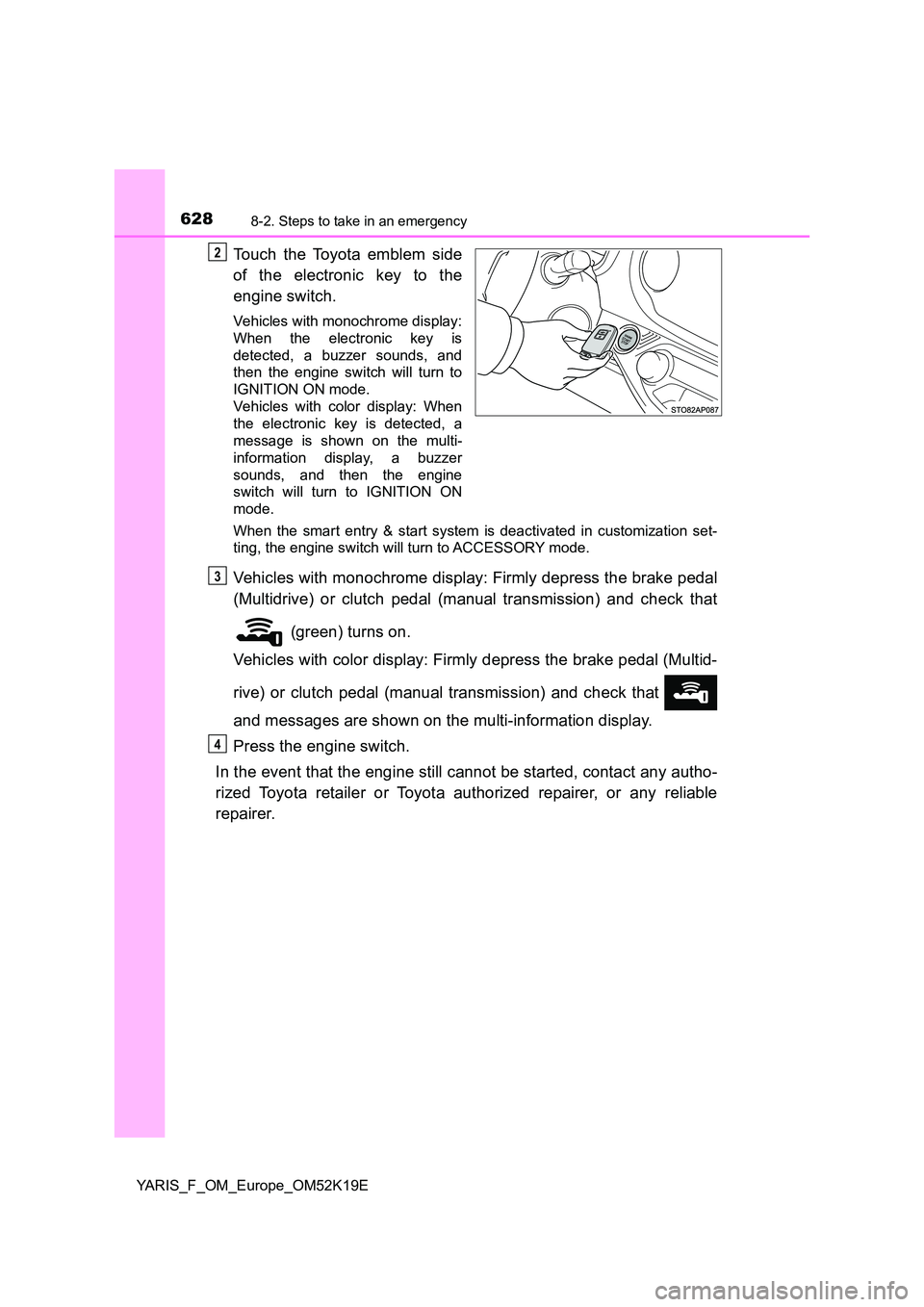
Touch the Toyota emblem side
of the electronic key to the
engine switch.
Vehicles with monochrome display:
When the electronic key is
detected, a buzzer sounds, and
then the engine switch will turn to
IGNITION ON mode.
Vehicles with color display: When
the electronic key is detected, a
message is shown on the multi-
information display, a buzzer
sounds, and then the engine
switch will turn to IGNITION ON
mode.
When the smart entry & start system is deactivated in customization set-
ting, the engine switch will turn to ACCESSORY mode.
Vehicles with monochrome display: Firmly depress the brake pedal
(Multidrive) or clutch pedal (manual transmission) and check that
(green) turns on.
Vehicles with color display: Firmly depress the brake pedal (Multid-
rive) or clutch pedal (manual transmission) and check that
and messages are shown on the multi-information display.
Press the engine switch.
In the event that the engine still cannot be started, contact any autho-
rized Toyota retailer or Toyota authorized repairer, or any reliable
repairer.
2
3
4
Page 629 of 700
6298-2. Steps to take in an emergency
8
When trouble arises
YARIS_F_OM_Europe_OM52K19E
■Stopping the engine
Shift the shift lever to P (Multidrive) or N (manual transmission) and press the
engine switch as you normally do when stopping the engine.
■ Replacing the key battery
As the above procedure is a temporary measure, it is recommended that the
electronic key battery be replaced immediately when the battery is depleted.
( P. 532)
■ Changing engine switch modes
Release the brake pedal (Multidrive) or clutch pedal (manual transmission)
and press the engine switch in step above.
The engine does not start and modes will be changed each time the switch is
pressed. ( P. 248)
■ When the electronic key does not work properly
● Make sure that the smart entry & start system has not been deactivated in
the customization setting. If it is off, turn the function on.
(Customizable features: P. 671)
● Check if battery-saving mode is set. If it is set, cancel the function.
( P. 168)
3
Page 643 of 700
6438-2. Steps to take in an emergency
8
When trouble arises
YARIS_F_OM_Europe_OM52K19E
If the vehicle becomes stuck
Stop the engine. Set the parking brake and shift the shift lever to P
(Multidrive) or N (manual transmission).
Remove the mud, snow or sand from around the front wheels.
Place wood, stones or some other material under the front wheels
to help provide traction.
Restart the engine.
Shift the shift lever to D or R (Multidrive) or 1 or R (manual trans-
mission) and release the parking brake. Then, while exercising cau-
tion, depress the accelerator pedal.
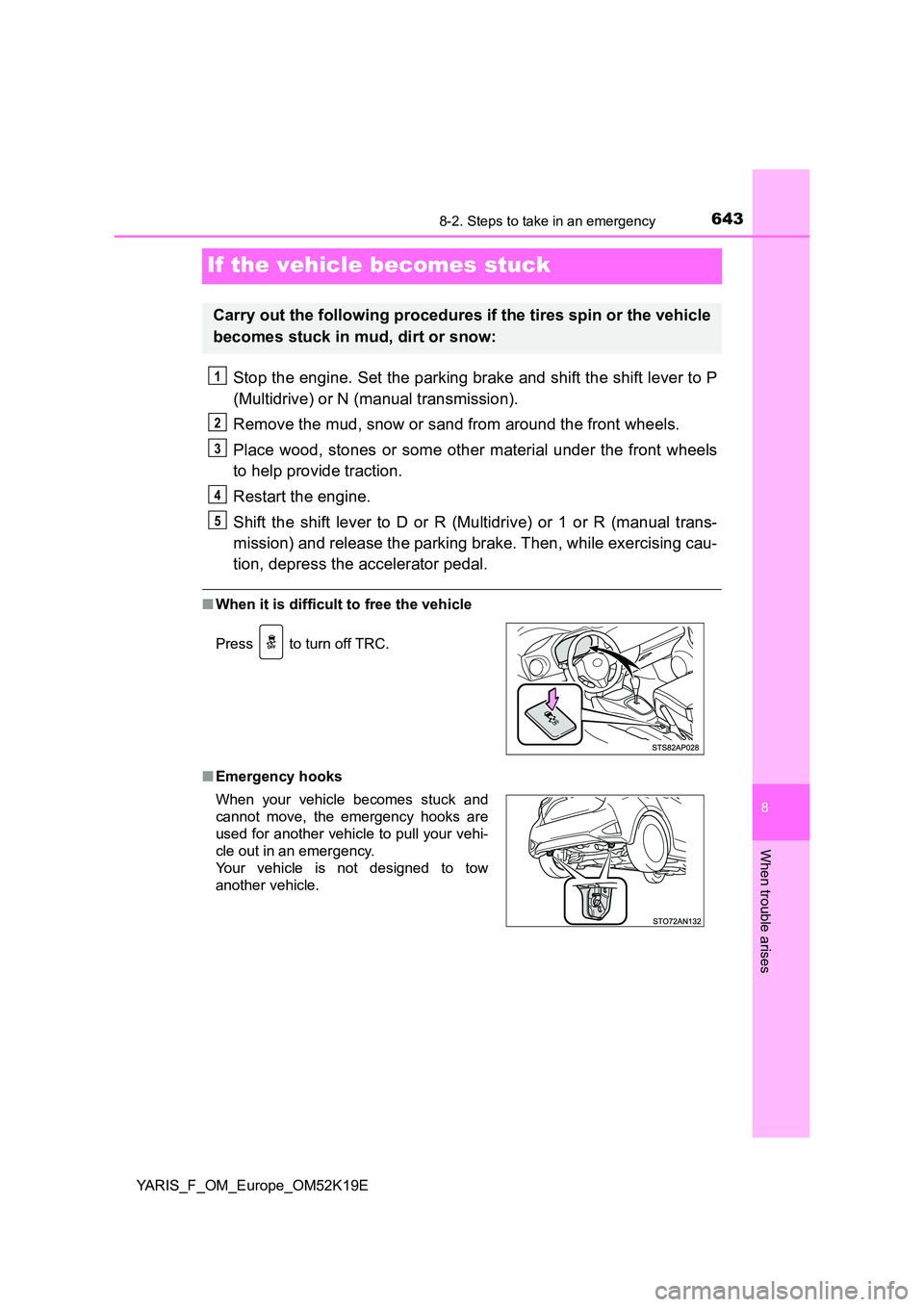
■ When it is difficult to free the vehicle
■ Emergency hooks
Carry out the following procedures if the tires spin or the vehicle
becomes stuck in mud, dirt or snow:
Press to turn off TRC.
When your vehicle becomes stuck and
cannot move, the emergency hooks are
used for another vehicle to pull your vehi-
cle out in an emergency.
Your vehicle is not designed to tow
another vehicle.
1
2
3
4
5
Page 644 of 700
6448-2. Steps to take in an emergency
YARIS_F_OM_Europe_OM52K19E
WARNING
■When attempting to free a stuck vehicle
If you choose to push the vehicle back and forth to free it, make sure the
surrounding area is clear to avoid striking other vehicles, objects or people.
The vehicle may also lunge forward or lunge back suddenly as it becomes
free. Use extreme caution.
■ When shifting the shift lever
Be careful not to shift the shift lever with the accelerator pedal depressed.
This may lead to unexpected rapid acceleration of the vehicle that may
cause an accident resulting in death or serious injury.
NOTICE
■ To avoid damage to the transmission and other components
● Avoid spinning the front wheels and depressing the accelerator pedal
more than necessary.
● If the vehicle remains stuck even after these procedures are performed,
the vehicle may require towing to be freed.
Page 647 of 700
6479-1. Specifications
9
Vehicle specifications
YARIS_F_OM_Europe_OM52K19E
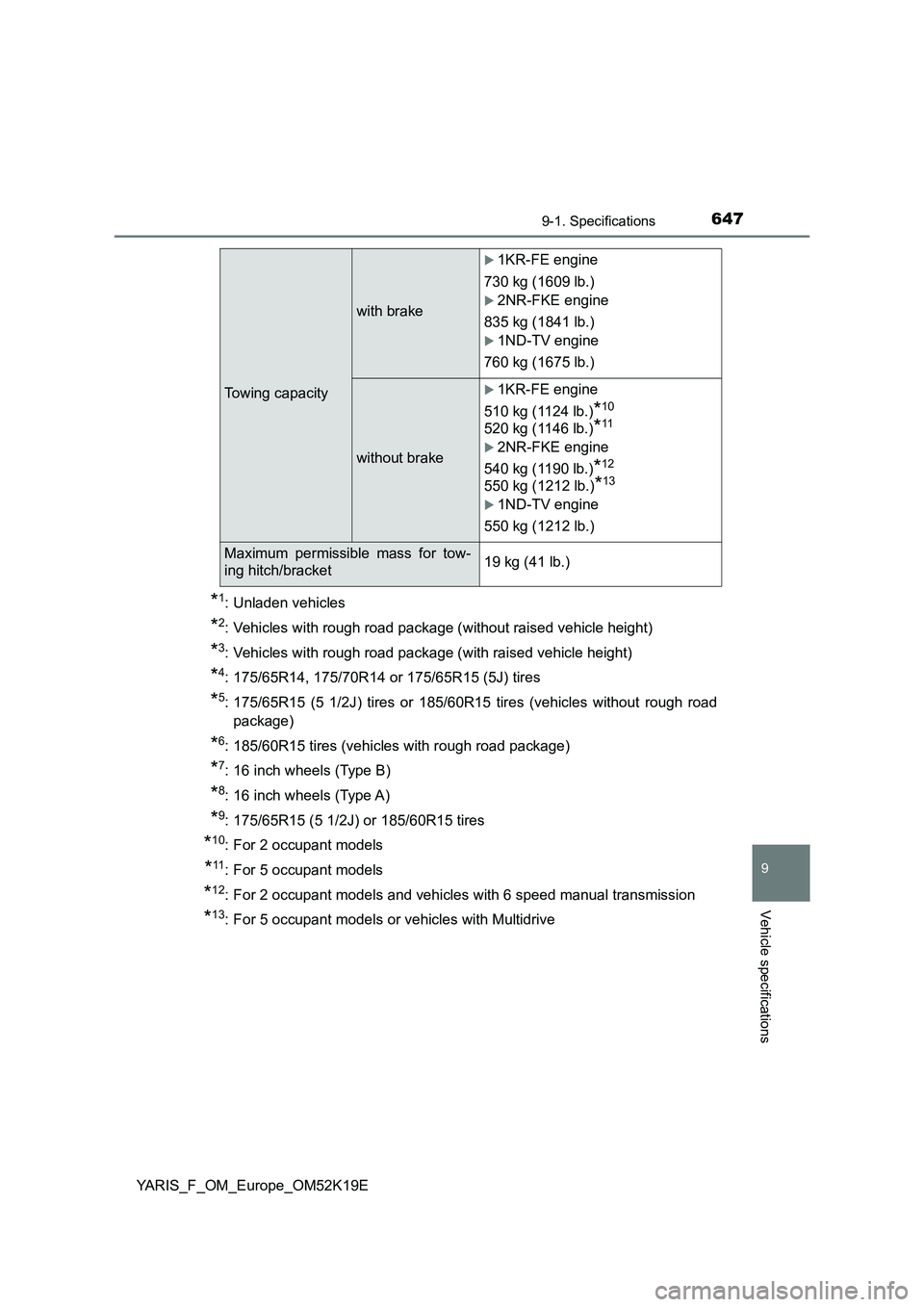
*1: Unladen vehicles
*2: Vehicles with rough road package (without raised vehicle height)
*3: Vehicles with rough road package (with raised vehicle height)
*4: 175/65R14, 175/70R14 or 175/65R15 (5J) tires
*5: 175/65R15 (5 1/2J) tires or 185/60R15 tires (vehicles without rough road
package)
*6: 185/60R15 tires (vehicles with rough road package)
*7: 16 inch wheels (Type B)
*8: 16 inch wheels (Type A)
*9: 175/65R15 (5 1/2J) or 185/60R15 tires
*10: For 2 occupant models
*11: For 5 occupant models
*12: For 2 occupant models and vehicles with 6 speed manual transmission
*13: For 5 occupant models or vehicles with Multidrive
Towing capacity
with brake
1KR-FE engine
730 kg (1609 lb.)
2NR-FKE engine
835 kg (1841 lb.)
1ND-TV engine
760 kg (1675 lb.)
without brake
1KR-FE engine
510 kg (1124 lb.)*10
520 kg (1146 lb.)*11
2NR-FKE engine
540 kg (1190 lb.)*12
550 kg (1212 lb.)*13
1ND-TV engine
550 kg (1212 lb.)
Maximum permissible mass for tow-
ing hitch/bracket 19 kg (41 lb.)