power TOYOTA YARIS 2021 Owner's Manual
[x] Cancel search | Manufacturer: TOYOTA, Model Year: 2021, Model line: YARIS, Model: TOYOTA YARIS 2021Pages: 568, PDF Size: 110.34 MB
Page 150 of 568
150
YARIS(HB) Owner's Manual_Europe_MK0001_en
4-1. Before driving
NOTICE
• Do not use the clutch pedal to adjust vehicle speed. When stop-
ping the vehicle with the shift lever in a position other then N, make sure to fully depress the clutch
pedal and stop the vehicle using the brake.Doing so may damage the clutch.
• When stopping the vehicle with the shift lever in a position other than N,
make sure to fully depress the clutch pedal and stop the vehicle using the brakes.
●Do not shift the shift lever to R with-out the vehicle completely stopped.
Doing so may damage the clutch, transmission and gears.
■When parking the vehicle (vehi-cles with a Multidrive)
Always set the parking brake and shift
the shift lever to P. Failure to do so may cause the vehicle to move or the vehicle may accelerate suddenly if
the accelerator pedal is accidentally depressed.
■Avoiding damage to vehicle parts
●Do not turn the steering wheel fully in either direction and hold it there
for an extended period of time. Doing so may damage the power steering motor.
●When driving over bumps in the road, drive as slowly as possible to
avoid damaging the wheels, under- side of the vehicle, etc.
■If you get a flat tire while driving
A flat or damaged tire may cause the following situations. Hold the steering
wheel firmly and gradually depress the brake pedal to slow down the vehicle.
●It may be difficult to control your vehicle.
●The vehicle will make abnormal sounds or vibrations.
●The vehicle will lean abnormally.
Information on what to do in case of a
flat tire ( →P.379, 389)
■When encountering flooded
roads
Do not drive on a road that has flooded after heavy rain, etc. Doing so
may cause the following serious dam- age to the vehicle:
●Engine stalling
●Short in electrical components
●Engine damage caused by water immersion
In the event that you drive on a flooded road and the vehicle becomes flooded or stuck in mud or
sand, be sure to have any authorized Toyota retailer or Toyota authorized repairer, or any reliable repairer check
the following:
●Brake function
●Changes in the quantity and quality of the engine oil, transmission fluid,
clutch fluid, differential oil, etc.
●Lubricant condition for the bearings
and suspension joints (where possi- ble), and the function of all joints, bearings, etc.
Page 155 of 568
155
4
YARIS(HB) Owner's Manual_Europe_MK0001_en
4-1. Before driving
Driving
■Break-in schedule
Toyota recommends that vehicles fitted with new power train components should not be used for towing trailers for
the first 800 km (500 miles).
■Safety checks before towing
●Check that the maximum load limit for
the towing hitch/bracket hitch ball is not exceeded. Bear in mind that the coupling weight of the trailer will add
to the load exerted on the vehicle. Also make sure that you will not be towing a load that exceeds the maxi-
mum permissible axle capacity.
●Ensure that the trailer load is secure.
●Supplementary outside rear view mir- rors should be added to the vehicle if
the traffic behind cannot be clearly seen with standard mirrors. Adjust the extending arms of these mirrors on
both sides of the vehicle so that they always provide maximum visibility of the road behind.
■Maintenance
●Maintenance must be performed more frequently when using the vehicle for
towing due to the greater weight bur- den placed on the vehicle compared to normal driving.
●Retighten all bolts securing the hitch-ing ball and bracket after towing for
approximately 1000 km (600 miles).
■If trailer sway occurs
One or more factors (crosswinds, pass- ing vehicles, rough roads, etc.) can
adversely affect handling of your vehicle and trailer, causing instability.
●If trailer swaying occurs:• Firmly grip the steering wheel. Steer straight ahead.
Do not try to control trailer swaying by turning the steering wheel.• Begin releasing the accelerator pedal
immediately but very gradually to reduce speed.
Do not increase speed. Do not apply
vehicle brakes.
If you make no extreme correction with
the steering or brakes, your vehicle and
trailer should stabilize (if enabled, Trailer
Sway Control can also help to stabilize
the vehicle and trailer.).
●After the trailer swaying has stopped: • Stop in a safe place. Get all occupants out of the vehicle.
• Check the tires of the vehicle and the trailer.• Check the load in the trailer.
Make sure the load has not shifted. Make sure the tongue weight is appro-priate, if possible.
• Check the load in the vehicle. Make sure the vehicle is not over-loaded after occupants get in.
If you cannot find any problems, the
speed at which trailer swaying occurred
is beyond the limit of your particular
vehicle-trailer combination. Drive at a
lower speed to prevent instability.
Remember that swaying of the towing
vehicle-trailer increases as speed
increases.
Your vehicle will handle differently
when towing a trailer. In order to
avoid accident, death or serious
injury, keep the following in mind
NOTICE
■When the rear bumper strength- ening material is aluminum
Ensure the steel bracket part does not
come directly in contact with that area.When steel and aluminum come into
contact, there is a reaction similar to corrosion, which will weaken the sec-tion concerned and may result in
damage. Apply a rust inhibitor to parts that will come in contact when attach-ing a steel bracket.
Guidance
Page 162 of 568
162
YARIS(HB) Owner's Manual_Europe_MK0001_en
4-2. Driving procedures
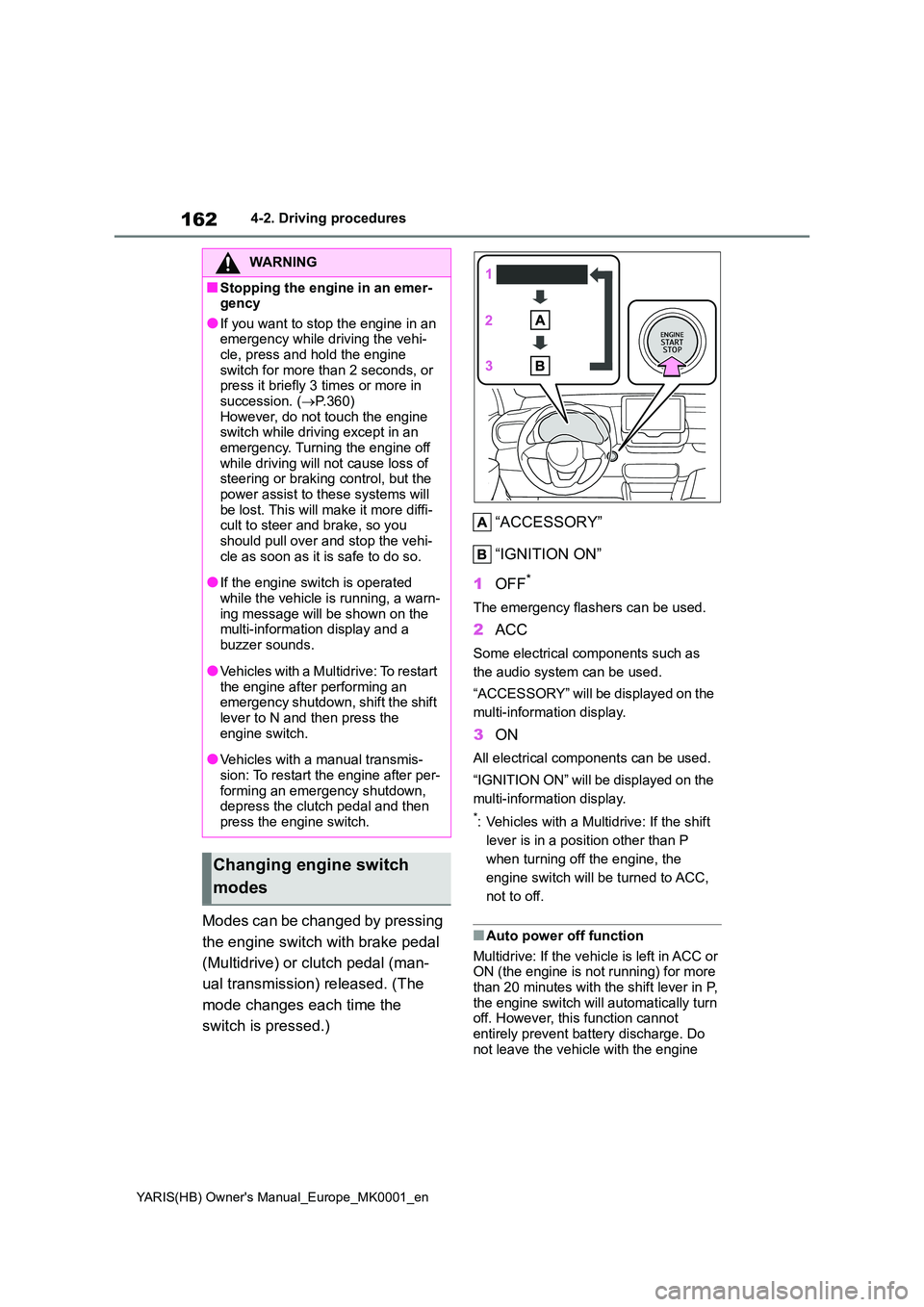
Modes can be changed by pressing
the engine switch with brake pedal
(Multidrive) or clutch pedal (man-
ual transmission) released. (The
mode changes each time the
switch is pressed.)
“ACCESSORY”
“IGNITION ON”
1 OFF*
The emergency flashers can be used.
2ACC
Some electrical components such as
the audio system can be used.
“ACCESSORY” will be displayed on the
multi-information display.
3 ON
All electrical components can be used.
“IGNITION ON” will be displayed on the
multi-information display.
*: Vehicles with a Multidrive: If the shift
lever is in a position other than P
when turning off the engine, the
engine switch will be turned to ACC,
not to off.
■Auto power off function
Multidrive: If the vehicle is left in ACC or ON (the engine is not running) for more than 20 minutes with the shift lever in P,
the engine switch will automatically turn off. However, this function cannot entirely prevent battery discharge. Do
not leave the vehicle with the engine
WARNING
■Stopping the engine in an emer- gency
●If you want to stop the engine in an emergency while driving the vehi-cle, press and hold the engine
switch for more than 2 seconds, or press it briefly 3 times or more in succession. ( →P.360)
However, do not touch the engine switch while driving except in an emergency. Turning the engine off
while driving will not cause loss of steering or braking control, but the power assist to these systems will
be lost. This will make it more diffi- cult to steer and brake, so you should pull over and stop the vehi-
cle as soon as it is safe to do so.
●If the engine switch is operated
while the vehicle is running, a warn- ing message will be shown on the multi-information display and a
buzzer sounds.
●Vehicles with a Multidrive: To restart
the engine after performing an emergency shutdown, shift the shift lever to N and then press the
engine switch.
●Vehicles with a manual transmis-
sion: To restart the engine after per- forming an emergency shutdown, depress the clutch pedal and then
press the engine switch.
Changing engine switch
modes
Page 164 of 568
164
YARIS(HB) Owner's Manual_Europe_MK0001_en
4-2. Driving procedures
*: If equipped
*: To improve fuel efficiency and reduce
noise, shift the shift lever to D for nor-
mal driving.
■To protect the Multidrive
If the Multidrive fluid temperature is
high, “Transmission Oil Temp. High Stop
in a safe place and See owner’s man-
ual” will be displayed on the multi-infor-
mation display and the vehicle will go
into transmission protection mode auto-
matically. Have the vehicle inspected by
any authorized Toyota retailer or Toyota
authorized repairer, or any reliable
repairer.
■Multidrive fail-safe control
The system detects malfunctioning parts
targeted (all of the solenoids that per-form the shifting function) by the On-
Board Diagnostics, and performs fail-
safe mechanisms, such as restricting
the shifting function or transmission ratio
control. In this event, the malfunction
indicator lamp turns on.
■When driving with dynamic radar
cruise control activated (if
equipped)
Even when switching the driving mode
to power mode with the intent of
enabling engine braking, engine braking
will not occur because dynamic radar
cruise control will not be canceled.
(→P.266)
■Restraining sudden start (Drive-
Start Control)
→P. 1 4 5
■AI-SHIFT
AI-SHIFT automatically selects the suit-
able gear step according to driver per-
formance and driving conditions. AI-
SHIFT automatically operates when the
driving mode is set to Normal mode with
the shift lever in D. (Shifting the shift
lever to M cancels the function.)
■G AI-SHIFT
G AI-SHIFT automatically selects a suit-
able gear for sporty driving according to
driver’s input and driving conditions. G
AI-SHIFT operates automatically when
the shift lever is in D and power mode is
selected for the driving mode. (Selecting
other than power mode or shifting the
shift lever to the other position cancels
this function)
■After recharging/reconnecting the
battery
→P. 4 0 3
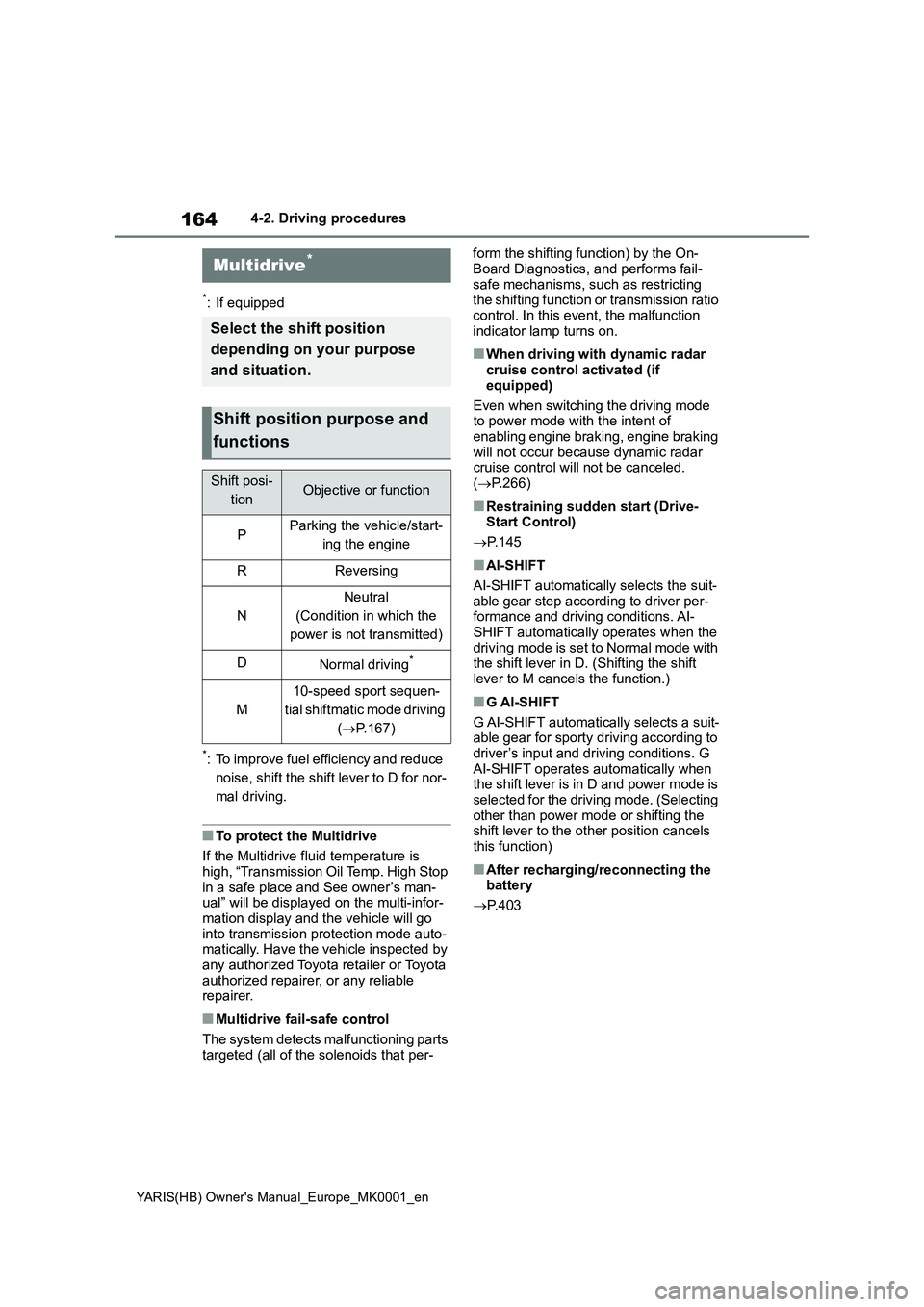
Multidrive*
Select the shift position
depending on your purpose
and situation.
Shift position purpose and
functions
Shift posi-
tionObjective or function
PParking the vehicle/start-
ing the engine
RReversing
N
Neutral
(Condition in which the
power is not transmitted)
DNormal driving*
M
10-speed sport sequen-
tial shiftmatic mode driving
(→P.167)
Page 200 of 568
200
YARIS(HB) Owner's Manual_Europe_MK0001_en
4-5. Using the driving support systems
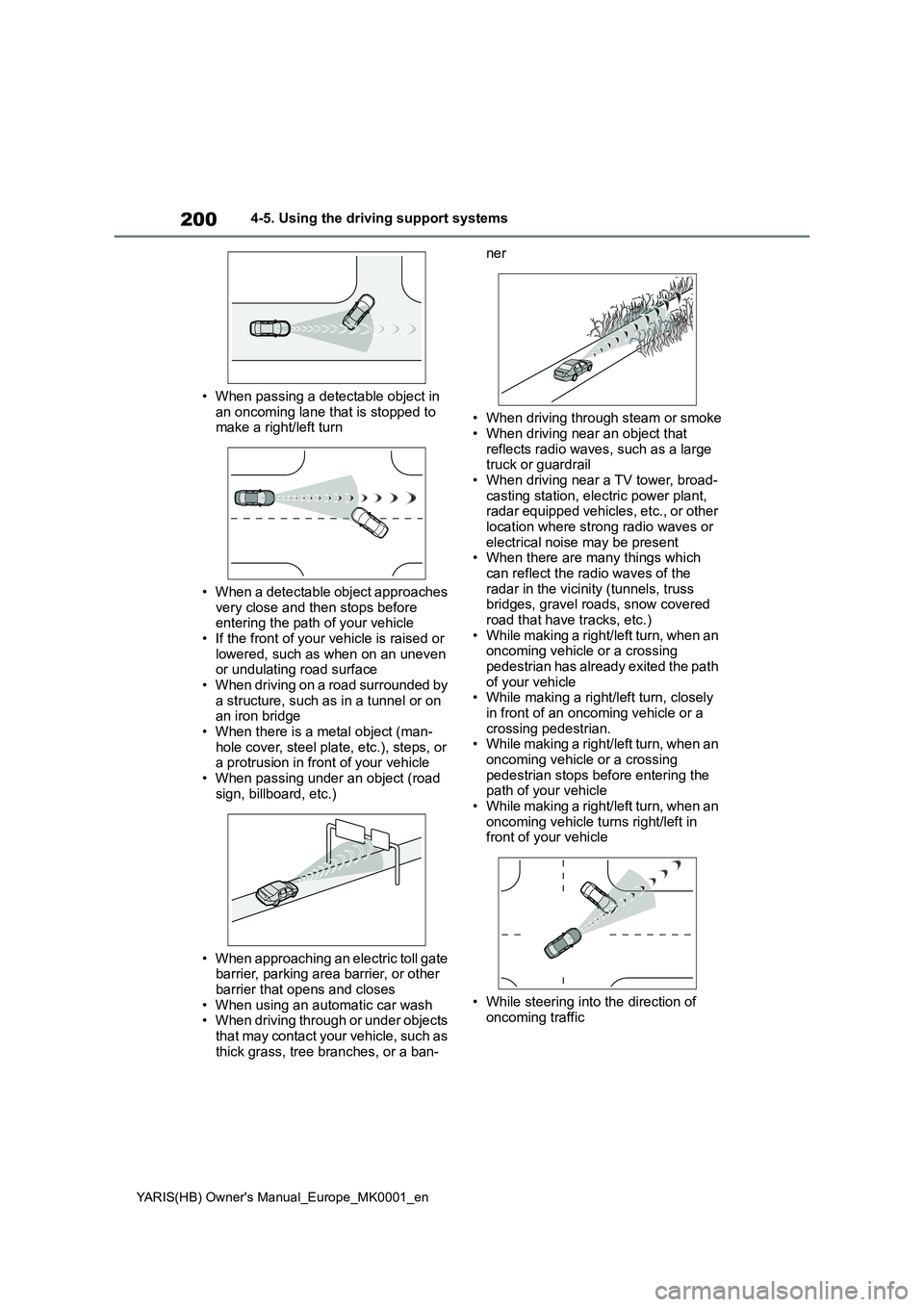
• When passing a detectable object in
an oncoming lane that is stopped to make a right/left turn
• When a detectable object approaches very close and then stops before entering the path of your vehicle
• If the front of your vehicle is raised or lowered, such as when on an uneven or undulating road surface
• When driving on a road surrounded by a structure, such as in a tunnel or on an iron bridge
• When there is a metal object (man- hole cover, steel plate, etc.), steps, or a protrusion in front of your vehicle
• When passing under an object (road sign, billboard, etc.)
• When approaching an electric toll gate barrier, parking area barrier, or other barrier that opens and closes
• When using an automatic car wash • When driving through or under objects that may contact your vehicle, such as
thick grass, tree branches, or a ban-
ner
• When driving through steam or smoke • When driving near an object that
reflects radio waves, such as a large truck or guardrail• When driving near a TV tower, broad-
casting station, electric power plant, radar equipped vehicles, etc., or other location where strong radio waves or
electrical noise may be present • When there are many things which can reflect the radio waves of the
radar in the vicinity (tunnels, truss bridges, gravel roads, snow covered road that have tracks, etc.)
• While making a right/left turn, when an oncoming vehicle or a crossing pedestrian has already exited the path
of your vehicle • While making a right/left turn, closely in front of an oncoming vehicle or a
crossing pedestrian. • While making a right/left turn, when an oncoming vehicle or a crossing
pedestrian stops before entering the path of your vehicle• While making a right/left turn, when an
oncoming vehicle turns right/left in front of your vehicle
• While steering into the direction of oncoming traffic
Page 232 of 568
232
YARIS(HB) Owner's Manual_Europe_MK0001_en
4-5. Using the driving support systems
the vehicle from rolling backwards
before the engine is restarted and
drive force is generated. When
drive force is generated, the main-
tained brake force is automatically
canceled.
zThis function operates on flat
surfaces as well as steep
inclines.
zSound may be generated from
the brake system, but this does
not indicate a malfunction.
zBrake pedal response may
change and vibration may occur,
but this does not indicate a mal-
function.
■Points for use
●If the engine switch is pressed when
the engine is stopped by the Stop &
Start system, the engine will not be
able to be restarted by the automatic
engine start function. In this case,
restart the engine using the normal
engine starting procedure. (→ P.158,
159)
●When the engine is being restarted by
the Stop & Start system, the power
outlets may be temporarily unusable,
but this does not indicate a malfunc-
tion.
●Installation and removal of electrical
components and wireless devices
may affect the Stop & Start system.
Contact any authorized Toyota retailer
or Toyota authorized repairer, or any
reliable repairer for details.
●When stopping the vehicle for a lon-
ger period of time, turn the engine
switch off to stop the engine com-
pletely.
●When the engine is restarted by the
Stop & Start system, the steering
wheel may temporarily feel heavy.
■Operating conditions
●The Stop & Start system is operational
when all of the following conditions
are met:
• The vehicle has been driven a certain
amount of time.
• The brake pedal is being depressed
firmly.
• The clutch pedal is not depressed
(vehicles with a manual transmission).
• The shift lever is in D or P (vehicles
with a Multidrive).
• The shift lever is in N (vehicles with a
manual transmission).
• The driver’s seat belt is fastened.
• The driver’s door is closed.
• The selected driving mode is Normal
or Eco drive mode.
• The windshield defogger is off. (vehi-
cles without a manual air conditioning
system)
• The accelerator pedal is not being
depressed (vehicles with a Multidrive).
• The engine is adequately warmed up.
• The outside temperature is -5°C
(23°F) or higher.
• The hood is closed. (→P.233)
●In the following situations the engine
may not be stopped by the Stop &
Start system. This is not a malfunction
of the Stop & Start system.
• When the air conditioning system is
being used.
• When the battery is undergoing a peri-
odic recharge.
• When the battery is not sufficiently
charged, such as if the vehicle has
been parked for a long time and the
battery charge has decreased, the
electric load is large, the battery fluid
temperature is excessively low or the
battery has deteriorated.
• When the brake booster vacuum is
low.
• When the elapsed time since the
engine was restarted is short.
• When the vehicle is stopped fre-
quently, such as when in a traffic jam.
• When the engine coolant temperature
or transmission fluid temperature is
extremely low or high.
• When the vehicle is stopped on a
Page 266 of 568
266
YARIS(HB) Owner's Manual_Europe_MK0001_en
4-5. Using the driving support systems
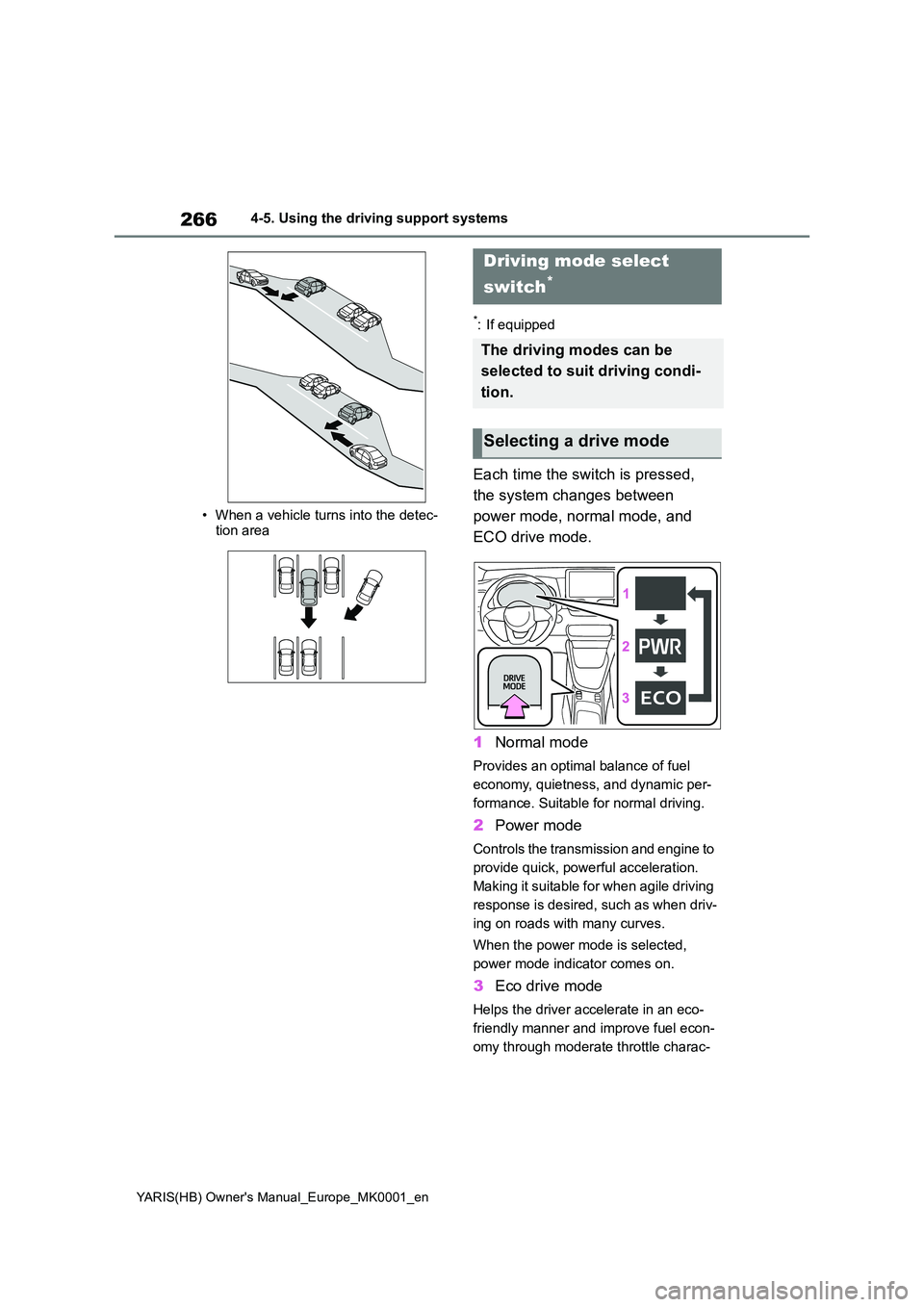
• When a vehicle turns into the detec- tion area
*: If equipped
Each time the switch is pressed,
the system changes between
power mode, normal mode, and
ECO drive mode.
1 Normal mode
Provides an optimal balance of fuel
economy, quietness, and dynamic per-
formance. Suitable for normal driving.
2 Power mode
Controls the transmission and engine to
provide quick, powerful acceleration.
Making it suitable for when agile driving
response is desired, such as when driv-
ing on roads with many curves.
When the power mode is selected,
power mode indicator comes on.
3 Eco drive mode
Helps the driver accelerate in an eco-
friendly manner and improve fuel econ-
omy through moderate throttle charac-
Driving mode select
switch*
The driving modes can be
selected to suit driving condi-
tion.
Selecting a drive mode
Page 267 of 568
267
4
YARIS(HB) Owner's Manual_Europe_MK0001_en
4-5. Using the driving support systems
Driving
teristics and by controlling the operation
of the air conditioning system (heat-
ing/cooling).
When the Eco drive mode is selected,
Eco drive mode indicator comes on.
■Operation of the air conditioning
system in Eco drive mode
Eco drive mode controls the heat-
ing/cooling operations and fan speed of
the air conditioning system to enhance
fuel efficiency. To improve air condition-
ing performance, perform the following
operations:
●Turn off air conditioning eco mode
(vehicles with an automatic air condi-
tioning system) (→P.285)
●Adjust the fan speed (→P.279, 284)
●Turn off Eco drive mode
■Automatic deactivation of power
mode
If the engine switch is turned off after
driving in power mode, the drive mode
will be changed to normal mode.
*: If equipped
■If “Exhaust Filter Full See Owner’s
Manual” is shown on the multi-
information display
●The message may be displayed while
high load driving with particulate mat-
ter accumulating.
●Engine output is restricted while the
message is displayed, however, it is
possible to drive the vehicle unless
the malfunction indicator lamp comes
on.
●Particulate matter can accumulate
more quickly if the vehicle is fre-
quently driven short trips or at low
speeds, or if the engine is regularly
started in an extremely cold environ-
ment. Excessive accumulation of par-
ticulate matter can be prevented by
periodically driving long distances
continuously with intermittent releas-
ing of the accelerator pedal, such as
when driving on highways and free-
ways.
■If the malfunction indicator lamp
comes on or “Engine Maintenance
Required Visit Your Dealer” is
shown on the multi-information
display
The amount of accumulated particulate
matter has exceeded a certain level.
Have the vehicle inspected by any
authorized Toyota retailer or Toyota
GPF (Gasoline Particu-
late Filter) system
*
The GPF system collects par-
ticulate matter in the exhaust
gas by using an exhaust gas
filter.
The system will operate to
regenerate the filter automati-
cally, depending on the vehicle
conditions.
Page 269 of 568
269
4
YARIS(HB) Owner's Manual_Europe_MK0001_en
4-5. Using the driving support systems
Driving
■Trailer Sway Control
Helps the driver to control trailer
sway by selectively applying brake
pressure for individual wheels and
reducing driving torque when trailer
sway is detected.
■TRC (Traction Control)
Helps to maintain drive power and
prevent the drive wheels from spin-
ning when starting the vehicle or
accelerating on slippery roads
■Active Cornering Assist (ACA)
Helps to prevent the vehicle from
drifting to the outer side by perform-
ing inner wheel brake control when
attempting to accelerate while turn-
ing
■Hill-start assist control
Helps to reduce the backward
movement of the vehicle when
starting on an uphill
■EPS (Electric Power Steering)
Employs an electric motor to
reduce the amount of effort needed
to turn the steering wheel.
■Emergency brake signal
When the brakes are applied sud-
denly, the emergency flashers auto-
matically flash to alert the vehicle
behind.
■Secondary Collision Brake
When the SRS airbag sensor
detects a collision and the system
operates, the brakes and brake
lights are automatically controlled
to reduce the vehicle speed and help reduce the possibility of further
damage due to a secondary colli-
sion.
■When the TRC/VSC/Trailer Sway
Control systems are operating
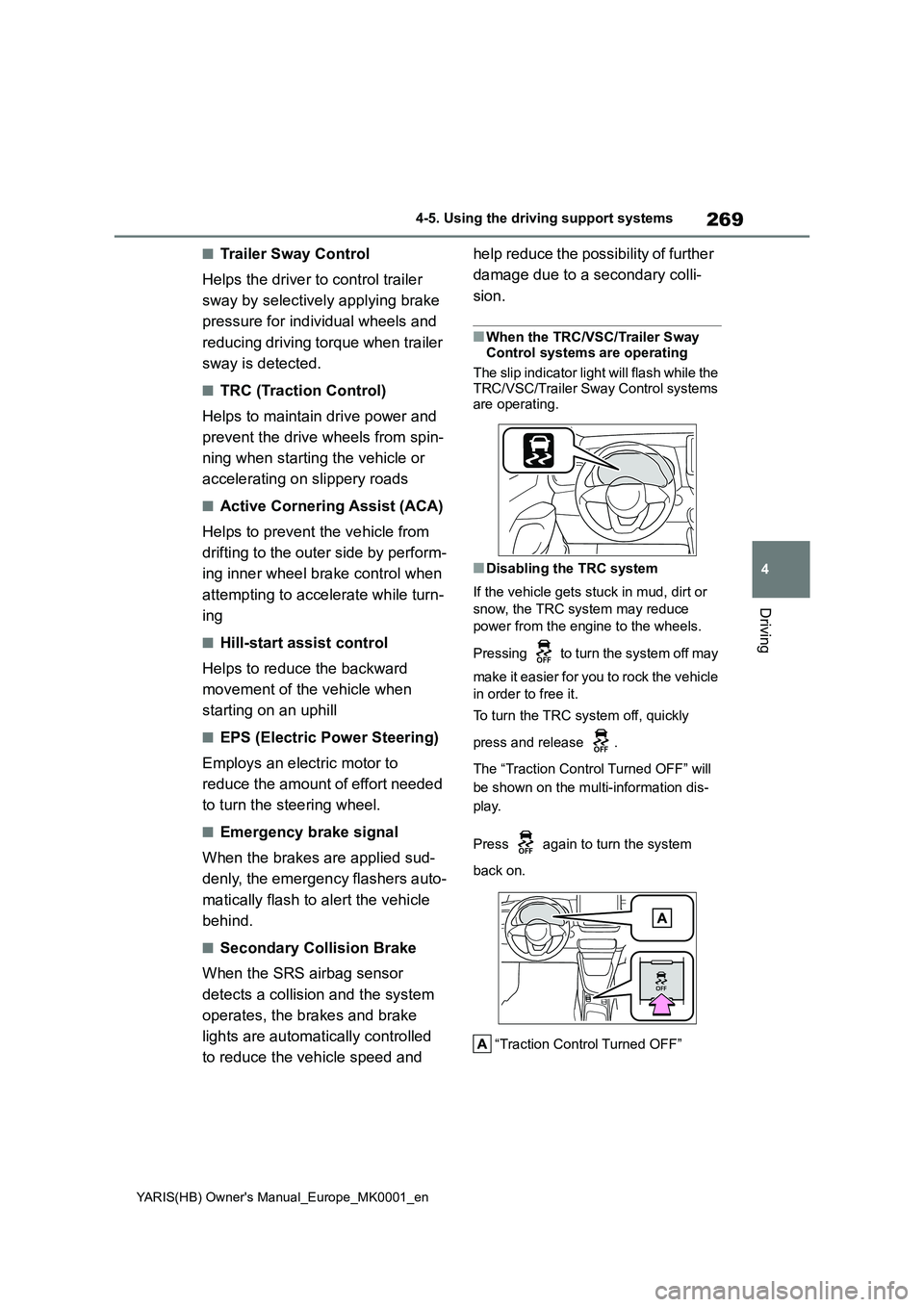
The slip indicator light will flash while the
TRC/VSC/Trailer Sway Control systems
are operating.
■Disabling the TRC system
If the vehicle gets stuck in mud, dirt or
snow, the TRC system may reduce
power from the engine to the wheels.
Pressing to turn the system off may
make it easier for you to rock the vehicle
in order to free it.
To turn the TRC system off, quickly
press and release .
The “Traction Control Turned OFF” will
be shown on the multi-information dis-
play.
Press again to turn the system
back on.
“Traction Control Turned OFF”
Page 272 of 568
272
YARIS(HB) Owner's Manual_Europe_MK0001_en
4-5. Using the driving support systems
WARNING
●The vehicle hydroplanes while driv- ing at high speed on wet or slick
roads.
■Stopping distance when the ABS
is operating may exceed that of normal conditions
The ABS is not designed to shorten
the vehicle’s stopping distance. Always maintain a safe distance from the vehicle in front of you, especially
in the following situations:
●When driving on dirt, gravel or
snow-covered roads
●When driving with tire chains
●When driving over bumps in the road
●When driving over roads with pot-holes or uneven surfaces
■TRC/VSC may not operate effec-tively when
Directional control and power may not be achievable while driving on slip-pery road surfaces, even if the
TRC/VSC system is operating. Drive the vehicle carefully in conditions where stability and power may be
lost.
■Active Cornering Assist does not
operate effectively when
●Do not overly rely on Active Corner- ing Assist. Active Cornering Assist
may not operate effectively when accelerating down slopes or driving on slippery road surfaces.
●When Active Cornering Assist fre-quently operates, Active Cornering
Assist may temporarily stop operat- ing to ensure proper operation of the brakes, TRC and VSC.
■Hill-start assist control does not operate effectively when
●Do not overly rely on hill-start assist
control. Hill-start assist control may not operate effectively on steep inclines and roads covered with ice.
●Unlike the parking brake, hill-start assist control is not intended to hold
the vehicle stationary for an extended period of time. Do not attempt to use hill-start assist con-
trol to hold the vehicle on an incline, as doing so may lead to an acci-dent.
■When the TRC/VSC/Trailer Sway Control is activated
The slip indicator light flashes. Always drive carefully. Reckless driving may cause an accident. Exercise particular
care when the indicator light flashes.
■When the TRC/VSC/Trailer Sway
Control systems are turned off
Be especially careful and drive at a speed appropriate to the road condi-
tions. As these are the systems to help ensure vehicle stability and driv-ing force, do not turn the
TRC/VSC/Trailer Sway Control sys- tems off unless necessary.Trailer Sway Control is part of the
VSC system and will not operate if VSC is turned off or experiences a malfunction.
■Replacing tires
Make sure that all tires are of the
specified size, brand, tread pattern and total load capacity. In addition, make sure that the tires are inflated to
the recommended tire inflation pres- sure level.The ABS, TRC Trailer Sway Control
and VSC systems will not function correctly if different tires are installed on the vehicle.
Contact any authorized Toyota retailer or Toyota authorized repairer, or any reliable repairer for further information
when replacing tires or wheels.