flat tire TOYOTA YARIS 2021 Owners Manual
[x] Cancel search | Manufacturer: TOYOTA, Model Year: 2021, Model line: YARIS, Model: TOYOTA YARIS 2021Pages: 568, PDF Size: 110.34 MB
Page 1 of 568
1
6
5
4
3
2
7
YARIS(HB) Owner's Manual_Europe_MK0001_en
8
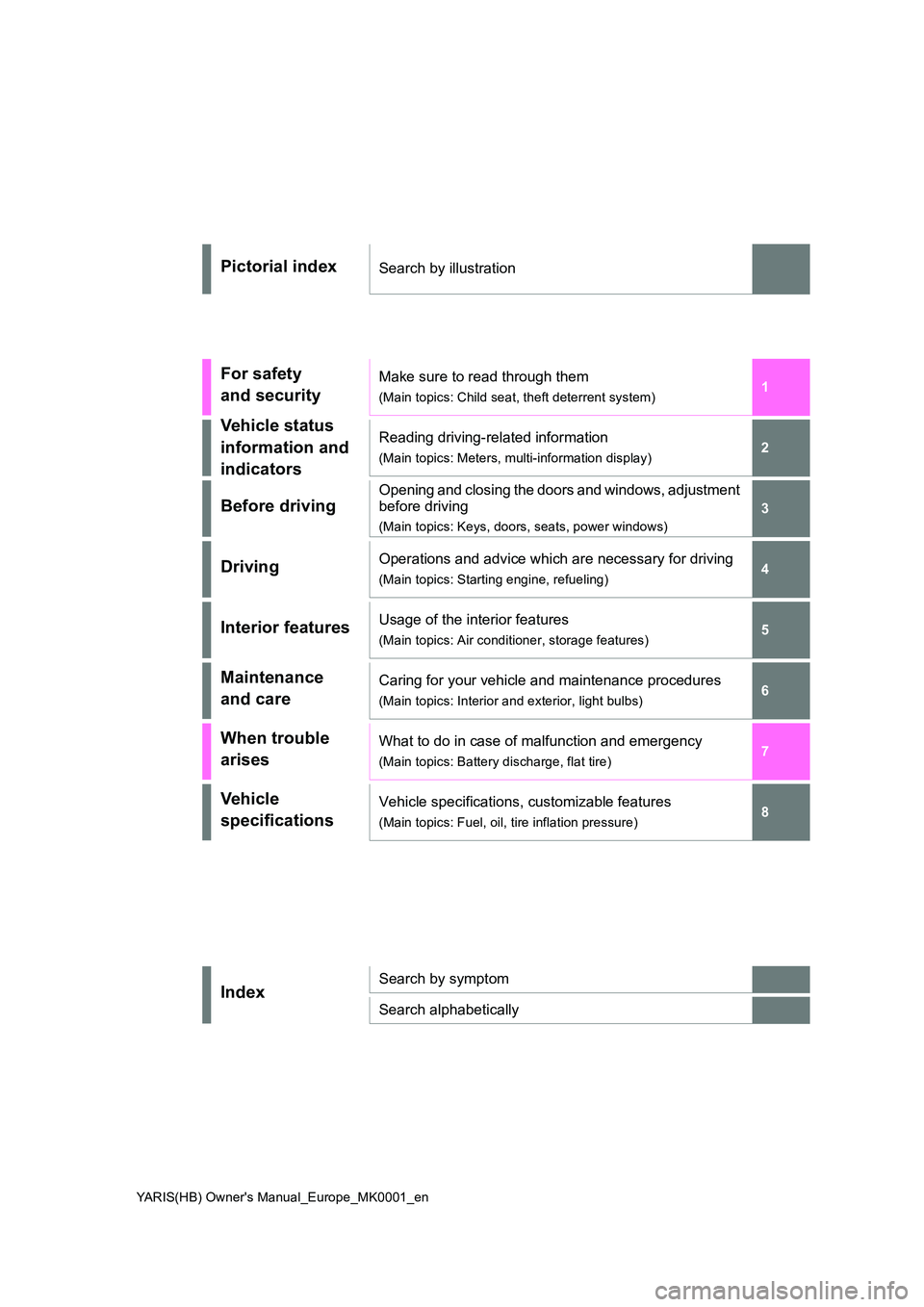
Pictorial indexSearch by illustration
For safety
and security
Make sure to read through them
(Main topics: Child seat, theft deterrent system)
Vehicle status
information and
indicators
Reading driving-related information
(Main topics: Meters, multi-information display)
Before driving
Opening and closing the doors and windows, adjustment
before driving
(Main topics: Keys, doors, seats, power windows)
DrivingOperations and advice which are necessary for driving
(Main topics: Starting engine, refueling)
Interior featuresUsage of the interior features
(Main topics: Air conditioner, storage features)
Maintenance
and care
Caring for your vehicle and maintenance procedures
(Main topics: Interior and exterior, light bulbs)
When trouble
arises
What to do in case of malfunction and emergency
(Main topics: Battery discharge, flat tire)
Vehicle
specifications
Vehicle specifications, customizable features
(Main topics: Fuel, oil, tire inflation pressure)
IndexSearch by symptom
Search alphabetically
Page 4 of 568
4
YARIS(HB) Owner's Manual_Europe_MK0001_en
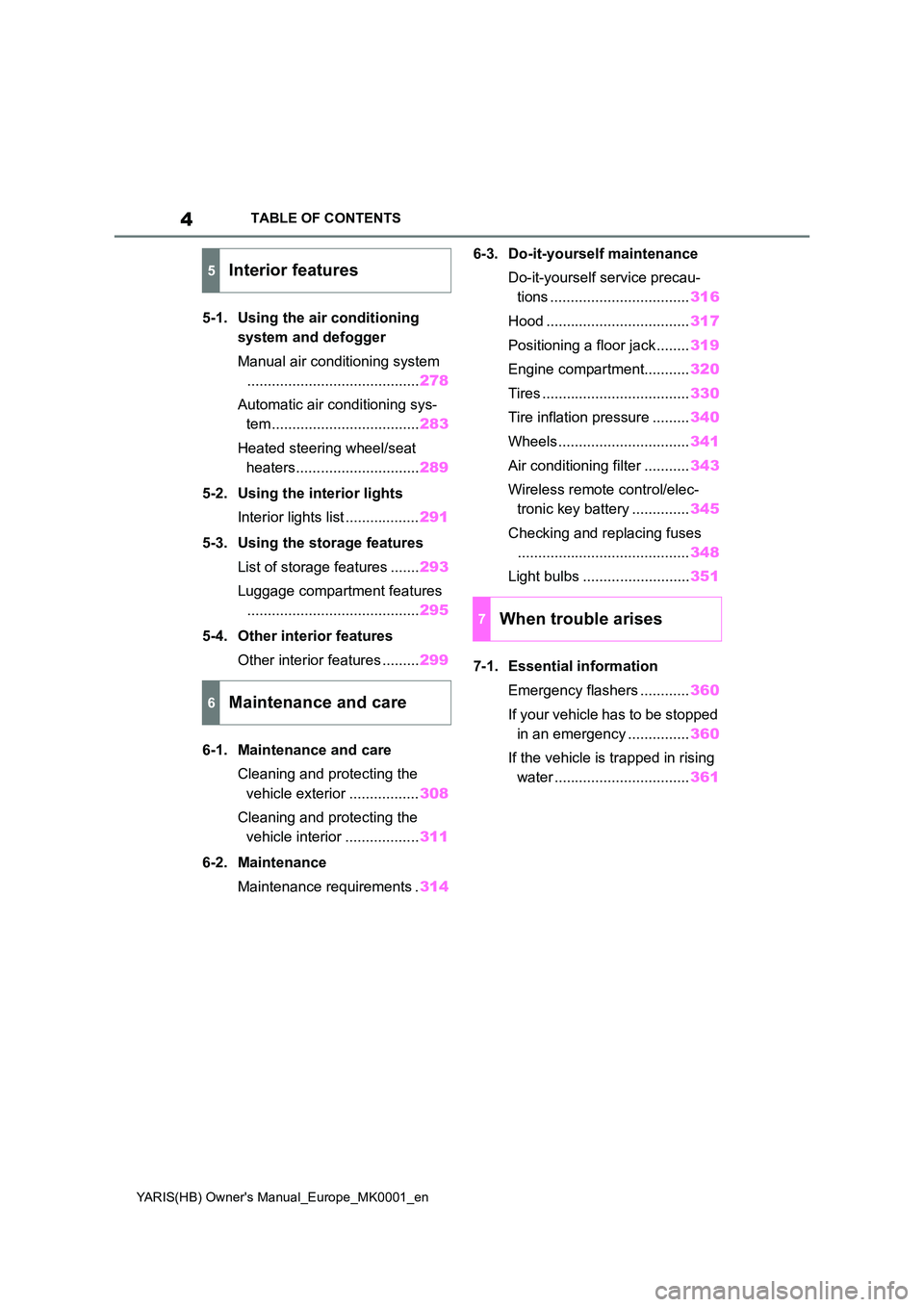
TABLE OF CONTENTS
5-1. Using the air conditioning
system and defogger
Manual air conditioning system
.......................................... 278
Automatic air conditioning sys-
tem .................................... 283
Heated steering wheel/seat
heaters.............................. 289
5-2. Using the interior lights
Interior lights list .................. 291
5-3. Using the storage features
List of storage features ....... 293
Luggage compartment features
.......................................... 295
5-4. Other interior features
Other interior features ......... 299
6-1. Maintenance and care
Cleaning and protecting the
vehicle exterior ................. 308
Cleaning and protecting the
vehicle interior .................. 311
6-2. Maintenance
Maintenance requirements . 314
6-3. Do-it-yourself maintenance
Do-it-yourself service precau-
tions .................................. 316
Hood ................................... 317
Positioning a floor jack ........ 319
Engine compartment........... 320
Tires .................................... 330
Tire inflation pressure ......... 340
Wheels ................................ 341
Air conditioning filter ........... 343
Wireless remote control/elec-
tronic key battery .............. 345
Checking and replacing fuses
.......................................... 348
Light bulbs .......................... 351
7-1. Essential information
Emergency flashers ............ 360
If your vehicle has to be stopped
in an emergency ............... 360
If the vehicle is trapped in rising
water ................................. 361
5Interior features
6Maintenance and care
7When trouble arises
Page 5 of 568
5
YARIS(HB) Owner's Manual_Europe_MK0001_en
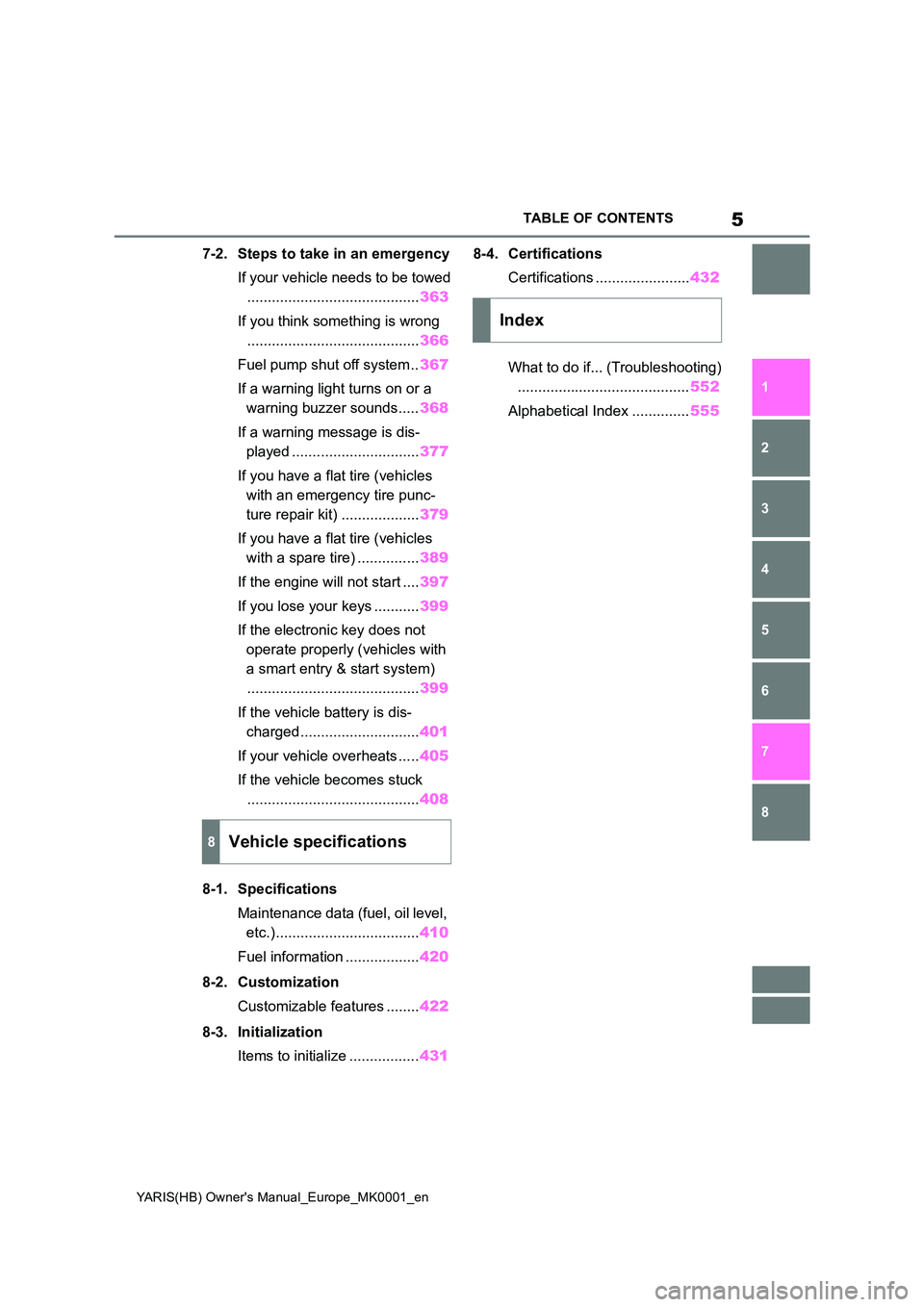
TABLE OF CONTENTS
1
6
5
4
3
2
8
7
7-2. Steps to take in an emergency
If your vehicle needs to be towed
.......................................... 363
If you think something is wrong
.......................................... 366
Fuel pump shut off system .. 367
If a warning light turns on or a
warning buzzer sounds..... 368
If a warning message is dis-
played ............................... 377
If you have a flat tire (vehicles
with an emergency tire punc-
ture repair kit) ................... 379
If you have a flat tire (vehicles
with a spare tire) ............... 389
If the engine will not start .... 397
If you lose your keys ........... 399
If the electronic key does not
operate properly (vehicles with
a smart entry & start system)
.......................................... 399
If the vehicle battery is dis-
charged............................. 401
If your vehicle overheats ..... 405
If the vehicle becomes stuck
.......................................... 408
8-1. Specifications
Maintenance data (fuel, oil level,
etc.)................................... 410
Fuel information .................. 420
8-2. Customization
Customizable features ........ 422
8-3. Initialization
Items to initialize ................. 431
8-4. Certifications
Certifications ....................... 432
What to do if... (Troubleshooting)
.......................................... 552
Alphabetical Index .............. 555
8Vehicle specifications
Index
Page 13 of 568
13
YARIS(HB) Owner's Manual_Europe_MK0001_en
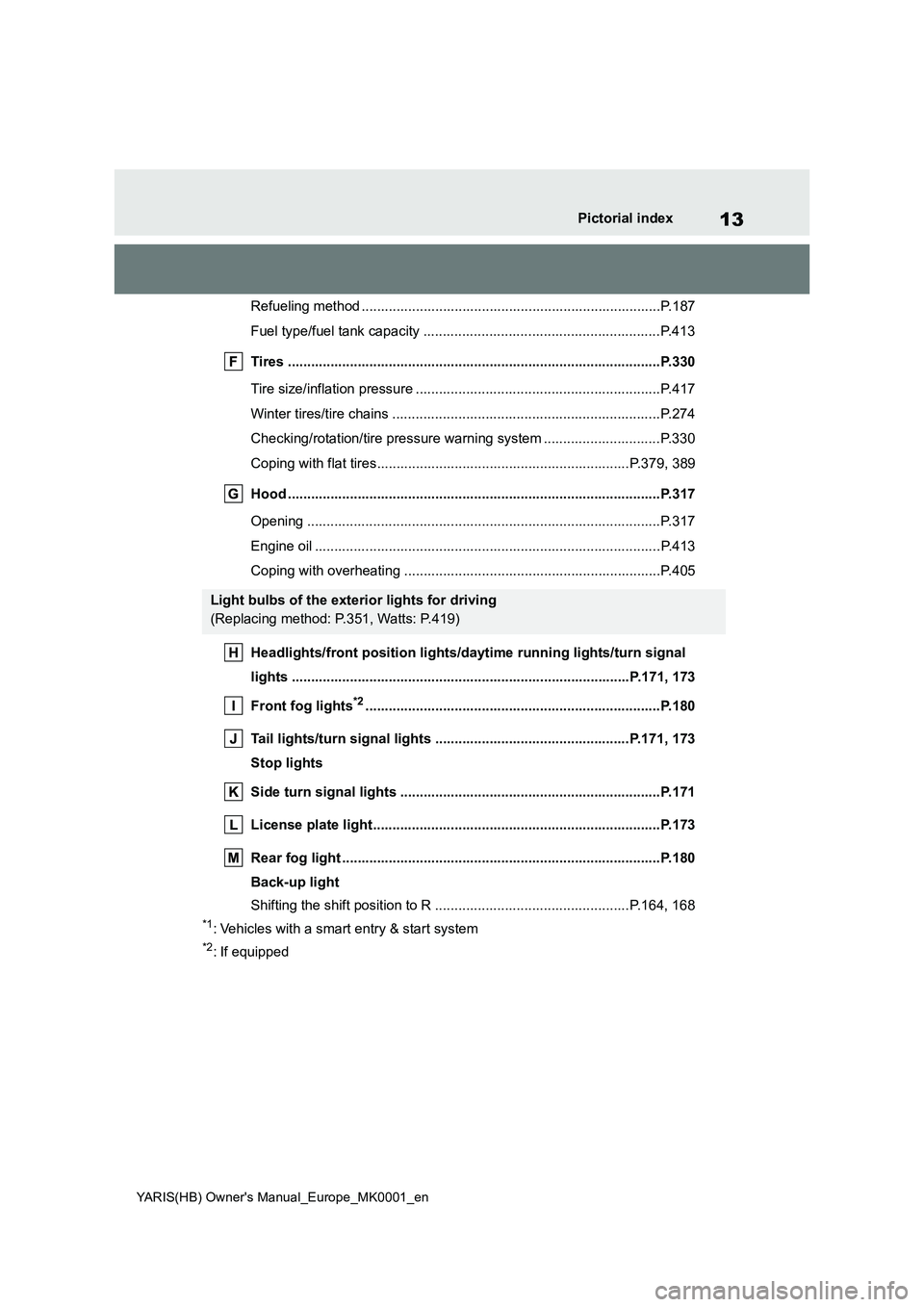
Pictorial index
Refueling method .............................................................................P.187
Fuel type/fuel tank capacity .............................................................P.413
Tires ................................................................................................P.330
Tire size/inflation pressure ...............................................................P.417
Winter tires/tire chains .....................................................................P.274
Checking/rotation/tire pressure warning system ..............................P.330
Coping with flat tires.................................................................P.379, 389
Hood ................................................................................................P.317
Opening ...........................................................................................P.317
Engine oil .........................................................................................P.413
Coping with overheating ..................................................................P.405
Headlights/front position lights/daytime running lights/turn signal
lights .......................................................................................P.171, 173
Front fog lights
*2............................................................................P.180
Tail lights/turn signal lights ..................................................P.171, 173
Stop lights
Side turn signal lights ...................................................................P.171
License plate light..........................................................................P.173
Rear fog light ..................................................................................P.180
Back-up light
Shifting the shift position to R ..................................................P.164, 168
*1: Vehicles with a smart entry & start system
*2: If equipped
Light bulbs of the exterior lights for driving
(Replacing method: P.351, Watts: P.419)
Page 150 of 568
150
YARIS(HB) Owner's Manual_Europe_MK0001_en
4-1. Before driving
NOTICE
• Do not use the clutch pedal to adjust vehicle speed. When stop-
ping the vehicle with the shift lever in a position other then N, make sure to fully depress the clutch
pedal and stop the vehicle using the brake.Doing so may damage the clutch.
• When stopping the vehicle with the shift lever in a position other than N,
make sure to fully depress the clutch pedal and stop the vehicle using the brakes.
●Do not shift the shift lever to R with-out the vehicle completely stopped.
Doing so may damage the clutch, transmission and gears.
■When parking the vehicle (vehi-cles with a Multidrive)
Always set the parking brake and shift
the shift lever to P. Failure to do so may cause the vehicle to move or the vehicle may accelerate suddenly if
the accelerator pedal is accidentally depressed.
■Avoiding damage to vehicle parts
●Do not turn the steering wheel fully in either direction and hold it there
for an extended period of time. Doing so may damage the power steering motor.
●When driving over bumps in the road, drive as slowly as possible to
avoid damaging the wheels, under- side of the vehicle, etc.
■If you get a flat tire while driving
A flat or damaged tire may cause the following situations. Hold the steering
wheel firmly and gradually depress the brake pedal to slow down the vehicle.
●It may be difficult to control your vehicle.
●The vehicle will make abnormal sounds or vibrations.
●The vehicle will lean abnormally.
Information on what to do in case of a
flat tire ( →P.379, 389)
■When encountering flooded
roads
Do not drive on a road that has flooded after heavy rain, etc. Doing so
may cause the following serious dam- age to the vehicle:
●Engine stalling
●Short in electrical components
●Engine damage caused by water immersion
In the event that you drive on a flooded road and the vehicle becomes flooded or stuck in mud or
sand, be sure to have any authorized Toyota retailer or Toyota authorized repairer, or any reliable repairer check
the following:
●Brake function
●Changes in the quantity and quality of the engine oil, transmission fluid,
clutch fluid, differential oil, etc.
●Lubricant condition for the bearings
and suspension joints (where possi- ble), and the function of all joints, bearings, etc.
Page 154 of 568
154
YARIS(HB) Owner's Manual_Europe_MK0001_en
4-1. Before driving
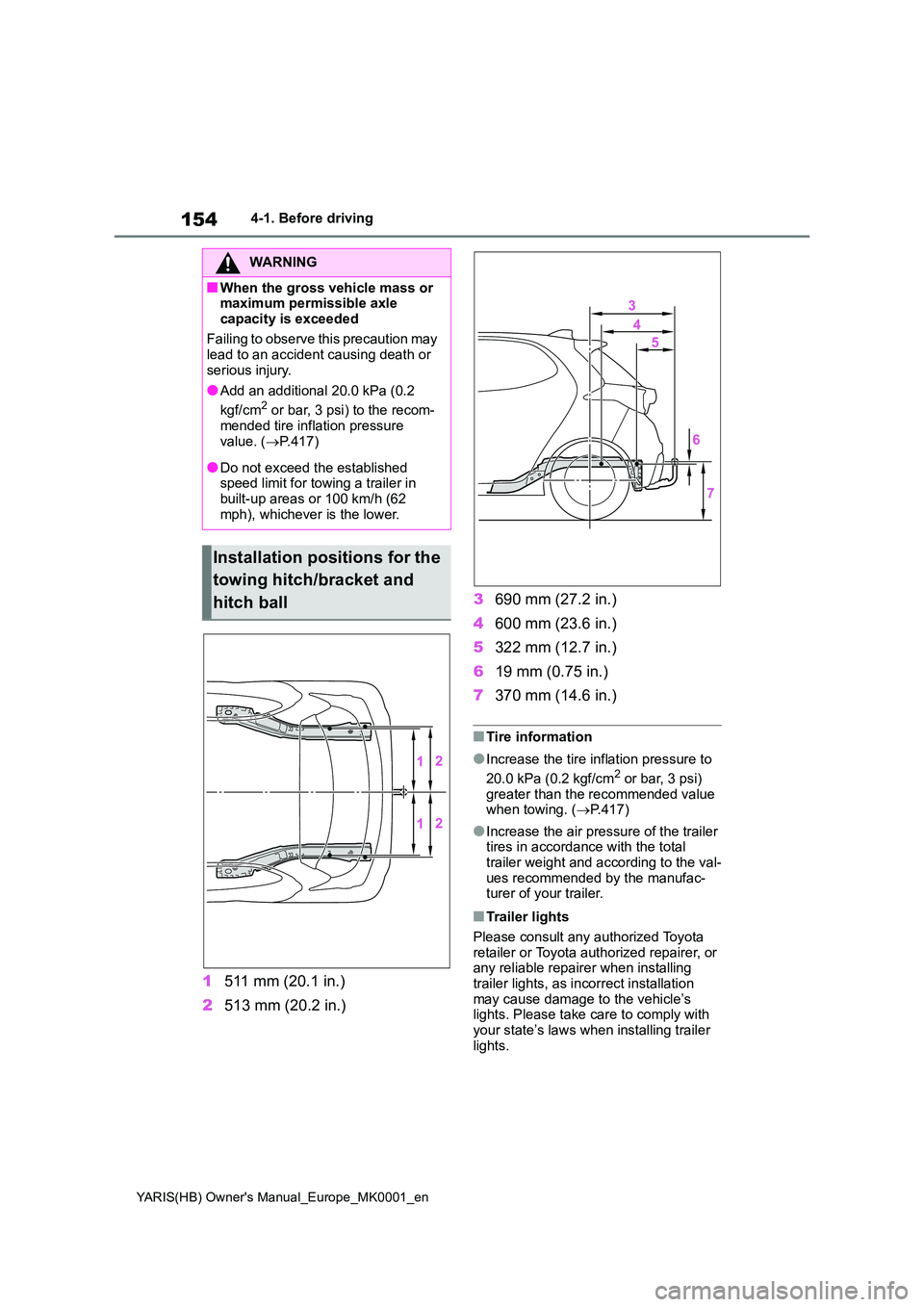
1511 mm (20.1 in.)
2 513 mm (20.2 in.)
3 690 mm (27.2 in.)
4 600 mm (23.6 in.)
5 322 mm (12.7 in.)
6 19 mm (0.75 in.)
7 370 mm (14.6 in.)
■Tire information
●Increase the tire inflation pressure to
20.0 kPa (0.2 kgf/cm2 or bar, 3 psi) greater than the recommended value when towing. ( P.417)
●Increase the air pressure of the trailer tires in accordance with the total
trailer weight and according to the val- ues recommended by the manufac-turer of your trailer.
■Trailer lights
Please consult any authorized Toyota retailer or Toyota authorized repairer, or any reliable repairer when installing
trailer lights, as incorrect installation may cause damage to the vehicle’s lights. Please take care to comply with
your state’s laws when installing trailer lights.
WARNING
■When the gross vehicle mass or maximum permissible axle
capacity is exceeded
Failing to observe this precaution may lead to an accident causing death or
serious injury.
●Add an additional 20.0 kPa (0.2
kgf/cm2 or bar, 3 psi) to the recom-
mended tire inflation pressure value. ( P.417)
●Do not exceed the established speed limit for towing a trailer in
built-up areas or 100 km/h (62 mph), whichever is the lower.
Installation positions for the
towing hitch/bracket and
hitch ball
Page 179 of 568
179
4
YARIS(HB) Owner's Manual_Europe_MK0001_en
4-3. Operating the lights and wipers
Driving
• When the windshield is obscured by
fog, mist, ice, dirt, etc. • When the windshield is cracked or damaged
• When the camera sensor is deformed or dirty• When the temperature of the camera
sensor is extremely high • When the surrounding brightness level is equal to that of headlights, tail
lights or fog lights • When headlights or tail lights of vehi-cles ahead are turned off, dirty, chang-
ing color, or not aimed properly • When the vehicle is hit by water, snow, dust, etc., from a preceding
vehicle • When driving through an area of inter-mittently changing brightness and
darkness • When frequently and repeatedly driv-ing ascending/descending roads, or
roads with rough, bumpy or uneven surfaces (such as stone-paved roads, gravel roads, etc.)
• When frequently and repeatedly tak- ing curves or driving on a winding road
• When there is a highly reflective object ahead of the vehicle, such as a sign or mirror
• When the back of a preceding vehicle is highly reflective, such as a con-tainer on a truck
• When the vehicle’s headlights are damaged or dirty, or are not aimed properly
• When the vehicle is listing or titling due to a flat tire, a trailer being towed, etc.
• When the headlights are changed between the high beams and low beams repeatedly in an abnormal
manner • When the driver believes that the high beams may be flashing or dazzling
pedestrians or other drivers
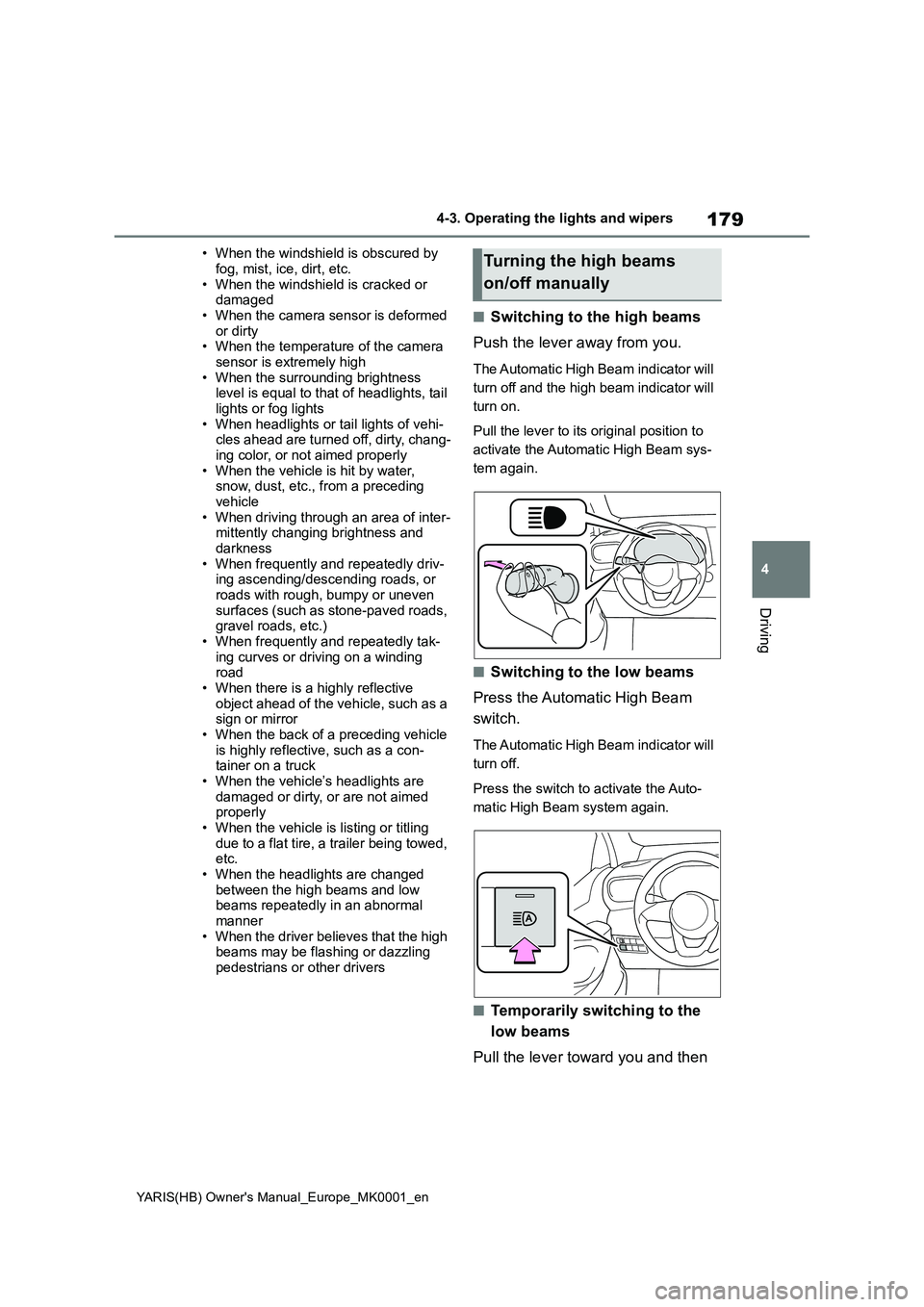
■Switching to the high beams
Push the lever away from you.
The Automatic High Beam indicator will
turn off and the high beam indicator will
turn on.
Pull the lever to its original position to
activate the Automatic High Beam sys-
tem again.
■Switching to the low beams
Press the Automatic High Beam
switch.
The Automatic High Beam indicator will
turn off.
Press the switch to activate the Auto-
matic High Beam system again.
■Temporarily switching to the
low beams
Pull the lever toward you and then
Turning the high beams
on/off manually
Page 196 of 568
196
YARIS(HB) Owner's Manual_Europe_MK0001_en
4-5. Using the driving support systems
■Enabling/disabling the pre-col-
lision system
The pre-collision system can be
enabled/disabled on ( →P.422)
of the multi-information display.
The system is automatically enabled
each time the engine switch is turned to
ON.
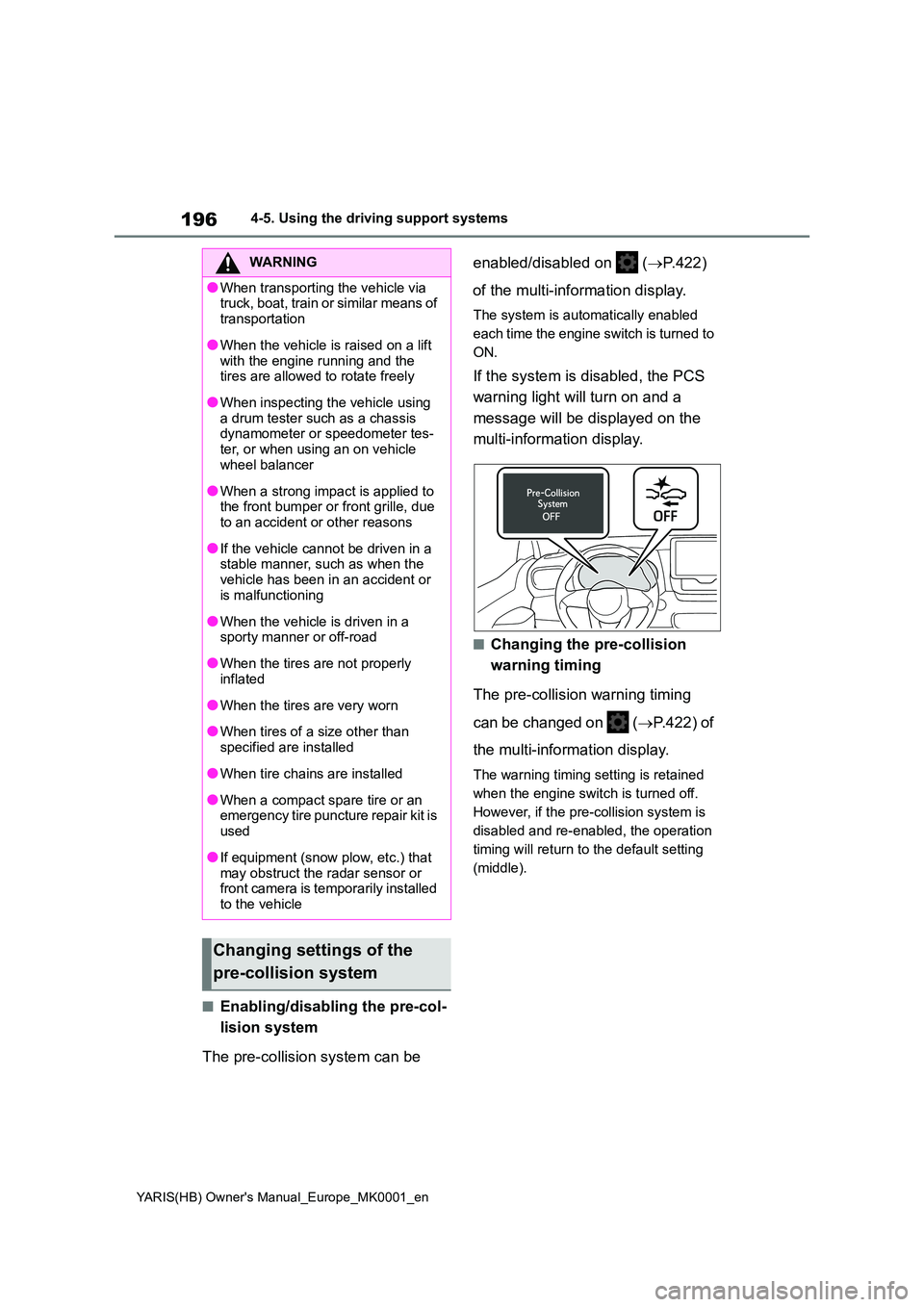
If the system is disabled, the PCS
warning light will turn on and a
message will be displayed on the
multi-information display.
■Changing the pre-collision
warning timing
The pre-collision warning timing
can be changed on ( →P.422) of
the multi-information display.
The warning timing setting is retained
when the engine switch is turned off.
However, if the pre-collision system is
disabled and re-enabled, the operation
timing will return to the default setting
(middle).
WARNING
●When transporting the vehicle via truck, boat, train or similar means of
transportation
●When the vehicle is raised on a lift
with the engine running and the tires are allowed to rotate freely
●When inspecting the vehicle using a drum tester such as a chassis dynamometer or speedometer tes-
ter, or when using an on vehicle wheel balancer
●When a strong impact is applied to the front bumper or front grille, due to an accident or other reasons
●If the vehicle cannot be driven in a stable manner, such as when the
vehicle has been in an accident or is malfunctioning
●When the vehicle is driven in a sporty manner or off-road
●When the tires are not properly inflated
●When the tires are very worn
●When tires of a size other than
specified are installed
●When tire chains are installed
●When a compact spare tire or an emergency tire puncture repair kit is
used
●If equipment (snow plow, etc.) that
may obstruct the radar sensor or front camera is temporarily installed to the vehicle
Changing settings of the
pre-collision system
Page 203 of 568
203
4
YARIS(HB) Owner's Manual_Europe_MK0001_en
4-5. Using the driving support systems
Driving
• If the braking functions cannot operate
to their full extent, such as when the
brake parts are extremely cold,
extremely hot, or wet
• If the vehicle is not properly main-
tained (brakes or tires are excessively
worn, improper tire inflation pressure,
etc.)
• When the vehicle is being driven on a
gravel road or other slippery surface
• When the road surface has deep
wheel tracks
• When driving on a hill road
• When driving on a road that has
inclines to the left or right
■If VSC is disabled
●If VSC is disabled (→P.270), the pre-
collision brake assist and pre-collision
braking functions are also disabled.
●The PCS warning light will turn on and
“VSC Turned OFF Pre-Collision Brake
System Unavailable” will be displayed
on the multi-information display.
*: If equipped
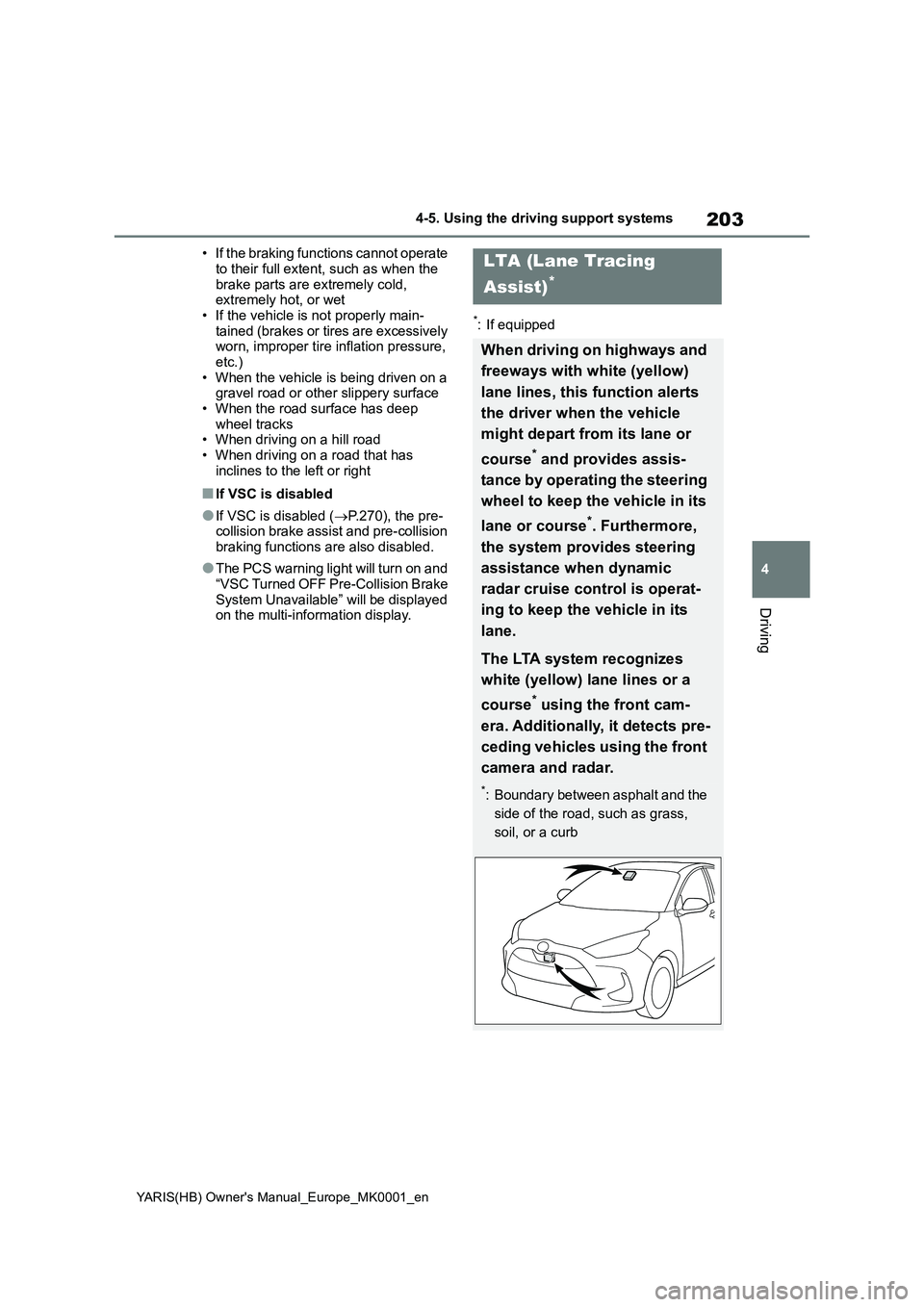
LTA (Lane Tracing
Assist)
*
When driving on highways and
freeways with white (yellow)
lane lines, this function alerts
the driver when the vehicle
might depart from its lane or
course
* and provides assis-
tance by operating the steering
wheel to keep the vehicle in its
lane or course
*. Furthermore,
the system provides steering
assistance when dynamic
radar cruise control is operat-
ing to keep the vehicle in its
lane.
The LTA system recognizes
white (yellow) lane lines or a
course
* using the front cam-
era. Additionally, it detects pre-
ceding vehicles using the front
camera and radar.
*: Boundary between asphalt and the
side of the road, such as grass,
soil, or a curb
Page 272 of 568
272
YARIS(HB) Owner's Manual_Europe_MK0001_en
4-5. Using the driving support systems
WARNING
●The vehicle hydroplanes while driv- ing at high speed on wet or slick
roads.
■Stopping distance when the ABS
is operating may exceed that of normal conditions
The ABS is not designed to shorten
the vehicle’s stopping distance. Always maintain a safe distance from the vehicle in front of you, especially
in the following situations:
●When driving on dirt, gravel or
snow-covered roads
●When driving with tire chains
●When driving over bumps in the road
●When driving over roads with pot-holes or uneven surfaces
■TRC/VSC may not operate effec-tively when
Directional control and power may not be achievable while driving on slip-pery road surfaces, even if the
TRC/VSC system is operating. Drive the vehicle carefully in conditions where stability and power may be
lost.
■Active Cornering Assist does not
operate effectively when
●Do not overly rely on Active Corner- ing Assist. Active Cornering Assist
may not operate effectively when accelerating down slopes or driving on slippery road surfaces.
●When Active Cornering Assist fre-quently operates, Active Cornering
Assist may temporarily stop operat- ing to ensure proper operation of the brakes, TRC and VSC.
■Hill-start assist control does not operate effectively when
●Do not overly rely on hill-start assist
control. Hill-start assist control may not operate effectively on steep inclines and roads covered with ice.
●Unlike the parking brake, hill-start assist control is not intended to hold
the vehicle stationary for an extended period of time. Do not attempt to use hill-start assist con-
trol to hold the vehicle on an incline, as doing so may lead to an acci-dent.
■When the TRC/VSC/Trailer Sway Control is activated
The slip indicator light flashes. Always drive carefully. Reckless driving may cause an accident. Exercise particular
care when the indicator light flashes.
■When the TRC/VSC/Trailer Sway
Control systems are turned off
Be especially careful and drive at a speed appropriate to the road condi-
tions. As these are the systems to help ensure vehicle stability and driv-ing force, do not turn the
TRC/VSC/Trailer Sway Control sys- tems off unless necessary.Trailer Sway Control is part of the
VSC system and will not operate if VSC is turned off or experiences a malfunction.
■Replacing tires
Make sure that all tires are of the
specified size, brand, tread pattern and total load capacity. In addition, make sure that the tires are inflated to
the recommended tire inflation pres- sure level.The ABS, TRC Trailer Sway Control
and VSC systems will not function correctly if different tires are installed on the vehicle.
Contact any authorized Toyota retailer or Toyota authorized repairer, or any reliable repairer for further information
when replacing tires or wheels.