warning TOYOTA YARIS 2022 Owners Manual
[x] Cancel search | Manufacturer: TOYOTA, Model Year: 2022, Model line: YARIS, Model: TOYOTA YARIS 2022Pages: 590, PDF Size: 128.6 MB
Page 342 of 590
340
HV Owner's Manual_Europe_M52N30_en
6-3. Do-it-yourself maintenance
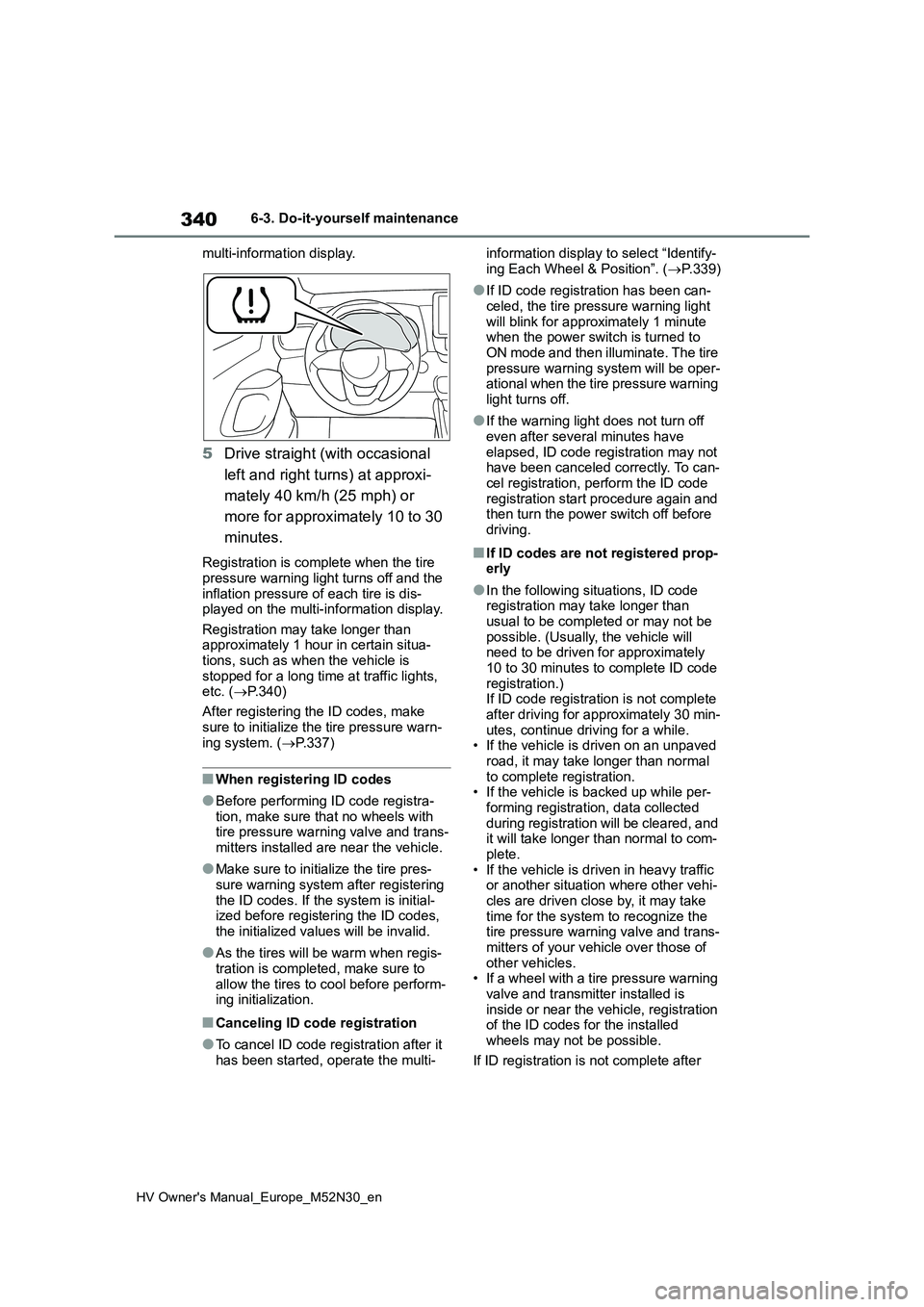
multi-information display.
5 Drive straight (with occasional
left and right turns) at approxi-
mately 40 km/h (25 mph) or
more for approximately 10 to 30
minutes.
Registration is complete when the tire
pressure warning light turns off and the inflation pressure of each tire is dis-played on the multi-information display.
Registration may take longer than approximately 1 hour in certain situa-tions, such as when the vehicle is
stopped for a long time at traffic lights, etc. ( P.340)
After registering the ID codes, make
sure to initialize the tire pressure warn- ing system. ( P.337)
■When registering ID codes
●Before performing ID code registra- tion, make sure that no wheels with tire pressure warning valve and trans-
mitters installed are near the vehicle.
●Make sure to initialize the tire pres-
sure warning system after registering the ID codes. If the system is initial-ized before registering the ID codes,
the initialized values will be invalid.
●As the tires will be warm when regis-
tration is completed, make sure to allow the tires to cool before perform-ing initialization.
■Canceling ID code registration
●To cancel ID code registration after it has been started, operate the multi-
information display to select “Identify-
ing Each Wheel & Position”. ( P.339)
●If ID code registration has been can-
celed, the tire pressure warning light will blink for approximately 1 minute when the power switch is turned to
ON mode and then illuminate. The tire pressure warning system will be oper-ational when the tire pressure warning
light turns off.
●If the warning light does not turn off
even after several minutes have elapsed, ID code registration may not have been canceled correctly. To can-
cel registration, perform the ID code registration start procedure again and then turn the power switch off before
driving.
■If ID codes are not registered prop- erly
●In the following situations, ID code registration may take longer than usual to be completed or may not be
possible. (Usually, the vehicle will need to be driven for approximately 10 to 30 minutes to complete ID code
registration.) If ID code registration is not complete after driving for approximately 30 min-
utes, continue driving for a while. • If the vehicle is driven on an unpaved road, it may take longer than normal
to complete registration. • If the vehicle is backed up while per-forming registration, data collected
during registration will be cleared, and it will take longer than normal to com-plete.
• If the vehicle is driven in heavy traffic or another situation where other vehi-cles are driven close by, it may take
time for the system to recognize the tire pressure warning valve and trans-mitters of your vehicle over those of
other vehicles. • If a wheel with a tire pressure warning valve and transmitter installed is
inside or near the vehicle, registration of the ID codes for the installed wheels may not be possible.
If ID registration is not complete after
Page 343 of 590
341
6
HV Owner's Manual_Europe_M52N30_en
6-3. Do-it-yourself maintenance
Maintenance and care
driving for approximately 1 hour, park
the vehicle in a safe place for approxi-
mately 20 minutes and then perform the
ID code registration procedure again.
●In the following situations, ID code registration will not be started or was not completed properly and the sys-
tem will not operate properly. Perform the ID code registration procedure again.
• If, when attempting to start ID code registration, the tire pressure warning light does not blink slowly 3 times.
• If, when the vehicle has been driven for about 10 minutes after performing ID code registration, the tire pressure
warning light blinks for approximately 1 minute and then illuminates.
●If ID code registration cannot be com-pleted after performing the above pro-cedure, contact any authorized Toyota
retailer or Toyota authorized repairer, or any reliable repairer.
Your vehicle is equipped with tire
pressure warning system with the
function to have ID codes regis-
tered for a second wheel set, for
example a winter set, by any autho-
rized Toyota retailer or Toyota
authorized repairer, or any reliable
repairer.
After registration of a second wheel
set, either of these two wheel sets
can be selected for usage with the
tire pressure warning system.
■Operating conditions for the
function
This function will perform the
change of wheel set only if a sec-
ond wheel set has been regis-
tered. If no second wheel set has
been registered, no change will
be made when selecting this
function in the menu.
Only a change between both
registered wheel set is possible,
mixing between these wheel sets
is not supported.
■How to change between wheel
sets
1 Have the vehicle fitted with the
preferred wheel set.
2 Press / (vertical display)
or / (horizontal display)
of the meter control switch to
select .
3 Press / (vertical display)
or / (horizontal display)
to select “Vehicle Settings” and
then press .
4 Press / to select “TPWS
setting” and then press .
5 Press / to select “Identi-
fying Each Wheel & Position”.
Then press and hold until
the tire pressure warning light
blinks slowly 3 times. Afterward,
Selecting wheel set
Page 344 of 590
342
HV Owner's Manual_Europe_M52N30_en
6-3. Do-it-yourself maintenance
turns on after flashing for 1 min-
ute.
After 2 minutes, registration of a second wheel set is being performed. The tire
pressure warning light will turn off and “--” will be displayed for the inflation pressure of each tire on the multi-infor-
mation display.
6 Initialize the tire pressure warn-
ing system. ( P.337)
If the tire inflation pressure settings for
the installed tire changes, initialization operations are required, but if the same tire inflation pressure, initialization is
not required.
7 Drive straight (with occasional
left and right turns) at approxi-
mately 40 km/h (25 mph) or
more for approximately 10 to 30
minutes.
Registration of a second wheel set is complete when the tire pressure warn-
ing light turns off and the inflation pres- sure of each tire is displayed on the multi-information display.
■Certifications for the tire pressure warning system
P. 5 6 3
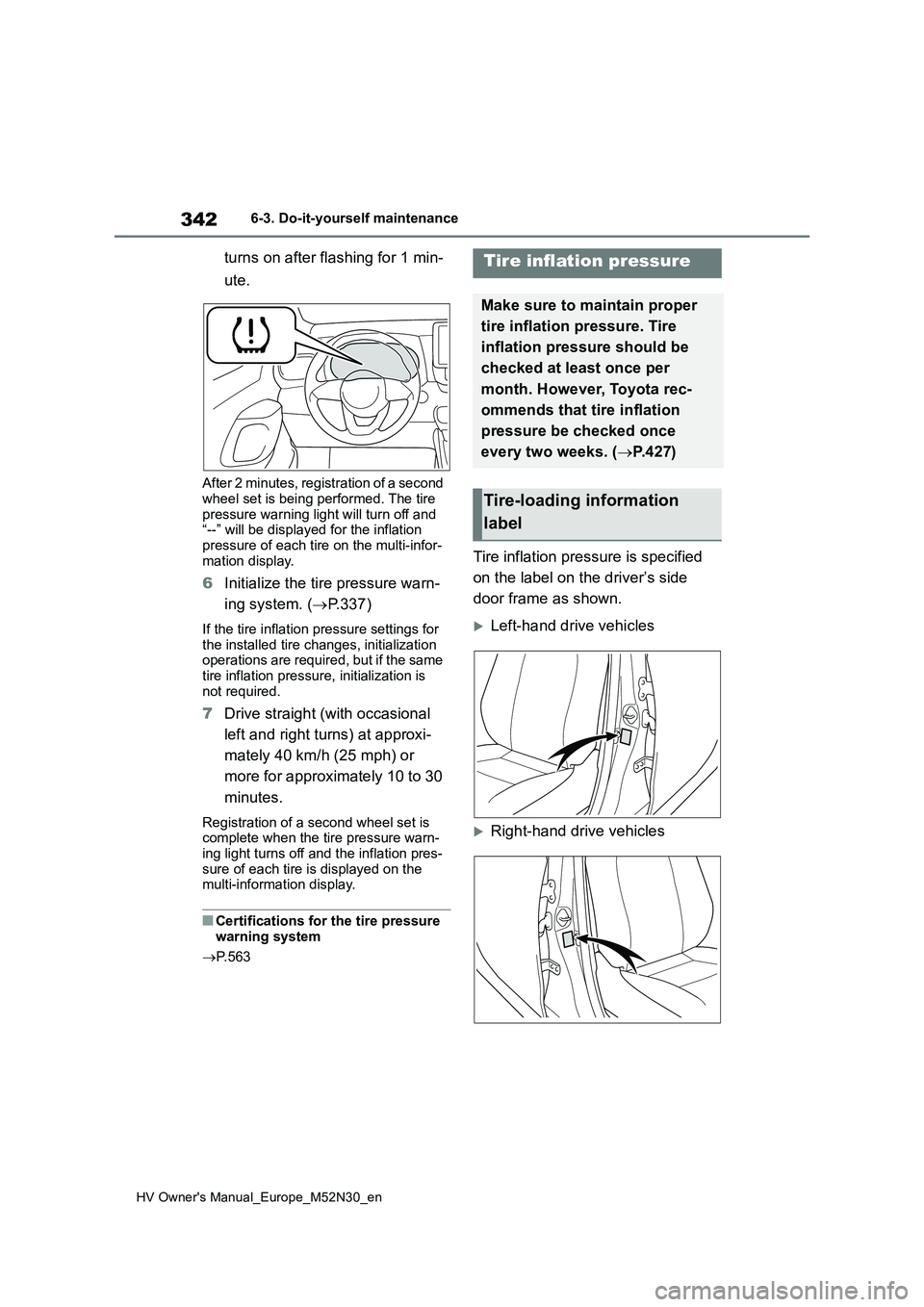
Tire inflation pressure is specified
on the label on the driver’s side
door frame as shown.
Left-hand drive vehicles
Right-hand drive vehicles
Tire inflation pressure
Make sure to maintain proper
tire inflation pressure. Tire
inflation pressure should be
checked at least once per
month. However, Toyota rec-
ommends that tire inflation
pressure be checked once
every two weeks. ( P. 4 2 7 )
Tire-loading information
label
Page 345 of 590
343
6
HV Owner's Manual_Europe_M52N30_en
6-3. Do-it-yourself maintenance
Maintenance and care
■Effects of incorrect tire inflation pressure
Driving with incorrect tire inflation pres- sure may result in the following:
●Reduced safety
●Damage to the drivetrain
●Reduced tire life due to wear
●Reduced fuel economy
●Reduced driving comfort and poor
handling
If a tire needs frequent inflating, have it checked by any authorized Toyota
retailer or Toyota authorized repairer, or any reliable repairer.
■Instructions for checking tire infla-tion pressure
When checking tire inflation pressure, observe the following:
●Check only when the tires are cold.If your vehicle has been parked for at least 3 hours or has not been driven
for more than 1.5 km or 1 mile, you will get an accurate cold tire inflation pressure reading.
●Always use a tire pressure gauge.It is difficult to judge if a tire is properly
inflated based only on its appearance.
●It is normal for the tire inflation pres-
sure to be higher after driving as heat is generated in the tire. Do not reduce
tire inflation pressure after driving.
●Passengers and luggage weight
should be placed so that the vehicle is balanced.
WARNING
■Proper inflation is critical to save
tire performance
Keep your tires properly inflated. If the tires are not properly inflated,
the following conditions may occur which could lead to an accident resulting in death or serious injury:
●Excessive wear
●Uneven wear
●Poor handling
●Possibility of blowouts resulting from overheated tires
●Air leaking from between tire and wheel
●Wheel deformation and/or tire dam-age
●Greater possibility of tire damage while driving (due to road hazards,
expansion joints, sharp edges on the road, etc.)
NOTICE
■When inspecting and adjusting
tire inflation pressure
Be sure to put the tire valve caps back on.
If a valve cap is not installed, dirt or moisture may get into the valve and cause an air leak, resulting in
decreased tire inflation pressure.
Page 346 of 590
344
HV Owner's Manual_Europe_M52N30_en
6-3. Do-it-yourself maintenance
When replacing wheels, care
should be taken to ensure that they
are equivalent to those removed in
load capacity, diameter, rim width
and inset*.
Replacement wheels are available
at any authorized Toyota retailer or
Toyota authorized repairer, or any
reliable repairer.
*: Conventionally referred to as offset.
Toyota does not recommend using
the following:
Wheels of different sizes or types
Used wheels
Bent wheels that have been
straightened
■When replacing wheels
The wheels of your vehicle are equipped with tire pressure warning valves and
transmitters that allow the tire pressure warning system to provide advance warning in the event of a loss in tire
inflation pressure. Whenever wheels are replaced, the tire pressure warning valves and transmitters must be
installed. ( P.336)
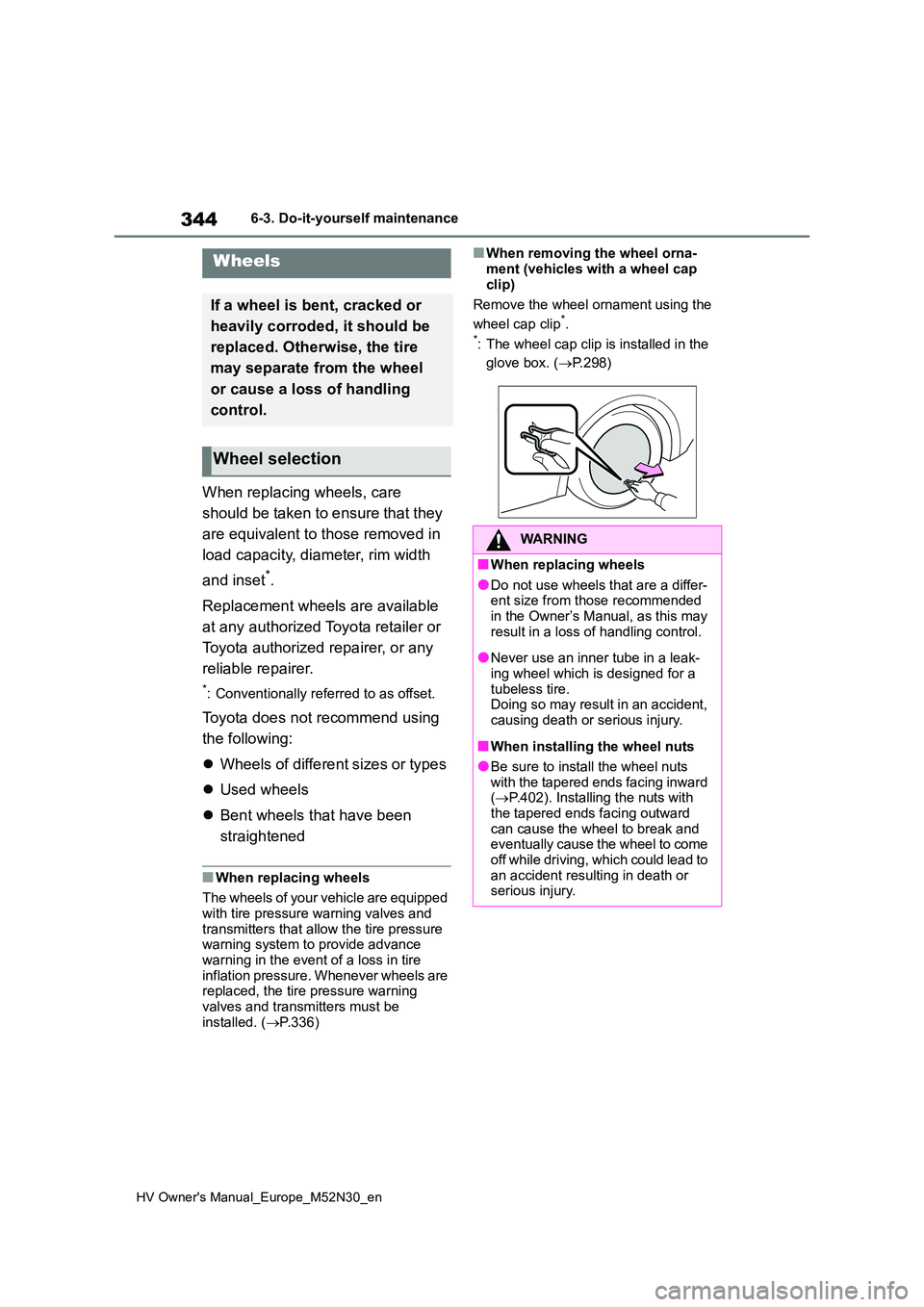
■When removing the wheel orna-
ment (vehicles with a wheel cap clip)
Remove the wheel ornament using the
wheel cap clip*.*: The wheel cap clip is installed in the
glove box. ( P.298)
Wheels
If a wheel is bent, cracked or
heavily corroded, it should be
replaced. Otherwise, the tire
may separate from the wheel
or cause a loss of handling
control.
Wheel selection
WARNING
■When replacing wheels
●Do not use wheels that are a differ- ent size from those recommended in the Owner’s Manual, as this may
result in a loss of handling control.
●Never use an inner tube in a leak-
ing wheel which is designed for a tubeless tire.Doing so may result in an accident,
causing death or serious injury.
■When installing the wheel nuts
●Be sure to install the wheel nuts with the tapered ends facing inward ( P.402). Installing the nuts with
the tapered ends facing outward can cause the wheel to break and eventually cause the wheel to come
off while driving, which could lead to an accident resulting in death or serious injury.
Page 347 of 590
345
6
HV Owner's Manual_Europe_M52N30_en
6-3. Do-it-yourself maintenance
Maintenance and care
Use only Toyota wheel nuts and
wheel nut wrenches designed for
use with your aluminum wheels.
When rotating, repairing or
changing your tires, check that
the wheel nuts are still tight after
driving 1600 km (1000 miles).
Be careful not to damage the
aluminum wheels when using
tire chains.
Use only Toyota genuine balance
weights or equivalent and a plas-
tic or rubber hammer when bal-
ancing your wheels.
WARNING
●Never use oil or grease on the wheel bolts or wheel nuts.
Oil and grease may cause the wheel nuts to be excessively tight-ened, leading to bolt or disc wheel
damage. In addition, the oil or grease can cause the wheel nuts to loosen and the wheel may fall off,
causing an accident and resulting in death or serious injury. Remove any oil or grease from the wheel bolts or
wheel nuts.
■Use of defective wheels prohib-
ited
Do not use cracked or deformed wheels. Doing so could cause the tire
to leak air during driving, possibly causing an accident.
NOTICE
■Replacing tire pressure warning
valves and transmitters
●Because tire repair or replacement
may affect the tire pressure warning valves and transmitters, make sure to have tires serviced by any autho-
rized Toyota retailer or Toyota authorized repairer, or any reliable repairer. In addition, make sure to
purchase your tire pressure warn- ing valves and transmitters at any authorized Toyota retailer or Toyota
authorized repairer, or any reliable repairer.
●Ensure that only genuine Toyota wheels are used on your vehicle.Tire pressure warning valves and
transmitters may not work properly with non-genuine wheels.
Aluminum wheel precau-
tions (if equipped)
Page 351 of 590
349
6
HV Owner's Manual_Europe_M52N30_en
6-3. Do-it-yourself maintenance
Maintenance and care
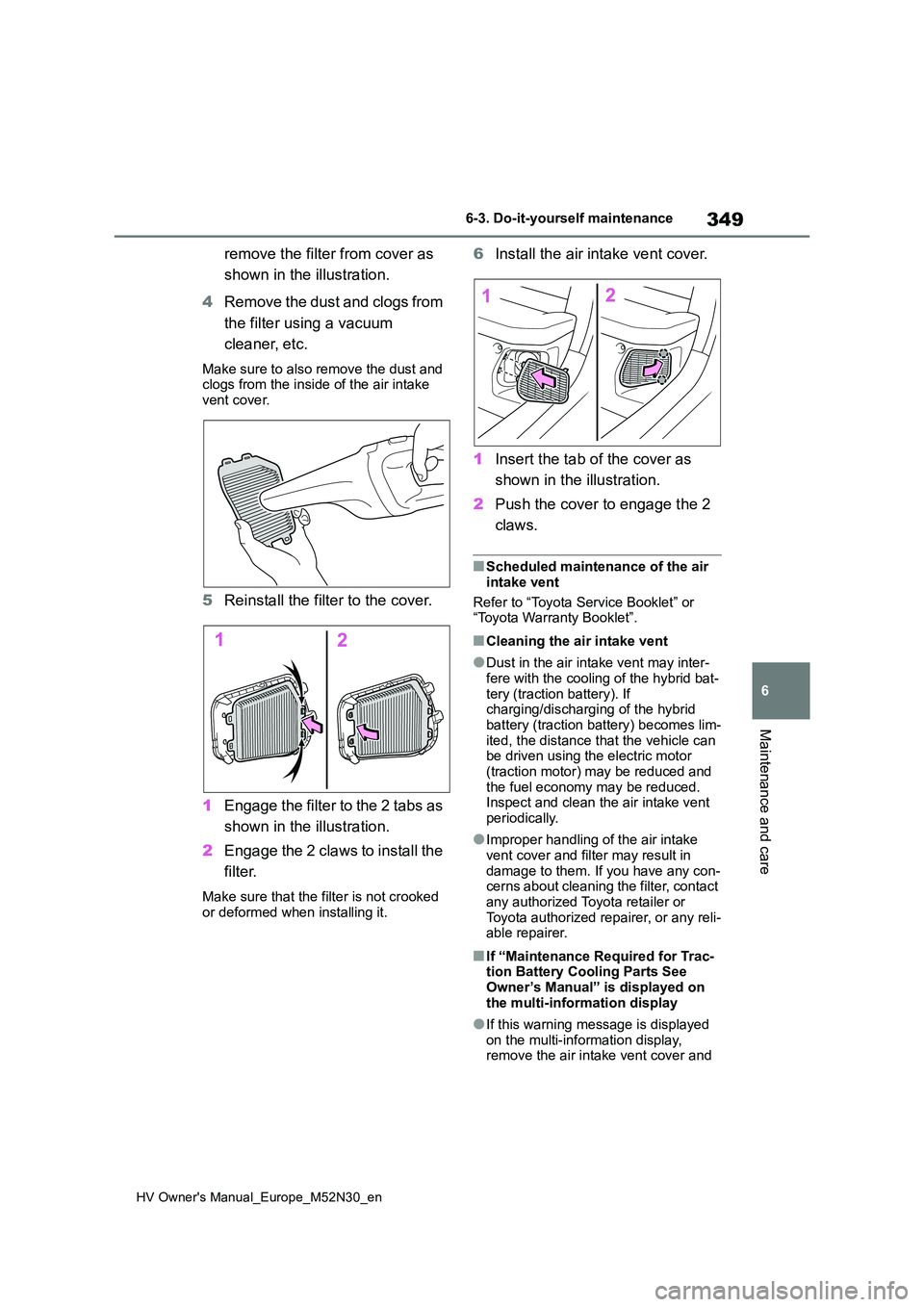
remove the filter from cover as
shown in the illustration.
4 Remove the dust and clogs from
the filter using a vacuum
cleaner, etc.
Make sure to also remove the dust and clogs from the inside of the air intake
vent cover.
5 Reinstall the filter to the cover.
1 Engage the filter to the 2 tabs as
shown in the illustration.
2 Engage the 2 claws to install the
filter.
Make sure that the filter is not crooked or deformed when installing it.
6 Install the air intake vent cover.
1 Insert the tab of the cover as
shown in the illustration.
2 Push the cover to engage the 2
claws.
■Scheduled maintenance of the air
intake vent
Refer to “Toyota Service Booklet” or “Toyota Warranty Booklet”.
■Cleaning the air intake vent
●Dust in the air intake vent may inter-fere with the cooling of the hybrid bat-
tery (traction battery). If charging/discharging of the hybrid battery (traction battery) becomes lim-
ited, the distance that the vehicle can be driven using the electric motor (traction motor) may be reduced and
the fuel economy may be reduced. Inspect and clean the air intake vent periodically.
●Improper handling of the air intake vent cover and filter may result in
damage to them. If you have any con- cerns about cleaning the filter, contact any authorized Toyota retailer or
Toyota authorized repairer, or any reli- able repairer.
■If “Maintenance Required for Trac-tion Battery Cooling Parts See
Owner’s Manual” is displayed on the multi-information display
●If this warning message is displayed on the multi-information display, remove the air intake vent cover and
Page 352 of 590
350
HV Owner's Manual_Europe_M52N30_en
6-3. Do-it-yourself maintenance
clean the filter. ( P.348)
●After cleaning the air intake vent, start the hybrid system and check that the
warning message is no longer dis- played.After the hybrid system is started, it
may be necessary to drive the vehicle up to approximately 20 minutes before the warning message disappears. If
the warning message does not disap- pear after driving for appropriately 20 minutes, have the vehicle inspected
by any authorized Toyota retailer or Toyota authorized repairer, or any reli-able repairer.
WARNING
■When cleaning the air intake vent
●Do not use water or other liquids to clean the air intake vent. If water is
applied to the hybrid battery (trac- tion battery) or other components, a malfunction or fire may occur.
●Before cleaning the air intake vent, make sure to turn the power switch
off to stop the hybrid system.
■When removing the air intake
vent cover
Do not touch the service plug located near the air intake vent. ( P.80)
NOTICE
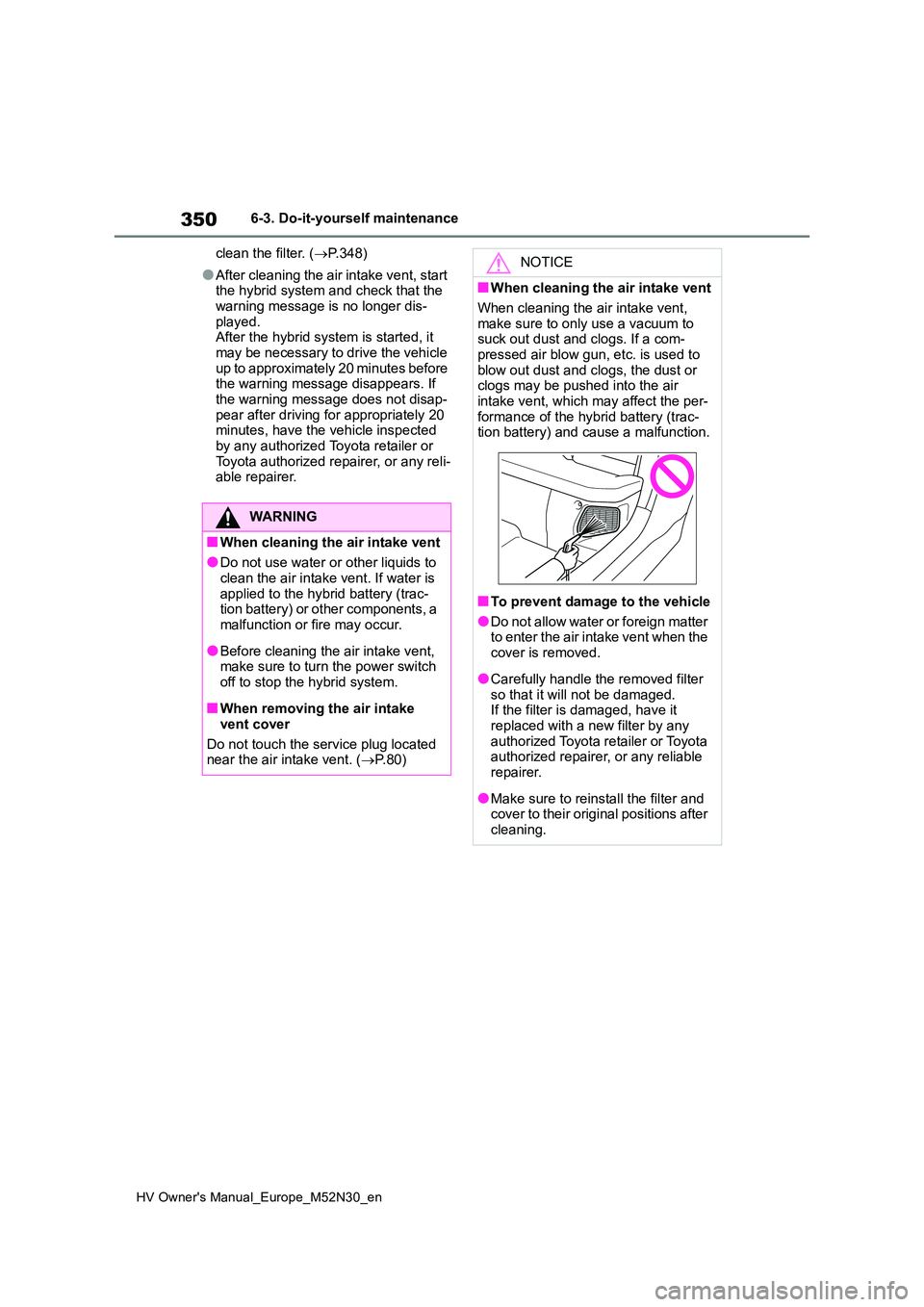
■When cleaning the air intake vent
When cleaning the air intake vent,
make sure to only use a vacuum to suck out dust and clogs. If a com-pressed air blow gun, etc. is used to
blow out dust and clogs, the dust or clogs may be pushed into the air intake vent, which may affect the per-
formance of the hybrid battery (trac- tion battery) and cause a malfunction.
■To prevent damage to the vehicle
●Do not allow water or foreign matter to enter the air intake vent when the
cover is removed.
●Carefully handle the removed filter
so that it will not be damaged. If the filter is damaged, have it replaced with a new filter by any
authorized Toyota retailer or Toyota authorized repairer, or any reliable repairer.
●Make sure to reinstall the filter and cover to their original positions after
cleaning.
Page 353 of 590
351
6
HV Owner's Manual_Europe_M52N30_en
6-3. Do-it-yourself maintenance
Maintenance and care
■If the electronic key battery is depleted
The following symptoms may occur:
●The smart entry & start system (if equipped) and wireless remote control
will not function properly.
●The operational range will be reduced.
Flathead screwdriver
Small flathead screwdriver
Lithium battery CR2032 (vehi-
cles without a smart entry & start
system), or CR2450 (vehicles
with a smart entry & start sys-
tem)
■Use a CR2032 (vehicles without a
smart entry & start system) or CR2450 (vehicles with a smart entry & start system) lithium bat-
tery
●Batteries can be purchased at any
authorized Toyota retailer or Toyota authorized repairer, or any reliable
NOTICE
●Do not install anything to the air intake vent other than the exclusive
filter for this vehicle or use the vehi- cle without the filter installed.
■If “Maintenance Required for Traction Battery Cooling Parts See Owner’s Manual” is dis-
played on the multi-information display
If the vehicle is continuously driven
with the warning message (indicating that charging/discharging of the hybrid battery [traction battery] may
become limited) displayed, the hybrid battery (traction battery) may mal-function. If the warning message is
displayed, clean the air intake vent immediately.
Wireless remote con-
trol/electronic key bat-
ter y
Replace the battery with a new
one if it is depleted.
As the key may be damaged if
the following procedure is not
performed properly, it is rec-
ommended that key battery
replacement be performed by
any authorized Toyota retailer
or Toyota authorized repairer,
or any reliable repairer.
Items to prepare
Page 356 of 590
354
HV Owner's Manual_Europe_M52N30_en
6-3. Do-it-yourself maintenance
1Turn the power switch off.
2 Open the fuse box cover.
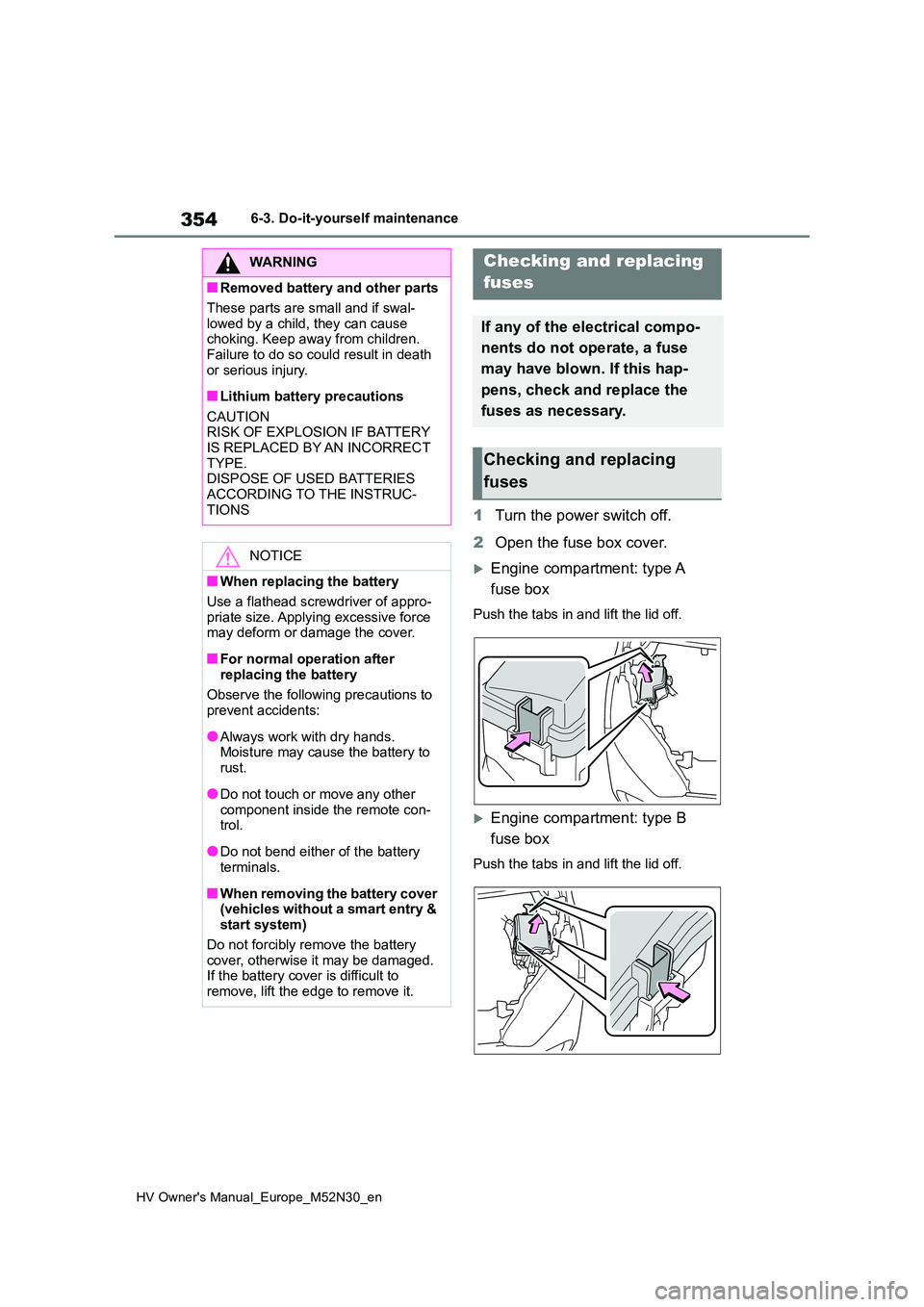
Engine compartment: type A
fuse box
Push the tabs in and lift the lid off.
Engine compartment: type B
fuse box
Push the tabs in and lift the lid off.
WARNING
■Removed battery and other parts
These parts are small and if swal-
lowed by a child, they can cause choking. Keep away from children. Failure to do so could result in death
or serious injury.
■Lithium battery precautions
CAUTION RISK OF EXPLOSION IF BATTERY IS REPLACED BY AN INCORRECT
TYPE. DISPOSE OF USED BATTERIES ACCORDING TO THE INSTRUC-
TIONS
NOTICE
■When replacing the battery
Use a flathead screwdriver of appro- priate size. Applying excessive force may deform or damage the cover.
■For normal operation after replacing the battery
Observe the following precautions to prevent accidents:
●Always work with dry hands.Moisture may cause the battery to
rust.
●Do not touch or move any other
component inside the remote con- trol.
●Do not bend either of the battery terminals.
■When removing the battery cover (vehicles without a smart entry & start system)
Do not forcibly remove the battery cover, otherwise it may be damaged. If the battery cover is difficult to
remove, lift the edge to remove it.
Checking and replacing
fuses
If any of the electrical compo-
nents do not operate, a fuse
may have blown. If this hap-
pens, check and replace the
fuses as necessary.
Checking and replacing
fuses