check engine TOYOTA YARIS 2022 User Guide
[x] Cancel search | Manufacturer: TOYOTA, Model Year: 2022, Model line: YARIS, Model: TOYOTA YARIS 2022Pages: 590, PDF Size: 128.6 MB
Page 285 of 590
283
4
HV Owner's Manual_Europe_M52N30_en
4-6. Driving tips
Driving
a traffic jam, gently release the
brake pedal to allow the vehicle to
move forward slightly while avoid-
ing overuse of the accelerator
pedal. Doing so can help control
excessive gasoline consumption.
Control and maintain the vehicle at
a constant speed. Before stopping
at a toll booth or similar, allow
plenty of time to release the accel-
erator and gently apply the brakes.
A greater amount of electrical
energy can be regenerated when
slowing down.
Use the air conditioning only when
necessary. Doing so can help
reduce excessive gasoline con-
sumption.
In summer: When the ambient tem-
perature is high, use the recircu-
lated air mode. Doing so will help to
reduce the burden on the air condi-
tioning system and reduce fuel con-
sumption as well.
In winter: Because the gasoline
engine will not automatically cut out
until it and the interior of the vehicle
are warm, it will consume fuel. Also,
fuel consumption can be improved
by avoiding overuse of the heater.
Make sure to check the tire inflation
pressure frequently. Improper tire
inflation pressure can cause poor
fuel economy.
Also, as snow tires can cause large
amounts of friction, their use on dry
roads can lead to poor fuel econ-
omy. Use tires that are appropriate
for the season.
Carrying heavy luggage will lead to
poor fuel economy. Avoid carrying
unnecessary luggage. Installing a
large roof rack will also cause poor
fuel economy.
Since the gasoline engine starts up
and cuts out automatically when
cold, warming up the engine is
unnecessary. Moreover, frequently
driving short distances will cause
the engine to repeatedly warm up,
which can lead to excess fuel con-
sumption.
Highway driving
Air conditioning
Checking tire inflation pres-
sure
Luggage
Warming up before driving
Page 313 of 590
6
311
HV Owner's Manual_Europe_M52N30_en
6
Maintenance and care
Maintenance and care
6-1. Maintenance and care
Cleaning and protecting the
vehicle exterior ............... 312
Cleaning and protecting the
vehicle interior ................ 315
6-2. Maintenance
Maintenance requirements 318
6-3. Do-it-yourself maintenance
Do-it-yourself service precau-
tions ................................ 320
Hood ................................. 322
Positioning a floor jack...... 323
Engine compartment ........ 325
12-volt battery ................... 330
Tires .................................. 332
Tire inflation pressure ....... 342
Wheels.............................. 344
Air conditioning filter ......... 346
Cleaning the hybrid battery
(traction battery) air intake
vent and filter .................. 348
Wireless remote control/elec-
tronic key battery ............ 351
Checking and replacing fuses
....................................... 354
Light bulbs ........................ 357
Page 321 of 590
319
6
HV Owner's Manual_Europe_M52N30_en
6-2. Maintenance
Maintenance and care
request that a record of maintenance
be kept.
■Does your vehicle need repairs?
Be on the alert for changes in perfor- mance and sounds, and visual tip-offs
that indicate service is needed. Some important clues are:
●Engine misses (misfire), stumbling or pinging
●Appreciable loss of power
●Strange engine noises
●A fluid leak under the vehicle (How-ever, water dripping from the air con-
ditioning system after use is normal.)
●Change in exhaust sound (This may
indicate a dangerous carbon monox- ide leak. Drive with the windows open and have the exhaust system checked
immediately.)
●Flat-looking tires, excessive tire
squeal when cornering, uneven tire wear
●Vehicle pulls to one side when driven straight on a level road
●Strange noises related to suspension movement
●Loss of brake effectiveness, spongy feeling brake pedal, pedal almost touches the floor, vehicle pulls to one
side when braking
●Engine coolant temperature continu- ally higher than normal ( P.94, 99)
If you notice any of these clues, take
your vehicle to any authorized Toyota retailer or Toyota authorized repairer, or any reliable repairer as soon as possi-
ble. Your vehicle may need adjustment or repair.
Page 327 of 590
325
6
HV Owner's Manual_Europe_M52N30_en
6-3. Do-it-yourself maintenance
Maintenance and care
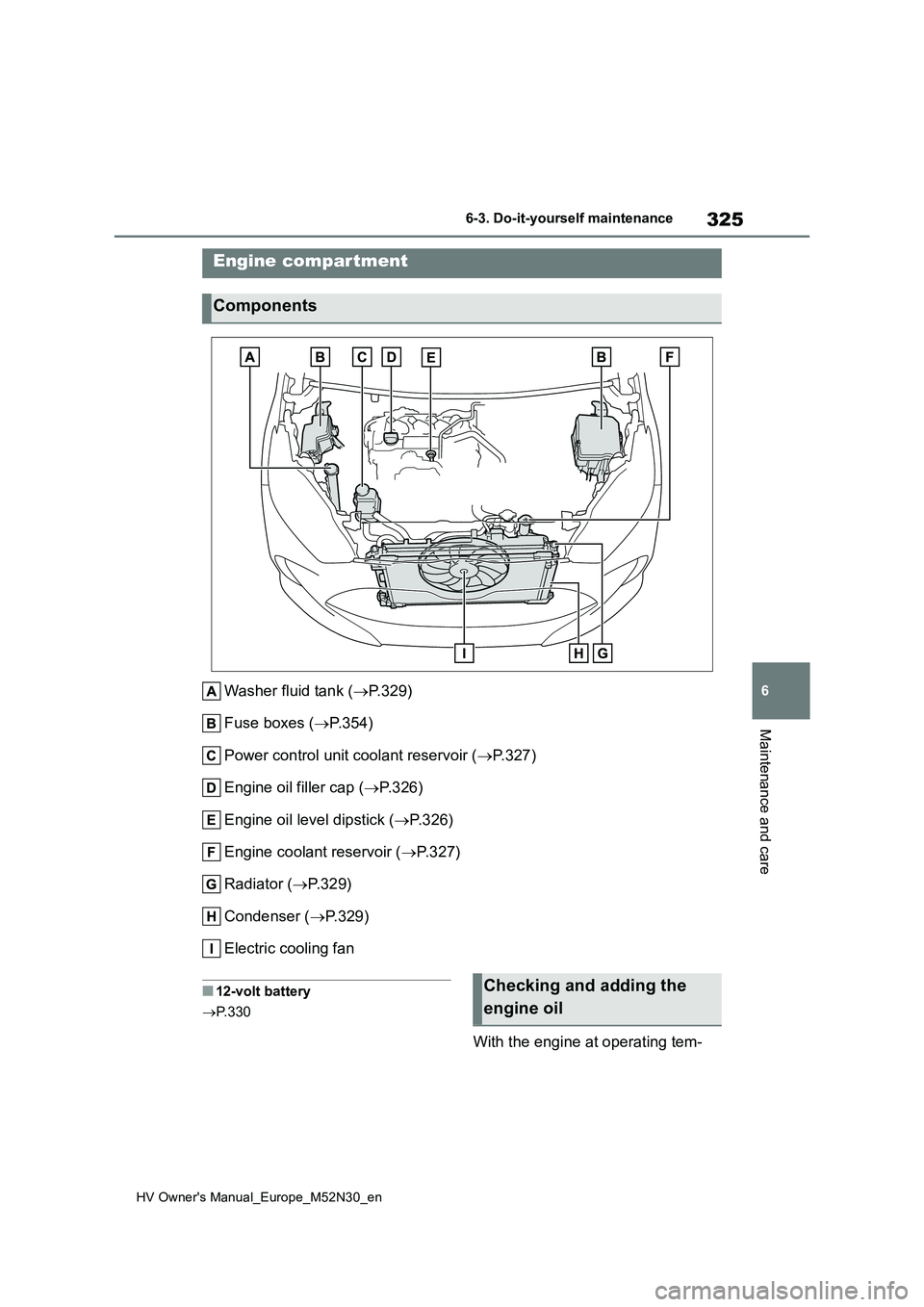
Washer fluid tank (P.329)
Fuse boxes ( P.354)
Power control unit coolant reservoir ( P.327)
Engine oil filler cap ( P.326)
Engine oil level dipstick ( P.326)
Engine coolant reservoir ( P. 3 2 7 )
Radiator ( P.329)
Condenser ( P.329)
Electric cooling fan
■12-volt battery
P. 3 3 0
With the engine at operating tem-
Engine compartment
Components
Checking and adding the
engine oil
Page 328 of 590
326
HV Owner's Manual_Europe_M52N30_en
6-3. Do-it-yourself maintenance
perature and turned off, check the
oil level on the dipstick.
■Checking the engine oil
1 Park the vehicle on level
ground. After warming up the
engine and turning off the hybrid
system, wait more than 5 min-
utes for the oil to drain back into
the bottom of the engine.
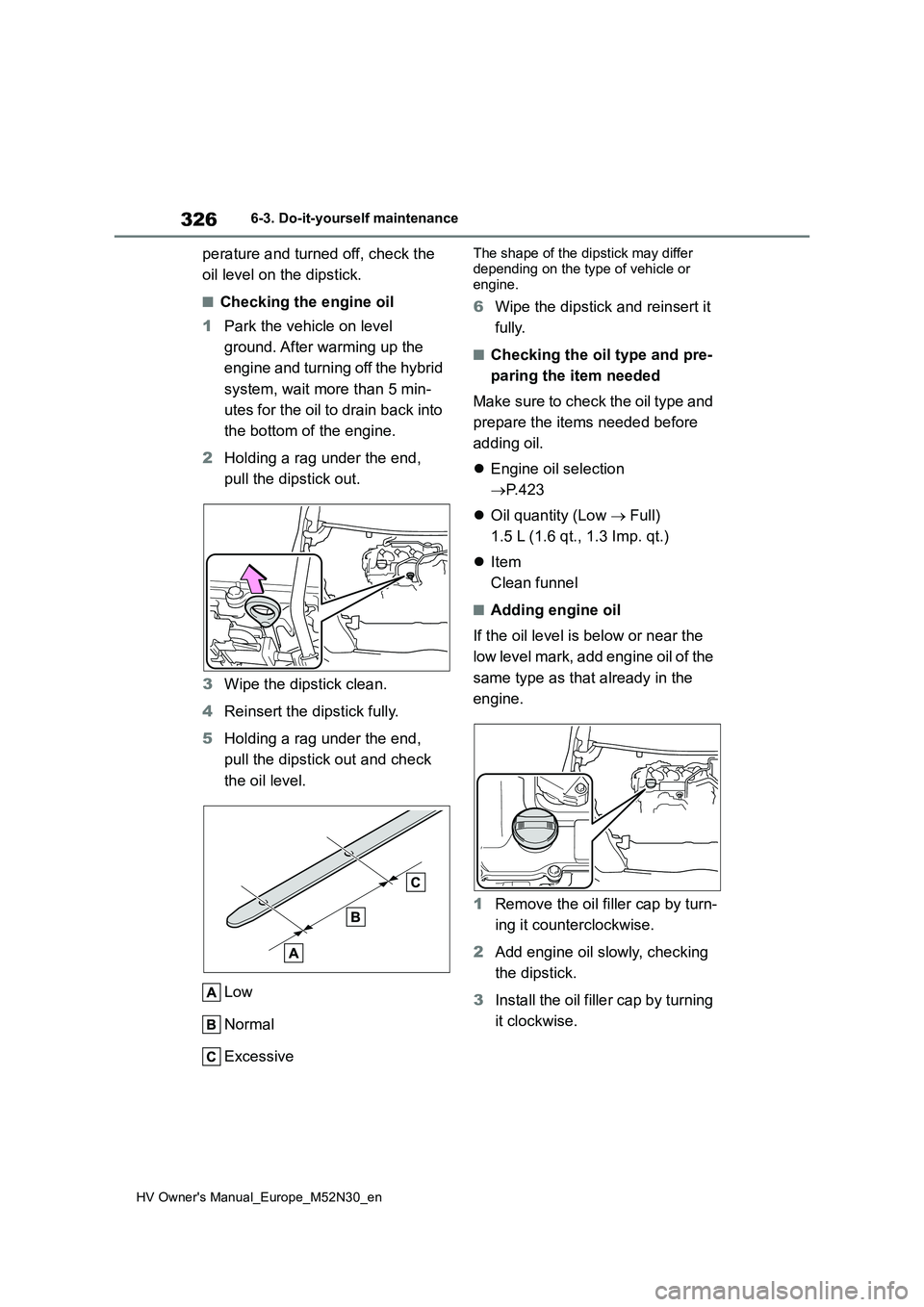
2 Holding a rag under the end,
pull the dipstick out.
3 Wipe the dipstick clean.
4 Reinsert the dipstick fully.
5 Holding a rag under the end,
pull the dipstick out and check
the oil level.
Low
Normal
Excessive
The shape of the dipstick may differ
depending on the type of vehicle or engine.
6 Wipe the dipstick and reinsert it
fully.
■Checking the oil type and pre-
paring the item needed
Make sure to check the oil type and
prepare the items needed before
adding oil.
Engine oil selection
P.423
Oil quantity (Low Full)
1.5 L (1.6 qt., 1.3 Imp. qt.)
Item
Clean funnel
■Adding engine oil
If the oil level is below or near the
low level mark, add engine oil of the
same type as that already in the
engine.
1 Remove the oil filler cap by turn-
ing it counterclockwise.
2 Add engine oil slowly, checking
the dipstick.
3 Install the oil filler cap by turning
it clockwise.
Page 329 of 590
327
6
HV Owner's Manual_Europe_M52N30_en
6-3. Do-it-yourself maintenance
Maintenance and care
■Engine oil consumption
A certain amount of engine oil will be
consumed while driving. In the following situations, oil consumption may increase, and engine oil may need to be
refilled in between oil maintenance inter- vals.
●When the engine is new, for example directly after purchasing the vehicle or after replacing the engine
●If low quality oil or oil of an inappropri-ate viscosity is used
●When driving at high engine speeds or with a heavy load, when towing
(vehicles with towing packages), or when driving while accelerating or decelerating frequently
●When leaving the engine idling for a long time, or when driving frequently
through heavy traffic
■After changing the engine oil
The engine oil maintenance data should be reset. Perform the following proce-
dures:
1 Press / (vertical display) or
/ (horizontal display) of the
meter control switch to select .
2 Press / (vertical display) or
/ (horizontal display) to
select “Vehicle Settings” and then
press and hold .
3 Press / to select “Oil Mainte-
nance” and then press .
4 Press / to select “Yes” and
then press .
A message will be displayed on the multi-information display when the reset
procedure has been completed.
■Engine coolant reservoir
The coolant level is satisfactory if it
is between the “F” and “L” lines on
WARNING
■Used engine oil
●Used engine oil contains poten-
tially harmful contaminants which may cause skin disorders such as inflammation and skin cancer, so
care should be taken to avoid pro- longed and repeated contact. To remove used engine oil from your
skin, wash thoroughly with soap and water.
●Dispose of used oil and filters only in a safe and acceptable manner. Do not dispose of used oil and fil-
ters in household trash, in sewers or onto the ground.Call any authorized Toyota retailer
or Toyota authorized repairer, or any reliable repairer, service station or auto parts store for information
concerning recycling or disposal.
●Do not leave used engine oil within
the reach of children.
NOTICE
■To prevent serious engine dam- age
Check the oil level on a regular basis.
■When replacing the engine oil
●Be careful not to spill engine oil on
the vehicle components.
●Avoid overfilling, or the engine
could be damaged.
●Check the oil level on the dipstick
every time you refill the vehicle.
●Be sure the engine oil filler cap is
properly tightened.
Checking the coolant
Page 330 of 590
328
HV Owner's Manual_Europe_M52N30_en
6-3. Do-it-yourself maintenance
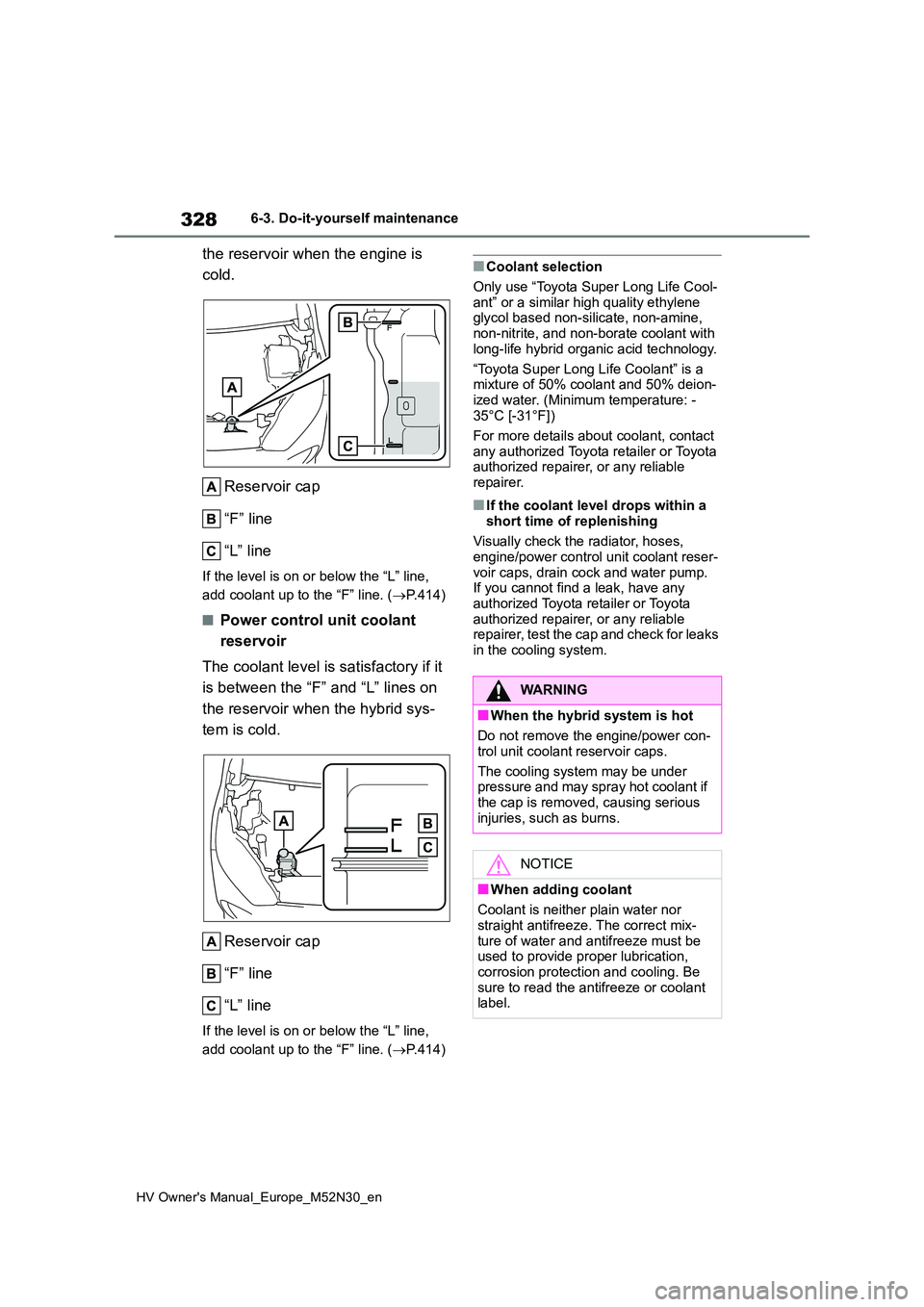
the reservoir when the engine is
cold.
Reservoir cap
“F” line
“L” line
If the level is on or below the “L” line,
add coolant up to the “F” line. ( P.414)
■Power control unit coolant
reservoir
The coolant level is satisfactory if it
is between the “F” and “L” lines on
the reservoir when the hybrid sys-
tem is cold.
Reservoir cap
“F” line
“L” line
If the level is on or below the “L” line,
add coolant up to the “F” line. ( P.414)
■Coolant selection
Only use “Toyota Super Long Life Cool-
ant” or a similar high quality ethylene glycol based non-silicate, non-amine, non-nitrite, and non-borate coolant with
long-life hybrid organic acid technology.
“Toyota Super Long Life Coolant” is a mixture of 50% coolant and 50% deion-
ized water. (Minimum temperature: - 35°C [-31°F])
For more details about coolant, contact
any authorized Toyota retailer or Toyota authorized repairer, or any reliable repairer.
■If the coolant level drops within a
short time of replenishing
Visually check the radiator, hoses, engine/power control unit coolant reser-
voir caps, drain cock and water pump. If you cannot find a leak, have any authorized Toyota retailer or Toyota
authorized repairer, or any reliable repairer, test the cap and check for leaks in the cooling system.
WARNING
■When the hybrid system is hot
Do not remove the engine/power con-
trol unit coolant reservoir caps.
The cooling system may be under pressure and may spray hot coolant if
the cap is removed, causing serious injuries, such as burns.
NOTICE
■When adding coolant
Coolant is neither plain water nor straight antifreeze. The correct mix-
ture of water and antifreeze must be used to provide proper lubrication, corrosion protection and cooling. Be
sure to read the antifreeze or coolant label.
Page 331 of 590
329
6
HV Owner's Manual_Europe_M52N30_en
6-3. Do-it-yourself maintenance
Maintenance and care
Check the radiator and condenser
and clear away any foreign objects.
If either of the above parts is
extremely dirty or you are not sure
of their condition, have your vehicle
inspected by any authorized Toyota
retailer or Toyota authorized
repairer, or any reliable repairer.
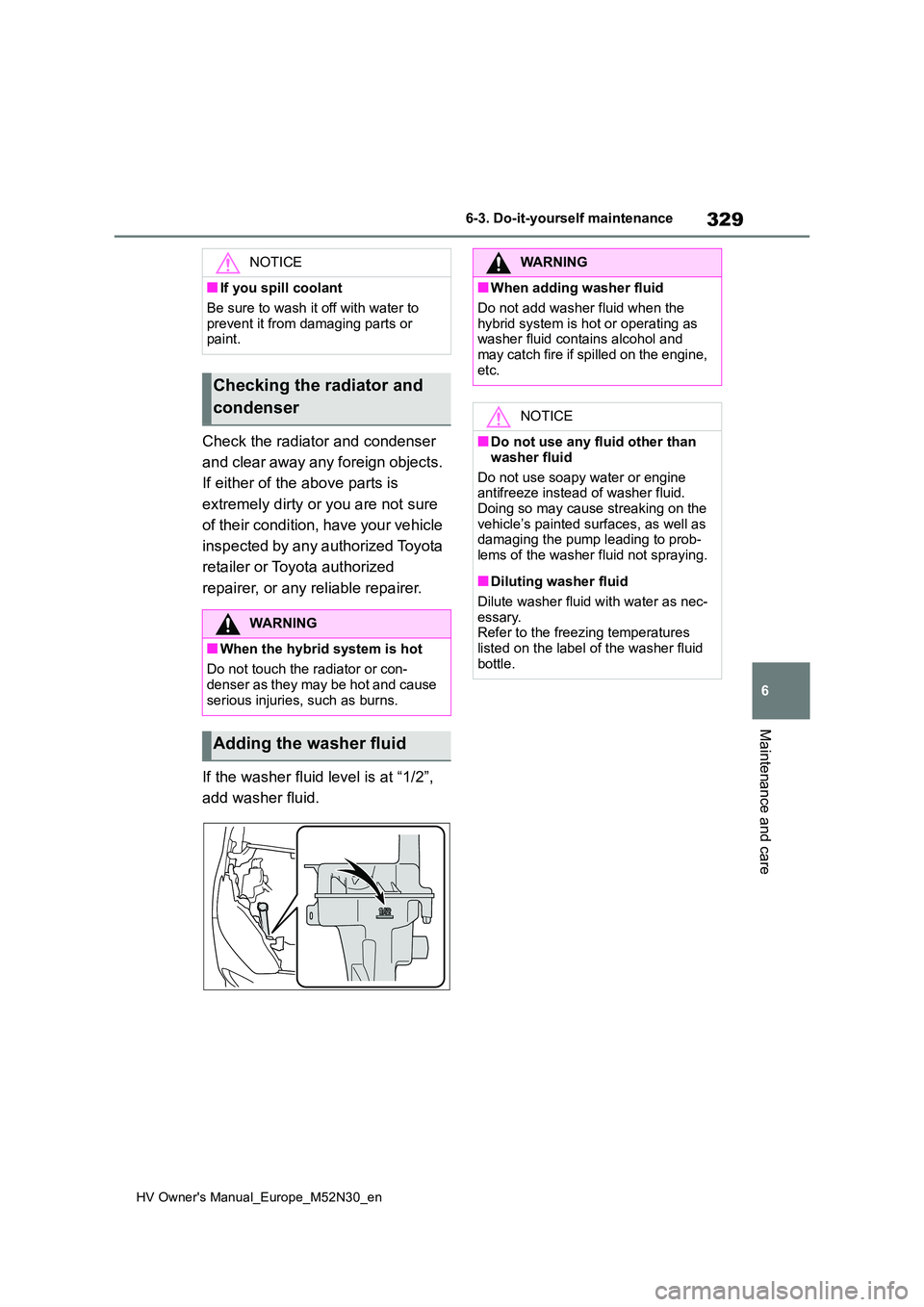
If the washer fluid level is at “1/2”,
add washer fluid.
NOTICE
■If you spill coolant
Be sure to wash it off with water to
prevent it from damaging parts or paint.
Checking the radiator and
condenser
WARNING
■When the hybrid system is hot
Do not touch the radiator or con-
denser as they may be hot and cause serious injuries, such as burns.
Adding the washer fluid
WARNING
■When adding washer fluid
Do not add washer fluid when the
hybrid system is hot or operating as washer fluid contains alcohol and may catch fire if spilled on the engine,
etc.
NOTICE
■Do not use any fluid other than
washer fluid
Do not use soapy water or engine antifreeze instead of washer fluid.
Doing so may cause streaking on the vehicle’s painted surfaces, as well as damaging the pump leading to prob-
lems of the washer fluid not spraying.
■Diluting washer fluid
Dilute washer fluid with water as nec- essary.Refer to the freezing temperatures
listed on the label of the washer fluid bottle.
Page 356 of 590
354
HV Owner's Manual_Europe_M52N30_en
6-3. Do-it-yourself maintenance
1Turn the power switch off.
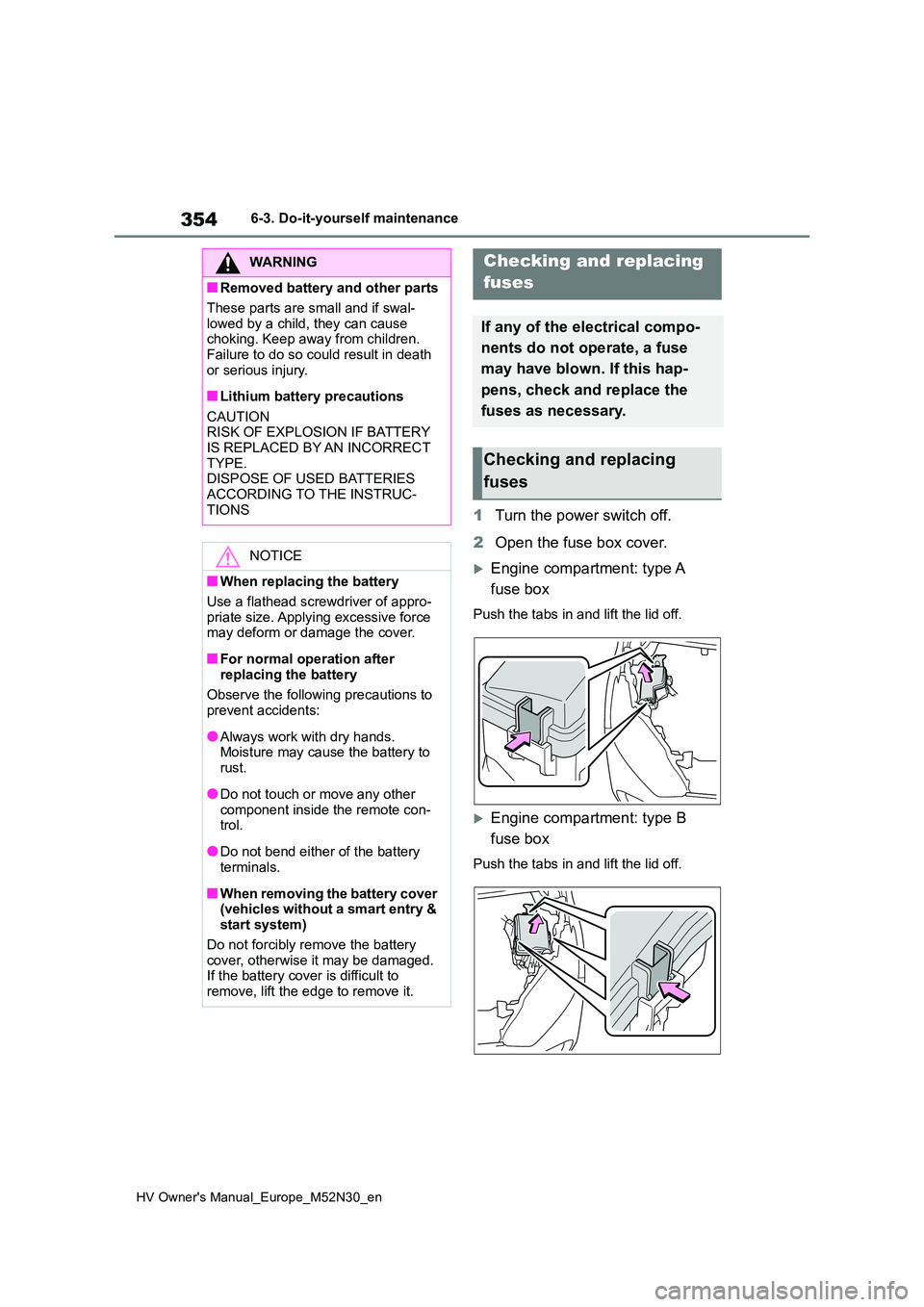
2 Open the fuse box cover.
Engine compartment: type A
fuse box
Push the tabs in and lift the lid off.
Engine compartment: type B
fuse box
Push the tabs in and lift the lid off.
WARNING
■Removed battery and other parts
These parts are small and if swal-
lowed by a child, they can cause choking. Keep away from children. Failure to do so could result in death
or serious injury.
■Lithium battery precautions
CAUTION RISK OF EXPLOSION IF BATTERY IS REPLACED BY AN INCORRECT
TYPE. DISPOSE OF USED BATTERIES ACCORDING TO THE INSTRUC-
TIONS
NOTICE
■When replacing the battery
Use a flathead screwdriver of appro- priate size. Applying excessive force may deform or damage the cover.
■For normal operation after replacing the battery
Observe the following precautions to prevent accidents:
●Always work with dry hands.Moisture may cause the battery to
rust.
●Do not touch or move any other
component inside the remote con- trol.
●Do not bend either of the battery terminals.
■When removing the battery cover (vehicles without a smart entry & start system)
Do not forcibly remove the battery cover, otherwise it may be damaged. If the battery cover is difficult to
remove, lift the edge to remove it.
Checking and replacing
fuses
If any of the electrical compo-
nents do not operate, a fuse
may have blown. If this hap-
pens, check and replace the
fuses as necessary.
Checking and replacing
fuses
Page 359 of 590
357
6
HV Owner's Manual_Europe_M52N30_en
6-3. Do-it-yourself maintenance
Maintenance and care
Check the wattage of the light bulb
to be replaced. ( P.428)
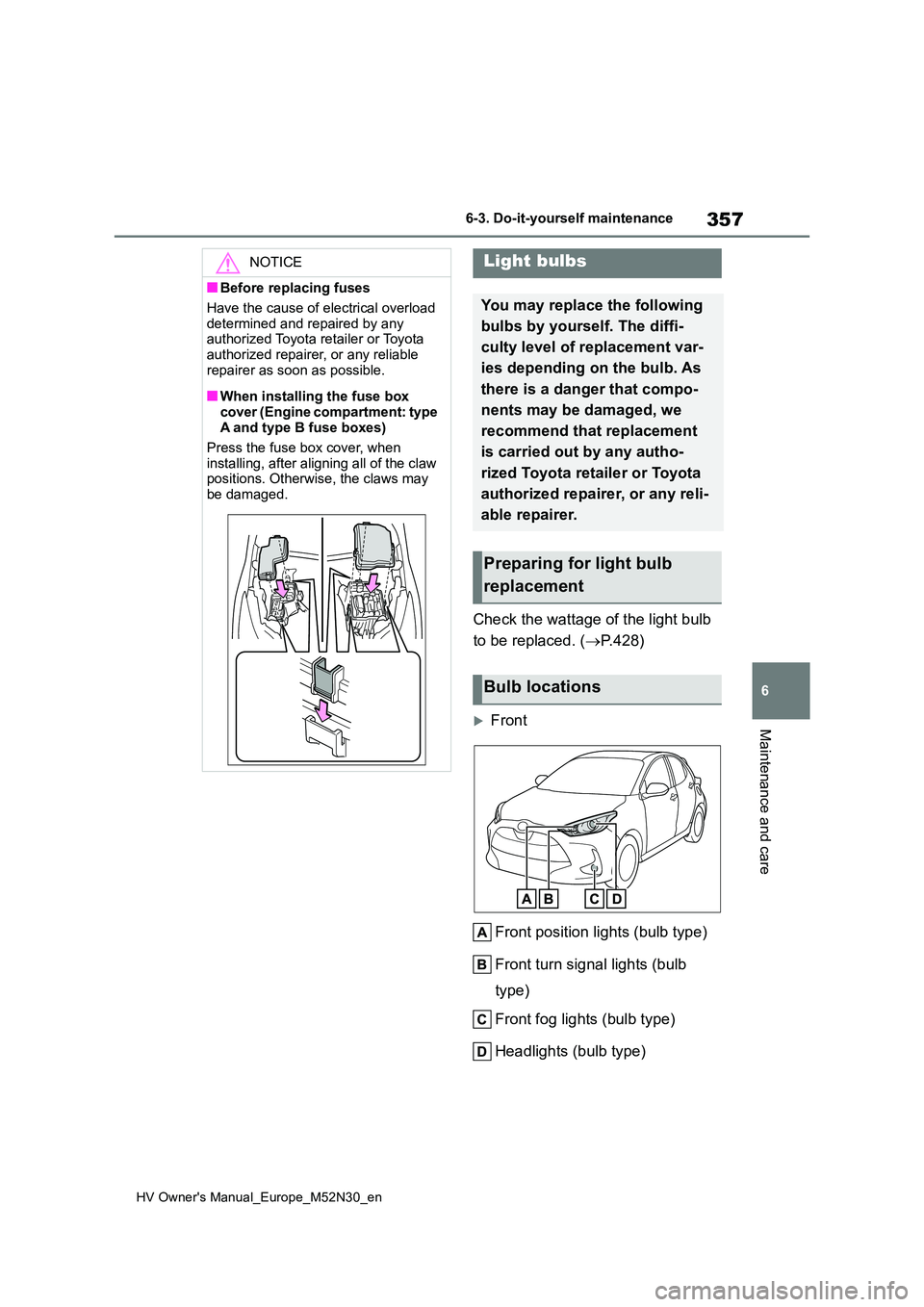
Front
Front position lights (bulb type)
Front turn signal lights (bulb
type)
Front fog lights (bulb type)
Headlights (bulb type)
NOTICE
■Before replacing fuses
Have the cause of electrical overload
determined and repaired by any authorized Toyota retailer or Toyota authorized repairer, or any reliable
repairer as soon as possible.
■When installing the fuse box
cover (Engine compartment: type A and type B fuse boxes)
Press the fuse box cover, when
installing, after aligning all of the claw positions. Otherwise, the claws may be damaged.
Light bulbs
You may replace the following
bulbs by yourself. The diffi-
culty level of replacement var-
ies depending on the bulb. As
there is a danger that compo-
nents may be damaged, we
recommend that replacement
is carried out by any autho-
rized Toyota retailer or Toyota
authorized repairer, or any reli-
able repairer.
Preparing for light bulb
replacement
Bulb locations