Replacing TOYOTA YARIS CROSS 2023 Owners Manual
[x] Cancel search | Manufacturer: TOYOTA, Model Year: 2023, Model line: YARIS CROSS, Model: TOYOTA YARIS CROSS 2023Pages: 698, PDF Size: 147.65 MB
Page 6 of 698

4
Owners Manual_Europe_M52N75_en
TABLE OF CONTENTS
5-1. Using the air conditioning
system and defogger
Automatic air conditioning sys-
tem .................................... 342
Heated steering wheel/seat
heaters.............................. 348
5-2. Using the interior lights
Interior lights list .................. 350
5-3. Using the storage features
List of storage features ....... 352
Luggage compartment features
.......................................... 355
5-4. Other interior features
Other interior features ......... 359
6-1. Maintenance and care
Cleaning and protecting the
vehicle exterior ................. 368
Cleaning and protecting the
vehicle interior .................. 371
6-2. Maintenance
Maintenance requirements . 376
6-3. Do-it-yourself maintenance
Do-it-yourself service precau-
tions .................................. 378
Hood ................................... 380
Positioning a floor jack ........ 381
Engine compartment........... 383
12-volt battery ..................... 388
Tires .................................... 390
Tire inflation pressure ......... 400
Wheels ................................ 402
Air conditioning filter ........... 404
Cleaning the hybrid battery (trac-
tion battery) air intake vent and
filter ................................... 406
Wireless remote control/elec-
tronic key battery .............. 409
Checking and replacing fuses
.......................................... 413
Light bulbs .......................... 417
7-1. Essential information
Emergency flashers ............ 426
If your vehicle has to be stopped
in an emergency ............... 426
If the vehicle is submerged or
water on the road is rising 427
5Interior features
6Maintenance and care
7When trouble arises
Page 15 of 698
13
Owners Manual_Europe_M52N75_en
Pictorial index
Precautions for car wash (vehicles with rain-sensing windshield wipers)
............................................................... ..........................................P.369
Fuel filler door ............................................... .................................P.224
Refueling method ............................................... ..............................P.225
Fuel type/fuel tank capacity ................................... ..........................P.486
Tires .......................................................... ......................................P.390
Tire size/inflation pressure ................................... ............................P.490
Winter tires/tire chains ....................................... ..............................P.337
Checking/rotation/tire pressure warning system ................. .............P.390
Coping with flat tires......................................... ........................P.448, 459
Hood ........................................................... .....................................P.380
Opening ........................................................ ...................................P.380
Engine oil ..................................................... ....................................P.486
Coping with overheating ........................................ ..........................P.477
Headlights/front position lights ............................... .............P.200, 206
Turn signal lights/daytime running lights ...................... ......P.200, 206
Front fog lights*2............................................................... .............P.218
Tail lights/turn signal lights ................................. .................P.200, 206
Stop lights
Tail lights*2 /turn signal lights*2............................................P.200, 206
Rear fog light*2............................................................... ................P.218
Back-up light*2
Shifting the shift position to R ............................... ...........................P.197
Side turn signal lights ........................................ ...........................P.200
License plate lights........................................... .............................P.206
*1: Vehicles with a smart entry & start system
Light bulbs of the exterior lights for driving
(Replacing method: P.417, Watts: P.492)
Page 39 of 698

37
1
Owners Manual_Europe_M52N75_en
1-1. For safe use
For safety and security
2To release the seat belt, press
the release button .
■Emergency locking retractor (ELR)
The retractor will lock the belt during a sudden stop or on impact. It may also lock if you lean forward too quickly.
When the seat belt locks, pull the belt strongly and then release the belt, then a slow and easy pulling will allow the
belt to extend.
■After using the rear center seat belt
Stow seat belt buckle in the pocket.
The pretensioners help the seat
belts to quickly restrain the occu-
pants by retracting the seat belts
when the vehicle is subjected to
certain types of severe frontal or
side collision.
The pretensioners do not activate in the
event of a minor frontal impact, a minor
side impact, a rear impact or a vehicle
rollover.
■Replacing the belt after the pretensioner has been activated
If the vehicle is involved in multiple colli-
sions, the pretensioner will activate for the first collision, but will not activate for the second or subsequent collisions.
■PCS-linked seat belt pretensioner
control (vehicles with Toyota Safety Sense)
If the PCS (Pre-Collision System) deter-
mines that the possibility of a collision with a vehicle is high, the seat belt pretensioners will be prepared to oper-
ate.
Seat belt pretensioners
(front and outboard rear
seats)
WARNING
■Seat belt pretensioners
If the pretensioner has activated, the SRS warning light will come on. In that case, the seat belt cannot be
used again and must be replaced at any authorized Toyota retailer or Toyota authorized repairer, or any reli-
able repairer.
Failure to do so may cause death or serious injury.
Page 89 of 698

87
1
Owners Manual_Europe_M52N75_en
1-5. Theft deterrent system
For safety and security
●A person inside the vehicle opens a
door or hood, or unlocks the vehicle.
●The 12-volt battery is recharged or
replaced when the vehicle is locked. ( P.474)
■Alarm-operated door lock
In the following cases, depending on the situation, the door may automatically
lock to prevent improper entry into the vehicle:
●When a person remaining in the vehi-cle unlocks the door and the alarm is activated.
●While the alarm is activated, a person remaining in the vehicle unlocks the
door.
●When recharging or replacing the 12-
volt battery
■Customization
Some functions can be customized. ( P.494)
NOTICE
■To ensure the system operates correctly
Do not modify or remove the system. If modified or removed, the proper operation of the system cannot be
guaranteed.
Page 133 of 698
131
3
Owners Manual_Europe_M52N75_en
3-1. Key information
Before driving
battery may be depleted. Replace the
battery when necessary. ( P.409) • The wireless remote control does not operate.
• The detection area becomes smaller.
■Key battery depletion (vehicles with a smart entry & start system)
●The standard battery life is 1 to 2 years.
●If the battery becomes low, an alarm will sound in the cabin and a message will be shown on the multi-information
display when the hybrid system is stopped.
●To reduce key battery depletion when the electronic key is to not be used for long periods of time, set the electronic
key to the battery-saving mode. ( P.153)
●As the electronic key always receives radio waves, the battery will become depleted even if the electronic key is
not used. The following symptoms indicate that the electronic key battery may be depleted. Replace the battery
when necessary. ( P.409) • The smart entry & start system or the wireless remote control does not oper-
ate. • The detection area becomes smaller.• The LED indicator on the key surface
does not turn on.
●To avoid serious deterioration, do not
leave the electronic key within 1 m (3 ft.) of the following electrical appli-ances that produce a magnetic field:
•TVs • Personal computers• Cellular phones, cordless phones and
battery chargers • Recharging cellular phones or cord-less phones
• Table lamps • Induction cookers
●If the electronic key is near the vehicle for longer than necessary, even if the smart entry & start system is not oper-
ated, the key battery may become depleted faster than normal.
■Replacing the battery
P. 4 0 9
■If “New Key Registered Contact Your Dealer if You Did Not Register a New Key” is shown on the multi-
information display (vehicles with a smart entry & start system)
This message will be displayed each
time the driver’s door is opened when the doors are unlocked from the outside for approximately 10 days after a new
electronic key has been registered. If this message is displayed but you have not had a new electronic key regis-
tered, ask any authorized Toyota retailer or Toyota authorized repairer, or any reli-able repairer to check if an unknown
electronic key (other than those in your possession) has been registered.
■If a wrong key is used
The key cylinder rotates freely, isolated
from the internal mechanism.
NOTICE
■To prevent key damage
●Do not drop the keys, subject them
to strong shocks, or bend them.
●Do not expose the keys to high
temperatures for long periods of time.
●Do not get the keys wet or wash them in an ultrasonic washer, etc.
●Vehicles with a smart entry & start system: Do not attach metallic or magnetic materials to the keys or
place the keys close to such materi- als.
●Do not disassemble the keys.
●Do not attach a sticker or anything
else to the surface of the key.
Page 227 of 698

225
4
Owners Manual_Europe_M52N75_en
4-4. Refueling
Driving
1Pull up the opener to open the
fuel filler door.
2 Turn the fuel tank cap slowly
and remove it, then hang it on
the back of the fuel filler door.
After refueling, turn the fuel tank
cap until you hear a click. Once the
cap is released, it will turn slightly in
the opposite direction.
NOTICE
■Refueling
Do not spill fuel during refueling.
Doing so may damage the vehicle, such as causing the emission control system to operate abnormally or dam-
aging fuel system components or the vehicle’s painted surface.
Opening the fuel tank cap
Closing the fuel tank cap
WARNING
■When replacing the fuel tank cap
Do not use anything but a genuine
Toyota fuel tank cap designed for your vehicle. Doing so may cause a fire or other incident which may result in
death or serious injury.
Page 230 of 698
228
Owners Manual_Europe_M52N75_en
4-5. Using the driving support systems
WARNING
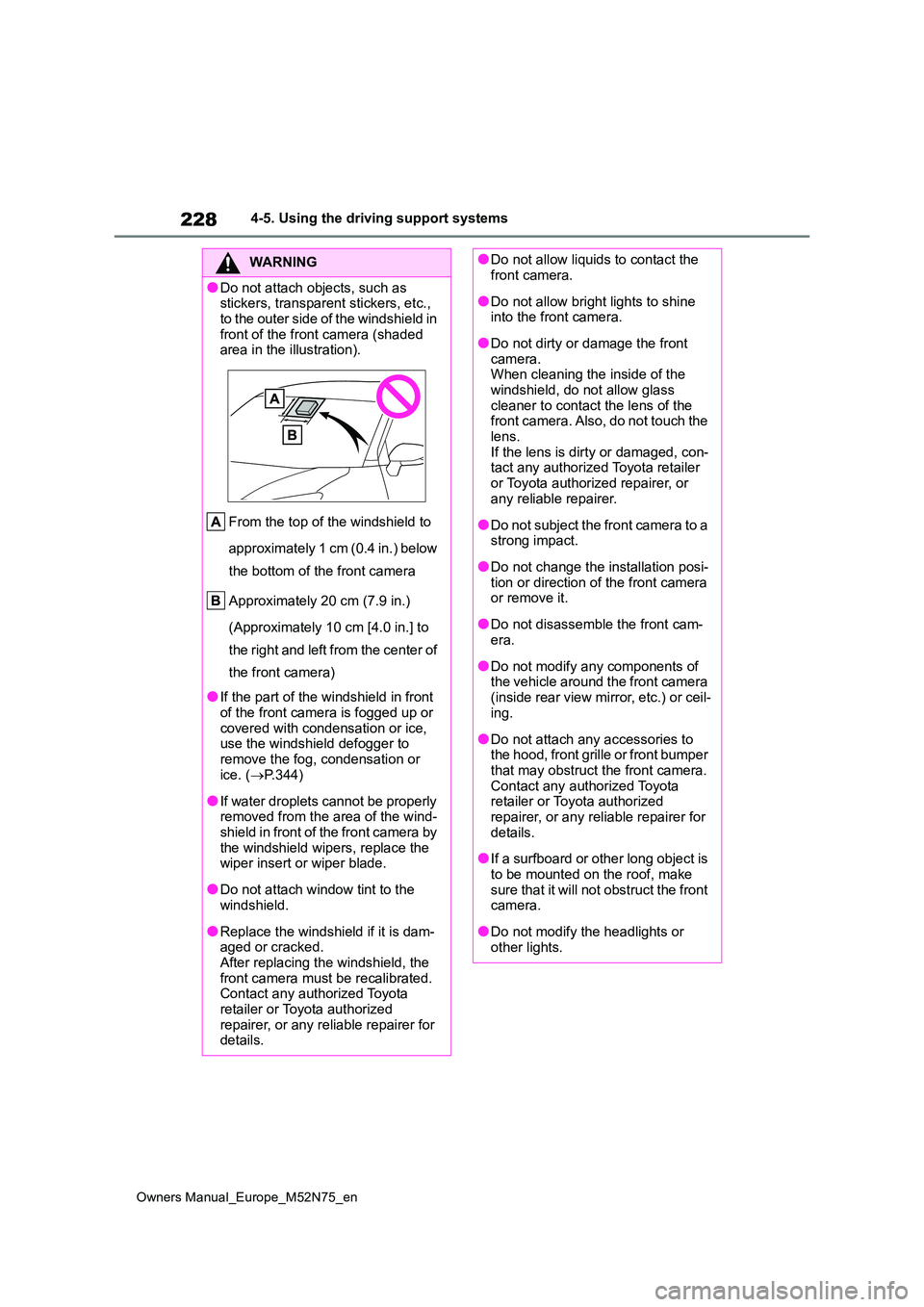
●Do not attach objects, such as stickers, transparent stickers, etc.,
to the outer side of the windshield in front of the front camera (shaded area in the illustration).
From the top of the windshield to
approximately 1 cm (0.4 in.) below
the bottom of the front camera
Approximately 20 cm (7.9 in.)
(Approximately 10 cm [4.0 in.] to
the right and left from the center of
the front camera)
●If the part of the windshield in front
of the front camera is fogged up or covered with condensation or ice, use the windshield defogger to
remove the fog, condensation or ice. ( P.344)
●If water droplets cannot be properly removed from the area of the wind-shield in front of the front camera by
the windshield wipers, replace the wiper insert or wiper blade.
●Do not attach window tint to the windshield.
●Replace the windshield if it is dam-aged or cracked.After replacing the windshield, the
front camera must be recalibrated. Contact any authorized Toyota retailer or Toyota authorized
repairer, or any reliable repairer for details.
●Do not allow liquids to contact the front camera.
●Do not allow bright lights to shine into the front camera.
●Do not dirty or damage the front camera.When cleaning the inside of the
windshield, do not allow glass cleaner to contact the lens of the front camera. Also, do not touch the
lens. If the lens is dirty or damaged, con-tact any authorized Toyota retailer
or Toyota authorized repairer, or any reliable repairer.
●Do not subject the front camera to a strong impact.
●Do not change the installation posi-tion or direction of the front camera or remove it.
●Do not disassemble the front cam-era.
●Do not modify any components of the vehicle around the front camera
(inside rear view mirror, etc.) or ceil- ing.
●Do not attach any accessories to the hood, front grille or front bumper that may obstruct the front camera.
Contact any authorized Toyota retailer or Toyota authorized repairer, or any reliable repairer for
details.
●If a surfboard or other long object is
to be mounted on the roof, make sure that it will not obstruct the front camera.
●Do not modify the headlights or other lights.
Page 335 of 698
333
4
Owners Manual_Europe_M52N75_en
4-5. Using the driving support systems
Driving
WARNING
■The ABS does not operate effec- tively when
●The limits of tire gripping perfor-mance have been exceeded (such as excessively worn tires on a snow
covered road).
●The vehicle hydroplanes while driv-
ing at high speed on wet or slick roads.
■Stopping distance when the ABS is operating may exceed that of normal conditions
The ABS is not designed to shorten the vehicle’s stopping distance. Always maintain a safe distance from
the vehicle in front of you, especially in the following situations:
●When driving on dirt, gravel or snow-covered roads
●When driving with tire chains
●When driving over bumps in the
road
●When driving over roads with pot-
holes or uneven surfaces
■TRC/VSC may not operate effec-
tively when
Directional control and power may not be achievable while driving on slip-
pery road surfaces, even if the TRC/VSC system is operating. Drive the vehicle carefully in conditions
where stability and power may be lost.
■Active Cornering Assist does not operate effectively when
●Do not overly rely on Active Corner-
ing Assist. Active Cornering Assist may not operate effectively when accelerating down slopes or driving
on slippery road surfaces.
●When Active Cornering Assist fre- quently operates, Active Cornering Assist may temporarily stop operat-
ing to ensure proper operation of the brakes, TRC and VSC.
■Hill-start assist control does not operate effectively when
●Do not overly rely on hill-start assist
control. Hill-start assist control may not operate effectively on steep inclines and roads covered with ice.
●Unlike the parking brake, hill-start assist control is not intended to hold
the vehicle stationary for an extended period of time. Do not attempt to use hill-start assist con-
trol to hold the vehicle on an incline, as doing so may lead to an acci-dent.
■When the TRC/ABS/VSC is acti-vated
The slip indicator light flashes. Always drive carefully. Reckless driving may cause an accident. Exercise particular
care when the indicator light flashes.
■When the TRC/VSC systems are
turned off
Be especially careful and drive at a speed appropriate to the road condi-
tions. As these are the systems to help ensure vehicle stability and driv-ing force, do not turn the TRC/VSC
systems off unless necessary.
■Replacing tires
Make sure that all tires are of the specified size, brand, tread pattern and total load capacity. In addition,
make sure that the tires are inflated to the recommended tire inflation pres-sure level.
The ABS, TRC and VSC systems will not function correctly if different tires are installed on the vehicle.
Contact any authorized Toyota retailer or Toyota authorized repairer, or any reliable repairer for further information
when replacing tires or wheels.
Page 339 of 698

337
4
Owners Manual_Europe_M52N75_en
4-6. Driving tips
Driving
Use fluids that are appropriate to
the prevailing outside tempera-
tures.
• Engine oil
• Engine/power control unit coolant
• Washer fluid
Have a service technician
inspect the condition of the 12-
volt battery.
Have the vehicle fitted with four
snow tires or purchase a set of
tire chains for the front tires.
Ensure that all tires are the same size
and brand, and that chains match the
size of the tires.
Perform the following according to
Winter driving tips
Carry out the necessary prepa-
rations and inspections before
driving the vehicle in winter.
Always drive the vehicle in a
manner appropriate to the pre-
vailing weather conditions.
Pre-winter preparations
WARNING
■Driving with snow tires
Observe the following precautions to
reduce the risk of accidents. Failure to do so may result in a loss of vehicle control and cause death or
serious injury.
●Use tires of the size specified.
●Maintain the recommended level of air pressure.
●Do not drive at speeds in excess of the speed limit or the speed limit specified for the snow tires being
used.
●Use snow tires on all, not just some
wheels.
■Driving with tire chains
Observe the following precautions to reduce the risk of accidents.Failure to do so may result in the vehi-
cle being unable to be driven safely, and may cause death or serious injury.
●Do not drive in excess of the speed limit specified for the tire chains
being used, or 50 km/h (30 mph), whichever is lower.
●Avoid driving on bumpy road sur-faces or over potholes.
●Avoid sudden acceleration, abrupt steering, sudden braking and shift-ing operations that cause sudden
engine braking.
●Slow down sufficiently before enter-
ing a curve to ensure that vehicle control is maintained.
●Do not use LTA (Lane Tracing Assist) system. (if equipped)
NOTICE
■Repairing or replacing snow tires
Request repairs or replacement of snow tires from any authorized Toyota retailer or Toyota authorized repairer,
or any reliable repairer or legitimate tire retailers.This is because the removal and
attachment of snow tires affects the operation of the tire pressure warning valves and transmitters.
Before driving the vehicle
Page 369 of 698
6
367
Owners Manual_Europe_M52N75_en
6
Maintenance and care
Maintenance and care
6-1. Maintenance and care
Cleaning and protecting the
vehicle exterior ............... 368
Cleaning and protecting the
vehicle interior ................ 371
6-2. Maintenance
Maintenance requirements 376
6-3. Do-it-yourself maintenance
Do-it-yourself service precau-
tions ................................ 378
Hood ................................. 380
Positioning a floor jack...... 381
Engine compartment ........ 383
12-volt battery ................... 388
Tires .................................. 390
Tire inflation pressure ....... 400
Wheels.............................. 402
Air conditioning filter ......... 404
Cleaning the hybrid battery
(traction battery) air intake
vent and filter .................. 406
Wireless remote control/elec-
tronic key battery ............ 409
Checking and replacing fuses
....................................... 413
Light bulbs ........................ 417