gas type TOYOTA YARIS CROSS 2023 Owners Manual
[x] Cancel search | Manufacturer: TOYOTA, Model Year: 2023, Model line: YARIS CROSS, Model: TOYOTA YARIS CROSS 2023Pages: 698, PDF Size: 147.65 MB
Page 42 of 698
40
Owners Manual_Europe_M52N75_en
1-1. For safe use
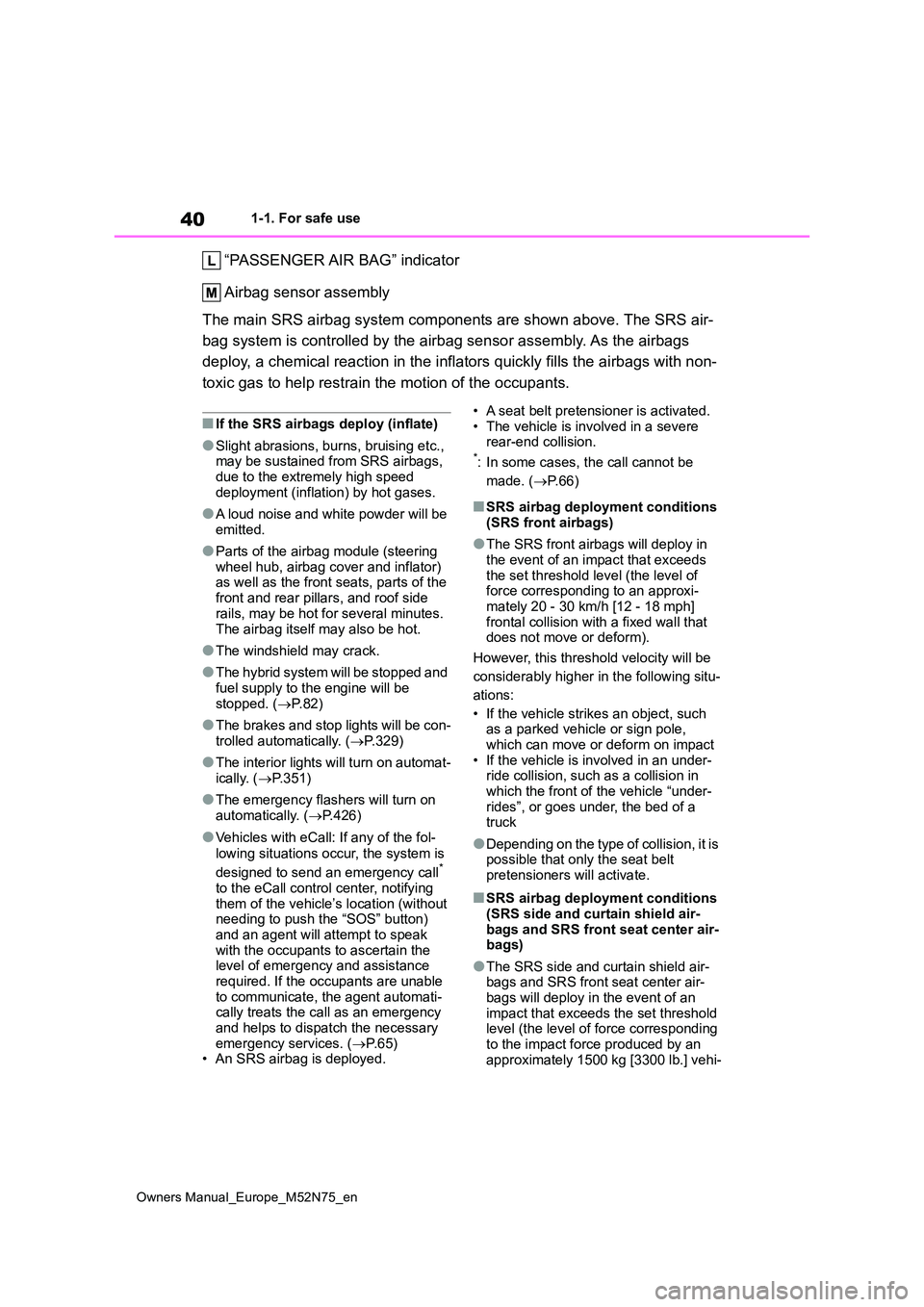
“PASSENGER AIR BAG” indicator
Airbag sensor assembly
The main SRS airbag system components are shown above. The SRS air-
bag system is controlled by the airbag sensor assembly. As the airbags
deploy, a chemical reaction in the inflators quickly fills the airbags with non-
toxic gas to help restrain the motion of the occupants.
■If the SRS airbags deploy (inflate)
●Slight abrasions, burns, bruising etc., may be sustained from SRS airbags,
due to the extremely high speed deployment (inflation) by hot gases.
●A loud noise and white powder will be emitted.
●Parts of the airbag module (steering wheel hub, airbag cover and inflator) as well as the front seats, parts of the
front and rear pillars, and roof side rails, may be hot for several minutes.
The airbag itself may also be hot.
●The windshield may crack.
●The hybrid system will be stopped and fuel supply to the engine will be
stopped. ( P.82)
●The brakes and stop lights will be con-
trolled automatically. ( P.329)
●The interior lights will turn on automat-
ically. ( P.351)
●The emergency flashers will turn on
automatically. ( P.426)
●Vehicles with eCall: If any of the fol-
lowing situations occur, the system is
designed to send an emergency call* to the eCall control center, notifying
them of the vehicle’s location (without needing to push the “SOS” button) and an agent will attempt to speak
with the occupants to ascertain the level of emergency and assistance required. If the occupants are unable
to communicate, the agent automati- cally treats the call as an emergency and helps to dispatch the necessary
emergency services. ( P.65) • An SRS airbag is deployed.
• A seat belt pretensioner is activated. • The vehicle is involved in a severe rear-end collision.*: In some cases, the call cannot be
made. ( P. 6 6 )
■SRS airbag deployment conditions
(SRS front airbags)
●The SRS front airbags will deploy in
the event of an impact that exceeds the set threshold level (the level of force corresponding to an approxi-
mately 20 - 30 km/h [12 - 18 mph] frontal collision with a fixed wall that does not move or deform).
However, this threshold velocity will be
considerably higher in the following situ-
ations:
• If the vehicle strikes an object, such as a parked vehicle or sign pole, which can move or deform on impact
• If the vehicle is involved in an under- ride collision, such as a collision in which the front of the vehicle “under-
rides”, or goes under, the bed of a truck
●Depending on the type of collision, it is possible that only the seat belt pretensioners will activate.
■SRS airbag deployment conditions
(SRS side and curtain shield air- bags and SRS front seat center air-bags)
●The SRS side and curtain shield air-bags and SRS front seat center air-
bags will deploy in the event of an impact that exceeds the set threshold level (the level of force corresponding
to the impact force produced by an approximately 1500 kg [3300 lb.] vehi-
Page 72 of 698
70
Owners Manual_Europe_M52N75_en
1-3. Emergency assistance
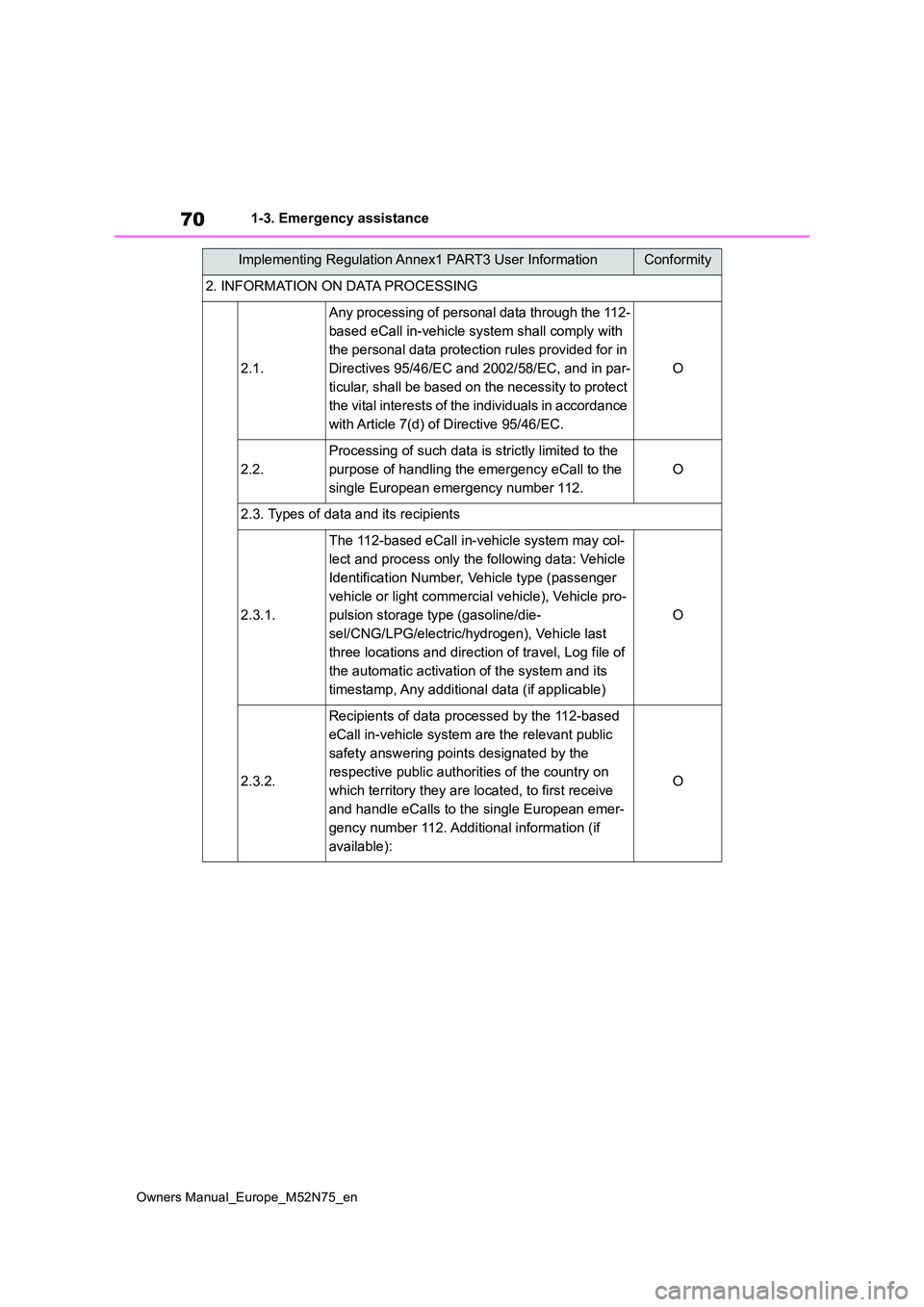
2. INFORMATION ON DATA PROCESSING
2.1.
Any processing of personal data through the 112-
based eCall in-vehicle system shall comply with
the personal data protection rules provided for in
Directives 95/46/EC and 2002/58/EC, and in par-
ticular, shall be based on the necessity to protect
the vital interests of the individuals in accordance
with Article 7(d) of Directive 95/46/EC.
O
2.2.
Processing of such data is strictly limited to the
purpose of handling the emergency eCall to the
single European emergency number 112.
O
2.3. Types of data and its recipients
2.3.1.
The 112-based eCall in-vehicle system may col-
lect and process only the following data: Vehicle
Identification Number, Vehicle type (passenger
vehicle or light commercial vehicle), Vehicle pro-
pulsion storage type (gasoline/die-
sel/CNG/LPG/electric/hydrogen), Vehicle last
three locations and direction of travel, Log file of
the automatic activation of the system and its
timestamp, Any additional data (if applicable)
O
2.3.2.
Recipients of data processed by the 112-based
eCall in-vehicle system are the relevant public
safety answering points designated by the
respective public authorities of the country on
which territory they are located, to first receive
and handle eCalls to the single European emer-
gency number 112. Additional information (if
available):
O
Implementing Regulation Annex1 PART3 User InformationConformity
Page 113 of 698
111
2
Owners Manual_Europe_M52N75_en
2-1. Instrument cluster
Vehicle status information and indicators
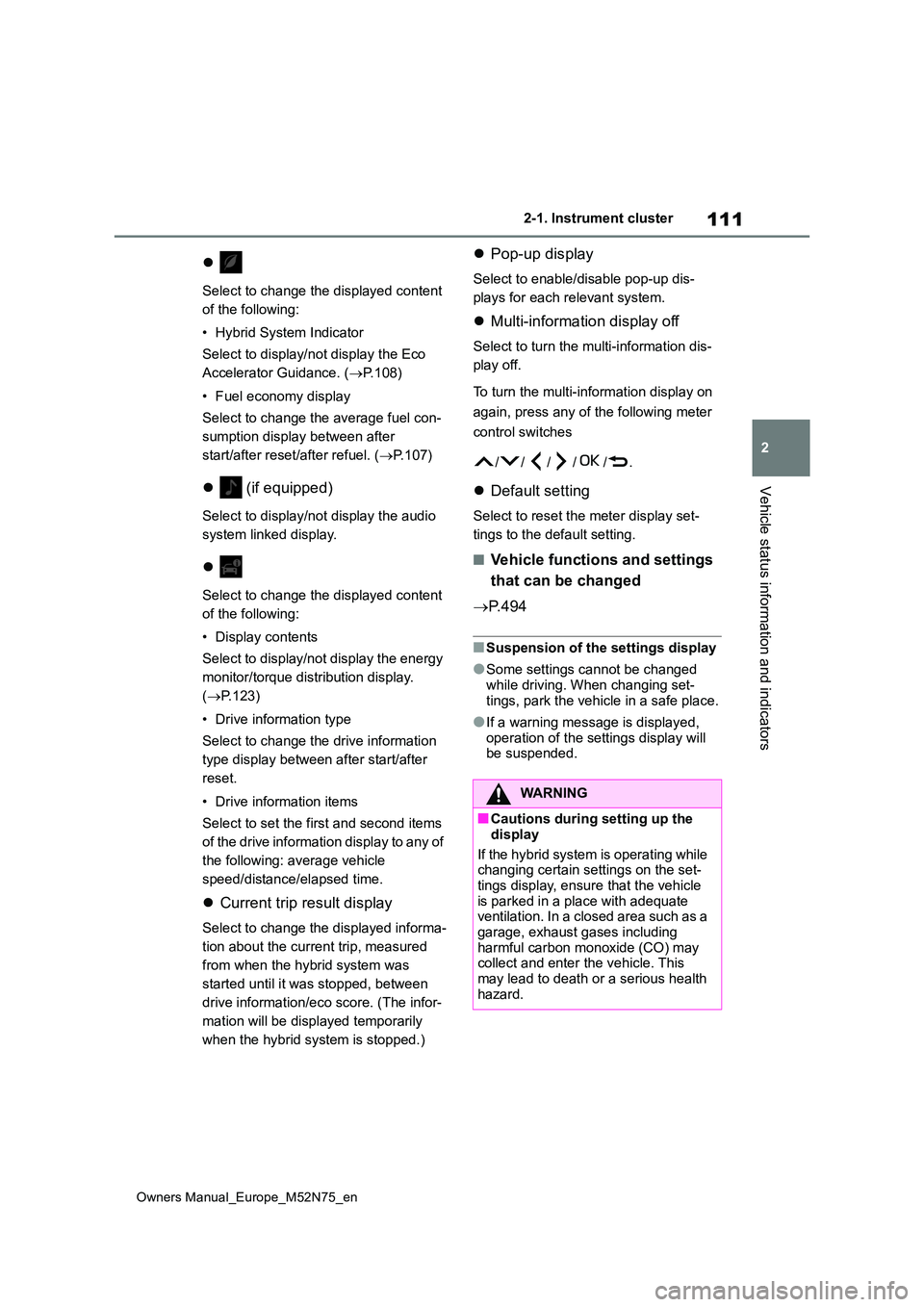
Select to change the displayed content
of the following:
• Hybrid System Indicator
Select to display/not display the Eco
Accelerator Guidance. ( P.108)
• Fuel economy display
Select to change the average fuel con-
sumption display between after
start/after reset/after refuel. ( P.107)
(if equipped)
Select to display/not display the audio
system linked display.
Select to change the displayed content
of the following:
• Display contents
Select to display/not display the energy
monitor/torque distribution display.
( P.123)
• Drive information type
Select to change the drive information
type display between after start/after
reset.
• Drive information items
Select to set the first and second items
of the drive information display to any of
the following: average vehicle
speed/distance/elapsed time.
Current trip result display
Select to change the displayed informa-
tion about the current trip, measured
from when the hybrid system was
started until it was stopped, between
drive information/eco score. (The infor-
mation will be displayed temporarily
when the hybrid system is stopped.)
Pop-up display
Select to enable/disable pop-up dis-
plays for each relevant system.
Multi-information display off
Select to turn the multi-information dis-
play off.
To turn the multi-information display on
again, press any of the following meter
control switches
//// /.
Default setting
Select to reset the meter display set-
tings to the default setting.
■Vehicle functions and settings
that can be changed
P. 4 9 4
■Suspension of the settings display
●Some settings cannot be changed while driving. When changing set-
tings, park the vehicle in a safe place.
●If a warning message is displayed,
operation of the settings display will be suspended.
WARNING
■Cautions during setting up the
display
If the hybrid system is operating while changing certain settings on the set-
tings display, ensure that the vehicle is parked in a place with adequate ventilation. In a closed area such as a
garage, exhaust gases including harmful carbon monoxide (CO) may collect and enter the vehicle. This
may lead to death or a serious health hazard.
Page 226 of 698
224
Owners Manual_Europe_M52N75_en
4-4. Refueling
4-4.Refuelin g
Turn the power switch off and
ensure that all the doors and
windows are closed.
Confirm the type of fuel.
■Fuel types
P. 4 9 3
■Fuel tank opening for unleaded gasoline
To help prevent incorrect fueling, your vehicle has a fuel tank opening that only accommodates the special nozzle on
unleaded fuel pumps.
Opening the fuel tank
cap
Perform the following steps to
open the fuel tank cap:
Before refueling the vehicle
WARNING
■When refueling the vehicle
Observe the following precautions
while refueling the vehicle. Failure to do so may result in death or serious injury.
●After exiting the vehicle and before opening the fuel door, touch an
unpainted metal surface to dis- charge any static electricity. It is important to discharge static elec-
tricity before refueling because sparks resulting from static electric-ity can cause fuel vapors to ignite
while refueling.
●Always hold the grips on the fuel tank cap and turn it slowly to remove it.
A whooshing sound may be heard when the fuel tank cap is loosened. Wait until the sound cannot be
heard before fully removing the cap. In hot weather, pressurized fuel may spray out the filler neck
and cause injury.
●Do not allow anyone that has not
discharged static electricity from their body to come close to an open fuel tank.
●Do not inhale vaporized fuel.Fuel contains substances that are
harmful if inhaled.
●Do not smoke while refueling the
vehicle. Doing so may cause the fuel to ignite and cause a fire.
●Do not return to the vehicle or touch any person or object that is stati-
cally charged. This may cause static electricity to build up, resulting in a possible igni-
tion hazard.
■When refueling
Observe the following precautions to prevent fuel overflowing from the fuel tank:
●Securely insert the fuel nozzle into the fuel filler neck.
●Stop filling the tank after the fuel nozzle automatically clicks off.
●Do not top off the fuel tank.
Page 374 of 698
372
Owners Manual_Europe_M52N75_en
6-1. Maintenance and care
WARNING
■Water in the vehicle
●Do not splash or spill liquid in the
vehicle, such as on the floor, in the hybrid battery (traction battery) air intake vent, and in the luggage
compartment. ( P.371) Doing so may cause the hybrid bat-tery, electrical components, etc. to
malfunction or catch fire.
●Do not get any of the SRS compo-
nents or wiring in the vehicle interior wet. ( P. 3 8 ) An electrical malfunction may
cause the airbags to deploy or not function properly, resulting in death or serious injury.
●Vehicles with wireless charger:Do not let the wireless charger
( P.359) get wet. Failure to do so may cause the charger to become hot and cause burns or could cause
electric shock resulting in death or serious injury.
■Cleaning the interior (especially instrument panel)
Do not use a polish wax or polish
cleaner. The instrument panel may reflect off the windshield, obstructing the driver’s view and leading to an
accident, resulting in death or serious injury.
NOTICE
■Cleaning detergents
●Do not use the following types of
detergent, as they may discolor the vehicle interior or cause streaks or damage to painted surfaces:
• Non-seat portions: Organic sub- stances such as benzene or gaso-
line, alkaline or acidic solutions, dye, and bleach
• Seats: Alkaline or acidic solutions, such as thinner, benzene, and alco-hol
●Do not use a polish wax or polish cleaner. The instrument panel’s or
other interior part’s painted surface may be damaged.
■Preventing damage to leather surfaces
Observe the following precautions to
avoid damage to and deterioration of leather surfaces:
●Remove any dust or dirt from
leather surfaces immediately.
●Do not expose the vehicle to direct
sunlight for extended periods of time. Park the vehicle in the shade, especially during summer.
●Do not place items made of vinyl, plastic, or containing wax on the
upholstery, as they may stick to the leather surface if the vehicle interior heats up significantly.
■Water on the floor
Do not wash the vehicle floor with
water. Vehicle systems such as the audio system may be damaged if water
comes into contact with electrical components such as the audio sys-tem above or under the floor of the
vehicle. Water may also cause the body to rust.
■When cleaning the inside of the windshield (vehicles with Toyota Safety Sense)
Do not allow glass cleaner to contact the lens. Also, do not touch the lens. ( P.226)
Page 414 of 698
412
Owners Manual_Europe_M52N75_en
6-3. Do-it-yourself maintenance
WARNING
■Battery precautions
Observe the following precautions.
Failure to do so may result in death or serious injury.
●Do not swallow the battery is used in the electronic key. If a battery is swallowed, it may cause severe
chemical burns in as little as 2 hours and may result in death or serious injury.
●Keep away new and removed bat-teries from children.
●If the cover cannot be firmly closed, stop using the electronic key and
stow the key in the place where children cannot reach, and then contact your Toyota dealer.
●If you accidentally swallow a battery or put a battery into a part of your
body, get emergency medical atten- tion immediately.
■To prevent battery explosion or leakage of flammable liquid or gas
●Replace the battery with a new bat-tery of the same type. If a wrong type of battery is used, it may
explode.
●Do not expose batteries to
extremely low pressure due to high altitude or extremely high tempera-tures.
●Do not burn, break or cut a battery.
■Lithium battery precautions
CAUTION RISK OF EXPLOSION IF BATTERY
IS REPLACED BY AN INCORRECT TYPE.DISPOSE OF USED BATTERIES
ACCORDING TO THE INSTRUC- TIONS
NOTICE
■When replacing the battery
Use a flathead screwdriver of appro-
priate size. Applying excessive force may deform or damage the cover.
■For normal operation after replacing the battery
Observe the following precautions to
prevent accidents:
●Always work with dry hands.
Moisture may cause the battery to rust.
●Do not touch or move any other component inside the remote con-trol.
●Do not bend either of the battery terminals.
■When removing the battery cover (vehicles without a smart entry &
start system)
Do not forcibly remove the battery cover, otherwise it may be damaged.
If the battery cover is difficult to remove, lift the edge to remove it.
Page 476 of 698
474
Owners Manual_Europe_M52N75_en
7-2. Steps to take in an emergency
authorized repairer, or any reliable
repairer as soon as possible.
■Starting the hybrid system when the 12-volt battery is discharged
The hybrid system cannot be started by
push-starting.
■To prevent 12-volt battery dis- charge
●Turn off the headlights and the audio system while the hybrid system is off.
●Turn off any unnecessary electrical components when the vehicle is run-ning at a low speed for an extended
period, such as in heavy traffic.
■When the 12-volt battery is removed or discharged
●Information stored in the ECU is cleared. When the 12-volt battery is depleted, have the vehicle inspected
at any authorized Toyota retailer or Toyota authorized repairer, or any reli-able repairer.
●Some systems may require initializa-tion. ( P.505)
■When removing the 12-volt battery
terminals
When the 12-volt battery terminals are removed, the information stored in the
ECU is cleared. Before removing the 12- volt battery terminals, contact any
authorized Toyota retailer or Toyota authorized repairer, or any reliable repairer.
■Charging the 12-volt battery
The electricity stored in the 12-volt bat- tery will discharge gradually even when the vehicle is not in use, due to natural
discharge and the draining effects of certain electrical appliances. If the vehi-cle is left for a long time, the 12-volt bat-
tery may discharge, and the hybrid system may be unable to start. (The 12-volt battery recharges automatically
while the hybrid system is operating.)
■When recharging or replacing the
12-volt battery (vehicles with a smart entry & start system)
●In some cases, it may not be possible to unlock the doors using the smart entry & start system when the 12-volt
battery is discharged. Use the wire- less remote control or the mechanical key to lock or unlock the doors.
●The hybrid system may not start on the first attempt after the 12-volt bat-
tery has recharged but will start nor- mally after the second attempt. This is not a malfunction.
●The power switch mode is memorized by the vehicle. When the 12-volt bat-
tery is reconnected, the system will return to the mode it was in before the 12-volt battery was discharged.
Before disconnecting the 12-volt bat- tery, turn the power switch off.If you are unsure what mode the
power switch was in before the 12-volt battery discharged, be especially careful when reconnecting the 12-volt
battery.
■When replacing the 12-volt battery
●Use a Central Degassing type 12-volt
battery (European Regulations).
●Use a battery that the case size is
same as the previous one, 20 hour rate capacity (20HR) is equivalent or greater, and performance rating
(CCA) is equivalent or greater. Check the label on top of the battery for the battery size and specifications (ex.
LN0, 35Ah, 264A). • If the sizes differ, the 12-volt battery cannot be properly secured.
• If the 20 hour rate capacity is low, even if the time period where the vehi-cle is not used is a short time, the 12-
volt battery may discharge and the hybrid system may not be able to start.
●Use a ventilation type calcium battery
●Use a 12-volt battery with a handle. If a 12-volt battery without a handle is used, removal is more difficult.
Page 488 of 698
![TOYOTA YARIS CROSS 2023 Owners Manual 486
Owners Manual_Europe_M52N75_en
8-1. Specifications
■Oil capacity (Drain and refill
[Reference*])*: The engine oil capacity is a reference
quantity to be used when changing
Fuel
Fuel type
Wh](/img/14/60811/w960_60811-487.png "TOYOTA YARIS CROSS 2023 Owners Manual 486
Owners Manual_Europe_M52N75_en
8-1. Specifications
■Oil capacity (Drain and refill
[Reference*])*: The engine oil capacity is a reference
quantity to be used when changing
Fuel
Fuel type
Wh")
486
Owners Manual_Europe_M52N75_en
8-1. Specifications
■Oil capacity (Drain and refill
[Reference*])*: The engine oil capacity is a reference
quantity to be used when changing
Fuel
Fuel type
When you find these types of fuel label at
the gas station, use only the fuel with one
of the following labels.
EU area:
Unleaded gasoline conforming to Euro-
pean standard EN228 only
Except EU area:
Unleaded gasoline only
Research Octane Number95 or higher
Fuel tank capacity
(Reference)36.0 L (9.5 gal., 7.9 Imp. gal.)
Electric motor (traction motor)
Typ ePermanent magnet synchronous motor
Maximum output59 kW
Maximum torque141 N•m (14.4 kgf•m, 104 ft•lbf)
Hybrid battery (traction battery)
Ty p eLithium-ion battery
Vol t ag e3.7 V/cell
Capacity4.3 Ah
Quantity48 cells
Nominal voltage177.6 V
Lubrication systemWith filter3.6 L (3.8 qt., 3.2 Imp. qt.)
Without fil-
ter3.3 L (3.5 qt., 2.9 Imp. qt.)
Page 490 of 698
488
Owners Manual_Europe_M52N75_en
8-1. Specifications
operated at high speeds, or
under extreme load conditions.
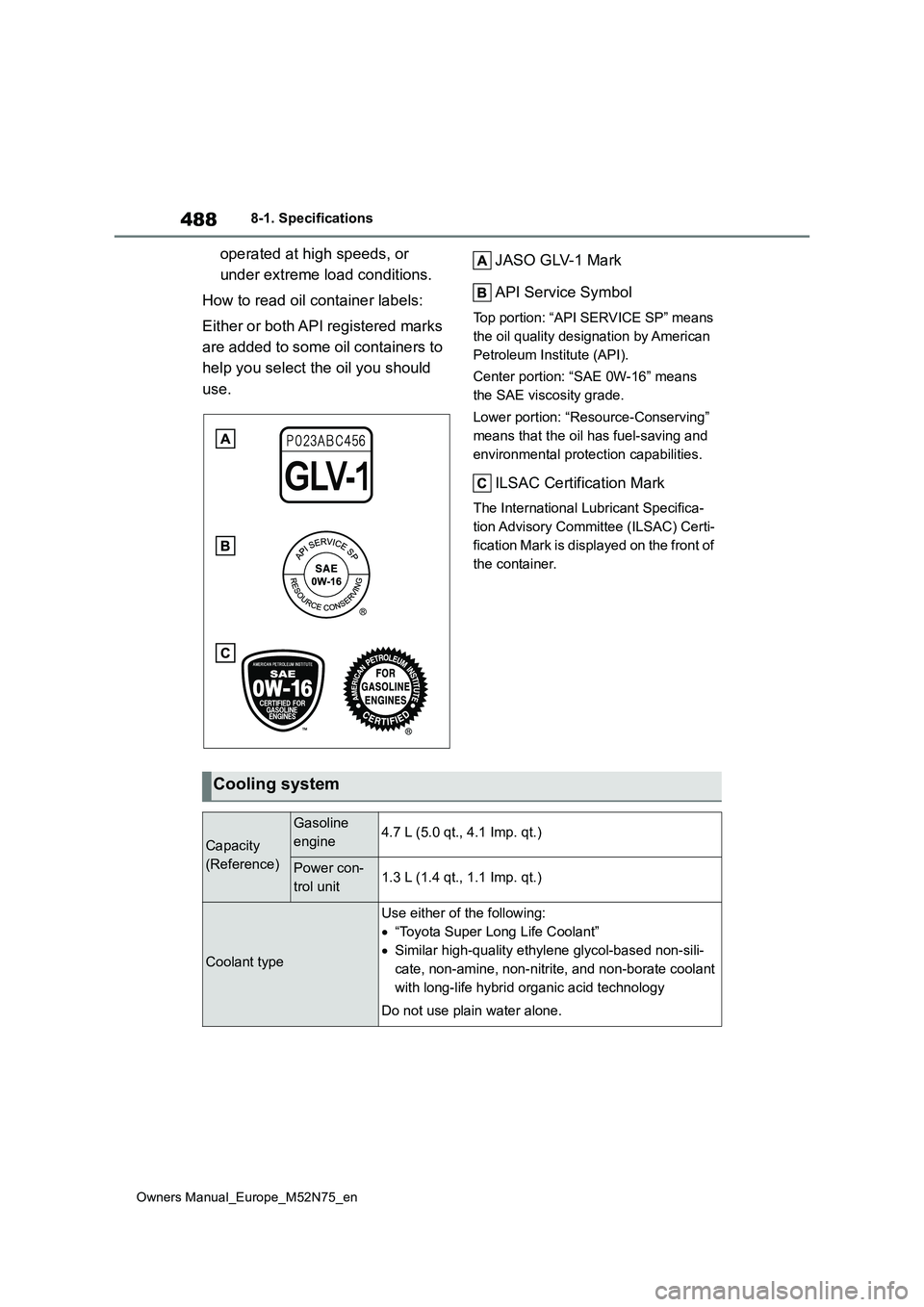
How to read oil container labels:
Either or both API registered marks
are added to some oil containers to
help you select the oil you should
use.
JASO GLV-1 Mark
API Service Symbol
Top portion: “API SERVICE SP” means
the oil quality designation by American
Petroleum Institute (API).
Center portion: “SAE 0W-16” means
the SAE viscosity grade.
Lower portion: “Resource-Conserving”
means that the oil has fuel-saving and
environmental protection capabilities.
ILSAC Certification Mark
The International Lubricant Specifica-
tion Advisory Committee (ILSAC) Certi-
f ic at i o n M ar k i s d is pl a ye d on t h e f r o nt o f
the container.
Cooling system
Capacity
(Reference)
Gasoline
engine4.7 L (5.0 qt., 4.1 Imp. qt.)
Power con-
trol unit1.3 L (1.4 qt., 1.1 Imp. qt.)
Coolant type
Use either of the following:
“Toyota Super Long Life Coolant”
Similar high-quality ethylene glycol-based non-sili-
cate, non-amine, non-nitrite, and non-borate coolant
with long-life hybrid organic acid technology
Do not use plain water alone.
Page 495 of 698
493
8
Owners Manual_Europe_M52N75_en
8-1. Specifications
Vehicle specifications
■Use of ethanol blended gasoline in a gasoline engine
Toyota allows the use of ethanol
blended gasoline where the ethanol content is up to 10%. Make sure that the ethanol blended gasoline to be used has
a Research Octane Number that follows the above.
■If your engine knocks
●Consult any authorized Toyota retailer or Toyota authorized repairer, or any reliable repairer.
●You may occasionally notice light knocking for a short time while accel-
erating or driving uphill. This is normal
and there is no need for concern.Fuel information
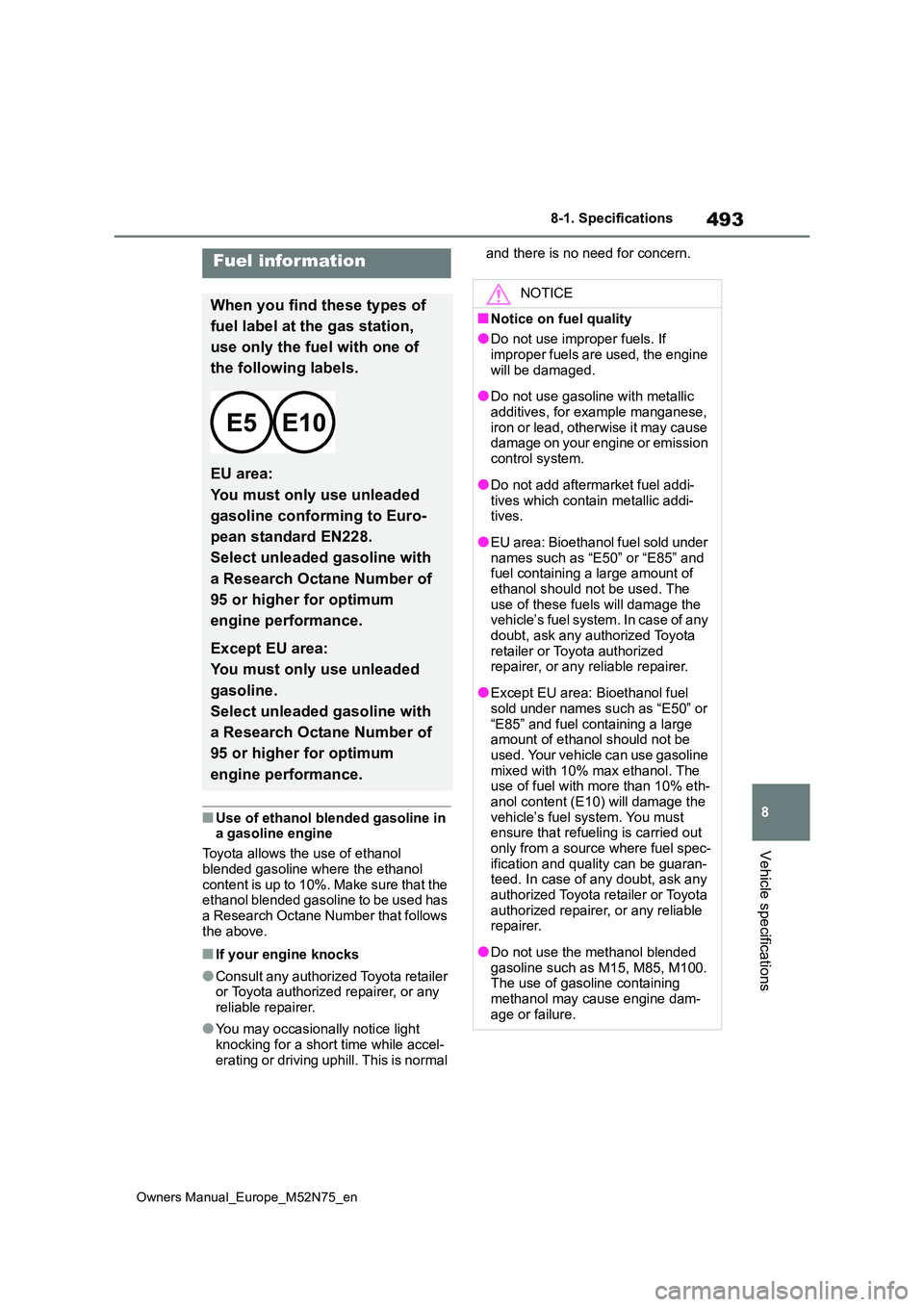
When you find these types of
fuel label at the gas station,
use only the fuel with one of
the following labels.
EU area:
You must only use unleaded
gasoline conforming to Euro-
pean standard EN228.
Select unleaded gasoline with
a Research Octane Number of
95 or higher for optimum
engine performance.
Except EU area:
You must only use unleaded
gasoline.
Select unleaded gasoline with
a Research Octane Number of
95 or higher for optimum
engine performance.
NOTICE
■Notice on fuel quality
●Do not use improper fuels. If improper fuels are used, the engine
will be damaged.
●Do not use gasoline with metallic
additives, for example manganese, iron or lead, otherwise it may cause damage on your engine or emission
control system.
●Do not add aftermarket fuel addi-
tives which contain metallic addi- tives.
●EU area: Bioethanol fuel sold under names such as “E50” or “E85” and fuel containing a large amount of
ethanol should not be used. The use of these fuels will damage the vehicle’s fuel system. In case of any
doubt, ask any authorized Toyota retailer or Toyota authorized repairer, or any reliable repairer.
●Except EU area: Bioethanol fuel sold under names such as “E50” or
“E85” and fuel containing a large amount of ethanol should not be used. Your vehicle can use gasoline
mixed with 10% max ethanol. The use of fuel with more than 10% eth-anol content (E10) will damage the
vehicle’s fuel system. You must ensure that refueling is carried out only from a source where fuel spec-
ification and quality can be guaran- teed. In case of any doubt, ask any authorized Toyota retailer or Toyota
authorized repairer, or any reliable repairer.
●Do not use the methanol blended gasoline such as M15, M85, M100. The use of gasoline containing
methanol may cause engine dam- age or failure.