airbag TOYOTA YARIS HATCHBACK 2016 Owners Manual
[x] Cancel search | Manufacturer: TOYOTA, Model Year: 2016, Model line: YARIS HATCHBACK, Model: TOYOTA YARIS HATCHBACK 2016Pages: 368, PDF Size: 7.86 MB
Page 1 of 368
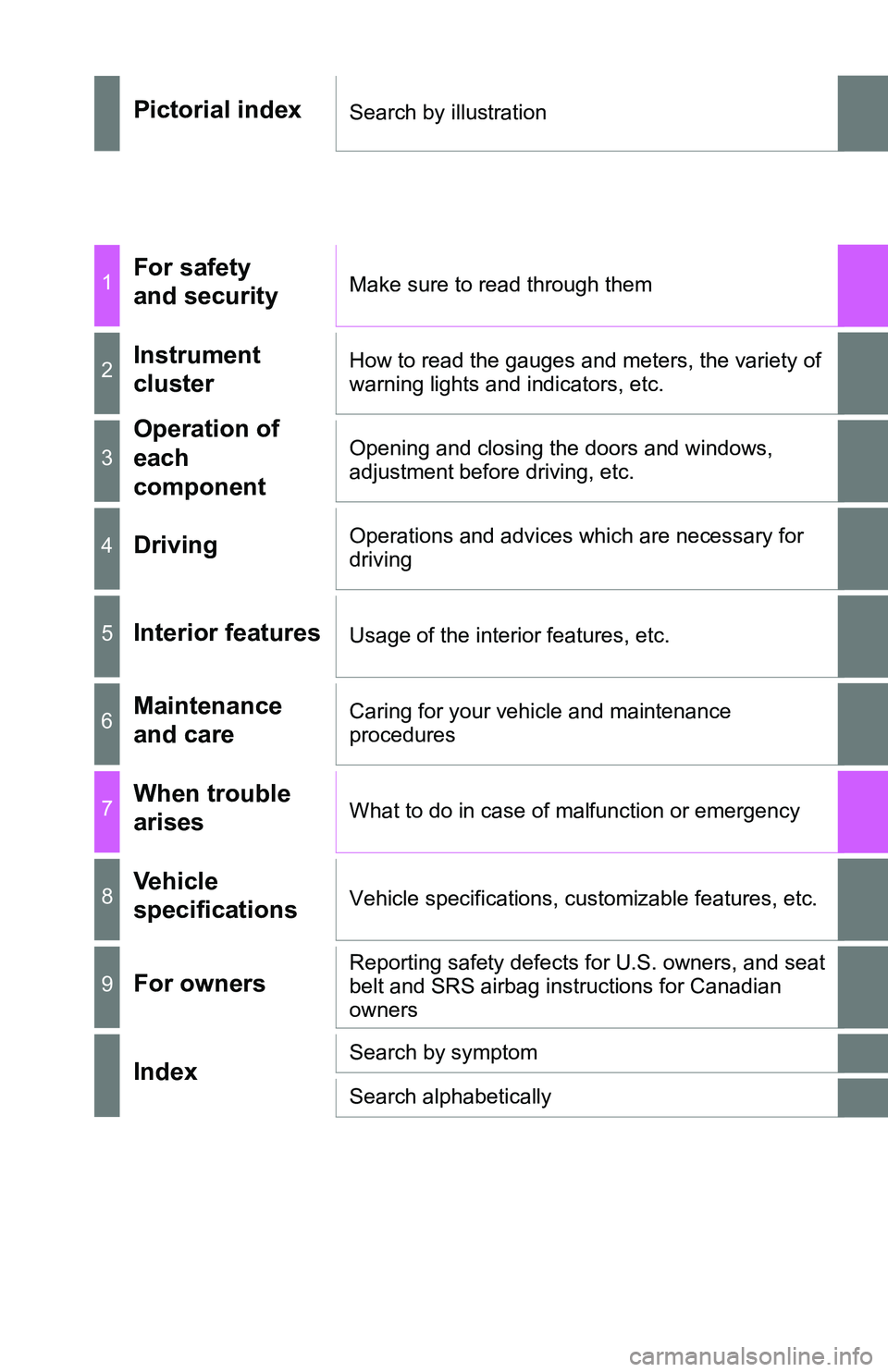
Pictorial indexSearch by illustration
1For safety
and securityMake sure to read through them
2Instrument
clusterHow to read the gauges and meters, the variety of
warning lights and indicators, etc.
3
Operation of
each
componentOpening and closing the doors and windows,
adjustment before driving, etc.
4DrivingOperations and advices which are necessary for
driving
5Interior featuresUsage of the interior features, etc.
6Maintenance
and careCaring for your vehicle and maintenance
procedures
7When trouble
arisesWhat to do in case of malfunction or emergency
8Vehicle
specificationsVehicle specifications, customizable features, etc.
9For ownersReporting safety defects for U.S. owners, and seat
belt and SRS airbag instructions for Canadian
owners
IndexSearch by symptom
Search alphabetically
Page 2 of 368
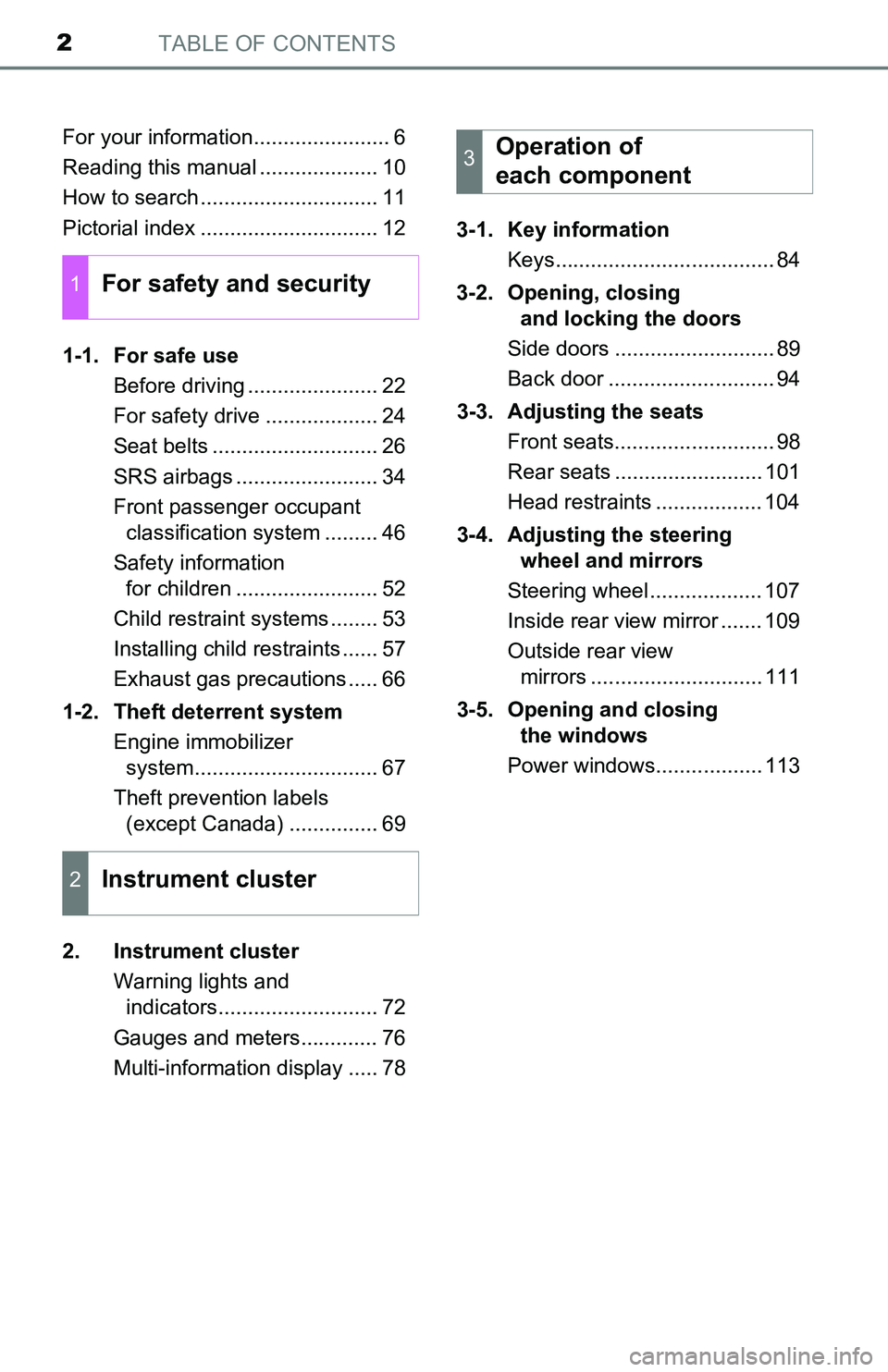
TABLE OF CONTENTS2
For your information....................... 6
Reading this manual .................... 10
How to search .............................. 11
Pictorial index .............................. 12
1-1. For safe useBefore driving ...................... 22
For safety drive ................... 24
Seat belts ............................ 26
SRS airbags ........................ 34
Front passenger occupant classification system ......... 46
Safety information for children ........................ 52
Child restraint systems ........ 53
Installing child restraints ...... 57
Exhaust gas precautions ..... 66
1-2. Theft deterrent system Engine immobilizer system............................... 67
Theft prevention labels (except Canada) ............... 69
2. Instrument cluster Warning lights and indicators........................... 72
Gauges and meters............. 76
Multi-information display ..... 78 3-1. Key information
Keys..................................... 84
3-2. Opening, closing and locking the doors
Side doors ........................... 89
Back door ............................ 94
3-3. Adjusting the seats Front seats........................... 98
Rear seats ......................... 101
Head restraints .................. 104
3-4. Adjusting the steering wheel and mirrors
Steering wheel ................... 107
Inside rear view mirror ....... 109
Outside rear view mirrors ............................. 111
3-5. Opening and closing the windows
Power windows.................. 113
1For safety and security
2Instrument cluster
3Operation of
each component
Page 5 of 368
5
1
8 7 5 4
3
2
9
6
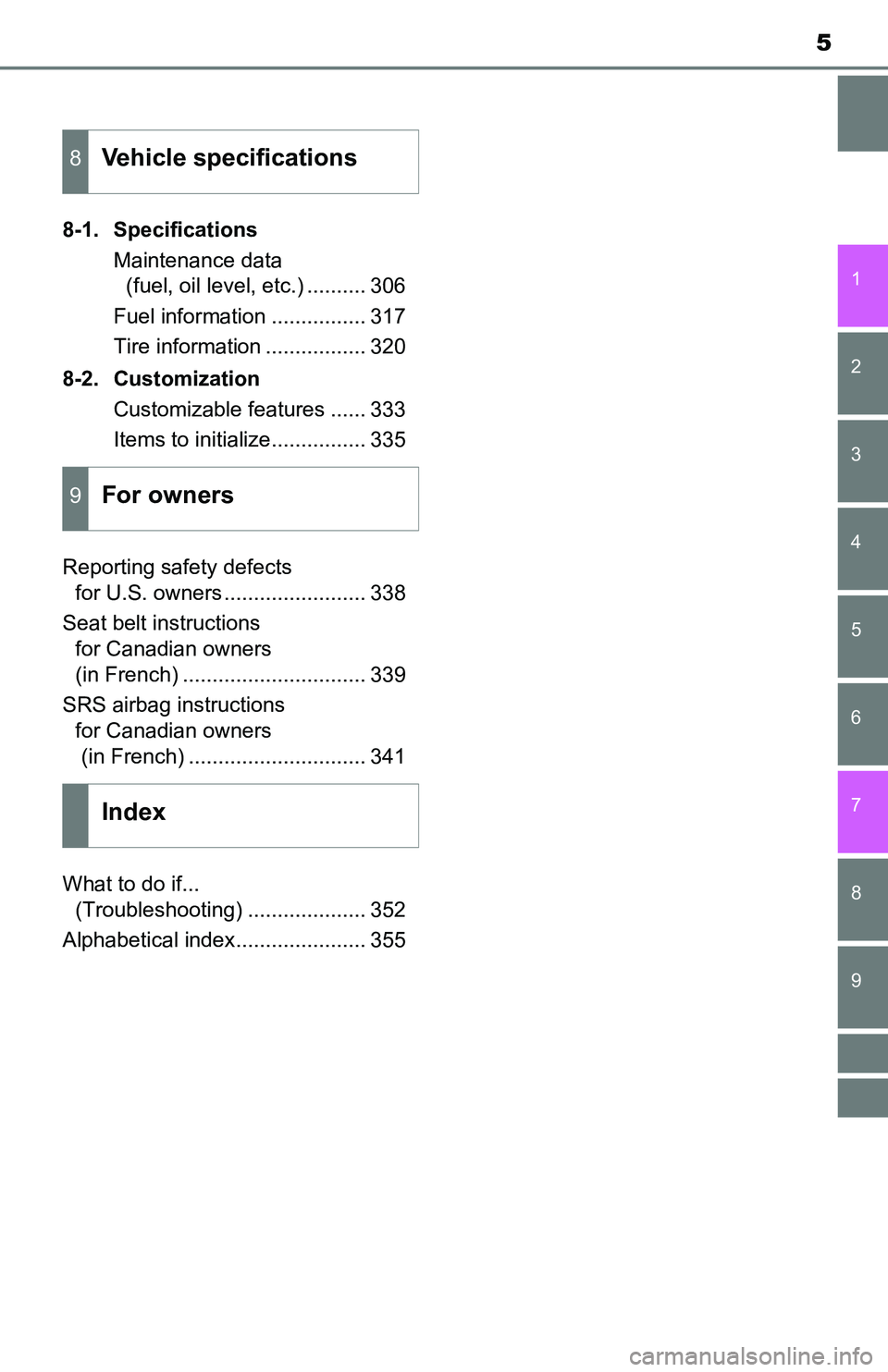
8-1. SpecificationsMaintenance data (fuel, oil level, etc.) .......... 306
Fuel information ................ 317
Tire information ................. 320
8-2. Customization Customizable features ...... 333
Items to initialize................ 335
Reporting safety defects for U.S. owners ........................ 338
Seat belt instructions for Canadian owners
(in French) ............................... 339
SRS airbag instructions for Canadian owners
(in French) .............................. 341
What to do if... (Troubleshooting) .................... 352
Alphabetical index...................... 355
8Vehicle specifications
9For owners
Index
Page 7 of 368
7
The installation of a mobile two-way radio system in your vehicle could affect
electronic systems such as:
●Multiport fuel injection system/sequential multiport fuel injection system
● Cruise control system (if equipped)
● Anti-lock brake system
● SRS airbag system
● Seat belt pretensioner system
Be sure to check with your Toyota dealer for precautionary measures or spe-
cial instructions regarding installation of a mobile two-way radio system.
Your Toyota is equipped with several sophisticated computers that will record
certain data, such as: • Engine speed
• Accelerator status
• Brake status
• Vehicle speed
• Shift position (except manual transmission)
The recorded data varies according to the vehicle grade level and options
with which it is equipped. Furthermore, these computers do not record con-
versations, sounds or pictures.
●Data usage
Toyota may use the data recorded in these computers to diagnose malfunc-
tions, conduct research and development, and improve quality.
Toyota will not disclose the recorded data to a third party except:
• With the consent of the vehicle owner or with the consent of the lessee if the vehicle is leased
• In response to an official request by the police, a court of law or a govern- ment agency
• For use by Toyota in a lawsuit
• For research purposes where the data is not tied to a specific vehicle or vehicle owner
Installation of a mobile two-way radio system
Vehicle data recordings
Page 9 of 368
9
The SRS airbag and seat belt pretensioner devices in your Toyota contain
explosive chemicals. If the vehicle is scrapped with the airbags and seat belt
pretensioners left as they are, this may cause an accident such as fire. Be
sure to have the systems of the SRS airbag and seat belt pretensioner
removed and disposed of by a qualified service shop or by your Toyota dealer
before you scrap your vehicle.
Special handling may apply,
See www.dtsc.ca.gov/hazardouswaste/perchlorate.
Your vehicle has components that may contain perchlorate. These compo-
nents may include airbag, seat belt pretensioners, and wireless remote con-
trol batteries.
Scrapping of your Toyota
Perchlorate Material
WARNING
■General precautions while driving
Driving under the influence: Never drive your vehicle when under the influ-
ence of alcohol or drugs that have impaired your ability to operate your vehi-
cle. Alcohol and certain drugs delay reaction time, impair judgment and
reduce coordination, which could lead to an accident that could result in
death or serious injury.
Defensive driving: Always drive defensively. Anticipate mistakes that other
drivers or pedestrians might make and be ready to avoid accidents.
Driver distraction: Always give your full attention to driving. Anything that
distracts the driver, such as adjusting controls, talking on a cellular phone or
reading can result in a collision with resulting death or serious injury to you,
your occupants or others.
■ General precaution regard ing children’s safety
Never leave children unattended in the vehicle, and never allow children to
have or use the key.
Children may be able to start the vehicle or shift the vehicle into neutral.
There is also a danger that children may injure themselves by playing with
the cigarette lighter, the windows, or other features of the vehicle. In addi-
tion, heat build-up or extremely cold temperatures inside the vehicle can be
fatal to children.
Page 18 of 368
18Pictorial index
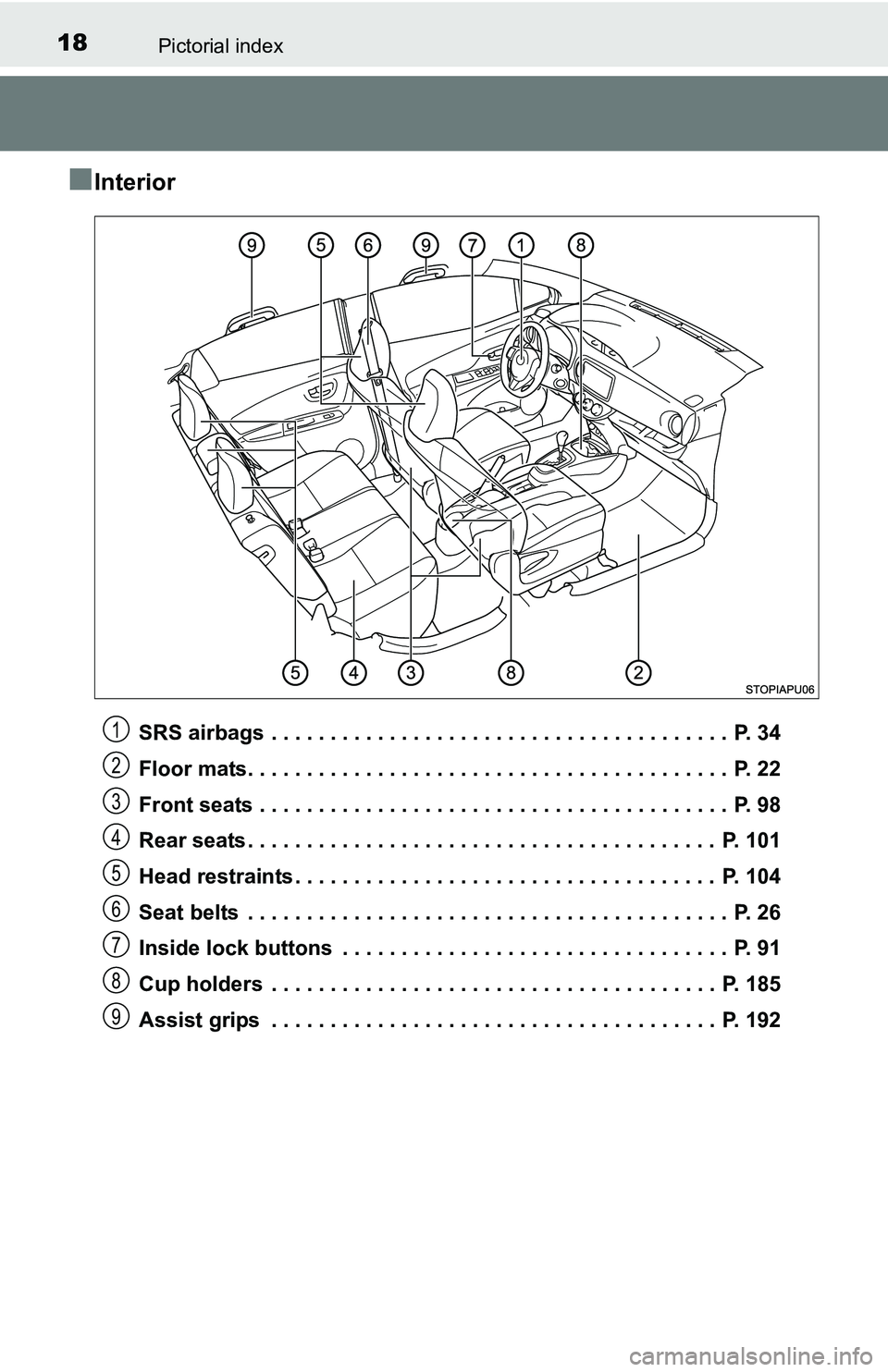
■Interior
SRS airbags . . . . . . . . . . . . . . . . . . . . . . . . . . . . . . . . . . . . . . . P. 34
Floor mats. . . . . . . . . . . . . . . . . . . . . . . . . . . . . . . . . . . . . . . . . P. 22
Front seats . . . . . . . . . . . . . . . . . . . . . . . . . . . . . . . . . . . . . . . . P. 98
Rear seats . . . . . . . . . . . . . . . . . . . . . . . . . . . . . . . . . . . . . . . . P. 101
Head restraints . . . . . . . . . . . . . . . . . . . . . . . . . . . . . . . . . . . . P. 104
Seat belts . . . . . . . . . . . . . . . . . . . . . . . . . . . . . . . . . . . . . . . . . P. 26
Inside lock buttons . . . . . . . . . . . . . . . . . . . . . . . . . . . . . . . . . P. 91
Cup holders . . . . . . . . . . . . . . . . . . . . . . . . . . . . . . . . . . . . . . P. 185
Assist grips . . . . . . . . . . . . . . . . . . . . . . . . . . . . . . . . . . . . . . P. 1921
2
3
4
5
6
7
8
9
Page 21 of 368
21
For safety and security1
1-1. For safe useBefore driving ...................... 22
For safety drive ................... 24
Seat belts ............................ 26
SRS airbags ........................ 34
Front passenger occupant classification system ......... 46
Safety information for children ........................ 52
Child restraint systems........ 53
Installing child restraints...... 57
Exhaust gas precautions..... 66
1-2. Theft deterrent system Engine immobilizer system .............................. 67
Theft prevention labels (except Canada) ............... 69
Page 34 of 368
341-1. For safe use
SRS airbags
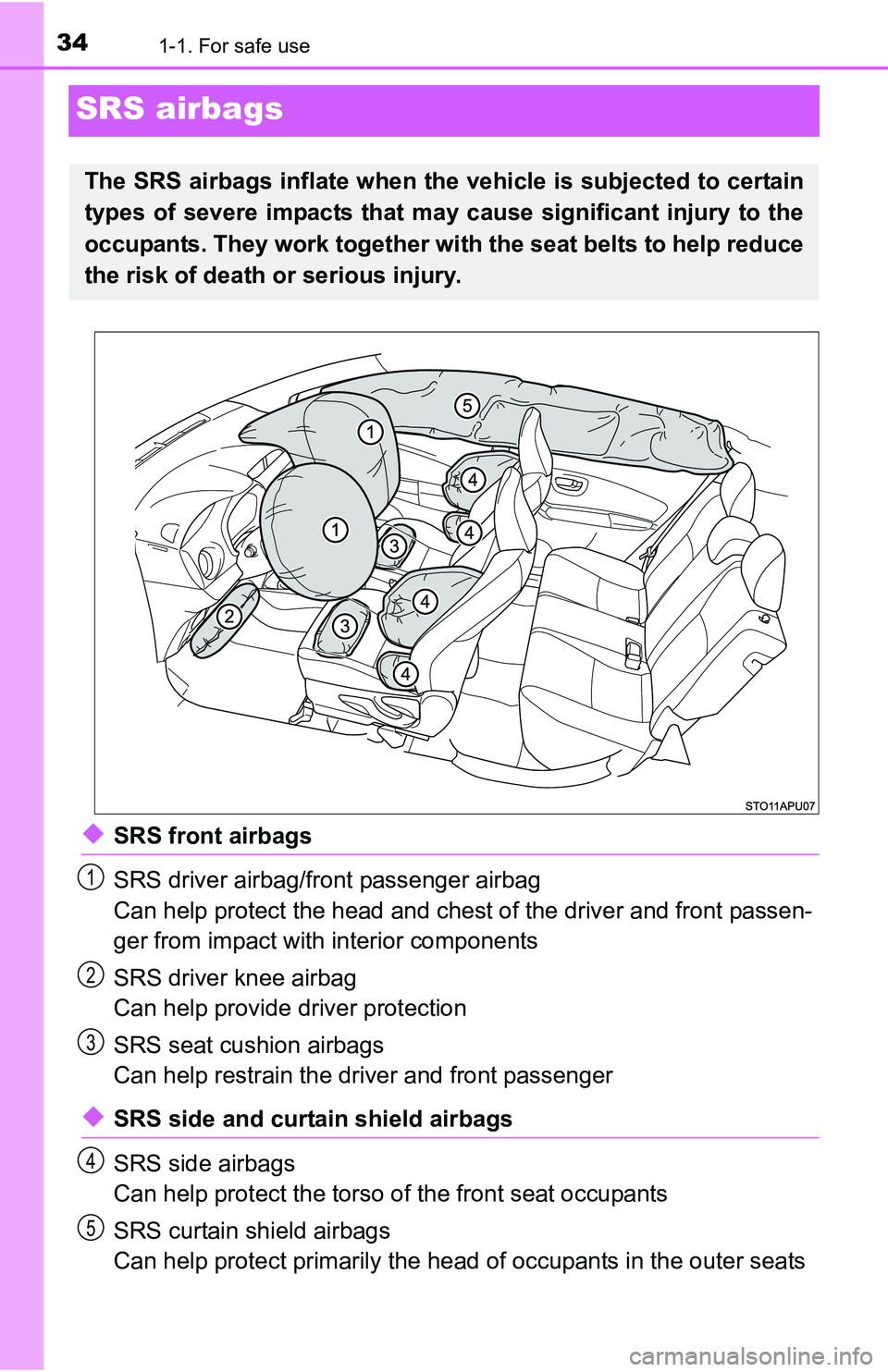
◆SRS front airbags
SRS driver airbag/front passenger airbag
Can help protect the head and chest of the driver and front passen-
ger from impact with interior components
SRS driver knee airbag
Can help provide driver protection
SRS seat cushion airbags
Can help restrain the driver and front passenger
◆SRS side and curtain shield airbags
SRS side airbags
Can help protect the torso of the front seat occupants
SRS curtain shield airbags
Can help protect primarily the head of occupants in the outer seats
The SRS airbags inflate when the vehicle is subjected to certain
types of severe impacts that may cause significant injury to the
occupants. They work together with the seat belts to help reduce
the risk of death or serious injury.
1
2
3
4
5
Page 35 of 368
351-1. For safe use
1
For safety and security
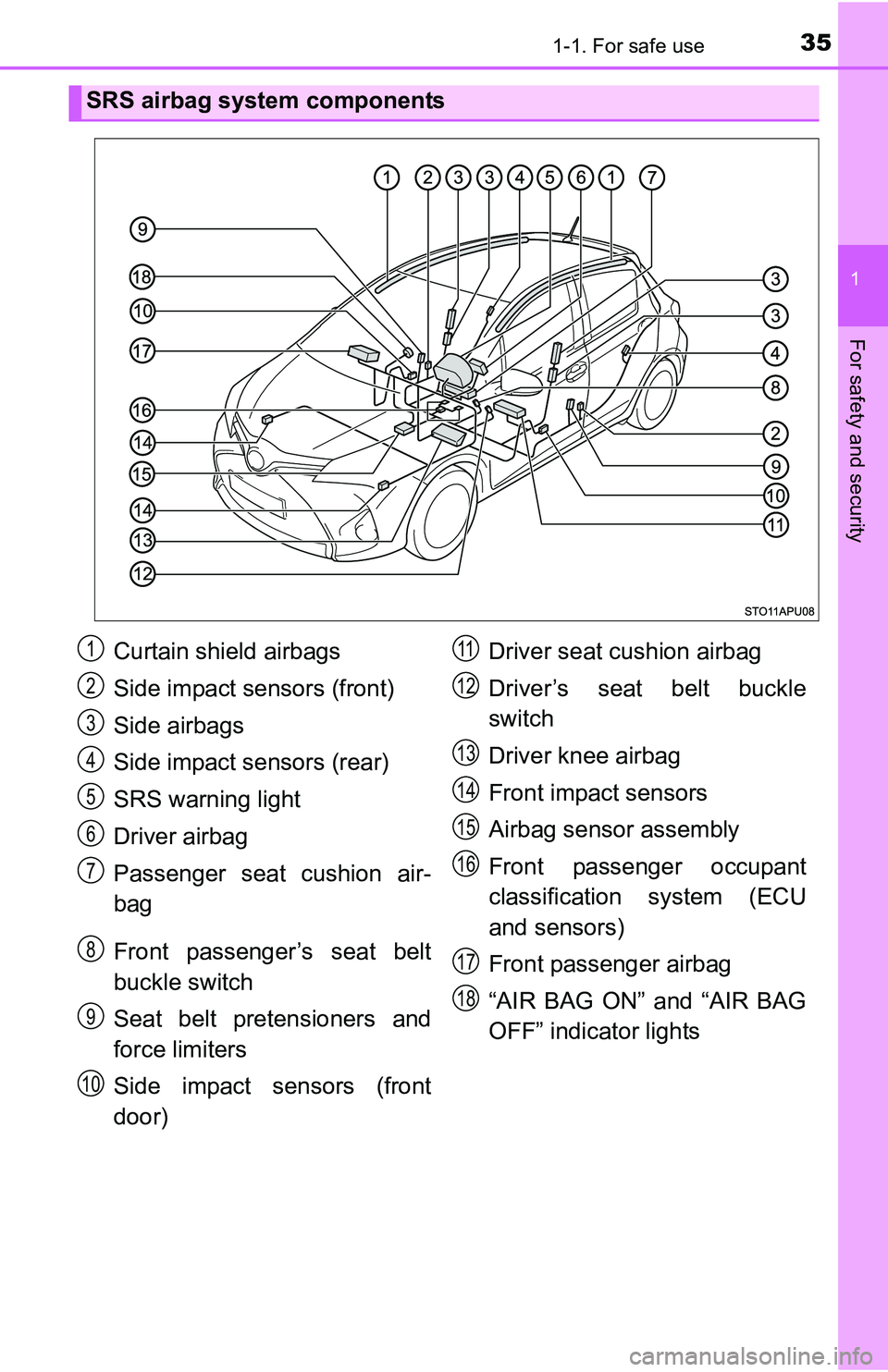
SRS airbag system components
Curtain shield airbags
Side impact sensors (front)
Side airbags
Side impact sensors (rear)
SRS warning light
Driver airbag
Passenger seat cushion air-
bag
Front passenger’s seat belt
buckle switch
Seat belt pretensioners and
force limiters
Side impact sensors (front
door)Driver seat cushion airbag
Driver’s seat belt buckle
switch
Driver knee airbag
Front impact sensors
Airbag sensor assembly
Front passenger occupant
classification system (ECU
and sensors)
Front passenger airbag
“AIR BAG ON” and “AIR BAG
OFF” indicator lights1
2
3
4
5
6
7
8
9
10
11
12
13
14
15
16
17
18
Page 36 of 368
361-1. For safe use
Your vehicle is equipped with ADVANCED AIRBAGS designed based
on the US motor vehicle safety standards (FMVSS208). The airbag
sensor assembly (ECU) controls airbag deployment based on infor-
mation obtained from the sensors, etc. shown in the system compo-
nents diagram above. This informat ion includes crash severity and
occupant information. As the airbags deploy, a chemical reaction in
the inflators quickly fills the airbag s with non-toxic gas to help restrain
the motion of the occupants.
WARNING
■ SRS airbag precautions
Observe the following precautions regarding the SRS airbags.
Failure to do so may cause death or serious injury.
● The driver and all passengers in the vehicle must wear their seat belts
properly.
The SRS airbags are supplemental devices to be used with the seat belts.
● The SRS driver airbag deploys with considerable force, and can cause
death or serious injury especially if the driver is very close to the ai\
rbag.
The National Highway Traffic Safety Administration (NHTSA) advises:
Since the risk zone for the driver’s airbag is the first 2 - 3 in. (50 - 75 mm)
of inflation, placing yourself 10 in. (250 mm) from your driver airbag pro-
vides you with a clear margin of safety. This distance is measured from
the center of the steering wheel to your breastbone. If you sit less than
10 in. (250 mm) away now, you can change your driving position in sev-
eral ways:
• Move your seat to the rear as far as you can while still reaching the ped-
als comfortably.
• Slightly recline the back of the seat. Although vehicle designs vary, many drivers can achieve the 10 in. (250 mm) distance, even with the
driver seat all the way forward, simply by reclining the back of the seat
somewhat. If reclining the back of your seat makes it hard to see the
road, raise yourself by using a firm, non-slippery cushion, or raise the
seat if your vehicle has that feature.
• If your steering wheel is adjustable, tilt it downward. This points the air- bag toward your chest instead of your head and neck.
The seat should be adjusted as recommended by NHTSA above, while
still maintaining control of the foot pedals, steering wheel, and your view
of the instrument panel controls.