ECU TOYOTA YARIS HATCHBACK 2018 Owner's Guide
[x] Cancel search | Manufacturer: TOYOTA, Model Year: 2018, Model line: YARIS HATCHBACK, Model: TOYOTA YARIS HATCHBACK 2018Pages: 520, PDF Size: 8.69 MB
Page 67 of 520
671-2. Child safety
1
For safety and security
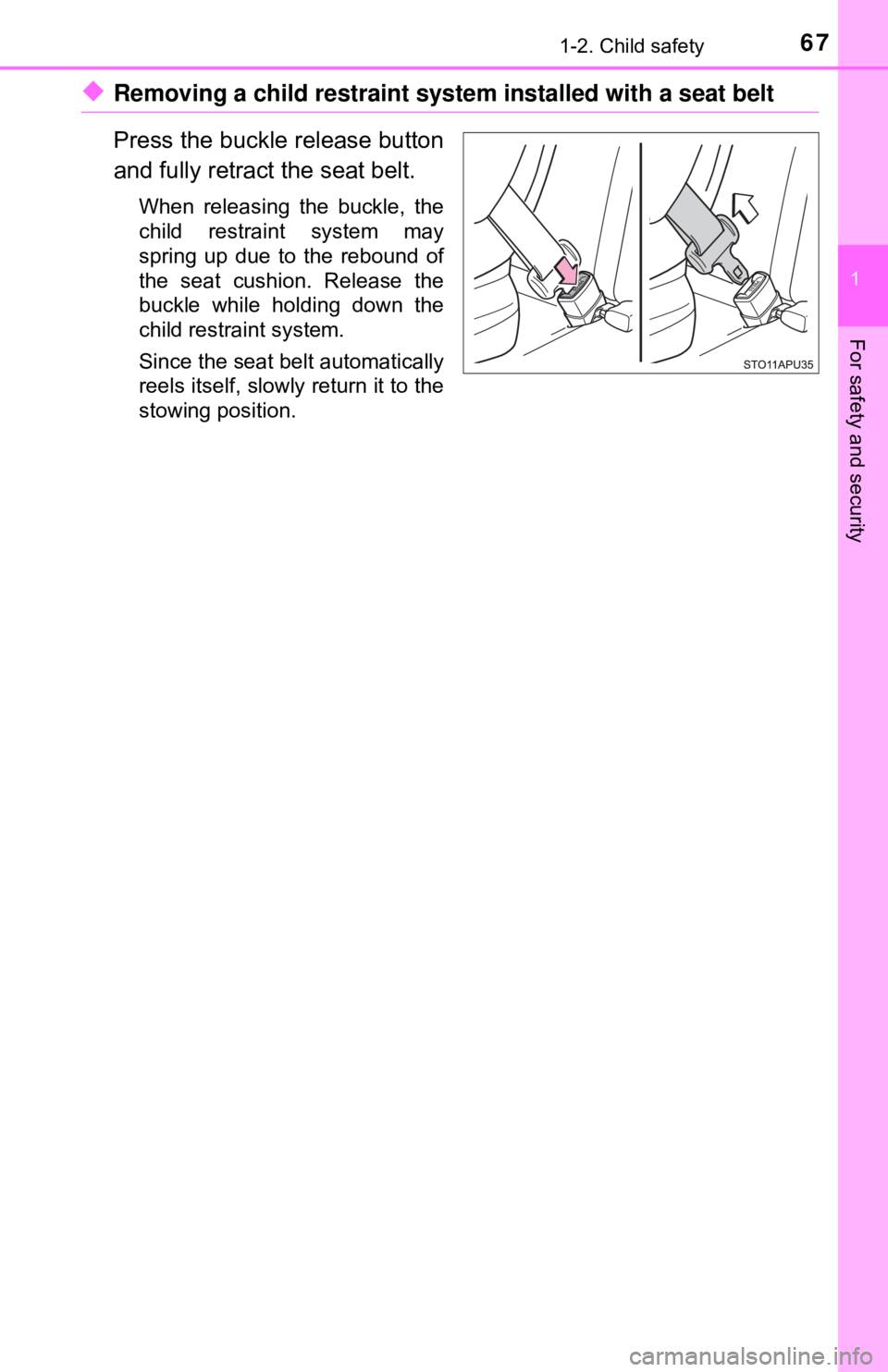
◆Removing a child restraint system installed with a seat belt
Press the buckle release button
and fully retract the seat belt.
When releasing the buckle, the
child restraint system may
spring up due to the rebound of
the seat cushion. Release the
buckle while holding down the
child restraint system.
Since the seat belt automatically
reels itself, slowly return it to the
stowing position.
Page 68 of 520
681-2. Child safety
WARNING
■When installing a child restraint system
Observe the following precautions.
Failure to do so may result in death or serious injury.
● Do not allow children to play with the seat belt. If the seat belt becomes
twisted around a child’s neck, it may lead to choking or other serious inju-
ries that could result in death.
If this occurs and the buckle cannot be unfastened, scissors should be
used to cut the belt.
● Ensure that the belt and plate are securely locked and the seat belt is not
twisted.
● Shake the child restraint system left and right, and forward and backward
to ensure that it has been securely installed.
● After securing a child restraint system, never adjust the seat.
● When a booster seat is installed, always ensure that the shoulder belt is
positioned across the center of the child’s shoulder. The belt should be
kept away from the child’s neck, but not so that it could fall off the child’s
shoulder.
● Follow all installation instructions provided by the child restraint system
manufacturer.
● When securing some types of child restraint systems in rear seats, it may
not be possible to properly use the seat belts in positions next to the child
restraint without interfering with it or affecting seat belt effectiveness. Be
sure your seat belt fits snugly across your shoulder and low on your hips. If
it does not, or if it interferes with the child restraint, move to a different
position. Failure to do so may result in death or serious injury.
■ When installing a booster seat
To prevent the belt from going into ALR lock mode, do not fully extend the
shoulder belt. ALR mode causes the belt to tighten only. This could cause
injury or discomfort to the child. ( →P. 31)
■ Do not use a seat belt extender
If a seat belt extender is used when installing a child restraint system, the
seat belt will not securely hold the child restraint system, which could cause
death or serious injury to the child or other passengers in the event of sud-
den braking, sudden swerving or an accident.
Page 69 of 520
691-2. Child safety
1
For safety and security
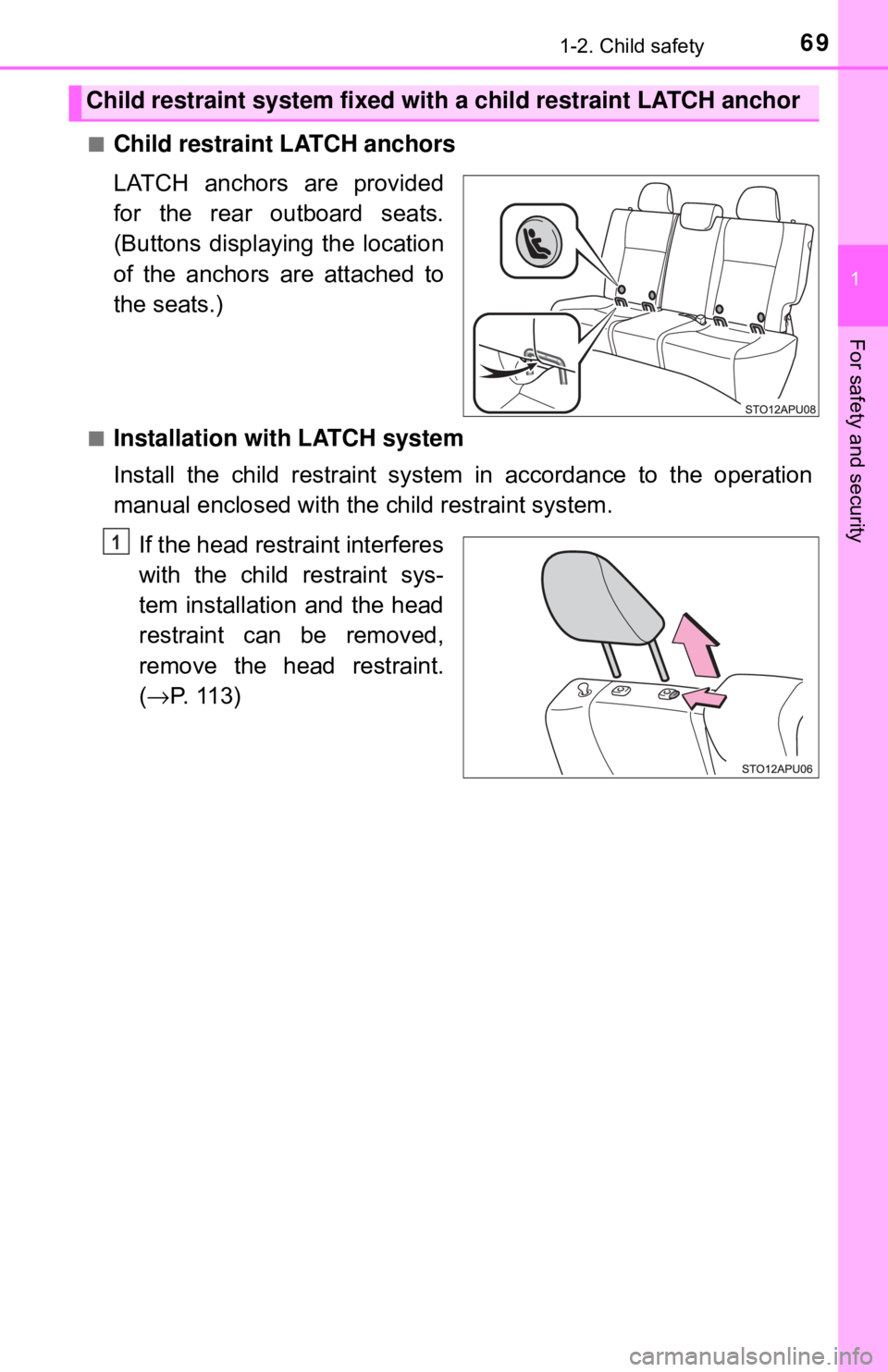
■Child restraint LATCH anchors
LATCH anchors are provided
for the rear outboard seats.
(Buttons displaying the location
of the anchors are attached to
the seats.)
■Installation with LATCH system
Install the child restraint system in accordance to the operation
manual enclosed with the child restraint system.If the head restraint interferes
with the child restraint sys-
tem installation and the head
restraint can be removed,
remove the head restraint.
(→ P. 113)
Child restraint system fixed with a child restraint LATCH anchor
1
Page 71 of 520
711-2. Child safety
1
For safety and security
If the child restraint has a top tether strap, follow the child
restraint manufacturer’s operation manual regarding the installa-
tion, using the top tether strap to latch onto the top tether strap
anchor. (→ P. 7 2 )
After installing the child restraint system, rock it back and forth to
ensure that it is installed securely. ( →P. 68)
■Laws and regulations pertaining to anchors
The LATCH system conforms to FMVSS225 or CMVSS210.2.
Child restraint systems conforming to FMVSS213 or CMVSS213 specifica-
tions can be used.
This vehicle is designed to conform to SAE J1819.
WARNING
■When installing a child restraint system
Observe the following precautions.
Failure to do so may result in death or serious injury.
● When using the LATCH anchors, be sure that there are no foreign objects
around the anchors and that the seat belt is not caught behind the child
restraint system.
● Follow all installation instructions provided by the child restraint system
manufacturer.
● When securing some types of child restraint systems in rear seats, it may
not be possible to properly use the seat belts in positions next to the child
restraint without interfering with it or affecting seat belt effectiveness. Be
sure your seat belt fits snugly across your shoulder and low on your hips. If
it does not, or if it interferes with the child restraint, move to a different
position. Failure to do so may result in death or serious injury.
3
4
Page 72 of 520
721-2. Child safety
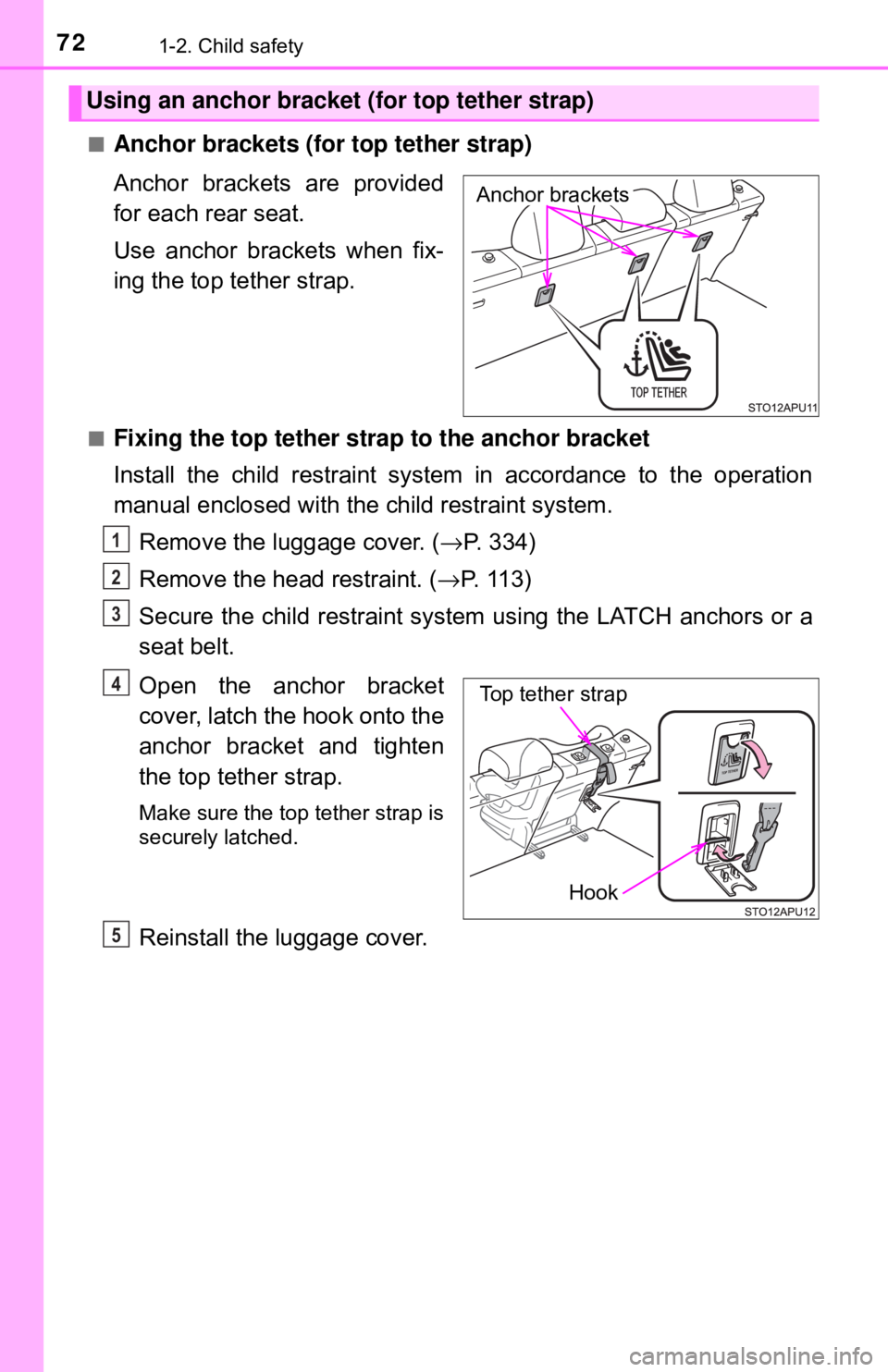
■Anchor brackets (for top tether strap)
Anchor brackets are provided
for each rear seat.
Use anchor brackets when fix-
ing the top tether strap.
■Fixing the top tether strap to the anchor bracket
Install the child restraint system in accordance to the operation
manual enclosed with the child restraint system.Remove the luggage cover. ( →P. 334)
Remove the head restraint. ( →P. 1 1 3 )
Secure the child restraint syst em using the LATCH anchors or a
seat belt.
Open the anchor bracket
cover, latch the hook onto the
anchor bracket and tighten
the top tether strap.
Make sure the top tether strap is
securely latched.
Reinstall the luggage cover.
Using an anchor bracket (for top tether strap)
Anchor brackets
1
2
3
Top tether strap
Hook
4
5
Page 73 of 520
731-2. Child safety
1
For safety and security
■Laws and regulations pertaining to anchors
The LATCH system conforms to FMVSS225 or CMVSS210.2.
Child restraint systems conforming to FMVSS213 or CMVSS213 specifica-
tions can be used.
This vehicle is designed to conform to SAE J1819.
WARNING
■When installing a child restraint system
Observe the following precautions.
Failure to do so may result in death or serious injury.
● Firmly attach the top tether strap and make sure that the belt is not twisted.
● Do not attach the top tether strap to anything other than the anchor
bracket.
● After securing a child restraint system, never adjust the seat.
● Follow all installation instructions provided by the child restraint system
manufacturer.
● When a child restraint system with a top tether strap is installed, do not
install the head restraint. The head restraint may interfere with the top
tether strap preventing secure installation of the child restraint system.
● Make sure to properly store the removed head restraint in a secure place
when you use the child restraint system on the rear seat.
NOTICE
■Anchor brackets (for top tether strap)
When not in use, make certain to close the lid. If it remains open, the lid
may be damaged.
Page 74 of 520
741-3. Theft deterrent system
Engine immobilizer system∗
The system begins operating after the key has been removed from
the engine switch. The system is canceled after the registered key
has been inserted into the engine switch.
■System maintenance
The vehicle has a maintenance-free type engine immobilizer system.
■ Conditions that may cause the system to malfunction
●If the grip portion of the key is in contact with a metallic object
● If the key is in close proximity to or touching a key to the security system
(key with a built-in transponder chip) of another vehicle
∗: If equipped
The vehicle’s keys have built-in transponder chips that prevent
the engine from starting if a key has not been previously regis-
tered in the vehicle’s on-board computer.
Never leave the keys inside the vehicle when you leave the vehi-
cle.
This system is designed to help prevent vehicle theft but does
not guarantee absolute security against all vehicle thefts.
Page 75 of 520
751-3. Theft deterrent system
1
For safety and security
■Certifications for the engine immobilizer system
U.S.A.
FCC ID: PSIRI-43BTY
This device complies with part 15 of the FCC Rules. Operation is subject to
the following two conditions: (1) This device may not cause harmful interfer-
ence; and (2) This device must accept any interference received, including
interference that may cause undesired operation.
Changes or modifications not expressly approved by the party responsible for
compliance could void the user’s authority to operate the equipment.
Canada
This device complies with Industry Canada licence-exempt RSSs.
Operation is subject to the following two conditions: (1) This device may not
cause interference; and (2) This device must accept any interference, includ-
ing interference that may cause undesired operation of the device.
NOTICE
■ To ensure the system operates correctly
Do not modify or remove the system. If modified or removed, the proper
operation of the system cannot be guaranteed.
Page 93 of 520
933-1. Key information
3
Operation of each component
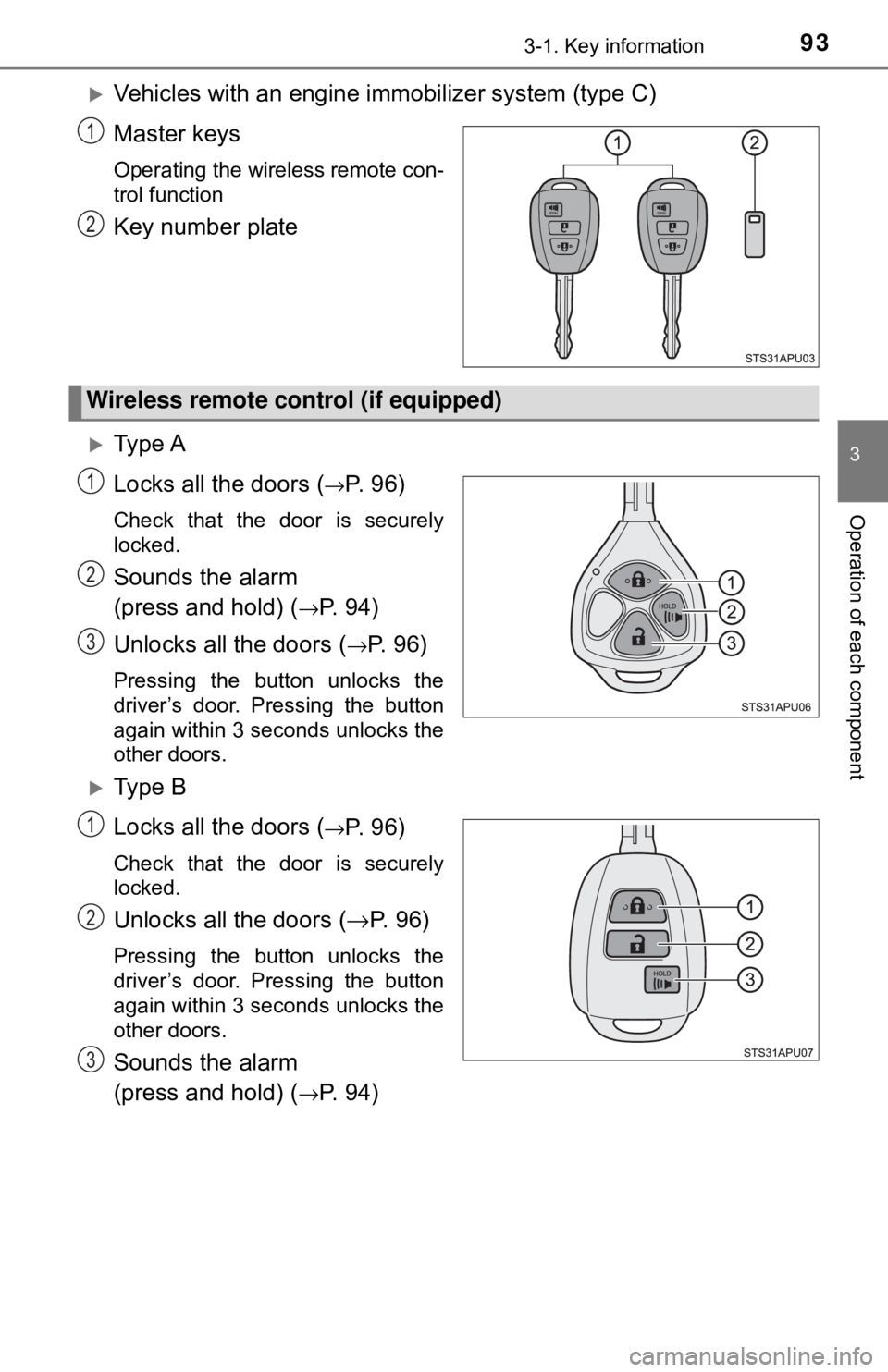
Vehicles with an engine immobilizer system (type C)
Master keys
Operating the wireless remote con-
trol function
Key number plate
Ty p e A
Locks all the doors (
→P. 9 6 )
Check that the door is securely
locked.
Sounds the alarm
(press and hold) (
→P. 94)
Unlocks all the doors (
→P. 96)
Pressing the button unlocks the
driver’s door. Pressing the button
again within 3 seconds unlocks the
other doors.
Ty p e B
Locks all the doors (
→P. 9 6 )
Check that the door is securely
locked.
Unlocks all the doors ( →P. 9 6 )
Pressing the button unlocks the
driver’s door. Pressing the button
again within 3 seconds unlocks the
other doors.
Sounds the alarm
(press and hold) (
→P. 94)
1
2
Wireless remote control (if equipped)
1
2
3
1
2
3
Page 96 of 520
963-2. Opening, closing and locking the doors
Side doors
◆Wireless remote control (if equipped)
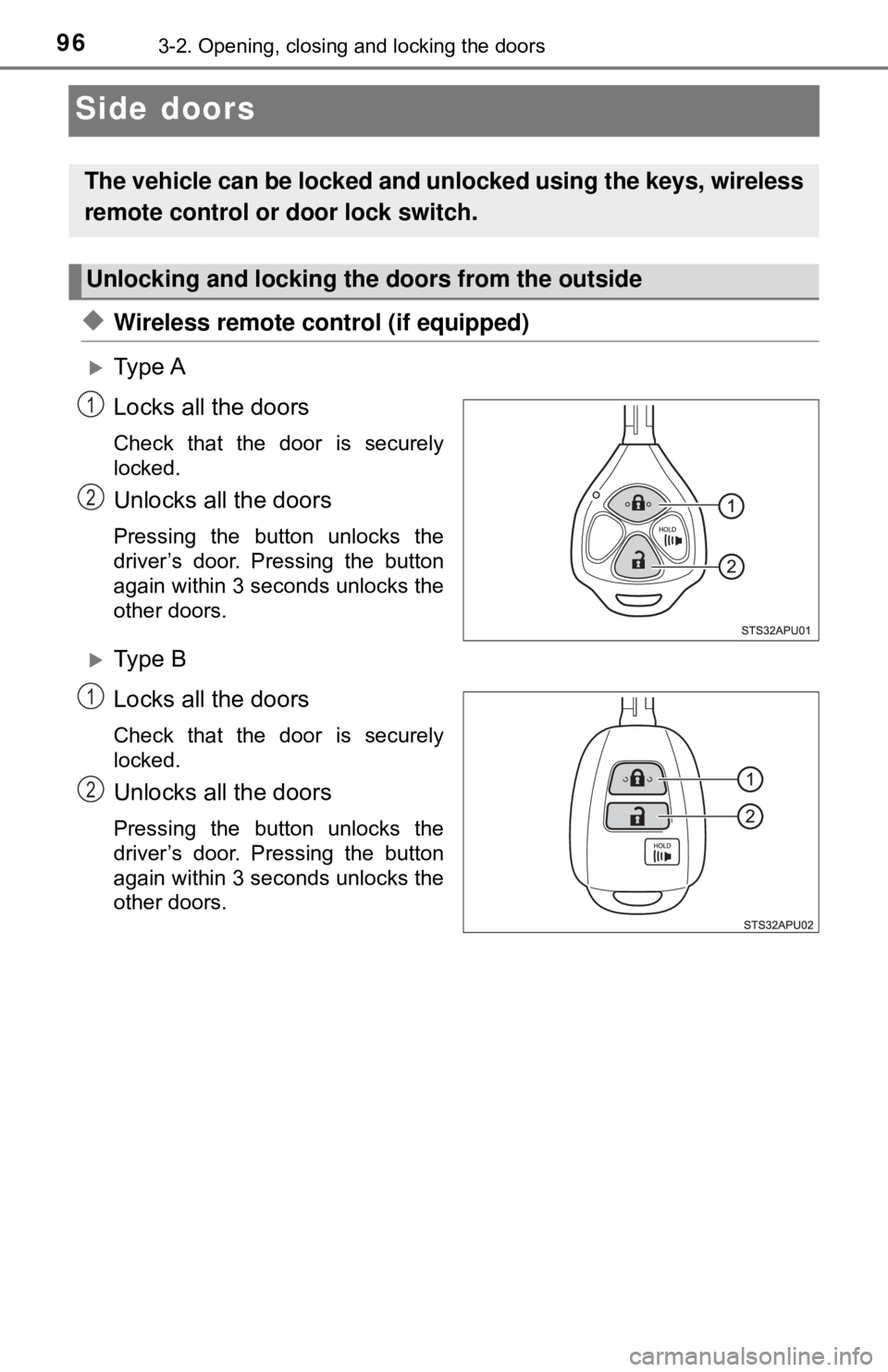
Ty p e A
Locks all the doors
Check that the door is securely
locked.
Unlocks all the doors
Pressing the button unlocks the
driver’s door. Pressing the button
again within 3 seconds unlocks the
other doors.
Ty p e B
Locks all the doors
Check that the door is securely
locked.
Unlocks all the doors
Pressing the button unlocks the
driver’s door. Pressing the button
again within 3 seconds unlocks the
other doors.
The vehicle can be locked and unlocked using the keys, wireless
remote control or door lock switch.
Unlocking and locking the doors from the outside
1
2
1
2