stop start VAUXHALL MOVANO_B 2016 Owner's Guide
[x] Cancel search | Manufacturer: VAUXHALL, Model Year: 2016, Model line: MOVANO_B, Model: VAUXHALL MOVANO_B 2016Pages: 233
Page 130 of 233

128Driving and operatingWhen the fault is critical, Õ and A
flash continuously and after the next
engine restart the vehicle speed will
be limited to approx. 12 mph.
Notice
These restrictions are a legal
requirement.
Seek the assistance of a workshop as
soon as possible.
Refilling AdBlueCaution
Only use AdBlue that complies
with European standards
DIN 70 070 and ISO 22241-1.
Do not use additives.
Do not dilute AdBlue.
Otherwise the selective catalytic
reduction system could be
damaged.
Notice
If AdBlue must be refilled at very low temperatures, the refilling of AdBlue
may not be detected by the system.
In this case, park the vehicle in a
space with a higher ambient
temperature until AdBlue is
liquefied.
Notice
If engine starting is prohibited due to low Adblue level, we recommend
adding a volume of at least 10 litres
of AdBlue when refilling. Avoid minor
top-ups (e.g. less than 5 litres),
otherwise the system may not detect a refill.
Notice
When unscrewing the protective cap from the filler neck, ammonia fumes
may emerge. Do not inhale as the fumes have a pungent smell. The
fumes are not harmful by inhalation.
The vehicle must be parked on a level surface.
The filler neck for AdBlue is located
behind the filler flap located on the
right-hand side of the vehicle.
The filler flap can only be opened if the vehicle is unlocked and the right-hand door is opened.9 Danger
Vehicles with stop-start system:
The engine must be switched off
and the ignition key removed, to
avoid risk of engine being
restarted automatically by the
system.
Capacities 3 218.
Filling station
9 Danger
Follow the operating and safety
instructions of the filling station
when refilling Adblue.
1. Switch off engine and remove key
from ignition switch.
2. Pull filler flap to open.
Page 133 of 233
Driving and operating131Starting the engine
Depress the brake pedal when
starting the engine. If the brake pedal
is not depressed, T illuminates in the
transmission display and the engine
cannot be started.
When the brake pedal is depressed,
the transmission automatically shifts
to N (neutral); "N" appears in the
transmission display and the engine
can be started. There may be a slight delay.
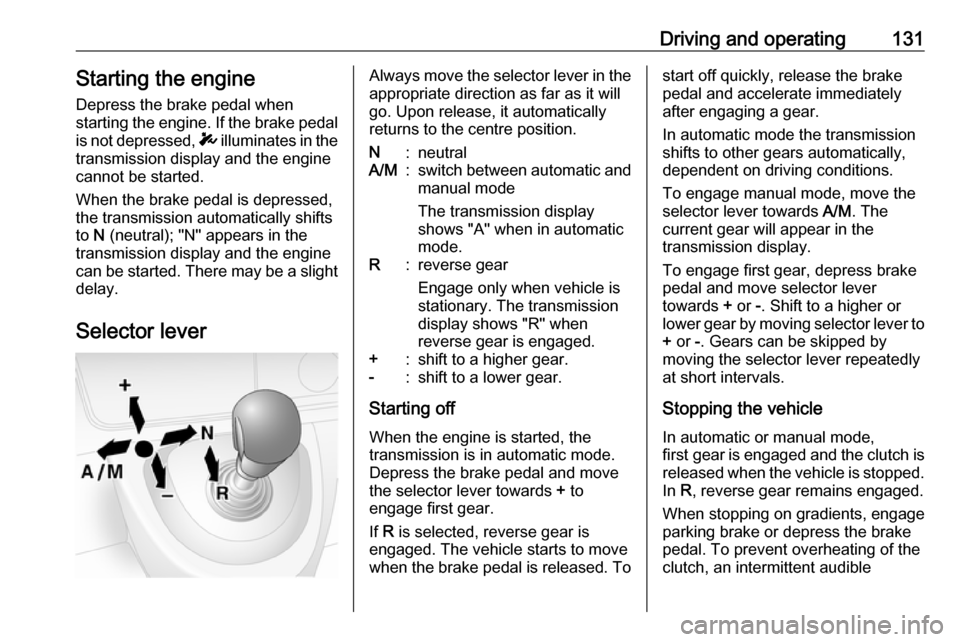
Selector leverAlways move the selector lever in the
appropriate direction as far as it will
go. Upon release, it automatically
returns to the centre position.N:neutralA/M:switch between automatic and manual mode
The transmission display
shows "A" when in automatic
mode.R:reverse gear
Engage only when vehicle is
stationary. The transmission
display shows "R" when
reverse gear is engaged.+:shift to a higher gear.-:shift to a lower gear.
Starting off
When the engine is started, the
transmission is in automatic mode. Depress the brake pedal and move
the selector lever towards + to
engage first gear.
If R is selected, reverse gear is
engaged. The vehicle starts to move
when the brake pedal is released. To
start off quickly, release the brake pedal and accelerate immediately
after engaging a gear.
In automatic mode the transmission
shifts to other gears automatically,
dependent on driving conditions.
To engage manual mode, move the
selector lever towards A/M. The
current gear will appear in the
transmission display.
To engage first gear, depress brake
pedal and move selector lever
towards + or -. Shift to a higher or
lower gear by moving selector lever to + or -. Gears can be skipped by
moving the selector lever repeatedly
at short intervals.
Stopping the vehicle In automatic or manual mode,
first gear is engaged and the clutch is
released when the vehicle is stopped.
In R, reverse gear remains engaged.
When stopping on gradients, engage
parking brake or depress the brake
pedal. To prevent overheating of the
clutch, an intermittent audible
Page 138 of 233

136Driving and operatingBrake assistIf the brake pedal is depressed
quickly and forcefully, maximum
brake force is automatically applied
(full braking).
Maintain steady pressure on the
brake pedal for as long as full braking
is required. Maximum brake force is
automatically reduced when the
brake pedal is released.
Brake assist is not available during an
Autostop. Stop-start system 3 119.
Hill start assist
The system helps prevent unintended movement when driving away on
inclines.
When releasing the brake pedal after
stopping on an incline (with the
selector lever in a forward gear or
reverse gear), the brakes remain on
for a further 2 seconds. The brakes
release automatically as soon as the
vehicle begins to accelerate.Caution
The Hill start assist cannot
completely prevent vehicle
movement in all situations
(extremely steep gradients, etc.).
If necessary, depress the brake
pedal to prevent the vehicle from
rolling forwards or backwards.
The Hill start assist is not active
during an Autostop. Stop-start system 3 119.
Ride control systems
Traction Control system The Traction Control system (TC) is a
component part of the Electronic
Stability Program (ESP® Plus
) which
improves driving stability when
necessary, regardless of the type of
road surface or tyre grip, by
preventing the drive wheels from
spinning.
As soon as the drive wheels starts to spin, engine output is reduced and
the wheel spinning the most is braked
individually. This considerably
improves the driving stability of the
vehicle on slippery road surfaces.
TC is operational as soon as the
ignition is switched on and control
indicator b extinguishes in the
instrument cluster. A corresponding message also appears in the Driver
Information Centre (DIC) 3 89.
When TC is active b flashes.
Page 147 of 233
Driving and operating145Notice
To achieve the optimum visibility, the
rear view camera must not be
obscured by dirt, snow or ice.
Activation
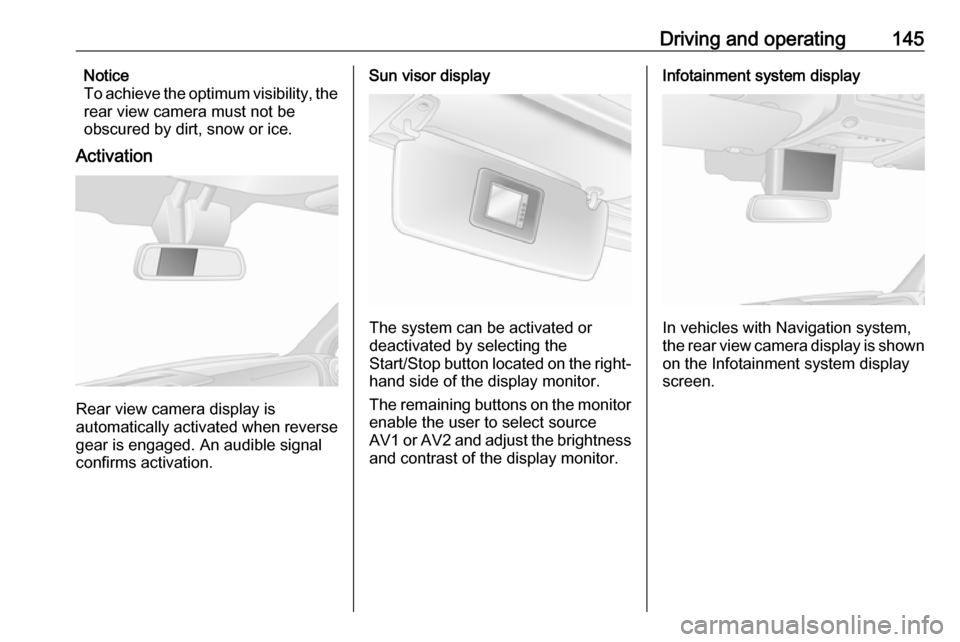
Rear view camera display is
automatically activated when reverse
gear is engaged. An audible signal
confirms activation.
Sun visor display
The system can be activated or
deactivated by selecting the
Start/Stop button located on the right-
hand side of the display monitor.
The remaining buttons on the monitor
enable the user to select source
AV1 or AV2 and adjust the brightness
and contrast of the display monitor.
Infotainment system display
In vehicles with Navigation system,
the rear view camera display is shown
on the Infotainment system display
screen.
Page 151 of 233
Driving and operating1499Danger
Fuel is flammable and explosive.
No smoking. No naked flames or
sparks.
If you can smell fuel in your
vehicle, have the cause of this
remedied immediately by a
workshop.
Caution
In case of misfuelling, do not
switch on ignition.
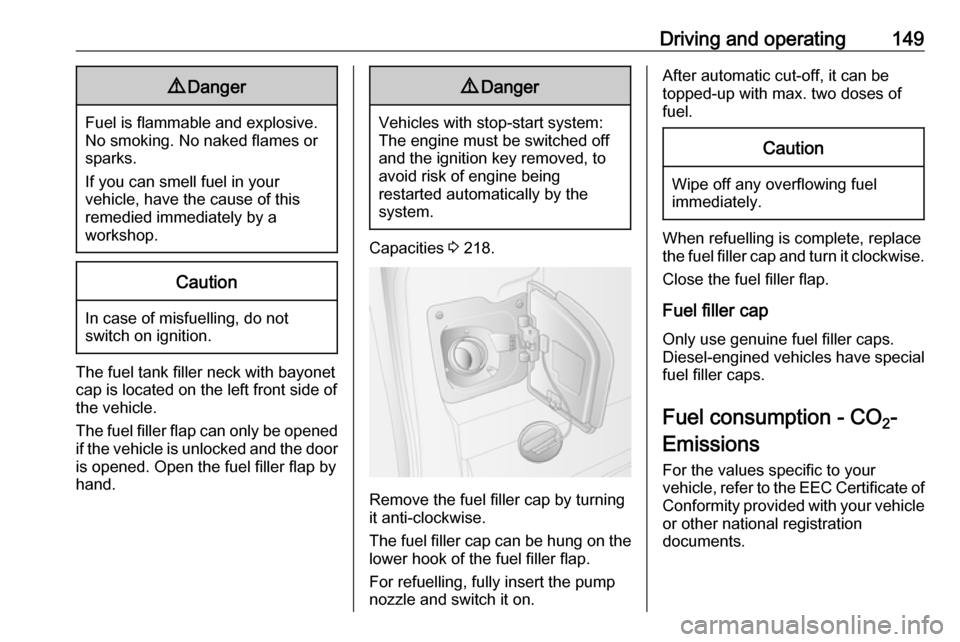
The fuel tank filler neck with bayonet
cap is located on the left front side of
the vehicle.
The fuel filler flap can only be opened
if the vehicle is unlocked and the door is opened. Open the fuel filler flap by
hand.
9 Danger
Vehicles with stop-start system:
The engine must be switched off
and the ignition key removed, to
avoid risk of engine being
restarted automatically by the
system.
Capacities 3 218.
Remove the fuel filler cap by turning
it anti-clockwise.
The fuel filler cap can be hung on the lower hook of the fuel filler flap.
For refuelling, fully insert the pump
nozzle and switch it on.
After automatic cut-off, it can be
topped-up with max. two doses of
fuel.Caution
Wipe off any overflowing fuel
immediately.
When refuelling is complete, replace
the fuel filler cap and turn it clockwise.
Close the fuel filler flap.
Fuel filler cap
Only use genuine fuel filler caps.
Diesel-engined vehicles have special
fuel filler caps.
Fuel consumption - CO 2-
Emissions For the values specific to your
vehicle, refer to the EEC Certificate of
Conformity provided with your vehicle
or other national registration
documents.
Page 152 of 233

150Driving and operatingGeneral information
The official fuel consumption and
specific CO 2 emission figures quoted
relate to the EU base model with
standard equipment.
Fuel consumption data and CO 2
emission data are determined
according to regulation
715/2007 692/2008 A, taking into
consideration the vehicle weight in
running order, as specified by the
regulation.
The figures must not be taken as a
guarantee for the actual fuel
consumption of a particular vehicle.
Additional equipment may result in
slightly higher results than the stated
consumption and CO 2 figures.
Furthermore, fuel consumption is
dependent on personal driving style
as well as road and traffic conditions.Trailer hitch
General information
Only use towing equipment that has
been approved for your vehicle.
Entrust fitting of towing equipment at
a later date to a workshop. It may be
necessary to make changes that
affect the cooling system, heat
shields or other equipment.
Driving characteristics and towing tips
In the case of trailers with brakes,
attach the breakaway stopping cable.
Before attaching a trailer, lubricate
the coupling ball. However, do not do
so if a stabiliser, which acts on the coupling ball, is being used to reduce snaking movements. For trailers with
low driving stability the use of a
stabiliser is recommended.
A maximum speed of 50 mph must
not be exceeded, even in countries
where higher speeds are permitted.If the trailer starts snaking, drive more slowly, do not attempt to correct the
steering and brake sharply if
necessary.
When driving downhill, drive in the
same gear as if driving uphill and
drive at a similar speed.
Adjust tyre pressure to the value
specified for full load 3 219.
Trailer towing Trailer loadsThe permissible trailer loads are
vehicle-dependent and engine-
dependent maximum values which
must not be exceeded. The actual
trailer load is the difference between
the actual gross weight of the trailer
and the actual coupling socket load
with the trailer coupled.
The permissible trailer loads are
specified in the vehicle documents. In
general, they are valid for gradients
up to max. 12%.
The permitted trailer load applies up
to the specified incline and up to an
altitude of 1000 metres above sea
Page 158 of 233
156Vehicle care
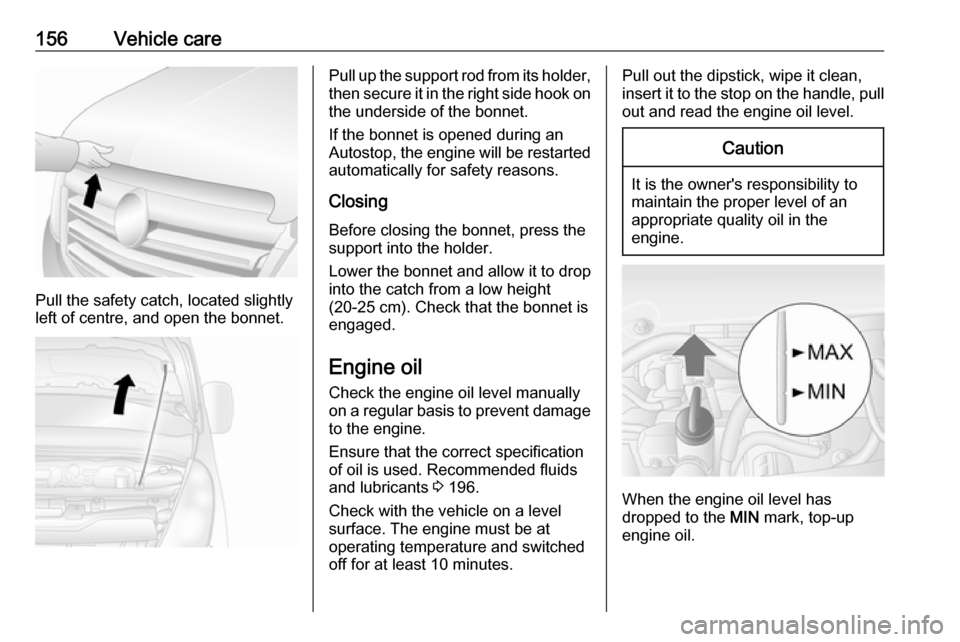
Pull the safety catch, located slightly
left of centre, and open the bonnet.
Pull up the support rod from its holder,
then secure it in the right side hook on the underside of the bonnet.
If the bonnet is opened during an Autostop, the engine will be restarted
automatically for safety reasons.
Closing Before closing the bonnet, press the
support into the holder.
Lower the bonnet and allow it to drop into the catch from a low height
(20-25 cm). Check that the bonnet is
engaged.
Engine oil Check the engine oil level manuallyon a regular basis to prevent damage
to the engine.
Ensure that the correct specification
of oil is used. Recommended fluids
and lubricants 3 196.
Check with the vehicle on a level
surface. The engine must be at
operating temperature and switched
off for at least 10 minutes.Pull out the dipstick, wipe it clean, insert it to the stop on the handle, pull
out and read the engine oil level.Caution
It is the owner's responsibility to
maintain the proper level of an
appropriate quality oil in the
engine.
When the engine oil level has
dropped to the MIN mark, top-up
engine oil.
Page 226 of 233

224IndexAAccessories and vehicle modifications .......................... 154
Adaptive forward lighting .....98, 164
AdBlue .......................... 87, 125, 196
Adblue gauge ............................... 79
AdBlue tank ................................ 218
Adjustable air vents ...................113
Airbag and belt tensioners ...........84
Airbag deactivation ................53, 84
Airbag label................................... 49 Airbag system .............................. 49
Air conditioning regular operation ................................ 114
Air conditioning system .............. 104
Air intake .................................... 114
Air suspension ........................... 122
Air suspension system................ 190
Air vents...................................... 113
Antifreeze ................................... 157
Antilock brake system ................ 134
Antilock brake system (ABS) .......86
Anti-theft alarm system ................31
Anti-theft bolts............................. 184
Anti-theft locking system .............. 30
Anti-theft security lock ..................21
Appearance care ........................192
Armrest ........................................ 44
Ashtrays ....................................... 77
Automatic light control .................95Automatic locking ...................21, 25
Autostop ..................................... 118
Auxiliary heater ........................... 109
B Battery discharge protection ......102
Battery, jump starting.................. 188
Belts.............................................. 46 BlueInjection ............................... 125
Bonnet ....................................... 155
Brake assist ............................... 136
Brake fluid .......................... 159, 196
Brakes ............................... 134, 159
Brake system ............................... 85
Breakdown.................................. 190
Bulb replacement ....................... 162
C Capacities .................................. 218
Cargo management system ........67
Car Pass ...................................... 19
Catalytic converter .....................124
Central locking system ................21
Centre high-mounted brake light 167
Changing tyre and wheel size ...179
Charging system .......................... 84
Child locks ................................... 25
Child restraint installation locations ................................... 56
Child restraints.............................. 55
Child restraint systems ................55
Page 230 of 233

228Steering...................................... 116
Steering column controls ..............73
Steering wheel adjustment ......9, 73
Steering wheel controls ...............73
Stop engine .................................. 85
Stop-start system............ 16, 88, 119
Storage ......................................... 64
Storage compartments .................64
Sunglasses storage .....................65
Sun visors .................................... 37
Suspension height ......................122
Suspension seat ........................... 40
Symbols ......................................... 4
T
Tachograph ............................ 89, 94
Tachometer ................................. 78
Tail lights ................................... 166
Technical data ............................ 201
Three-point seat belt .................... 47
Tools .......................................... 174
Top-tether fastening eyes ............63
Tow bar....................................... 150
Towing ........................................ 150
Towing another vehicle .............191
Towing a trailer ........................... 150
Towing equipment .....................151
Towing eye ................................. 190
Towing the vehicle .....................190
Traction Control system ............. 136Trailer coupling ........................... 150
Trailer stability assist .................151
Trailer towing ............................. 150
Transmission ............................... 16
Transmission display ...........81, 130
Tread depth ............................... 179
Trip computer .............................. 92
Triple-Info-Display .......................90
Trip odometer .............................. 78
Turbo engine warm-up ...............118
Turn and lane-change signals .....98
Turn signal ................................... 83
Tyre chains ................................ 180
Tyre changing ............................. 184
Tyre designations ......................176
Tyre pressure ............................ 176
Tyre pressure monitoring system ............................... 87, 177
Tyre pressures ........................... 219
Tyre repair kit ............................. 180
Tyres .......................................... 175
Tyres and wheel size, changing. 179
U Ultrasonic parking assist............. 142
Underseat storage .......................66
Upholstery .................................. 193
Upshift .......................................... 86
Using this manual ..........................3V
Vehicle battery ........................... 159
Vehicle checks............................ 155
Vehicle data ................................ 200
Vehicle data recording and privacy ..................................... 221
Vehicle dimensions .................... 209
Vehicle Identification Number ....198
Vehicle jack ................................ 174
Vehicle messages .......................90
Vehicle security ............................ 30
Vehicle specific data ......................3
Vehicle storage ........................... 154
Vehicle tools ............................... 174
Vehicle unlocking ........................... 6
Vehicle weight ........................... 202
Ventilation ................................... 103
W
Warning chimes ........................... 91
Warning lights ............................... 77
Warning triangle .......................... 69
Washer and wiper systems .........14
Washer fluid ............................... 159
Washing the vehicle ...................192
Wheel changing .........................184
Wheel covers ............................. 180
Wheels and tyres .......................175
Wheel wrench ............................. 174
Wide view mirror .....................34, 37