light VAUXHALL MOVANO_B 2016 Workshop Manual
[x] Cancel search | Manufacturer: VAUXHALL, Model Year: 2016, Model line: MOVANO_B, Model: VAUXHALL MOVANO_B 2016Pages: 233
Page 171 of 233
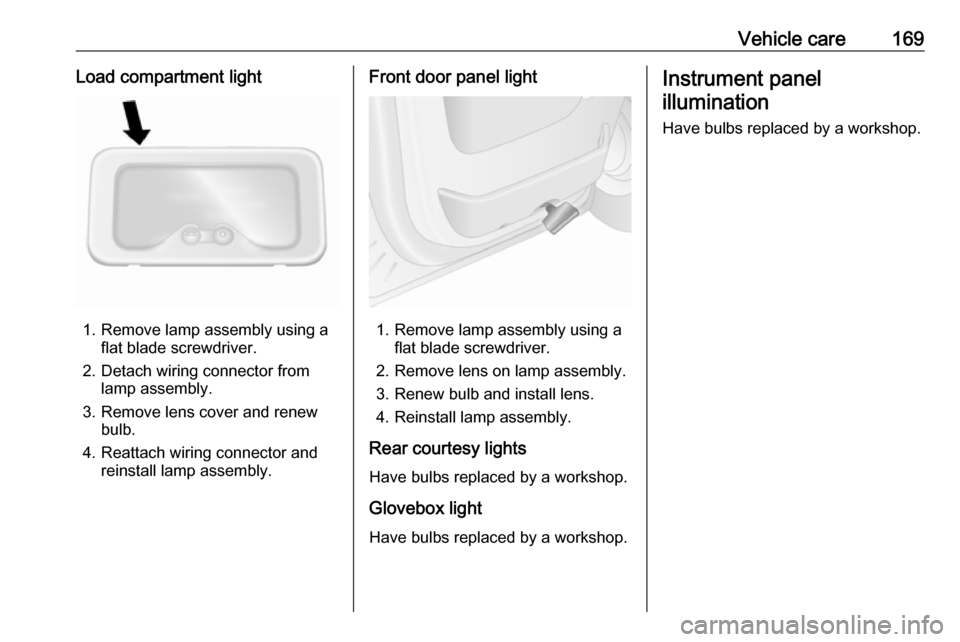
Vehicle care169Load compartment light
1. Remove lamp assembly using aflat blade screwdriver.
2. Detach wiring connector from lamp assembly.
3. Remove lens cover and renew bulb.
4. Reattach wiring connector and reinstall lamp assembly.
Front door panel light
1. Remove lamp assembly using aflat blade screwdriver.
2. Remove lens on lamp assembly.
3. Renew bulb and install lens. 4. Reinstall lamp assembly.
Rear courtesy lights Have bulbs replaced by a workshop.
Glovebox light
Have bulbs replaced by a workshop.
Instrument panel
illumination
Have bulbs replaced by a workshop.
Page 173 of 233
Vehicle care171
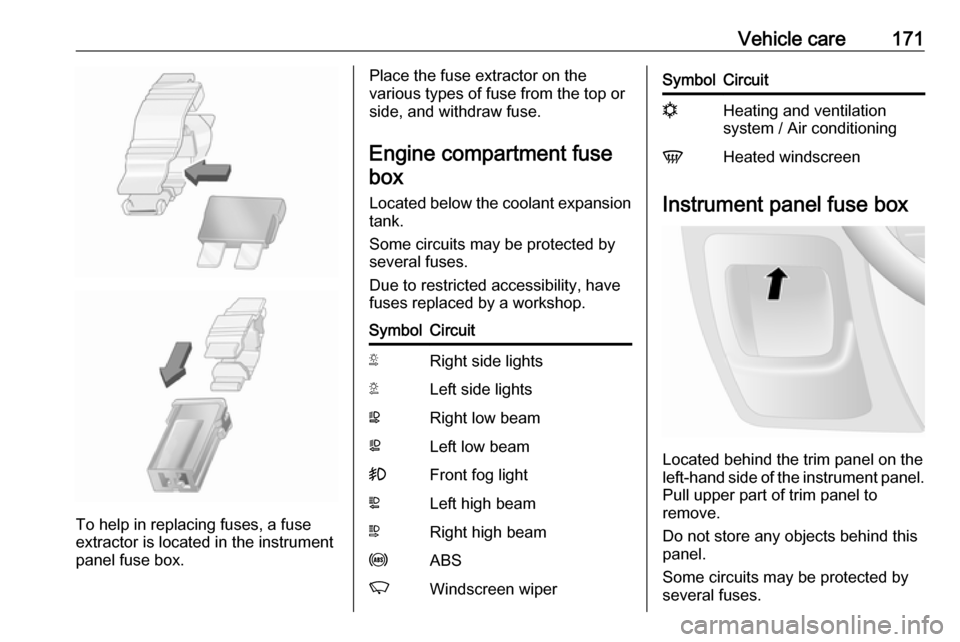
To help in replacing fuses, a fuse
extractor is located in the instrument
panel fuse box.
Place the fuse extractor on the
various types of fuse from the top or
side, and withdraw fuse.
Engine compartment fusebox
Located below the coolant expansion tank.
Some circuits may be protected by
several fuses.
Due to restricted accessibility, have
fuses replaced by a workshop.SymbolCircuitSRight side lightsTLeft side lightsWRight low beamaLeft low beam>Front fog lightLLeft high beamNRight high beamuABSKWindscreen wiperSymbolCircuitnHeating and ventilation
system / Air conditioningVHeated windscreen
Instrument panel fuse box
Located behind the trim panel on the
left-hand side of the instrument panel.
Pull upper part of trim panel to
remove.
Do not store any objects behind this
panel.
Some circuits may be protected by
several fuses.
Page 174 of 233
172Vehicle careSymbolCircuitZInfotainment system / Seat
heating / Vehicle display
screen / Audio connec‐
tions / Alarm?Power outletÌCigarette lightereInstrument panelUCentral locking0Interior lightsOTurn signals / Rear fog
lights / Body control moduleDIAGDiagnostic connectoruABS / Electronic Stability
ProgramdInterior lights / Brake lightsZBody control moduleSTOPBrake lightIBody control module /
Power windows / Heating
and ventilation system / Air
conditioningSymbolCircuitmLeft heated rear windownRight heated rear windowRWindscreen washerMElectronic immobiliserUHeated seatsFBLCornering lightlHands-free connection&TachographPTOPower take-offjHornÍPreheating / Diesel fuel filterxClimate control fandHeated exterior mirrorsTLeft-hand side lightSRight-hand side lightQPneumatic suspensionONavigation systemSymbolCircuitADPAdditional adaptations,Power windows / Body
control module
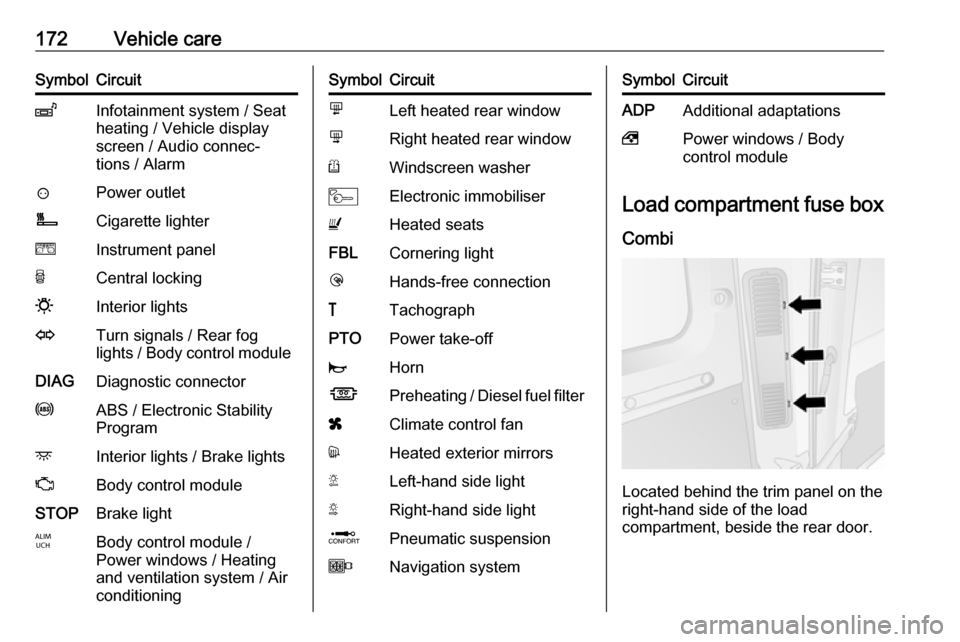
Load compartment fuse box
Combi
Located behind the trim panel on the
right-hand side of the load
compartment, beside the rear door.
Page 176 of 233
174Vehicle careNo.Circuit1Speed 2: right-hand evaporator
fan2Speed 2: left-hand evaporator
fan3Speed 1: left-hand evaporator
fan4Left-hand heating5Speed 3: left-hand evaporator
fan6Condenser fan7Right-hand heating8Speed 3: right-hand evaporator
fan9Power sliding door10Corridor lighting11Foot panel12Child safety warning buzzer13Speed 1: right-hand evaporator
fanSome circuits may be protected by
several fuses.Vehicle tools
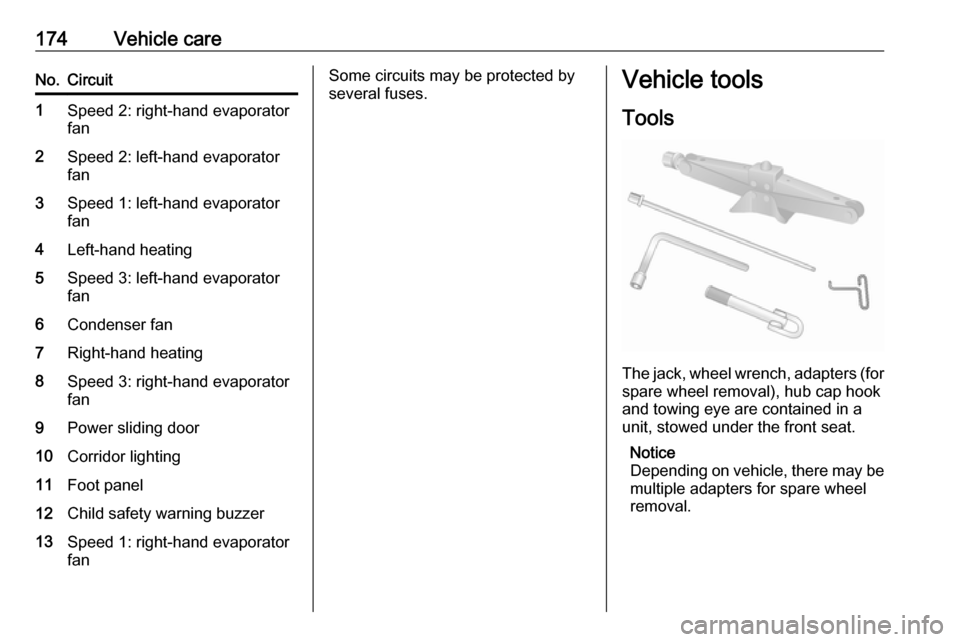
Tools
The jack, wheel wrench, adapters (for
spare wheel removal), hub cap hook
and towing eye are contained in a
unit, stowed under the front seat.
Notice
Depending on vehicle, there may be multiple adapters for spare wheel
removal.
Page 184 of 233
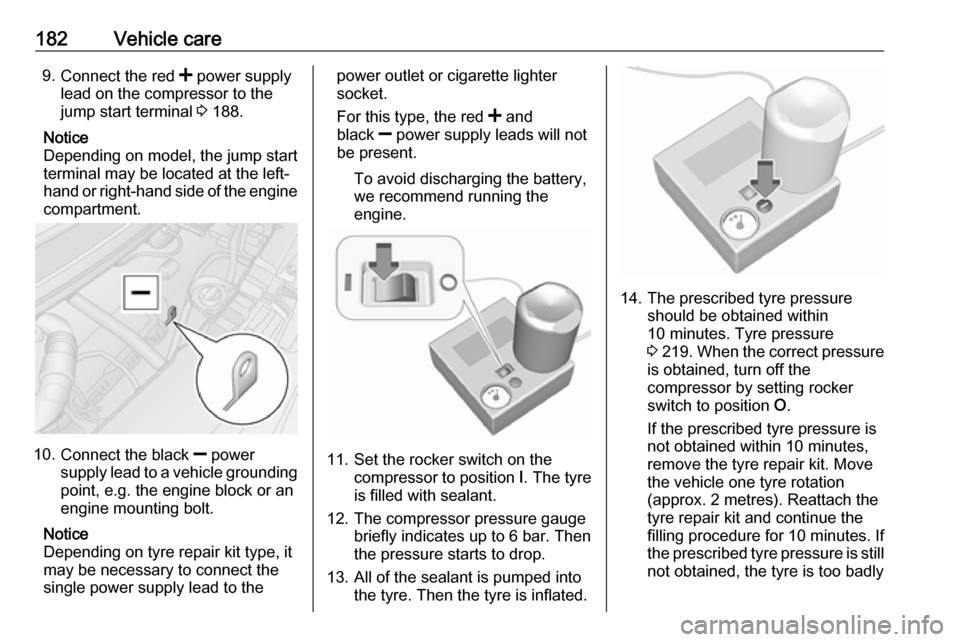
182Vehicle care9.Connect the red < power supply
lead on the compressor to the
jump start terminal 3 188.
Notice
Depending on model, the jump start
terminal may be located at the left-
hand or right-hand side of the engine compartment.
10. Connect the black ] power
supply lead to a vehicle grounding
point, e.g. the engine block or an
engine mounting bolt.
Notice
Depending on tyre repair kit type, it
may be necessary to connect the
single power supply lead to the
power outlet or cigarette lighter
socket.
For this type, the red < and
black ] power supply leads will not
be present.
To avoid discharging the battery,
we recommend running the
engine.
11. Set the rocker switch on the compressor to position I. The tyre
is filled with sealant.
12. The compressor pressure gauge briefly indicates up to 6 bar. Then
the pressure starts to drop.
13. All of the sealant is pumped into the tyre. Then the tyre is inflated.
14. The prescribed tyre pressureshould be obtained within
10 minutes. Tyre pressure
3 219 . When the correct pressure
is obtained, turn off the
compressor by setting rocker
switch to position O.
If the prescribed tyre pressure is
not obtained within 10 minutes,
remove the tyre repair kit. Move
the vehicle one tyre rotation
(approx. 2 metres). Reattach the
tyre repair kit and continue the
filling procedure for 10 minutes. If
the prescribed tyre pressure is still not obtained, the tyre is too badly
Page 192 of 233
190Vehicle care
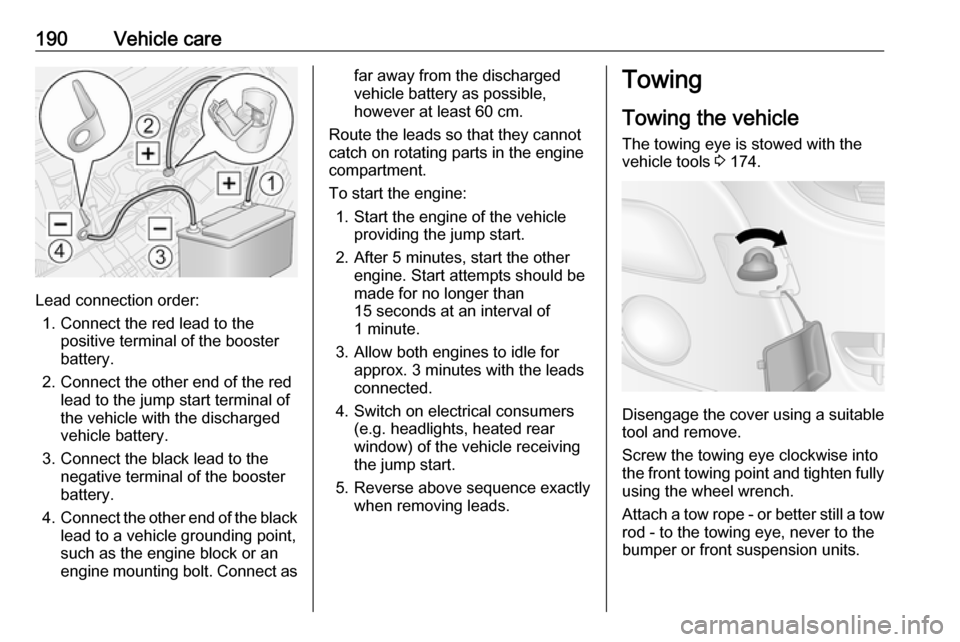
Lead connection order:1. Connect the red lead to the positive terminal of the booster
battery.
2. Connect the other end of the red lead to the jump start terminal of
the vehicle with the discharged
vehicle battery.
3. Connect the black lead to the negative terminal of the booster
battery.
4. Connect the other end of the black
lead to a vehicle grounding point,
such as the engine block or an
engine mounting bolt. Connect as
far away from the discharged
vehicle battery as possible,
however at least 60 cm.
Route the leads so that they cannot
catch on rotating parts in the engine
compartment.
To start the engine: 1. Start the engine of the vehicle providing the jump start.
2. After 5 minutes, start the other engine. Start attempts should be
made for no longer than
15 seconds at an interval of
1 minute.
3. Allow both engines to idle for approx. 3 minutes with the leads
connected.
4. Switch on electrical consumers (e.g. headlights, heated rear
window) of the vehicle receiving
the jump start.
5. Reverse above sequence exactly when removing leads.Towing
Towing the vehicle
The towing eye is stowed with the vehicle tools 3 174.
Disengage the cover using a suitable
tool and remove.
Screw the towing eye clockwise into
the front towing point and tighten fully using the wheel wrench.
Attach a tow rope - or better still a tow
rod - to the towing eye, never to the
bumper or front suspension units.
Page 193 of 233
Vehicle care191Caution
Do not tow the vehicle from the
rear. The front towing eye must
only be used for towing and not
recovering a vehicle.
Switch on ignition to permit operation
of brake lights, horn and windscreen
wipers, and move the steering wheel
slightly to release the steering wheel
lock.
Switch off the air suspension system 3 122.
Transmission in neutral.
Caution
Vehicles with manual
transmission automated: If neutral cannot be selected, the vehiclemust only be towed with the drive
wheels raised off the ground.
The vehicle should always be
towed with the ignition switched
off.
Manual transmission automated
3 130.
Caution
Drive slowly. Do not drive jerkily.
Excessive tractive force can
damage the vehicle.
When the engine is not running,
considerably more force is needed to
brake and steer.
To prevent the entry of exhaust fumes
from the towing vehicle, switch on the
air recirculation system 3 104 and
close the windows.
Seek the assistance of a workshop.
After towing, unscrew the towing eye
and refit the cover.
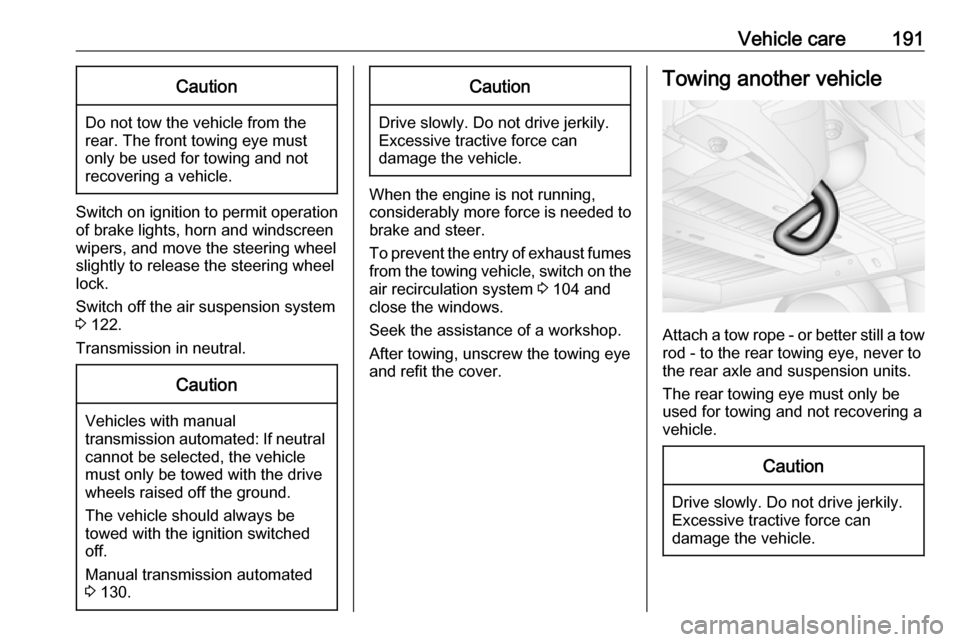
Towing another vehicle
Attach a tow rope - or better still a tow
rod - to the rear towing eye, never to
the rear axle and suspension units.
The rear towing eye must only be
used for towing and not recovering a
vehicle.
Caution
Drive slowly. Do not drive jerkily.
Excessive tractive force can
damage the vehicle.
Page 194 of 233
192Vehicle careAppearance careExterior care
Locks The locks are lubricated at the factoryusing a high quality lock cylinder
grease. Use de-icing agent only when
absolutely necessary, as this has a
degreasing effect and impairs lock function. After using a de-icing agent, have the locks regreased by a
workshop.
Washing The paintwork of your vehicle is
exposed to environmental influences. Wash and wax your vehicle regularly.
When using automatic vehicle
washes, select a programme that
includes waxing. Restrictions for
filmed or matt painted body parts or decor tapes, see "Polishing and
waxing".
Bird droppings, dead insects, resin,
pollen and the like should be cleaned
off immediately, as they contain
aggressive constituents which can cause paint damage.If using a vehicle wash, comply with
the vehicle wash manufacturer's instructions. The windscreen wipersmust be switched off and the exterior
mirrors must be folded in. Remove
antenna and external accessories
such as roof racks etc.
If you wash your vehicle by hand,
make sure that the insides of the
wheel housings are also thoroughly
rinsed out.
Clean edges and folds on opened
doors and the bonnet as well as the
areas they cover.
Clean bright metal mouldings with a
cleaning solution approved for
aluminium to avoid damages.Caution
Always use a cleaning agent with
a pH value of 4 to 9.
Do not use cleaning agents on hot surfaces.
Have the door hinges of all doors
greased by a workshop.
Do not clean the engine compartment with a steam-jet or high-pressure jet
cleaner.
Thoroughly rinse and leather-off the vehicle. Rinse leather frequently. Use
separate leathers for painted and
glass surfaces: remnants of wax on
the windows will impair vision.
Exterior lights
Headlight and other light covers are
made of plastic. Do not use any
abrasive or caustic agents, do not use
an ice scraper, and do not clean them
dry.
Polishing and waxing
Wax the vehicle regularly (at the
latest when water no longer beads).
Otherwise, the paintwork will dry out.
Polishing is necessary only if the paint
has become dull or if solid deposits
have become attached to it.
Paintwork polish with silicone forms a protective film, making waxing
unnecessary.
Page 196 of 233

194Vehicle careThe instrument cluster and the
displays should only be cleaned using
a soft damp cloth. If necessary use a
weak soap solution.
Clean fabric upholstery with a
vacuum cleaner and brush. Remove
stains with an upholstery cleaner.
Clothing fabrics may not be
colourfast. This could cause visible
discolourations, especially on light-
coloured upholstery. Removable
stains and discolourations should be
cleaned as soon as possible.
Clean seat belts with lukewarm water or interior cleaner.Caution
Close Velcro fasteners as open
Velcro fasteners on clothing could damage seat upholstery.
The same applies to clothing with
sharp-edged objects, like zips or
belts or studded jeans.
Plastic and rubber parts
Plastic and rubber parts can be
cleaned with the same cleaner as
used to clean the body. Use interior cleaner if necessary. Do not use any
other agent. Avoid solvents and petrol in particular. Do not use high-
pressure jet cleaners.
Page 226 of 233

224IndexAAccessories and vehicle modifications .......................... 154
Adaptive forward lighting .....98, 164
AdBlue .......................... 87, 125, 196
Adblue gauge ............................... 79
AdBlue tank ................................ 218
Adjustable air vents ...................113
Airbag and belt tensioners ...........84
Airbag deactivation ................53, 84
Airbag label................................... 49 Airbag system .............................. 49
Air conditioning regular operation ................................ 114
Air conditioning system .............. 104
Air intake .................................... 114
Air suspension ........................... 122
Air suspension system................ 190
Air vents...................................... 113
Antifreeze ................................... 157
Antilock brake system ................ 134
Antilock brake system (ABS) .......86
Anti-theft alarm system ................31
Anti-theft bolts............................. 184
Anti-theft locking system .............. 30
Anti-theft security lock ..................21
Appearance care ........................192
Armrest ........................................ 44
Ashtrays ....................................... 77
Automatic light control .................95Automatic locking ...................21, 25
Autostop ..................................... 118
Auxiliary heater ........................... 109
B Battery discharge protection ......102
Battery, jump starting.................. 188
Belts.............................................. 46 BlueInjection ............................... 125
Bonnet ....................................... 155
Brake assist ............................... 136
Brake fluid .......................... 159, 196
Brakes ............................... 134, 159
Brake system ............................... 85
Breakdown.................................. 190
Bulb replacement ....................... 162
C Capacities .................................. 218
Cargo management system ........67
Car Pass ...................................... 19
Catalytic converter .....................124
Central locking system ................21
Centre high-mounted brake light 167
Changing tyre and wheel size ...179
Charging system .......................... 84
Child locks ................................... 25
Child restraint installation locations ................................... 56
Child restraints.............................. 55
Child restraint systems ................55