technical specifications VOLKSWAGEN CORRADO 1990 Repair Manual
[x] Cancel search | Manufacturer: VOLKSWAGEN, Model Year: 1990, Model line: CORRADO, Model: VOLKSWAGEN CORRADO 1990Pages: 906, PDF Size: 6.56 MB
Page 551 of 906

F - BASIC TESTING
Article Text (p. 6)
1990 Volkswagen Corrado
For Volkswagen Technical Site: http://vw.belcom.ru
Copyright © 1998 Mitchell Repair Information Company, LLC
Thursday, March 23, 2000 09:44PM
ALL EXCEPT CORRADO & VANAGON
1) Remove fuel return line located near left strut tower.
Remove fuel tank cap. Attach a piece of hose between return line and a
1 qt. (.95 liter) graduated container.
2) Activate fuel pump for 30 seconds by removing fuel pump
relay and attaching jumper wire between terminals No. 30 and No. 87.
Remove fuel pump relay from fuse/relay block. Compare volume with
specifications.
CORRADO
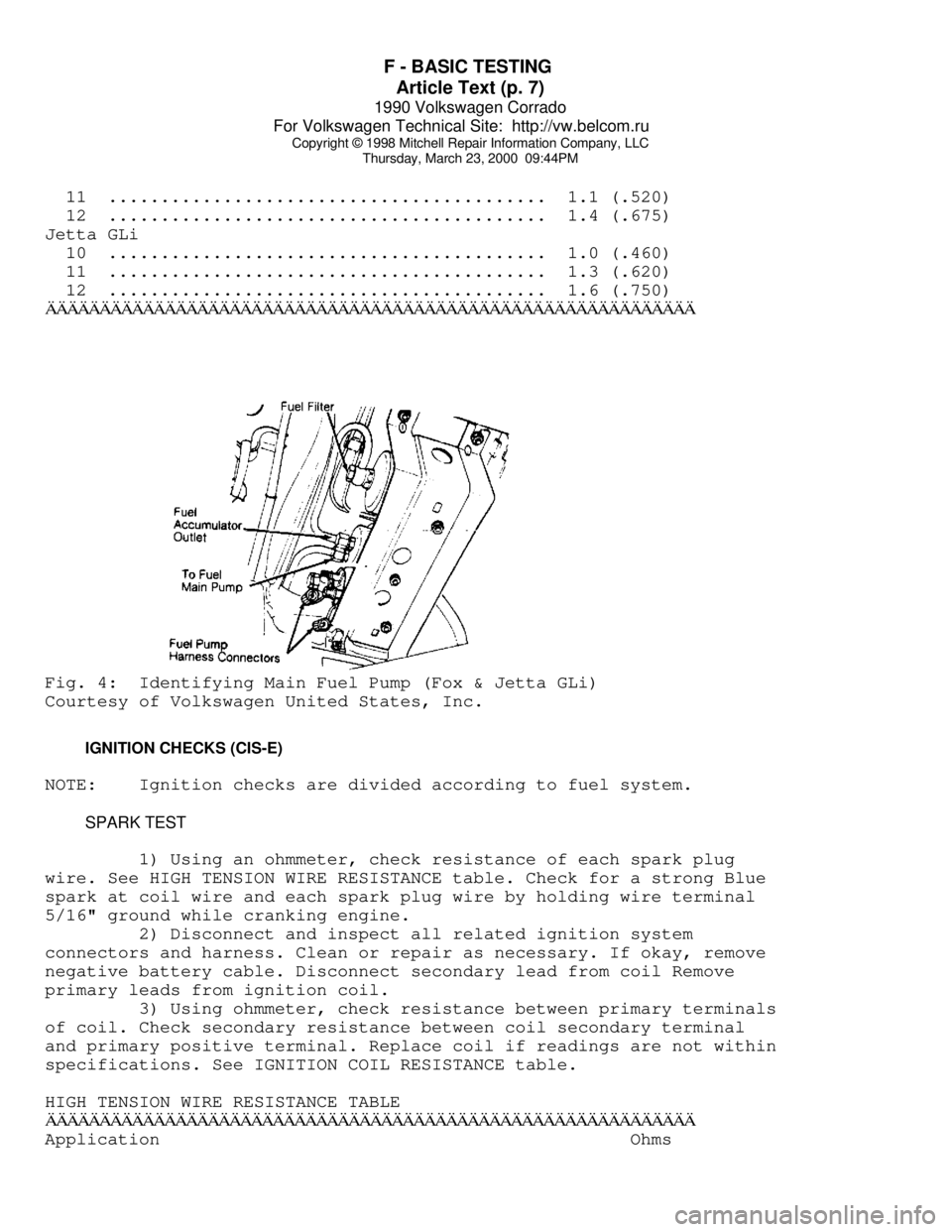
1) Disconnect wire harness connector from fuel pump. See
Fig. 4. With voltmeter attached to terminals, activate fuel pump by
removing fuel pump relay and applying battery voltage to terminals No.
4 of the fuse box connection for the fuel pump relay. Fuel pump relay
located on fuse box housing. Terminal numbers are molded into fuse box
plastic housing.
2) Record voltage. Remove fuel line from outlet side of
accumulator. See Fig. 4. Attach a piece of hose between return line
and a graduated container. Activate fuel pump for 30 seconds. Compare
volume with specifications given in MAIN FUEL PUMP VOLUME (AFC-
Digifant II) table.
VANAGON
1) Remove the return line from the pressure regulator located
in engine compartment left side. Push a piece of hose onto open
connection of pressure regulator. Insert hose into a 1 qt. (1 liter)
graduated container.
2) Activate fuel pump for 30 seconds by removing fuel pump
relay and attaching jumper wire between terminals No. 30 and No. 87.
Fuel pump relay located left side of engine compartment in Black
plastic box. Compare volume with specifications.
FUEL PUMP PERFORMANCE TABLE (AFC-DIGIFANT II)ÄÄÄÄÄÄÄÄÄÄÄÄÄÄÄÄÄÄÄÄÄÄÄÄÄÄÄÄÄÄÄÄÄÄÄÄÄÄÄÄÄÄÄÄÄÄÄÄÄÄÄÄÄÄÄÄÄÄÄÄÄÄÄÄÄÄÄÄÄÄ Pressure Min. Vol. in 30 Sec.
Application psi (kg/cm
ý) Pts. (L)
Cabriolet, Corrado,
Golf GL/GTI & Jetta .... 29-36 (2.0-2.5) ............... 1.0 (.5)
Vanagon ................. 33-39 (2.3-2.7) ............... 1.0 (.5)
ÄÄÄÄÄÄÄÄÄÄÄÄÄÄÄÄÄÄÄÄÄÄÄÄÄÄÄÄÄÄÄÄÄÄÄÄÄÄÄÄÄÄÄÄÄÄÄÄÄÄÄÄÄÄÄÄÄÄÄÄÄÄÄÄÄÄÄÄÄÄFUEL PUMP PERFORMANCE TABLE (CIS-E & CIS-MOTRONIC)
ÄÄÄÄÄÄÄÄÄÄÄÄÄÄÄÄÄÄÄÄÄÄÄÄÄÄÄÄÄÄÄÄÄÄÄÄÄÄÄÄÄÄÄÄÄÄÄÄÄÄÄÄÄÄÄÄÄÄÄÄApplication @ Voltage Min. Vol. in 30 Sec. Pts. (L)
Fox
10 ........................................... .8 (.375)
Page 552 of 906
F - BASIC TESTING
Article Text (p. 7)
1990 Volkswagen Corrado
For Volkswagen Technical Site: http://vw.belcom.ru
Copyright © 1998 Mitchell Repair Information Company, LLC
Thursday, March 23, 2000 09:44PM
11 .......................................... 1.1 (.520)
12 .......................................... 1.4 (.675)
Jetta GLi
10 .......................................... 1.0 (.460)
11 .......................................... 1.3 (.620)
12 .......................................... 1.6 (.750)ÄÄÄÄÄÄÄÄÄÄÄÄÄÄÄÄÄÄÄÄÄÄÄÄÄÄÄÄÄÄÄÄÄÄÄÄÄÄÄÄÄÄÄÄÄÄÄÄÄÄÄÄÄÄÄÄÄÄÄÄFig. 4: Identifying Main Fuel Pump (Fox & Jetta GLi)
Courtesy of Volkswagen United States, Inc.
IGNITION CHECKS (CIS-E)
NOTE: Ignition checks are divided according to fuel system.
SPARK TEST
1) Using an ohmmeter, check resistance of each spark plug
wire. See HIGH TENSION WIRE RESISTANCE table. Check for a strong Blue
spark at coil wire and each spark plug wire by holding wire terminal
5/16" ground while cranking engine.
2) Disconnect and inspect all related ignition system
connectors and harness. Clean or repair as necessary. If okay, remove
negative battery cable. Disconnect secondary lead from coil Remove
primary leads from ignition coil.
3) Using ohmmeter, check resistance between primary terminals
of coil. Check secondary resistance between coil secondary terminal
and primary positive terminal. Replace coil if readings are not within
specifications. See IGNITION COIL RESISTANCE table.
HIGH TENSION WIRE RESISTANCE TABLE
ÄÄÄÄÄÄÄÄÄÄÄÄÄÄÄÄÄÄÄÄÄÄÄÄÄÄÄÄÄÄÄÄÄÄÄÄÄÄÄÄÄÄÄÄÄÄÄÄÄÄÄÄÄÄÄÄÄÄÄÄApplication Ohms
Page 554 of 906
F - BASIC TESTING
Article Text (p. 9)
1990 Volkswagen Corrado
For Volkswagen Technical Site: http://vw.belcom.ru
Copyright © 1998 Mitchell Repair Information Company, LLC
Thursday, March 23, 2000 09:44PM
1) Perform SPARK TEST check. If secondary spark is present,
ignition control unit is okay. If not, turn ignition off. Disconnect
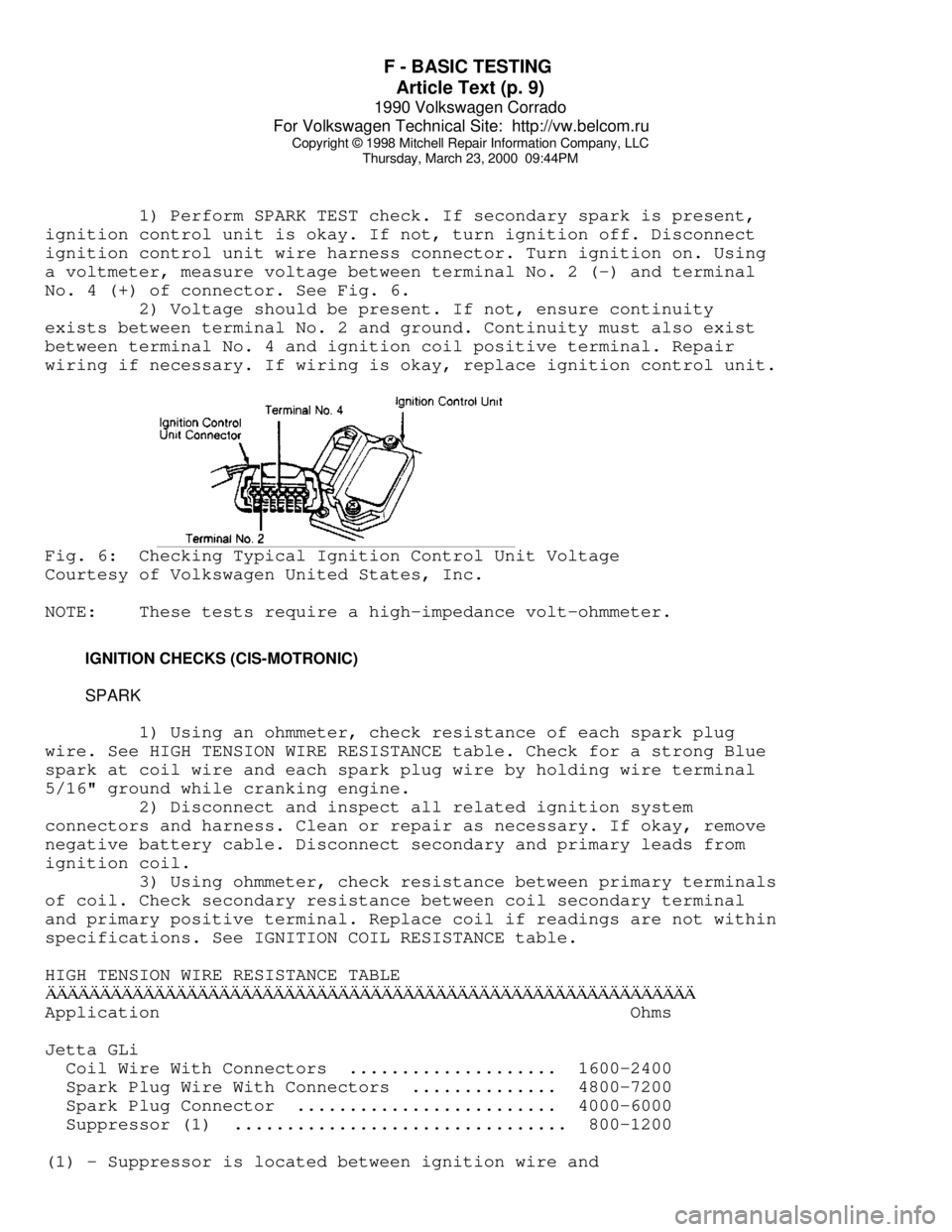
ignition control unit wire harness connector. Turn ignition on. Using
a voltmeter, measure voltage between terminal No. 2 (-) and terminal
No. 4 (+) of connector. See Fig. 6.
2) Voltage should be present. If not, ensure continuity
exists between terminal No. 2 and ground. Continuity must also exist
between terminal No. 4 and ignition coil positive terminal. Repair
wiring if necessary. If wiring is okay, replace ignition control unit.Fig. 6: Checking Typical Ignition Control Unit Voltage
Courtesy of Volkswagen United States, Inc.
NOTE: These tests require a high-impedance volt-ohmmeter.
IGNITION CHECKS (CIS-MOTRONIC)
SPARK
1) Using an ohmmeter, check resistance of each spark plug
wire. See HIGH TENSION WIRE RESISTANCE table. Check for a strong Blue
spark at coil wire and each spark plug wire by holding wire terminal
5/16" ground while cranking engine.
2) Disconnect and inspect all related ignition system
connectors and harness. Clean or repair as necessary. If okay, remove
negative battery cable. Disconnect secondary and primary leads from
ignition coil.
3) Using ohmmeter, check resistance between primary terminals
of coil. Check secondary resistance between coil secondary terminal
and primary positive terminal. Replace coil if readings are not within
specifications. See IGNITION COIL RESISTANCE table.
HIGH TENSION WIRE RESISTANCE TABLEÄÄÄÄÄÄÄÄÄÄÄÄÄÄÄÄÄÄÄÄÄÄÄÄÄÄÄÄÄÄÄÄÄÄÄÄÄÄÄÄÄÄÄÄÄÄÄÄÄÄÄÄÄÄÄÄÄÄÄÄApplication Ohms
Jetta GLi
Coil Wire With Connectors .................... 1600-2400
Spark Plug Wire With Connectors .............. 4800-7200
Spark Plug Connector ......................... 4000-6000
Suppressor (1) ................................ 800-1200
(1) - Suppressor is located between ignition wire and
Page 557 of 906

F - BASIC TESTING
Article Text (p. 12)
1990 Volkswagen Corrado
For Volkswagen Technical Site: http://vw.belcom.ru
Copyright © 1998 Mitchell Repair Information Company, LLC
Thursday, March 23, 2000 09:44PM
No. 1 and No. 15 of the coil.
2) Turn the ignition on, using a jumper wire, briefly connect
the center terminal of the Hall Effect sender connector to ground. The
voltage should briefly increase to at least 2 volts then drop to zero.
If not, either the ECU or coil power stage are defective.
IGNITION CHECKS (AFC-DIGIFANT II)
SPARK TEST
1) Using an ohmmeter, check resistance of each spark plug
wire. See HIGH TENSION WIRE RESISTANCE table. Check for a strong Blue
spark at coil wire and each spark plug wire by holding wire terminal
5/16" ground while cranking engine.
2) Disconnect and inspect all related ignition system
connectors and harness. Clean or repair as necessary. If okay, remove
negative battery cable. Disconnect secondary and primary leads from
ignition coil.
3) Using ohmmeter, check resistance between primary terminals
of coil. Check secondary resistance between coil secondary terminal
and primary positive terminal. Replace coil if readings are not within
specifications. See IGNITION COIL RESISTANCE table.
HIGH TENSION WIRE RESISTANCE TABLEÄÄÄÄÄÄÄÄÄÄÄÄÄÄÄÄÄÄÄÄÄÄÄÄÄÄÄÄÄÄÄÄÄÄÄÄÄÄÄÄÄÄÄÄÄÄÄÄÄÄÄÄÄÄÄÄÄÄÄÄApplication Ohms
Vanagon
Coil Wire With Connectors ................... 1200-2800
Spark Plug Wire/Connector ................... 4600-7400
Spark Plug Connector ........................ 4000-6000
Suppressor (1) ............................... 600-1400
All Other Models
Coil Wire Only .................................... (1)
Coil Wire With Connector .................... 1600-2400
Spark Plug Wire/ Connector .................. 4000-6000
Suppressor (2) ............................... 600-1400
(1) - Check for continuity.
(2) - Suppressor is located between ignition wire and
distributor cap.
ÄÄÄÄÄÄÄÄÄÄÄÄÄÄÄÄÄÄÄÄÄÄÄÄÄÄÄÄÄÄÄÄÄÄÄÄÄÄÄÄÄÄÄÄÄÄÄÄÄÄÄÄÄÄÄÄÄÄÄÄ IGNITION COIL
IGNITION COIL RESISTANCE TABLE - Ohms @ 68
øF (20øC)
ÄÄÄÄÄÄÄÄÄÄÄÄÄÄÄÄÄÄÄÄÄÄÄÄÄÄÄÄÄÄÄÄÄÄÄÄÄÄÄÄÄÄÄÄÄÄÄÄÄÄÄÄÄÄÄÄÄÄÄÄApplication Primary Secondary
Jetta GLi 2.0L ......... .60-.70 ............. 6900-8500
All Other Models ....... .52-.76 ............. 2400-3500
ÄÄÄÄÄÄÄÄÄÄÄÄÄÄÄÄÄÄÄÄÄÄÄÄÄÄÄÄÄÄÄÄÄÄÄÄÄÄÄÄÄÄÄÄÄÄÄÄÄÄÄÄÄÄÄÄÄÄÄÄ
Page 568 of 906

GEAR TOOTH CONTACT PATTERNS
Article Text
1990 Volkswagen Corrado
For Volkswagen Technical Site: http://vw.belcom.ru
Copyright © 1998 Mitchell Repair Information Company, LLC
Thursday, March 23, 2000 09:45PM
ARTICLE BEGINNING
GENERAL INFORMATION
Gear Tooth Contact Patterns
* PLEASE READ THIS FIRST *
The following article is for GENERAL INFORMATION purposes
only. Information does not SPECIFICALLY apply to all years, makes and
models, but is to be used as a general reference guide.
INSPECTION
PRELIMINARY INSPECTION
Wipe lubricant from internal parts. Rotate gears and inspect
for wear or damage. Mount dial indicator to housing, and check
backlash at several points around ring gear. Backlash must be within
specifications at all points. If no defects are found, check gear
tooth contact pattern.
GEAR TOOTH CONTACT PATTERN
NOTE: Drive pattern should be well centered on ring gear teeth.
Coast pattern should be centered, but may be slightly toward
toe of ring gear teeth.
1) Paint ring gear teeth with marking compound. Wrap cloth or
rope around drive pinion flange to act as brake. Rotate ring gear
until clear tooth contact pattern is obtained.
2) Contact pattern will indicate whether correct pinion
bearing mounting shim has been installed and if drive gear backlash
has been set properly. Backlash between drive gear and pinion must be
maintained within specified limits, until correct tooth pattern is
obtained.
Page 574 of 906

H - TESTS W/O CODES
Article Text
1990 Volkswagen Corrado
For Volkswagen Technical Site: http://vw.belcom.ru
Copyright © 1998 Mitchell Repair Information Company, LLC
Thursday, March 23, 2000 09:45PM
ARTICLE BEGINNING
1990 ENGINE PERFORMANCE
Trouble Shooting - No Codes
Volkswagen; Cabriolet, Corrado, Fox, Golf GL/GTI,
Jetta, Vanagon
INTRODUCTION
Before diagnosing symptoms or intermittent faults, perform
steps in F - BASIC TESTING article. Use this article to diagnose
driveability problems existing when a hard fault code is not present
or vehicle is not equipped with a self-diagnostic system.
NOTE: Some driveability problems may have been corrected by
manufacturer with a revised computer calibration chip or
computer control unit. Check with manufacturer for latest
chip or computer application.
Symptom checks can direct the technician to malfunctioning
component(s) for further diagnosis. A symptom should lead to a
specific component, system test or an adjustment.
Use intermittent test procedures to locate driveability
problems that DO NOT occur when the vehicle is being tested. These
test procedures should also be used if a soft (intermittent) trouble
code was present, but no problem was found during self-diagnostic
testing.
NOTE: For specific testing procedures, see I - SYSTEM/COMP
TESTS article. For specifications, see D - ADJUSTMENTS
or C - SPECIFICATIONS articles.
SYMPTOM DIAGNOSIS
Symptom checks cannot be used properly unless the problem is
actually happening while the vehicle is being tested. To reduce
diagnostic time, ensure steps in F - BASIC TESTING article have been
performed before attempting to diagnose a symptom. Symptoms available
for diagnosis include the following:
* Will Not Start or Starts Hard Cold (Cranks Okay)
* Will Not Start or Starts Hard Hot (Cranks Okay)
* Engine Stalls or Idles Rough
* Engine Misfires or Hesitates
* Excessive Fast Idle
* Engine Hesitates On Acceleration
* Engine Lacks Power
* Poor Fuel Mileage
* Engine Diesels
* Failed Emissions Test
Page 578 of 906

H - TESTS W/O CODES
Article Text (p. 5)
1990 Volkswagen Corrado
For Volkswagen Technical Site: http://vw.belcom.ru
Copyright © 1998 Mitchell Repair Information Company, LLC
Thursday, March 23, 2000 09:45PM
* Ensure there are no vacuum leaks.
* Check idle stabilizer operation (if equipped).
* Ensure fuel system pressure and volume are correct.
* Check auxiliary air by-pass regulator.
* Check cold start valve for leaking (engine warm).
ENGINE HESITATES ON ACCELERATION
* Inspect intake air components for leaking hoses
* Check injector spray pattern. Check for faulty injectors.
* Check cold start valve for leaking (engine warm).
* Check airflow sensor plate movement. Replace fuel distributor
as necessary.
* Check airflow sensor plate position. Adjust as necessary.
* Check fuel system and control system pressure. Replace pressure
regulator if necessary.
* Test airflow sensor plate potentiometer. Adjust or replace
as necessary.
* Perform system electrical checks.
* Check idle mixture CO adjustment. Adjust as necessary.
ENGINE LACKS POWER
* Test coolant temperature sensor and wiring. Repair or
replace as required.
* Check fuel system and control system pressure. Replace pressure
regulator if necessary.
* Check throttle cable adjustment.
* Check throttle switch. Adjust or replace as necessary.
* Check airflow sensor screen for damage or incorrect installation
(if equipped).
* Check ignition timing and knock sensor control (if equipped).
Adjust as necessary.
* Check EGR system for correct operation (if equipped).
* Ensure base timing is correct and timing advance system
is functional.
* Check transmission for correct downshift (auto. trans.)
* Check fuel tank filler tube for tampering of restrictor. If
tampering has occurred, check catalytic converter for lead
contamination and exhaust system restriction.
* Check for use of poor quality fuel containing insufficient
cleaning additives. Prolonged use of poor quality fuel can
cause injector clogging and carbon build-up on intake system.
* Inspect intake air element, housing, and preheating system.
* Check airflow sensor plate movement. Replace if necessary.
POOR FUEL MILEAGE
* Ensure idle speed, base timing and timing advance are
set to specifications.
* Check cold start valve for leaking (engine warm).
Page 579 of 906

H - TESTS W/O CODES
Article Text (p. 6)
1990 Volkswagen Corrado
For Volkswagen Technical Site: http://vw.belcom.ru
Copyright © 1998 Mitchell Repair Information Company, LLC
Thursday, March 23, 2000 09:45PM
* Check fuel system and control system pressure. Replace
pressure regulator if necessary.
* Check thermo time switch operation.
* Check airflow sensor voltage output.
* Check air induction system for leaks.
* Check fuel injector operation.
* Check coolant temperature sensor operation.
* Check Oxygen (O2) sensor operation.
ENGINE DIESELING
CIS-E & CIS-E MOTRONIC
* Ensure ignition timing and timing advance are set to
specifications.
* Check for engine overheating.
* Check cold start valve for leaking (engine warm).
* Check for leaking injectors.
* Check airflow sensor plate/control plunger rest position.
Adjust as necessary.
* Check carbon canister solenoid valve.
* Verify no leaks in exhaust system.
FAILED EMISSIONS TEST
* Test lambda control system. Replace if faulty.
* Check air/fuel mixture. Adjust if necessary.
* Ensure air intake system is not restricted.
* Ensure engine is at normal operating temperature.
* Ensure fuel system pressure is correct.
* Check cold start valve for leaking (engine warm).
* Check thermo time switch operation.
* Verify base timing is correct.
* Check for correct PCV valve operation.
* Check crankcase for gasoline contamination.
* Check idle stabilizer operation.
* Check EGR system for correct operation (if equipped).
* Check vapor recovery system operation.
* Check operation of coolant temperature sensor.
* Check fuel tank filler tube for tampering of restrictor.
If tampering has occurred, check catalytic converter for
lead contamination and exhaust system restriction.
* Check for use of poor quality fuel containing insufficient
cleaning additives. Prolonged use of poor quality fuel can
cause injector clogging and carbon build-up on intake system.
INTERMITTENT PROBLEM DIAGNOSIS
Intermittent fault testing requires duplicating circuit or
component failure to identify the problem. If necessary, monitor
voltage or resistance values using a DVOM while attempting to
Page 594 of 906
I - SYSTEM/COMPONENT TESTS
Article Text (p. 7)
1990 Volkswagen Corrado
For Volkswagen Technical Site: http://vw.belcom.ru
Copyright © 1998 Mitchell Repair Information Company, LLC
Thursday, March 23, 2000 09:46PM
1) Disconnect throttle valve switch connector. With ohmmeter
set on 200-ohm scale, attach probes to male terminals. Ensure throttle
valve switch is completely closed. With throttle valve closed, meter
reading should be zero.
2) Position throttle valve to 1/2 open position. Ohmmeter
reading should be infinite. Position throttle to fully open position.
Ohmmeter reading should be zero. If any reading is incorrect, perform
throttle valve switch adjustment. See D - ADJUSTMENTS article.
3) If correct specifications cannot be obtained, check
throttle shaft play, accelerator cable adjustment and throttle switch
actuating cam. If okay, replace throttle valve switch.
RELAYS
FUEL PUMP RELAY (CABRIOLET, GOLF GL/GTI & JETTA)
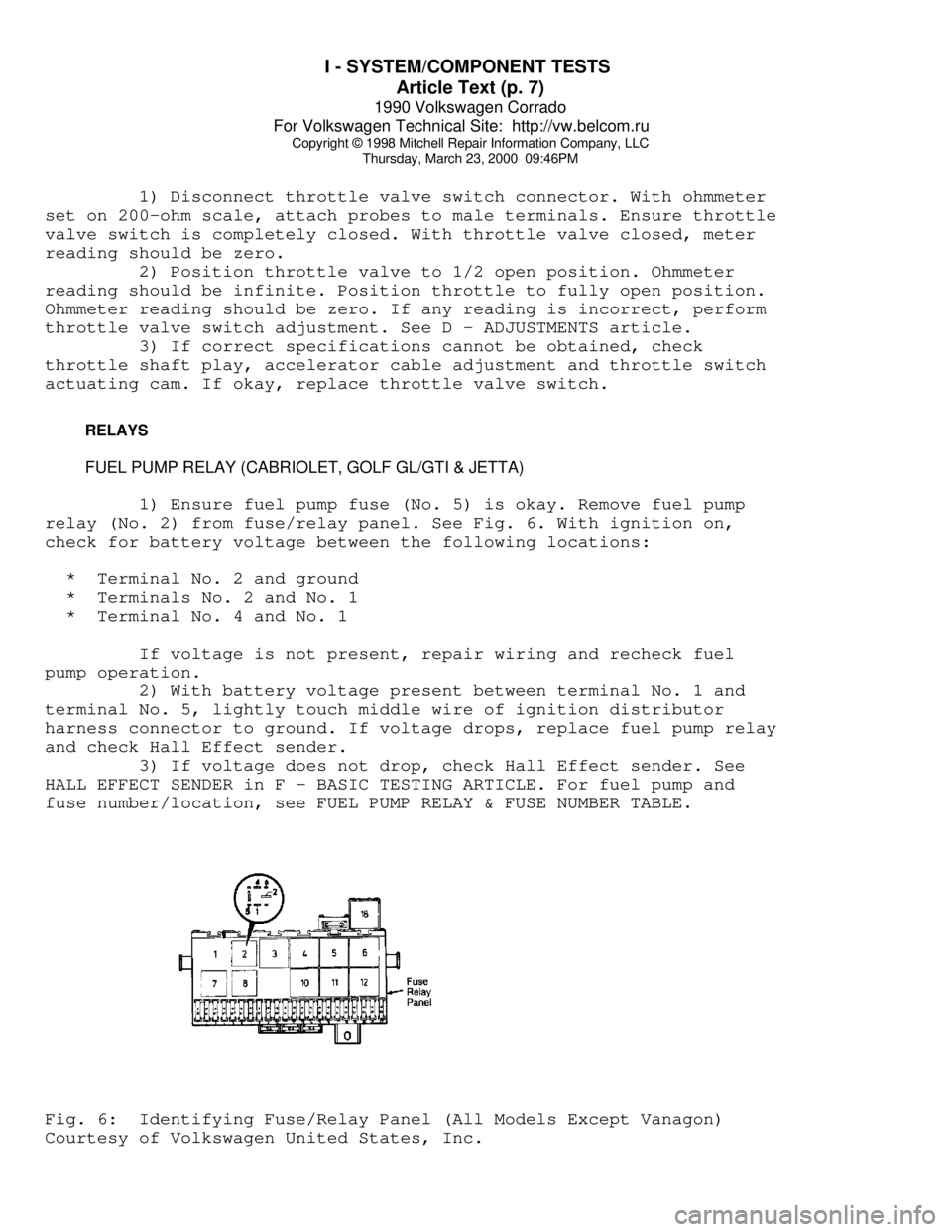
1) Ensure fuel pump fuse (No. 5) is okay. Remove fuel pump
relay (No. 2) from fuse/relay panel. See Fig. 6. With ignition on,
check for battery voltage between the following locations:
* Terminal No. 2 and ground
* Terminals No. 2 and No. 1
* Terminal No. 4 and No. 1
If voltage is not present, repair wiring and recheck fuel
pump operation.
2) With battery voltage present between terminal No. 1 and
terminal No. 5, lightly touch middle wire of ignition distributor
harness connector to ground. If voltage drops, replace fuel pump relay
and check Hall Effect sender.
3) If voltage does not drop, check Hall Effect sender. See
HALL EFFECT SENDER in F - BASIC TESTING ARTICLE. For fuel pump and
fuse number/location, see FUEL PUMP RELAY & FUSE NUMBER TABLE.Fig. 6: Identifying Fuse/Relay Panel (All Models Except Vanagon)
Courtesy of Volkswagen United States, Inc.
Page 603 of 906

INSTRUMENT PANEL
Article Text
1990 Volkswagen Corrado
For Volkswagen Technical Site: http://vw.belcom.ru
Copyright © 1998 Mitchell Repair Information Company, LLC
Thursday, March 23, 2000 09:46PM
ARTICLE BEGINNING
1989-90 ACCESSORIES & EQUIPMENT
Volkswagen Instrument Panels
Cabriolet, Fox, Golt, GTI, Jetta, Jetta GLI, Vanagon
DESCRIPTION & OPERATION
Instrument cluster for most models includes speedometer, fuel
gauge and temperature gauge. Optional instruments include clock,
tachometer, voltmeter and oil temperature gauge.
Printed circuit provides voltage to gauges. A voltage
regulator attached to the printed circuit controls voltage to fuel and
temperature gauges. Light Emitting Diodes (LEDs) are used for most
warning lights. To replace diodes, pull from printed circuit sockets.
NOTE: Volkswagen Tester (1301) is required for resistance tests.
Tester settings are numerical. Settings do not indicate
resistance in ohms. Manufacturer does not supply resistance
value in ohms.
TESTING
FUEL & TEMPERATURE GAUGE
1) Disconnect wire from fuel tank or temperature sending
unit. Connect VW tester between wire and ground. Turn ignition on and
allow 2 minutes for gauge reading to stabilize. Use FUEL GAUGE TESTING
or TEMPERATURE GAUGE TESTING table to compare gauge reading. Gauge
should be within one pointer width of specification.
2) If gauge needle does not move, check continuity between
sender wire and gauge. If needle moves, but does not match
specifications, replace gauge. If gauge works correctly with tester,
but not sending unit, replace sending unit.
FUEL GAUGE TESTINGÄÄÄÄÄÄÄÄÄÄÄÄÄÄÄÄÄÄÄÄÄÄÄÄÄÄÄÄÄÄÄÄÄÄÄÄÄÄÄÄÄÄÄÄÄÄÄÄÄÄÄÄÄÄÄApplication Dial Setting Indicator
Cabriolet & Fox .......... 55 ................ Full
560 ................Empty
Golf, GTI, Jetta
& Jetta GLI .............. 52 ................ Full
550 ................Empty
Vanagon .................. 50 ................ Full
320 ................Empty
ÄÄÄÄÄÄÄÄÄÄÄÄÄÄÄÄÄÄÄÄÄÄÄÄÄÄÄÄÄÄÄÄÄÄÄÄÄÄÄÄÄÄÄÄÄÄÄÄÄÄÄÄÄÄÄTEMPERATURE GAUGE TESTING
ÄÄÄÄÄÄÄÄÄÄÄÄÄÄÄÄÄÄÄÄÄÄÄÄÄÄÄÄÄÄÄÄÄÄÄÄÄÄÄÄÄÄÄÄÄÄÄÄÄÄÄÄÄÄÄ