technical specifications VOLKSWAGEN CORRADO 1990 Repair Manual
[x] Cancel search | Manufacturer: VOLKSWAGEN, Model Year: 1990, Model line: CORRADO, Model: VOLKSWAGEN CORRADO 1990Pages: 906, PDF Size: 6.56 MB
Page 435 of 906

C - SPECIFICATIONS
Article Text (p. 7)
1990 Volkswagen Corrado
For Volkswagen Technical Site: http://vw.belcom.ru
Copyright © 1998 Mitchell Repair Information Company, LLC
Thursday, March 23, 2000 09:43PM
INJECTOR RESISTANCE SPECS TABLE
INJECTOR RESISTANCE SPECIFICATIONS TABLEÄÄÄÄÄÄÄÄÄÄÄÄÄÄÄÄÄÄÄÄÄÄÄÄÄÄÄÄÄÄÄÄÄÄÄÄÄÄÄÄÄÄÄÄÄÄÄÄÄÄÄÄÄÄÄÄÄÄÄÄÄÄÄÄÄApplication Ohms
Vanagon ............................................. 16.0-16.4
All Other Models .................................. (1) 3.7-5.0
(1) - Resistance measured at main electrical connector on the end
of fuel rail.
ÄÄÄÄÄÄÄÄÄÄÄÄÄÄÄÄÄÄÄÄÄÄÄÄÄÄÄÄÄÄÄÄÄÄÄÄÄÄÄÄÄÄÄÄÄÄÄÄÄÄÄÄÄÄÄÄÄÄÄÄÄÄÄÄÄ IDLE SPEED & MIXTURE SPECS TABLE
IDLE SPEED & CO LEVEL TABLE
ÄÄÄÄÄÄÄÄÄÄÄÄÄÄÄÄÄÄÄÄÄÄÄÄÄÄÄÄÄÄÄÄÄÄÄÄÄÄÄÄÄÄÄÄÄÄÄÄÄÄÄÄÄÄÄApplication Idle RPM CO Level
Cabriolet .......... 850-1000 ............ 0.3-1.2%
Fox ................ 800-1000 ............ 0.3-1.2%
Golf ............... 800-1000 ............ 0.3-1.2%
Golf GT ............. 800-900 ............ 0.3-1.2%
GTI ................ 800-1000 ............ 0.3-1.2%
Jetta .............. 800-1000 ............ 0.3-1.2%
Vanagon ............. 830-930 ............ 0.3-1.2%
ÄÄÄÄÄÄÄÄÄÄÄÄÄÄÄÄÄÄÄÄÄÄÄÄÄÄÄÄÄÄÄÄÄÄÄÄÄÄÄÄÄÄÄÄÄÄÄÄÄÄÄÄÄÄÄEND OF ARTICLE
Page 438 of 906

D - ADJUSTMENTS
Article Text
1990 Volkswagen Corrado
For Volkswagen Technical Site: http://vw.belcom.ru
Copyright © 1998 Mitchell Repair Information Company, LLC
Thursday, March 23, 2000 09:43PM
ARTICLE BEGINNING
1990 ENGINE PERFORMANCE
On-Vehicle Adjustments
Volkswagen; Cabriolet, Corrado, Fox, Golf GL/GTI,
Jetta, Vanagon
ENGINE COMPRESSION
Check engine compression with engine at normal operating
temperature at specified cranking speed, all spark plugs removed and
throttle wide open.
ENGINE COMPRESSION TESTÄÄÄÄÄÄÄÄÄÄÄÄÄÄÄÄÄÄÄÄÄÄÄÄÄÄÄÄÄÄÄÄÄÄÄÄÄÄÄÄÄÄÄÄÄÄÄÄÄÄÄÄÄÄÄÄÄÄÄÄÄÄÄÄÄÄÄÄÄÄModel Standard Minimum
psi (kg/cm
ý) psi (kg/cmý)
Cabriolet ............. 131-174 (9.0-12.0) ............. 109 (7.5)
Corrado ............... 116-174 (8.0-12.0) .............. 87 (6.0)
Fox ................... 131-174 (9.0-12.0) ............. 102 (7.0)
Golf GL/GTI 1.8L ...... 131-174 (9.0-12.0) ............. 102 (7.0)
Jetta ................. 131-174 (9.0-12.0) ............. 102 (7.0)
Jetta GLi 2.0L ........ 145-190 (10.0-13.0) ............ 109 (7.5)
Vanagon ............... 87-131 (6.1-9.2) ................ 87 (6.0)
ÄÄÄÄÄÄÄÄÄÄÄÄÄÄÄÄÄÄÄÄÄÄÄÄÄÄÄÄÄÄÄÄÄÄÄÄÄÄÄÄÄÄÄÄÄÄÄÄÄÄÄÄÄÄÄÄÄÄÄÄÄÄÄÄÄÄÄÄÄÄ VALVE CLEARANCE
NOTE: All models use hydraulic lifters. No adjustments are
required.
IGNITION TIMING
NOTE: Basic timing readings are only valid when engine idle speed
and idle mixture are within specifications. For best
results, the manufacturer recommends ignition timing, idle
CO and idle speed be checked and adjusted in that order.
NOTE: Off idle timing is computer controlled on models with knock
sensor(s). Only idle ignition timing can be set.
ALL MODELS EXCEPT VANAGON
1) Warm engine to normal operating temperature (cooling fan
should cycle at least once). Remove the 27 mm plastic plug from timing
check hole on transaxle bellhousing.
2) With ignition off, connect a tachometer and timing light
to vehicle. Start engine, raise speed above 2100 RPM a few times, and
allow engine to idle normally. With distributor vacuum hoses
Page 442 of 906
D - ADJUSTMENTS
Article Text (p. 5)
1990 Volkswagen Corrado
For Volkswagen Technical Site: http://vw.belcom.ru
Copyright © 1998 Mitchell Repair Information Company, LLC
Thursday, March 23, 2000 09:43PM
8) Connect adapter between connector and regulator. Connect
multimeter to adapter and turn switch to DCA 200 milliamp-range. Read
and compare current (4-16 milliamps) and CO values to specifications.
Turn engine off.
9) If CO reading is more than 1.2% at current reading of 4-16
milliamps, check for exhaust system leaks, ignition timing, injector
inserts for leaks, and fuel distributor for uneven fuel distribution.
If required, seal injector inserts with sealing compound and tighten
to 15 ft. lbs. (20 N.m).
10) If current reading is less than 4 milliamps or more than
16 milliamps, adjustment must be made with CO adjustment screw as
follows: remove boot from mixture control unit. Center punch hole in
CO adjusting hole and drill a 3/32" hole to a depth of 5/32" (4 mm).
DO NOT drill completely through as adjustment screw will be damaged.
11) Install a 1/8" sheet metal screw and remove plug using
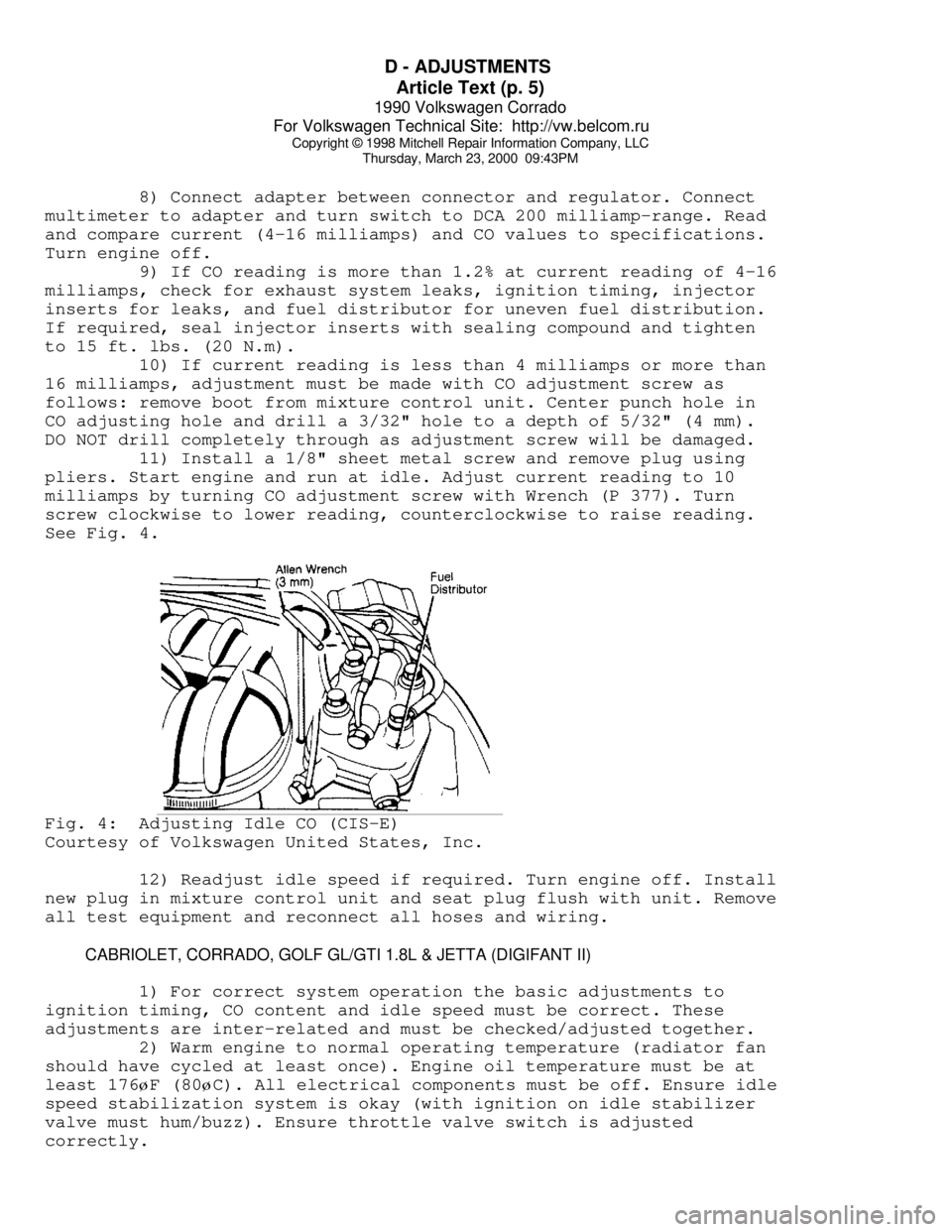
pliers. Start engine and run at idle. Adjust current reading to 10
milliamps by turning CO adjustment screw with Wrench (P 377). Turn
screw clockwise to lower reading, counterclockwise to raise reading.
See Fig. 4.Fig. 4: Adjusting Idle CO (CIS-E)
Courtesy of Volkswagen United States, Inc.
12) Readjust idle speed if required. Turn engine off. Install
new plug in mixture control unit and seat plug flush with unit. Remove
all test equipment and reconnect all hoses and wiring.
CABRIOLET, CORRADO, GOLF GL/GTI 1.8L & JETTA (DIGIFANT II)
1) For correct system operation the basic adjustments to
ignition timing, CO content and idle speed must be correct. These
adjustments are inter-related and must be checked/adjusted together.
2) Warm engine to normal operating temperature (radiator fan
should have cycled at least once). Engine oil temperature must be at
least 176øF (80øC). All electrical components must be off. Ensure idle
speed stabilization system is okay (with ignition on idle stabilizer
valve must hum/buzz). Ensure throttle valve switch is adjusted
correctly.
Page 446 of 906
D - ADJUSTMENTS
Article Text (p. 9)
1990 Volkswagen Corrado
For Volkswagen Technical Site: http://vw.belcom.ru
Copyright © 1998 Mitchell Repair Information Company, LLC
Thursday, March 23, 2000 09:43PM
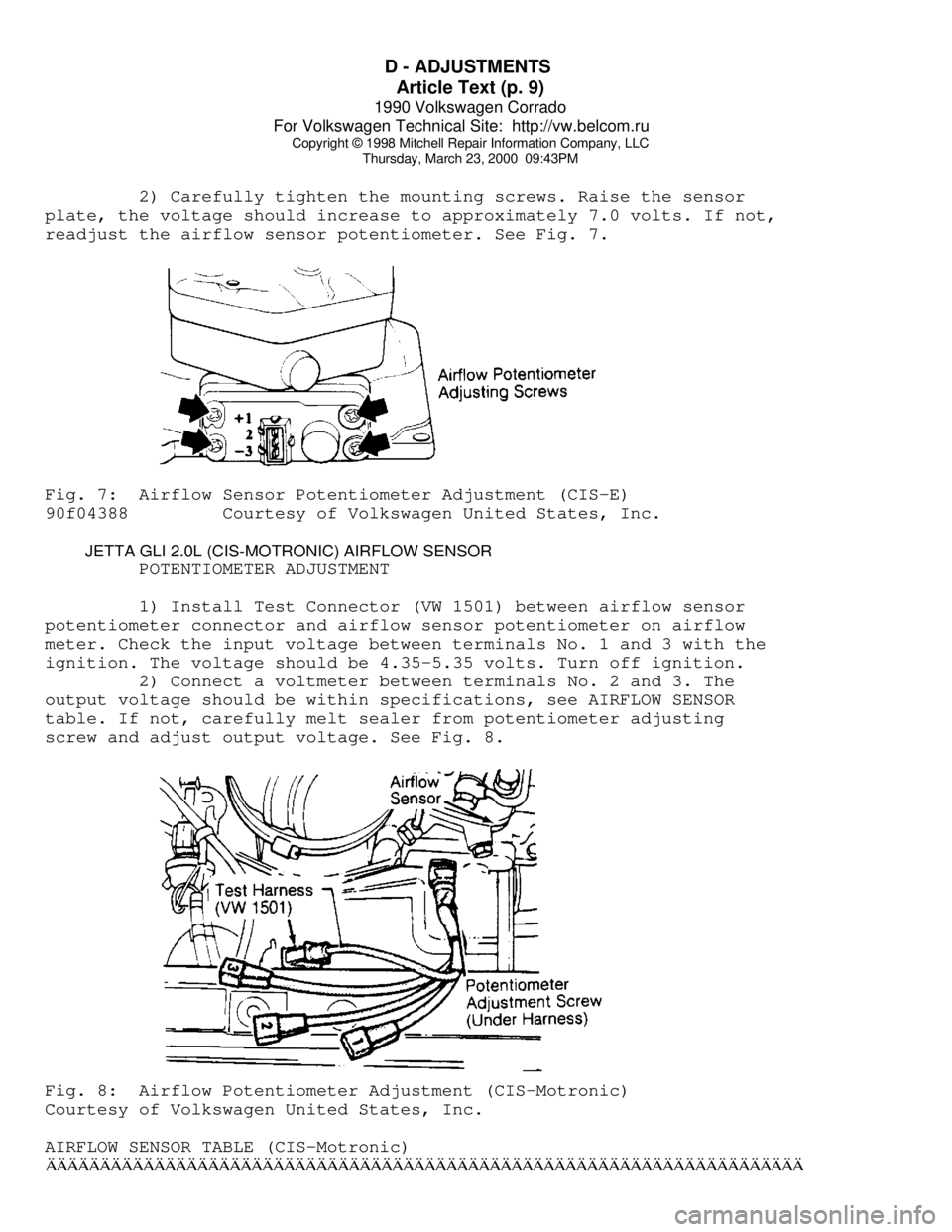
2) Carefully tighten the mounting screws. Raise the sensor
plate, the voltage should increase to approximately 7.0 volts. If not,
readjust the airflow sensor potentiometer. See Fig. 7.Fig. 7: Airflow Sensor Potentiometer Adjustment (CIS-E)
90f04388 Courtesy of Volkswagen United States, Inc.
JETTA GLI 2.0L (CIS-MOTRONIC) AIRFLOW SENSOR
POTENTIOMETER ADJUSTMENT
1) Install Test Connector (VW 1501) between airflow sensor
potentiometer connector and airflow sensor potentiometer on airflow
meter. Check the input voltage between terminals No. 1 and 3 with the
ignition. The voltage should be 4.35-5.35 volts. Turn off ignition.
2) Connect a voltmeter between terminals No. 2 and 3. The
output voltage should be within specifications, see AIRFLOW SENSOR
table. If not, carefully melt sealer from potentiometer adjusting
screw and adjust output voltage. See Fig. 8.Fig. 8: Airflow Potentiometer Adjustment (CIS-Motronic)
Courtesy of Volkswagen United States, Inc.
AIRFLOW SENSOR TABLE (CIS-Motronic)ÄÄÄÄÄÄÄÄÄÄÄÄÄÄÄÄÄÄÄÄÄÄÄÄÄÄÄÄÄÄÄÄÄÄÄÄÄÄÄÄÄÄÄÄÄÄÄÄÄÄÄÄÄÄÄÄÄÄÄÄÄÄÄÄÄÄÄÄÄÄ
Page 448 of 906

DRIVE AXLE - GEAR TOOTH CONTACT PATTERNS
Article Text
1990 Volkswagen Corrado
For Volkswagen Technical Site: http://vw.belcom.ru
Copyright © 1998 Mitchell Repair Information Company, LLC
Thursday, March 23, 2000 09:43PM
ARTICLE BEGINNING
1983-93 DRIVE AXLES
Gear Tooth Contact Patterns
All Models
INSPECTION
PRELIMINARY INSPECTION
Wipe lubricant from internal parts. Rotate gears and inspect
for wear or damage. Mount dial indicator to housing, and check
backlash at several points around ring gear. Backlash must be within
specifications at all points. If no defects are found, check gear
tooth contact pattern.
GEAR TOOTH CONTACT PATTERN
NOTE: Drive pattern should be well centered on ring gear teeth.
Coast pattern should be centered, but may be slightly toward
toe of ring gear teeth.
1) Paint ring gear teeth with marking compound. Wrap cloth or
rope around drive pinion flange to act as brake. Rotate ring gear
until clear tooth contact pattern is obtained.
2) Contact pattern will indicate whether correct pinion
bearing mounting shim has been installed and if drive gear backlash
has been set properly. Backlash between drive gear and pinion must be
maintained within specified limits, until correct tooth pattern is
obtained.
Page 495 of 906
EMISSION CONTROL VISUAL INSPECTION PROCEDURES
Article Text
1990 Volkswagen Corrado
For Volkswagen Technical Site: http://vw.belcom.ru
Copyright © 1998 Mitchell Repair Information Company, LLC
Thursday, March 23, 2000 09:44PM
ARTICLE BEGINNING
GENERAL INFORMATION
All Makes Emission Control Visual Inspection Procedures
All Models
PLEASE READ THIS FIRST
This article is provided for general information only. Not
all information applies to all makes and models. For more complete
information, see appropriate article(s) in the ENGINE PERFORMANCE
Section.
EMISSION CONTROL LABELS
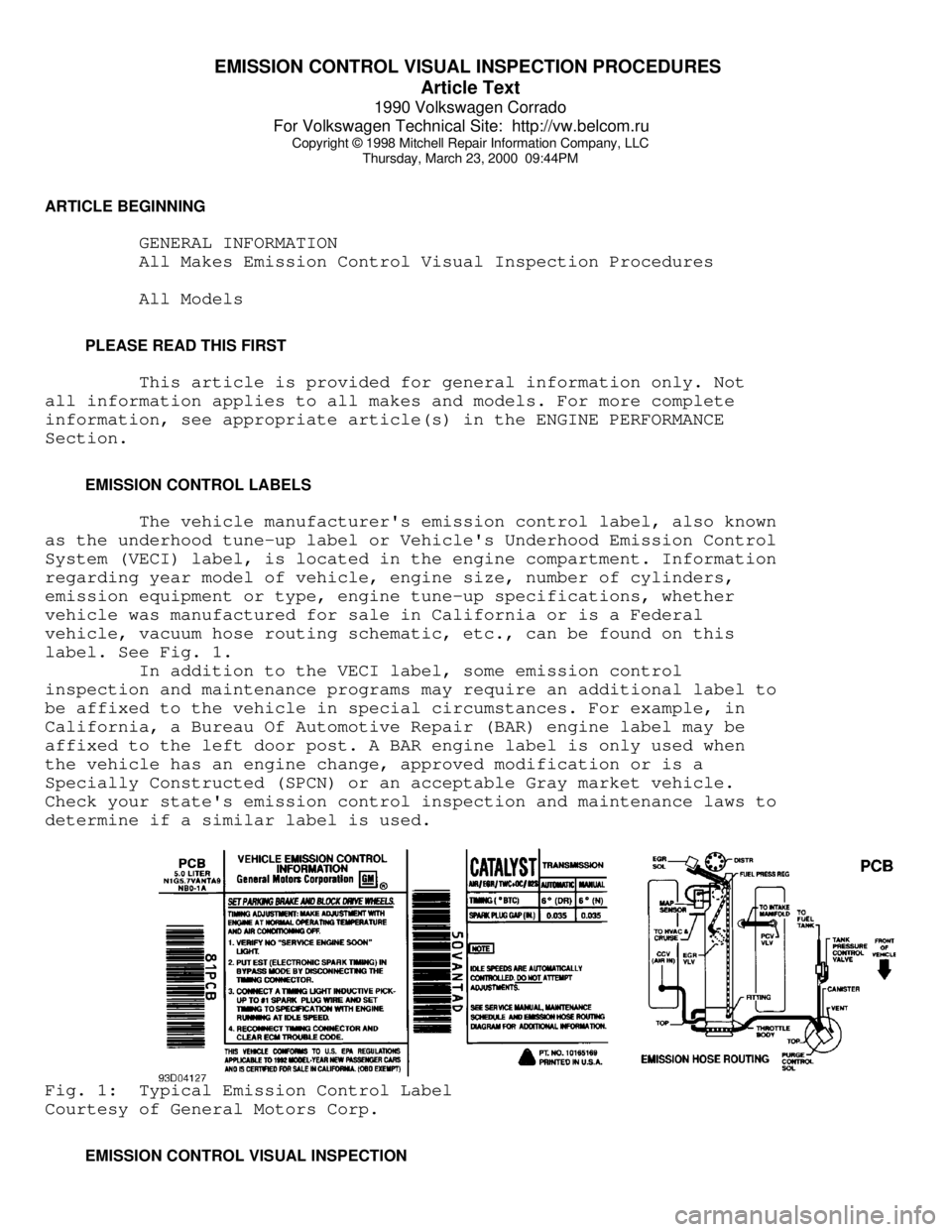
The vehicle manufacturer's emission control label, also known
as the underhood tune-up label or Vehicle's Underhood Emission Control
System (VECI) label, is located in the engine compartment. Information
regarding year model of vehicle, engine size, number of cylinders,
emission equipment or type, engine tune-up specifications, whether
vehicle was manufactured for sale in California or is a Federal
vehicle, vacuum hose routing schematic, etc., can be found on this
label. See Fig. 1.
In addition to the VECI label, some emission control
inspection and maintenance programs may require an additional label to
be affixed to the vehicle in special circumstances. For example, in
California, a Bureau Of Automotive Repair (BAR) engine label may be
affixed to the left door post. A BAR engine label is only used when
the vehicle has an engine change, approved modification or is a
Specially Constructed (SPCN) or an acceptable Gray market vehicle.
Check your state's emission control inspection and maintenance laws to
determine if a similar label is used.Fig. 1: Typical Emission Control Label
Courtesy of General Motors Corp.
EMISSION CONTROL VISUAL INSPECTION
Page 510 of 906

ENGINE OVERHAUL PROCEDURES - GENERAL INFORMATION
Article Text
1990 Volkswagen Corrado
For Volkswagen Technical Site: http://vw.belcom.ru
Copyright © 1998 Mitchell Repair Information Company, LLC
Thursday, March 23, 2000 09:44PM
ARTICLE BEGINNING
Engine Overhaul Procedures - General Information
ALL PISTON ENGINES
* PLEASE READ THIS FIRST *
Examples used in this article are general in nature and do
not necessarily relate to a specific engine or system. Illustrations
and procedures have been chosen to guide mechanic through engine
overhaul process. Descriptions of processes of cleaning, inspection,
assembly and machine shop practice are included.
Always refer to appropriate engine overhaul article in the
ENGINES section for complete overhaul procedures and specifications
for the vehicle being repaired.
ENGINE IDENTIFICATION
The engine may be identified from its Vehicle Identification
Number (VIN) stamped on a metal tab. Metal tab may be located in
different locations depending on manufacturer. Engine identification
number or serial number is located on cylinder block. Location varies
with manufacturer.
INSPECTION PROCEDURES
* PLEASE READ THIS FIRST *
NOTE: Always refer to appropriate engine overhaul article in the
ENGINES section for complete overhaul procedures and
specifications for the vehicle being repaired.
GENERAL
Engine components must be inspected to meet manufacturer's
specifications and tolerances during overhaul. Proper dimensions and
tolerances must be met to obtain proper performance and maximum engine
life.
Micrometers, depth gauges and dial indicator are used for
checking tolerances during engine overhaul. Magnaflux, Magnaglo, dye-
check, ultrasonic and x-ray inspection procedures are used for parts
inspection.
MAGNETIC PARTICLE INSPECTION
Magnaflux & Magnaglo
Magnaflux is an inspection technique used to locate material
flaws and stress cracks. The part in question is subjected to a strong
magnetic field. The entire part, or a localized area, can be
magnetized. The part is coated with either a wet or dry material that
contains fine magnetic particles.
Page 512 of 906

ENGINE OVERHAUL PROCEDURES - GENERAL INFORMATION
Article Text (p. 3)
1990 Volkswagen Corrado
For Volkswagen Technical Site: http://vw.belcom.ru
Copyright © 1998 Mitchell Repair Information Company, LLC
Thursday, March 23, 2000 09:44PM
* PLEASE READ THIS FIRST *
NOTE: Always refer to appropriate engine overhaul article in the
ENGINES section for complete overhaul procedures and
specifications for the vehicle being repaired.
GENERAL
All components of an engine do not have the same cleaning
requirements. Physical methods include bead blasting and manual
removal. Chemical methods include solvent blast, solvent tank, hot
tank, cold tank and steam cleaning of components.
BEAD BLASTING
Manual removal of deposits may be required prior to bead
blasting, followed by some other cleaning method. Carbon, paint and
rust may be removed using bead blasting method. Components must be
free of oil and grease prior to bead blasting. Beads will stick to
grease or oil soaked areas causing area not to be cleaned.
Use air pressure to remove all trapped residual beads from
components after cleaning. After cleaning internal engine parts made
of aluminum, wash thoroughly with hot soapy water. Component must be
thoroughly cleaned as glass beads will enter engine oil resulting in
bearing damage.
CHEMICAL CLEANING
Solvent tank is used for cleaning oily residue from
components. Solvent blasting sprays solvent through a siphon gun using
compressed air.
The hot tank, using heated caustic solvents, is used for
cleaning ferrous materials only. DO NOT clean aluminum parts such as
cylinder heads, bearings or other soft metals using the hot tank.
After cleaning, flush parts with hot water.
A non-ferrous part will be ruined and caustic solution will
be diluted if placed in the hot tank. Always use eye protection and
gloves when using the hot tank.
Use of a cold tank is for cleaning of aluminum cylinder
heads, carburetors and other soft metals. A less caustic and unheated
solution is used. Parts may be lift in the tank for several hours
without damage. After cleaning, flush parts with hot water.
Steam cleaning, with boiling hot water sprayed at high
pressure, is recommended as the final cleaning process when using
either hot or cold tank cleaning.
COMPONENT CLEANING
* PLEASE READ THIS FIRST *
NOTE: Always refer to appropriate engine overhaul article in the
ENGINES section for complete overhaul procedures and
Page 513 of 906

ENGINE OVERHAUL PROCEDURES - GENERAL INFORMATION
Article Text (p. 4)
1990 Volkswagen Corrado
For Volkswagen Technical Site: http://vw.belcom.ru
Copyright © 1998 Mitchell Repair Information Company, LLC
Thursday, March 23, 2000 09:44PM
specifications for the vehicle being repaired.
SHEET METAL PARTS
Examples of sheet metal parts are the rocker covers, front
and side covers, oil pan and bellhousing dust cover. Glass bead
blasting or hot tank may be used for cleaning.
Ensure all mating surfaces are flat. Deformed surfaces should
be straightened. Check all sheet metal parts for cracks and dents.
INTAKE & EXHAUST MANIFOLDS
Using solvent cleaning or bead blasting, clean manifolds for
inspection. If the intake manifold has an exhaust crossover, all
carbon deposits must be removed. Inspect manifolds for cracks, burned
or eroded areas, corrosion and damage to fasteners.
Exhaust heat and products of combustion cause threads of
fasteners to corrode. Replace studs and bolts as necessary. On "V"
type intake manifolds, the sheet metal oil shield must be removed for
proper cleaning and inspection. Ensure that all manifold parting
surfaces are flat and free of burrs.
CYLINDER HEAD REPLACEMENT
* PLEASE READ THIS FIRST *
NOTE: Always refer to appropriate engine overhaul article in the
ENGINES section for complete overhaul procedures and
specifications for the vehicle being repaired.
REMOVAL
Remove intake and exhaust manifolds and valve cover. Cylinder
head and camshaft carrier bolts (if equipped), should be removed only
when the engine is cold. On many aluminum cylinder heads, removal
while hot will cause cylinder head warpage. Mark rocker arm or
overhead cam components for location.
Remove rocker arm components or overhead cam components.
Components must be installed in original location. Individual design
rocker arms may utilize shafts, ball-type pedestal mounts or no rocker
arms. For all design types, wire components together and identify
according to the corresponding valve. Remove cylinder head bolts.
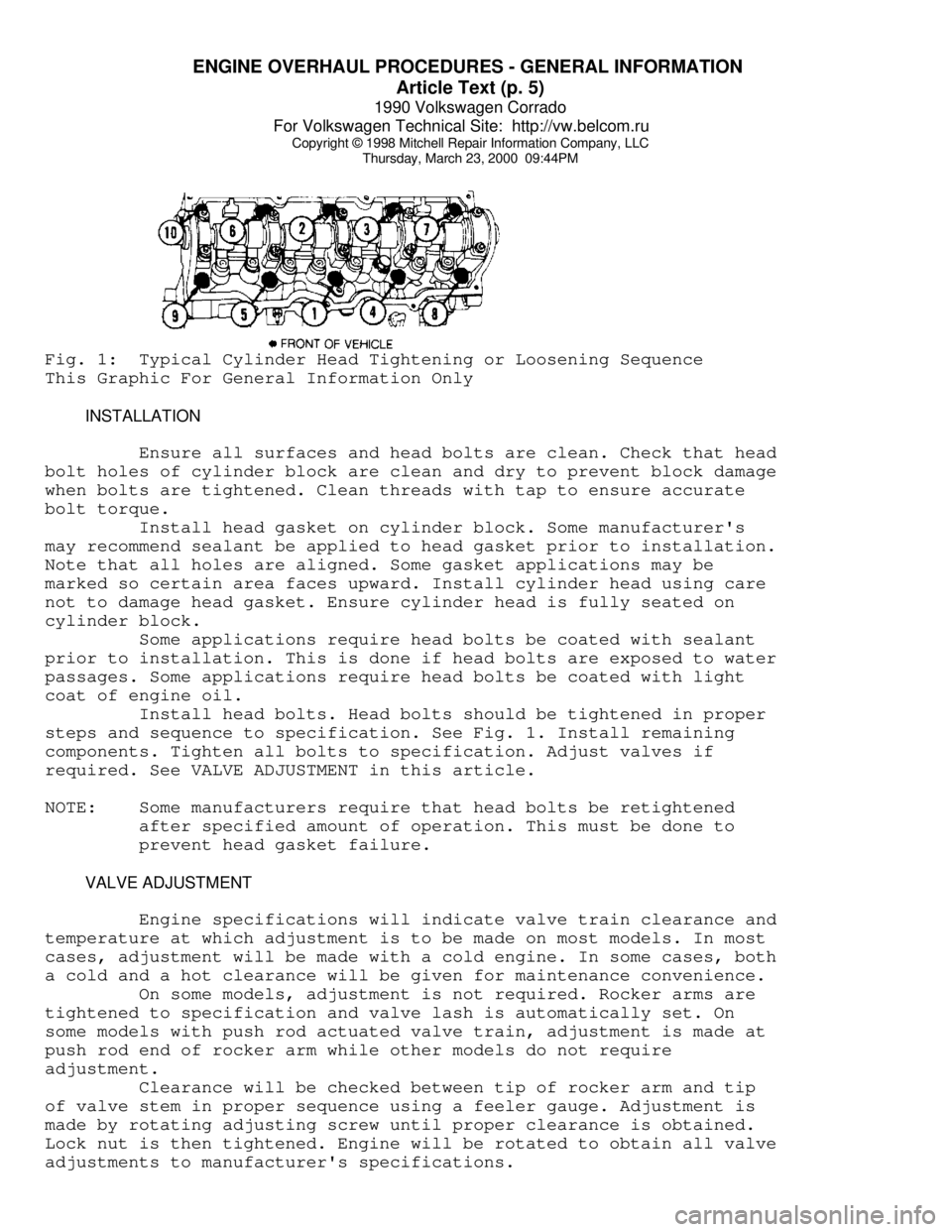
Note length and location. Some applications require cylinder head
bolts be removed in proper sequence to prevent cylinder head damage.
See Fig. 1. Remove cylinder head.
Page 514 of 906
ENGINE OVERHAUL PROCEDURES - GENERAL INFORMATION
Article Text (p. 5)
1990 Volkswagen Corrado
For Volkswagen Technical Site: http://vw.belcom.ru
Copyright © 1998 Mitchell Repair Information Company, LLC
Thursday, March 23, 2000 09:44PMFig. 1: Typical Cylinder Head Tightening or Loosening Sequence
This Graphic For General Information Only
INSTALLATION
Ensure all surfaces and head bolts are clean. Check that head
bolt holes of cylinder block are clean and dry to prevent block damage
when bolts are tightened. Clean threads with tap to ensure accurate
bolt torque.
Install head gasket on cylinder block. Some manufacturer's
may recommend sealant be applied to head gasket prior to installation.
Note that all holes are aligned. Some gasket applications may be
marked so certain area faces upward. Install cylinder head using care
not to damage head gasket. Ensure cylinder head is fully seated on
cylinder block.
Some applications require head bolts be coated with sealant
prior to installation. This is done if head bolts are exposed to water
passages. Some applications require head bolts be coated with light
coat of engine oil.
Install head bolts. Head bolts should be tightened in proper
steps and sequence to specification. See Fig. 1. Install remaining
components. Tighten all bolts to specification. Adjust valves if
required. See VALVE ADJUSTMENT in this article.
NOTE: Some manufacturers require that head bolts be retightened
after specified amount of operation. This must be done to
prevent head gasket failure.
VALVE ADJUSTMENT
Engine specifications will indicate valve train clearance and
temperature at which adjustment is to be made on most models. In most
cases, adjustment will be made with a cold engine. In some cases, both
a cold and a hot clearance will be given for maintenance convenience.
On some models, adjustment is not required. Rocker arms are
tightened to specification and valve lash is automatically set. On
some models with push rod actuated valve train, adjustment is made at
push rod end of rocker arm while other models do not require
adjustment.
Clearance will be checked between tip of rocker arm and tip
of valve stem in proper sequence using a feeler gauge. Adjustment is
made by rotating adjusting screw until proper clearance is obtained.
Lock nut is then tightened. Engine will be rotated to obtain all valve
adjustments to manufacturer's specifications.