check engine VOLKSWAGEN CORRADO 1993 Repair Manual
[x] Cancel search | Manufacturer: VOLKSWAGEN, Model Year: 1993, Model line: CORRADO, Model: VOLKSWAGEN CORRADO 1993Pages: 920, PDF Size: 6.92 MB
Page 601 of 920

H - TESTS W/O CODES
Article Text (p. 5)
1993 Volkswagen Corrado
For Volkswagen Technical Site: http://vw.belcom.ru
Copyright © 1998 Mitchell Repair Information Company, LLC
Wednesday, March 22, 2000 09:11PM
ENGINE STALLS WHILE DRIVING
* Check fuel pump.
* Check auxiliary air intake system.
* Check injector fuel pressure and volume.
* Check idle and full throttle switches.
* Check intake air preheating system.
* Check ignition timing, spark plugs, distributor, secondary
ignition wiring and coil.
POOR PERFORMANCE
* Check fuel pump.
* Check throttle cable adjustment.
* Check auxiliary air intake system.
* Check airflow sensor lever adjustment and control plunger.
* Check throttle potentiometer.
* Check fuel system differential and residual pressures.
* Check injector fuel pressure and volume.
* Check full throttle switch.
* Check mass airflow sensor (if equipped).
* Check intake air preheating system.
* Check catalytic converter.
* Check ignition timing.
ENGINE RUN-ON (DIESELING)
* Check fuel evaporative frequency solenoid(s).
* Check fuel system for leaks.
* Check cold-start valve.
* Check injector fuel pressure and volume.
* Check airflow sensor lever adjustment and control plunger.
HIGH FUEL CONSUMPTION
* Check fuel system for leaks.
* Check oxygen sensor control circuit.
* Check cold-start valve.
* Check injector fuel pressure and volume.
* Check airflow sensor lever adjustment and control plunger.
* Check throttle potentiometer.
* Check injector fuel pressure and volume.
* Check full throttle switch.
* Check mass airflow sensor (if equipped).
* Check intake air preheating system.
* Check exhaust system for leaks (between cylinder and
oxygen (O2) sensor).
* Check ignition timing.
ENGINE KNOCK
* Check knock sensors (if equipped).
Page 602 of 920

H - TESTS W/O CODES
Article Text (p. 6)
1993 Volkswagen Corrado
For Volkswagen Technical Site: http://vw.belcom.ru
Copyright © 1998 Mitchell Repair Information Company, LLC
Wednesday, March 22, 2000 09:11PM
* Check full throttle switch.
* Check ignition timing.
ENGINE RUNS UNEVENLY OVER ENTIRE SPEED RANGE
* Check auxiliary air intake system.
* Check injector fuel pressure and volume.
* Check ignition timing, spark plugs, distributor, secondary
ignition wiring and coil.
INTERMITTENTS
INTERMITTENT PROBLEM DIAGNOSIS
Intermittent fault testing requires duplicating circuit or
component failure to identify the problem. These procedures may lead
to the computer setting a fault code (on some systems) which may help
in diagnosis.
If problem vehicle does not produce fault codes, monitor
voltage or resistance values using a DVOM while attempting to
reproduce conditions causing intermittent fault. A status change on
DVOM indicates a fault has been located.
Use a DVOM to pinpoint faults. When monitoring voltage,
ensure ignition switch is in ON position or engine is running. Ensure
ignition switch is in OFF position or negative battery cable is
disconnected when monitoring circuit resistance. Status changes on
DVOM during test procedures indicate area of fault.
TEST PROCEDURES
Intermittent Simulation
To reproduce the conditions creating an intermittent fault,
use the following methods:
* Lightly vibrate component.
* Heat component.
* Wiggle or bend wiring harness.
* Spray component with water.
* Remove/apply vacuum source.
Monitor circuit/component voltage or resistance while
simulating intermittent. If engine is running, monitor for self-
diagnostic codes. Use the test results to identify a faulty component
or circuit. For system or component testing refer to the appropriate
I - SYS/COMP TESTS article in this section. See the menu below:
* For Cabriolet, see: I - SYSTEM/COMPONENT TESTS
* For Corrado SLC, see: I - SYSTEM/COMPONENT TESTS
* For EuroVan, see: I - SYSTEM/COMPONENT TESTS
* For Fox, see: I - SYSTEM/COMPONENT TESTS
* For Golf, GTI, Jetta, see: I - SYSTEM/COMPONENT TESTS
* For Passat GL 2.0L 4-Cylinder, see:
Page 614 of 920

I - SYSTEM/COMPONENT TESTS
Article Text (p. 2)
1993 Volkswagen Corrado
For Volkswagen Technical Site: http://vw.belcom.ru
Copyright © 1998 Mitchell Repair Information Company, LLC
Wednesday, March 22, 2000 09:11PM
COMPUTERIZED ENGINE CONTROLS
ELECTRONIC CONTROL MODULE (ECM)
Ground & Power Circuits
Check ECM ground and power circuits using the values in the
appropriate J - PIN VOLTAGE CHARTS article.
ENGINE SENSORS & SWITCHES
ENGINE COOLANT TEMPERATURE SENSOR
Corrado SLC (2.8L)
1) Ensure engine is cold. Connect Scan Tester (VAG 1551) to
Data Link Connectors (DLC) located in center console, in front of
shift lever. Start engine and allow it to idle.
2) With scan tester in READ TEST VALUE BLOCK function, select
group No. 01 and read coolant temperature value in field No. 2 of scan
tester. Temperature value must increase uniformly without
interruption. If value increases as specified, select END OUTPUT
function on scan tester.
3) If displayed value does not change or if engine
malfunctions during certain temperature ranges, turn ignition off and
measure engine coolant temperature sensor resistance. See ENGINE
COOLANT TEMPERATURE SENSOR RESISTANCE table.
ENGINE COOLANT TEMPERATURE SENSOR RESISTANCEÄÄÄÄÄÄÄÄÄÄÄÄÄÄÄÄÄÄÄÄÄÄÄÄÄÄÄÄÄÄÄÄÄÄÄÄÄÄÄÄÄÄÄÄÄTemperature
øF (øC) Ohms
68 (20) ......................... 3000-2000
86 (30) ......................... 2000-1500
104 (40) ........................ 1500-1000
122 (50) ......................... 1000-800
140 (60) .......................... 700-500
158 (70) .......................... 500-375
176 (80) .......................... 375-275
194 (90) .......................... 275-225
ÄÄÄÄÄÄÄÄÄÄÄÄÄÄÄÄÄÄÄÄÄÄÄÄÄÄÄÄÄÄÄÄÄÄÄÄÄÄÄÄÄÄÄÄÄ INTAKE AIR TEMPERATURE SENSOR
Corrado SLC (2.8L)
1) Turn ignition off. Disconnect intake air temperature
sensor. Remove sensor from intake manifold and plug opening in
manifold. Reconnect sensor to wiring harness.
2) Connect Scan Tester (VAG 1551) to Data Link Connectors
(DLC) located in center console, in front of shift lever. Start engine
and allow it to idle. With scan tester in READ TEST VALUE BLOCK
function, select group 03 and read intake air temperature sensor value
in field No. 4 of scan tester.
3) Spray sensor with cooling spray and observe value on scan
Page 615 of 920

I - SYSTEM/COMPONENT TESTS
Article Text (p. 3)
1993 Volkswagen Corrado
For Volkswagen Technical Site: http://vw.belcom.ru
Copyright © 1998 Mitchell Repair Information Company, LLC
Wednesday, March 22, 2000 09:11PM
tester. Scan tester value must decrease. If temperature value does not
change, repair intake air temperature sensor circuit or replace sensor
as necessary. After repairs, erase Diagnostic Trouble Code (DTC)
memory (if applicable) and select END OUTPUT function.
HALL EFFECT SENSOR
Corrado SLC (2.8L)
Testing information is not available from manufacturer. These
vehicles are equipped with a distributorless ignition system.
FUEL SYSTEM
ACCELERATION/FULL THROTTLE ENRICHMENT & DECELERATION FUEL
CUT-OFF
Corrado SLC (2.8L)
1) Ensure engine coolant temperature is at least 176øF
(80
øC). Connect Scan Tester (VAG 1551) to Data Link Connectors (DLC)
located in center console, in front of shift lever.
2) Start engine and allow it to idle. With scan tester in
READ TEST VALUE BLOCK function, select group No. 04 and read value in
field No. 4 of scan tester. Display value must be 00010 at idle.
3) Using accelerator pedal, increase engine speed to 3000 RPM
and observe scan tester. Display value in field No. 4 of scan tester
must briefly be 10100. Release accelerator pedal and observe scan
tester.
4) Display value in field No. 4 of scan tester must briefly
be 00011, then return to 00010 at idle. If values are not as
specified, see THROTTLE POSITION (TP) SENSOR ADJUSTMENT procedures in
the D - ADJUSTMENTS article. If values are as specified, select END
OUTPUT function on scan tester.
FUEL INJECTORS & CIRCUIT
Corrado SLC (2.8L)
1) To access fuel injectors, remove ignition wires. Remove
hose from mass airflow sensor. Disconnect hose to fuel evaporative
(frequency) solenoid valve at throttle body.
2) Disconnect throttle position sensor and idle air control
valve. Disconnect accelerator cable from throttle body. Disconnect and
plug coolant hoses at throttle body.
3) Disconnect hose from air intake heated tube. Detach fuel
lines at cylinder head cover and remove from fuel rail. Disconnect
vacuum hose from fuel pressure regulator. Remove intake manifold upper
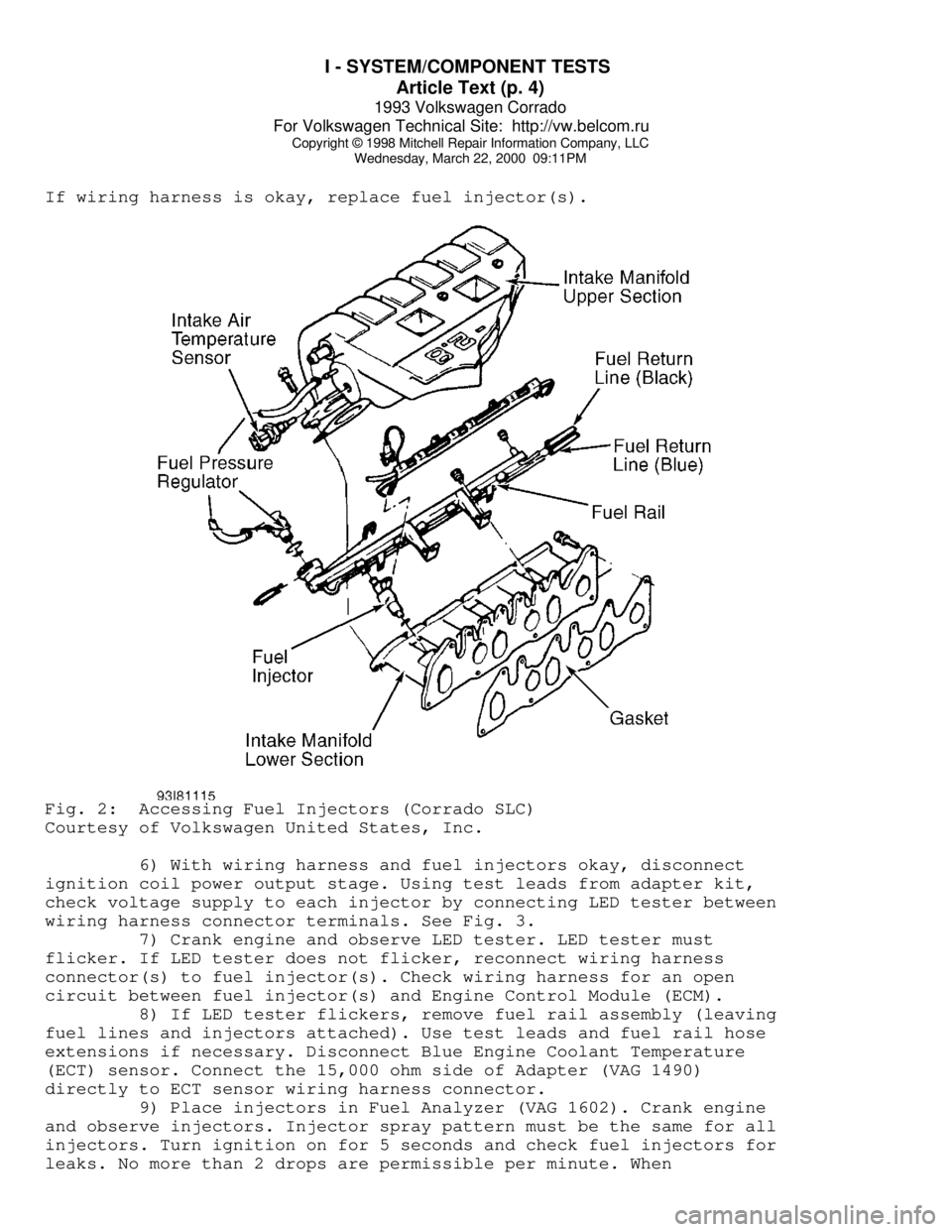
section. See Fig. 2.
4) With intake manifold upper section removed, disconnect
wiring harness from fuel injectors. Using a Digital Volt-Ohmmeter
(DVOM) and test leads from Adapter Kit (VW 1594), check fuel injector
resistance. See Fig. 3.
5) Fuel injector resistance should be 15.0-21.5 ohms. If
resistance is zero ohms, check for a short circuit in wiring harness.
Page 616 of 920
I - SYSTEM/COMPONENT TESTS
Article Text (p. 4)
1993 Volkswagen Corrado
For Volkswagen Technical Site: http://vw.belcom.ru
Copyright © 1998 Mitchell Repair Information Company, LLC
Wednesday, March 22, 2000 09:11PM
If wiring harness is okay, replace fuel injector(s).Fig. 2: Accessing Fuel Injectors (Corrado SLC)
Courtesy of Volkswagen United States, Inc.
6) With wiring harness and fuel injectors okay, disconnect
ignition coil power output stage. Using test leads from adapter kit,
check voltage supply to each injector by connecting LED tester between
wiring harness connector terminals. See Fig. 3.
7) Crank engine and observe LED tester. LED tester must
flicker. If LED tester does not flicker, reconnect wiring harness
connector(s) to fuel injector(s). Check wiring harness for an open
circuit between fuel injector(s) and Engine Control Module (ECM).
8) If LED tester flickers, remove fuel rail assembly (leaving
fuel lines and injectors attached). Use test leads and fuel rail hose
extensions if necessary. Disconnect Blue Engine Coolant Temperature
(ECT) sensor. Connect the 15,000 ohm side of Adapter (VAG 1490)
directly to ECT sensor wiring harness connector.
9) Place injectors in Fuel Analyzer (VAG 1602). Crank engine
and observe injectors. Injector spray pattern must be the same for all
injectors. Turn ignition on for 5 seconds and check fuel injectors for
leaks. No more than 2 drops are permissible per minute. When
Page 618 of 920
I - SYSTEM/COMPONENT TESTS
Article Text (p. 6)
1993 Volkswagen Corrado
For Volkswagen Technical Site: http://vw.belcom.ru
Copyright © 1998 Mitchell Repair Information Company, LLC
Wednesday, March 22, 2000 09:11PM
IGNITION COIL
EMISSION SYSTEMS & SUB-SYSTEMS
NOTE: Other than EGR system, additional emission systems and
sub-system component testing information is not available
from manufacturer.
EXHAUST GAS RECIRCULATION (EGR)
Corrado SLC (2.8L)
1) Ensure engine coolant temperature is at least 122øF
(50
øC). Start engine and allow it to idle. Disconnect vacuum hose from
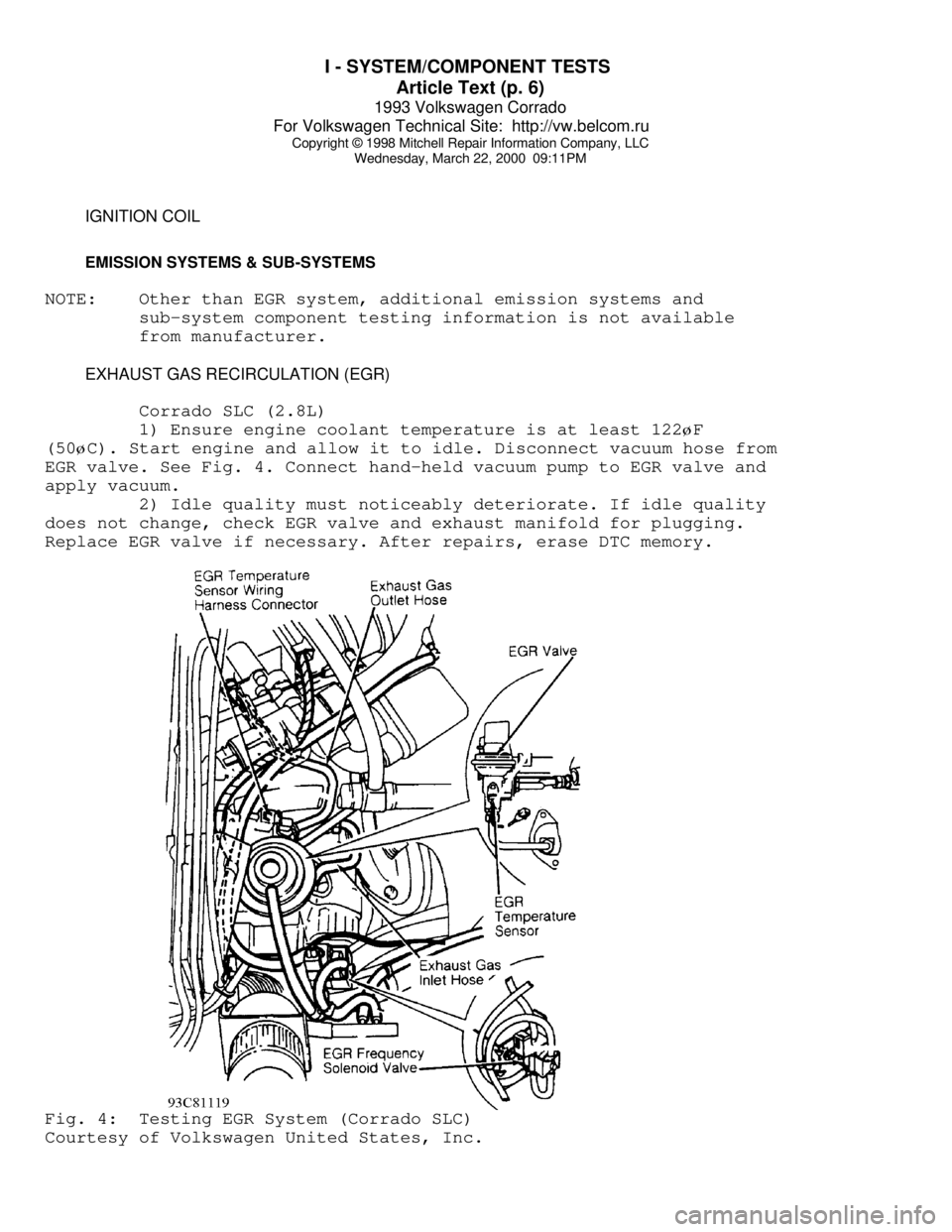
EGR valve. See Fig. 4. Connect hand-held vacuum pump to EGR valve and
apply vacuum.
2) Idle quality must noticeably deteriorate. If idle quality
does not change, check EGR valve and exhaust manifold for plugging.
Replace EGR valve if necessary. After repairs, erase DTC memory.Fig. 4: Testing EGR System (Corrado SLC)
Courtesy of Volkswagen United States, Inc.
Page 626 of 920

INTERFERENCE VERIFICATION CHECK FOR OHC ENGINE
Article Text
1993 Volkswagen Corrado
For Volkswagen Technical Site: http://vw.belcom.ru
Copyright © 1998 Mitchell Repair Information Company, LLC
Wednesday, March 22, 2000 09:12PM
ARTICLE BEGINNING
Maintenance & Service Information
1974-96 Volkswagen - Timing Belt Information
Cabrio, Cabriolet, Corrado, Dasher, Eurovan (Canadian), Fox,
Golf, Golf (Canadian), GTI, GTI (Canadian), Jetta, Jetta GLI,
Passat, Passat (Canadian), Pickup, Quantum, Rabbit, Scirocco,
Scirocco (Canadian), Transporter (Canadian), Vanagon
TIMING BELT INTERFERENCE VERIFICATION INFORMATION
TIMING BELT INTERFERENCE CAUTION
NOTE: CAMSHAFT DRIVE BELTS OR TIMING BELTS - The condition of
camshaft drive belts should always be checked on vehicles
which have more than 50,000 miles. Although some
manufacturers do not recommend replacement at a specified
mileage, others require it at 60,000-100,000 miles. A
camshaft drive belt failure may cause extensive damage to
internal engine components on most engines, although some
designs do not allow piston-to-valve contact. These designs
are often called "Free Wheeling". Many manufacturers changed
their maintenance and warranty schedules in the mid-1980's to
reflect timing belt inspection and/or replacement at
50,000-60,000 miles. Most service interval schedules shown in
this section reflect these changes. Belts or components
should be inspected and replaced if any of the following
conditions exist:
* Crack Or Tears In Belt Surface
* Missing, Damaged, Cracked Or Rounded Teeth
* Oil Contamination
* Damaged Or Faulty Tensioners
* Incorrect Tension Adjustment
TIMING BELT INTERFERENCE CHECK MENU
TIMING BELT INTERFERENCE VERIF. TABLE - PASSENGER CARS (1)ÄÄÄÄÄÄÄÄÄÄÄÄÄÄÄÄÄÄÄÄÄÄÄÄÄÄÄÄÄÄÄÄÄÄÄÄÄÄÄÄÄÄÄÄÄÄÄÄÄÄÄÄÄÄÄÄÄÄÄÄ Replacement Interval
Application Engine (Miles)
Cabrio
1995-96 .......... 2.0L 4-Cyl. ............ (3) 60,000
Cabriolet
1985-89 ....... 1.8L 4-Cyl. (DOHC) ........ (3) 60,000
1.8L 4-Cyl. (SOHC) ........ (3) 60,000
1990-93 .......... 1.8L 4-Cyl. ............ (3) 60,000
Corrado
1990-92 .......... 1.8L 4-Cyl. ............ (3) 60,000
Dasher
Page 627 of 920

INTERFERENCE VERIFICATION CHECK FOR OHC ENGINE
Article Text (p. 2)
1993 Volkswagen Corrado
For Volkswagen Technical Site: http://vw.belcom.ru
Copyright © 1998 Mitchell Repair Information Company, LLC
Wednesday, March 22, 2000 09:12PM
1976-80 ..... (2) 1.5L 4-Cyl. Diesel ...... (3) 60,000
1974-80 .......... 1.6L 4-Cyl. ............ (3) 60,000
1981-80 ......... (2) 1.6L 4-Cyl.
Diesel & Turbo Diesel ...... (3) 60,000
Fox
1987-93 .......... 1.8L 4-Cyl. ............ (3) 60,000
Golf
1985-88 ..... (2) 1.6L 4-Cyl. Diesel ...... (3) 60,000
1985-89 ....... 1.8L 4-Cyl. (DOHC) ........ (3) 60,000
1985-93 ....... 1.8L 4-Cyl. (SOHC) ........ (3) 60,000
1990-92 .......... 1.8L 4-Cyl. ............ (3) 60,000
1993-96 .......... 2.0L 4-Cyl. ............ (3) 60,000
Golf (Canadian)
1985-92 ..... (2) 1.6L 4-Cyl. Diesel ...... (3) 60,000
1993 ............. 1.8L 4-Cyl. ............ (3) 60,000
GTI
1983-84 ..... (2) 1.6L 4-Cyl. Diesel ...... (3) 60,000
(2) 1.6L 4-Cyl. Turbo Diesel ... (3) 60,000
1.7L 4-Cyl. ............ (3) 60,000
1.8L 4-Cyl. ............ (3) 60,000
1985-89 .......... 1.8L 4-Cyl. (DOHC) ..... (3) 60,000
1983-92 .......... 1.8L 4-Cyl. (SOHC) ..... (3) 60,000
1990-92 .......... 1.8L 4-Cyl. ............ (3) 60,000
1990-96 .......... 2.0L 4-Cyl. ............ (3) 60,000
GTI (Canadian)
1993 ............. 2.0L 4-Cyl. ............ (3) 60,000
Jetta
1980 ............. 1.6L 4-Cyl. ............ (3) 60,000
1981-92 ........ (2) 1.6L 4-Cyl.
Diesel & Turbo Diesel ....... (3) 60,000
1983-84 .......... 1.7L 4-Cyl. ............ (3) 60,000
1.8L 4-Cyl. ............ (3) 60,000
1985-89 ....... 1.8L 4-Cyl. (DOHC) ........ (3) 60,000
1983-92 ....... 1.8L 4-Cyl. (SOHC) ........ (3) 60,000
1990-92 .......... 1.8L 4-Cyl. ............ (3) 60,000
1993-96 .......... 2.0L 4-Cyl. ............ (3) 60,000
Jetta GLI
1990-92 .......... 2.0L 4-Cyl. ............ (3) 60,000
Passat
1990-96 .......... 2.0L 4-Cyl. ............ (3) 60,000
Passat (Canadian)
1993 ............. 1.8L 4-Cyl. ............ (3) 60,000
Quantum
1981-86 ........ (2) 1.6L 4-Cyl.
Diesel & Turbo Diesel ....... (3) 60,000
1981-84 .......... 1.7L 4-Cyl. ............ (3) 60,000
1984-85 .......... 2.1L 5-Cyl. ............ (3) 60,000
1983-88 .......... 2.2L 5-Cyl. ............ (3) 60,000
1985-86 .......... 1.8L 4-Cyl. ............ (3) 60,000
Rabbit
1974-79 .......... 1.5L 4-Cyl. ............ (3) 60,000
1.6L 4-Cyl. ............ (3) 60,000
Page 628 of 920

INTERFERENCE VERIFICATION CHECK FOR OHC ENGINE
Article Text (p. 3)
1993 Volkswagen Corrado
For Volkswagen Technical Site: http://vw.belcom.ru
Copyright © 1998 Mitchell Repair Information Company, LLC
Wednesday, March 22, 2000 09:12PM
1976-80 ..... (2) 1.5L 4-Cyl. Diesel ...... (3) 60,000
1981-84 ........ (2) 1.6L 4-Cyl.
Diesel & Turbo Diesel ....... (3) 60,000
1983-84 .......... 1.7L 4-Cyl. ............ (3) 60,000
1.8L 4-Cyl. ............ (3) 60,000
Scirocco
1976-79 .......... 1.5L 4-Cyl. ............ (3) 60,000
1976-80 .......... 1.6L 4-Cyl. ............ (3) 60,000
1983-84 .......... 1.7L 4-Cyl. ............ (3) 60,000
1.8L 4-Cyl. ............ (3) 60,000
1985-89 ....... 1.8L 4-Cyl. (DOHC) ........ (3) 60,000
1.8L 4-Cyl. (SOHC) ........ (3) 60,000
Scirocco (Canadian)
1989 .......... 1.8L 4-Cyl. (DOHC) ........ (3) 60,000
1.8L 4-Cyl. (SOHC) ........ (3) 60,000
(1) - Other interference engine applications may exist which
are not indicated here.
(2) - Interference engine. Check for possible damage to
piston(s) or valve(s) if there has been a timing belt
failure.
(3) - Although the vehicle manufacturer does not recommend a
specific scheduled maintenance interval, aftermarket
belt manufacturers suggest the belt be replaced at
60,000 mile intervals.
(4) - Vehicle manufacturer recommends replacing all belts at
the same time.ÄÄÄÄÄÄÄÄÄÄÄÄÄÄÄÄÄÄÄÄÄÄÄÄÄÄÄÄÄÄÄÄÄÄÄÄÄÄÄÄÄÄÄÄÄÄÄÄÄÄÄÄÄÄÄÄÄÄÄÄTIMING BELT INTERFERENCE VERIF. TABLE - LIGHT TRUCKS (1)
ÄÄÄÄÄÄÄÄÄÄÄÄÄÄÄÄÄÄÄÄÄÄÄÄÄÄÄÄÄÄÄÄÄÄÄÄÄÄÄÄÄÄÄÄÄÄÄÄÄÄÄÄÄÄÄÄÄÄÄÄ Replacement Interval
Application Engine (Miles)
Eurovan (Canadian)
1992-96 .......... 2.5L 5-Cyl. ............ (3) 60,000
Pickup
1980 ....... (2) 1.5L 4-Cyl. Diesel ....... (3) 60,000
1980-83 .......... 1.6L 4-Cyl. ............ (3) 60,000
1981-83 .... (2) 1.6L 4-Cyl. Diesel ....... (3) 60,000
1.7L 4-Cyl. ............ (3) 60,000
Transporter (Canadian)
1992-96 .......... 2.5L 5-Cyl. ............ (3) 60,000
Vanagon
1981-82 .... (2) 1.6L 4-Cyl. Diesel ....... (3) 60,000
(1) - Other interference engine applications may exist which
are not indicated here.
(2) - Interference engine. Check for possible damage to
piston(s) or valve(s) if there has been a timing belt
failure.
(3) - Although the vehicle manufacturer does not recommend a
Page 629 of 920

INTERFERENCE VERIFICATION CHECK FOR OHC ENGINE
Article Text (p. 4)
1993 Volkswagen Corrado
For Volkswagen Technical Site: http://vw.belcom.ru
Copyright © 1998 Mitchell Repair Information Company, LLC
Wednesday, March 22, 2000 09:12PM
specific scheduled maintenance interval, aftermarket
belt manufacturers suggest the belt be replaced at
60,000 mile intervals.
(4) - Vehicle manufacturer recommends replacing all belts at
the same time.ÄÄÄÄÄÄÄÄÄÄÄÄÄÄÄÄÄÄÄÄÄÄÄÄÄÄÄÄÄÄÄÄÄÄÄÄÄÄÄÄÄÄÄÄÄÄÄÄÄÄÄÄÄÄÄÄÄÄÄÄEND OF ARTICLE