engine VOLKSWAGEN CORRADO 1993 Repair Manual
[x] Cancel search | Manufacturer: VOLKSWAGEN, Model Year: 1993, Model line: CORRADO, Model: VOLKSWAGEN CORRADO 1993Pages: 920, PDF Size: 6.92 MB
Page 506 of 920

E - THEORY/OPERATION
Article Text
1993 Volkswagen Corrado
For Volkswagen Technical Site: http://vw.belcom.ru
Copyright © 1998 Mitchell Repair Information Company, LLC
Wednesday, March 22, 2000 09:09PM
ARTICLE BEGINNING
1993 ENGINE PERFORMANCE
Volkswagen Theory & Operation - Motronic
Corrado SLC
INTRODUCTION
This article covers basic description and operation of engine
performance-related systems and components. Read this article before
diagnosing vehicles or systems with which you are not completely
familiar.
COMPUTERIZED ENGINE CONTROLS
ELECTRONIC CONTROL UNIT
The Motronic engine management system uses a single
Electronic Control Module (ECM) for fuel injection, idle speed
control, ignition, and emission controls. The Electronic Control
Module (ECM) continually corrects air/fuel mixture based on signals
from various signals. The ECM is located underneath center of
windshield cowl, directly behind engine compartment firewall.
NOTE: Components are grouped into 2 categories. The first category
covers INPUT DEVICES, which control or produce voltage
signals monitored by the control unit. The second category
covers OUTPUT SIGNALS, which are components controlled by
the control unit.
INPUT DEVICES
Engine Coolant Temperature (ECT) Sensor
Sensor is located on thermostat housing. As engine coolant
temperature increases, the resistance of the sensor decreases. Engine
coolant temperature sensor signals are used for control of ignition
timing, injector pulse width, and idle speed stabilization. In
addition, knock sensors, idle speed control, oxygen sensor and fuel
tank venting are activated based on coolant temperature.
Engine Speed (RPM)/Reference Sensor
Engine speed (RPM) and crankshaft position are registered by
a single sensor located on side of engine block. The sensor reads a
toothed wheel mounted on the crankshaft. The wheel has a 2-tooth gap
which is used as a reference point for crankshaft position. The engine
speed/reference signal is used to monitor engine RPM and to identify
TDC position of cylinder No. 1.
Hall Effect Sensor
See ELECTRONIC IGNITION SYSTEM under IGNITION SYSTEM in this
Page 508 of 920

E - THEORY/OPERATION
Article Text (p. 3)
1993 Volkswagen Corrado
For Volkswagen Technical Site: http://vw.belcom.ru
Copyright © 1998 Mitchell Repair Information Company, LLC
Wednesday, March 22, 2000 09:09PM
Mass Airflow Sensor
A hot-wire air mass sensor is used to measure airflow into
the engine. The sensor is attached to air filter housing. The hot-wire
in sensor is kept at 356øF (180øC) above air temperature.
As airflow increases, the wire is cooled and the resistance
of the sensor changes. The resulting current change is converted to a
voltage signal and is used by the ECM to calculate the volume of air
taken in.
If a fault develops with mass airflow sensor signal, the
signal from throttle valve potentiometer is used as a substitute in
order for the car to be driveable.
Throttle Valve Potentiometer
Throttle valve potentiometer (throttle position sensor) is
connected to throttle valve shaft. It informs the ECM about the power
requested by the driver (throttle opening). Idle and full throttle
switches are NOT used in potentiometer. Idle speed and full throttle
applications are recognized by the ECM from the voltage output of the
potentiometer.
Throttle valve potentiometer signals are used for idle speed
stabilization, idle air volume control, fuel after-run shut-off, and
full throttle enrichment. The ECM uses mass airflow sensor signal and
engine RPM signals as substitute values if the potentiometer fails.
NOTE: On automatic transmission equipped vehicles, the throttle
valve potentiometer is combined in the housing with the
potentiometer for transmission control.
Oxygen (O2) Sensor
The heated oxygen sensor is made from zirconium dioxide,
while the inner and outer surfaces are coated with platinum. If fuel
mixture is lean (excess oxygen), the oxygen sensor will send a low
voltage signal (about 100 millivolts) to the ECM. If fuel mixture is
rich (lack of oxygen), the oxygen sensor will send a high voltage
signal (about 900 millivolts) to the ECM.
OUTPUT SIGNALS
NOTE: Vehicles are equipped with different combinations of
computer-controlled components. Not all components listed
below are used on every vehicle. For theory and operation on
each output component, refer to the system indicated after
component.
EGR Frequency Valve
See EXHAUST GAS RECIRCULATION (EGR) SYSTEM under EMISSION
SYSTEMS in this article.
Fuel Evaporative (Frequency) Valve
See FUEL EVAPORATIVE EMISSIONS SYSTEM under EMISSION SYSTEMS
in this article.
Page 509 of 920

E - THEORY/OPERATION
Article Text (p. 4)
1993 Volkswagen Corrado
For Volkswagen Technical Site: http://vw.belcom.ru
Copyright © 1998 Mitchell Repair Information Company, LLC
Wednesday, March 22, 2000 09:09PM
Fuel Injectors
See FUEL CONTROL under FUEL SYSTEM in this article.
Fuel Pump
See FUEL DELIVERY under FUEL SYSTEM in this article.
Idle Air Control/Stabilizer Valve
See IDLE SPEED under FUEL SYSTEM in this article.
Ignition Coil & Output Stage
See DISTRIBUTORLESS IGNITION SYSTEM (DIS) under IGNITION
SYSTEM in this article.
Malfunction Indicator (CHECK ENGINE) Light
See MALFUNCTION INDICATOR (CHECK ENGINE) LIGHT under SELF-
DIAGNOSTIC SYSTEM in this article.
FUEL SYSTEM
FUEL DELIVERY
Fuel Pump
A 2-stage fuel pump, located in fuel tank, is used (one motor
drives two separate pumps). The stage one vane-type pump draws fuel,
through a screen, from bottom of fuel tank and into an accumulator.
The vane-type pump acts as a transfer pump. The stage two gear-type
pump draws fuel from bottom of accumulator and out fuel lines.
Fuel Pressure Regulator
The diaphragm-type fuel pressure regulator is attached to
fuel return side of fuel rail. Fuel pressure is regulated depending on
intake manifold pressure. As intake manifold pressure changes, the
pressure regulator will increase or decrease fuel system pressure.
FUEL CONTROL
Fuel Injectors
Fuel injectors are supplied with battery (system) voltage
through power supply relay and are controlled (grounded) by the ECM.
Injectors are opened sequentially in cylinder firing order. Fuel
quantity is determined by injector on time (duty cycle).
IDLE SPEED
Idle Air Control/Stabilizer Valve
The idle air control/stabilizer valve is actuated by the ECM
thorough the valve's ground control circuit. When a defect in circuit
is recognized, both output stages are shut-off and the valve rotates
to a fixed potion. This permits engine to idle at a warm engine idle
speed.
IGNITION SYSTEM
Page 510 of 920

E - THEORY/OPERATION
Article Text (p. 5)
1993 Volkswagen Corrado
For Volkswagen Technical Site: http://vw.belcom.ru
Copyright © 1998 Mitchell Repair Information Company, LLC
Wednesday, March 22, 2000 09:09PM
NOTE: Corrado SLC models are equipped with a Distributorless
Ignition System (DIS).
ELECTRONIC IGNITION SYSTEM
The electronic ignition system consists of ECM, power output
stage, ignition coil, distributor, mass airflow sensor, throttle valve
potentiometer, engine coolant temperature sensor, and Hall Effect
sensor.
Ignition system uses engine speed, engine load, and throttle
valve potentiometer signals to calculate ignition timing. Engine
coolant temperature signal is used to correct ignition timing when
engine is cold and to activate knock sensor circuit. See KNOCK
SENSOR(S) under IGNITION TIMING CONTROL in this article.
Hall Effect Sensor
On Corrado SLC, this sensor is mounted on end of camshaft
(near ignition coil). Sensor consists of a magnetic enclosure and
integrated semi-conductor circuit. A voltage signal is generated when
trigger wheel, turning at camshaft speed, interrupts magnetic field
created by the semi-conductor. Hall Effect sensor and engine
speed/reference signals are used to identify TDC position of cylinder
No. 1 for sequential fuel injection and spark knock regulation.
DISTRIBUTORLESS IGNITION SYSTEM (DIS)
Hall Effect Sensor
See HALL EFFECT SENSOR under ELECTRONIC IGNITION SYSTEM in
this article.
Ignition Coil & Output Stage
The distributorless (direct) ignition system consists of ECM,
power output stage, 3 double-ended ignition coils and secondary
ignition wires. The ECM operates each ignition coil through the power
output stage. The power output stage and heat sink are located behind
ignition coils. The ignition coils are located on left side of
cylinder head. When the power output stage fires an ignition coil, a
spark is supplied to 2 spark plugs at one time. One spark plug fires
during the compression stroke, and the other spark plug fires during
the exhaust stroke (waste spark).
IGNITION TIMING CONTROL
Knock Sensor(s)
The knock sensor(s) work(s) like a microphone to "listen" for
spark knock (detonation). When detonation occurs, ignition timing is
retarded until the knock is eliminated.
On Corrado SLC, 2 knock sensors are mounted on side of engine
block. Knock sensor I monitors cylinders No. 1, 3 and 5. Knock sensor
II monitors cylinders No. 2, 4 and 6.
Page 511 of 920

E - THEORY/OPERATION
Article Text (p. 6)
1993 Volkswagen Corrado
For Volkswagen Technical Site: http://vw.belcom.ru
Copyright © 1998 Mitchell Repair Information Company, LLC
Wednesday, March 22, 2000 09:09PM
EMISSION SYSTEMS
AIR INJECTION SYSTEM
The air injection system consists of electrically operated
air pump, inlet valve, shut-off valve (mounted between intake ports
for cylinders No. 2 and 4), and air pump control relay.
The Electronic Control Module (ECM) control operation of air
injection system air pump by completing the ground circuit of the air
pump control relay (located above brake master cylinder). In addition,
the relay operates the secondary air injection inlet valve.
EXHAUST GAS RECIRCULATION (EGR) SYSTEM
The EGR system consist of EGR valve, EGR frequency valve, and
EGR temperature sensor. All Corrado SLC models are equipped with the
EGR system. The EGR system is switched on when engine coolant
temperature reaches 122øF (50øC). The system recirculates a small
portion of exhaust gas into the intake air/fuel mixture to reduce
nitrous oxide emissions (NOx).
EGR Frequency Valve
The EGR frequency valve is mounted on back of intake
manifold. The frequency valve controls the amount of vacuum supplied
to the EGR valve. The ECM, depending on engine speed and load,
controls the frequency valve's ground circuit. In doing so, the ECM
controls the amount of recirculated exhaust gas entering the engine.
EGR Temperature Sensor
Sensor is located in EGR valve exhaust gas recirculation
channel. The EGR temperature sensor measures exhaust gas temperature.
The electrical resistance of the sensor decreases as the temperature
of the exhaust gas increases. The signal generated by the EGR
temperature sensor is ONLY used for diagnosis of the EGR system.
FUEL EVAPORATIVE EMISSIONS SYSTEM
Fuel Evaporative (Frequency) Valve
The ECM determines the duty cycle of the frequency valve to
regulate the flow of fuel vapors from fuel evaporative (carbon)
canister into engine. When no current is supplied to valve, it remains
in the open position. The valve is closed (100% duty cycle) when the
engine is started cold. A spring operated check valve inside the
frequency valve closes when the engine is off. This prevents fuel
vapors from entering intake manifold and causing a rich mixture during
engine restart.
Fuel Tank Venting
The engine speed, engine load, engine coolant temperature,
and throttle valve potentiometer input signals are used by the ECM to
control fuel tank venting. Fuel vapors from fuel tank are vented to
fuel evaporative (carbon) canister. When engine is warm and above idle
Page 512 of 920

E - THEORY/OPERATION
Article Text (p. 7)
1993 Volkswagen Corrado
For Volkswagen Technical Site: http://vw.belcom.ru
Copyright © 1998 Mitchell Repair Information Company, LLC
Wednesday, March 22, 2000 09:09PM
speed, the vapors will be drawn into intake manifold. Depending on
engine load and oxygen sensor signal, the fuel evaporative (frequency)
valve will regulate the amount of vapors entering the intake manifold.
SELF-DIAGNOSTIC SYSTEM
The Electronic Control Module (ECM) recognizes faults (open
circuits, short circuits, missing signals, or a continuously applied
signal voltage) in the following circuits/components.
* EGR Frequency Valve
* EGR Temperature Sensor
* Engine Coolant Temperature Sensor
* Engine Speed (RPM)/Reference Sensor
* Fuel Evaporative (Frequency) Valve
* Hall Effect Sensor
* Idle Air Control/Stabilizer Valve
* Intake Air Temperature Sensor
* Knock Sensor(s)
* Throttle Valve Potentiometer
* Oxygen Sensor
MALFUNCTION INDICATOR (CHECK ENGINE) LIGHT
All California models are equipped with a malfunction
indicator (CHECK ENGINE) light. If CHECK ENGINE light comes on and
remains on during vehicle operation, cause of malfunction must be
determined. See the G - TESTS W/CODES article.
END OF ARTICLE
Page 515 of 920
EMISSION CONTROL VISUAL INSPECTION PROCEDURES
Article Text
1993 Volkswagen Corrado
For Volkswagen Technical Site: http://vw.belcom.ru
Copyright © 1998 Mitchell Repair Information Company, LLC
Wednesday, March 22, 2000 09:09PM
ARTICLE BEGINNING
GENERAL INFORMATION
All Makes Emission Control Visual Inspection Procedures
All Models
PLEASE READ THIS FIRST
This article is provided for general information only. Not
all information applies to all makes and models. For more complete
information, see appropriate article(s) in the ENGINE PERFORMANCE
Section.
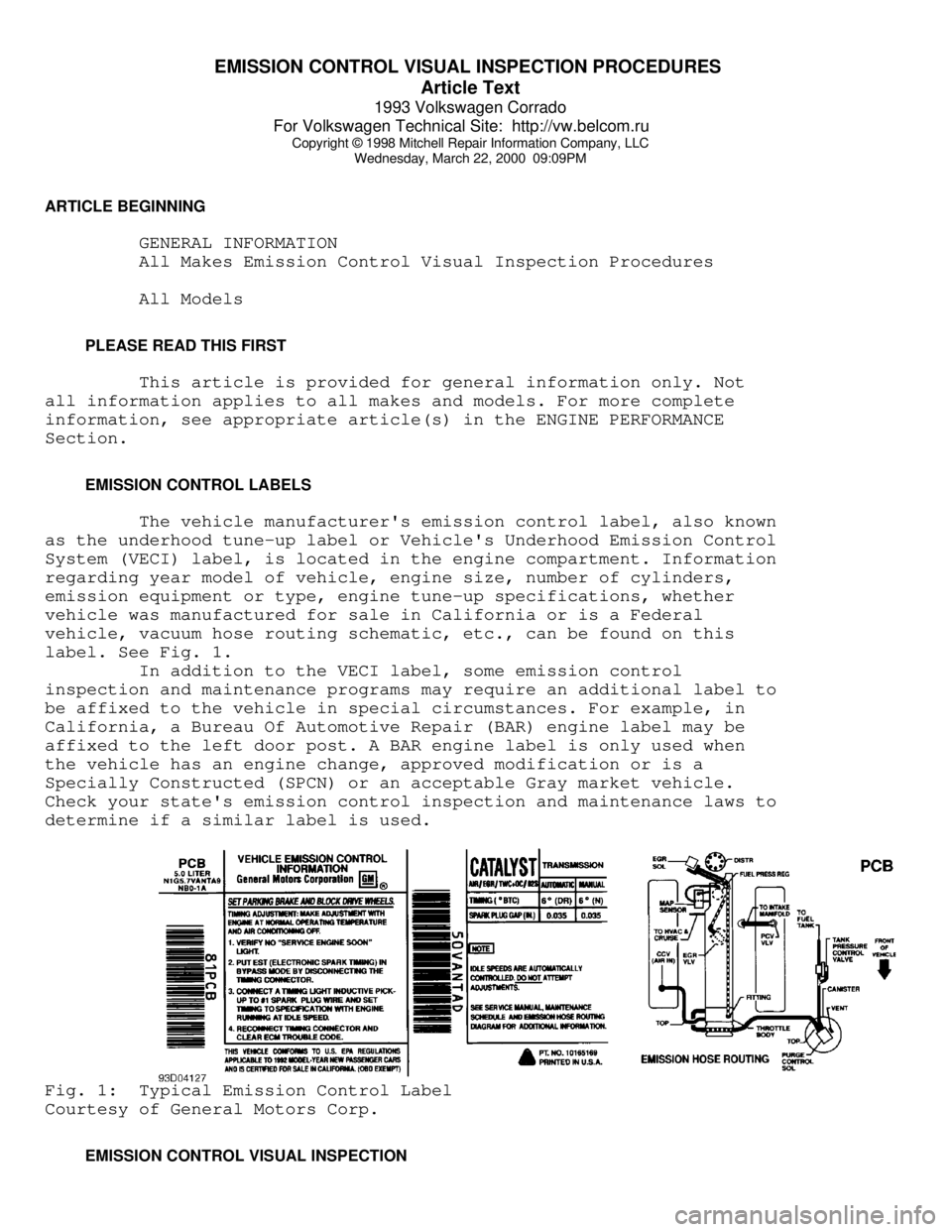
EMISSION CONTROL LABELS
The vehicle manufacturer's emission control label, also known
as the underhood tune-up label or Vehicle's Underhood Emission Control
System (VECI) label, is located in the engine compartment. Information
regarding year model of vehicle, engine size, number of cylinders,
emission equipment or type, engine tune-up specifications, whether
vehicle was manufactured for sale in California or is a Federal
vehicle, vacuum hose routing schematic, etc., can be found on this
label. See Fig. 1.
In addition to the VECI label, some emission control
inspection and maintenance programs may require an additional label to
be affixed to the vehicle in special circumstances. For example, in
California, a Bureau Of Automotive Repair (BAR) engine label may be
affixed to the left door post. A BAR engine label is only used when
the vehicle has an engine change, approved modification or is a
Specially Constructed (SPCN) or an acceptable Gray market vehicle.
Check your state's emission control inspection and maintenance laws to
determine if a similar label is used.Fig. 1: Typical Emission Control Label
Courtesy of General Motors Corp.
EMISSION CONTROL VISUAL INSPECTION
Page 516 of 920
EMISSION CONTROL VISUAL INSPECTION PROCEDURES
Article Text (p. 2)
1993 Volkswagen Corrado
For Volkswagen Technical Site: http://vw.belcom.ru
Copyright © 1998 Mitchell Repair Information Company, LLC
Wednesday, March 22, 2000 09:09PM
NOTE: The following emission control visual inspection procedures
should be used as a guide only. When performing a visual
inspection, always follow your state's recommended
inspection procedures.
A visual inspection is made to determine if any required
emission control devices are missing, modified or disconnected.
Missing, modified or disconnected systems must be made fully
operational before a vehicle can be certified.
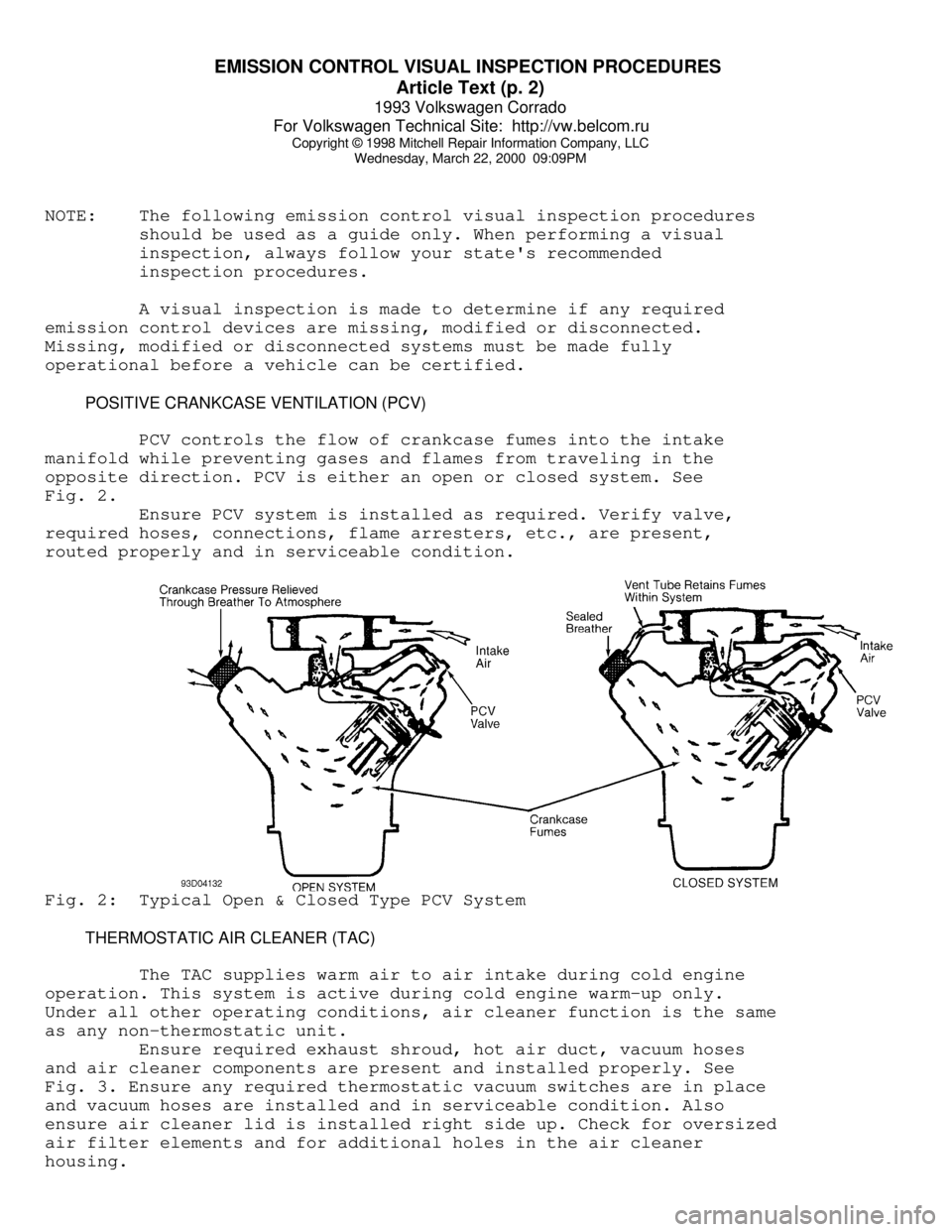
POSITIVE CRANKCASE VENTILATION (PCV)
PCV controls the flow of crankcase fumes into the intake
manifold while preventing gases and flames from traveling in the
opposite direction. PCV is either an open or closed system. See
Fig. 2.
Ensure PCV system is installed as required. Verify valve,
required hoses, connections, flame arresters, etc., are present,
routed properly and in serviceable condition.Fig. 2: Typical Open & Closed Type PCV System
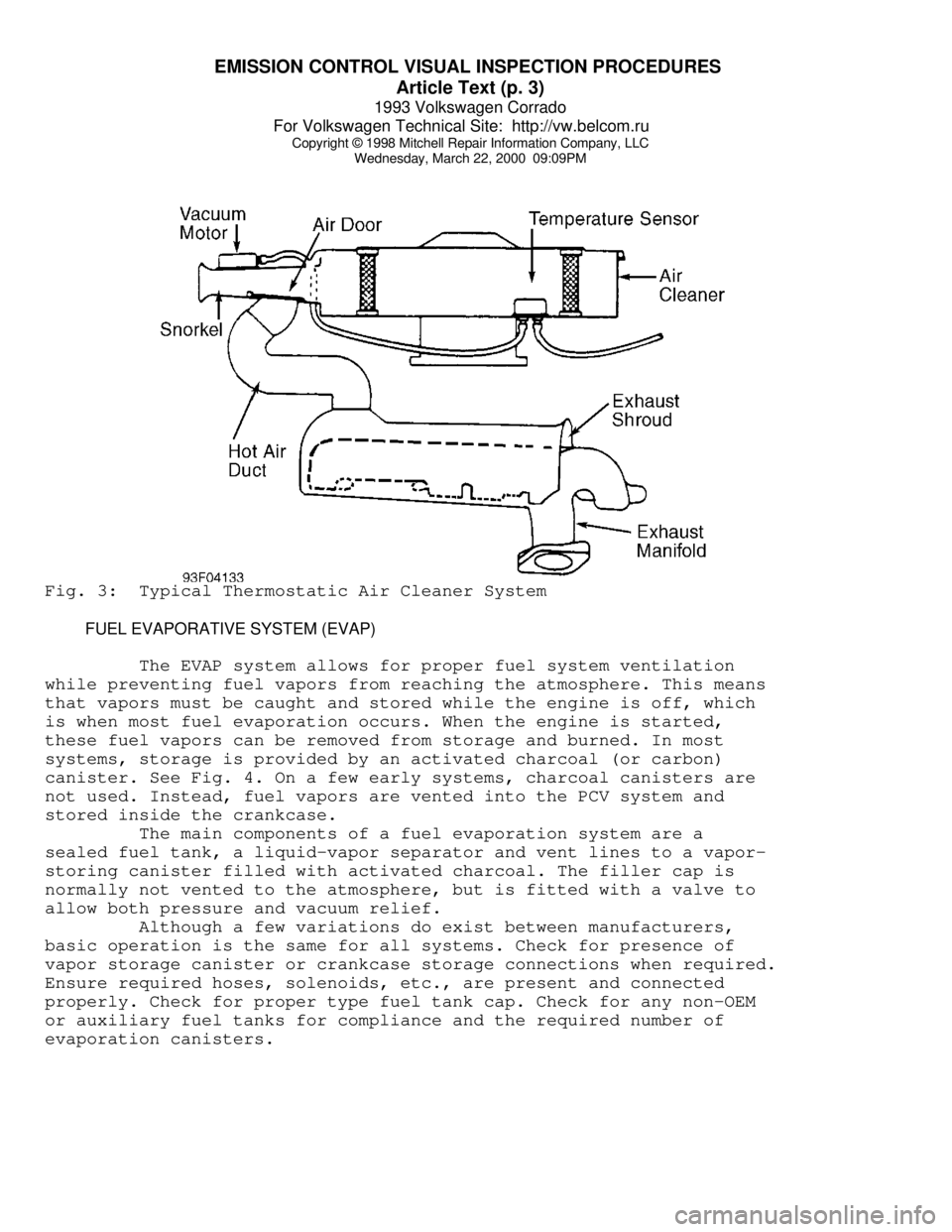
THERMOSTATIC AIR CLEANER (TAC)
The TAC supplies warm air to air intake during cold engine
operation. This system is active during cold engine warm-up only.
Under all other operating conditions, air cleaner function is the same
as any non-thermostatic unit.
Ensure required exhaust shroud, hot air duct, vacuum hoses
and air cleaner components are present and installed properly. See
Fig. 3. Ensure any required thermostatic vacuum switches are in place
and vacuum hoses are installed and in serviceable condition. Also
ensure air cleaner lid is installed right side up. Check for oversized
air filter elements and for additional holes in the air cleaner
housing.
Page 517 of 920
EMISSION CONTROL VISUAL INSPECTION PROCEDURES
Article Text (p. 3)
1993 Volkswagen Corrado
For Volkswagen Technical Site: http://vw.belcom.ru
Copyright © 1998 Mitchell Repair Information Company, LLC
Wednesday, March 22, 2000 09:09PMFig. 3: Typical Thermostatic Air Cleaner System
FUEL EVAPORATIVE SYSTEM (EVAP)
The EVAP system allows for proper fuel system ventilation
while preventing fuel vapors from reaching the atmosphere. This means
that vapors must be caught and stored while the engine is off, which
is when most fuel evaporation occurs. When the engine is started,
these fuel vapors can be removed from storage and burned. In most
systems, storage is provided by an activated charcoal (or carbon)
canister. See Fig. 4. On a few early systems, charcoal canisters are
not used. Instead, fuel vapors are vented into the PCV system and
stored inside the crankcase.
The main components of a fuel evaporation system are a
sealed fuel tank, a liquid-vapor separator and vent lines to a vapor-
storing canister filled with activated charcoal. The filler cap is
normally not vented to the atmosphere, but is fitted with a valve to
allow both pressure and vacuum relief.
Although a few variations do exist between manufacturers,
basic operation is the same for all systems. Check for presence of
vapor storage canister or crankcase storage connections when required.
Ensure required hoses, solenoids, etc., are present and connected
properly. Check for proper type fuel tank cap. Check for any non-OEM
or auxiliary fuel tanks for compliance and the required number of
evaporation canisters.
Page 520 of 920
EMISSION CONTROL VISUAL INSPECTION PROCEDURES
Article Text (p. 6)
1993 Volkswagen Corrado
For Volkswagen Technical Site: http://vw.belcom.ru
Copyright © 1998 Mitchell Repair Information Company, LLC
Wednesday, March 22, 2000 09:09PM
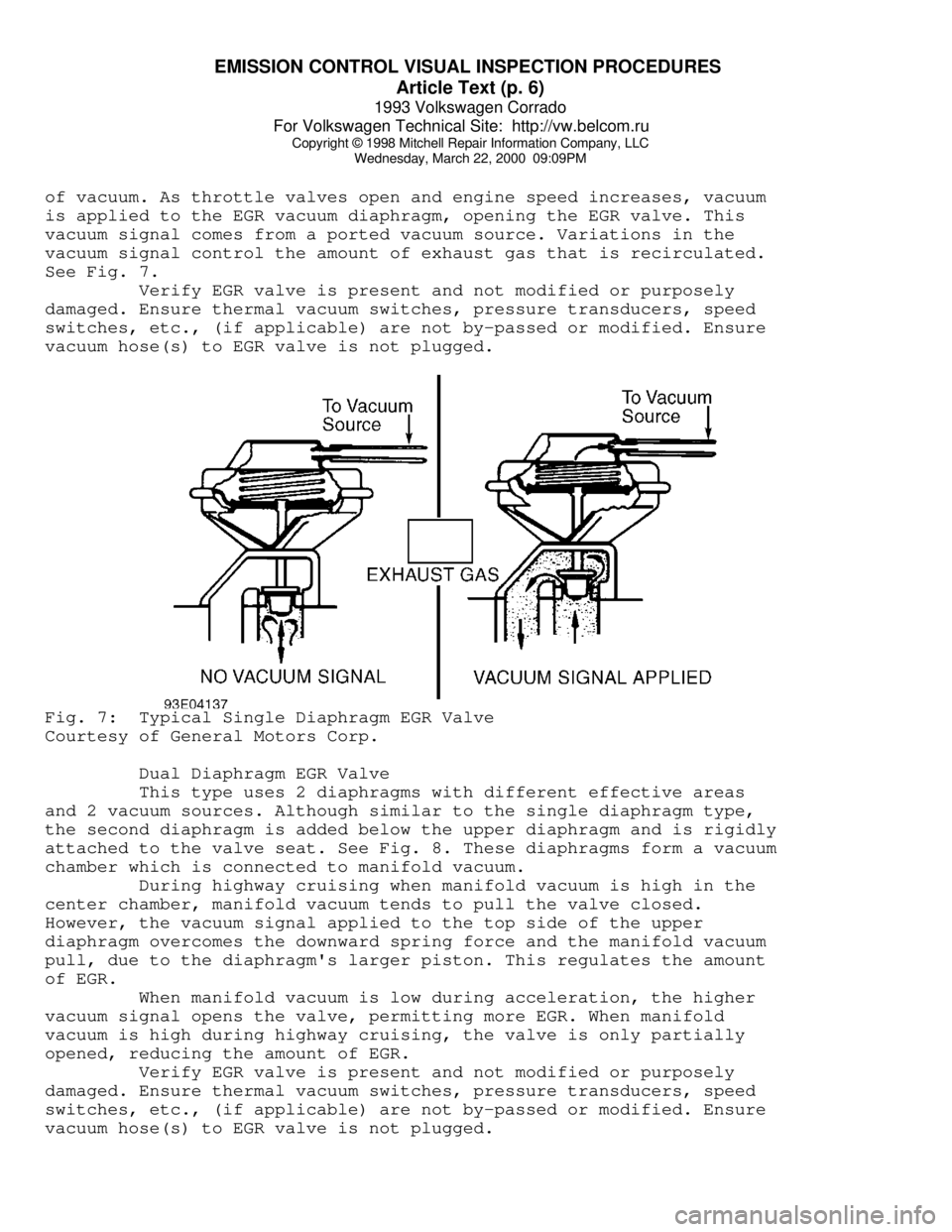
of vacuum. As throttle valves open and engine speed increases, vacuum
is applied to the EGR vacuum diaphragm, opening the EGR valve. This
vacuum signal comes from a ported vacuum source. Variations in the
vacuum signal control the amount of exhaust gas that is recirculated.
See Fig. 7.
Verify EGR valve is present and not modified or purposely
damaged. Ensure thermal vacuum switches, pressure transducers, speed
switches, etc., (if applicable) are not by-passed or modified. Ensure
vacuum hose(s) to EGR valve is not plugged.Fig. 7: Typical Single Diaphragm EGR Valve
Courtesy of General Motors Corp.
Dual Diaphragm EGR Valve
This type uses 2 diaphragms with different effective areas
and 2 vacuum sources. Although similar to the single diaphragm type,
the second diaphragm is added below the upper diaphragm and is rigidly
attached to the valve seat. See Fig. 8. These diaphragms form a vacuum
chamber which is connected to manifold vacuum.
During highway cruising when manifold vacuum is high in the
center chamber, manifold vacuum tends to pull the valve closed.
However, the vacuum signal applied to the top side of the upper
diaphragm overcomes the downward spring force and the manifold vacuum
pull, due to the diaphragm's larger piston. This regulates the amount
of EGR.
When manifold vacuum is low during acceleration, the higher
vacuum signal opens the valve, permitting more EGR. When manifold
vacuum is high during highway cruising, the valve is only partially
opened, reducing the amount of EGR.
Verify EGR valve is present and not modified or purposely
damaged. Ensure thermal vacuum switches, pressure transducers, speed
switches, etc., (if applicable) are not by-passed or modified. Ensure
vacuum hose(s) to EGR valve is not plugged.