check engine VOLKSWAGEN CORRADO 1993 Service Manual
[x] Cancel search | Manufacturer: VOLKSWAGEN, Model Year: 1993, Model line: CORRADO, Model: VOLKSWAGEN CORRADO 1993Pages: 920, PDF Size: 6.92 MB
Page 380 of 920

A/C-HEATER SYSTEM - MANUAL
Article Text (p. 5)
1993 Volkswagen Corrado
For Volkswagen Technical Site: http://vw.belcom.ru
Copyright © 1998 Mitchell Repair Information Company, LLC
Wednesday, March 22, 2000 08:49PM
both gauges read too low, locate leak and recharge system. If both
gauges read too high, replace expansion valve. If low side is too high
and high side is too low, replace compressor.
INSUFFICIENT COOLING
1) Ensure blower fan motor operates at all 4 speeds. Ensure
air duct closes off outside air intake and heater water valve is
closed. Clean condenser.
2) Adjust engine speed to 2500 RPM. Set controls for maximum
cooling and high fan. Insert thermometer in left air duct and close
all other ducts. With vehicle in shade, close windows and doors and
connect pressure gauges. Operate system for 10 minutes.
3) If both gauges read too high, replace expansion valve. If
both gauges read low, locate leak and recharge system. If both gauge
readings are normal, go to next step. If high side is too high and
suction side is normal, go to step 5). If high side is too low and
suction side is too high, go to step 6). If high side is normal and
suction side is too low, go to step 7).
4) Turn compressor off and observe gauges. If readings
equalize in 30 seconds, replace compressor. If readings take longer to
equalize, ensure capillary tube installed length is 13" (330 mm).
5) If capillary tube installation is correct, run system at
maximum cooling for 15 minutes. If thermometer indicates temperature
is less than 36øF (2øC) when compressor is turned off, or temperature
is greater than 48
øF (9øC) with compressor on, replace thermostatic
switch.
6) Check condenser fins and clean or straighten. If operation
is still not correct, discharge system until bubbles appear in sight
glass. Recharge system until bubbles disappear, and recheck pressures.
If operation is still incorrect, locate leaks and tighten fittings.
Discharge A/C system using approved refrigerant recovery/recycling
equipment. Evacuate system to remove all air and recharge system.
7) Check for bubbles at sight glass. If bubbles are present,
repair leaks and recharge system. If no bubbles are present, check
condenser-to-expansion valve line for kinks and repair if necessary.
Check line (from condenser to expansion valve) for restrictions by
feeling line for cold spots. If there are no cold spots, replace
expansion valve.
8) If cold spot is felt, remove and flush out lines and
condenser. Check for bubbles at sight glass. If there are no bubbles
present, replace compressor. If bubbles are present, check for leaks.
Repair and recharge system.
INTERMITTENT COOLING
1) Ensure blower fan motor operates in all 4 speeds. Ensure
air duct closes off outside air and heater water valve is closed.
Clean condenser.
2) Adjust engine speed to 2500 RPM. Set controls for maximum
cooling and high fan. Insert thermometer in left air duct and close
all other ducts. With vehicle in shade, close windows and doors and
Page 381 of 920

A/C-HEATER SYSTEM - MANUAL
Article Text (p. 6)
1993 Volkswagen Corrado
For Volkswagen Technical Site: http://vw.belcom.ru
Copyright © 1998 Mitchell Repair Information Company, LLC
Wednesday, March 22, 2000 08:49PM
connect pressure gauges. Operate system for 10 minutes.
3) Check for cool air from left duct. Low pressure gauge
should read more than 16 psi (1.1 kg/cmý). If low pressure gauge
reading is incorrect, place hands around expansion valve to warm
valve. If pressure rises, moisture is present in system. Discharge A/C
system using approved refrigerant recovery/recycling equipment.
Evacuate and recharge system. If pressure does not rise, go to next
step.
4) Check temperature on thermometer when thermostatic switch
turns compressor off. If temperature is 39
øF (4øC), system is okay. If
temperature is lower than 39
øF (4øC), ensure capillary tube installed
length is 13" (330 mm). If capillary tube installation is correct,
replace thermostatic switch.
TESTING
A/C SYSTEM PERFORMANCE
1) Park vehicle out of direct sunlight. Start engine and
operate engine at 2500 RPM. Set A/C controls to outside air, panel
(vent) mode, full cold, and A/C button on.
2) Set blower/fan on high speed and open windows. Operate
system for 6-7 minutes to allow system to stabilize. Insert
thermometer in center vent, and measure temperature. Temperature at
center vent must be 19-40
øF (-7 to 4øC) at center vent, with high side
and low side pressures within specification. See SPECIFICATIONS table
at beginning of article.
AMBIENT TEMPERATURE SWITCH
1) Remove air intake grille from right side cowl. Remove
switch from panel on right side of tray area. Place switch in freezer.
2) Using a DVOM, check switch resistance. Switch resistance
must be infinite (no continuity) below 30
øF (-1øC). Allow switch to
warm above 45
øF (7øC). Switch resistance must be zero ohms
(continuity). Replace switch if necessary.
COMPRESSOR CLUTCH COIL
Disconnect compressor clutch harness connector. Check
resistance between clutch connector terminals. Resistance reading
should be 3.6 ohms. If resistance reading is not as specified, replace
clutch coil.
DUAL-PRESSURE SWITCH
High-Pressure Cut-Out Switch
Locate dual-pressure switch on refrigerant line (right strut
tower). Switch is identified by its 4 wires. Ensure switch opens at
464 psi (32 kg/cm
ý). Ensure switch closes at 348 psi (24 kg/cmý).
NOTE: Dual-pressure switch may be removed without discharging
Page 389 of 920

AA - USING THIS SECTION (GENERAL HELP INFORMATION)
Article Text (p. 3)
1993 Volkswagen Corrado
For Volkswagen Technical Site: http://vw.belcom.ru
Copyright © 1998 Mitchell Repair Information Company, LLC
Wednesday, March 22, 2000 08:49PM
* Replacement intervals.
* Belt adjustment.
* Engine Compression.
* Valve clearance.
* Valve Arrangement.
* Ignition coil specifications.
* High tension wire resistance.
* Spark plug type and gap.
* Firing order.
* Ignition timing.
* Fuel pump performance and injector resistance specifications
* Slow and fast idle speed and mixture specifications.
* Carbon monoxide (CO) level specifications.
* Throttle position sensor/switch specifications.
C - SPECIFICATIONS
This is a collection of quick-reference type specifications.
This article is helpful when you are familiar with proper adjustment
procedures and only need specifications. Included in this section are:
* Battery specifications.
* Fluid capacities.
* Replacement intervals.
* Belt adjustment.
* Engine Compression.
* Valve clearance.
* Valve Arrangement.
* Ignition coil specifications.
* High tension wire resistance.
* Spark plug type and gap.
* Firing order.
* Ignition timing.
* Fuel pump performance and injector resistance specifications
* Slow and fast idle speed and mixture specifications.
* Carbon monoxide (CO) level specifications.
* Throttle position sensor/switch specifications.
D - ADJUSTMENTS
This article contains the information that use to be included
in the TUNE-UP section. Checking and adjusting valves, spark plugs,
spark plug wires, base ignition timing and idle speed are found in
this section. Use this article for routine maintenance. Also, if you
have a driveability problem, ensure all on-vehicle adjustments are
correct before proceeding with any diagnosis.
E - THEORY/OPERATION
Page 390 of 920

AA - USING THIS SECTION (GENERAL HELP INFORMATION)
Article Text (p. 4)
1993 Volkswagen Corrado
For Volkswagen Technical Site: http://vw.belcom.ru
Copyright © 1998 Mitchell Repair Information Company, LLC
Wednesday, March 22, 2000 08:49PM
This article covers basic theory and operation of engine
performance-related systems and components. Before diagnosing vehicles
or systems with which you are not completely familiar, read this
article.
F - BASIC TESTING
When diagnosing driveability problems, there are certain
"BASIC DIAGNOSTIC PROCEDURES" which must FIRST be performed. It is
necessary to perform a careful, complete check of basic engine
mechanical and electrical conditions, and verify spark availability
and adequate fuel supply.
The procedures apply to both computerized and non-
computerized systems. If all systems are okay, go to G - TESTS W/
CODES for vehicles with self-diagnostic systems or H - TESTS W/O CODES
for diagnosis by symptom.
G - TESTS W/ CODES
Use this article to retrieve and interpret trouble codes from
the engine computer self-diagnostic system. Once information is
retrieved, diagnostic procedures are given to help pinpoint and repair
computer system/component faults. Necessary steps for clearing trouble
codes are also given. If faults indicated by trouble codes are not
present at time of testing, proceed to TESTS W/O CODES for
intermittent testing procedures.
H - TESTS W/O CODES
This article helps trouble shoot driveability problems based
upon available "SYMPTOMS" and "INTERMITTENT TESTING" procedures.
Procedures in this section should lead you to specific component or
system tests which may or may not be computer monitored/controlled.
I - SYS/COMP TESTS
In this article, you will find tests for systems and
components related to air induction systems (turbochargers), fuel
control, ignition control, and emissions control systems.
J - PIN VOLTAGE CHARTS
PIN VOLTAGE CHARTS are supplied (where available) to speed up
the diagnostic process. By checking pin voltages at the electronic
control unit, it is possible to determine if the control unit is
receiving and transmitting proper voltage signals.
K - SENSOR RANGE CHARTS
Use the SENSOR OPERATING RANGE CHARTS to determine if a
Page 391 of 920

AA - USING THIS SECTION (GENERAL HELP INFORMATION)
Article Text (p. 5)
1993 Volkswagen Corrado
For Volkswagen Technical Site: http://vw.belcom.ru
Copyright © 1998 Mitchell Repair Information Company, LLC
Wednesday, March 22, 2000 08:49PM
sensor is out of calibration. A sensor that is out of calibration may
not set a trouble code, but it will cause driveability problems.
L - WIRING DIAGRAMS
Use these WIRING DIAGRAMS to identify and trace component
circuits, locate shorts and opens in circuits, and understand how
individual circuits function as part of a system. The diagrams in this
article are only for fuel, ignition and emission systems
M - VACUUM DIAGRAMS
The VACUUM DIAGRAMS will assist you in finding incorrectly
routed vacuum hoses which may cause driveability problems or computer
indicated malfunctions.
N - REMOVE/INSTALL/OHAUL
N - REMOVE/INSTALL/OHAUL contains information found in the
sub-headings of REMOVAL, OVERHAUL & INSTALLATION. These are procedures
and specifications required to remove, overhaul (if possible) and
install components related to engine performance.
WHERE TO START
PERFORM BASIC INSPECTION
1) Verify customer complaint.
2) Perform visual inspection. See F - BASIC TESTING.
3) Test engine sub-system to determine that the following
systems are functioning properly. See F- BASIC TESTING.
* Mechanical conditions (compression)
* Ignition output
* Fuel Delivery
4) Check air induction system for leaks.
5) Check & adjust basic engine settings listed below to
ensure they are to specification. See D - ADJUSTMENTS.
* Ignition timing
* Idle speed
CHECK FOR TROUBLE CODES
1) If equipped with self-diagnostics, check for trouble
codes. Refer to G - TESTS W/ CODES.
2) Repair causes of trouble code(s).
3) Clear control unit memory.
SYMPTOM DIAGNOSIS
Page 395 of 920

ABBREVIATIONS
Article Text (p. 3)
1993 Volkswagen Corrado
For Volkswagen Technical Site: http://vw.belcom.ru
Copyright © 1998 Mitchell Repair Information Company, LLC
Wednesday, March 22, 2000 08:49PM³CBD ³Closed Bowl Distributor ³
³CBVV
³Carburetor Bowl Vent Valve ³
³cc
³Cubic Centimeter ³
³CCC
³Computer Command Control ³
³CCD
³Computer Controlled Dwell ³
³CCM
³Central Control Module ³
³CCO
³Converter Clutch Override ³
³CCOT
³Cycling Clutch Orifice Tube ³
³CCW
³Counterclockwise ³
³CDI
³Capacitor Discharge Ignition ³
³CEC
³Computerized Engine Control ³
³CFI
³Central Fuel Injection ³
³CID
³Cubic Inch Displacement ³
³CID
³Cylinder Identification sensor ³
³CIS
³Continuous Injection System ³
³CIS-E
³Continuous Injection System-Electronic ³
³CKT
³Circuit ³
³CLR
³Clear ³
³CNG
³Compressed Natural Gas ³
³CO
³Carbon Monoxide ³
³CO2
³Carbon Dioxide ³
³CONV
³Convertible ³
³CP
³Canister Purge ³
³CPA
³Connector Position Assurance ³
³CPS
³Crank Position Sensor ³
³CTS
³Coolant Temperature Sensor ³
³CV
³Check Valve or Constant Velocity ³
³CVC
³Constant Vacuum Control ³
³CW
³Clockwise ³
³CYL or Cyl.
³Cylinder ³
³Calif.
³California ³
³Carb.
³Carburetor ³
³Chrg.
³Charging ³
³Circ.
³Circuit ³
³Cntrl.
³Control ³
³Comp.
³Compressor or Compartment ³
³Conn.
³Connector ³
³Cont.
³Continued ³
³Conv.
³Convertible or Converter ³
³Cu. In.
³Cubic Inch ³
³Cyl.
³Cylinder ³
ÀÄÄÄÄÄÄÄÄÄÄÄÄÄÄÄÄÄÁÄÄÄÄÄÄÄÄÄÄÄÄÄÄÄÄÄÄÄÄÄÄÄÄÄÄÄÄÄÄÄÄÄÄÄÄÄÄÄÄÄÄÄÄÄÄÄÄÄÄÙ "D" ABBREVIATION TABLE
"D" ABBREVIATION TABLE
ÚÄÄÄÄÄÄÄÄÄÄÄÄÄÄÄÄÄÂÄÄÄÄÄÄÄÄÄÄÄÄÄÄÄÄÄÄÄÄÄÄÄÄÄÄÄÄÄÄÄÄÄÄÄÄÄÄÄÄÄÄÄÄÄÄÄÄÄÄ¿
³ABBREVIATION
³DEFINITION ³
ÃÄÄÄÄÄÄÄÄÄÄÄÄÄÄÄÄÄÅÄÄÄÄÄÄÄÄÄÄÄÄÄÄÄÄÄÄÄÄÄÄÄÄÄÄÄÄÄÄÄÄÄÄÄÄÄÄÄÄÄÄÄÄÄÄÄÄÄÄ´
³"D"
³Drive ³
³DBC
³Dual Bed Catalyst ³
³DC
³Direct Current or Discharge ³
Page 406 of 920

ALTERNATOR & REGULATOR
Article Text (p. 2)
1993 Volkswagen Corrado
For Volkswagen Technical Site: http://vw.belcom.ru
Copyright © 1998 Mitchell Repair Information Company, LLC
Wednesday, March 22, 2000 08:56PM
(1) - Turn tensioning nut on toothed rack with Torque Wrench
(VAG1410) and Ring Insert (SW VAG 1410-2).
(2) - Start engine and let it idle for 5 minutes. Loosen bolts and
retighten belt to specification.
(3) - Serpentine belt tension automatically adjusted by tensioner.ÄÄÄÄÄÄÄÄÄÄÄÄÄÄÄÄÄÄÄÄÄÄÄÄÄÄÄÄÄÄÄÄÄÄÄÄÄÄÄÄÄÄÄÄÄÄÄÄÄÄÄÄÄÄÄÄÄÄÄÄÄÄÄÄÄÄÄÄÄÄ ON-VEHICLE TESTING
WIRING CONTINUITY TEST
1) With ignition off, connect a voltmeter between alternator
B+ terminal and ground. Voltmeter should indicate battery voltage. If
battery voltage is not present, check wiring between alternator and
battery.
2) Turn ignition on and ensure alternator indicator light
comes on. If light does not come on, check wiring between alternator
and warning light, including indicator bulb.
OUTPUT TEST
CAUTION: DO NOT load electrical system for more than 15-20 seconds
during output test or possible system damage may occur.
1) Ensure connections at battery, alternator, and starter
(most vehicles) are clean and tight. Ensure alternator, engine and
body are properly grounded. Ensure alternator drive belt is tight and
in good condition.
2) Turn off all accessories. Start engine and allow to idle.
Connect ammeter following manufacturer's instructions. Run engine at
2000 RPM. Adjust carbon pile on tester to obtain maximum alternator
output. DO NOT allow battery voltage to drop to less than 12.6 volts.
3) Alternator output should equal alternator rated output,
minus 16-20 amps. If reading is more than 20 amps less than alternator
rating, replace regulator and retest. If output is still low, repair
or replace alternator.
REGULATOR CONTROL VOLTAGE TEST
1) Connect ammeter following manufacturer's instructions.
Connect voltmeter leads to battery terminals. Start engine and run at
3000 RPM.
2) Run engine until voltage stops rising. Voltage should be
13.5-14.5 volts. If reading is incorrect, remove regulator and ensure
brushes are longer than 3/16" (5 mm). Replace if necessary.
3) If brushes are okay and regulator fails to keep voltage
within specified limits, replace regulator and retest. If voltage is
still incorrect, repair or replace alternator.
BENCH TESTING
Page 414 of 920
ANTI-LOCK BRAKE SYSTEM
Article Text (p. 4)
1993 Volkswagen Corrado
For Volkswagen Technical Site: http://vw.belcom.ru
Copyright © 1998 Mitchell Repair Information Company, LLC
Wednesday, March 22, 2000 08:57PM
HYDRAULIC MODULATOR/PUMP
Depressurize brake system. See DEPRESSURIZING BRAKE SYSTEM.
Turn ignition on. Hydraulic modulator/pump should operate for 60
seconds maximum and then stop. Depress brake pedal a few times; pump
should operate again for a few seconds. If pump motor does not
operate, check electrical system. If pump motor operates for more than
60 seconds, internal or external hydraulic leak may be indicated.
Check for external leaks. If external leak is not found, further
testing may be needed to check for internal leaks.
ANTILOCK WARNING LIGHT
Start engine. ANTILOCK warning light should come on, then
turn off after a few seconds. If light does not come on when engine is
started, check electrical system. If light comes on and stays on,
fault has been detected by the ECU and testing will be needed. See
SYSTEM TESTING under DIAGNOSIS & TESTING.
DIAGNOSIS & TESTING
SYSTEM TESTING
NOTE: Check battery condition, brake fluid level, electrical
connections and wiring for damage. If fluid level is
incorrect or battery and/or electrical connections are
faulty, correct problem before preceding. Perform each step,
in sequence, to test entire system, except for ECU. If
faulty ECU is suspected, replace with a known good one, and
retest system. Unplug ECU connector for all test steps.
Power-To-ECU Test
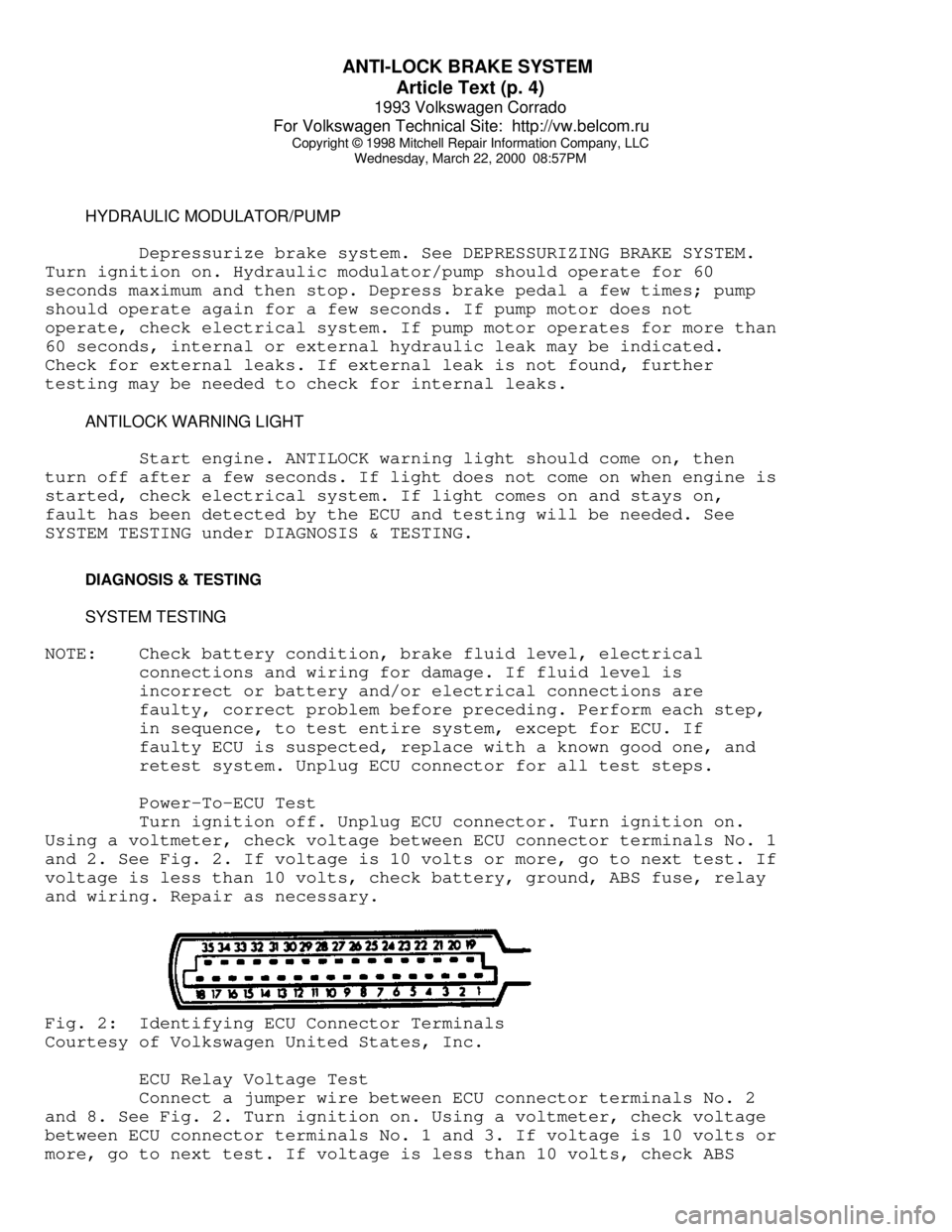
Turn ignition off. Unplug ECU connector. Turn ignition on.
Using a voltmeter, check voltage between ECU connector terminals No. 1
and 2. See Fig. 2. If voltage is 10 volts or more, go to next test. If
voltage is less than 10 volts, check battery, ground, ABS fuse, relay
and wiring. Repair as necessary.Fig. 2: Identifying ECU Connector Terminals
Courtesy of Volkswagen United States, Inc.
ECU Relay Voltage Test
Connect a jumper wire between ECU connector terminals No. 2
and 8. See Fig. 2. Turn ignition on. Using a voltmeter, check voltage
between ECU connector terminals No. 1 and 3. If voltage is 10 volts or
more, go to next test. If voltage is less than 10 volts, check ABS
Page 425 of 920

ANTI-THEFT SYSTEM
Article Text (p. 3)
1993 Volkswagen Corrado
For Volkswagen Technical Site: http://vw.belcom.ru
Copyright © 1998 Mitchell Repair Information Company, LLC
Wednesday, March 22, 2000 08:57PM
positive lead to anti-theft control module 10-pin wiring harness
connector terminal No. "7" (Red/Yellow wire for Corrado SLC;
Yellow/Red wire for Passat). Insert key in driver's door lock. Turn
key against stop and hold momentarily. Voltmeter should register 12
volts. Repeat procedure for passengers door. If voltage is correct for
each door, go to next step. If voltage is correct, repair door switch
or open circuit.
3) Door Lock Switch Check
Connect voltmeter negative lead to ground. Connect positive
lead to anti-theft control module 10-pin wiring harness connector
terminal No. "6" (Red/Black wire). Insert key in driver's door lock.
Turn key against stop and hold momentarily. Voltmeter should register
12 volts. Repeat procedure for passengers door. If voltage is correct
for each door, replace control module. If voltage is not correct,
repair door switch or open circuit.
ALARM HORN INOPERATIVE
1) Alarm Horn Check
Ensure battery is fully charged. Obtain radio security code.
Disconnect battery cable terminals. Disconnect anti-theft control
module 6-pin and 10-pin wiring harness connector. See ANTI-THEFT
CONTROL MODULE LOCATION table.
2) Connect ohmmeter negative lead to ground. Connect positive
lead to anti-theft control module 6-pin wiring harness connector
terminal No. "4" (Black/Yellow wire). If continuity is present,
replace anti-theft control module. If continuity is not present, check
for open circuit and repair as necessary. If circuit is okay, replace
alarm horn.
LIGHTS DO NOT FLASH
1) Alarm Horn Check
Ensure battery is fully charged and emergency flasher system
is functional. Obtain radio security code. Disconnect battery cable
terminals. Disconnect anti-theft control module 6-pin and 10-pin
wiring harness connector. See ANTI-THEFT CONTROL MODULE LOCATION
table.
2) Connect voltmeter negative lead to ground. Connect
positive lead to anti-theft control module 6-pin wiring harness
connector terminal No. "1" (Black/White wire for Corrado SLC; Black
Yellow wire for Passat). Turn emergency flashers on. When lights flash
on, battery voltage should be present.
3) Remove voltmeter positive from terminal No. "1" and
connect to terminal No. "2" (Black/Green wire for Corrado SLC;
Green/Black wire for Passat). Turn emergency flashers on. When lights
flash on, battery voltage should be present. If voltage is correct,
replace anti-theft control module. If voltage is not correct, repair
open circuit in wiring harness between anti-theft control module and
lights.
ENGINE DOES NOT CRANK WITH ALARM SYSTEM OFF
Page 431 of 920

B - EMISSION APPLICATION
Article Text (p. 2)
1993 Volkswagen Corrado
For Volkswagen Technical Site: http://vw.belcom.ru
Copyright © 1998 Mitchell Repair Information Company, LLC
Wednesday, March 22, 2000 08:57PM
2.0L 4-Cyl. CIS-E Motronic
Major Control Systems & Devices ............. PCV, EVAP, TWC, FR,
(2) EGR, SPK, AP,
(1) O2, CEC, (2) MIL
Components & Other Related Devices ........ (4) EVAP-PV, EVAP-CV,
EGR-VA, EGR-TVV, SPK-CC
2.8L VR6 Motronic MFI
Major Control Systems & Devices ........ PCV, EVAP, TWC, FR, EGR,
SPK, AP, (1) O2, CEC, (2) MIL
Components & Other Related Devices ...... AP-EAP, AP-ERLY, AP-SV,
AP-SOV, EVAP-PV, EVAP-VC,
EGR-CV, EGR-TS, SPK-CC
(1) - Heated O2 sensor.
(2) - California only.
(3) - Digifant II only.
(4) - Two required.ÄÄÄÄÄÄÄÄÄÄÄÄÄÄÄÄÄÄÄÄÄÄÄÄÄÄÄÄÄÄÄÄÄÄÄÄÄÄÄÄÄÄÄÄÄÄÄÄÄÄÄÄÄÄÄÄÄÄÄÄÄÄÄÄÄÄÄÄÄÄ ABBREVIATION DEFINITIONS
ABBREVIATION DEFINITION TABLE
ÄÄÄÄÄÄÄÄÄÄÄÄÄÄÄÄÄÄÄÄÄÄÄÄÄÄÄÄÄÄÄÄÄÄÄÄÄÄÄÄÄÄÄÄÄÄÄÄÄÄÄÄÄÄÄÄÄÄÄÄAbbreviation Definition
AP ............................. Air Pump Injection System
AP-EAP .............................. AP Electric Air Pump
AP-ERLY ....................... AP Electric Air Pump Relay
AP-SV .......................... AP Solenoid (Inlet) Valve
AP-SOV ................................. AP Shut Off Valve
CEC ......................... Computerized Engine Controls
EGR ............................ Exhaust Gas Recirculation
EGR-CV ..................... EGR Control (Frequency) Valve
EGR-TS ............................ EGR Temperature Sensor
EGR-TVV ......................... EGR Thermal Vacuum Valve
EGR-VA .............................. EGR Vacuum Amplifier
EVAP ............................. Fuel Evaporative System
EVAP-CS ............................ EVAP Control Solenoid
EVAP-PV ................................. EVAP Purge Valve
EVAP-VC .............................. EVAP Vapor Canister
FR .................................. Fill Pipe Restrictor
HAI ....................................... Hot Air Intake
MIL ........... Malfunction Indicator (CHECK ENGINE) Light
MFI ............................. Multiport Fuel Injection
O2 ......................................... Oxygen Sensor
PCV ....................... Positive Crankcase Ventilation
SPK ................................. Spark Control System
SPK-CC ........................... SPK Computer Controlled
TWC ................................... Three-Way Catalyst
ÄÄÄÄÄÄÄÄÄÄÄÄÄÄÄÄÄÄÄÄÄÄÄÄÄÄÄÄÄÄÄÄÄÄÄÄÄÄÄÄÄÄÄÄÄÄÄÄÄÄÄÄÄÄÄÄÄÄÄÄEND OF ARTICLE