Page 24 VOLKSWAGEN GOLF 2009 Manual Online
[x] Cancel search | Manufacturer: VOLKSWAGEN, Model Year: 2009, Model line: GOLF, Model: VOLKSWAGEN GOLF 2009Pages: 516, PDF Size: 105.12 MB
Page 156 of 516
Power sunroof-convenience closing feature
on page 56.
Convenience closing
The conven ience closing feature lets you the power sunroof as fo llows:
Turn the vehicle key bit in the lock of the driver door to the closi ng position and hold it there The power sunroof is key in order to stop the process.
Convenience clos ing first closes the windows and
t hen the power sunroof.
Convenience from the out side leaves the rotary switch in
the l ast selected position. The switch must be new-
ly positioned when starting to drive again .
on page 56.
P inch protection
can help reduce the risk of If
the power sunroof clo sing meets resistance or
th ere is something in the way, the power sunroof opens again immedia te ly.
Check why the p ower sunroof did not close.
the power sunroof er sunroof close the next time without pinch protection .
31 ® and down th e rear part of the switch un til the power sunroof closes completely .
the power sunroof not close, please see an authorized Volkswagen dealer or an
Without pinc h protection, the power sunroof close with enoug h force t o cause serious personal injury.
Pinch protection is also active durin g ience
tection may not fu nction properly. thorized Volkswagen dealer or an authorized Volkswagen Service F acility for assis tance.
Page 157 of 516
Adjusting the seating position
Introduction
this section find inf ormation about:
Examp les
of improper seat ing pos itions . . . 59
Pr ope r seating position . . . . . . . . . . . . .
Manual contr ols on the driver and passe nger
seat . . . . . . . . . . . . . . . . . . . . . . . . . . . . . . . . . . . 61 Ele ctrica l co ntr ols o n the driver and front
passenger seats . . . . . . . . . . . . . . . . . . . . . . . . 62
Adj ustin g
the head restra ints . . . . . . . . . . . . . 63
R emoving and re in stalling head restraints . . . 64
Adj usting the stee
ring whee l position . . . . . . . 65
Cen te r armrest . . . . . . . . . . . . . . . . . . . . . . . . . . 66
Number of seats
Th e vehicle
has a t otal of 5 seat ing posit ions: 2 in front and 3 in the rea r. Eac h seating pos ition has a
safety belt.
More information:
funct ions 67
page 69
Ai r ba g syste m 82
safety and child restraints
WARNING
Improper seat ing pos itions increase the risk of severe or fatal injuries in a crash or other accidents,
times .
Never
Always secure children in the vehicle with a n approved and suitable restraint system appropriate for their age, weight, and height 82 .
Always keep your feet on the in front of the seat. Never rest them on the seat,
Always adjust seat , safety belts, and head straints properly before driving and make sure that
inches (25 em) betw een the front pa ssenger' s breastbone and the in strument panel.
ches (25 em) between your breastbone and the steering wheel.
Adjust the driver's seat so that you can push the pedals while keeping your knee(s) slightly bent. The
di stance to the instrument panel in the knee
a rea must be at least 4 inche s
these requirements cannot be met for physical reason s, contact an authorized
Volk swagen dealer or an auth orized gen Facility to see whether adaptive equipment is avai la bl e.
Always hold the steering wheel on the side of the steering wheel rim with your hands at the 9 o'clock and 3 o'clock positions to help reduce the risk of personal injury if the driver's airbag inflates .
Never hold the steering whee l a t the
12 o'clock position or with your hands at e r places inside the steering whee l rim or on the steering wheel hub. Holding the steering wheel the wrong way can cause serious rie s to the hand s, arm s, and head if the
Pointing the steer ing whe el t oward your face dec reases the of the driver's bag to h elp protect you in a
Never drive with backrest s reclined or ed back farthe r than necessary to drive
Page 158 of 516
ment area is clear .
on page 58.
No t wea ring or imp rope
rly fastening safety belts creases the risk of seve re o r fatal injuries . Safety
be lts can work only w hen they are p roperly tioned on th e body . An improper seating pos itio n
significan tly impai rs the protection provided by safety belts. Thi s can cause severe or even fatal
inj uries . seating positions also increase
the ris k of ser iou s in jury o r de ath when an airbag
dep loys and strikes an occ upant who is not in the
proper seating position. The driver is respo nsible
f or all passengers
and espec ially c hildren riding in th e vehicle.
T he following are only some examples
of seating
posi tions that will increase the risk of s eri ous injury or death.
Therefore, whenever the vehicle is moving:
Never sit on the edge of the seat.
Never sit sideways.
Contact with parts of the vehicle interior can cause serious personal injury in a crash.
Page 159 of 516
first rea d and note the introductory information and hee d the WARNon page 58.
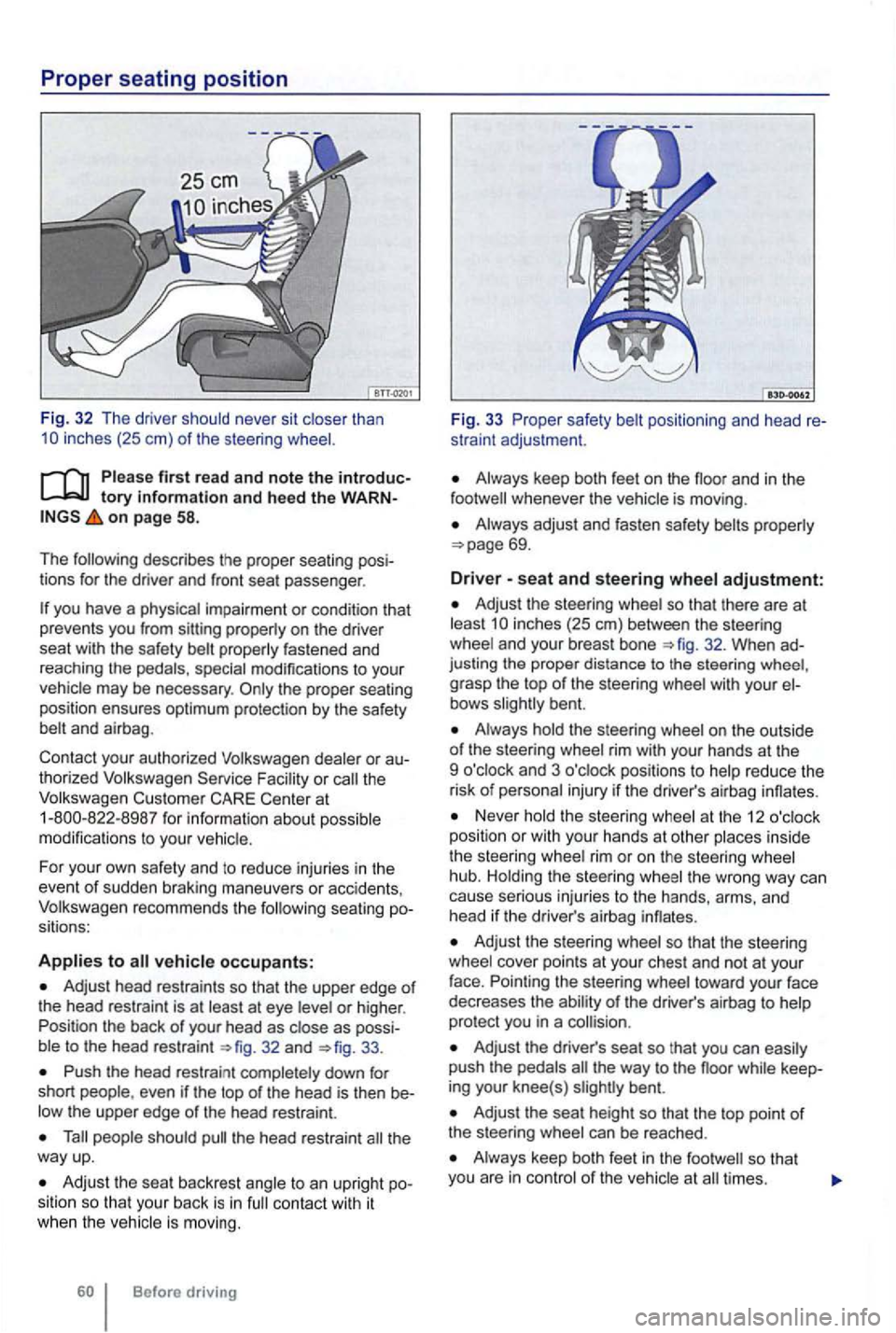
The following describes the proper seating posi
tions for the driver and front seat passenger .
special modifications to your
vehicle may be necessary .
to
Adjust head restraints so that the upper edge of the head restraint is at least at eye
32 and 33.
Push the head restrai nt completely down for
short even if the top of the head is then be
people should the head restraint the way up.
Adjust the sea t backrest angle to an upright position so that your back is in contact with it when the veh icle is moving.
Before driving
Fig. 33 P roper safety
Always keep both feet on the whenever the vehicle is moving .
Always adjust and fasten safety belts properly
adjustment:
Adjust the steering whe el so that there are at least inches (25 em) between the steeri ng
wheel and your breast bone
grasp the top of the steering wheel with your bent.
Always hold the steering wheel on the outside of the steering wheel rim with your hands at the
9 o'clock and 3 o'clock positions to help reduce the
risk
of personal injury if the driver's airbag innates.
Never hold the steering wheel at the 12
and
head if th e driver's airbag innates.
Adjust the steering wheel so that the steering
wheel cover points at your chest and not at your
face. Pointing the steer ing wheel toward your face
dec reases the ability
of the driver's airbag to help
protec t you in a
Adjust the driver's seat so tha t you can easily push the pedals the way to the noor while keep
ing your knee(s) bent.
Adjust the seat height so that the top point o f
the steering wheel can be reached .
Always keep both feet in the times.
Page 160 of 516
N
N
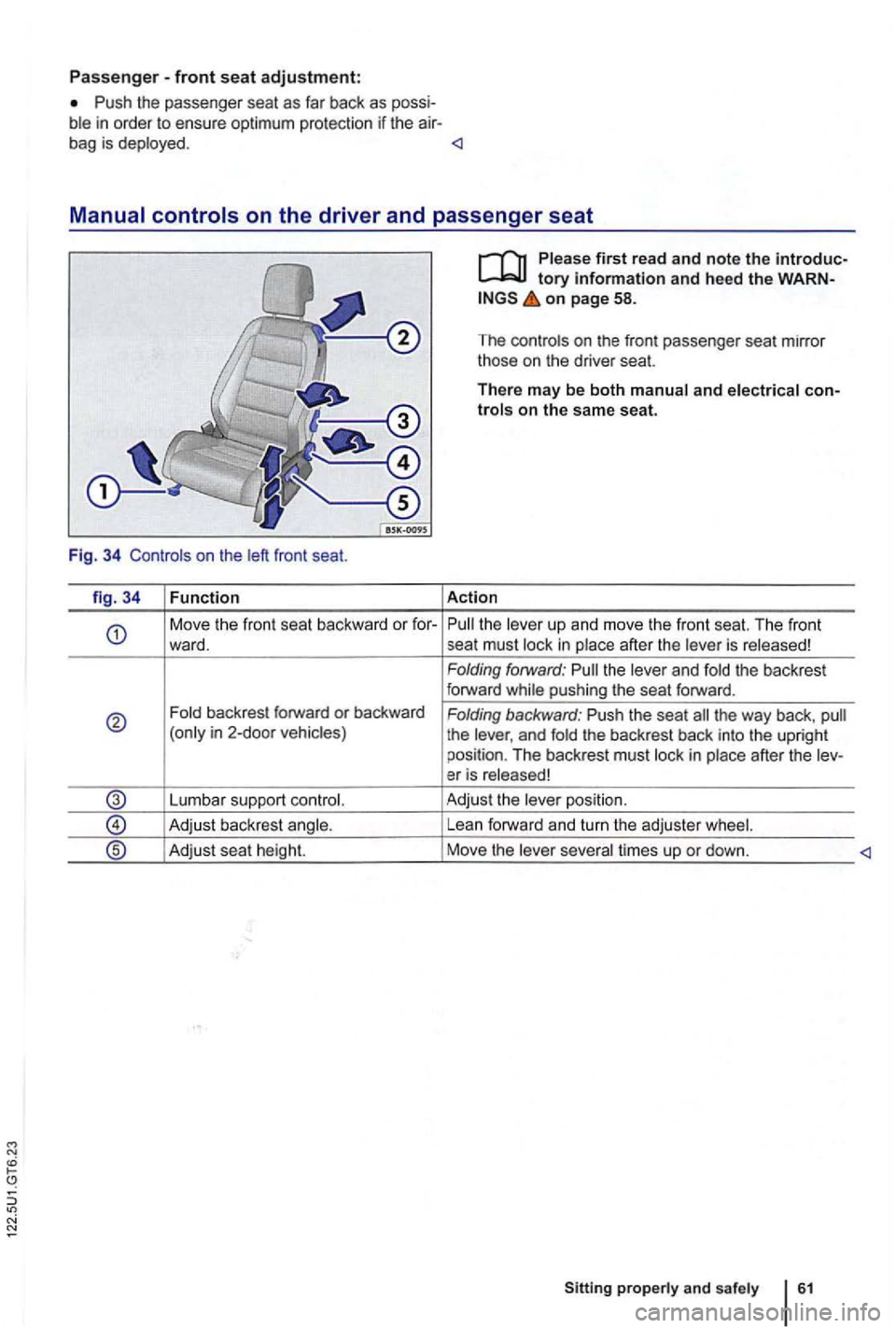
Passenger-front seat adjustment:
P ush the passe nger seat as far back as possi
M ove the front seat backward or for-ward.
Fold backrest forward o r backwa rd
(only in 2-door vehicles)
Lumbar support contro l.
Adjust back rest angle .
Adjust seat height.
on page 58.
The contr o ls on the fr on t passenger seat mirror
those on the
driver seat.
There may be both manual and electrical con
in place after the leve r is released!
Folding forwar d: Pull the
the way back , p ull
t he lever , a nd fold the back res t back into the upright
p osit
ion . The backrest must in place after the le v-
er is released!
Adj ust the leve r position.
Lea n forward and tu
rn th e adjuster wheel.
Move the lever
times up o r down .
Sitting properly and
safely
Page 161 of 516
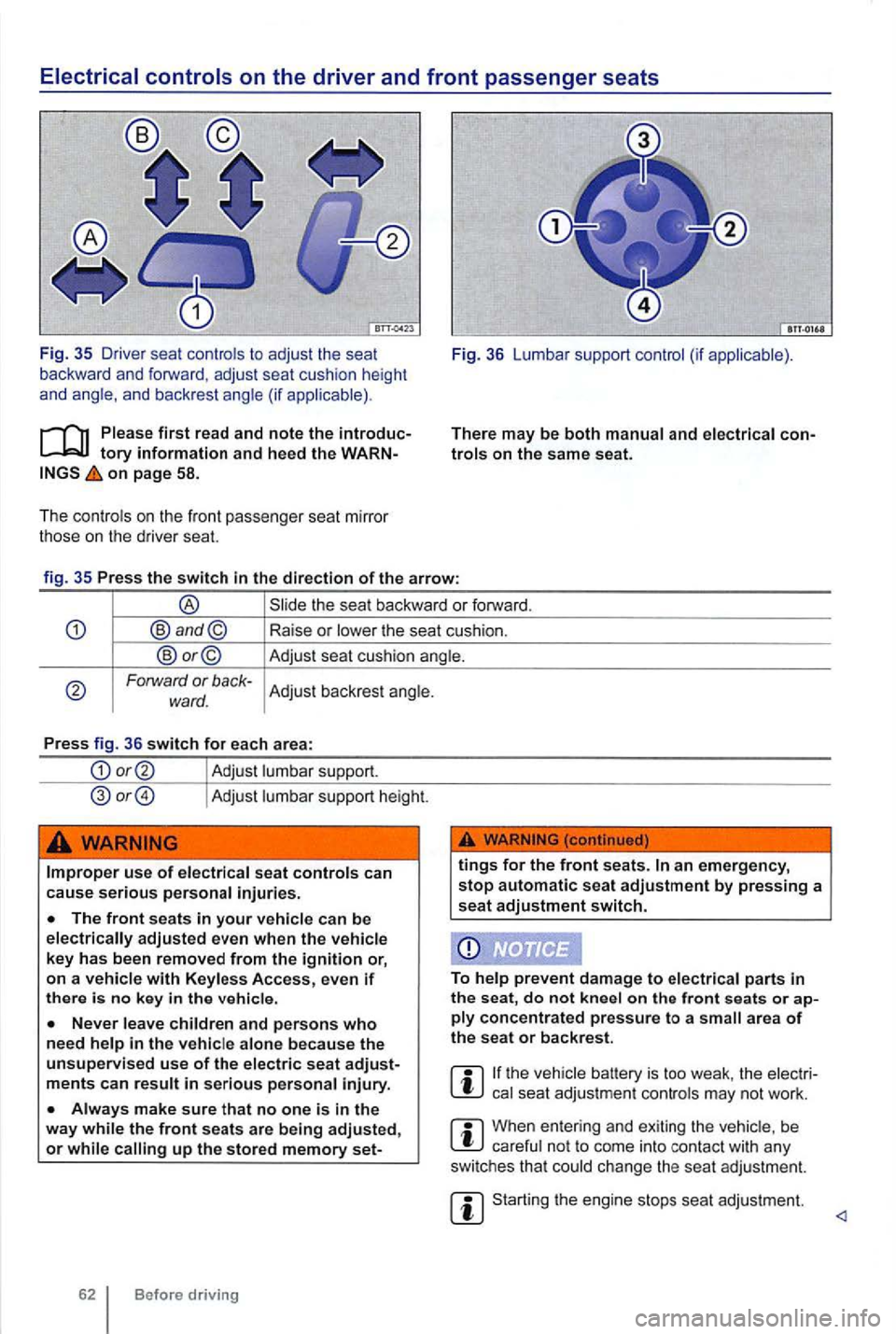
on page 58.
The cont rols on the front passenger seat mirro r
those on the driver seat. Fig
. 36 Lumbar support control (if app licable) .
There
may be both manual and elect rical
Forward or back-Adjust backrest angle. ward.
Press fig. 36 switch for each area:
Adjust lumbar support.
Adjust lumbar support height.
Improper use of electrical seat controls can cause serious personal injuries.
up the stored memory set-
tings for the front seats.
on ply concentrated pressure to a area of the seat or backrest.
the vehicle battery is too weak , the elect rical seat adjustment controls may not work .
When entering and exiting the vehicle , be careful not to come into contact with any
switches that could change the seat adjustment.
Starting the engine stops seat adjustment.
Page 162 of 516
Adjusting the head restraints
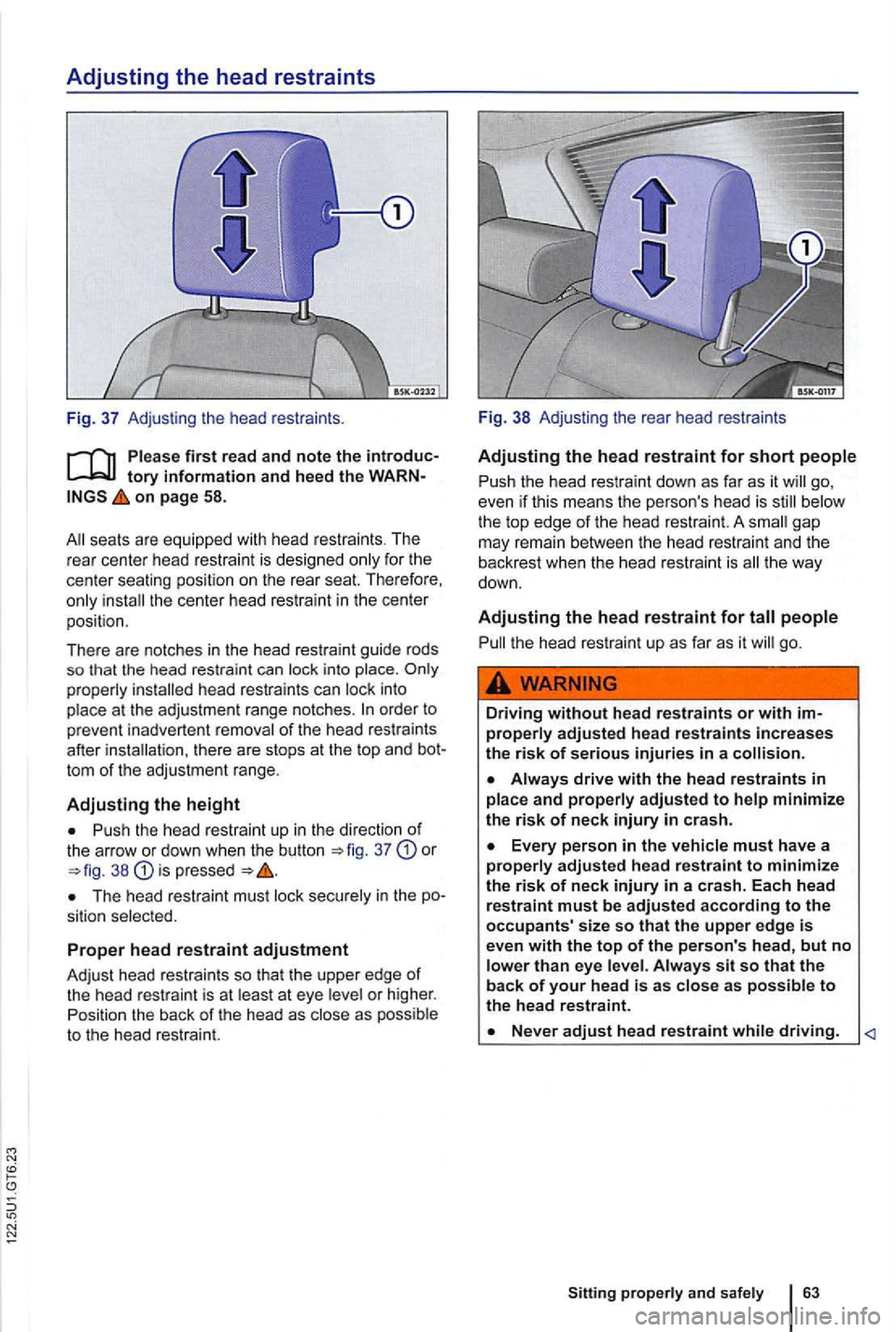
Fig. 37 Adjusting the head restraints .
on page 58.
th e ce nter head rest rai nt in th e center
pos ition.
There are notches in the head restraint gu ide rods
so that the head restraint can lock into place .
prope rly
tom of the adjus tment range.
Adjusting the height
37 o r 38 is
The head restraint must lock secu re ly in the
gap
may rema in betwee n th e head restra int and th e
ba ckrest when the head rest r
aint is t h e way
down .
Adjusting the head restraint for
go.
Dri v
ing without head restraints or with properly adjusted head restraints increases
the risk of serious injuri es in a collision.
Page 163 of 516
Removing and reinstalling head restra ints
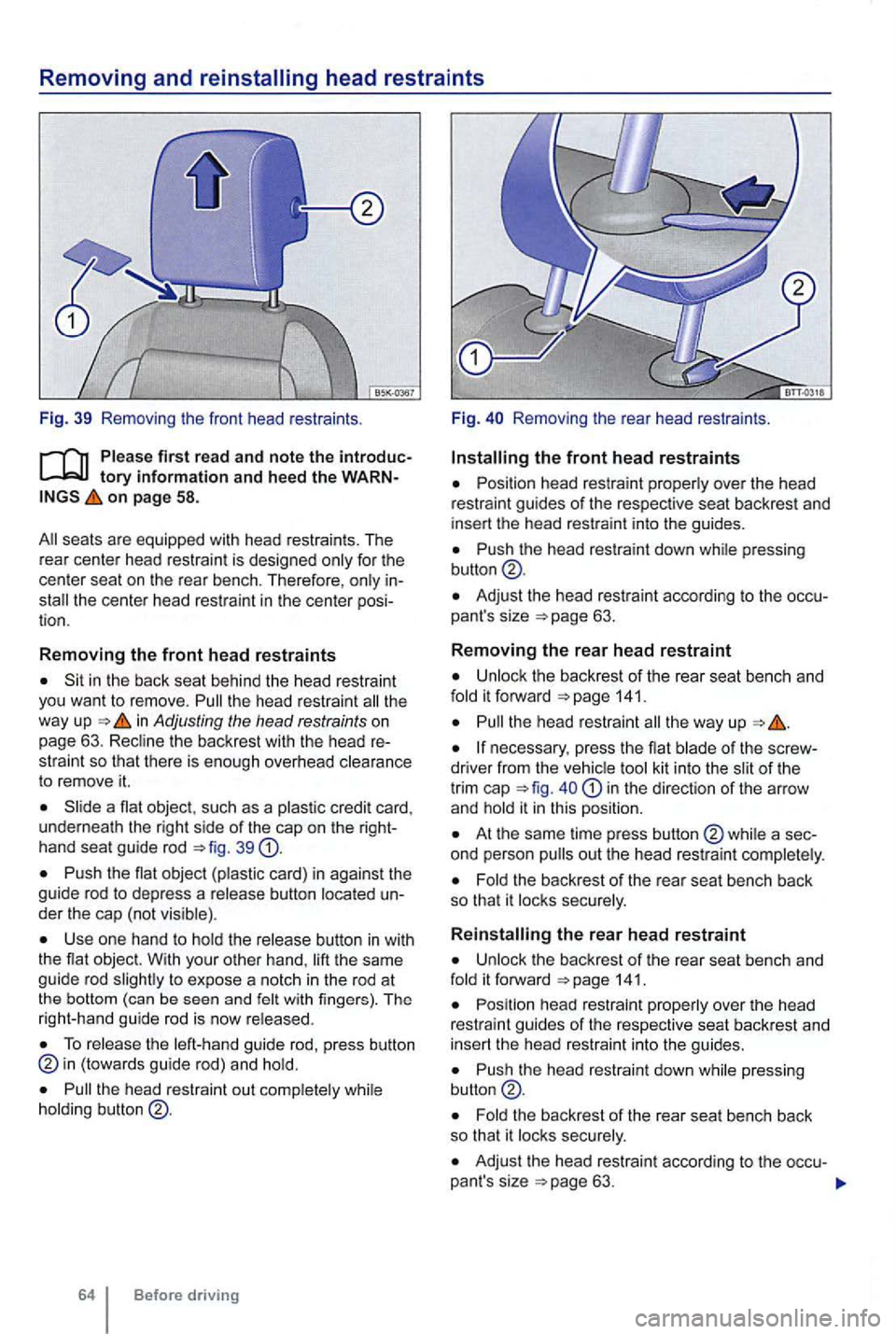
Fig. 39 Remo ving the front head restraints .
on page 58.
for the
center seat on the rear bench . T he refore ,
Sit in the back seat behind the head restraint
you want to remove. the head restraint th e
way up in Adjusting the head restraints on
page 63. the backrest with the head re
stra int so that there is enough overhead
to remove it.
a nat object , such as a
button
Use one hand to the same
guide rod to expose a notc h in the rod at
t he bottom (can be seen and with fingers) . T he
r ight-hand guide rod is now
To the guide rod, p ress button (towards guide rod) and
the head restraint out
64 Before driving F
ig.
Removing the rear head restr aints .
Posi tion head restraint over the head
restr aint guides of the respective seat backrest and
i nsert the head restra int into the guides.
Push the head restraint down
Adjust the head rest raint according to the occu
pant's size 63.
Removing the rear head restraint
the backrest of the rear seat bench and it forward 141.
the head restrain t
necessary , press the nat of the scr ew
d river from the kit in to the of the
tr im cap in the direction of the arrow
and
At the same time press button
the back rest of the rea r seat bench back
so that it
it forward 141.
P osition head restraint over the head
restraint guides of the respective seat backrest and
i ns e
rt the head restrain t into the guides.
Push the head restraint down pressing
t he backres t of the rear seat bench back so that it
Adjust the head restraint according to the occu-
pant 's size
Page 164 of 516
Driving without head restraints or with properly adjusted head restraints increases
the risk of serious injuries in a
tory information and heed the on page 58.
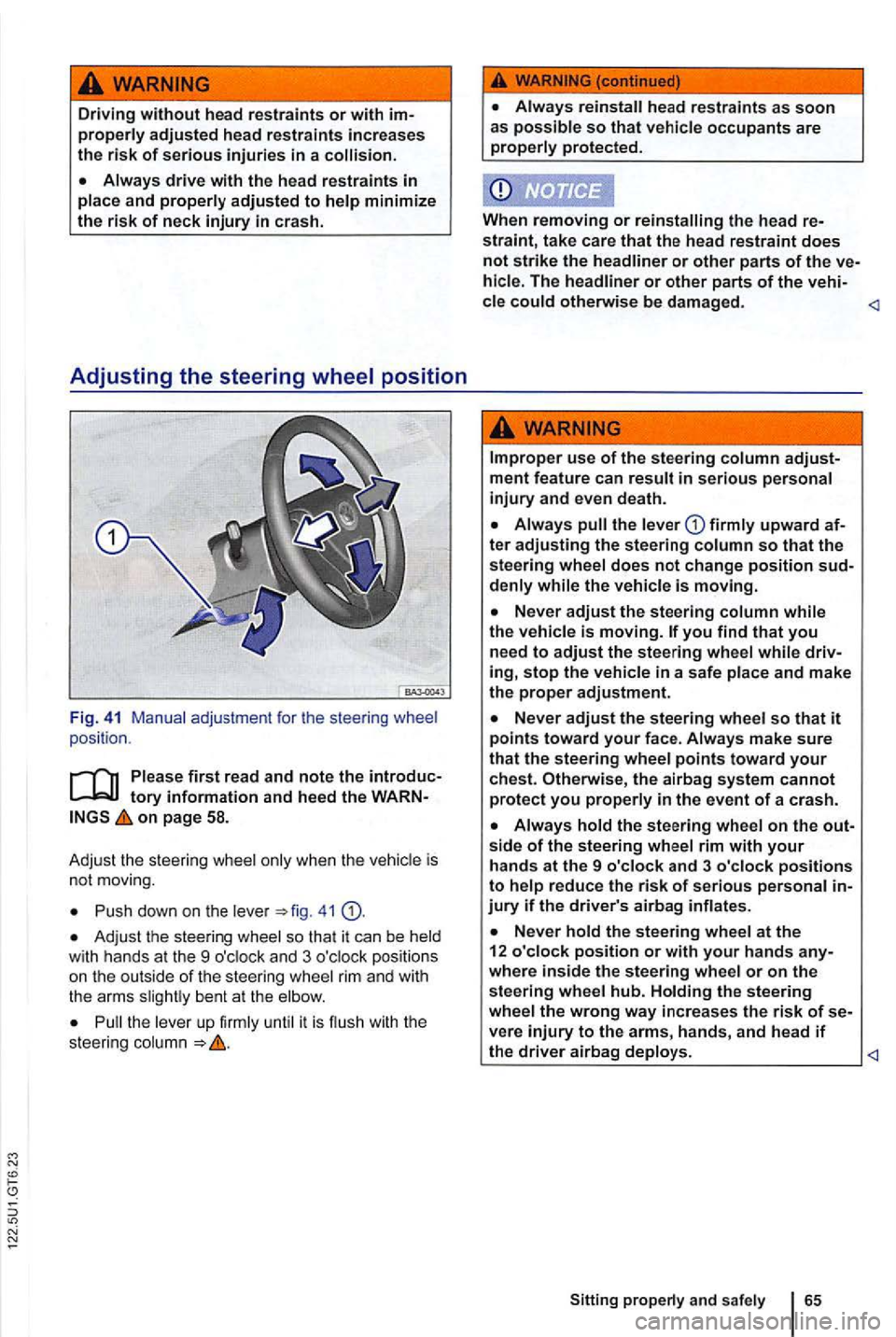
Adju st the steerin g whee l only w he n the veh icl e is
no t m ovi ng.
Push dow n o n the leve r 41
Adj ust th e steering whee l so th a t it ca n b e held w ith hands at the 9 o'cloc k and 3 o 'clock positio ns
o n the out side of the steering wheel rim and with
t he arms slightl y b ent at the elbow .
Pull the leve r up firml y until it is flu sh with th e
stee ring colum n
the lever
denly while the vehicle is moving.
Never adjust the steering wheel so that it points toward your face . Always make sure that the steering wheel points toward your chest. Otherwise, the airbag system cannot protect you properly in the event of a crash.
side of the steering wheel rim with your hands at the 9 o'clock and 3 o'clock positions to help reduce the risk of serious personal
where inside the steering wheel or on the steering wheel hub. Holding the steering wheel the wrong way increases the risk of vere injury to the arms, hands, and head if the driver airbag deploys.
Page 165 of 516
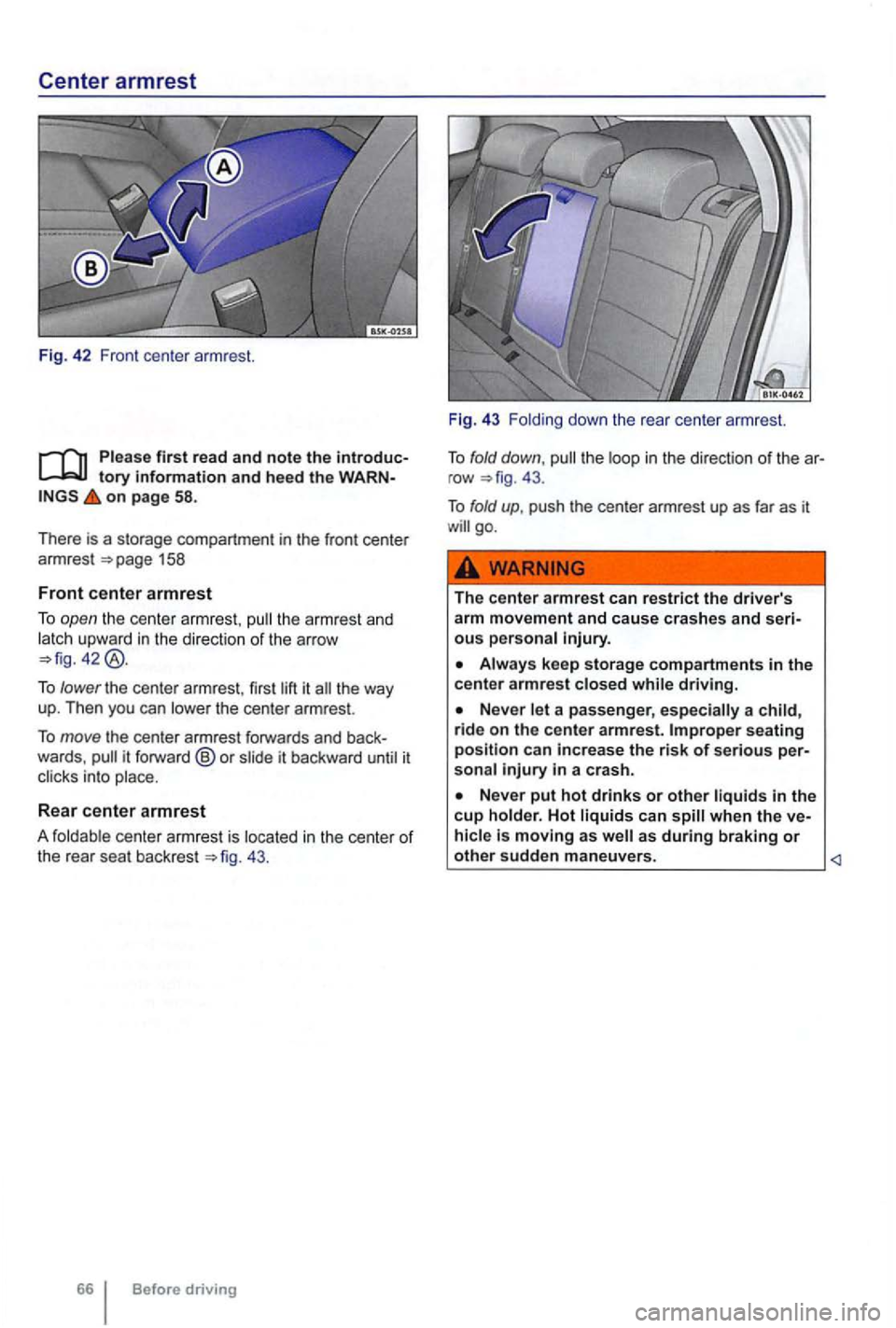
Center armrest
Fig . 42 Front center arm rest.
on page 58.
There is a storage compartment in the front center
armrest
the armr est an d
latch upward in the direction of the arrow
To lower the center arm rest , firs t lift it the way
up . T hen you can lower the cente r armrest.
T o
move the center armrest forwards and back
wards ,
43.
66
the loop in the direction of the ar
r ow 4 3.
To fold up, push the center armrest up as far as it go .
The center armrest can
restrict the driver's
arm movement and cause crashes and seri-
ous personal injury.