Part no VOLKSWAGEN POLO 2015 Owner´s Manual
[x] Cancel search | Manufacturer: VOLKSWAGEN, Model Year: 2015, Model line: POLO, Model: VOLKSWAGEN POLO 2015Pages: 100, PDF Size: 4.14 MB
Page 36 of 100
Downloaded from www.Manualslib.com manuals search engine 12/29/2015Bedienungsanleitung < Service & Zubehör < Volkswagen Deutschland
1/136
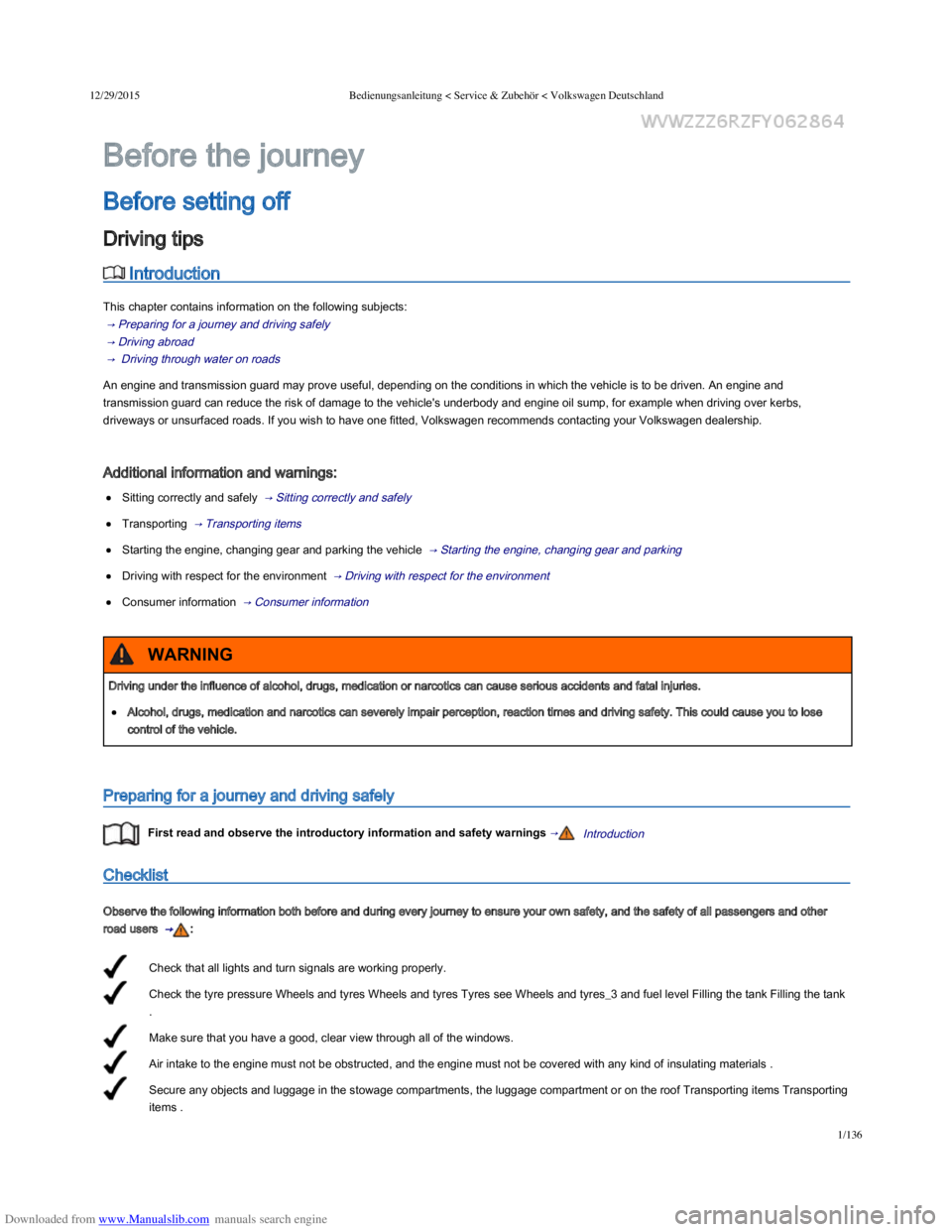
Check that all lights and turn signals are working properly.
Check the tyre pressure Wheels and tyres Wheels and tyres Tyres see Wheels and tyres_3 and fuel level Filling the tank Filling the tank
.
Make sure that you have a good, clear view through all of the windows.
Air intake to the engine must not be obstructed, and the engine must not be covered with any kind of insulating materials .
Secure any objects and luggage in the stowage compartments, the luggage compartment or on the roof Transporting items Transporting
items .
Introduction
This chapter contains information on the following subjects:
→ Preparing for a journey and driving safely
→ Driving abroad
→ Driving through water on roads
An engine and transmission guard may prove useful, depending on the conditions in which the vehicle is to be driven. An engine and
transmission guard can reduce the risk of damage to the vehicle's underbody and engine oil sump, for example when driving over kerbs,
driveways or unsurfaced roads. If you wish to have one fitted, Volkswagen recommends contacting your Volkswagen dealership.
Additional information and warnings:
Sitting correctly and safely → Sitting correctly and safely
Transporting → Transporting items
Starting the engine, changing gear and parking the vehicle → Starting the engine, changing gear and parking
Driving with respect for the environment → Driving with respect for the environment
Consumer information → Consumer information
Preparing for a journey and driving safely
First read and observe the introductory information and safety warnings →Introduction
Checklist
Observe the following information both before and during every journey to ensure your own safety, and the safety of all passengers and other
road users → :
Before the journey
Before setting off
Driving tips
Driving under the influence of alcohol, drugs, medication or narcotics can cause serious accidents and fatal injuries.
Alcohol, drugs, medication and narcotics can severely impair perception, reaction times and driving safety. This could cause you to lose
control of the vehicle.
WARNING
Page 37 of 100
Downloaded from www.Manualslib.com manuals search engine 12/29/2015Bedienungsanleitung < Service & Zubehör < Volkswagen Deutschland
2/136
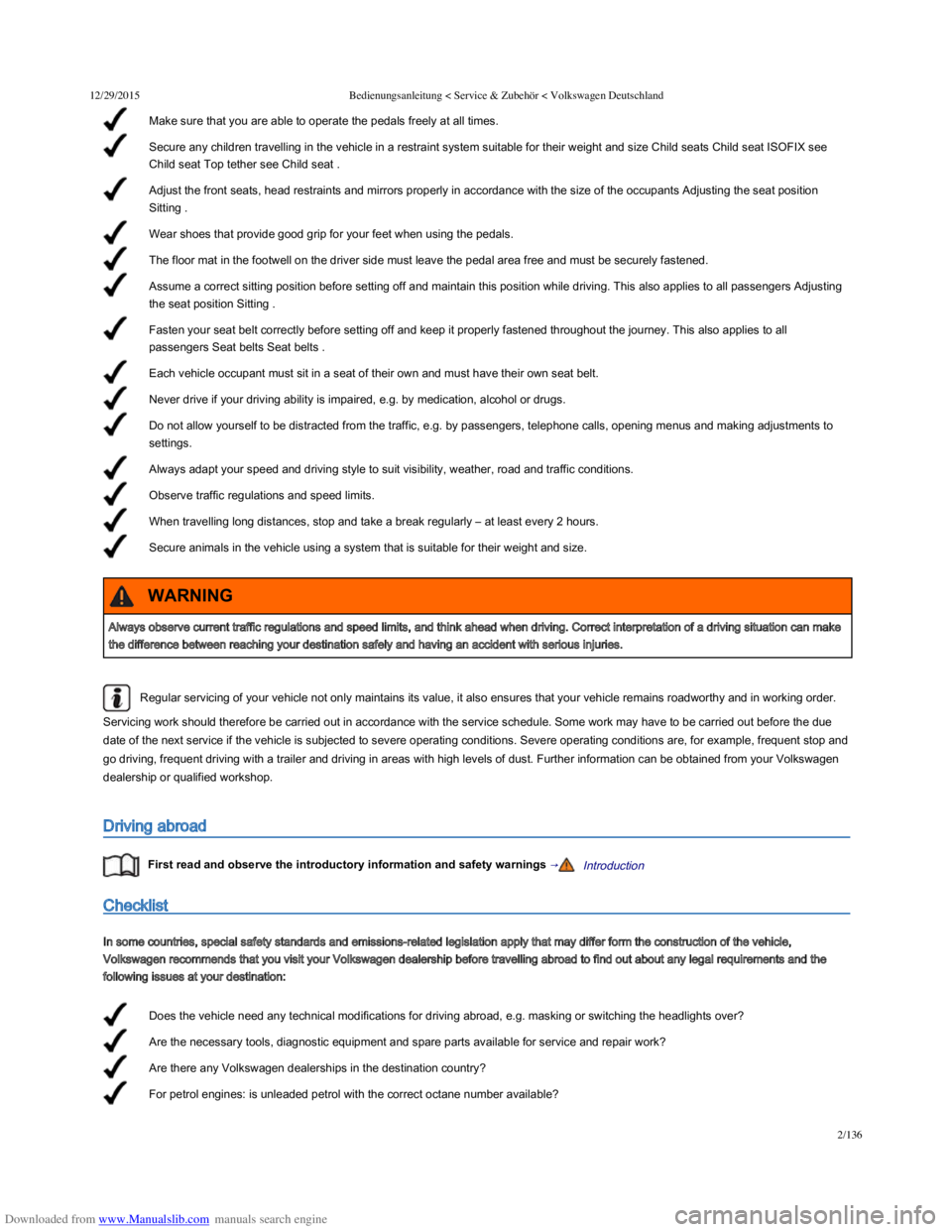
Make sure that you are able to operate the pedals freely at all times.
Secure any children travelling in the vehicle in a restraint system suitable for their weight and size Child seats Child seat ISOFIX see
Child seat Top tether see Child seat .
Adjust the front seats, head restraints and mirrors properly in accordance with the size of the occupants Adjusting the seat position
Sitting .
Wear shoes that provide good grip for your feet when using the pedals.
The floor mat in the footwell on the driver side must leave the pedal area free and must be securely fastened.
Assume a correct sitting position before setting off and maintain this position while driving. This also applies to all passengers Adjusting
the seat position Sitting .
Fasten your seat belt correctly before setting off and keep it properly fastened throughout the journey. This also applies to all
passengers Seat belts Seat belts .
Each vehicle occupant must sit in a seat of their own and must have their own seat belt.
Never drive if your driving ability is impaired, e.g. by medication, alcohol or drugs.
Do not allow yourself to be distracted from the traffic, e.g. by passengers, telephone calls, opening menus and making adjustments to
settings.
Always adapt your speed and driving style to suit visibility, weather, road and traffic conditions.
Observe traffic regulations and speed limits.
When travelling long distances, stop and take a break regularly – at least every 2 hours.
Secure animals in the vehicle using a system that is suitable for their weight and size.
Does the vehicle need any technical modifications for driving abroad, e.g. masking or switching the headlights over?
Are the necessary tools, diagnostic equipment and spare parts available for service and repair work?
Are there any Volkswagen dealerships in the destination country?
For petrol engines: is unleaded petrol with the correct octane number available?
Regular servicing of your vehicle not only maintains its value, it also ensures that your vehicle remains roadworthy and in working order.
Servicing work should therefore be carried out in accordance with the service schedule. Some work may have to be carried out before the due
date of the next service if the vehicle is subjected to severe operating conditions. Severe operating conditions are, for example, frequent stop and
go driving, frequent driving with a trailer and driving in areas with high levels of dust. Further information can be obtained from your Volkswagen
dealership or qualified workshop.
Driving abroad
First read and observe the introductory information and safety warnings →Introduction
Checklist
In some countries, special safety standards and emissions-related legislation apply that may differ form the construction of the vehicle,
Volkswagen recommends that you visit your Volkswagen dealership before travelling abroad to find out about any legal requirements and the
following issues at your destination:
Always observe current traffic regulations and speed limits, and think ahead when driving. Correct interpretation of a driving situation can make
the difference between reaching your destination safely and having an accident with serious injuries.
WARNING
Page 38 of 100
Downloaded from www.Manualslib.com manuals search engine 12/29/2015Bedienungsanleitung < Service & Zubehör < Volkswagen Deutschland
3/136
For diesel engines: is diesel with a low sulphur level available?
Are the correct engine oil ( Engine oil Engine oil Engine compartment Engine oil_3 Oil see Engine oil_3 ) and other service fluids that
comply with Volkswagen specifications available in the destination country?
Will the factory-fitted navigation system work with the navigation data available in the destination country?
Are special tyres necessary for travelling in the destination country?
Driving through water on roads
First read and observe the introductory information and safety warnings →Introduction
Please follow these rules to help prevent damage to your vehicle when driving through water, for example if the road is flooded:
Check the depth of the water before driving through it. The water level must be no higher than the lower edge of the vehicle body → .
Do not drive faster than walking speed.
Never stop the vehicle, reverse or switch off the engine while in water.
Oncoming vehicles create waves that could increase the water level for your vehicle to such an extent that it is not safe to drive through the
water.
When driving through water, always switch start/stop system off manually → Pull-away assist systems .
Introduction
This chapter contains information on the following subjects:
→ Vehicle identification data
→ Engine data
→ Dimensions
→ Performance figures
Volkswagen is not responsible for any vehicle damage caused by low-quality fuel, inadequate servicing work or lack of Genuine Parts.
NOTICE
After driving through water, mud, slush etc., the brakes may react slowly and the braking distance will be increased as the brake discs and pads
will be wet, or possibly iced up in winter.
You can dry and de-ice the brakes by performing careful braking manoeuvres. Make sure that you do not endanger any other road users or
violate any legal regulations when doing so.
Avoid abrupt and sudden braking manoeuvres directly after driving through water.
WARNING
If you drive through water, parts of the vehicle, such as the engine, drive train, running gear and vehicle electrics, could sustain severe
damage.
Never drive through salt water as salt can cause corrosion. Rinse all components that have been exposed to salt water immediately with
fresh water.
NOTICE
Technical data
Page 40 of 100
Downloaded from www.Manualslib.com manuals search engine 12/29/2015Bedienungsanleitung < Service & Zubehör < Volkswagen Deutschland
5/136
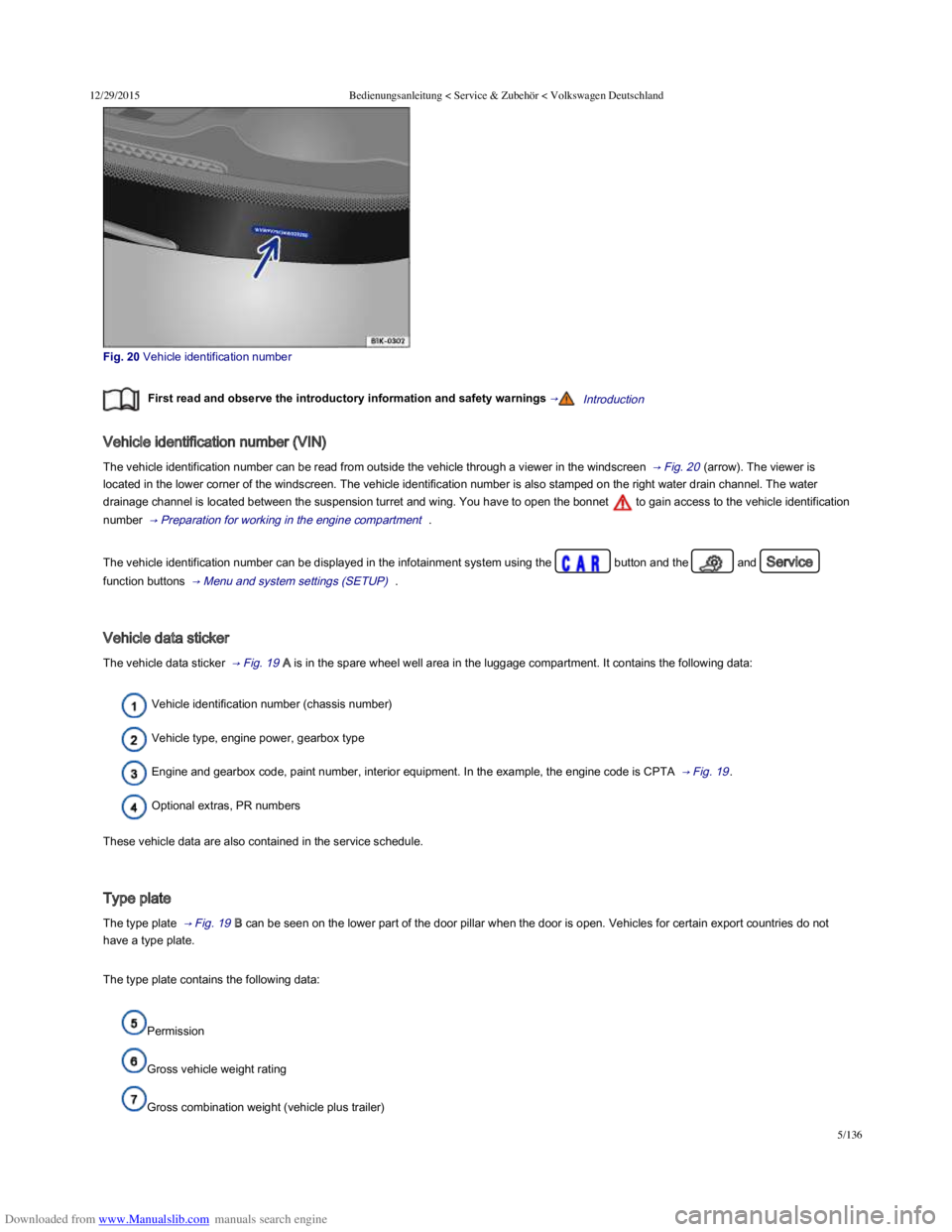
Fig. 20 Vehicle identification number
First read and observe the introductory information and safety warnings →Introduction
Vehicle identification number (VIN)
The vehicle identification number can be read from outside the vehicle through a viewer in the windscreen → Fig. 20 (arrow). The viewer is
located in the lower corner of the windscreen. The vehicle identification number is also stamped on the right water drain channel. The water
drainage channel is located between the suspension turret and wing. You have to open the bonnet to gain access to the vehicle identification
number → Preparation for working in the engine compartment .
The vehicle identification number can be displayed in the infotainment system using the button and the and Service
function buttons → Menu and system settings (SETUP) .
Vehicle data sticker
The vehicle data sticker → Fig. 19 A is in the spare wheel well area in the luggage compartment. It contains the following data:
Vehicle identification number (chassis number)
Vehicle type, engine power, gearbox type
Engine and gearbox code, paint number, interior equipment. In the example, the engine code is CPTA → Fig. 19 .
Optional extras, PR numbers
These vehicle data are also contained in the service schedule.
Type plate
The type plate → Fig. 19 B can be seen on the lower part of the door pillar when the door is open. Vehicles for certain export countries do not
have a type plate.
The type plate contains the following data:
Permission
Gross vehicle weight rating
Gross combination weight (vehicle plus trailer)
Page 43 of 100
Downloaded from www.Manualslib.com manuals search engine 12/29/2015Bedienungsanleitung < Service & Zubehör < Volkswagen Deutschland
8/136
a) Kerb weight without driver, without payload.
b) Kerb weight with driver (75 kg) and service fluids.
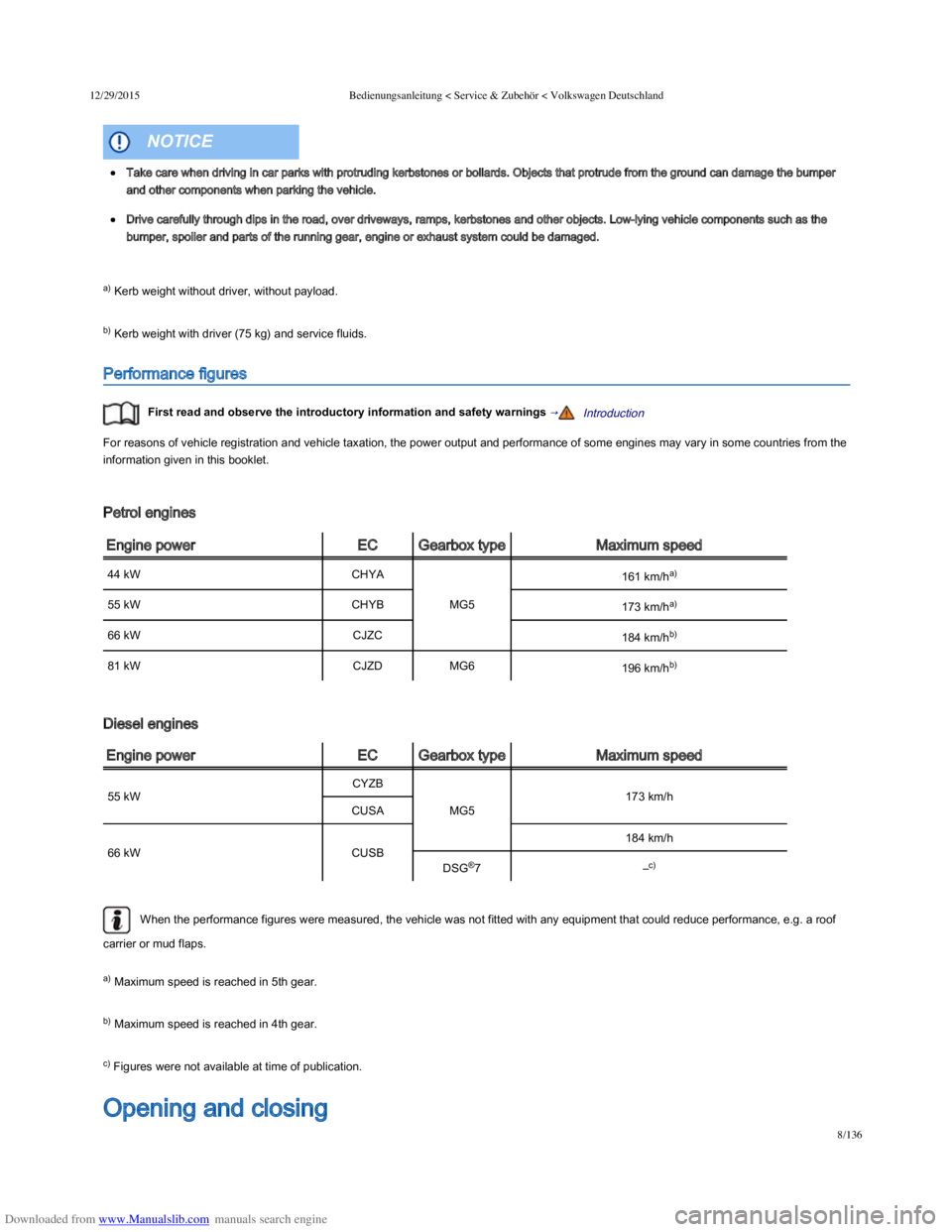
Performance figures
First read and observe the introductory information and safety warnings →Introduction
For reasons of vehicle registration and vehicle taxation, the power output and performance of some engines may vary in some countries from the
information given in this booklet.
Petrol engines
Engine powerECGearbox typeMaximum speed
44 kWCHYA
MG5
161 km/ha)
55 kWCHYB173 km/ha)
66 kWCJZC184 km/hb)
81 kWCJZDMG6196 km/hb)
Diesel engines
Engine powerECGearbox typeMaximum speed
55 kW
CYZB
MG5
173 km/h
CUSA
66 kWCUSB
184 km/h
DSG®7–c)
When the performance figures were measured, the vehicle was not fitted with any equipment that could reduce performance, e.g. a roof
carrier or mud flaps.
a) Maximum speed is reached in 5th gear.
b) Maximum speed is reached in 4th gear.
c) Figures were not available at time of publication.
Take care when driving in car parks with protruding kerbstones or bollards. Objects that protrude from the ground can damage the bumper
and other components when parking the vehicle.
Drive carefully through dips in the road, over driveways, ramps, kerbstones and other objects. Low-lying vehicle components such as the
bumper, spoiler and parts of the running gear, engine or exhaust system could be damaged.
NOTICE
Opening and closing
Vehicle key set
Page 44 of 100
Downloaded from www.Manualslib.com manuals search engine 12/29/2015Bedienungsanleitung < Service & Zubehör < Volkswagen Deutschland
9/136
Introduction
This chapter contains information on the following subjects:
→ Vehicle key
→ Indicator lamp in the vehicle key
→ Replacing the battery
→ Synchronising the vehicle key
Additional information and warnings:
Settings in the Volkswagen information system → Volkswagen information system
Central locking system → Central locking system
Starting and stopping the engine → Starting and stopping the engine
Consumer information → Consumer information
Manual opening and closing → Manual opening and closing
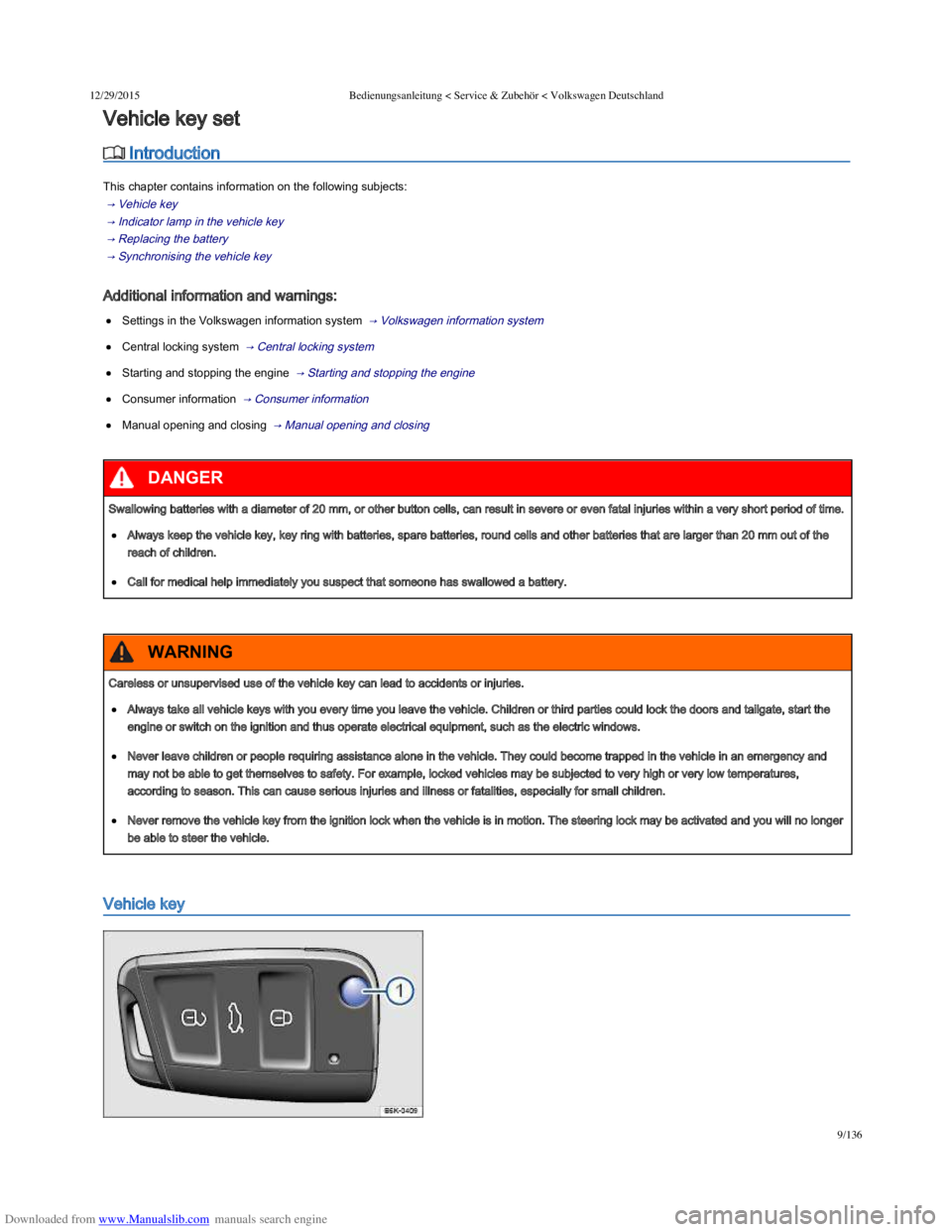
Vehicle key
Vehicle key set
Swallowing batteries with a diameter of 20 mm, or other button cells, can result in severe or even fatal injuries within a very short period of time.
Always keep the vehicle key, key ring with batteries, spare batteries, round cells and other batteries that are larger than 20 mm out of the
reach of children.
Call for medical help immediately you suspect that someone has swallowed a battery.
DANGER
Careless or unsupervised use of the vehicle key can lead to accidents or injuries.
Always take all vehicle keys with you every time you leave the vehicle. Children or third parties could lock the doors and tailgate, start the
engine or switch on the ignition and thus operate electrical equipment, such as the electric windows.
Never leave children or people requiring assistance alone in the vehicle. They could become trapped in the vehicle in an emergency and
may not be able to get themselves to safety. For example, locked vehicles may be subjected to very high or very low temperatures,
according to season. This can cause serious injuries and illness or fatalities, especially for small children.
Never remove the vehicle key from the ignition lock when the vehicle is in motion. The steering lock may be activated and you will no longer
be able to steer the vehicle.
WARNING
Page 46 of 100
Downloaded from www.Manualslib.com manuals search engine 12/29/2015Bedienungsanleitung < Service & Zubehör < Volkswagen Deutschland
11/136
Indicator lamp in the vehicle key
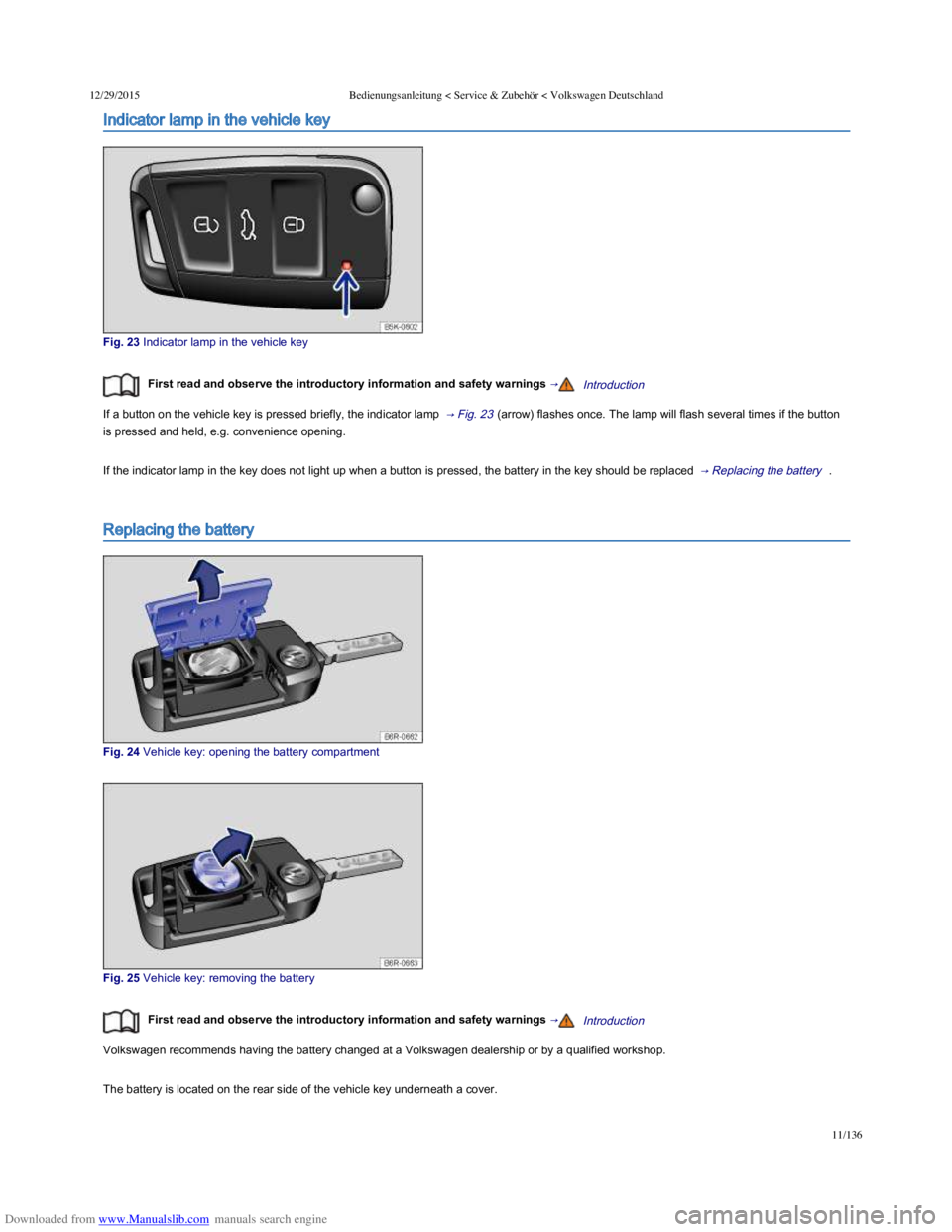
Fig. 23 Indicator lamp in the vehicle key
First read and observe the introductory information and safety warnings →Introduction
If a button on the vehicle key is pressed briefly, the indicator lamp → Fig. 23 (arrow) flashes once. The lamp will flash several times if the button
is pressed and held, e.g. convenience opening.
If the indicator lamp in the key does not light up when a button is pressed, the battery in the key should be replaced → Replacing the battery .
Replacing the battery
Fig. 24 Vehicle key: opening the battery compartment
Fig. 25 Vehicle key: removing the battery
First read and observe the introductory information and safety warnings →Introduction
Volkswagen recommends having the battery changed at a Volkswagen dealership or by a qualified workshop.
The battery is located on the rear side of the vehicle key underneath a cover.
Replacing the battery
Page 47 of 100
Downloaded from www.Manualslib.com manuals search engine 12/29/2015Bedienungsanleitung < Service & Zubehör < Volkswagen Deutschland
12/136
Replacing the battery
Fold out the key bit of the vehicle key → Opening and closing the key bit .
Pull up the cover on the rear side of the vehicle key → Fig. 24 in the direction of the arrow → .
Using a suitable thin object, lever the battery out of the battery compartment → Fig. 25 .
Insert the new battery as shown → Fig. 25 and push it into the battery compartment against the direction of the arrow → .
Fit the cover as shown → Fig. 24 and push it onto the vehicle key housing against the direction shown by the arrow until it engages.
Dispose of discharged batteries in accordance with regulations governing the protection of the environment.
The battery in the vehicle key may contain perchlorate. Please comply with any legal requirements and regulations when handling and
disposing of these batteries.
Synchronising the vehicle key
First read and observe the introductory information and safety warnings →Introduction
It may no longer be possible to lock or unlock the vehicle with the remote control if the button is pressed repeatedly outside of the
effective range of the vehicle key. If this is the case, the vehicle key should be re-synchronised as follows:
Fold out the key bit of the vehicle key → Opening and closing the key bit .
Press the button on the vehicle key. Remain standing close to the vehicle.
Unlock the vehicle with the key bit within one minute. The synchronisation process is complete.
Fold in the key bit of the vehicle key.
Introduction
This chapter contains information on the following subjects:
→ Indicator lamp
→ Description of the central locking system
→ Locking and unlocking the vehicle from the outside
→ Locking and unlocking the vehicle from the inside
→ SAFELOCK mechanism
→ Anti-theft alarm
→ Interior monitoring system and anti-tow alarm
The central locking system will only work correctly when all doors and the tailgate are properly closed. The vehicle cannot be locked with the key
if the driver door is open.
If the vehicle is unlocked and not used for a long time (e.g. in your own garage) the vehicle battery could discharge or the engine may not start.
The vehicle key can be damaged if the battery is not changed properly.
Unsuitable batteries can damage the vehicle key. Replace discharged batteries only with new batteries of the same voltage rating, size and
specification.
Make sure that the battery is fitted the right way round.
NOTICE
Central locking system
Page 55 of 100
Downloaded from www.Manualslib.com manuals search engine 12/29/2015Bedienungsanleitung < Service & Zubehör < Volkswagen Deutschland
20/136
If any people or animals are to remain inside the vehicle for a short period.
If the vehicle is to be loaded onto another vehicle.
If the vehicle is being transported (e.g. on a ferry).
If the vehicle is going to be towed with one axle off the ground.
If the vehicle is to be parked in a two-storey garage.
If the vehicle is to be parked in a car wash.
Risk of false alarm
Interior monitoring can only work properly if the vehicle is completely closed. Comply with legal regulations. A false alarm can be triggered in any
of the following circumstances:
If one or more windows are fully or partly open.
If the electric panorama sliding/tilting roof is fully or partly open.
If lightweight items such as loose pieces of paper or items hung from the interior mirror (e.g. air-fresheners) are left in the vehicle.
If a mobile telephone that is left in the vehicle vibrates.
If the vehicle is being transported (e.g. on a ferry).
If the vehicle is being parked in a two-storey garage.
If the vehicle is in a car wash.
If doors or the tailgate are still open when the anti-theft alarm is activated, only the anti-theft alarm is activated. Interior monitoring and the
anti-tow alarm are not activated until all doors and the tailgate are closed.
The SAFELOCK mechanism is deactivated when the interior monitor and anti-tow alarm are switched off → SAFELOCK mechanism .
Introduction
This chapter contains information on the following subjects:
→ Warning lamp
→ Childproof lock
Additional information and warnings:
Exterior views → Exterior views
Vehicle key set → Vehicle key set
Central locking system → Central locking system
Manual opening and closing → Manual opening and closing
Doors
Page 58 of 100
Downloaded from www.Manualslib.com manuals search engine 12/29/2015Bedienungsanleitung < Service & Zubehör < Volkswagen Deutschland
23/136
Transporting → Driving tips
Manual opening and closing → Manual opening and closing
Warning lamp
First read and observe the introductory information and safety warnings →Introduction
Lit upPossible causeAction
The tailgate is open or not properly closed.
Do not drive on!
Open the tailgate and close it again.
Several warning and indicator lamps will light up briefly as a functional check when the ignition is switched on. They will go out after a few
seconds.
A warning lamp appears in the instrument cluster display if the tailgate is open or not properly closed.
Incorrect and unsupervised unlocking, opening or closing of the tailgate can cause accidents and serious injuries.
Therefore the tailgate should only be opened or closed when you are sure there is no-one in its path.
Never close the tailgate by pushing it down with your hand on the window. The rear window could shatter and cause injuries.
After closing the tailgate, check to make sure that it is closed and locked correctly so that it does not open while the vehicle is in motion. The
closed tailgate must be flush with the surrounding body panels.
Always keep the tailgate closed while the vehicle is in motion so that no toxic exhaust fumes can enter the vehicle interior.
Never open the tailgate if there is a load attached to it, e.g. a rack or luggage carrier. It may also not possible to open the tailgate if there are
objects attached to it, e.g. bicycles. The additional load might cause the open tailgate to close by itself. Support the tailgate as necessary or
remove the load from the surface.
Close and lock the tailgate and all vehicle doors when the vehicle is not in use. Make sure there is no-one left in the vehicle.
Never leave children playing unattended in or around the vehicle, especially when the tailgate is open. Children could climb into the luggage
compartment and shut the tailgate, thereby trapping themselves inside. Temperatures inside a locked vehicle may reach extremes of heat or
cold, according to season. This can cause serious injuries and illness or fatalities, especially to small children.
WARNING
Before opening the tailgate, please check that there is enough space to open and close the tailgate, e.g. when towing a trailer or when in a
garage.
NOTICE
Never use the gas-filled strut or the rear spoiler (depending on the equipment level of the vehicle) to fix or hold a load. This could result in
damage preventing closure of the tailgate, or could even lead to the rear spoiler being ripped off.
NOTICE